




Abstract
Servant leaders go beyond their self-centeredness and genuinely work toward strengthening the well-being (WB) of their followers. However, organizations cannot solely rely on servant leaders to stimulate the WB of their workforce as numerous factors affect servant leadership (SL), which may hinder its successful implementation in the workplace. Therefore, it is essential to determine to what extent an individual trait such as mindfulness can compensate for this leadership. Being focused, optimistic, and present in the moment fosters the WB of a person, which may reduce their reliance on external leadership. Thus, by relying on the “substitutes for leadership theory,” this study examines the moderating role of mindfulness in the SL and WB relationship. The data were collected from the 265 Indian service sector employees and were analyzed using the SPSS-20 and AMOS-21 software. The study’s results revealed that SL and mindfulness were significantly related to employee WB. Moreover, employees’ mindfulness moderates the SL and WB relationship. Also, mindfulness partly substitutes for a low level of SL in the workplace. Hence, by organizing meditation and yoga sessions in the organizations, employees’ mindfulness can be enhanced which reduce the reliance on the leadership style of the managers.
Human resources are indispensable as they are strategic assets of the organization (Dupret & Pultz, 2022), and they also help in attaining a sustainable competitive edge (Berisha Qehaja & Kutllovci, 2015). Unfortunately, organizations are facing difficulty in retaining them due to which employee turnover is rising rapidly (Singh, 2019). Retention of employees can be guaranteed if organizations focus on their welfare and well-being (WB) (Ismail & Warrak, 2019), as it is now commonly acknowledged that psychologically and mentally balanced employees are more contented and they are less likely to leave their jobs (Wright & Huang, 2012). Here, the term WB denotes “a person’s cognitive and affective evaluations of his or her life” (Diener et al., 2002, p. 187).
Globally, WB has become incredibly valuable for policymakers, practitioners, and researchers (Grant et al., 2007). Notably, it is related to an individual’s valuable experience that makes them more efficient in the work they do, and forms an essential foundation of a healthy workplace (Huang et al., 2016; Waida, 2021). Given the significance of employee WB, a vast number of studies have attempted to comprehend its causes. Despite this, organizations have not yet become successful in augmenting it, as a report of the recent Gallup survey revealed that employee WB has been hampered severely (Harter, 2020). Thus, it is essential to devote efforts to the factors, which can help stimulate it.
Among numerous aspects that can promote WB, this research points out that preserving and fostering employee WB largely depend on a good leadership style as leaders have an impact on a wide range of workforce health outcomes, including stress and emotional WB (Kelloway & Barling, 2010). Notably, among leadership techniques, emphasis has now been turned toward the servant leadership (SL) style as servant leaders prioritize serving their followers and stresses on their best interests (Farrington & Lillah, 2019; Walsh & Arnold, 2020). Hale and Fields (2007), in their research, explained SL as “an understanding and practice of leadership that places the good of those led over the self-interest of the leader, emphasizing leader behaviors that focus on follower development and de-emphasizing glorification of the leader” (p. 397). Particularly, servant leaders focus on the growth of the employees (de Waal & Sivro, 2012) and provide them with a suitable organizational environment that helps in their development (Zhang et al., 2012). Also, they keep their interests aside and work for the benefit of their supporters and organization (Liden et al., 2008). Besides, studies have found that SL is strongly connected with significant outcomes such as outstanding employee performance, commitment, and innovative behavior (Liden et al., 2008; Neubert et al., 2008). Furthermore, it boosts employees’ job satisfaction and WB (Farrington & Lillah, 2019; Li et al., 2018). Based on the premises of these SL-related benefits and SL’s capacity to augment employees’ WB, we contend that there is a constructive link between SL and WB.
SL, despite being a crucial leadership approach, is having several possible challenges associated with it that may hinder its successful implementation in the workplace (Palumbo, 2016). First, as the SL style involves effective interpersonal ties between the leader and his followers comprising engaging psychological, cognitive, and ethical dimensions of adherents, so this leadership approach usually requires time to nurture. Additionally, this leadership approach may not be proven appropriate for several organizations, particularly for those organizations that work in a rapidly changing environment and that require decisions to be taken swiftly (Canavesi & Minelli, 2021). It is because the SL style focuses on a bottom-up approach rather than the top-down approach, which can lead to delays in the decisions. Not only this, but the recent research in this field has also shown that if a leader exhibits too much compassion and empathy toward followers (by relying on the SL approach), it may come across as just response efficacy, which would deter them from taking the initiative and coping with pressing problems within the firm (Canavesi & Minelli, 2021; Palumbo, 2016). Indeed, all these constraints associated with SL can hinder its successful adoption in the workplace. Therefore, it is imperative to identify the elements that can serve as a stand-in for this leadership style by acting as a substitute for it. Even the researchers have emphasized the importance to investigate the factors that can act as a substitute for leadership styles (Arnold, 2017). Based on the prevailing literature and the “substitutes for leadership” theory (SLT), we argue that employees’ mindfulness can be such an underlying factor, that can act as a substitute for SL. Here, mindfulness denotes “paying attention in a particular way: on purpose, in the present moment non-judgmentally” (Kabat-Zinn, 1994, p. 4).
The SLT stated above suggests that a leader’s effectiveness may be moderated by followers’ personal and professional traits to have a beneficial influence on their attitudes (Kerr & Jermier, 1978). Notably, as mindful individuals are engrossed in their work, and can meet their needs efficiently, so, they can manage their WB themselves (Brown & Ryan, 2003; Keng et al., 2011), thus requiring them to be less dependent on servant leaders for their WB. In this sense, mindfulness is viewed as a form of self-leadership (Kroon et al., 2017), which describes the capacity of individuals to motivate themselves and accomplish the self-direction and self-motivation necessary to perform positively (Houghton & Neck, 2002), which ultimately reduces the need for any other leadership (Manz & Sims, 1980; Morgeson, 2005). Particularly, among the numerous personal facets, “employee mindfulness” has been chosen because the prevailing literature has mainly focused on the dimensions such as hope and resilience (Kroon et al., 2017), leaving the other crucial indicators such as mindfulness requiring further attention (Luthans et al., 2007). Moreover, researchers, in the past have investigated the moderating role of organizational-related factors as a substitute for SL style (Eva et al., 2021), but none of them have empirically checked the moderating role of mindfulness as a substitute for it. Therefore, based on the above reasoning and gaps in the literature, and the applicability of SL, and mindfulness as a significant driver for boosting WB, we propose that (a) there exists a significant relationship of SL, and mindfulness with employees’ WB, and (b) mindfulness acts as a substitute for SL in augmenting employees’ WB. Generally, this study incorporates insights from SLT, to better understand these relationships.
The first section of the article dwells on reviewing the literature in this area, after which the methodology used for data collection is discussed. The findings are then provided and discussed followed by implications, limitations, and guidelines for the future before concluding the article.
Literature Review and Hypothesis Development
Servant Leadership and Employee Well-being
SL is a leadership strategy, where a leader focuses on inspiring and motivating their followers by displaying endearing traits and attributes (Hannah et al., 2011). This leadership style assists in creating pleasant employee perceptions and work conditions that promote the interests of both employees and the work unit (Walumbwa et al., 2010). Notably, these leaders show conduct that is genuine, modest, and generous, and display kindness, consideration, and care for their followers, along with providing them encouragement and assistance (Chen et al., 2013). Apparently, they are more inclined to be respected and regarded fondly by their followers because they appear to care for their requirements and WB (Yukl, 1981).
Additionally, servant leaders are committed to giving their followers opportunities to learn new skills and expertise and they inspire them to pursue creative goals by utilizing their intellectual abilities and knowledge, which helps enhance their work and life satisfaction (Farrington & Lillah, 2019; Li et al., 2018; Panaccio et al., 2015; Walumbwa et al., 2010). It also ensures a solid bond between leaders and their followers and promotes organizational productivity (Kaur, 2018). Given this dyadic connection between the leader and the followers, it is possible to postulate that SL enables workers to demonstrate a friendly perception of their work based on the comparison of the outcomes to their aspirations, considerably enhancing their WB (Kaur, 2018). According to academic research, when employees see their leaders are trying to provide possibilities for their personal and professional development, it may increase their loyalty to their organization and promotes their WB (Farrington & Lillah, 2019; Panaccio et al., 2015). Therefore, based on these premises, we can infer that SL is crucial for improving employees” WB, and thus we hypothesize that:
H1: SL style has a positive relationship with employee WB.
Mindfulness and Employee Well-being
Mindfulness refers to “the nonjudgmental observation of the ongoing stream of internal and external stimuli as they arise” (Baer, 2003, p. 125). It is an individual characteristic where individuals keep an eye on both their internal and outside environments and do not dwell on the past or despair or daydream about tomorrow (Brown & Ryan, 2003). Basically, it is all about “experiencing the present” rather than “wishing the present to be better” (Gunaratana, 2002). Being aware of this moment makes an individual experience positivity and such individuals rarely drive through negative experiences (Brown & Ryan, 2003).
Generally greater awareness enables attentive people to better adapt to suggestions emerging from their fundamental wants, allowing them to control their behavior in a way that satisfies their needs, which ultimately helps in reducing their distress and boosts their job satisfaction perception (Brown & Ryan, 2003; Zivnuska et al., 2016). Such individuals can withstand emotional exhaustion because of their ability to cope with strenuous circumstances proactively (Hülsheger et al., 2012; Mulla et al., 2017). Also, they tend to view criticism in a positive and non-threatening way, which also helps them in avoiding suffering, thereby helps strengthen their WB (Giluk, 2009; Glomb et al., 2011; Keng et al., 2011; Schultz et al., 2015). It signifies that individuals who are aware and conscious of the present moment are more likely to behave in an emotionally challenging situation in a flexible and non-impulsive manner, and this attentive nature tends to improve their WB favorably (Malinowski & Lim, 2015). Studies have demonstrated that a more conscious outlook promotes the WB of an individual, and encourages them to focus on their tasks (Malinowski & Lim, 2015). Thus, based on these premises, and based on the aforementioned relationship between mindfulness and WB, we hypothesize that:
H2: Mindfulness has a positive relationship with employee WB.
Mindfulness as a Substitute for Servant Leadership
SLT (Kerr & Jermier, 1978), proposed that the individuals and work characteristics may moderate the leader’s efficiency to affect their followers’ behavior positively or negatively. For instance, results of the previous studies have found job characteristics, and individual traits as booster or substitute for leadership style (Eva et al., 2021; Kroon et al., 2017; Walsh & Arnold, 2020). Thus, we also argue that an individual’s mindfulness may work as a substitute for the SL style in stimulating employees’ WB. Notably, servant leaders instill the importance of “serving others” in the organization (Zhang et al., 2012, p. 750), thereby helping boost employees’ WB (Clarence et al., 2020). However, as mindful employees are engrossed in the work they do and use to fulfill their needs in a better manner than non-mindful employees (Brown & Ryan, 2003), they can effectively manage their WB themselves (Keng et al., 2011), thus requiring them to be less reliant on servant leaders. In this regard, mindfulness can be considered a type of self-leadership (Kroon et al., 2017) which denotes that people can stimulate their-self to achieve the self-direction and self-motivation required to perform in constructive manner (Houghton & Neck, 2002), which in turn reduce the requirement of any other leadership (Manz & Sims, 1980; Morgeson, 2005).
It is vital to note that, even though mindfulness can act as both promoter and a substitute for leadership (Kroon et al., 2017; Walsh & Arnold, 2020), but concerning WB, research has mostly focused on the significance of mindfulness as a booster of leadership’s influence on employee WB (Walsh & Arnold, 2020), ignoring the parameters under which it can serve as a substitute. That’s why, we seek to determine its relevance as a substitute based on the above reasonings, and the SLT. Hence, we hypothesize that:
H3: Employee mindfulness moderates the connection between SL and employee WB in a way that the relationship is more powerful for less mindful individual than more mindful ones.
Methods
Participants and Procedure
This cross-sectional study relied on the survey information gathered from the Indian service sector employees by incorporating convenience sampling techniques, to check whether mindfulness acts as a substitute for SL in fostering employee WB or not. In this study, the convenience sampling technique was chosen as a suitable sampling technique, where the respondents are easily accessible and are based on their readiness to fill out the survey (Etikan et al., 2016). Additionally, the Indian service sector was selected as being the most prominent and growing sector contributing to the labor’s productivity and development (Srivastava et al., 2022).
The data collection procedure began by requesting the managers of numerous service sector companies in India to allow data collection from their respective organizations either via online or offline mode. Based on the suggestions received, data collection was started by incorporating online and offline modes for collecting employees’ responses. The online mode comprised requesting employees on social networking sites and via email to contribute to the research by sparing some time and filling out the questionnaire. The offline mode includes visiting the organizations personally to get the questionnaire filled, where the employees were assured about the confidentiality of their responses. The employees responded to the questions regarding SL style, mindfulness, and WB based on their experiences and perception.
Following such criteria, 520 questionnaires were circulated during 5 months, that is, January 2022 to May 2022 (the satisfactory sample size recommended by the G* power software was 99), out of which 304 complete questionnaires were received, representing a response rate of 58.4%. Then, data screening of the received questionnaires was done, as screening is essential for any multivariate analysis and it lay the groundwork for significant findings from a quantitative study. Also, the caliber of the preliminary data screening determines the outcome and integrity of an admissible analysis (Abdulwahab et al., 2011). Hence, two crucial methods were employed for confirming data quality, these were proofreading, and using computer software (Abdulwahab et al., 2011).
Based on the proofreading, some of the missing values were observed, concerning which numerous studies have demonstrated that researchers must address this since not doing so can have a detrimental impact on the outcomes of empirical investigation (Cavana et al., 2001). Therefore, this missing information was addressed by notifying the reachable respondents again and requesting them to deliver the needed details. This method allowed for the completion of certain missing values while eliminating the remaining unusable responses from further investigation. During the initial screening and eliminating incomplete responses, 34 responses were excluded from further analysis, which resulted in reducing the overall response to 270.
Thereafter, additional screening was performed using SPSS to evaluate and handle the outliers, if any as internet surveys were used to obtain the data, so information quality can be an issue because it might lead to irresponsible responses (Meade & Craig, 2012). Therefore, the multivariate outlier analysis was carried out using the “Mahalanobis distance” measure (D2 measure) to make sure that there were no thoughtless responses or outliers and to assure high-quality data (Mahalanobis, 1936). The D2 measure calculates the multifactorial disparity between a person’s reply matrix and the survey’s overall average response matrix (DeSimone & Harms, 2018; Meade & Craig, 2012; Stevens, 1984). And, the participants who deviate the greatest from the typical response pattern may have “low-quality data” (DeSimone & Harms, 2018). Thus, based on the D2 measure, several observations having p values less than .001 were excluded, which resulted in reducing the final data set to 265.
Overall, 23.4% of the participants were female employees, and 76.6% were male employees. About 38% were younger than 25 years, 41.5% lay in the 26–30 years range, while the rest were 31 years of age or above. Most of the respondents were unmarried (70.6%) and had 1–5 years of working experience in the current industry (80.8%). In terms of the industry, most of the participants were from the Banking and Insurance sector (33.2%) with the data being incorporated from the employees working in different service sector industries comprising Banking and Insurance, IT and ITES, logistics, and other service industries.
Measurement Instruments
Servant Leadership
To measure the employees’ perception regarding the SL style, the SL-7 scale developed by Liden et al. (2015) was used. The responses were gathered on a five-point Likert measure (1= “Strongly disagree” and 5 = “Strongly agree”) as it is an appropriate measure for increasing the overall number and quality of the responses (Babakus & Mangold, 1992). Sample statements of the scale used in this study were “My leader can tell if something work-related is going wrong” and “My leader makes my career development a priority.” The Cronbach’s alpha of the scale was 0.75.
Mindfulness
To measure the mindfulness level of employees, nine items were chosen from the mindfulness’ scale developed by Feldman et al. (2007). Respondents were asked to rate their views on a five-point scale based on the extent they feel mindful. The scale items were “I am able to focus on the present moment” and “It’s easy for me to keep track of my thoughts and feelings.” The Cronbach’s alpha of the mindfulness scale was 0.70.
Employee Well-being
To appraise the employee’s ongoing feeling of WB, the six items measuring their positive experiences were used (Diener et al., 2009). The employees were asked to rate them on a five-point scale ranging from “never” to “always.” The sample items of the scale were “How often have you felt pleasant?” and “How often have you felt happy?” The Cronbach’s alpha of the WB scale was 0.74.
Statistical Analysis Procedure
The statistical analysis was conducted using the SPSS (version 20) and AMOS (version 21) software. The data analysis comprised descriptive statistics, followed by the reliability and validity checks using Cronbach’s alpha (a), average variance extracted (AVE), and Composite Reliability (CR) analysis. Moreover, the model fitness, the method bias, and the multicollinearity were computed. Last, the regression and moderation analysis were conducted to check the hypothesis framed.
Results
Initial Analysis
The mean (M), standard deviation (SD), and correlation (r) values of the variable are provided in Table 1. As revealed by the results, the average rating on the SL scale was M = 4.12 and SD = 0.53. Moreover, the rating on the mindfulness scale was M = 4.01, SD = 0.48, and employee WB was M = 4.02, SD = 0.52.
Correlation Matrix.

Age: 1 (<25 years), 2 (26 to 30 years), 3 (31 to 40 years), 4 (41 years or more).
Tenure: 1 (<5 years), 2 (5–10 years), 3 (10 years or more).
Gender, Age, and Tenure were chosen as control variables in the study.
**p < .05. *p < .01.
The results of the correlation analysis displayed a significant positive relationship between SL and employee WB (r = 0.612, p < .01), and between mindfulness and employee WB (r = 0.552, p < .01).
Validity Analysis
In this study, the item parceling approach was applied to create the parcels for the items of the constructs used in the study. The parceling approach was used to control for the multiple indicators’ inflated measurement errors (Wang et al., 2017). For the seven-item SL scale, three parcels were created (one parcel containing three statements and two parcels containing two statements each). Similarly, three parcels were created for mindfulness (each parcel containing three statements) and an employee WB scale (each parcel comprising two statements) too. After that, Confirmatory Factor Analysis was conducted to check the discriminant and convergent validity of the constructs. To check the validity, the factor loadings, the AVE, and CR of the constructs were calculated. The analysis results revealed that the factor loadings of all parcels were above the minimum threshold of 0.5 (Hair et al., 1998). Moreover, the CR of the constructs ranges from 0.67 to 0.76, and the value of AVE ranges from 0.41 to 0.51 (see Table 2). These results, thus, confirmed the convergent validity of the proposed model as even though the AVE’s value of mindfulness and WB constructs were less than the threshold limit of 0.5, the value of CR for all constructs was more than 0.6 (Fornell & Larcker, 1981). Moreover, even though the AVE is a stringent measure for convergent validity (Malhotra & Dash, 2011), according to Pahlevansharif and Sharif Nia (2018) it can be formed solely based on CR.
Convergent and Discriminant Validity.

SL: Servant leadership; WB: Well-being; AVE: Average variance extracted.
SL1–SL3 denotes three parcels of SL.
M1–M3 denotes three parcels of mindfulness.
WB1–WB3 denotes three WB’s parcels.
*p < .01.
Discriminant validity was determined by comparing the AVE’s square root values with the correlation values. As shown in Table 2, the AVE’s square root values were greater than the correlation values, indicating discriminant validity. Additionally, the results of the fitness assessment showed a good fit (chi-square minimum/degree of freedom (CMIN/df) = 1.880, comparative fit index (CFI) = 0.972, normed fit index (NFI) = 0.943, Tucker–Lewis index (TLI) = 0.958, root mean square error of approximation (RMSEA) = 0.058) (Byrne, 1998; Kline, 2015; O’Rourke et al., 2005).
To check for the presence of multicollinearity issues, the multicollinearity test was performed by incorporating the Variance Inflation Factor technique, the results of which revealed that the value of SL and mindfulness was less than 2.6 (1.284 and 1.284, respectively). These advocates for the absence of multicollinearity within the Independent Variables in the study (Hair et al., 2017).
Furthermore, as the data were gathered from the respondents at a particular point in time, hence it could be subject to common method bias (CMB) problems (Podsakoff et al., 2003). Hence, several procedural fixes recommended by Podsakoff et al. (2012) were adopted to decrease the effects of technique bias. Thus, while information gathering, primary indicator, and criterion variables were segregated, and validated measures were chosen. Also, the participants were provided assurances regarding the privacy and confidentiality of their answers, and they were cautioned that there was no right or wrong way to respond, so they ought to be as realistic as they could (Chang et al., 2010). In addition to these procedural remedies, CMB was also checked using the Harman Single Factor Analysis. The analysis results showed that CMB was not a problem as the single factor revealed about 19.7% of the variance, which was within the limit of 50% (Podsakoff et al., 2003).
Hypothesis Testing
The hypothesis (H) framed in this study was tested by conducting regression analysis at 95% Confidence Intervals (see Table 3), and as indicated by the results, SL significantly predicted employee WB (β = 0.450, t = 8.69, p < .05), thus supporting the H1. The results of the study also supported the H2, confirming the significant relationship between mindfulness and employee WB (β = 0.342, t = 6.61, p < .05). Moreover, the interaction term of SL and mindfulness was significantly and negatively related to employee WB (β = −0.124, t = −2.63, p < .05). This negative interaction term denotes that the SL’s relationship with employee WB significantly reduces as the level of employees’ mindfulness increases.
Hypothesis Testing.
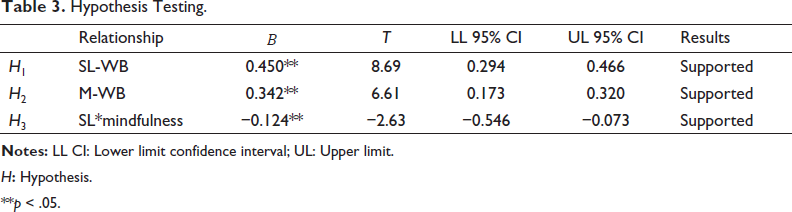
H: Hypothesis.
**p < .05.
In support of H3, the interaction plot was created using the simple slope analysis for checking the SL and mindfulness’ links at low and high mindfulness. As shown in Figure 1, the association between SL and WB was high at low mindfulness and low for the high level of mindfulness. These results indicate that mindfulness moderates the SL and employee WB’s relationship. Also, mindfulness partly substitutes for a low level of SL in the workplace.
Interaction Plot for the Interaction Between Servant Leadership and Employee Well-being at Low and High Mindfulness Levels.

Discussion and Implications
The study’s findings emphasized the significance of servant leaders and mindful individuals for the success of Indian organizations. Also, this study has checked the moderating role of mindfulness and its ability to act as a substitute for the SL style.
The findings of the study demonstrated that there is a significant positive relationship between SL and employee WB. These findings supported the H1 and were consistent with the results of Li et al. (2018). It implies that to ensure the WB of the Indian employees and to make them committed to the organizations, corporate executives and leaders should demonstrate SL style. Notably, these leaders are equipped to address organizational issues including low efficiency, work pressure, and absenteeism because of traits such as tolerance, devotion, empathy, and selfless love as well as spirituality and a caring temperament (Mishra & Mahapatra, 2019). And, these qualities of a SL style make it an ideal and preferred approach from the employees’ perspective as a way to promote their welfare, especially in the Indian culture which is accompanied by a lack of gender equality, high power distance, and humanistic inclination (Gupta et al., 2002).
Further, the results of H2 backed up the key findings of Zivnuska et al. (2016) regarding the notable connection between mindfulness and employee WB. These results follow the findings of the existing studies concerning the outstanding role of SL style and employee mindfulness in stimulating positive emotions within an individual, thereby boosting their WB. The results of H3 confirmed the findings of Kroon et al. (2017) regarding the ability of mindfulness to make an individual less dependent on external leadership by uncovering the moderating role of employees’ mindfulness in SL and employees’ WB relationship.
Interestingly, these findings significantly advance the body of knowledge in numerous ways. To begin with, even though the prevailing research has evaluated the effectiveness of mindfulness as a substitute for transformational leadership style (Kroon et al., 2017); however, to the author’s knowledge, no studies have looked into the function of mindfulness as a replacement for SL. Also, researchers have investigated the moderating function of organizational-related elements as a substitute for the SL style (Eva et al., 2021), leaving the field of the substituting role of personal traits such as mindfulness unexplored. As a result, the findings of this study contribute to the extant literature by emphasizing the value of using mindfulness as a stand-in for SL. Moreover, this study adds to the body of research on mindfulness, which, according to Gunasekara and Zheng (2019), is a little-discussed topic in the work context.
Theoretical Implications
This study has several implications from a theoretical point of view. To begin with, this study supported the existing findings regarding the links between SL and WB (Li et al., 2018), and mindfulness and WB (Zivnuska et al., 2016). Notably, concerning the link between SL and WB, authors have found that SL is significantly related to employee WB. These findings signify that as servant leaders provide emotional support to the employees, and demonstrate concern for them, such noble behavior displayed by them helps to promote employee WB. Additionally, concerning the relationship between mindfulness and WB, the results found that mindfulness is significantly and positively related to WB. These results signify that a mindful employee inclines to have better WB. It implies that mindful individuals are more likely to experience and adapt to emotionally demanding circumstances in a versatile and non-impulsive way, and this mindful nature tends to improve their WB favorably.
In addition to determining the direct relationship between the aforementioned variables (i.e., between SL and WB, and between Mindfulness and WB), the study also identified the interaction effect of SL and mindfulness on WB. Thus, through identifying the interaction effect and the moderating role of mindfulness in the SL and WB relation, this study has addressed the need to examine the role of substitutes in the leader-follower relationship (Dionne et al., 2005). The study’s results add to the prevailing literature by identifying the importance of mindfulness in acting as a substitute for the SL style. These results denote that rather than solely relying on the SL style, organizations should rely on mindful individuals for their long-term existence. Finally, this study extends the application of SLT (Kerr & Jermier, 1978), concerning the need to reduce the over-dependence on other theories such as social learning and exchange theories in the SL field (Madison & Eva, 2019).
Practical Implications
Following the theoretical contribution, the study also has practical implications. The study’s findings are relevant for the managers and leaders of numerous service sector industries, as research evidence confirms the importance of mindful employees in the workplace. By unpacking the substituting role of mindfulness, the study helps in highlighting the need to employ mindful individuals in an organization. This implies that organizations and HR managers should focus on strengthening the mindfulness level of their workforce. They can do so by organizing meditation sessions (Gunasekara & Zheng, 2019), which will promote relaxation and physiological balance, and facilitate the WB of the employees.
Also, organizational managers should focus on cultivating a positive mindset among the employees so that they can accept things as they are. It will enable employees to adapt to dynamic work situations more successfully and effectively rather than repressing and opposing the current reality. Furthermore, organizations and HR managers can also embrace a range of programs and techniques, such as the implementation of work–life balance measures and stress management techniques, to develop and foster employees’ mindfulness (Smith et al., 2008). Certainly, it could be beneficial to support these projects because they will assist to increase employee awareness, which can in turn will prove fruitful for stimulating their overall WB.
Moreover, HR managers should encourage employees to take a break from their hectic work schedule and practice mindfulness. It will help relieve job strain and will boost employees’ emotional health. Additionally, HR managers and professionals should encourage modern work setups with meditation centers. This will help employees relax, which will enhance their productivity. Along with these techniques, HR managers should organize mindfulness-based training programs (Zivnuska et al., 2016) to improve employees’ mindfulness. Along with the employees, training should be provided to the leaders too, to enhance their ability to recognize the employees who get distracted very easily, so that they can work to improve their mindfulness level. Overall, if managers and leaders want to improve their workplace environment, they should devote efforts to create a mindful work culture. It will not only boost employees’ health but will also strengthen healthy relationships in the workplace.
Limitations and Scope for Future
As with most research, this study also has several limitations, which can be considered an interesting avenue by researchers to conduct further research on this area. The first limitation pertains to the study being cross-sectional due to which the decision about the causality cannot be drawn. Therefore, future researchers can focus on conducting a longitudinal study. Second, as the study was undertaken concerning Indian employees, the results of the same cannot be applied to other countries due to the differences in the policies and practices being followed in different countries. Thus, future research can focus on other countries apart from the one studied in this research, which will help get an idea regarding the differences in the results concerning different countries’ contexts. Third, among numerous leadership styles, the SL style was chosen in this study to analyze whether mindfulness acts as a substitute for it. Thus, other crucial leadership styles such as empowering leadership or supportive leadership style can be considered in the future, which might give different results. This will also contribute to the SLT by identifying the role of mindfulness in moderating the positive or negative effects of leadership styles in shaping employees’ behavior.
A final limitation of the study is that only the role of a single individual characteristic was considered to determine its role as a substitute for the leadership style. However, other relevant individual factors can also be considered like resilience or employees’ optimism, to ensure whether these factors play a remarkable role by being a substitute for numerous leadership styles or not. Moreover, other relevant outcomes can also be included in future studies, such as employee engagement or performance, which will be beneficial in further contributing to this theory. Despite having several limitations, this study’s findings add to the SLT, which is an indispensable area of research.
Conclusion
The findings verified that mindfulness partly buffers the effect of SL on employee WB. This suggests that mindfulness can boost employee WB, thus reducing the need to rely on a SL style. The findings present managers with the potential route to focus on the training practices, which will prove beneficial in enhancing the mindful level of their workforce. This will boost positive emotions within an individual, the favorable impact of which will benefit the entire organization, relying on the fact that the success of an organization depends upon its workforce. This study has several limitations also, for example, focusing on a single leadership style only. But, despite its shortcomings, this study provides a base for future researchers to further contribute to this crucial area. Also, the study is accompanied by numerous benefits, both for HR managers and for future researchers.
Footnotes
Declaration of Conflicting Interests
The authors declared no potential conflicts of interest with respect to the research, authorship, and/or publication of this article.
Funding
The authors received no financial support for the research, authorship, and/or publication of this article.
