



Abstract
The competitive business environment is new world order, which applies to firms worldwide. Corporate transparency and disclosure (CTD) impact the market valuation of the firms. However, the impacts of CTD on the value in the competitive business environment are not explored well, which is the current study’s aim. Panel data of 76 diversified Indian firms are gathered. The sample (76 firms) is shortlisted from the BSE 100 index for 10 years (2010–2019). The static panel data are applied to the data. It is found that competition negatively (the learners’ index is an inverse proxy of competition) moderates the CTD’s impact on the valuation of the firms. This finding implies that a low level of competition in the business environment enhances the CTD’s impact on the firm’s valuation more than a high level of competition. Moreover, no other study finds a nonlinear positive association of CTD on the valuation and the moderation by competition. The study’s unique outcomes that CTD is effective for valuation only when it reaches a threshold level (found through nonlinear association) and a low level of competition can enhance CTD’s impact on the valuation is a significant contribution of the study.
Introduction
Transparency in disclosing financial information is a controversial and hugely debated topic despite being at the forefront for years (Connelly, 1981; Kothari et al., 2009; Sukhari & de Villiers, 2019). The reason may be attributed to a lack of a straight definition. A clear-cut definition of disclosure is impossible due to the extensive involvement of subjectivity and varying intentions in disclosing business information (Herrmann & Thomas, 2000; Hess, 2019; Michalak et al., 2017). Despite all the controversy around corporate transparency and disclosures (CTD), it has a universally recognized utility (Obiekwe & Nwaeke, 2018).
In the literature, there is evidence that CTD reduces the cost of capital ( Easley & O’hara, 2004; Nahar et al., 2016). It reduces the volatility in the stock market (Bushee & Noe, 2000). A few studies reported that CTD increases stock market participation (Diamond & Verrecchia, 1991; Easley & O’hara, 2004). It helps in increasing profitability (Qiu et al., 2016). A voluminous literature is found that talks about CTD’s impact on the firm’s valuation. The evidence on the nature of the association is mixed. Some studies have evidence that CTD positively influence the valuation and high returns in the securities market (Anam et al., 2011; Charumathi & Ramesh, 2020; Sheu et al., 2010). On the contrary, there are evidence that CTD does not influence the valuation and there is no significant CTD’s impact on the firm’s value (Alencar, 2005; Banghøj & Plenborg, 2008; Hassan et al., 2009).
Moreover, studies postulate that the industry’s competition level influences CTD. The firm’s competitive position may decide the level of CTD adopted by the firm. There is two dialectical, diametrically opposite hypothesis regarding competition’s influence on the CTD in the firms. One hypothesis says that there is a proprietary cost linked to CTD; hence, firms prefer to play down the level of CTD in the firms (Verrecchia, 2001). On the contrary, another hypothesis presents that a high level of CTD may enhance the firms’ credibility, and hence, firms tend to disclose more (Shivaani & Agarwal, 2020). In addition, Li (2010) presents a mixed case where the former adheres if the competition is from the existing competitive parties, and the latter is witnessed if the competition is from the new entrant in the fray. Above all, competition certainly influences the CTD by the firms whether either of the hypotheses holds.
However, surprisingly, we rarely observe any study that tries to figure out how CTD influences the firms’ valuation under the gamut of competition, which is a reality. Liu et al. (2022) recently did significant work in this regard. They find that competitiveness plays a vital role in the association of CTD with a firm’s market valuation in the USA. The situation becomes more pressing, as we not only find evidence in the literature that competition influences CTD (as seen in the previous paragraph) but also the valuation of the firms (Audretsch, 2001; Beiner et al., 2011; Kaunyangi, 2014; Leong & Yang, 2020). Competition is part and parcel of any market-based economy. Assuming it to be either nonexistent or constant may digress the findings on the connectivity of CTD with the firm’s valuation. Hence, extending the generic connection of CTD on the valuation to prevailing competition as a moderator is not only obvious but also contextual and a wise decision. Earlier works are mainly focused on firms in the developed market. India’s economy is growing rapidly and has emerged as one of the most booming economies. Therefore, the role of competition (along with the CTD) and the firm’s valuation should be explored. The current study fills this research gap. The study’s objective is to determine the CTD’s impact on the firm’s valuation under the influence of competition (as a moderating variable).
A qualitative study between CTD and valuation under the influence of competition may not objectively serve the purpose. A quantitative study would fit the bill. However, among the cross-sectional, time series, and longitudinal studies, it is decided in the present study to go for the longitudinal study to serve the objective raised in this research.
The present study makes a few unique and novel contributions. It is found in the current study that competition (measured by the Learners’ index, which is an inverse proxy for the competition; for details, please see the methodology section) is negatively moderating the association of CTD with the firm’s valuation. Low competition leads to a higher CTD’s impact on the firm’s market value, and vice versa is not seen in the literature. The current study’s findings significantly affect all the firms’ stakeholders. Mainly, the policymaker can be more informed and decisive in setting up the holistic policy on corporate governance, disclosures, and competition in the Indian corporate world. They (the policymakers and regulatory body) may devise a long-term strategy to ensure effective CTD and a reasonable level of competitiveness in the market so that it may achieve the best of both worlds simultaneously. They may be able to strike a balance between competition and disclosures so that the benefit of both would be ensured, and simultaneously the negatives (as witnessed in the current study) may be minimized.
The remaining article is arranged in the following six sections. A literature review (the second section) follows the first section of the introduction. The third section talks about the data and methodology used in the study. The results are reported in the fourth section. The fifth section compares the findings of the current article with the earlier studies in the discussion. The article is concluded in the sixth and last section.
Review of Literature
CTD and Valuation
CTD is integral to corporate governance (CG) practices (Bhimavarpu et al., 2023). CG practices are substantially influenced by the Agency theory (Naz et al., 2022; Raimo et al., 2022). As per corporate agency theory, a corporate is the relationship of agents, that is, executives and principles, that is, shareholders. Hence, some conflicts of interest (Agency conflict) between the agent and the principal may exist. The increasing CTD level may reduce such conflicts if the disclosures of information are transparent. Hence, CTD reduces the information asymmetry issue between the agent and principal (Naz et al., 2022; Raimo et al., 2022). The reduced agency conflicts improve the firm’s performance (Cahan wt al., 2016). Disclosures and their impact on the firm’s valuation are researched extensively. The outcome is mixed (Alencar, 2005; Hassan et al., 2009; Sheu et al., 2010). However, the literature is skewed in favor of CTD’s positive impact on the firms’ value, supporting the theories mentioned above. Jiao (2011) studies CTD and the valuation of 40 industries in the USA from 1979 to 1996 and considered 13 leading analyst firms’ reports. He evinces CTD’s positive association with the the firm’s market value. Bravo (2017) studies the S&P500 manufacturing firms in the USA in 2009 and found evidence that risk disclosures increase the firm’s market valuation. The firm’s reputation moderates the positive association of CTD with the firm’s valuation. Cahan et al. (2016) study CSR disclosures and their influence on the value of firms in 21 countries. They breakdown the CSR disclosures into expected and unexpected disclosures. They highlight that unexpected CSR disclosures increase the value of the firm. Moreover, the association is positively moderated if the national-level institutions are weak.
However, some of studies have no evidence supporting the CTD’s significant association with firm’s value). Alencar (2005) does not find CTD’s association with market valuation in a study on Brazilian firms. Banghøj and Plenborg (2008) also do not see any impact of voluntary disclosures on the firms’ stock market return and valuation in their study on the 36 industrial firms in Denmark from 1996 to 2000. A strange, but non-positive association is seen in 80 Egyptian non-financial firms spread among three sectors. It is found that the CTD is negatively associated with the firm’s valuation. However, the voluntary disclosures are insignificant to the firm’s valuation (Hassan et al., 2009).
In addition, in an extensive survey of the studies on CTD’s influence on the cost of capital (COC) by Botosan (2006), it is presented that evidence favors the hypothesis that CTD reduces COC. The COC and valuation are inversely related (Fernández, 2007; Nhleko & Musingwini, 2016). Hence, it can be deduced that CTD increases the valuation of the firms.
The above-mentioned discussion provides enough reasons to find new evidence. Hence, the following alternate hypothesis is assumed for empirical investigation:
H1: Corporate transparency and disclosures (CTD) positively impact the firms’ value.
Competition and CTD
As discussed earlier, there are two schools of thought on the influence of competition on firms’ disclosures (CTD). One finding suggests that competition impedes the CTD, and the other realizes competition encourages and brings trust among the stakeholder by having more CTD. The difference between both schools of thought may be attributed to how competition and disclosures (CTD) are defined (Li, 2010). Hence, ambiguity prevails. The nature of the association may depend on the level of competition in the sector, the firm’s situation concerning its market share and the nature of the business (Li, 2010). Hence, generalization is problematic across all the sectors of an economy across all nations.
Shivaani and Agarwal (2020), in their study of Indian firms, present that risk disclosures in 400 annual reports for 10 years (2005–2015) showed that competitively strong firms are generous in terms of sharing and being more transparent. Other studies also endorse such results that the firm’s competitive position decides the disclosure level (Elzahar & Hussainey, 2012; Ntim et al., 2013). In contrast, Clinch and Verrecchia (1997) report a disadvantage in revealing the information in the firms’ competitive environment. A similar disadvantaged situation (the proprietary cost hypothesis) is also found in other studies (Arya & Mittendorf, 2007; Board, 2009). However, in both cases (competition is positively or negatively linked to CTD), the association between competition and CTD is undoubtedly witnessed. Hence, it is justified to have competition as a moderator on the CTD’s impact on firm’s valuation of in the current study.
Competition and Valuation
Literature has little work regarding competition’s association with the firm’s valuation. However, the literature is replete with instances that the competition increases the efficiency (Bikker & Van Leuvensteijn, 2008; Forlani, 2012) and performance (Kaunyangi, 2014) of the firms. Hence, it is evident that competition influences the firms’ valuation. The lack of studies on this area justifies the current study.
Liu et al. (2022) and Liu and Li (2022) argue that there is a bright side to competition. The firms are encouraged to perform well to make their position in the market. Therefore, it increases the firm’s performance. The financial performance of a firm reflects in firm’s value. Thus, empirical evidence is required to argue that competition affects a firm’s value.
Ammann et al. (2013) use competition as a moderating variable for corporate governance (CG) to impact the firm’s valuation. The study encompasses firms from European Union’s 14 countries from 2003 to 2007. Competition positively influences the CG’s connection to firm’s valuation in the sample. Similarly, Liu et al. (2022) and Liu and Li (2022) indicate that competition improves a firm’s market value in the United States. In another study of 156 Swiss firms in 2002, Beiner et al. (2011) find a negative impact of competition on the firm valuation. Moradi et al. (2017) explore more than 90 Iranian firms from 2004 to 2012 (876 observations) for the influence of competition on the firm’s performance. They corroborate that competition significantly and positively impacts the performance of the firms. In addition, they also find competition to positively moderate the CG’s on the firms’ performance (financial). However, Moradi et al. (2017) present the competition’s impact on financial performance; the unexplored direct impact of competition on the valuation should also be done.
As we do not find any other study directly linking competition with valuation, we explore some relevant literature which indirectly links the two. Li and Luo (2019) find evidence that product market competition among Chinese firms from 2009 to 2017 negatively correlates with the stock market crash. The results are tested for robustness as well. Leong and Yang (2020) use the KLD database on the social impact of the firms from 1991 to 2015 due to competitiveness. It is found that the association is positive. Since CSR and the social involvement of the firms influence their valuation (Chu, 2021; Schramade, 2016), the unexplored direct association of competition on the valuation of the firms can be further researched.
The scarce studies and research gaps found in extant literature are enough reasons to look for fresh evidence on how competition impacts the valuation of firms. Thus, the hypothesis in given in an alternate form in the following way for empirical investigation:
H2: Competition positively impacts the firm’s valuation.
CTD and Valuation Under the Influence of Competition
Following the Bright Side competition view, Ammann et al. (2013) have found the positive influence of competition on the CG and valuation nexus of firms in the European Union. Similarly, in their recent work, Liu et al. (2022) find that competition significantly and positively impacts the connectivity of CTD and a firm’s valuation in the USA. Their findings ascertain that competition is an essential factor influencing CTD’s connection to Valuation. However, we do not find any other study which encompasses all three concerns (CTD, Valuation, and competition) at the same time. In the Indian context, no such study is available that simultaneously studies all three factors of firms. However, the discussion in the above sections clarifies that all three are connected. Keeping this in view, we propose that competition moderate the association between CTD and the firm’s valuation (Figure 1). Thus, the following alternate hypothesis is formed for the empirical investigation:
H3: Competition positively moderates the CTD’s impact on the firm’s valuation.
Conceptual Model.

Data and Research Methodology
The study investigates how a firm’s transparency and disclosure practices impact its valuation and market capitalization. Quantitative research methodology, which relies on analysing available data to generalize the results from a sample to a larger population, is employed for the study.
Data and Variables
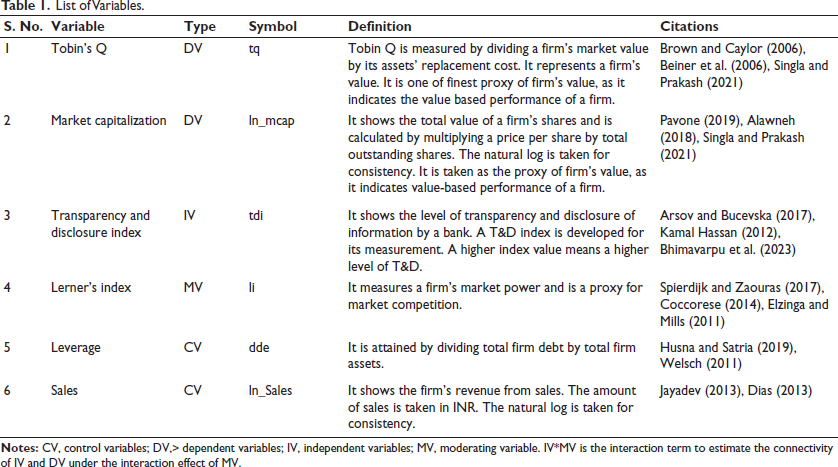
The study uses data from individual firms’ balance sheets and income statements from 2010 to 2019. We have taken data considered the post-crisis period (2010–2019), as the effect of detrimental economic disruption prompted by the financial crisis would have minimal influence on the considered data attributes for the study. The strongly balanced panel data comprise 760 observations and 76 companies on the Bombay Stock Exchange (BSE)100 list for consistent results. Only 76 non-financial firms are considered for the study out of 100 listed firms. Financial firms are excluded due to their different approach to information reporting. The data are captured from sources such as CMIE Prowess and the firm’s official websites. Table 1 elaborates the study’s usable variables.
List of Variables.
Methodology and Model Specifications
The study uses panel data analysis, as it more suitably combines the effects of cross-sectional and time series information, which might not be possible by carrying out a time series or a cross-sectional analysis (Hsiao, 2005). The numerous literature makes it evident that longitudinal studies (panel data analysis) reveal more specific and rich information than their counterparts (cross-sectional and time series analysis) (Baltagi, 2008; Hsiao, 1985, 2005, 2007). It incorporates both cross-sectional and time series analysis. Hence, an econometric model where valuation is endogenous, CTD is an exogenous variable, and competition is a moderating variable is formulated to estimate the model’s coefficients and interpret the results.
The article beholds the association between transparency and disclosure practices and firms’ valuation and market capitalization. The study examines these associations using an interaction model under different conditions incorporating linear, nonlinear, and moderating associations (under competitiveness level). The model’s construction follows Wooldridge (2013) and is specified as follows:
Model 1:

Model 2:

where tq and ln_mcap are the two dependent variables that measure firms’ valuation and market capitalization, respectively. The tdi is the explanatory variable. tdi² is square_term (tdi-mean*tdi-mean) for nonlinear connection. Furthermore, the interaction term i_tdi_li (tdi-mean*li-mean) is also introduced to observe how the tq and ln_mcap respond to the firms’ transparency and disclosure practices (tdi), as their market competitiveness (li) varies. The dde and ln_sales are taken as control variables for a good fit of models. Leverage (dde) and sales (ln_sales) are included as control variables because they are deciding factors in evaluating banks’ economic importance across segments/groups and thus can interfere with valuation measurement.
A detailed discussion on variables is reported in Table 1. uit and eit are error terms, and “”” is an entity (firm) at a time “t.” βj is the coefficient where β0 is constant.
Descriptive Statistics and Correlation Matrix
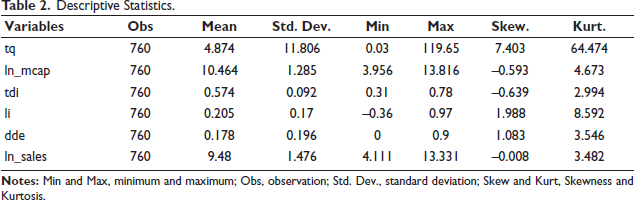
Table 2 depicts the outcome of the descriptive statistics of the sample. The 4.874 mean value of tq, which is closer to its minimum value of 0.03 than its maximum of 119.65, exhibits that the valuation of firms in India is low. However, ln_mcap has an average of 10.464 (inclined to maximum), indicating that most sample firms have a high market capitalization. The low tq value with high market capitalization implies that most sample firms have high stocks on their balance sheet with a relatively lower market value. The tdi has an average score of 0.574, demonstrating a moderate level of transparency and disclosure practices followed by Indian firms. The lower mean value of li exhibits that Indian firms operate in a highly competitive environment. The mean value of dde indicates that most firms are less dependent on debt. The mean value of sales is 9.48, which is quite close to the maximum; hence, it shows that firms have a sufficient level of sales. The lower Std. Dev. of all variables signals that these determinants do not much differ from one firm to another.
Descriptive Statistics.
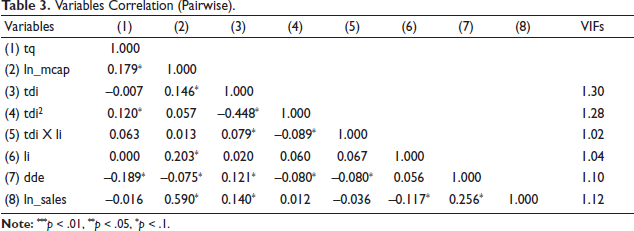
Performing correlation analysis measures correlation level among the study variables, presented in Table 3. The correlation coefficients (pairwise) among the variables are not high. The highest significant correlation is obtained for the pair ln_mcap and ln_sales, with a value of 0.590, lower than 0.80. However, the variance inflation factor (VIF) values are all less than 2, indicating that multicollinearity is not a concern.
VariablesCorrelation (Pairwise).
Results
Outcomes of Regression Models
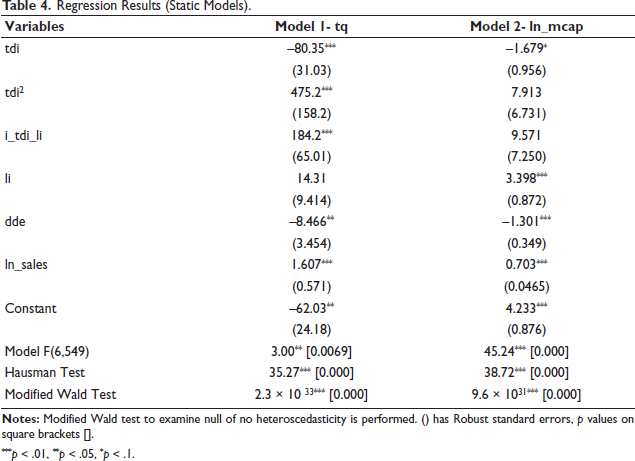
Table 4 elaborates on the regression results of Models 1 and 2. Model 1 demonstrates the impact of tdi on the valuation of firms using tq, whereas model 2 showcases the relationship between tdi (transparency and disclosure) and market capitalization (mcap). Both models have a significantp value for the Hausman test; therefore, the fixed effect model is applied for the analysis. Furthermore, the autocorrelation existence (as observed by the Wooldridge test with significant p value < .05) and the availability of heteroscedasticity (observered by the Wald test with p value < .05) prompt the consideration of robust standard error estimates (Baltagi, 2006).
Regression Results (Static Models).
*** p < .01, **p < .05, *p < .1.
Model 1 results indicate that tdi² has a positive and significant impact of transparency and disclosure on firms’ tq (firm value), thus evidencing a U-shaped relationship between the variables. The U-shaped relationship implies that initially, as firms adhere to better transparency and disclosure practices, their valuation deteriorates; however, beyond a point, the firms’ valuation starts improving as they increase their transparency and disclosure levels. Both control variables (dde [leverage] and ln_sales) are significant at 5% and 1% significance levels, respectively. However, the dde co-efficient is negative (–8.466), and the ln_sales co-efficient is positive (1.607), suggesting that dde (leverage) hurts the valuation of firms. In contrast, an increase in sales volume strengthens the firm’s value.
Furthermore, though li has an insignificant relationship with tq, the coefficient of i_tdi_li is positive (184.2) and significant at 1%, explained with the help of the interaction graph in Figure 2. The graph shows that li (reverse of competition) positively impacts the relationship between tdi (transparency and disclosure) and tq (firm’s value); however, the impact is more pronounced when the firms have significantly higher levels of li (less competition).
Interaction of li With tdi to Impact tq.
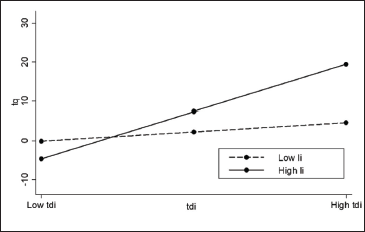
Model 2 results demonstrate that tdi (transparency and disclosure) has a detrimental impact on the market capitalization of companies, as the tdi coefficient is negative (–1.679) and significant at a 10% significance level. Further, tdi² and i_tdi_li are both insignificant in model 2. However, the coefficient of li (reverse of competition) is positive (3.398) and significant at 1%, highlighting that when firms have a higher level of power in the market, their market capitalization improves. Similar to model 1, both control variables are significant in model 2. The dde (leverage) coefficient is negative, and ln_sales is positive, respectively.
Endogeneity and Robustness
The endogeineity examination is perfomed by applying Durbin_ χ2 and Wu _Hausman tests (Baltagi, 2006). Table 5 presents the outcomes of these tests. Both tests output insignificant p values supporting the hypothesis null of no endogeneity for variables of interest in both models. In addition, the series of statistical methods followed in dealing with the effect of unnatural outlies in the data, the VIF values (< 2) that indicate the absence of multicollinearity issues, and the diagnostics that pointed toward the calculation of robust standard errors and the insignificant endogeneity tests; all in sync allow the final results to be robust and reliable.
Endogeneity Results.

Discussion
Hypothesis Testing
The current study reports disclosures’ linear and nonlinear impact on the firm’s valuation. Both linear and nonlinear association of CTD is positive. Hence, the first hypothesis cannot be rejected. The second hypothesis that competition positively impacts the firm’s valuation is rejected because competition negatively impacts the firm’s valuation [Lerners index (li) is an inverse proxy for the competition; a higher value of “li” means reduced competition]. The third hypothesis that competition is positively moderating is also rejected, as competition negatively moderates the association of CTD with the firm’s valuation. This result means low competition (higher the values of “li”) influences the CTD’s impact on valuation more than the high competition. The negative relationship between CTD and valuation indicates that CTD does not reduce information asymmetry and agency conflict between agents and principals in firms in India. The negative role of competition in the connection of CTD and valuation does not align with the bright side of the competition view (Liu et al., 2022) in firms in India.
Comparison
The significant linear association of CTD implies that the valuation will also be high, as the CTD is high. We have found a mixed association between CTD and valuation in the extant literature. This result also indicates that there might be a nonlinear relationship between CTD and valuation. Hence, the nonlinear quadratic association between CTD and the firm’s value is also observed. The significant nonlinear association implies that as we increase the CTD, initially, it hampers the valuation. However, as the CTD reaches a threshold level, the further increase in CTD increases the valuation. In addition, the low competition positively impacts the valuation.
Similarly, the low level of competition increases the CTD’s impact on the valuation more than the high level. The companies are from various sectors (the sample firms are non-financial firms from a diversified index set of 100 firms). So, the result viz-a-viz competition may vary from sector to sector. However, in a diversified pool of the sample, it is evident from the current study findings that a low level of competition adds more value to the firms individually and is a moderator between CTD and the valuation of the firms.
The findings of the current article support the premise that CTD increases the firm’s value, which is also found in other studies (Anam et al., 2011; Jiao, 2011; Sheu et al., 2010). This finding of the current article contrasts with the other studies, which find no evidence of the positive association of CTD with the value of the firms (Alencar, 2005; Azrak et al., 2020; Banghøj & Plenborg, 2008).
The second main finding indicates that lesser competition or higher market power adds value to the firm. These findings are supported by Board (2009), Clinch and Verrecchia (1997), and Arya and Mittendorf (2007) that a less competitive business environment adds more value to the firms in India. This result of the favorable influence of less competition on the value of the firm is contradicted by several studies, which opine that a more competitive business set-up and more extensive market share help in more market value of the firms (Elzahar & Hussainey, 2012; Ntim et al., 2013; Shivaani & Agarwal, 2020).
We do not observe any study which makes competition moderate the CTD’s influence on the firms’ value to compare the current study’s findings.
Contribution and Implication of the Findings
The nonlinear association of CTD with the firm’s value is one of the unique contributions of the current study. This contribution is logical. CTD, which is either minimal or done to satisfy the mandatory requirement, may not be able to add value to the firm. This mandatory requirement level of CTD can be considered the threshold level. Till this level, the value diminishes as the CTD incurs efforts and costs but is not large enough to influence the market value. However, as the CTD crosses that level, which implies that firms make efforts or incur costs to provide more transparency than the regulatory bodies require, it supports increasing the firms’ value. The second significant contribution of the study, which is also not observed in the literature, is the moderating role of the low competition in enhancing the CTD’s impact on the firm’s valuation. There is no other study where it is reported that low competition helps enhance the positive role of CTD to add more value to the firms.
The findings of the present study also have a few significant implications. First, it is endorsed in the study that more CTD is suitable for the higher valuation of the firms. However, the basic or mandatory CTD may not be much helpful. The efforts to be more transparent should be severe and more than what is required by the mandatory requirements. That is a necessary implication from this study that merely being transparent may not be fruitful in adding value, but being transparent more than the basic level will only be beneficial. Second, it is evident that competition is a crucial element in a firm’s performance. However, the insignificant association between competition and a firm’s value indicates that high competition does not always have to add more value to the firms. This finding is a red signal to the policymakers and other stakeholders of the firms. This finding implies that policymakers should look back and see how their efforts to bring competitiveness do not add value to the business. A course correction may be desired so that healthy competitiveness may be introduced, which would enhance the value by enhancing the efficiency and profitability of the firms. There may be other factors that should be focused on to enhance the firm’s value.
The third implication can be a mix of the abovementioned implications. High competition in the business environment may moderate the excellent contribution made by the CTD to the valuation of the firms in India. Either the format of the competition aiming to be helpful in the valuation of the firms would be changed, or investors should be wary of the current study’s findings and avoid firms having huge competition despite the level of CTD. Investors may concentrate on firms with high CTD but low competition to get the maximum benefit of CTD on the valuation.
Conclusion
This study is aimed to determine the CTD’s impact on the valuation of firms under the influence of competition (moderation effect of competition). It is found that CTD positively adds market value. Less competition also does the same and adds market value to Indian firms. However, the positive impact of CTD on the value is enhanced by the low level of competition more than the high level of competition.
The findings of the current article are essential and significant, as it sets the ground rule for the regulatory environment of the business, especially for transparency and disclosures and competition in India. The regulatory setup never happens in isolation. If rules of transparency are set, expecting its positive influence on the valuation without considering other things (e.g., competition) may not be able to have the desired results. Hence, the findings of the current study help provide a holistic view of transparency and competition viz-a-viz valuation of the firms. The study’s implications are strong enough to change the course of action of the regulatory mechanism. Transparency and disclosures are a subset of a more extensive set of CG. The implications of the current study will impact the long-term policy on CTD in particular and CG in general. Thus, the findings provide notable implications for the concerned stakeholders, including policymakers and managers, to take CTD and competition as essential elements for a firm’s valuation.
One of the significant limitations of the current study is that all the sample firms are from diversified lots. The nature of the association may change if the same study is done on the other sectors. This limitation of the current study can be one of the future scopes on the topic. Another limitation of the study is that CTD does show an association with valuation. However, the CTD’s impact on profitability and efficiency is not studied.. These areas of study on the topic can be explored well in future studies.
Appendix
According to the existing literature, it is discovered that Hassan (2012), Arsov and Bucevska (2017), and Aksu and Kosedag (2006) have developed CTD indices to measure the level of CTD in a firm. Three major categories: Ownership Structure & Investor Relations (OSIR), Financial Transparency and Information Disclosure (FTID), and Board & Management Structures & Processes have all been comprehensively taken into consideration (BMSP). To create the index, 98–106 attributes were taken into account. To create a new and more robust T&D index, this study has also added a new category of Strategic, Environmental, Technological, and Web Disclosures (SETWD). Due to its significance in current corporate practises and reporting techniques, the SETWD category is taken into consideration (Bhimavarpu et al., 2023; Rastogi & Kanoujiya, 2022).
Numerous studies have previously shown that non-financial performance information, including the state of intangibles, CG practices, customer satisfaction, risk management, human capital, product development and reliability, sustainable development, etc., also serves as an important predictor of future earnings, ultimately improving the performance of the stock market (Amir & Lev, 1996; Ittner & Larcker, 1999). In order to construct the index, the current study used 102 qualities based on the covered categories. The qualities for the categories FTID, BMSP, OSIR, and SETWD are 30 for FTID, 29 for BMSP, 10 for OSIR, and 33 for SETWD, respectively. Moreover, a binary technique is employed to measure the TD index, which is consistent with Aksu and Kosedag (2006), Arsov and Bucevska (2017), Hassan (2012), and Rastogi and Kanoujiya (2022). The availability of information (attribute) is given a score of 1, and “0” is for the absence of the information and then the average is taken.
The most often used indicator of market power or competitiveness is the Lerner index (Lerner, 1935), which is used in this study. According to Paktinat and Javid (2015) and Praveena and Samsai (2014), the Lerner index is calculated as follows,
LI = (Price – MC) / Price, where marginal cost (MC) is proxied by firm’s total operating expenses and price is by revenue.
or
LI = Profit of the firm i/ Revenue of the firm i
While the Lerner index adjusts for industry-specific elements, it does not display the market dominance of a firm’s product. Thus, in line with Gasper and Masa (2006) and Sharma (2011), an enhanced version of the Lerner index is used in the current study:

Where
Footnotes
Declaration of Conflicting Interests
The authors declared no potential conflicts of interest with respect to the research, authorship, and/or publication of this article.
Funding
The authors received no financial support for the research, authorship and/or publication of this article.
