



Abstract
Purpose
The research intended to reveal real behavioural inclination of marketer for SEO and SMM usage. This approach was developed to provide a constructive model for established marketers as well as emerging start up marketers.
Design/methodology/approach
The investigation was designed based on literature review followed by quantitative analysis of the collected data with appropriate statistical techniques based on random surveys of end users from the National Capital Region of India.
Findings
A new conceptual model is being proposed i.e. Marketer decision model, enabling a comparative framework which encourages more effective and result oriented decision-making techniques which ends up in developing better online marketing techniques. Internet users have different behavioural patterns based upon demographic profiles. The evidence based on the statistical analysis suggests that the consumer behavioural patterns need to take into consideration by online marketers while targeting and designing SEO and SMM strategies.
Research limitations/implications
The following research was based on a selected samples only but not the entire population of target consumers and there were cases where samples perhaps inaccurately representing the population.
Originality/value
The survey conducted on diversified demographic profiles, thereby providing few rich perspectives regarding online behavioural pattern.
Keywords
Introduction
Our spatial connections and encounters with the world are progressively advanced. The urban communities and towns that we live in comprise digital content, like information from Wikipedia, photos from Instagram, eatery reviews from Zomato, and algorithms, controlled by Google that make data rankings (Kilgour, Sasse, & Larke, 2015). The digitalized advancement started an issue of research that had demonstrated how they can have critical effects on how individuals financially, socially, furthermore, politically collaborate with their respective surroundings. Digital content in this way do not simply reflect the world but additionally produce it (Shah, 2016). The internet in the current scenario is one of the pivotal sources for marketing. Perhaps, a large proportion of population tends to get their respective information and updates through search engines and social media sites (Abels, White, & Hahn, 1997). Owing to a large number of audiences on online media websites, there is rapid broadcasting of information but also the existence of an ethnicity of the organic and inorganic click. Just an online digital presence is not enough and in contemporary competitive scenario, the uniformed rule for marketers is to be everywhere, every time, on all platforms (Zarkada & Polydorou, 2014). The evolution of digital marketing results in the growth of various contemporary search engines and social media sites, which have led to significant changes in online content (Yoo, 2012). Undeniably, a large portion of online traffic attracted to search engines for their respective search queries. Search engine optimization (SEO) is an accumulation of methodologies that enhance a site’s quality and perceptibility on search engine result pages (Sharma, Butler, Irwin, & Spallek, 2011). The higher and all the more as often as possible a site shows up in list search results, the more traffic it will get through the utilization of web crawlers (Xu, Luo, Carroll, & Rosson, 2011). These procedures can be isolated into four noteworthy classes: keyword planning, web search tool utilization, on-website page optimization, and off-website page optimization (Thelwall, 2015). On-website page optimization incorporates the administration of all defined factors specifically related with site (e.g., keywords, qualitative content, and navigation of the site), while off-page optimization incorporates every one of the endeavors made away from the site, for example, affiliate marketing or social sponsorship technique (Taylor, 2013). While an ever-increasing number of sites are recorded via search engines and perhaps guarantee their own piece of the pie, it is very obvious that elements, for example, the most elevated ranking of the query items page, turn out to be progressively significant for marketers (Berman & Katona, 2013). The perceptibility of a website through search engines has turned into a vital element for the survival of the brands (Zhang & Cabage, 2016).
Social media is a stage whereby user created content is traded in a cooperative, dynamic, and intuitive way. Web-based social networking channels (i.e., sites) can be additionally ordered into various sorts by their usefulness, including micro blogs, social networking sites (SNS), virtual world, synergistic tasks, content groups, and review forums (Yang & Ghose, 2010).
Social media sites have changed the strategies of marketing correspondence in the era of extensive digital communications. Besides receiving information from a single brand channel (e.g., marketers), social media users can easily publish their own opinions and comments on others’ posts (Smith, 2010). In this manner, the one-to-numerous styles of correspondence have advanced into many-to-one, one-to-many, many-to-many. Social media fulfills individuals’ requirements for data sharing in various parts of the world (Arora & Predmore, 2013).
Powerful marketing administration is basic for the achievement of objectives for most ventures. In a current research, most of the reviewed firms detailed that their present clients were their generally critical resources, and more than 80 percent construct marketing choices in light of casual client criticism on social media platforms more than on formal statistical surveying (Diephay, 2016). The Internet offers incredible chances to firms to accumulate casual input from clients and convey data to clients. Nevertheless, it was found in an international survey that exclusive 56 percent of respondent firms announced utilizing the Web broadly to advance their organizations, and 19 percent did not utilize any Web advancement marketing. Researchers recommend that business visionaries are utilizing the Web as adequately as they want (Baird & Parasnis, 2011).
There is no doubt that numerous vast firms are burning through millions of dollars on social media-based promoting efforts that put advertisements on intensely trafficked Web locales like Yahoo! or on the other hand Google. Nevertheless, numerous startup business people or small firms just do not have the money-related assets for such battles. However, some bigger firms, for example, Amazon, Apple, and Microsoft, have started utilizing SEO and social media journals to enhance execution and marketing endeavors (Yuksel, Milne, & Miller, 2016). Marketers utilized blogs to permit their consumers in different nations to talk about product issues and corporate procedures. Marketers use SNS that totals information on contenders to enable inside partners to remain up and coming on advertisement changes. Marketers made various blogs to advance their new launch (Weinberg, 2009). The social media strategy is composed from the point of view of the product features on the various platforms and was utilized to help fabricate online buzz for the brand. In every one of the three of these cases, imperative learning was overseen through blog locales keeping in mind the end goal to help enhance firm execution (Tsimonis & Dimitriadis, 2014). Regardless of whether it was for moving forward comprehension of product and user needs, gathering contender information or building awareness for another product rollout, these exercises all added to enhancing the marketing capacity of the organizations. Dissimilar to costly traditional marketing efforts, which depend on promotions that show up on surely understood outsider Web locales, web journals are moderate for all organizations (Sen, 2005).
Both SEO and social media marketing (SMM) strategies involve advancing market position of a brand, but there are differences how these results from the respective SEO and SMM strategies impact marketers’ decision-making. As paid results from SEO are considered to be displayed at the top or right-hand side corner of the result page, the organic results from SEO show within the main content body of the result page (Terblanche, 2011). As an SEO and SMM are mounting and considered as a rationale tool of online marketing strategy, marketers should be prepared with an understanding of contemporary technologies of digital marketing (Rugova & Prenaj, 2016).
Objectives of the Study
To compare SEO as a marketing tool with SMM tools.
To compare the implications on the customer’s perception about SEO and SMM as a marketing tool.
To understand the impact of SEO and SMM on the marketing performance of the brand
Review of Literature
Decision-making behavior toward marketing is multidimensional, complex, and dynamic. Researchers discovered captivated states of mind toward marketing and demonstrated that most respondents had a struggle between a valuation for marketing quality and a worry of marketing impacts on society (Papadopoulos, Stamati, & Nopparouch, 2013). Some public policy strategist and buyer protection forums would contend skepticism toward marketing decision-making because it may be used as tricky strategies by marketers to portray their respective brands in an exaggerated manner (Men & Tsai, 2013). Marketers need to adapt contemporary and non-deceitful marketing strategies which potentially lead to fair publicizing claims. Indeed, few consumer behaviour researchers in past quoted that "digital marketing tools emphatically used as an aggressive instrument and marketers believe digital instruments to be more trustful for marketing (Lorigo et al., 2006). On the contrary, few researchers also claim that as online digital marketing may counter contention of wide reach for awareness, in terms of trust it is considered to be a doubtful counterproductive tool which can prompt doubt for marketing. This doubt may make purchasers miss products that would be gainful to them and they may end up paying higher prices since they are suspicious about valuable rebates and buyer advancements (Levene, 2010).
Various academicians have analyzed different tools of marketing toward brand promotions. Most current examinations claimed most young marketers prefer online digital methods of marketing. They found that users’ impact and the measure of online adolescent users watched to be decidedly related to incredulity toward online marketing (Labrecque, 2014). It was the conviction of marketers that presentation to promoting through Internet elevated the marketer capacity to recognize advertising motives also, thus driving them to more alternatives for online Internet marketing. Various researches were found for various online marketing tools but SEO and SMM are considered to be most impactful marketing tools in the current scenario. It had been analyzed that with larger amounts of user’s learning about online marketing, the more noteworthy would the marketer level of incredulity toward online marketing (Moreno & Martinez, 2013).
Researchers additionally found a relationship among user’s age and incredulity; however it was not sufficiently solid to be huge. It has been observed that people in general have a tendency to be trustful toward online publicizing claims. Majority of online customers trust that publicizing is educational and honest on SEO and SMM. In later reports, claimed that a most of customers believe that marketing regularly on digital platforms with current and regular updates and endeavours push customers to buy things they even do not required (Luh, Yang, & Huang, 2016). In many case, these buyers additionally believe that online marketing gives important updates to them about the value addition in the product and service, and these advantages of marketing exceed the trust of users (Malaga, 2007).
Online Internet marketing consists of email advertising, intranet promoting, extranet marketing, and versatile marketing strategy. Most of researchers discovered that SEO and SMM are the most generally utilized e-showcasing instruments by independent venture and that the appropriations of such apparatuses have an optimistic effect on the results of these ventures. It has been demonstrated that the potential use of online networking is colossal (Krasnova, Spiekermann, Koroleva, & Hildebrand, 2010). Online networking is in any event as successful as customary advertising. There are various advantages for private ventures in utilizing social media marketing. Organizations can utilize online networking to contact a universal gathering of people with less time, exertion, and resources (Kim, Jeong, & Lee, 2010). SEO can reach their target markets in new and proficient ways. Independent companies understand that they can establish their esteem from using SNS, yet the advantages do not come without challenges. Small organizations have built up awareness in online networking; most have just an active awareness (Kawaski & Fitzpatrick, 2014).
Digital marketers operate in online digital environment which can be entirely navigated with online user intervention. To get maximum output from these digital platforms, marketers spend millions and millions of resources to provide access to content that perhaps users never know is existing. However, the Search engines and social media developers construct data with content provided by marketers or the users, and these linked databases and models are user-generated content only (Kaplan & Haenlein, 2010). At its core, organic SEO provides a model of best practices for marketing brand associations, creates metadata routines for web-scale external keywords, and measures the impact of applying optimizations and metadata to brand marketing strategies. More specifically, SMM creates significant returns with substantial increased traffic compared with the paid resources on SEO by the marketers as verified through Google analytics, Facebook analytics, and Twitter analytics. Underlying this research, the concept of SMM is connecting users where they are (i.e., on search engines and in social media networks) as advocated in the marketing concept (Hsun Ho, Hui Chiu, Chen, & Papazafeiropoulou, 2015).
This research offered a standard and innovative model for marketers to employ in paid online marketing strategies for users through the available web services by applying structured and linked data links. Like many previous researches, author also tried to give much attention to making homegrown digital collections discoverable by search engines and optimized for sharing on social media networks. Similarly, author has spent much time and effort understanding paid subscriptions optimized for teachable moments through available social media website and through search engine networks (Hazli, 2013). In this study, author offers an example of taking lessons from the presentation of both locally digitized collections and paid collections, and applying these lessons holistically to paid databases, making them openly discoverable by users through Internet search engines and social media networks, treating them as any of our other digital collections. Our research was based on several studies that reinforced our interest in meeting online users where they search for their respective needs (Casado, Navarro, Wensley, & Solano, 2016)
A study noted that
search engines perhaps continue to lead topping the list from the available online sources which are used prominently to search online queries in terms for required information followed closely by Social networking sites The major difference in terms usage between search engines and social networking sites is the frequency of usage as most percent of online users who search on continuous intervals use search engines, as compared to those who use social media sites for online search queries. (Berthon, Pitt, Plangger, & Shapiro, 2012)
Commercial search engines like Google increases the likelihood that they will discover, access, and share our subscribed resources in search engines and social media networks. Organic SEO methods are based on several components: structured semantic markup, search engine algorithm, and employing linked data techniques. Structured semantic markup is the act of providing rich descriptions of the “navigation” of web pages by embedding additional tags into HTML pages or constructing alternate data formats In this case, SEO includes a restructuring of the site architecture, creating a sitemap to list the inventory of pages for indexing, and the assigning of canonical URLs to each page to identify the preferred URL to appear in Search Engine Result Pages (SERPs) (Anderson, 2016). SMM includes adding Facebook Open Graph Tags and Twitter Card markup to database pages, as described on the Twitter Developer and Facebook Developer sites. Finally, the linked data techniques applied during the project were based on the external enumeration specification and consisted of linking to external linked open data keywords to connect page descriptions to the linked open data cloud. In this research article author tried to provide a blueprint of organic SEO and its application which includes providing user-generated databases free of any charges and the methods of promotion for items and services, by which the marketer reaches new and disintermediated markets (Amichai, 2008). In the core research of this article, the author tried to build a quantitative approach at the pre- and post-results to assess the organic SEO methods and its impact on search referrals and the use of the collection analyzing data from distinct users, and the same approach had been followed for SNS. This framework provided a broad adaptability to any library seeking to connect commercial resources to today’s learners in a digital environment (Akar & Topcu, 2011).
Research Methodology
Results of Kaiser’s Measure of Sampling Adequacy: Overall MSA is 0.724, and any value < 0.50 is considered to be an acceptable value for further analysis. Careful evaluation of factor analysis results, as shown in Table 3, led to identification of five orthogonal factors, which were named subsequently on the basis of variables which clustered together under different factors. Extraction method employed for factor analysis was principal component matrix and rotation method employed is varimax. The heterogeneous factors were extracted for the purpose of further analysis; therefore factor scores were calculated further to represent the five factors.

Hypothesis
Model A
The relationship between marketer’s decisions and firm’s value for SEO can be explained using the following model. Online users often visit various firms’ respective websites for information related to products and services, and the traffic on the website uplifts users’ interest as well as awareness level. Site visits by the traffic are closely associated with user acquisition by attracting users and retaining high degree of user attention, which perhaps lead to loyalty (as it is claimed more the amount of time spent, more the revenue to the firm). In order to generate online brand presence and associations for user attention, the firms need to generate continuous strategies because the extent of viewership, that is, in terms of numbers, may be considered as a yardstick to analyze firm’s performance. In addition, awareness for a marketer can be also created when online users share their respective reviews about a marketer’s products and services on the various web portals. Marketer’s digital marketing strategies have impact on consumer attitudes and advocacy which can level up firm’s value. Perhaps, digital buzz can raise marketer’s audience base and generate higher margins, all of which are precursors of customer value and firm performance. Hence, the author proposes:
H1A: Firm’s SEO strategies positively affect consumer behavior insights. H2A: Firm’s SEO strategies positively affect brand equity of the marketer. H3A: Firm’s SEO strategies positively affect customer relationship management. H4A: Firm’s SEO strategies positively affect purchase persuasion. H5A: Firm’s SEO strategies positively affect market share.
Model B
The marketer’s promotion strategies and brand’s value on various social media platforms have become a key element for a brand equity of a firm, and it also helps the marketer to create a consumer-based user-generated content, which can be further analyzed to understand the behavioral pattern of the users. User awareness is the key factor for creating user attention and consumption for information. Marketers are combating tough battles for views to their respective online promotional messages, websites in order to enhance purchase persuasion for the products, and services. An explicit social media presence perhaps enables markets a competitive edge to develop user attention, and positively impacts their brand selection. Additionally, another advantage of social media pages as it brings attention as well as traffic to a marketer’s social media platforms at relatively less expenses. With elements identified, the author proposed the following hypotheses:
H1B: Firm’s SMM strategies positively affect consumer behavior insights. H2B: Firm’s SMM strategies positively affect brand equity of the marketer. H3B: Firm’s SMM strategies positively affect customer relationship management. H4B: Firm’s SMM strategies positively affect purchase persuasion. H5B: Firm’s SMM strategies positively affect market share.
Hypothetical Testing
Model A
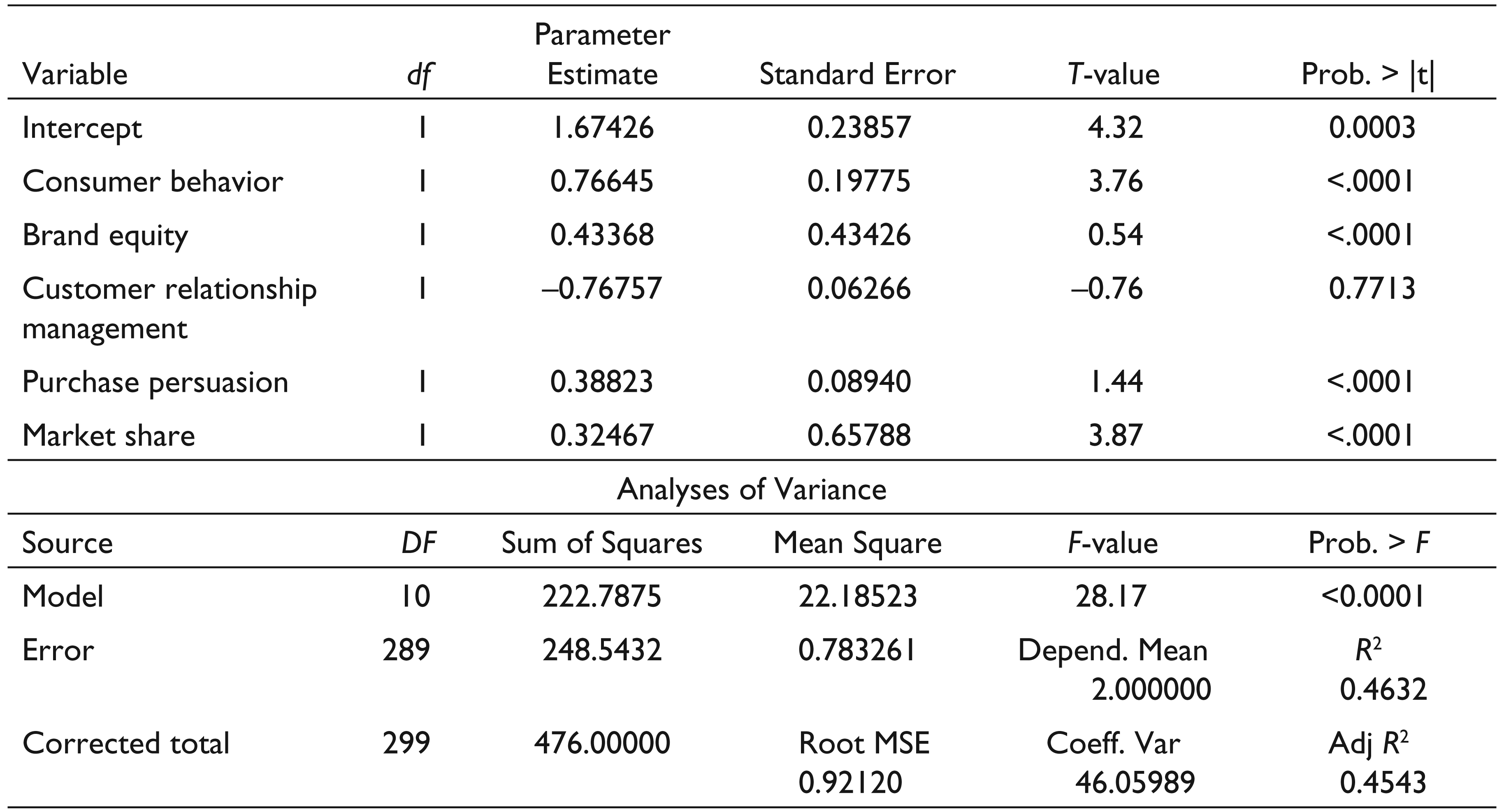
The hypothesized model for marketer decision (various elements of marketing) and SEO is presented in Table 4. The p-values calculated as presented in the table is <0.0001, F-value (28.17) and adjusted R2 (0.4543) as the calculated values are statistically acceptable, therefore the estimated coefficients are statistically significant.

Predicted (impact of SEO)
Model B
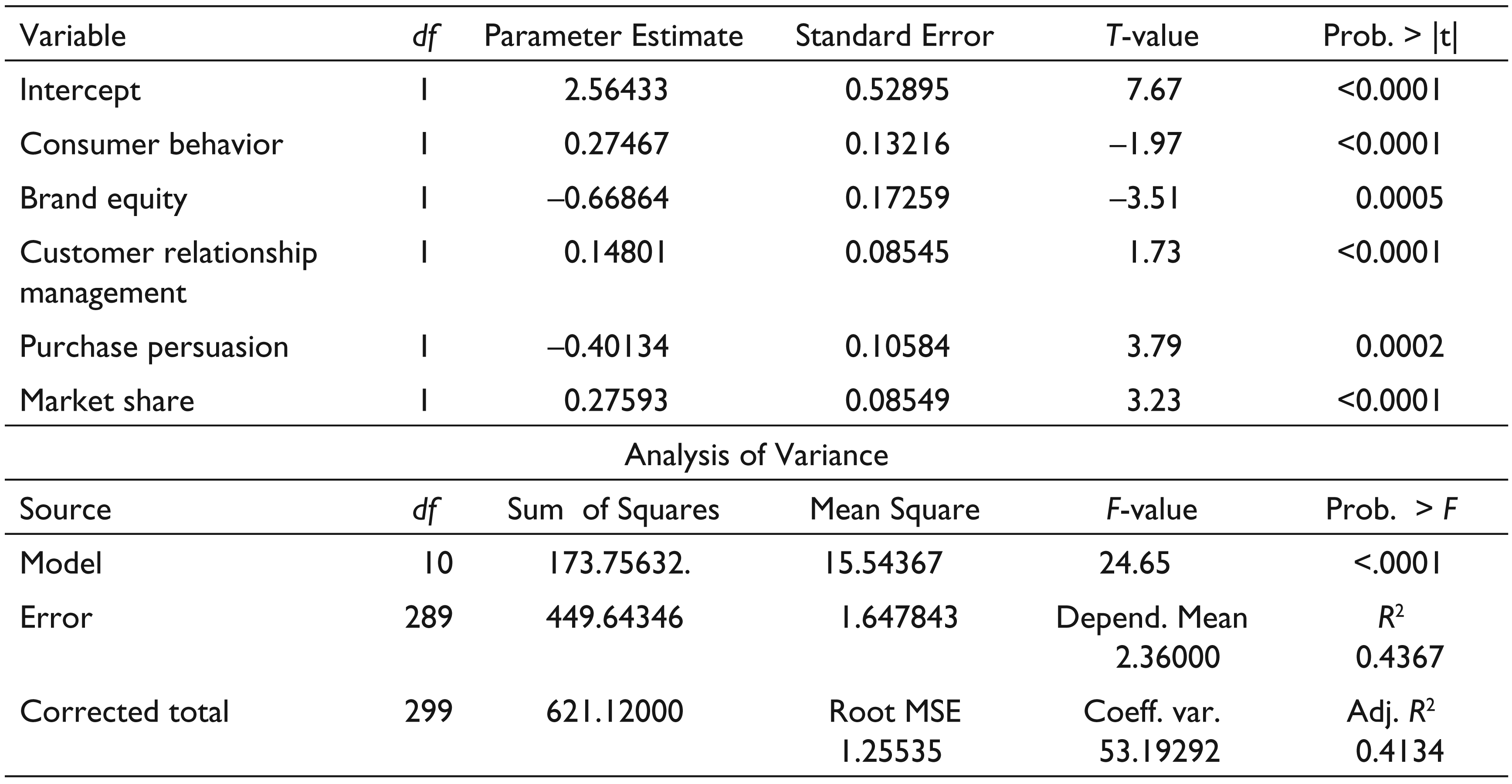
The hypothesized model for marketer decision (various elements of marketing) and SMM is presented in Table 2. The p-values calculated as presented in the table is less than 0.0001, F-value (24.65) and adjusted R2 (0.4134) as the calculated values are statistically acceptable, therefore the estimated coefficients are statistically significant.

Predicted (Impact of SEO) = 1.67426 + (0.76645 × Consumer behaviour) + (0.43368 × Brand equity) + (–0.76757 × Customer relationship management) + (0.38823 × Purchase persuasion) + (0.32467 × Market share)
Findings
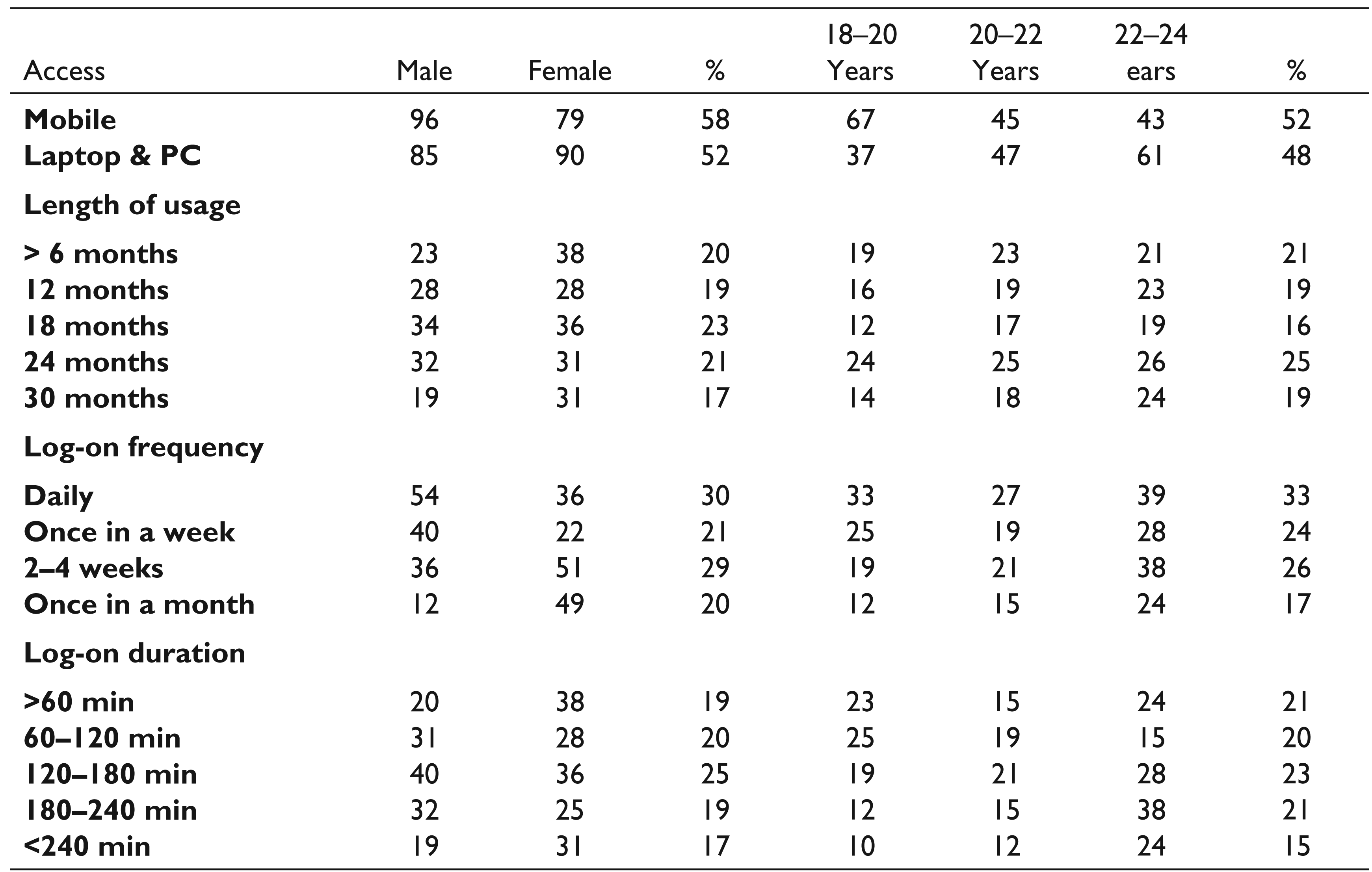
The first step in the analysis was to examine online usage pattern of the respondents with respect to the demographics of the users and results are shown in Tables 1 and 2. The user’s gender and age were significantly related to the decision-making behavior toward online marketing. The next part of the analysis examined univariate analysis of each of the identified variable found under the review of literature and it combines the homogeneous elements into factors using principal component matrix technique. Rotation method employed under factor analysis is varimax and the results for the same are shown in Table 3. Author conducted augmented multiple regression tests to check whether the relationship between the dependent and independent variables is evolving or stationary and the results are reported in Tables 4 and 5. Usually the multiple regression test results with Adjusted R square range from 0.40 to 0.60 and p < 0.0001, then the model is considered statistically significant. Thus, the null hypothesis of a unit root can be accepted with a 99 percent confidence level, suggesting that the series are evolving and have co-integrated in equilibrium. This led the author to estimate models with different levels of the endogenous variables. Having an SEO and SMM as marketing strategy was significantly related to attitude toward marketing as well as acceptance level of the users. Marketers that use analytical tools to understand consumer behavior have shown significant results, and if a company engaged in SEO marketing, then that users tended to have a more positive attitude toward brand equity. Model A suggests that SEO adds meaningful explanatory power for the firm value metrics, after accounting for the control variables. Model B shows the SMM of the endogenous variables. Table 5 visually depicts these dynamic impulse response functions for the firm SMM strategy. As shown in Table 5, the SMM strategy has a significant positive predictive relationship with firm returns for both the short term and long term (t-value = 3.23, p < 0.0001), and significantly increases long-term risk customer relationship management (t-value= 1.73, p < 0.0001). All of the evidence above supports that for marketer’s online buzz both SEO and SMM are effective for enhancing web traffic, and brand performance and hypothesis (H1A and H1B) stated that both SEO and SMM are useful predictors of the user’s online behavior.
Online Usage and Demographic Profile of Respondents (N = 300)
Univariate Statistics of Identified Variables

Factor Analysis Results for Marketing Elements (N = 300)

Results for Various Elements of Marketing and Search Engine Optimization (SEO)
Results for Various Elements of Marketing and Social media marketing (SMM)
Discussion
Online marketing has turned into a foundation of marketing culture and is utilized by all brands and organizations to some degree. Marketers are spending millions for resources for brands to enhance their respective online presence; the independent marketers are additionally aggravated by the postponed effect of online marketing and the test of estimating its impact. A critical determinant of marketing using SEO and SMM is that the marketer can get instant information about the behavior of the user and state of mind toward brand. Prudently, a marketer who has an inspirational strategy towards marketing would upgrade the marketing plan as per current behavior of the consumer This examination found that the marketer’s training for SEO and SMM was contrarily related with marketing decisions. The skilled marketers were positive in their attitude toward SEO and SMM. A larger amount of online marketers had a tendency to be more innovative. More research should be directed to confirm if this fact is acceptable for entrepreneurs. Perhaps the reason why the social media marketing has developed so quickly is because of its’ capacity to reach at a low cost, particularly contrasted with traditional marketing. The most remarkable finding of this research was that most of the start-ups which were reviewed had an official website as well as social media page. Future research should be directed to check whether this is the standard for large administration organizations.
As far SEO and SMM systems are concerned, the most mainstream elements were real time analysis of consumer behavior, for example, Google analytics and Facebook analytics. Despite the fact that these were the most prominent tools, under 25 percent of administration operations have any kind of online marketing programs and have used these tools. In view of the prominence of mobile devices, the Internet, and online networking, marketers are investing more energy in responsive websites than with customary navigation structure. Organizations that neglect to utilize these systems may lose an expansive level of their clientage base. This examination does not demonstrate circumstances and end results; rather it shows the rationality of a relationship. The examinations analyzed marketer decision-making behavior in light of the benefit that business has with an organization site, web-based business, blog, web-based social networking, and email showcasing. It can be talked about which drives which or if there is really a co-relationship. In this manner, it is the utilization of SEO and SMM promoting procedures that drive an uplifting disposition toward marketing, and leads to an inspirational state of mind toward publicizing that drives the utilization of SEO and SMM promoting procedures. Of the five that were inspected, the market share and the utilization of social media networking have shown a positive association with the behavior toward promoting. The more grounded the demeanor the benefit entrepreneur had toward marketing, the more noteworthy the level of fulfillment with the blog and online networking promoting methodologies.
The examinations analysed marketer decision-making behaviour and discovered business with an organization website, web-based presence, blog, web-based social networking page, and email have better image in the market. It can be debated which drives more traffic to the marketer. In this manner, it is the utilization of SEO and SMM promoting procedures that drive an uplifting disposition toward marketing, and leads to an inspirational state of mind toward publicizing that drives the utilization of SEO and SMM promoting procedures. Out the identified elements, the market shares based on the utilization of social media networking have shown a positive association with the behaviour toward promoting. The more technological behaviour the benefit entrepreneur had toward marketing, the higher relevance of content with the blog and online networking promoting methodologies also benefit marketer.
Footnotes
Declaration of Conflicting Interests
The authors declared no potential conflicts of interest with respect to the research, authorship, and/or publication of this article.
Funding
The authors received no financial support for the research, authorship, and/or publication of this article.