




Abstract
The world economy has been facing a huge turmoil in the last few financial years. With constant efforts some improvement was observed in the last financial year as the world economic situation strengthened itself with a lingering effect to subside the effects of slump and registering world gross domestic product of 3.2 percent, the highest since 2011. The impact of world economic growth can be clearly seen on the GDP of India. The IMF sees India as the largest growing economy with a GDP of 7.4 percent even outshining the growth of China’s GDP at 6.8 percent. This growth has presented a challenge for the HR managers to focus more on strategic policy formulation and utilize the growth in the right direction. The line managers’ implement HR functions and in doing so they also influence their team and generate response from them. On the basis of extensive review a conceptual model has been proposed to understand the impact of interpersonal trust as a mediating variable on reallocation of HR functions and HR effectiveness. On evaluating the hypotheses values of CFI = 0.909, NFI = 0.745, GFI = 0.762, CMIN/DF = 1.396, RMSEA = 0.060, and PCLOSE = 0.066, which indicate a good model fit, the model shows the impact of the mediating variable, that is, interpersonal trust on reallocation of HR functions and HR effectiveness.
Introduction
The world economy has been facing a huge turmoil in the last few financial years. With constant efforts some improvement was observed in the last financial year as the world economic situation strengthened itself with a lingering effect to subside the effects of slump and registering world gross domestic product of 3.2 percent, the highest since 2011. The impact of world economic growth can be clearly seen on the GDP of India. Even the IMF sees India as the largest growing economy with a GDP of 7.4 percent even outshining the growth of China’s GDP at 6.8 percent. This growth has presented a challenge for the HR managers to focus more on strategic policy formulation and utilize the growth in the right direction (Bos-Nehles & Bondarouk, 2017). Today the organizations are dependent on their human capital to gain an upper edge over its competitors. Every organization depends on their manpower, core competencies, and their organizational capabilities to face their new business challenges (Ulrich & Brockbank, 2005). The line managers’ implement HR functions and in doing so they also influence their team and generate response from them (Rimi, Yusliza, Walters, & Basher Rubel, 2017; Townsend, Wilkinson, Allan, & Bamber, 2012; Valverde et al., 2001) but reallocation of HR functions becomes a very tricky matter if there is lack of interpersonal trust between line managers and employees (Agrawal, 2010; Feierabend & Sender, 2017; Intindola, Weisinger, Benson, & Pittz, 2017; Küper, 2015).
In this ever-changing scenario the biggest partner of any organization is expected to be the HR services but in maximum organizations HR functions are being performed by line managers or middle managers. HR is transforming itself, different people are being involved and their major effort is to manage their units effectively (Lawler & Mohrman, 2003). Line managers are more local to the issues arising and the major reason to be the first choice of the management to handle the issues in an effective manner (Bond & Wise, 2003; Budhwar, 2000; Crawshaw & Game, 2015; Whittaker & Marchington, 2003). However the situations are not similarly observed by line managers, they would be forced to perform these decisions and may not be equally comfortable and they would like to concentrate more on their business tasks (Cunningham & Hyman 1999; Hassan, Manso, Rahman, & Kelana, 2015; Hope-Hailey, Gratton, McGovern, Stiles, & Truss, 1997; Whittaker & Marchington, 2003) but here the matter of concern is that the HR tasks would be neglected or the line managers can be less attentive to HR issues which is not the situation with HR specialists (Bond & Wise, 2003; Kulik & Perry, 2008). Another major threat that is posed here is the erosion of expert knowledge. The line managers are not experts for handling HR issues but because of relentless cost pressures the middle managers or line managers are asked to perform the tasks of personnel function (Feierabend & Sender, 2017; Intindola et al., 2017; Küper, 2015; Renwick, 2003).
Literature Review
Reallocation of HR Functions
Reallocation of HR functions is a notion of personnel tasks being transferred to middle managers (Guest, 1987; Legge, 1995). Responsibilities such as the appraisal of a team’s performance and the decisions taken as a consequence of that appraisal are done by middle managers and not by HR managers. In 2001, Valverde indicated that middle managers have a higher participation in operational level HR decisions or daily people management (such as carrying out performance appraisals or identifying training needs) or the service delivery functions (such as acting directly as trainers or interviewing candidates in a selection process) (Azmi & Mushtaq, 2015; Kuvaas, Dysvik, & Buch, 2014; Tufail, Muneer, & Ishtiaq, 2016; Valverde et al., 2001).
Today many organizations have adopted the strategy of reallocation, that is, imparting the line managers the power and authority to implement strategies formulated by the HR managers in collaboration with the top management (Perry & Kulik, 2008; Rimi et al., 2017) which has a positive impact on the performance of an organization (Azmi & Mushtaq, 2015). Effective localized HR decisions by the line managers are positive indicators of effective devolution (Gilbert, De Winne, & Sels, 2011). In the last few decades HRM has evolved as a function which supports other functions of the business (Papalexandris & Panayotopoulou, 2005). Today, everyone including line managers observe HR as a function that can help in gaining a competitive advantage. In 1996 Stewart suggested “To circumvent bureaucratic impediments, HRM could more usefully be reallocated to line managers or contracted to outside suppliers.” In order to deal with high labor turnover and increasing mobility across organization there is a need to reallocate the HR responsibility or outsource the HR role to external agencies which can act as a match maker between the two (Parker & Inkson, 1999). Thus it focuses on the new role of line and HR managers (Gottardello & Valverde, 2018; Hassan et al., 2015; Mutlu, 2014). Further, the ways to strengthen the relation between HR and line managers have also been elaborated (Bos-Nehles & Bondarouk, 2017; Papalexandris & Panayotopoulou, 2005; Rimi et al., 2017; Ruel & Gbur, 2017).
Reallocation of HR Functions and Interpersonal Trust
It is evident from the review that the focus of HR managers have shifted from the basic HR functions to more on strategy formulation and execution, but it will not give its best results until there is a relation of trust and cooperation between the line and HR managers (Agrawal, 2010). The confidence and trust between the line and HR manager forms the basis of cordial and sustainable relationship (Jones & George, 1998), but forming the same has been difficult as the line managers have a tendency “do not trust HR”. The major underlying reason behind lack of trust and low commitment (Stanton, Young, Bartram, & Leggat, 2010) is due to minimal of interaction between the two (Agrawal, 2010). In reallocation of HRM functions “Trust” plays a huge role in fair execution of HR policies; how the employees adjudge the fairness in the role played by the line managers, do the employees feel the air of honesty, integrity, and freedom to discuss their issues without any obstacle of unfairness and distrust between themselves and line managers (Dietz & Den Hartog, 2006; Searle & Skinner, 2011; Skinner, Saunders, & Duckett, 2004). If the situation of distrust arises, its impact is often considered as irreparable (Kim, Ferrin, Cooper, & Dirks, 2004; Mishra & Morrissey, 1990).
Trust is the most essential factor for reallocation of HR functions (Harrington, Rayner, & Warren, 2012). It becomes a very tricky matter if there is lack of interpersonal trust between the appraiser and appraise (Agrawal, 2010) or trainer and management (Garavan, 1993; Grace & Straub, 1991; Storey, 1992), or personnel handling disciplinary issues like workplace bullying (Harrington et al., 2012). The employee should completely trust that the line manager or the HR manager will handle the aforesaid factors fairly and efficiently in the interests of the employees (Six & Skinner, 2010). There will be a situation of distrust if the employee perceives lack of confidence in the personnel handling the issues and distrust is often considered to be more dangerous than trust (Cain et al., 2015; Evans & Krueger, 2017; Kim et al., 2004; Lewicki, Tomlinson, & Gillespie, 2006; Mishra & Morrissey, 1990; Zarolia, Weisbuch, & McRae, 2017). The relationship between reallocation of HR functions and trust has been established in several studies (Agrawal, 2010; Harrington et al., 2012; Jones & George, 1998; Kim, Su, & Wright, 2018; Lawless & Trif, 2016; Mitchell, Obeidat, & Bray, 2013; Op de Beeck, Wynen, & Hondeghem, 2016; Sanders & Frenkel, 2011; Stanton et al., 2010).
Attaining HR Effectiveness by Reallocation of HR Functions Through Interpersonal Trust
In current scenario, the efforts of HR managers are more concentrated towards their strategic role, but it will not bear fruitful results unless the relation between line managers is cordial, trusting, and cooperative. The mutual trust and respect between the HR and line managers result in HR effectiveness and commitment (Agrawal, 2010; Baek & Jung, 2015; Bakiev, 2013; Casimir, Lee, & Loon, 2012; Ferro, Padin, Svensson, & Payan, 2016; Ouedraogo & Ouakouak, 2018; Ponder, Bugg Holloway, & Hansen, 2016; Sholihin, Pike, Mangena, & Li, 2011; Vanhala, Heilmann, & Salminen, 2016; Yukl, 2008; Yukl, Gordon, & Taber, 2002). Reallocation of HR functions to line managers empowers the individual with responsibility and decision-making power to solve issues and problems without seeking and waiting for approvals from higher levels (Casimir et al., 2012; Fatima & Di Mascio, 2018; Ponder et al., 2016; Yukl et al., 2002). The major focus of the HR department is on the strategic issues and in this process they have no contact with the employees and are no longer in a position to understand and represent the employees in front of the top management (Francis & Keegan, 2006; Harris, Doughty, & Kirk, 2007; Hope-Hailey et al., 1997). Reallocation of HR functions to the line inspires trust and confidence in employees for their line managers as they are the one who listens to their issues, trains them, appraises them, promotes them, and the list goes on. This trust forms the basis for building commitment of the employees and in longer run helps in attaining effectiveness of the HR department (Bakiev, 2013; Casimir et al., 2012; Ferro et al., 2016; Gilbert et al., 2011; Ouedraogo & Ouakouak, 2018; Ponder et al., 2016; Vanhala et al., 2016). Since the line managers are walking in the shoes of a strong leader which in turn has an impact on the commitment of the employees but this also enhances the role of HR managers to motivate and support the line managers for performing the HR functions more effectively.
Conceptual Framework and Hypotheses
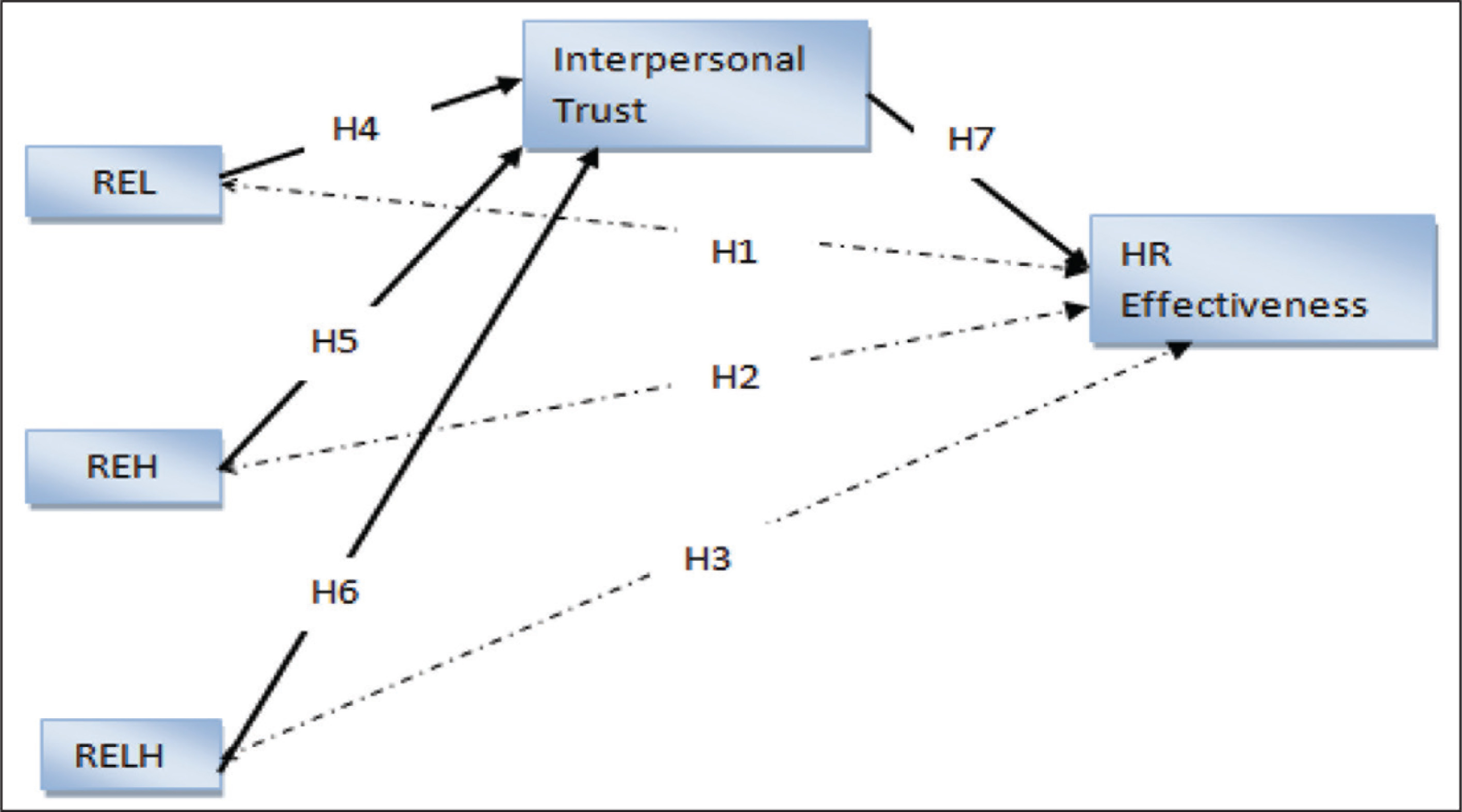
On the basis of extensive review a conceptual model has been proposed to understand the impact of interpersonal trust as a mediating variable on reallocation of HR functions and HR effectiveness. The relation has been tested using structural equation modeling (SEM) as shown in Figure 1.
Research Methodology
Based on an extensive literature review, a theoretical model has been proposed for investigation and tested on a sample of 110 employees collected from different branches of Jana Bank in Haryana and Punjab Region. The selected bank was one of the 13 banks that have been licensed recently. The new banks’ are incorporating structural changes and was considered as an appropriate sample frame. In the first phase of the study direct relation between reallocation of HR functions and HR effectiveness has been analysed. Reallocation of HR functions was further studied in three aspects: (a) HR functions only by line managers (REL); (b) HR functions only by HR managers (REH); and (c) HR functions by both HR and line managers (REHL). The model linked ROL, ROH, & REHL and its impact on HR effectiveness (HEF). In the second phase the mediating role of interpersonal trust (IT) on reallocation of HR functions and HR effectiveness (HEF) has been analysed. The model linked ROL, ROH, & REHL, interpersonal trust (IT), and HR effectiveness (HEF). The model was tested administrating a reliable and valid instrument for devolution (Sujan, Bhasin, & Mushtaq, 2017). Interpersonal trust and HR effectiveness were analysed using the scale defined in Cook and Wall (1980) and Teo and Crawford (2005), respectively. The questionnaire was distributed among 200 employees, of which 110 valid responses were collected constituting a response rate of 55 percent.
For the first phase of the study where direct relation between reallocation of HR functions and HR effectiveness was analysed, the following sub-hypotheses were formulated:
Discussion
The aforementioned model in Figure 2 indicates the impact of reallocation of HR functions that has on HR effectiveness. In the current situation, the HR functions are been performed by the line managers and the role of HR managers is to focus more on strategy formulation. This study is an attempt to understand to what extent the HR functions are performed solely by line managers alone and functions performed solely by HR managers or HR functions performed in coordination by both the line and HR managers. This study also analyses the impact of the aforesaid reallocation of HR functions on HR effectiveness. The proposed model indicating the aforementioned relationship was tested using SEM (Garver & Mentzer, 1999; Medsker, Williams, & Holahan, 1994). When the model was ascertained using AMOS18, the values of CFI = 0.938, NFI = 0.811, GFI = 0.818, CMIN/DF = 1.384, RMSEA = 0.06, and PCLOSE = 0.163 indicate a good model fit. It was further analysed that there existed a positive relation between reallocation of HR functions to only line managers and HR effectiveness, that is, REL-HEF is 0.020 and there also existed a positive relation between reallocation of HR functions to both line and HR managers and HR effectiveness, that is, REHL-HEF is 0.072, but the impact of reallocation to only HR managers had a negative impact on HR effectiveness, that is, REH-HEF is −0.075. This further indicates that HR functions should be devolved at this level and a proper counseling is essential for the same. The results indicate that reallocation of HR functions to both line and HR managers have an increasing impact than to only line managers. It further indicates that employees feel more committed if HR functions are performed by line and HR managers both in coordination with each other. It also enhances the overall effectiveness of the entire HR processes. Thus accepting the hypothesis that involvement of only line manager and line and HR managers both performing the HR functions have a positive impact on HR effectiveness (H1 and H3 are not rejected) and rejecting the hypothesis involvement of only HR managers in performing HR functions has a positive impact on HR effectiveness (H2 is rejected).

For the second phase of the study, that is, to study the mediating effect of interpersonal trust on reallocation of HR functions and HR effectiveness, the following sub-hypotheses were formulated:
The model in Figure 3 indicates relationship between reallocation of HR functions and interpersonal trust. It was analysed that there existed a positive relation between reallocation of HR functions to only line managers and interpersonal trust, that is, REL-IT = 0.061. A positive relation was observed between reallocation of HR functions to only HR managers and interpersonal trust, that is, REH-IT = 0.040 and a positive relation was seen between reallocation of HR functions to both line and HR managers and interpersonal trust, that is, REHL-IT = 0.102. It was also witnessed that there existed a positive relation between reallocation of HR functions to only line managers and HR effectiveness, that is, REL-HEF is 0.018. A positive relation has been determined between reallocation of HR functions to both line and HR managers and HR effectiveness, that is, REHL-HEF is 0.069 but the impact of reallocation to only HR managers had a negative impact on HR effectiveness, that is, REH-HEF is −0.077. A positive relation has been observed between interpersonal trust and HR effectiveness, that is, IT-HEF = 0.058. The values of CFI = 0.909, NFI = 0.745, GFI = 0.762, CMIN/DF = 1.396, RMSEA = 0.060, and PCLOSE = 0.066 which indicate a good model fit. Thus accepting the hypotheses that involvement of only line managers in performing HR functions has a positive impact on HR effectiveness; Involvement of both line & HR managers in performing HR functions has a positive impact on HR effectiveness; Involvement of only line managers in performing HR functions has a positive impact on interpersonal trust; Involvement of only HR managers in performing HR functions has a positive impact on interpersonal trust; Involvement of both line & HR managers in performing HR functions has a positive impact on Interpersonal Trust; Interpersonal trust has a positive impact on HR effectiveness and interpersonal trust has a mediating effect on reallocation of HR functions and HR effectiveness (i.e. H1, H3, H4, H5, H6, and H7) and rejecting the hypothesis that involvement of only HR managers in performing HR functions has a positive impact on HR effectiveness (H2).

Conclusion
In this article, the changing role of line managers and the HR managers in the banking industry has been investigated with interpersonal trust as a mediating variable. Reallocation of HR functions has brought an immense change in the tasks performed by the line managers. The line managers not only perform their routine job requirements but are also involved in HR functions like recruitment, selection training, and performance appraisal. The line managers are considered to be the first choice to perform these tasks as they are the local managers and they can handle the issues more effectively. The findings of the article reveal that reallocation of HR functions has levied a great impact on the trust among the line managers and the employees. In order to create a service quality environment for the customers of the bank the line managers encourage and motivate the employees of the bank, which in turn strengthens the relation between the line managers and the staff. The trust between the line managers and employees has paved way for the HR managers to focus on a more prominent role of strategy making and formulation (Bos-Nehles & Bondarouk, 2017; Butkute-Van de Voort, 2010; Crawshaw & Game, 2015; Hassan et al., 2015; Intindola et al., 2017), which in turn impacts the HR effectiveness (Agrawal, 2010; Yukl, 2008; Yukl et al., 2002). The findings of the study indicate a positive impact of reallocation of HR functions to only line managers (REL) and reallocation to both line and HR managers (REHL) on HR effectiveness (HEF) as indicated by various authors (Azmi & Mushtaq, 2015; Francis & Keegan, 2006; Harris, 2007; Hope-Hailey et al., 1997). REL, REH and REHL had a positive impact on interpersonal trust which collides with previous studies (Agrawal, 2010; Harrington et al., 2012; Jones & George, 1998; Stanton et al., 2010). REL and REHL had a positive impact on HR effectiveness with interpersonal trust as a mediating variable, but when the reallocation of HR functions is allocated to only HR managers it shows a negative impact on HR effectiveness. Various authors have indicated that HR mangers’ main focus is into strategic decision making and the line managers are considered as the local managers to perform the HR functions. In fact line managers are considered to be the first choice by the employees to handle their issues, appraise their performance as they are in constant touch with the line managers and for the line managers it is easy to motivate employees, excise control as they have more access to the root cause of any issue (Brewster & Larsen, 1992; Brewster & Soderstorm, 1994; Brown & Purcell, 2007; Budhwar & Sparrow, 1997; Dietz & Den Hartog, 2006; Feierabend & Sender, 2017; Küper, 2015; Ruel & Gbur, 2017; Schuler, 1992; Storey & Sisson, 1994). As indicated by the results that HR effectiveness is higher when the HR functions are performed by the line and HR managers both, but this requires a lot of trust and coordination between the two parties. It has been evidenced in literature that both the parties have different approach but their ultimate goal is the same. A lot of activities can also help in enhancing the interpersonal trust between the line, HR managers, and the employees for, for example, coaching and counseling activities, planning and goal setting activities, process consultation activities, etc. The coordinated efforts of the two parties can help the organization to reveal better results and achieve their targets with more efficiency and effectiveness.
Future Research Implications
The findings of the study would provide new theoretical insights to private and public banks on factors like how to improve communication between line managers and employees post reallocation of HR functions. The findings also explain how organizations can work on building team’s synergy that could help organizations to make a smooth working environment.
Limitations
The study revolves around banks from Haryana and Punjab; therefore, future research may involve more private and public banks. Research has increasingly become cost intensive, which has put constraints on the use of primary sources of data.
Footnotes
Declaration of Conflicting Interests
The authors declared no potential conflicts of interest with respect to the research, authorship, and/or publication of this article.
Funding
The authors received no financial support for the research, authorship, and/or publication of this article.