



Abstract
The dynamics involving market competition and the challenges of dealing with empowered customers, mean that creating and delivering relevant customer experience (CX) of service, is as important as creating product or services. Several studies have treated customer experience as though a front-desk, sales-point affair with the customer in the retailing environment, negating the critical role of organization-wide efforts in the overall customer experience management sequence. This review, however, adopts customer-centricity, as a theoretical lens to underscore the [re]configuration of organizational-level factors that are critical to adopting a high customer-experience centered organization. Based on the review, we highlight conditions for adopting high customer experience management organization: (a) developing an integrated CX strategy, (b) CX-based knowledge management, (c) organizational re-design that supports CX-management, (d) top management commitment, (e) integrated CX IT systems, and (f) CX-oriented HR policies. These practices are only necessary conditions, but not sufficient, for creating, delivering relevant and sustainable customer experience. However, more robust empirical studies are needed to advance the application of organization-wide customer experience management, which vary across industry, products/services, and sector.
Keywords
Introduction
The customer experience (henceforth, CX) as an emerging concept in Marketing, is gaining popularity in research (e.g., Grewal et al., 2009; Meyer & Schwager, 2007; Schmitt, 2009; Schmitt & Rogers, 2008) and in practice, particularly in the retails sector. Recently, Katherine and Verhoef considered it as one of the fastest growing streams of consumer research, because of the high potentials in service excellence and customer relationship. For instance, Schmitt and Rogers (2008), describe customer experience as an all-inclusive embodiment of a customer, how he/she behaves, thinks, feels, acts, socializes, and senses. Such experiences are personal and subjective, involving the customer at several levels of rational, emotional, sensory, physical, and spiritual levels (Verhoef et al., 2009) which are thus invoked through several phases of interaction between the customer and the brand/services (Lemon & Verhoef, 2016; Verhoef et al., 2009) along the whole purchase journey (including direct contact with the company, its representative), marketing activities (such as advertising, packaging, ease of use, reliability) (Grundey, 2008; Meyer & Schwager, 2007), product functionality (utilitarian and hedonic values) (Gentile et al., 2007), and the environment in which the experience takes place (Berry et al., 2002) such as the retailing environment (include services encounters, retail atmosphere, time, and social influence (Lemon & Verhoef, 2016).
Although several studies reviewed CX based on customer-firm dyads, relating to consumer brand experience, few researchers argue that CX extends far beyond the customer-firm context, which is critical to customer overall experience (e.g., Lemon & Verhoef, 2016; Pine & Gilmore, 1998). For instance, designing a customer-experience management centered organization is fundamental to the overall management of customer experience (Meyer & Schwager, 2007). Aligning an organization toward a more customer-centricity is because of the important role of customer satisfaction in organizational performance (Homburg et al., 2000) and firm’s long-term sustainability (Schmitt & Rogers, 2008). This means firms must invest in customer value-seeking behavior, through effective organizational design, to enhance long-term satisfaction and loyalty.
In fact, some firms do not understand the reasons for CX, and often, resistant to change. However, other corporations are looking to operate divisions to oversee and manage CX. For the former, such resistance could be due to the complexity in the unpredictable nature of customer experience and organizational level alignment of CX (Meyer & Schwager, 2007). Recently, Mosley (2007) suggests that understanding CX requires a shifting emphasis from the transactional CRM to a more relational, holistic focus toward customer total experience. Moreover, we are beginning to see companies adopting managerial roles for managing customer experiences, especially in the information and technology services sectors. This new portfolio of customer experience management could allow for easy coordination of inter-functional authority to deliver a superior customer experience (Palmer, 2010). CX as organizational level function could enable customers to enjoy the value they seek, to satisfy their needs and expectations, and thus generate a win-win for both customers and the firms (Grewal et al., 2009).
Thus, a comprehensive CX strategy for managing the holistic CX along all the relevant “consumer corridor” is dependent upon the type and form of organization design (Berry et al., 2002; Homburg et al., 2000). Every part of a customer journey is a moment of evaluative reasoning that makeup consumer experience and subsequently consumer behavior (Gilmore & Pine, 2002). For firms to understand which cues create relevant CX, they should understand what CX really is. Successful brands shape customer’s experiences by delivering on the core value propositions (Meyer & Schwager, 2007). For that reason, understanding CX should be atop every manager’s priority because time has come when keeping customers is even more important than making sales.
Moreover, studies show that every contact between the customer and the brand, firm or personnel of the firm exhibits series of thought-process resulting to customer impression—both good and bad (Berry et al., 2002; Palmer, 2010). For an overall CX management process, firms must commit resources and expertise on this potential competency—that is, knowledge of customer experience (Verhoef et al., 2009), and stakeholder participation in CX management process.
Leveraging relevant literature in services marketing, branding, and consumer theory, this study tries to discuss the conditions for building a high customer experience organization. Our goal is to address the challenges of adopting CX management by organizations as they look toward a more customer-centricity in today’s highly competitive and empowered customers. We hope that our results will advance CX research and highlight the core issues for CX adoption by mature and emerging firms. The motivation of this literature review is built on the premise that CX is not only a single encounter between the customer and the firm or the brand as it is popularly seen in a retail environment (e.g., Berry et al., 2002; Grewal et al., 2009; Gilmore & Pine, 2002; Meyer & Schwager, 2007), but one that requires an integrated and organizational re-design toward total CX management. Increasing CX studies in the retailing environment leaves CX as a function of sales/marketing, in addition to the growing debate, this review maintains that aligning CX with relevant organizational properties would constitute a more sustainable mean of managing CX. Further, it is of this contention that organizational level commitment to this new but integrated strategy will enhance a unified company-wide design, staging, delivering and communicating memorable and sustainable CX.
The rest of the article is organized first with the description of strategic CX. Second, we discussed the relevant studies on CX, branding and consumer theory, customer relationship management, and services marketing to identify some of the critical organizational level factors for the adoption of CX management organization. The third section entails the discussion and conclusion, highlighting the managerial implication and scientific contribution of the review.
Literature Review
Strategic Customer Experience Management
Katherine and Verhoef describe CX management process in terms of designing, measuring, and monitoring the total customer experience to promote firm’s brand equity in one hand and optimize customer experience on the other hand. Meyer and Schwager (2007) argue that in the heart of customer-centric management is the integration of CX data collection, and assessing within customer-focused IT support group for strategic decision making. CX management is a business strategy designed to manage the CX through coordination of internal business processes and external marketing and communication agencies (e.g., Berry et al., 2002; Grewal et al., 2009; Mosley, 2007; Verhoef et al., 2009).
Berry et al. (2002) posit that the first tool in CX management is “customer experience audit,” and the subsequent documentation of such body of knowledge for customer-experience centered decision support. Arnould and Price (1993) identify CX management according to four systematic stages of customer experience cycle: (a) pre-consumption experience involving searching for, planning, daydreaming about, foreseeing, and imaging the experience; (b) the purchase experience where choice, payment, packaging, and encounter with the services and environment, (c) the core consumption experience level is where sensation, the satiety, the satisfaction/dissatisfaction, the irritation/flow, and transformation; and (d) the remember consumption experience and the nostalgic experience—actions a picture to relive an experience. Similarly, Grewal et al. (2009) add five experience moments that are key to sustainable customer satisfaction and loyalty: (a) promotion experience, (b) pricing experience, (c) the merchandising and brand experience, (d) supply chain management experience, and (e) the location. However, the strategic implication for researchers is the ability to measure experience level at any given stage (Walden, 2017).
Integrated management of customer experience could enable firms to acquire distinct and unique competitive advantage (Berry et al., 2002), because customer-based knowledge allows firms to be more responsive to customer needs than competitors (Berry et al., 2002; Skaggs & Youndt, 2004). Good experience design allows for stronger ties customers—even in moments of services failure and dissatisfaction (Meyer & Schwager, 2007). Further, CX designs enable firms to optimize logistic and services ecosystem. Organizational re-design in terms of changes in a firm’s priorities, processes, and structure is an important starting point to new strategy adoption (Mosley, 2007; Vantrappen & Wirtz, 2018).
New customer strategy could not be successful unless it recognizes employees’ experiences (Meyer & Schwager, 2007). Like all new strategy, CX strategy adoption requires enormous risk and technical research techniques (Palmer, 2010). Technological advances enable newer and better ways to collect, store, and analyses customer-centric information (Shah et al., 2006). One key challenge of CX management is the difficulty involved in its measurement of the multidimensional nature of experience, (Verhoef et al., 2009) and resistance to change among top management executives (Meyer & Schwager, 2007). Because the global market environments create a higher level of uncertainty, firms are required to adapt to structural change in culture toward a more customer-centric approach (Shah et al., 2006). Where managers have an increasing desire to create value, CX could generate increased firm performance and competitiveness (Berry et al., 2002) and through customer involvement in the innovation process (Trejo et al., 2016). Grewal et al. (2009) argue that a topmost important job for today’s managers and CEOs should be about understanding and enhancing strong CX. Further, management commitment shapes the culture of the organization by ensuring every people-management touchpoint is first aligned with the relevant brand ethos of the organization (Mosley, 2007). This allows firms to change their organizational structure to accommodate a more responsive employee’s attitude toward customer needs (Homburg et al., 2000; Mosley, 2007).
CX management differs from CRM in that it involves not only the study of all relevant customer-brand touchpoints but also the strategic creation of experience providers—as a nudge to create relevant experiences along key customer experience journey. Most CRM programs failed due to lack of inter-functional coordinating authority (Palmer, 2010). CX differs from CRM because the former tends to focus more customer relationship and satisfaction rather than current and recorded history of customer experience (Verhoef et al., 2009). In addition to the CRM program, CX management could enable firms to leverage this customer-based knowledge as an intellectual integrator of service quality and customer relationship (Palmer, 2010). Based on these studies and other services marketing, branding and CRM literature, we argue that adopting a CX management requires holistic management, driven by an organizational structure that supports the design, and implementation of relevant customer experiences, as illustrated in Figure 1.
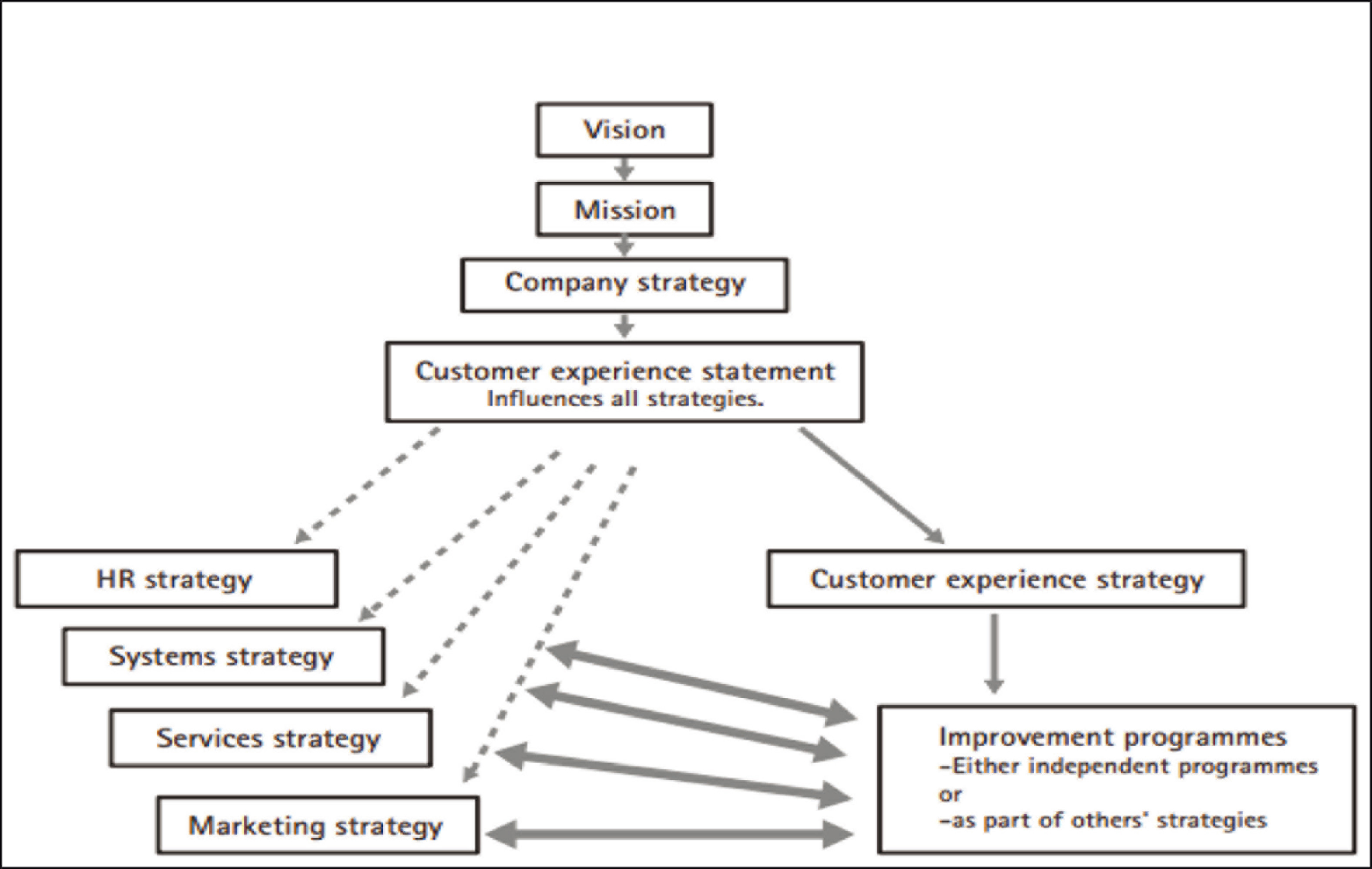
Organizational Level Readiness for the Adoption of CX Management
Integrated Customer Experience Strategy
A customer experience strategy represents a firm’s pursuit toward a more market-driven, customer experience approach. This effort is more than providing creative products or services. Relevant studies show that today’s customers are looking for distinct and memorable experiences in their interactions with the brand, product or services that complement their satisfaction and loyalty (Gilmore & Pine, 2002). Designing a memorable experience lies in the firm’s effort toward its overall business and customer strategy (Smith & Wheeler, 2002). The new customer-base strategy involves the re-configuration of organization in terms of structure, systems, processes, culture, and activities from top management to the lower-level requiring unified effort to CX strategy (Galbraith, 2005). Also, this strategy re-design involves altering organizational structure into the corporate vision to take advantage of new market opportunities (Vantrappen & Wirtz, 2018). Because the business environment is always changing, thus the organizational adjustment is necessary to enhance performance.
Therefore compatibility management is key in terms of the firm and its employees’ readiness considerations for the adoption of a customer-driven strategy (Verhoef et al., 2009), stakeholder management and company-wide coordination are fundamental (Gummesson, 2008). In the heart of a customer experience-driven strategy, the firm organizational alignment to the customer-driven strategy, cross-functional coordination and up-front leadership commitment and stewardship (Smith & Wheeler, 2002). Similarly, customer-driven strategy cannot be realized unless the firm has strong leadership commitment, and ensures all functional units to contribute to customer total experiences (Galbraith, 2005; Smith & Wheeler, 2002). Customer strategy is cooperation of relevant functional areas rather than in silos. Moreover, corporate vision and mission must be aligned with the internal culture (Schmitt & Rogers, 2008). Smith and Wheeler (2002) note that CX strategy requires drafting a CX blueprint that in corporate leadership roles, experience design, and experience management process. Payne and Frow (2006) posit that aligning business and customer experience strategy should be a key priority.
At the heart of CX design are a regular collection of market data on customers, sales, marketing effectiveness and firms responsiveness to market trends (Osarenkhoe & Bennani, 2007).
Since CX business strategy is different from product or services business strategy, specific skills are required to design, to stage, and deliver experience (Gilmore & Pine, 2002). CX strategy requires an outward-in approach toward a more customer-focus, market-driven, global in scope and flexibility in a firm’s ability to deliver superior value (Osarenkhoe & Bennani, 2007). Therefore, firms must provide sustainable customer by listening to customers and responding to them (Millard, 2006). Two-way communication, consistency, and feedback (Grewal et al., 2009) make a big difference in any customer-centric management. In designing a customer experience-driven strategy, Smith and Wheeler (2002) suggest the integration of customers in the entire operations of the firm such that:
People are recruited who have an attitude consistent with the brand; Human resources, operations (R&D, customer service, requisition), and marketing work together and share best practice; Management style reflects the behaviors that would be expected of staff dealing with customers.
In sum, sustainable CX strategy is more customer driven and require more inter-functional coordination and designing relevant and memorable experiences throughout the experience journey. This will ensure that all relevant stakeholders enhance customer total experiences. The first point of CX strategy lies in the corporate vision, its leadership commitment to steer the team toward a more customer-centric approach to doing business. The organizational re-configuration and design are a necessary condition of the form’s readiness to adopting an integrated customer experience strategy. CX design strategy relies on customer information across all relevant experience point of moments. Although the measurement of customer experience remains highly scared in the extant literature, an integrated CX strategy would provide relevant guides to experience management, control and implementation.
Customer Experience Management and Organizational Re-design
Organizational structure determines internal relationship, processes, and systems which are important drivers of strategy (Shaw & Ivens, 2000). Aligning CX with organization structure is one that requires [re]configuration of the organization toward a more customer-centricity (Chen & Popovich, 2003; Teixeira et al., 2012). A customer-centricity allows firms to be more adapted to customers, and thus internal conversions revolving around what customers need rather than what the organization wants, an outside-in approach (Shaw & Ivens, 2000). This approach enables firms to design products and services as a result of changes in organizational structures, systems, and processes to deliver great customer value (Mascarenhas et al., 2006). These systems and processes enable firms to engage deeply with their customers and consequently design products to install memorable experiences (Pine & Gilmore, 1998). Changing organizational structure that accommodates customer experience moments, will allow for easier management of interaction along relevant customer experience journey. Kumar et al. (2006) claimed that questions regarding the ownership of the customers in an organization, reside in the organizational structure, systems and processes. Palmer (2010) noted that organizational processes and systems enable the managerial usefulness of customer-driven data for planning and control purposes.
In fact, Shah et al. (2006) argue that key challenges confronting organizations to a more customer-centric, includes, organizational culture, structure, process, and financial metrics. To address these challenges, researchers suggest that firms must adopt strong leadership commitment, organizational re-alignment, systems, and process supports (Chen & Popovich, 2003; Shah et al., 2006) and revised financial metrics as rewards for employees’ customer-centric behavior (Homburg et al., 2000). Such practices of structural alignment, allow firms to be more culturally responsive to their customers (Homburg et al., 2000). Successful firms leverage the role of organizational culture to promote on-brand customer service behavior and re-shaping the culture to align corporate brand ethos with employees (Mosley, 2007).
Firms that optimized customer-centricity enjoys long run customer loyalty and profitability (Chen & Popovich, 2003). A great customer relationship with firms is a source of competitive advantage (Walden, 2017). The organizations that are customer-centric in approach are known to deliver strong customer value than less customer-oriented firms (Homburg et al., 2000). The transition toward customer-centricity provides firms with an opportunity to create relevant customer-brand experiences (Walden, 2017). Customer-centric structure intentionally use services as the “stage” and products or services as “props” to engage customers in a way that creates memorable events (Pine & Gilmore, 1998). Mascarenhas et al. (2006) note that integrating total CX and long-term customer loyalty require an integrated business strategy that revolves within the organizational structure. Such integration facilitates alignment of customers into various stages of service design (Teixeira et al., 2012) and the innovation process (Trejo et al., 2016). Finally, based on these streams of literature, it can be concluded that necessary changes in organizational design in terms of its processes, systems, and culture are crucial for the integration of CX management within an organization.
Customer Experience Management and Leadership Commitment
The goal of any organization rests on its leadership to be realized. From a common saying, management must give in their blessings to the full realization of any organizational goals, still holds. CX management project is no exception. Management commitment is just more than a CEO giving his blessing to any customer-driven initiative (Chen & Popovich, 2003). The fact is CX can be sustainable when the process involves relevant stakeholders like management, employees, and external agents. Top management commitment is a key starting point to bring the required leadership support (Chen & Popovich, 2003; Schmitt & Rogers, 2008) and innovation to service design and delivery (Trejo et al., 2016).
It lies in top management to resolve disagreement and objections arising from functional areas during customer-driven projects (Chen & Popovich, 2003). Leaders create the right working environment to promote great superior value to customers. They take ownership of the customer-centricity and provide required skills set for employees (Palmer, 2010) and responsible for integrating CX with the rest of marketing activities and other functional departments (Gilmore & Pine, 2002). Top management must serve as the inter-functional coordinator of CX programs (Chen & Popovich, 2003; Palmer, 2010) to reduce conflict in programs, resources allocation, etc.
Although there are challenges in adopting a change in organizations, it is, however, the Management’s affair to effect necessary changes (Chen & Popovich, 2003), and design new strategy and culture that support CX practice (Shaw & Ivens, 2000). Chen and Popovich (2003) suggest that reforms relating to job evaluations, compensation programs, and reward system must reflect positive employee-customer oriented behavior.
According to Gilmore and Pine (2002), the first level executive responsible for CX in the top management is the Chief Experience Officer (CXO) who should be responsible for developing, launching, and managing the rich portfolio of experiences to generate new sources of both revenue and profit. They argue that CXO position should not be assigned to a senior marketing executive officer, because, the skills required to design, scrip, and cast experiences differ greatly with those of brands and/or products. Therefore, the best talent is required in the top executive position to lead the team of experienced creators. Lack of the required skills-set for CX on the top management could lead to their weak oversight roles of functional departments and CX activities.
Customer Experience Management and HR Policies
Initially, we have seen the affairs of customers to be the sole responsibility of the customer care and salespeople. Today, this is not the case, because, customers are confronted with diverse contact points with the company, and its brands and services. Firms must align their relevant contact points, such as brand value (Schmitt, 2009) and employees as a conjecture to superior customer experience (Shaw & Ivens, 2000). Employees are fundamental integrators to the customers, and their involvement in customer experience efforts of the firm could help in value design and delivery, to enhance the customer experience. Therefore, an integrated HR strategy policy is required to pursue a vigorous customercentric strategy through recruitment of the right skills set (Shaw & Ivens, 2000), education and training incentives (Chen & Popovich, 2003) and financial metrics for compensation purpose (Shah et al., 2006) toward employees-customer behavior.
Integrating CX with HR policies could not only promote desired customer value but also enhance corporate brand integrity (Mosley, 2007). In a retail environment, employees are key experience providers to customers in terms of gesture, body language, comments, dress code, and tones of voice, and thus each cue carries with it meaning and expressions that contribute to customers’ total experiences (Berry et al., 2002). In fact, Mosley (2007) argues that the absence of employees as priority party, any customer-centric strategy, will likely fail. Thus, employees’ participatory tone (Mosley, 2007), clear communication (Chen & Popovich, 2003) and motivated and empowered workforce with the right attitude are fundamental to organization’s customer-centricity (Homburg et al., 2000; Mosley, 2007). Studies suggest that successful customer satisfaction is derived from a happy and positively reinforced employee (Berry et al., 2002; Homburg et al., 2000; Palmer, 2010). Improving their experiences, positive or negative, is part of the first step to integrating and delivering high-value customer experience.
Customer Experience Management and IT Systems
A plethora of literature support that IT system is fundamental to CRM (e.g., Chen & Popovich, 2003; Kumar et al., 2006; Mascarenhas et al., 2006; Palmer, 2010, etc.). We have seen a predominant use of technology, and its accompanying solutions, as essential tools in the services design process (Teixeira et al., 2012), an interface for services delivery and customer engagement with products, brands, and the firm (Chen & Popovich, 2003) and a platform for data generation, analysis, and storage (Grewal et al., 2009).
Studies have acknowledged that customer-driven IT systems provide pool of longitudinal customer data to confront changes in customers’ needs through newer and better ways to collect, store, and analyze data for managerial planning and control (Lemon & Verhoef, 2016; Mascarenhas et al., 2006; Shah et al., 2006).
Leveraging IT systems in marketing enables firms to get even more closer to the marketplace and execute operations that enhance customers’ needs efficiently, and gain competitive positions (Zineldin, 1996). Customers are empowered by IT and its related platforms, allowing them to decide which tools they use and when they wish to use them (Shaw & Ivens, 2000). Studies show that firms that leverage IT and organizational change toward a more customer-centricity enjoy customer loyalty and long-run profitability (e.g., Chen & Popovich, 2003; Jayachandran et al., 2005).
Kumar et al. (2006) stress that the success of CRM requires IT that enhances management to grow the value of customer asset. However, IT systems alone are no panacea to marketing problems, unless they are well harnessed to promote customer value and firm performance. New technologies have become new moments of contact that are crucial throughout the customer experience journey (Lemon & Verhoef, 2016; Shah et al., 2006). Technology and its systems such as the Internet, scanners in the supermarkets, mobile phones, and many others are helping to build great customer experiences. These IT systems capture relevant customer data to enable firms during service design and delivery, making IT systems important enablers to customer experience (Shaw & Ivens, 2000; Teixeira et al., 2012). For great CX purposes, firms use IT and its systems, to regularly collect customer data, and to influence customer experience design, delivery process and branding experiences (Mascarenhas et al., 2006; Palmer, 2010).
Customers use IT and online tools to create their own experiences, providing firms with the opportunity to invest in IT to complement experience creation along the customer experience journey (Lemon & Verhoef, 2016). Additionally, this will enable firms to immerse their customers to personalized presentations of their realities or value using the latest technologies (such as virtual reality, VR). IT systems in this situation will serve as a ‘‘stage’’ and “props” of the desired experience (Gilmore & Pine, 2002). Lemon and Verhoef (2016) find that IT capabilities reduce critical frictions areas such as waiting lines, handling frustrations and indecisions and improve overall retail experiences.
Meyer and Schwager (2007) argue that using IT in CX design allows for the integration of data collection from all relevant interactions, assessing within single, and IT-support customer focus group which help the firm in three major ways: (a) it saves cost, (b) it prevents customers from redundant and annoying solicitation, and (c) it permits comparison of customers based on location, choice of product, and many other criteria. These are some of the potentials that integrating CX-IT design systems could foster.
Customer Experience Knowledge Management
Customers are key sources of market information, which firms rely on for various value creation purposes. Customer-centered knowledge is a strategic tool for firms that seek to deliver superior customer value (Garrido & Padilla, 2011). Studies demonstrate that customer knowledge asset is a fundamental resource for firms to obtain competitive advantage (e.g., Platts & Yeung, 2000; Yali & Taozhen, 2011) and also allow firms to use such knowledge to orchestrate experience design into a value that meets or exceeds customer’s emotional need and expectations (Berry et al., 2002).
The inability to leverage customers as co-creators (prosumers), and innovation-driven members, in new product design and processes (Trejo et al., 2016) rather than as end users, results in various in forms of service failure, lack of customer satisfaction (Chinomona et al., 2013), customer switching (Ceesay, 2017; Ceesay & Sanyang, 2018), and distrust behavior (Maghzi et al., 2011).
Relevant customer information such as their interest, latent desires and past experiences (Yachin, 2018) does not only enhance firm’s innovative capacity but also, allows for a stronger bond between the firm and its customers (García et al., 2016). Furthermore, customer knowledge from lived experiences, are key, in experience design and implementation (Jaziri, 2019). Customers engagement with customers in ways that will motivate them to abandon their positions as customers and assume the role of participants is critical to value design (Mosley, 2007; Yachin, 2018).
Managing experience knowledge requires firms to pay attention to both explicit knowledge, and tacit knowledge, during customer-base decisions making (Platts & Yeung, 2000). Firms leveraging customer-driven information guarantee high innovative performance (García et al., 2016), customer long-term loyalty (Trejo et al., 2016) and for employees, tacit knowledge can improve individual work efficiency, output and income (Yali & Taozhen, 2011). Jaziri (2019) notes that that managing customer experiential knowledge is a process that enables firms to enhance the future customer service experience, or/and create an offer of service experience, that meets or exceeds customer’s lived experience.
However, Yali and Taozhen (2011) argue that firms must have the ability to learn and transfer this knowledge core competence to harness competitive advantages. Garrido and Padilla (2011) suggest that the importance of integrating knowledge management practices within an organizational structure, processes, organizational members, and internal changes, to enable organization-wide customer-centricity.
In sum, because knowledge is built over time, building on firm–customer interaction, would enhance the understanding of customers beyond their physical characteristics, location and choice. Repeated encounters allow the firm to relate with them at various levels of information, service and problem-solving levels. Each stage, customers demonstrate unique sets of attitudes and emotions, and this knowledge could be used to further enhance satisfaction and lifetime brand experience through sustainable customer experience design and delivery. Thus, investment in CX knowledge area allows for necessary capital, places and equipment for informal organizational activities toward the management of total customer experience (Yali & Taozhen, 2011) within and beyond relevant brand-touch points (Verhoef et al., 2009).
Discussion and Conclusions
Discussion
This section briefly discusses and highlights some of the theoretical implications in literature. First, our study shares a similar view that organizational re-configuration toward a customer-driven strategy requires changes in organizational structure, systems, and process flows (e.g., Shaw & Ivens, 2000). Such [re]design provides an internal culture toward a more customer-centricity, enabling superior service (Palmer, 2010) and customer brand equity. Harmonizing the internal culture with a customer-centric strategy will provide direction in the adoption of the new business level strategy (Rust et al., 2010). Organizational process and systems enhance the flow of activities and organizational commitment to any new strategic direction. Although, there are no such studies to support the assertion, however, aligning the organizational structure and systems guide the relevant patterns of organizational relationship that provides a realization of CX-driven strategy. This arouses the question for future studies: how organizational designs influence customer-experience culture?
Second, we argue the critical role of the top management in the CX management process in terms of creating a more unifying strategic direction. In fact, Mosley (2007), argues that the absence of strong management buy-in results in lack of sustainable strategic initiative, thus implying that CX-oriented leadership is critical to the CX management. Additionally, strong leadership commitment to strategy allows a unifying direction to attain the firm’s goals. Leaders inspire employees and promote a strategy-driven culture. Studies of Chen and Popovich (2003) argue that leadership commitment is more than a CEO’s buy-in to a strategy. Thus, leadership that ensures top management discussions and investment in support of a CX management strategy are fundamental. Future studies could explore this debate empirically.
Third, numerous studies are of the view that IT is a crucial tool in CRM (Chen & Popovich, 2003; Jayachandran et al., 2005; Schmitt & Rogers, 2008). Our study extends this opinion that a CX-oriented IT system designed to performed several tasks under CX management era: to foster online brandcustomer interactivity; to swiftly respond to online service failures; to regularly collect customer-driven data—for CX design, management planning and control (Berry et al., 2002; Shaw & Ivens, 2000). Customer-focused IT system allows for a more customer-oriented decision for experience design and value creation (Palmer, 2010).
Fourth, our study contributes the dialogue by integrating HR policy into the CX management cycle (Chen & Popovich, 2003; Shaw & Ivens, 2000; Shah et al., 2006). We argue that the recruitment of a well-motivated employee with the required skills set to promote the execution of CX strategy is an important aspect of CX-oriented HR policy. Under an atmosphere of well-motivated and energized working condition (Mosley, 2007), CX process thrives. Also, a well-inspired workforce, coupled with skillful employees, ensures a well customer-driven to a nurtured customer-driven employee culture.
Fifth, we recognized that an integrated CX strategy is key (Smith & Wheeler, 2002) arguing that most CX management practices fail because they operate in silos. Marketing and sales alone cannot deliver the desired CX along all relevant customer journey (Vantrappen & Wirtz, 2018), an integrated CX strategy will direct the functional departments toward a more CX centered performances: during R&D, product and services design, supply chains management, communication, finance, HR, etc. All these areas provide a point of customer experience value (Figure 2).
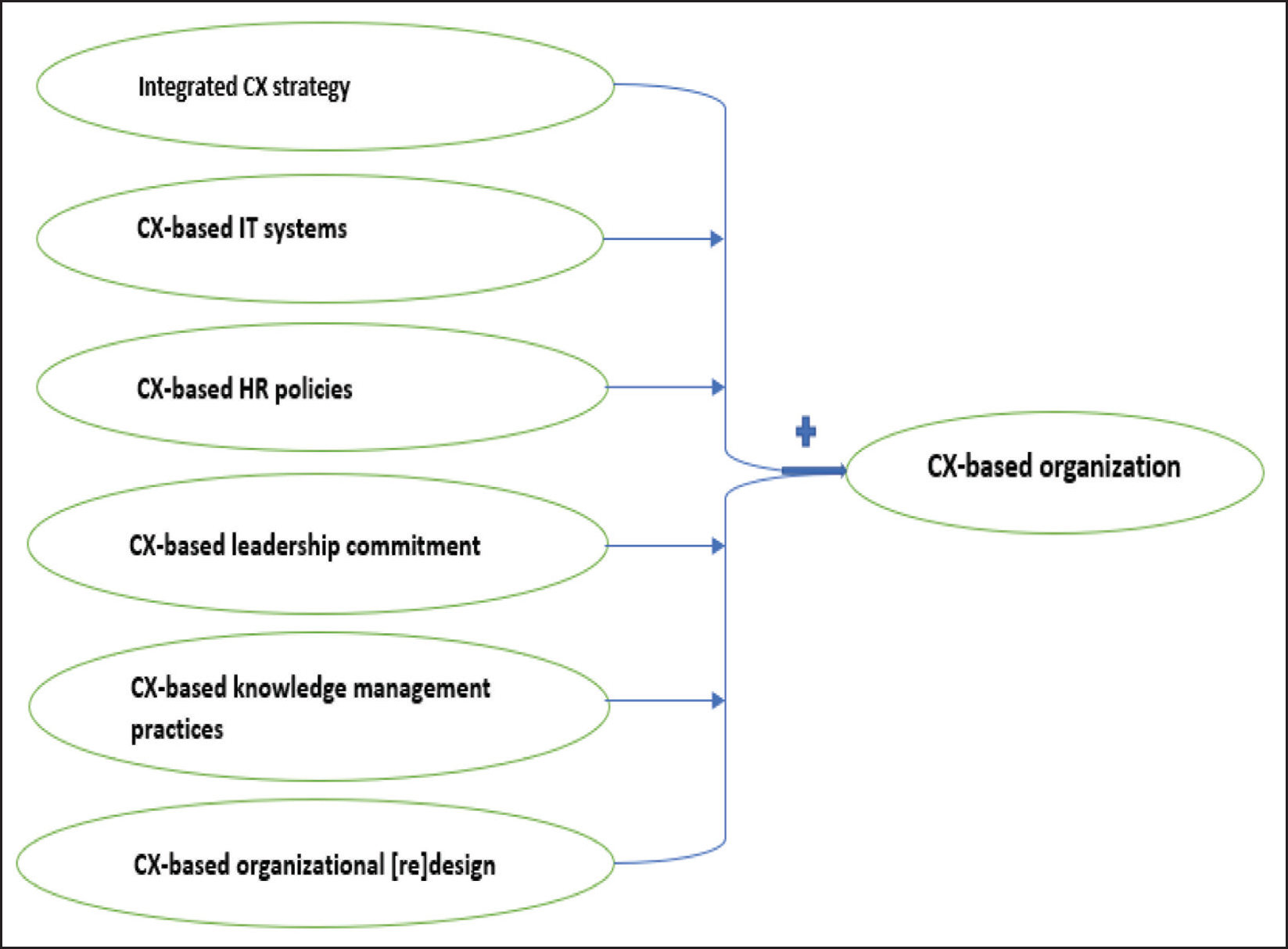
Finally, we advance the CRM theory, adding that when firms understand their customer, they can design relevant experiences to meet their emotional needs and expectations (Jaziri, 2019). According to Trejo et al. (2016), CX knowledge management provides firms with the opportunity to deliver cutting-edge design and customer value. Building on these studies (e.g., Jaziri, 2019; Trejo et al., 2016; Yachin, 2018), knowledge on the customer is as a competitive advantage for firms that leverage this information, consider customers as co-value creators, or key participants in product or service design process. Future studies could explore knowledge management practices, rather than through the lens of customer relationship management, but, through customer experience management. The relationship is subtle, but experiences are deep-seated, and thus influence behavior in a great way, positive or negative.
Conclusion
The purpose of this review is to identify critical factors for adopting high customer experience management organizational. Results of this review are anticipated to contribute to the emerging discussions of improving service quality beyond the traditional customer services and CRM.
The increasing need for firm’s adoption of experiential marketing has been largely due to the proliferation of competition, well-informed and value-driven customer base. To keep up with such pace, firms need to manage customers’ overall experience in the value or purchase journey. These efforts are not single interactions between the customer and the firm and its brand, but episodes of moments of contact with customers, to deliver in addition to value, relevant customer experiences. These activities are surmountable, and Marketing and Sales cannot perform this activity alone, but one that requires organization-wide efforts to deliver relevant and sustainable customer experiences.
Despite the relative paucity of the extant literature on CX management adoption, there is growing popularity of CX in marketing practice, particularly in the retails sector. The CX-driven strategy revolves around the firm’s integrated business strategy aim at delivering customer satisfying value at every moment of interaction with the firm and its products and services. The organization-wide support to customer experience management is indeed fundamental, thus firm’s readiness for the adoption of CX management is an important starting point to real CX management in practice. Beyond the operational level, sales point CX practices, the organizational [re]configuration toward a more CX-oriented design is essential in terms of product or services design, creating and staging experience, and delivering a superior experience, are vital to customers’ long-term positive cognition about, and the association with the firm and/or products/services (Ceesay, 2017).
This review, however, has limitations, in that the findings are purely theoretical, recognizing the limited literature in the field. More empirical studies are required to validate the arguments in the study. Our result is not specific to a particular organization or industry.
Footnotes
Declaration of Conflicting Interests
The author declared no potential conflicts of interest with respect to the research, authorship, and/or publication of this article.
Funding
The author received no financial support for the research, authorship, and/or publication of this article.