




Abstract
Entrepreneurial orientation (EO) refers to entrepreneurial activities of established and existing firms. It is different from individual entrepreneurial orientation (Popov et al., 2019, Education + Training, vol. 61, pp. 65–78). EO refers to the processes, practices, and decision-making activities that lead to new venture creation (Walter et al., 2006, Journal of Business Venturing, vol. 21, pp. 541–567). The EO scale by Lumpkin and Dess (1996, Academy of Management Review, vol. 21, pp. 135–172) consists of innovativeness, proactiveness, risk-taking, competitive aggressiveness, and autonomy. This scale is widely used in literature with major drawback of it being developed and evaluated in a developed economy (the USA) on large corporations. Very little literature is available with reference to validation of EO scales in developing economies, particularly India where firms are generally small. New Comprehensive Entrepreneurial Orientation Scale (CENTORES) has been developed and validated by adding additional dimension of strategic flexibility, which is the novelty of the present study. Data were collected using a survey instrument comprising of 19 items. The scientific scale development procedure as suggested by Schwab, (1980) was followed, first an exploratory factor analysis (EFA) was done to explore factors and later confirmatory factor analysis (CFA) was done to confirm factors (using SPSS and Amos). Six stable factors emerged from EFA which were subsequently confirmed through CFA. The measurement model confirmed the factors with good model fit indices as suggested by Hair et al. (2014). The model has CMIN/df = 2.237, CFI = 0.917, GFI = 0.928, NFI = 0.882, and RMSEA = 0.052.
Keywords
Introduction
Entrepreneurship activities have been on the rise across the globe with India being no exception. Entrepreneurial activities have been regarded as one of the major catalysts in socioeconomic development of the region they operate in (Schumpeter, 2017; Wennekers et al., 2005). Both in developing and developed economies, entrepreneurs have been able to change the way we live and work by providing solutions to complex problems by way of innovative products and services. In the process of developing products and providing services, entrepreneurs help in promoting various critical economic indicators such as employment generation (Baptista et al., 2008; Drucker, 2014), gross domestic product (GDP) growth (Van Stel et al., 2005), and regional development (Butler & Hansen, 1991; Fritsch & Mueller, 2004). The relationship between entrepreneurship and economic prosperity has been well established through various studies. As such, at macro level, entrepreneurship is of merit and, thus, a critical issue to be considered by policymakers while drafting and implementing the policies (Audretsch et al., 2007). At micro level (firm level), it is important both for new venture creation and for existing micro, small and medium enterprises (MSMEs). Entrepreneurship activities are important to MSME as it helps them to stay competitive and augment performance. Due to globalization, MSMEs are faced with increased competition by global competitors who offer substitutes at affordable prices. To compete in such hyper competitive global market, it is essential that both new ventures and existing ventures promote entrepreneurial mindset in organizations for appropriately responding to new threats, opportunities, and boosting business performance. As such, the definition and operationalization of entrepreneurial orientation (EO) becomes vital for both academicians and practitioners. The current study attempts to develop and validate the EO instrument for effectively measuring EO.
Theoretical Framework
The theoretical framework of this study has been built around the theory and research in the area of entrepreneurship and strategy literature. A review of past studies conducted in the field of EO was done to identify the need of the present study and define the objectives of the proposed study.
Many attempts have been made in literature to define the word entrepreneurship in last few decades with little consensus. The various perspectives used to define entrepreneurship can be clubbed under the following common themes: innovation, wealth creation, enterprise, agents of change, employment generation, and value creation (Kuratko & Morris, 2018).
The earliest attempt to define entrepreneurship include J. B. Say (1803) who defines it as a process of shifting economic resources from low to high productivity areas with higher yield. Entrepreneurship acts as the main vehicle to move an economy forward from static equilibrium, based on competencies of entrepreneurs (Schumpeter, 1911). Low and MacMillan (1988) suggest that entrepreneurship can be defined as the “creation of new enterprise.” Entrepreneurship is the ability to perceive and create new economic opportunities both within and outside existing organizations, to introduce products/ideas in the market in the face of uncertainty and other obstacles, by managing operations effectively in order to compete with other businesses for business performance and market share (Wennekers & Thurik, 1999).
From the above discussion, it is clear that entrepreneurship as an economic activity is not only limited to new venture creation, but it can be carried out in existing firms as well irrespective of size and age. Entrepreneurial behavior is not only possible in new ventures but also in existing firms regardless of their size and age (Kraus et al., 2011). EO is different from individual entrepreneurial orientation (Popov et al., 2019). The entrepreneurial activities of established and existing firms are generally referred as EO in literature (Lumpkin & Dess, 1996; Wiklund, 1999).
The initial attempts to define and operationalize the concept of EO can be traced back to the work of Khandwalla (1977) in his book titled The Design of Organizations, which is based on his previous contingency perspective work (Khandwalla, 1972; 1973). Building upon this work, Miller and Friesen (1977; 1978; 1980) identified three categories of variables (stimulus, organization attributes, and behavioral repertoire) to explain whether the firm’s attempts to survive and adapt have been successful or unsuccessful. In a subsequent article, out of these categories, Miller (1983) identified three dimensions: proactiveness (PA), risk-taking (RT), and product–market innovation. These three dimensions were later identified as specific components of EO by Covin and Slevin (1989). Lumpkin and Dess (1996) suggested adding two additional dimensions to EO, which they identified as competitive aggressiveness (CA) and autonomy (AU).
As has been discussed above, EO and entrepreneurship are different concepts (Lumpkin & Dess, 1996). The entrepreneurial activities of established and existing firms are generally referred as EO in literature. The operationalization of EO and various other constructs that form EO have been reproduced below.
Entrepreneurial Orientation
EO has become the central concept in entrepreneurship and strategy literature and has received significant empirical and conceptual attention. EO refers to the processes, practices, decision-making activities, actions, and behaviors that lead to new entry/new venture creation (Lumpkin & Dess, 1996; Walter et al., 2006; Wiklund & Shepherd, 2003). This may happen by way of entry in new markets or established markets through new or existing goods/services. Thus, EO involves intentions and actions of key players aimed at new entry/new venture creation (Lumpkin & Dess, 1996). As defined by Miller (1983), EO consists of three dimensions, namely innovativeness (INO), PA, and RT. Indeed, many studies focus on defining EO along these three dimensions (Covin & Slevin, 1989; Kemelgor, 2002; Naman & Slevin, 1993; Zahra & Garvis, 2000). However, based on past research, Lumpkin and Dess (1996) (Burgelman, 1984; Hart, 1992; MacMillan & Day, 1987; Venkatraman, 1989) suggested to add two additional dimensions to EO, which they identified as CA and AU.
There has been a considerable debate in literature about dimensionality of EO. Some suggest unidimensionality of EO (Covin & Slevin, 1989) while others advocate multidimensionality of EO (Lumpkin & Dess, 1996). For the present study, the EO has been theoretically conceputalized as type one (I) second-order multidimensional construct with six reflective first-order sub-dimensions. This pure (first-order reflective, second order reflective) conceputalization is consistent with Miller (1983) original idea of EO. In the following sections, various variables that play an important role in determination of EO as defined in previous studies are elaborated. Furthermore, one additional dimension, namely strategic flexibility (SF) has been added, which is also the contribution of this study to literature of EO.
Innovativeness
Schumpeter (1942) was among the first to raise the importance of innovation in entrepreneurship. He referred to disruptive innovations as “creative annihilation,” a method of wealth creation by introducing new products and services that disrupt the existing market and bring a change in status quo. The innovation dimension of EO is also related to pursuing novelty and development of creative processes through experimentation of new ideas (Lumpkin & Dess, 1996). INO of entrepreneurs is their propensity to innovate their business (Miller & Friesen, 1982).
Proactiveness
It is a perspective to anticipate future, understand complex business environment, recognize opportunities, and respond appropriately by introducing new products or services ahead of competitors (Kreiser et al., 2002; Lumpkin & Dess, 1996). PA is a process aimed at “seeking new opportunities in environment which may or may not be related to the present line of operations and strategically eliminating operations which are in the mature or declining stages of the life cycle” (Venkatraman, 1989). This action has been characterized as strategic agility (Bullinger, 1999; Tajeddini & Mueller, 2012). By virtue of PA, organizations tend to develop competitive advantage by becoming first movers (Zahra & Covin, 1995).
Risk-Taking
RT is synonymic to uncertainty. RT means borrowing heavily, venturing into new markets or products/services with uncertainty, or committing large resources to projects which have uncertain returns (Miller & Friesen, 1978). RT includes undertaking non-routine activities by wandering into the obscure, borrowing heavily, as well as investing significantly in assets to venture in undertaking new business activities (Wiklund & Shepherd, 2003; Zahra, 1991).
Competitive Aggressiveness
It is the conviction of firms’ efforts to do better than rivals and is characterized by firms’ propensity to directly and intensely challenge their competitors to achieve entry or improve position by adopting strong offensive posture or aggressive responses to competitive threats in environment in order to succeed (Porter & Millar, 1985). CA exhibited by new entrants in different forms includes adopting unconventional tactics to challenge industry leaders (Cooper & Dunkelberg, 1986), analyzing and targeting a competitor’s weaknesses (Macmillan & Jones, 1984), and focusing on high value-added products while carefully monitoring discretionary expenses (Woo & Cooper, 1981).
Autonomy
AU refers to the degree to which an individual or a team can take independent actions. In an organizational context, it refers to the ability and will to be self-directed in the pursuit of opportunities and take actions free of stifling organizational constraints (Kraus et al., 2005; Shrivastava & Grant, 1985). Firms must actually grant AU and encourage organizational players to exercise it to improve performance (Quinn, 1979).
Strategic Flexibility
Flexibility and adaptability have been long associated with entrepreneurship and better performance (Feifei, 2012; Hitt et al., 1998). The environment within which present firms operate tends to be highly volatile, uncertain, complex and ambiguous (VUCA). The VUCA environment is often described as a precursor of disruptive innovation (Millar et al., 2018). Harrigan (1980) regards SF as a firm’s capability to reorganize its assets without friction. To innovate, survive, and perform better, firms need to adapt by developing various plans and strategies to compensate for the changes in external environment. SF indicates the preparedness of a firm to convert or reverse ineffective strategic decisions to effective ones, which may, in turn, lead to development of new products or processes. Thus, plans or polices need to be strategically flexible to compensate for any time change; these changes often help the organization to perform better (Shalender & Yadav, 2019; Xiu et al., 2017), to develop future-oriented mindset (Davis & Davidson, 1991), and sometimes lead to disruptive innovation (Ghorban & Gholipour, 2018; Li et al., 2017), there by fostering EO in organization. SF has been found to be associated with EO and firm performance, particularly in the Indian context (Nadkarni & Herrmann, 2010). For this research per se SF is defined as the capability of the firm to adapt or respond to changing market environment, changing competition by regulating its goals with resource flexibility and coordination flexibility (Sanchez, 1995, 1997), and exhibit modular type, virtual type, and the barrier-free type organization design (Dess et al., 1999). In fact, entrepreneurial firms are often characterized as agile, responsive, flexible, and change-embracing (Miller & Friesen, 1978; Pettigrew & Fenton, 2000), which is consistent with the concept of SF that intends to measure firms’ intentions toward resource flexibility and coordination flexibility.
While PA is important and essential for EO, EO is not restrictive to PA or first mover advantage only. Sometimes, firms that are not first movers tend to actually do better than the first movers on account of SF they demonstrate both in terms of resources and coordination.
It is a well-known fact that Google was not the first search engine; rather, it was Ask.com. Similarly, in social media, Facebook was not the first social media platform, but it was Six Degrees. Furthermore, Amazon was not the first ecommerce platform; rather, it was Boo.com. However, the fact of matter is Google, Facebook, and Amazon succeeded as they were able to exhibit flexibility of their commitments in terms of resources and coordination. Their SF besides other reasons allowed these firms to improve their EO, while other firms that did not exhibit flexibility even though being first movers failed miserably. SF is one of the reasons besides others that we today know Google, Facebook, and Amazon as 100-billion-dollar MNCs, and possibly we do not even remember the names of others (first movers) in their respective industry. This phenomenal performance has been achieved due to SF which can be deciphered from various flexibilities exhibited by these companies on account of resource commitment and coordination. Various innovations in developed economies tend to be imitated in actual or in modified form by developing economies; for such adjustments, businesses need to be flexible in their resource deployment and coordination.
Thus, the construct of SF has been introduced as one more dimension of EO to capture resource flexibility and coordination flexibility in contemporary firms as they that tend to show higher EO (Dess et al., 1999).
The present study has been conducted with the view that SF adds to EO of any firm. SF includes flexibility in terms of resource flexibility and coordination flexibility. Although SF has been studied independently in relation to firm performance and entrepreneurship, very few studies are available in literature in the context of developing economies where EO and SF have been studied together. The present study attempts to add SF dimension to existing scale of EO (Lumpkin & Dess, 1996) and develop an instrument for effectively measuring EO in the context of developing economies.
Research Methods
Sample and Data Collection
The data for the present study have been collected from one of the union territories of India, namely Jammu and Kashmir (erstwhile state of Jammu and Kashmir). India was chosen for the study as it is one of the leading developing nations where MSMEs contribute 8% to GDP 45% to manufacturing output, approximately 40% of the country’s exports, and employ around 110 million persons (Ministry of MSME, 2019), as reported in MSME 2019 report. India has a mammoth 63.3 million registered MSMEs units, out of which 709,000 units are registered in Jammu and Kashmir providing employment to 1.088 million people, among which 150,000 are female and 937,000 are male (Ministry of MSME, 2019), thus making India a strategically important country where EO research should be conducted, as highlighted by Wales et al. (2013). Though having huge MSME network India is very less discussed in Entrepreneurship Literature (Bruton et al., 2008). Furthermore, most of the studies conducted on EO have been done in developed nations and on large corporations. Similar studies should also be conducted in developing countries on small and medium scale industries (Zahra et al., 1999). The present study has been conducted in this direction to enrich literature on EO in developing economies.
The above account provides enough justification for India (Jammu and Kashmir) as the study area.
Data for the study was collected from MSME firms (as defined in MSMED, 2006 Act) with offices in Jammu Division and Kashmir Division using survey method. The respondents of the survey were either the owners of businesses or senior executives in sample firms. All respondents could speak, read, and understand English language. The survey instrument in the form of a questionnaire was administered to 575 respondents, some electronically others physically. After multiple reminders, a total of 495 responses (86.1%) were received only. In initial data cleansing, 33 responses were found to be incomplete and, thus, were eliminated for further consideration; seven outlier responses were also eliminated; and final data analysis was conducted on 455 responses.
Measures
The following section describes in detail six dimensions used to measure EO for the present study. Five of these dimensions, that is, INO, RT, PA, CA, and AU, have been drawn from previous studies (Covin & Slevin, 1989; Lumpkin & Dess, 1996; Miller, 1983). The sixth dimension, namely SF has been an addition to measure other aspects of EO as they are not covered by the other five dimensions and, thus, a contribution of this study as well. Strategic flexibility indicates the preparedness of firms to convert or reverse ineffective strategic decisions to effective ones which may in turn lead to development of new products or processes. Such moves are only possible if an organization has resource flexibility and coordination flexibility (Sanchez, 1995; 1997).
All of the six dimensions of EO were measured using 5-point Likert-type scale along 19 items, which are designed to measure respondents’ EO. Each measurement item is measured on a 5-point Likert scale ranging from (1) representing “strongly disagree” to (7) “strongly agree.”
The wording of the items used to measure first five dimensions that is INO, RT, PA, CA, and AU are largely similar to previous EO scales developed and evaluated for validity and reliability. The sixth dimension, namely SF is self-developed and has been measured using four items with reliance on Sanchez’s (1995, 1997) theoretical model of SF. The four items capture information about resource flexibility and coordination flexibility.
The other dimensions of EO include INO which refers to pursuit of novel solutions or being creative or providing support to experimentation in introducing new products or services. PA is the measure of how firms seize market opportunities by trying to be the first movers in the marketplace. RT means borrowing heavily, venturing into new markets or products/services with uncertainty, or committing large resources to projects which have uncertain returns. CA close to PA (but different) refers to how firms compete with competitors. AU refers to the degree of freedom to act independently by an individual or team. SF is defined as the capability of the firm to respond to highly changing market environment and to changing competition by regulating its goals with resource flexibility capabilities and coordination flexibility, which can lead to disruptive product or process innovations and foster entrepreneurial spirit in organization.
Methodology
Scale Development
For the present study, scientific scale development procedure was adopted, as evident from existing literature (Rossiter, 2002; Schwab, 1980). Schwab (1980) suggests the following three stages were necessary for scale development and validation. Stage 1 is item development (generation of individual items). In stage 1, both inductive and deductive methods were used for item generation. In inductive method, operationalization of constructs was explained to respondents, and in deductive method, previous studies were considered for identifying items. In stage 2, scale development was done which comprises of manners in which items are combined to form scales (exploratory and confirmatory factor analysis [CFA]) and in stage 3, scale evaluation and validation were conducted which comprise of psychometric examination of new measure, as shown in Figure 1.

Exploratory Factor Analysis
In order to extract the underlying dimensions and reduce items to manageable number, data were subjected to exploratory factor analysis (EFA) using principal component analysis with varimax rotation (Netemeyer et al., 2003) using SPSS 20. Items that exhibited factor loadings greater than ±0.5 and Eigen values greater than 1 were considered (Hair et al., 2014). No item had loading less than ±0.5; thus, all items were considered for further analysis. The factor loadings of 19 items were in the range of 0.624–0.825. EFA was repeated with only 19 items that had loadings greater than 0.5.
All the items loaded significantly on six different factors with minimal or no cross loading, thus indicating each factor measures its own concept The six factors together explained 63.4% variance, which is well above the threshold value (Hair et al., 2014; Nunnally, 1978). The coefficient of reliability (Cronbach alpha) was estimated in the range 0.716–0.845, all greater than threshold value of 0.7 (Nunnally & Bernstein, 1967), thus indicating high reliability and internal consistency of data. The overall KMO measure of sampling adequacy for 19-item scale was estimated at 0.752, which is well above the recommended value of 0.6 (Kaiser, 1974), thus indicating the sample size was adequate enough to factorize the 19 items. The six factors that emerged were named as RT, INO, PA, CA, AU, and SF. The result of final factor analysis is presented in Table 1.
Results of Exploratory Factor Analysis

Confirmatory Factor Analysis
After EFA, convergent validity and divergent validity were estimated before performing CFA. Subsequently, CFA was conducted to confirm factors. For CFA, a minimum sample size of 200 has been recommended (Hoelter, 1983).
Convergent Validity
Convergent validity refers to, the degree of confidence with which indicators measure the construct appropriately (Campbell & Fiske, 1959). The indicators that measure the construct tend to covariate or converge or tend to share a large portion of variance in common. Convergent validity was measured by standard path loadings, average variance extracted (AVE), and composite reliability (CR) (Hair et al., 2014). The factor loadings of all items exceeded threshold value 0.50 (Hair et al., 2014). CR (a less biased reliability measure compared to Cronbach’s alpha) was estimated for each construct individually. AVE that measures variance in the indicators on account of latent construct was estimated for each construct. All such AVE were found to be above threshold value of 0.5 for each construct (Hair et al., 2014). The above results verify the convergent validity of constructs. The results of convergent test are presented in Table 2.
Convergent Validity and Reliability Results

Discriminant Validity
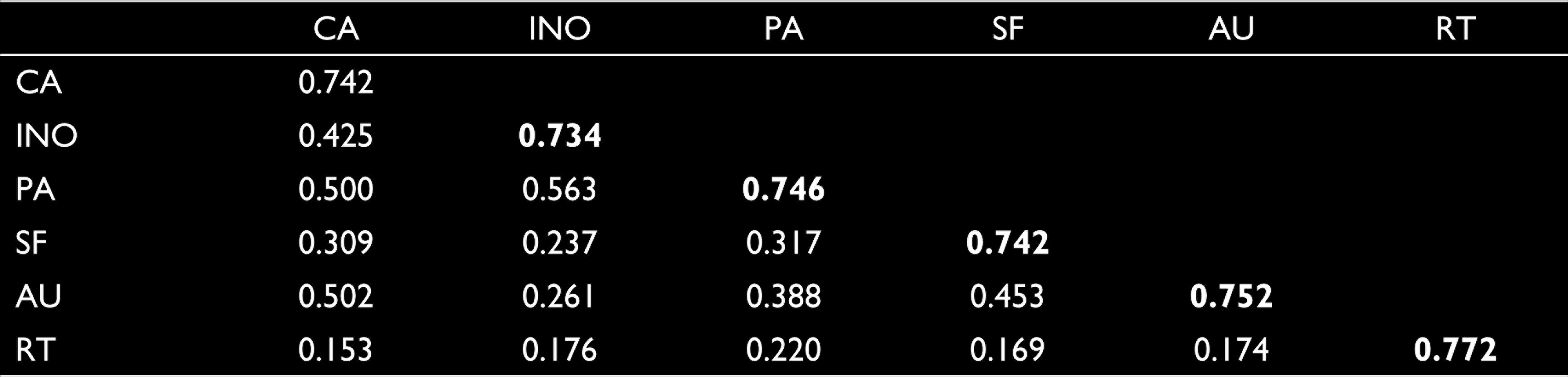
Discriminant validity of constructs is the measure of how two constructs differ from each other substantially. Discriminant validity was verified by checking whether square root of AEV for a construct is higher than its correlation with other constructs (Fornell & Larcker, 1981). The results presented in Table 3 are diagonal elements that represent the square root of AEV. The square root of AEV for all constructs is greater than its correlation, with other constructs suggesting all constructs are distinct and, thus, establishing the discriminant validity.
Discriminant Validity Results
Dimensionality, First- and Second-order Measurement Model of Entrepreneurial Orientation
To draw first-order measurement model of EO, Amos 20 (software) was used. The first-order CFA measurement model, as shown in Figure 2, was drawn to confirm the results of factor analysis. The recommended model fit indices for a good model require CMIN/df ≤ 5, NFI, CFI, GFI, TLI, and IFI ≥ 0.900 and RMSEA value in range of 0.05–0.08 (Hair et al., 2008). Based on these recommendations, the model fit indices were checked and reported as CMIN/df = 2.174, CFI = 0.926, GFI = 0.934, NFI = 0.880, TLI = 0.901, IFI = 0.927, and RMSEA = 0.051. These results of model fit indices indicate the model has good fit (Byrne, 2013). Thus, CFA reconfirmed the factors as extracted in EFA.
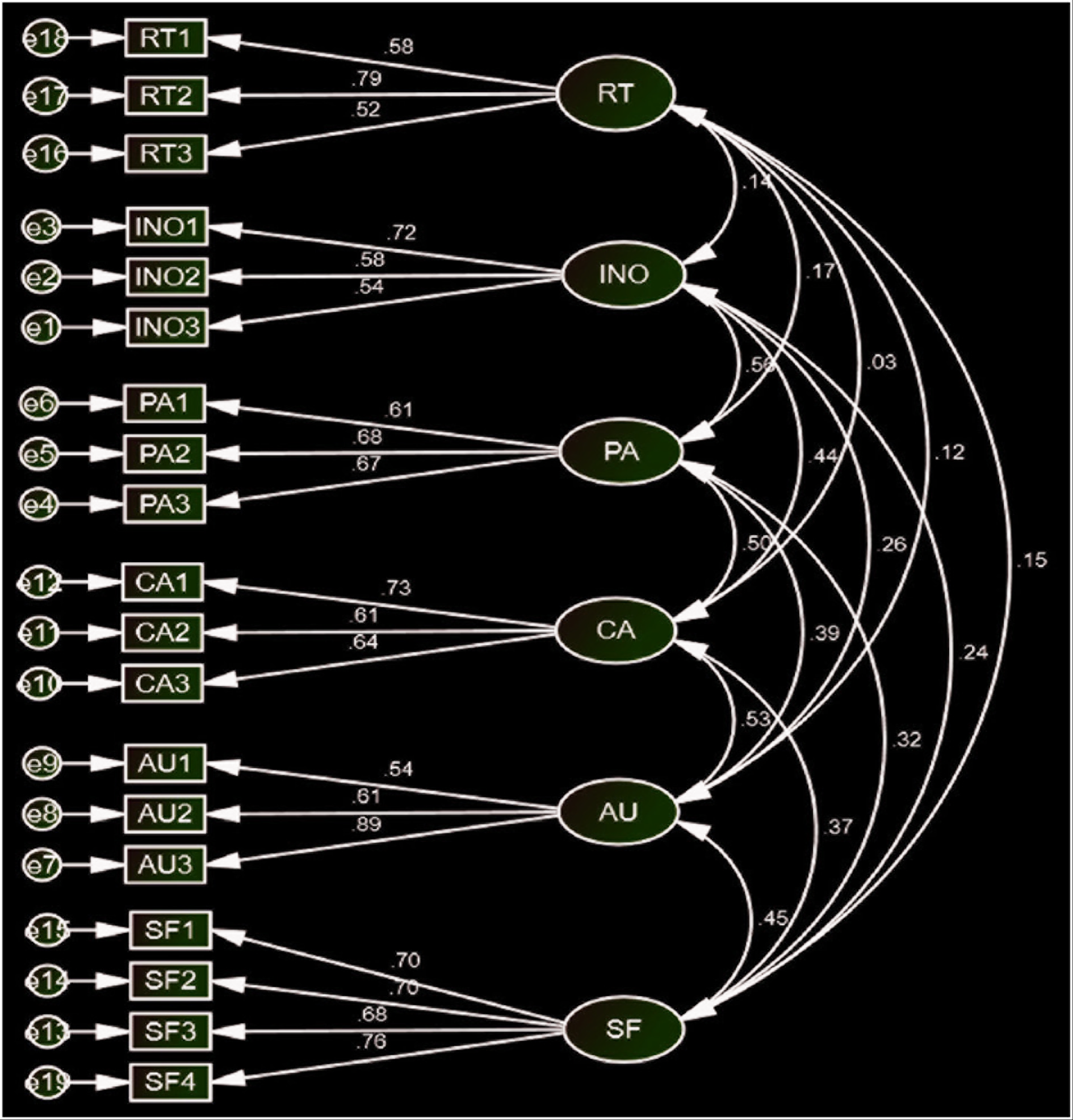
Source: The authors.
Discussion
The primary purpose of this study was to first explore the various dimensions of EO and thereafter develop and validate the scale in the context of developing economies like India. The literature review revealed that most of the sales relating to EO have been developed and evaluated in developed nations. The most widely used scales of EO be it three dimensions scale of Covin and Slevin (1989) or five dimensions scale of Lumpkin and Dess (1996) have been developed and tested in developed economies (USA and Europe). Thus, it was very important to develop a robust EO scale in developing economies (India). The said scale should take into consideration all dimensions that are akin to developed economies as well as specific to developing economies. The objective has been achieved by following scientific procedure for scale development and proposing a 19-item scale measured along 6 dimensions. This Comprehensive Entrepreneurial Orientation Scale (CENTORES) can be used across all developing economies for measuring EO effectively.
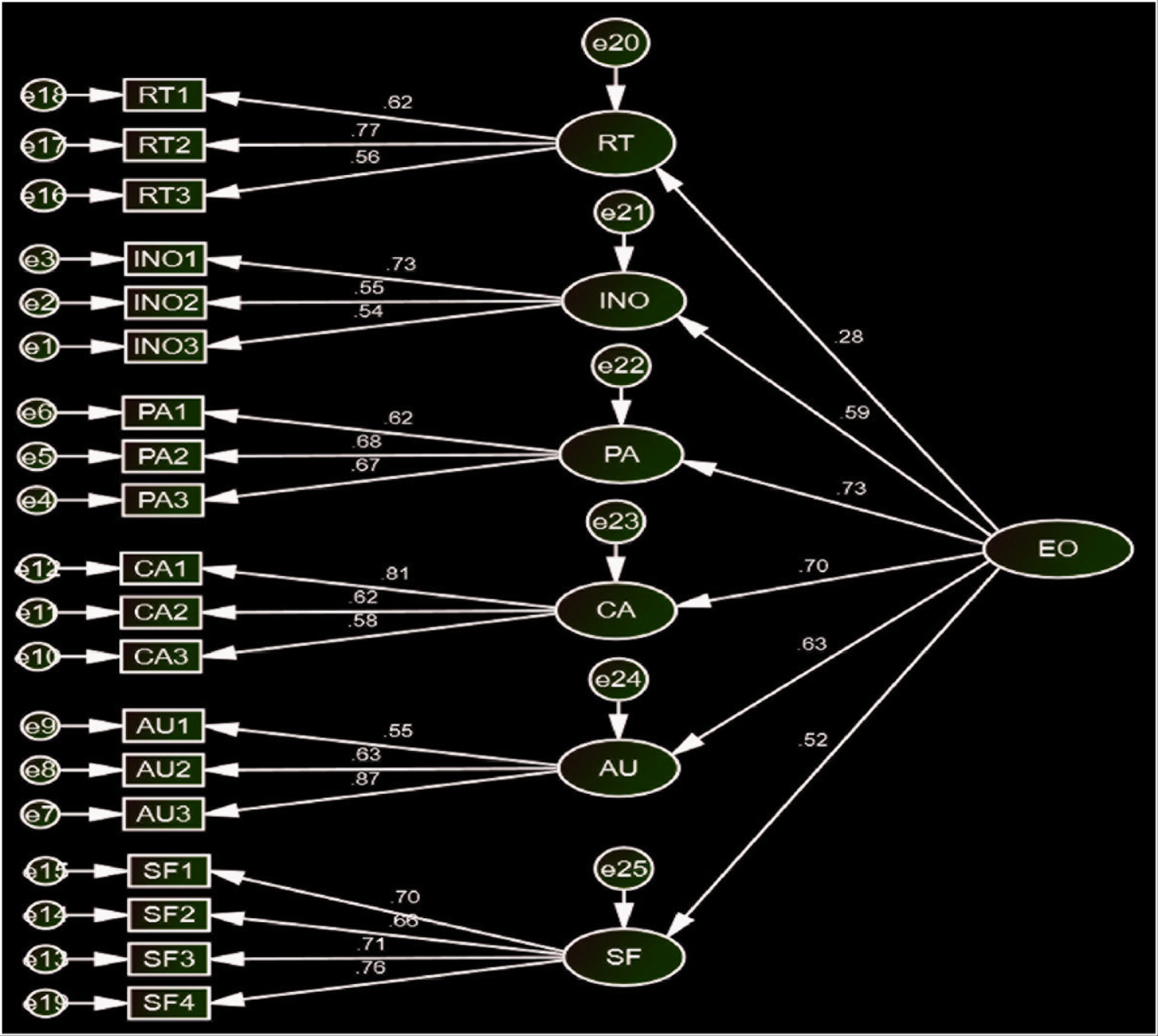
Among other dimensions, A new dimension, namely SF has been identified as a very important dimension for EO in developing economies (Nadkarni & Herrmann, 2010). The six dimensions of scale (CENTORES) are RT, INO, PA, CA, AU, and SF. The new scale is very robust as EFA fetched six dimensions and CFA confirmed all six dimensions essential for effective measurement of EO. The scale has both high validity and reliability. The factor loadings, CR, AVE, and Cronbach’s α measures of scale, are well above the threshold vales indicating high reliability and convergent validity. The discriminant validity analysis of scale also revealed that all the six dimensions are very distinct from each other. The study can be very useful in studying EO in developing economies, particularly in India.
The CENTORES scale can be particularly useful to the Government of India in formulating policy documents for MSME by precisely classifying MSME on basis of EO they possess. Although India has huge number of MSME units (63.3 million), most of these units are micro units (99%). Gauging EO of these units over a period of time can help government to understand the major problems that prevent these micro units from getting scaled up and transforming into small or medium or multinational enterprises.
The special contribution of this scale (CENTORES) is addition of SF as one more dimension of EO. SF is very essential for small organizations and organizations that are facing resource constraints and require flexibility in approach to deploy and redeploy resources in quick time. The scale can be very useful for entrepreneurship scholars in developing nations, especially India, as there is dearth of literature on EO in developing economies.
Managerial Implications
The present study can help managers to develop a comprehensive understanding of EO in addition to understanding how various dimensions of EO operate. The study should also help managers to properly access risk and develop appropriate strategies to mitigate such risk. It can provide insights into how to be innovative in terms of both products and process, how to be proactive and how to compete with competitors to stay relevant. The scale can also help managers to gauge the level of flexibility they have in resources and coordination. Furthermore, it can help to understand the level of AU that needs to be provided to employees in terms of decision-making. Above all, it can help managers to know along which dimensions of EO they are doing good and which dimensions need immediate attention. If proper assessment of these dimensions is done regularly by managers, it can help firms to exhibit and continuously improve their EO. EO generally helps organizations in developing comparative advantage, which is very essential for success in today’s business world.
Limitations of the Study
The present study is not free of limitations. One of the limitations of study is that the scale has been developed and evaluated on manufacturing businesses in Union Territory of Jammu and Kashmir. The future studies can be conducted pan India and include all manufacturing, service, and trading organizations to make better generalization. The present scale has been evaluated in Indian context only; more studies can be conducted in different cultures for checking heterogeneity and homogeneity. Future studies can also use other strategic constructs like market orientation and learning orientation and study their individual impact and collective impact on firms’ financial and non-financial performance. Future studies can also be conducted using the proposed scale in longitudinal analysis to understand if there are any changes in EO of a firm over a period of time.
Footnotes
Declaration of Conflicting Interests
The authors declared no potential conflicts of interest with respect to the research, authorship, and/or publication of this article.
Funding
The authors received no financial support for the research, authorship, and/or publication of this article.