




Abstract
Ceramic filters are an effective, low-cost solution for water potabilization, particularly in rural communities. The integration of 3D printing has advanced this traditional approach by enabling precise control over design parameters that govern filtration efficiency. Gyroid-type ceramic scaffolds for water treatment were fabricated by clay-based extrusion 3D printing. Two ceramic pastes (ECP 1 and ECP 2) containing kaolin, attapulgite, alumina, and feldspar were formulated; ECP 2 incorporated 10 wt% activated carbon as a sacrificial porogenic phase. Rheological characterization using rotational rheometry and Bingham model fitting identified 40 wt% water as optimal for extrusion. Sintering at 1100°C produced interconnected open-pore networks in ECP 2 (apparent porosity: 23.6%; water absorption: 11.8%). Scaffolds were functionalized with silver nanoparticles (AgNPs) and ethanolic extracts of Moringa oleifera. AgNPs exhibited surface plasmon resonance at 422 nm; silver leaching was 0.00282 ppm (WHO limit: 0.1 ppm). Ethanolic extract E2 (80% v/v) showed significantly lower MIC (0.175 g/mL) than E1 (0.35 g/mL; p < 0.05) and bactericidal activity (MBC/MIC ⩽ 4.0). Functionalized scaffolds (EG) reduced biofilm formation by 80%–95% versus controls at 24 h (MTT assay) and maintained cellular compatibility above the 80% ISO 10993-5 threshold at 7 days. This combination of properties positions them as a highly promising alternative for advanced ceramic water filters.
Keywords
Introduction
Access to safe drinking water in rural and infrastructure-limited regions remains a critical global challenge. 1 Ceramic filters offer a low-cost, deployable alternative, yet traditional manufacturing—slip casting, molding, manual pressing—introduces stochastic variation in porosity and filtration performance.2,3 Delgado reported kaolin–sand–sawdust filters achieving 86%–99% lead removal,4,5 while Huamaní and Espinoza 6 developed red clay filters meeting local standards; however, neither addressed antimicrobial functionalization.
Extrusion-based 3D printing enables complex geometries, including triply periodic minimal surfaces (TPMS). Elsersawy et al. demonstrated that gyroid geometry provides high interconnected porosity, large surface area, and homogeneous flow.7–9 Akowanou and Aina 10 showed potential of 3D-printed ceramic filters for turbidity and pathogen removal, though without antimicrobial agents. A persistent limitation is bacterial biofilm formation, which clogs pores and reduces filter lifespan. 11 AgNPs provide broad-spectrum antimicrobial activity without compromising ceramic integrity, 12 while M. oleifera extracts offer sustainable supplementary antibacterial properties. 13
To our knowledge, no prior study has integrated (i) gyroid scaffolds via clay-based 3D printing, (ii) activated carbon sacrificial templating, and (iii) dual AgNP + M. oleifera functionalization in a single ceramic filter. This proof-of-concept study aimed to develop and characterize such scaffolds, hypothesizing that the dual antimicrobial system synergistically inhibits biofilm formation. Essential water purification parameters remain to be evaluated in future work.
We aimed to develop 3D-printed ceramic scaffolds functionalized with silver nanoparticles and M. oleifera for water purification. We hypothesized that combining both agents creates a synergistic system—inorganic bactericidal plus natural extract—to inhibit biofilm formation. This is a preliminary proof-of-concept study; essential water purification parameters remain to be evaluated in future work.
Materials and methods
Formulation and preparation of the ceramic paste
Two experimental ceramic pastes (ECP) were prepared: ECP 1 (kaolin, attapulgite, alumina, feldspar) and ECP 2 (identical, but with 10 wt% feldspar replaced by activated carbon), both mixed with 40 wt% water. Raw material crystalline phases were identified by XRD (PANalytical X’Pert Pro, Cu-Kα, 5°–80° 2θ).
Rheological characterization of ceramic paste ECP2 used a rotational rheometer (Rheotest R.N 5.1, Medingen GmbH, Germany). Direct plate–plate measurements at 40 wt% exhibited slippage; therefore, a three-step extrapolation strategy was applied: (1) reference measurements at 50–90 wt% water via concentric cylinder geometry (shear rate 0–100 s−1, 600 s, 25°C); (2) fitting of Bingham, Power Law, and Herschel–Bulkley models; and (3) extrapolation to 40 wt% using the best-fit model (Bingham, R2 ≈ 0.97). Resulting parameters are approximations for guiding printing trials, not experimentally validated absolute values.
Scaffold design and printing
Scaffolds (7 × 7 × 1.5 cm) were designed in Fusion 360 software (Autodesk Inc., San Rafael, CA, USA), exported as STL, and sliced in Cura 5.10.0 with gyroid infill (40% density, 4.98 mm line spacing, 0.6 mm layer height, wall count: 0 or 1). Printing was performed on a clay extruder (Tronxy Moore 2 Pro). Scaffolds were dried at room temperature for 72 h then at 100°C for 24 h and sintered to 1100°C at 5°C/min with a 1 h dwell at 600°C (ECP 1) or 2 h (ECP 2), followed by furnace cooling.
Volumetric shrinkage and apparent porosity were measured per NTC 4635. 14 Dried samples were boiled in distilled water for 5 h and immersed for 24 h. All measurements were performed in triplicate (n = 3).
The volumetric shrinkage during drying was calculated using (equation (1)) and the total volumetric shrinkage from the freshly printed state to the sintered state was determined using (equation (2))


Where
The mass loss during drying was calculated using (equation (3)), while total mass loss between the freshly printed and sintered states was obtained using (equation (4)).


Where
The apparent porosity (P) was calculated using (equation (5)):

where V is the external volume of the specimen (mL). All measurements were performed in triplicate.
Silver nanoparticles synthesis
AgNO3 was prepared in situ by dissolving metallic silver (99.9%) in 70% HNO3 and standardized by Mohr titration. AgNPs were synthesized following Pal et al. 15 1% w/v PVP in ethanol was heated to 60°C, AgNO3 was added dropwise, and the colloidal suspension was stored sealed. Optical characterization was performed by UV-Vis spectrophotometry (PerkinElmer Lambda 35, 300–700 nm, 1 nm resolution).
Preparation of ethanolic extracts of M. oleifera
Dried M. oleifera leaves (10 g) were macerated with 90 g ethanol at 60% v/v (E1) or 80% v/v (E2) in amber containers for 48 h at room temperature. 16 Filtrates were pooled by concentration, then concentrated by rotary evaporation (40°C, 0.2 bar) to ~0.7 g/mL. Extracts were stored at 4°C. No chromatographic identification of specific bioactive compounds was performed.
Antimicrobial assays
Assays used E. coli (ATCC 25922) and E. faecalis (NCTC 775) at 1.5 × 10⁸ CFU/mL (90 NTU, CLSI guidelines). Inhibition zones (Kirby–Bauer agar well diffusion; 9 mm wells, 50 µL test solution, 37°C/5% CO2/24 h) were measured by ImageJ. One-way ANOVA with Tukey post hoc test was applied for multiple comparisons (normality confirmed by Shapiro–Wilk; homogeneity by Levene). MIC and MBC were determined by broth microdilution (96-well plate, MTT colorimetric indicator): MIC = lowest concentration with no color change; MBC = lowest concentration with no colony growth on BHI agar after 24 h. Student’s t-test (two-tailed, unpaired; p < 0.05) was used to compare E1 versus E2.
Scaffold functionalization
Sintered scaffolds were impregnated by controlled saturation: 45% of total pore volume with colloidal silver (35,000 ppm, 75 mL) and 55% with M. oleifera extract. Silver leaching was assessed by percolating 100 mL distilled water through impregnated scaffolds; effluent silver concentration was quantified by atomic absorption spectrometry. FT-IR spectra (Shimadzu IRTracer-100, 500–4000 cm−1, transmittance mode) were collected for four scaffold variants: ceramic alone, ceramic + M. oleifera, ceramic + Ag, and ceramic + Ag + M. oleifera.
Scaffold characterization
Surface morphology was examined by SEM (JEOL JSM-6490LV, gold-sputtered, high vacuum, secondary electron imaging). Mechanical properties were evaluated with a universal testing machine (Instron 3366, 1 mm/min): compression tests on ECP 1 and ECP 2 (n = 5 per group; specimens 36.5 × 27 × 10 mm) with and without external walls; three-point bending (n = 3 per group; 80% span) on ECP 2 comparing control (CG), +Ag, and +Ag+ M. oleifera (EG). One-way ANOVA with Tukey post hoc for all mechanical comparisons.
Biofilm reduction and cellular viability
Biofilm reduction was assessed by MTT assay: E. coli, E. faecalis, and co-culture (1.5 × 10⁶ CFU/mL each) seeded in 24-well plates containing EG or CG scaffolds (37°C, 5% CO2; 24 and 48 h; medium renewed every 16 h). After incubation, formazan was solubilized with DMSO; absorbance at 570 nm. MTT measures metabolic activity as an indirect proxy for bacterial viability; CFU confirmation is pending. Student’s t-test (EG vs CG per organism and time point).
Cytotoxicity used L929 fibroblasts (passages 15–20; 25,000 cells/cm2) seeded on pre-wetted scaffolds (PBS, 72 h). Cultures maintained in DMEM + 10% FBS + 1.2% penicillin/streptomycin; MTT at 48 h and 7 days. Student’s t-test per time point was performed.

Results and discussion
Raw material characterization
XRD confirmed expected phases in all materials (Figure 1). Attapulgite exhibited characteristic peaks at 8.5°, 13.9°, 19.9°, 21.7°, 34.5°, and 38.8° (2θ) with quartz as secondary phase; peak broadening reflects structural disorder typical of natural attapulgite, which promotes shear-thinning behavior for extrusion. 17 Alumina corresponded exclusively to α-Al2O3 (corundum; ICDD PDF 46-1212), confirming high crystallinity and thermal stability. 18 Potassium feldspar showed alkali feldspar reflections (microcline/orthoclase) with minor quartz, consistent with standard fluxing agents. 19 Kaolin was dominated by kaolinite with quartz, enhancing green body formability and mullite formation during sintering. 20 The assembled phase system ensures printability, controlled sintering densification, and mechanical integrity. 21

XRD patterns of the raw ceramic powders used in this study: (a) attapulgite, (b) alumina, (c) feldspar, and (d) kaolin.
Rheological behavior of the ceramic paste
The Bingham model best fitted experimental flow curves (R2 ≈ 0.97). Log–log correlation of plastic viscosity and yield stress with water content (50–90 wt%) yielded R2 > 0.98, enabling extrapolation to 40 wt%. The estimated Bingham equation for ECP 2 at 40 wt.% water (Figure 2):

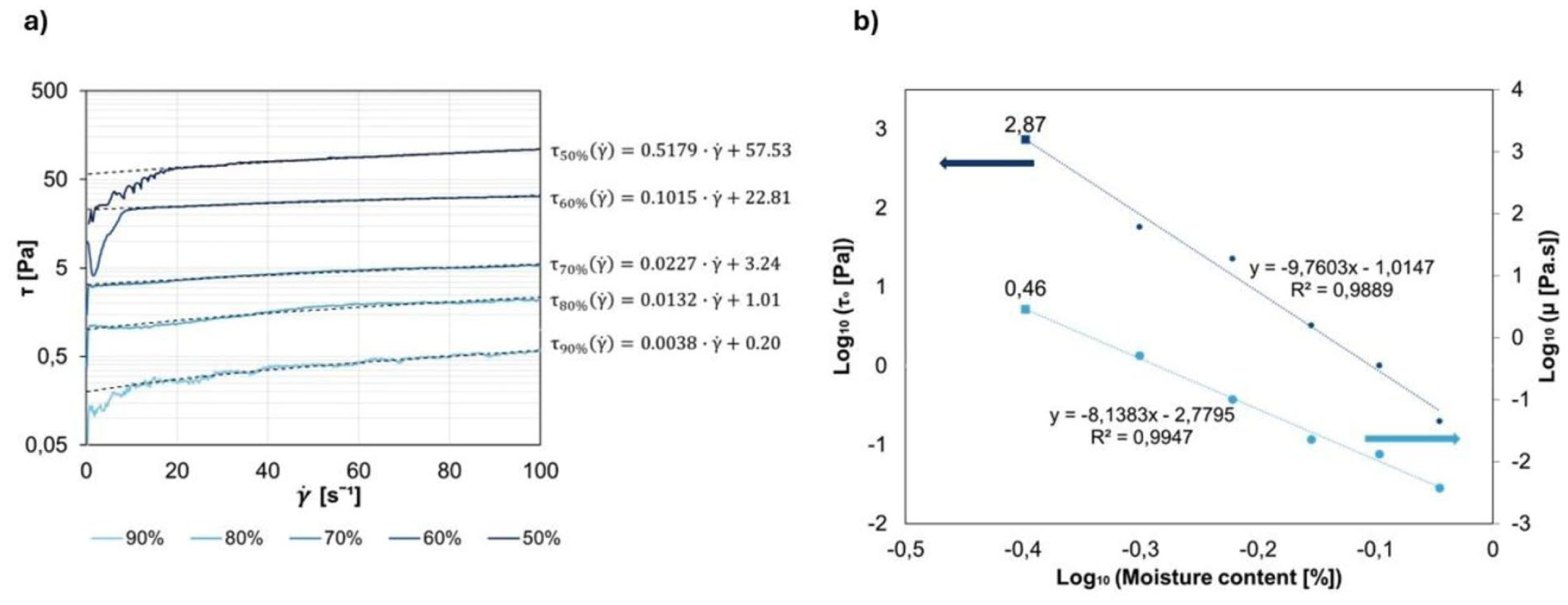
(a) Shear stress versus shear rate data and curve fitting, (b) log–log linear fits for τo and μ.
Based on equation (7) and parallel-plate measurements of the 40 wt% paste, Figure 3 presents the linear Bingham fit to the shear stress profile and the apparent viscosity μapp calculated from the extrapolated model. Here was observed at shear rates relevant to extrusion (>10 s−1); deviations at low rates reflect wall slip effects. These parameters guided printing trials successfully but await direct experimental validation at 40 wt%.
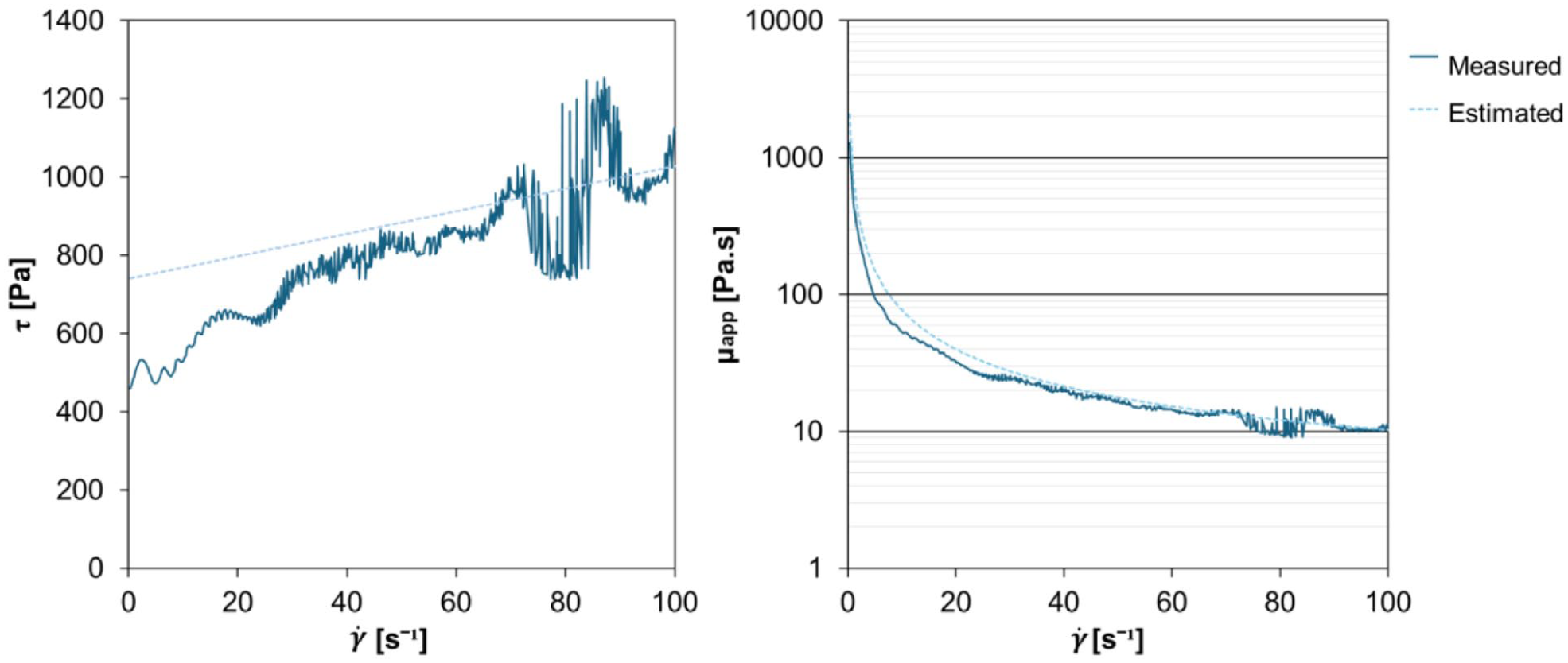
Validation of the Bingham model for the formulation containing 40 wt% water.
Scaffold shrinkage and porosity
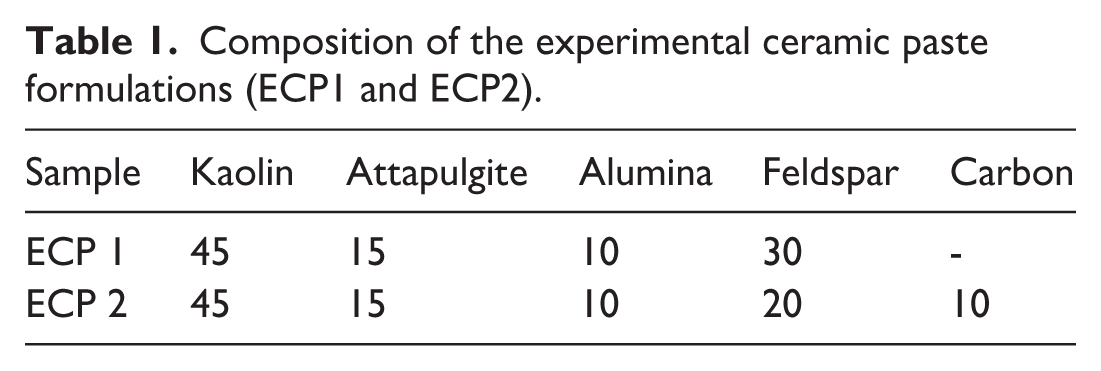
ECP 2 exhibited volumetric drying shrinkage of ~36% and total shrinkage of ~65%; ECP 1 reached 39% and 50%, respectively. ECP 2 mass loss was 44% (drying) and 52% (total), versus 42% and 45% for ECP 1, with the excess attributable to carbon burnout. Despite lower relative apparent porosity (ECP 2: 23.6%; ECP 1: 29.9%), ECP 2 exhibited higher water absorption (11.8% vs 8.2%) and greater absolute impregnable pore volume (13.6 mL vs 8.6 mL). Carbon burnout generated a hierarchical pore structure: macropores from gyroid architecture and micro/mesopores from carbon evolution, improving permeability without compromising structural integrity.22,23 Lower bulk density of ECP 2 (2.0 g/mL vs 3.6 g/mL) confirms internal porosity development, favorable for filtration and functional agent loading (Table 1).
Composition of the experimental ceramic paste formulations (ECP1 and ECP2).
AgNP characterization and silver leaching
UV–Vis spectrophotometry yielded a distinct SPR band at 422 nm, consistent with predominantly spherical, well-dispersed AgNPs. 15 Silver leaching from scaffolds impregnated at 35,000 ppm yielded 0.00282 ppm in 100 mL distilled water effluent, well below the WHO guideline of 0.1 ppm (2022). The distilled water control showed no detectable silver. The result indicates partial controlled release with most silver retained in the matrix, favorable for sustained antimicrobial action. Limitations: only short-term leaching with distilled water was assessed; long-term behavior under real-water conditions (minerals, organic matter, sediment) remains to be evaluated (Figure 4).
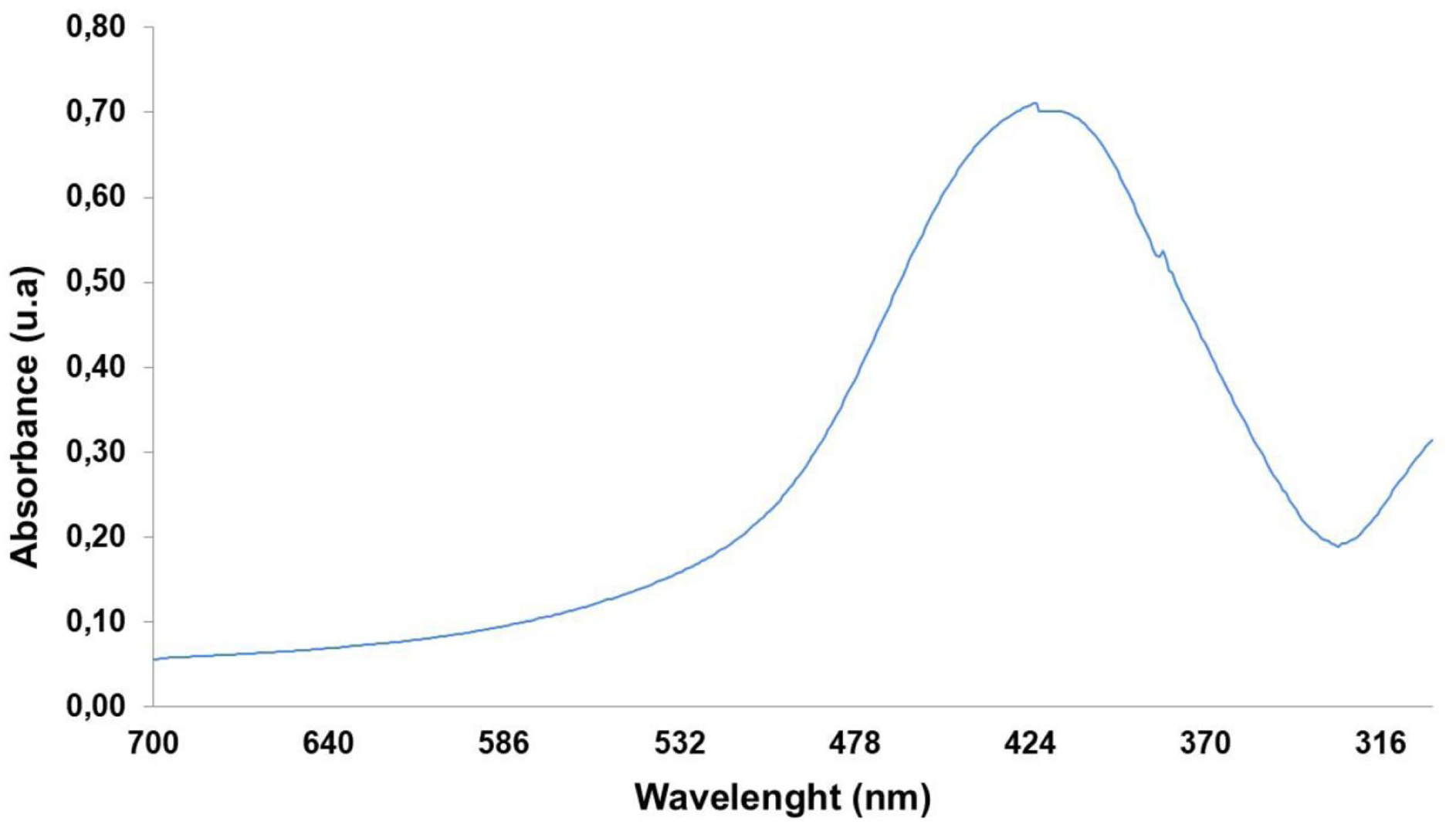
UV–Vis absorption spectrum of the colloidal silver suspension.
FT-IR analysis of functionalized scaffolds
Figure 5 shows the FTIR spectra (4000–500 cm−1) of ceramic, ceramic + M. oleifera, ceramic + Ag, and ceramic + Ag + M. oleifera. The four spectra practically overlap, indicating that functionalization does not alter the ceramic matrix. According to El Alouani et al., metakaolin is identified by attenuation of O–H bands at 3550–3410 cm−1 and 1620 cm−1, an intense Si–O–Si and Si–O–Al band between 1000–1100 cm−1, and framework modes between 800 and 500 cm−1. The obtained spectra show this pattern: no marked O–H absorptions above 3000 cm−1, a weak water signal at 1639 cm−1, and strong bands at 1162, 1039, 793, 691, and 651 cm−1.24 This confirms successful calcination and a dehydroxylated metakaolin-type aluminosilicate matrix.
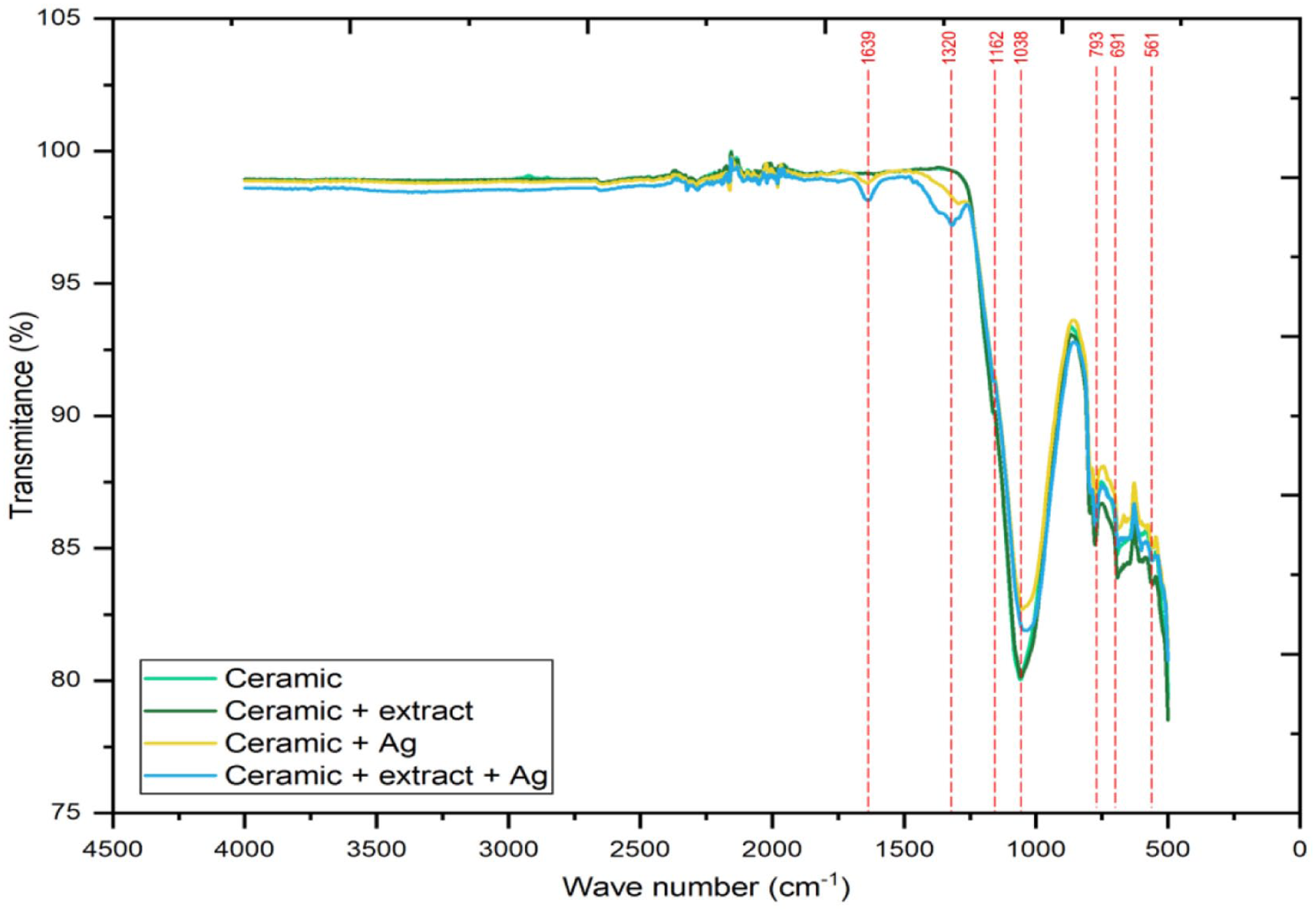
FTIR-ATR spectra (4000–500 cm−1) of the four formulations. Dashed lines indicate the positions of the assigned bands (1639, 1320, 1162, 1038, 793, 691, and 561 cm−1).
According to Fatiqin et al., aqueous M. oleifera extracts exhibit O–H bands at 3200–3500 cm−1, aliphatic C–H at 2920–2850 cm−1, C=O/C=C at 1700–1600 cm−1, and C–O/C–O–C at 1260–1020 cm−1. In the ethanolic extract, these organic bands are absent or strongly attenuated and do not shift the Si–O/Al–O vibrations, indicating a low-loading surface layer without matrix alteration. 25 Metallic silver is not infrared-active and introduces no new peaks. Overall, the four overlapping curves confirm that Ag and/or M. oleifera do not modify the inorganic fingerprint.
Antimicrobial activity of M. oleifera extracts
Inhibition zone diameters (Table 2) demonstrated significantly greater activity for E2 over E1 (p < 0.01): 12.0 ± 0.3 versus 10.0 ± 0.4 mm against E. coli, and 14.0 ± 0.3 versus 12.0 ± 0.3 mm against E. faecalis. The positive control (0.2% chlorhexidine) produced ~15 ± 0.3 mm; ethanol controls showed no activity, confirming inhibition was attributable to phytochemicals. E. faecalis was more susceptible than E. coli, consistent with restricted diffusion of hydrophobic compounds through the Gram-negative outer membrane. 26 Zones > 10 mm indicate moderate-to-high activity per Ahmad et al. 27
Porosity test results (NTC 4635) for ceramic pastes with and without carbon.

MIC for E1 was 0.35 g/mL against both strains; E2 MIC was 0.175 g/mL (p < 0.05), indicating more efficient recovery of membrane-active metabolites at higher ethanol concentration.25,28,29 E1 was purely bacteriostatic; E2 achieved bactericidal activity (MBC: 0.3 g/mL against E. coli; 0.7 g/mL against E. faecalis). MBC/MIC ratios of 1.71 and 4.0 classify E2 as bactericidal. 30 Higher bactericidal concentration required for E. faecalis is consistent with greater mechanical resistance of the thicker Gram-positive peptidoglycan layer to lytic action (Figure 6).31,32

(a) Measurement of inhibition zone diameters for the positive control chlorhexidine digluconate 0.2% (C+), M. oleifera extract obtained with 60% ethanol (E1), and M. oleifera extract obtained with 80% ethanol (E2), (b) representative photographs of inhibition zones produced by extracts E1 and E2, as well as by 60% ethanol (E60) and 80% ethanol (E80) solutions, against E. faecalis, and (c) representative photographs of inhibition zones produced by extracts E1 and E2, as well as by 60% ethanol (E60) and 80% ethanol (E80) solutions, against E. coli.
Scaffold morphology and mechanical properties
SEM revealed that ECP 1 scaffolds exhibited dense microstructure with narrow residual pores and well-preserved gyroid geometry after sintering. ECP 2 scaffolds showed a markedly more porous, interconnected microstructure arising from carbon burnout, favorable for fluid transport. Functionalized ECP 2 scaffolds maintained open macropore access after impregnation; partial pore-wall coatings confirmed Ag/M. oleifera deposition (SEM darkening) without channel blockage, preserving permeability.
For unimpregnated ECP 1 scaffolds (Figure 7(a)–(c)), a homogeneous macrostructure was observed. The TPMS gyroid geometry remained well-preserved with no visible collapse after thermal treatment (Figure 7(a)). At higher magnification (Figure 7(b)), the microstructure appeared dense with a narrow distribution of small residual pores (red circles), typical of sintering densification. The surface exhibited smoothed regions and sintering necks, promoted by feldspar fluxing. Digital imaging (Figure 7(c)) confirmed high geometric fidelity and dimensional stability, indicating optimal paste rheology.
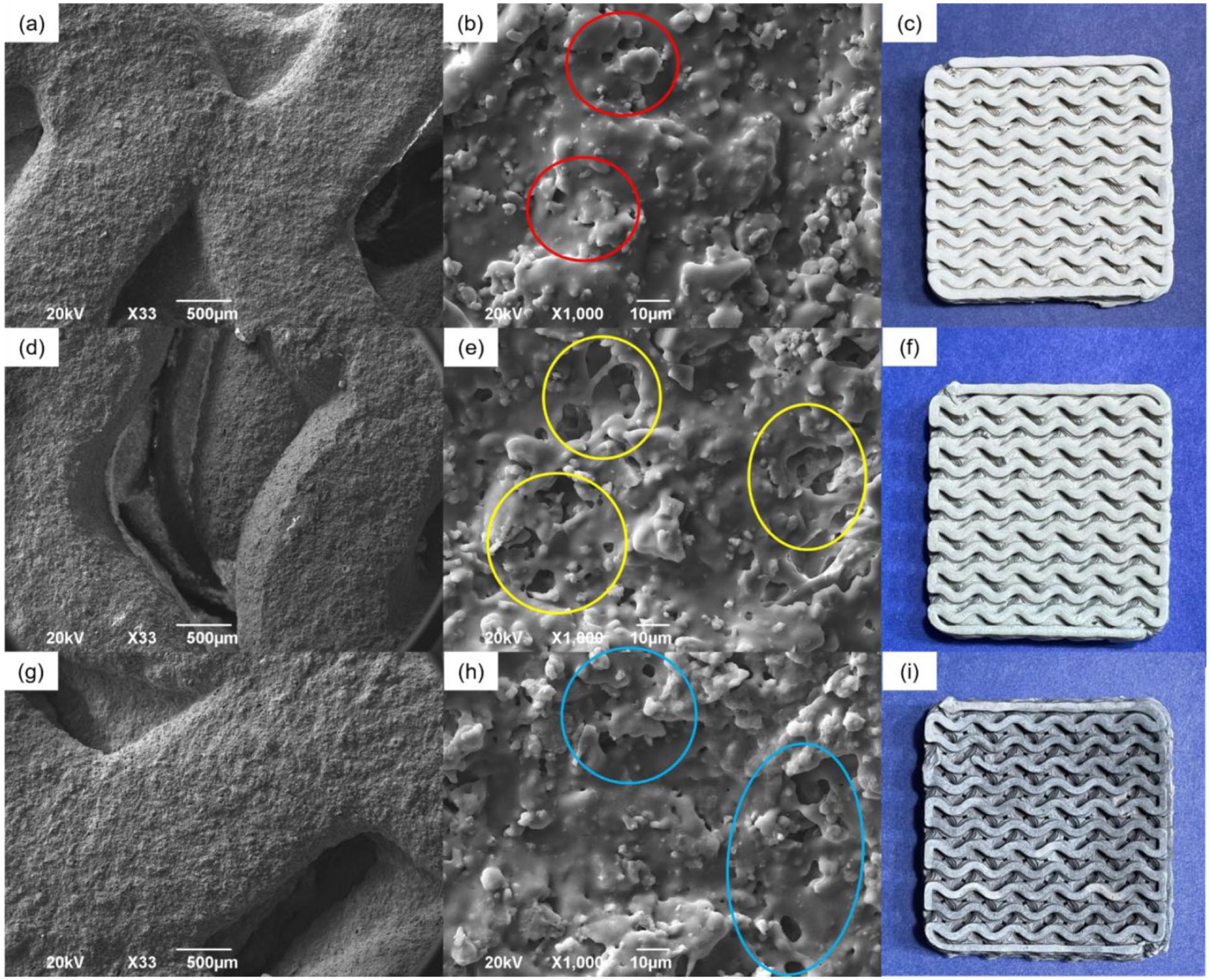
Morphology of the scaffolds. Images taken by scanning electron microscopy (SEM) and digitally. SEM images of (a and b) unimpregnated ECP 1 scaffold, (d and e) unimpregnated ECP 2 scaffold, (g and h) ECP 2 impregnated scaffold with colloidal silver and extract. Digital images of (c) unimpregnated ECP 1 scaffold, (f) unimpregnated ECP 2 scaffold, (i) ECP 2 impregnated scaffold with extract and colloidal silver.
In contrast, unimpregnated ECP 2 scaffolds (Figure 7(d)–(f)) displayed a more irregular and heterogeneous surface morphology despite the gyroid architecture (Figure 7(d)). The microstructure (Figure 7(e)) revealed significantly higher porosity, characterized by interconnected micrometer-sized open pores (yellow circles) resulting from carbon burnout. This porosity network is favorable for fluid transport. 33 Compared to ECP 1, the lower degree of surface smoothing suggests that carbon partially hindered local densification. The digital image (Figure 7(f)) shows slight material darkening without compromising structural integrity.
Functionalized ECP 2 scaffolds (Figure 7(g)–(i)) preserved their overall architecture after impregnation, with no macroscopic channel blockage (Figure 7(g)). SEM imaging (Figure 7(h)) revealed a heterogeneous surface texture with partial coatings on pore walls, suggesting successful deposition of silver nanoparticles and plant extract. Critically, the open porosity remained accessible (blue circles), maximizing surface area for antimicrobial action. The digital image (Figure 7(i)) shows pronounced darkening, visually confirming effective dispersion of the Ag/M. oleifera system (Table 3).
Average Young’s modulus and maximum compressive stress values for different ceramic paste formulations and scaffold designs.
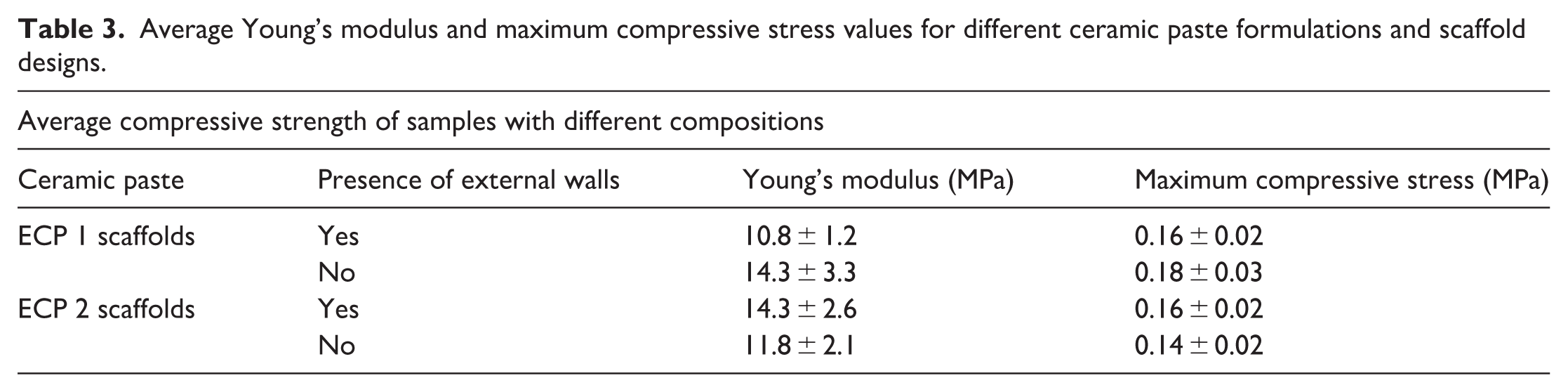
Regarding Young’s modulus, samples without activated carbon and without walls exhibited the highest value (14.3 MPa), indicating greater initial stiffness. In contrast, samples with activated carbon and without walls reached a lower modulus (11.8 MPa), indicating that activated carbon, although necessary to induce porosity, reduces structural stiffness. Samples with walls, both with and without activated carbon, showed intermediate values (14.3 and 10.8 MPa, respectively), indicating that geometric design influences mechanical response (Table 4).
Summary of flexural modulus and maximum flexural strength.

Compression tests showed the highest Young’s modulus in ECP 1 without walls (14.3 MPa) versus ECP 2 without walls (11.8 MPa), consistent with pore-induced stress concentration in porous ceramics.34,35 Maximum compressive stress ranged from 0.14 to 0.18 MPa with no significant between-group differences (p > 0.05). Given that filtration applications impose low mechanical loads, the wall-less ECP 2 configuration was selected as optimal, balancing stiffness and pore connectivity for enhanced fluid dynamics. Three-point bending showed ceramic + Ag + M. oleifera achieving the highest flexural modulus (700 MPa) and strength (7 MPa), indicating functionalization did not cause mechanical deterioration; partial pore filling by impregnated agents likely contributed to the slight increase.
Biofilm reduction and cellular viability
MTT-based assays suggest scaffold functionalization may reduce biofilm formation. After 24 h, EG showed 80%–95% MTT reduction versus CG (10%–20%), suggesting interference with early bacterial adhesion. 36 MTT results are preliminary. Activity remained stable in monocultures after 48 h (~95% reduction), suggesting sustained release from the scaffold.25,37–39
Polymicrobial co-cultures showed high reduction at 24 h (~80%) but decreased efficacy at 48 h (~58%), consistent with multispecies biofilm resilience.40–42 Combined bacterial interactions may form denser barriers,43–45 while cross-protection and metabolic gradients confer tolerance.44,46,47 The decline may also reflect metabolic adaptation or compound degradation in mature biofilms (Figure 8).48,49
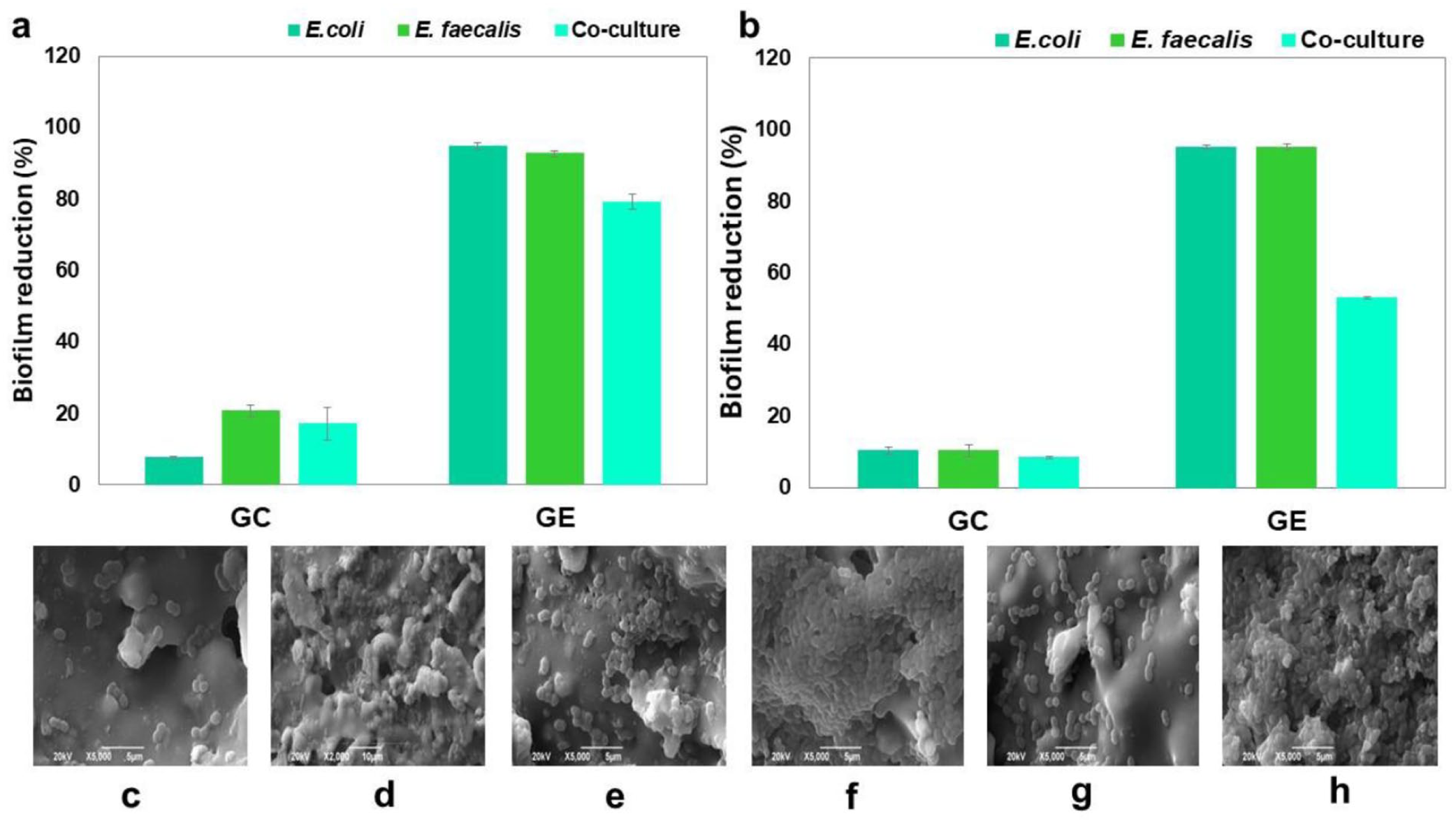
Percentage reduction of biofilm formation by Escherichia coli, Enterococcus faecalis, and their co-culture on control scaffolds (GC) and experimental scaffolds (GE) after (a) 24 h and (b) 48 h of incubation. SEM micrographs of scaffolds: (c) experimental (GE) incubated with E. coli for 24 h; (d) control (GC) incubated with E. coli for 24 h; (e) experimental (GE) incubated with E. faecalis for 24 h; (f) control (GC) incubated with E. faecalis for 24 h; (g) experimental (GE) incubated with co-culture for 24 h; and (h) control (GC) incubated with co-culture for 24 h.
The MTT assay revealed time-dependent differences between CG and EG scaffolds. After 48 h, EG exhibited a statistically significant reduction in cell proliferation compared to CG (p = 0.015). Nevertheless, EG values remained within non-cytotoxic ranges according to ISO 10993-5, indicating that functionalization does not induce severe adverse effects during early culture.50,51
After 7 days, CG reached 92.6 ± 1.6% proliferation, while EG showed 88.9 ± 2.2% (p = 0.0079). EG values remained above the 80% threshold, confirming absence of severe cytotoxicity. This slight reduction may be associated with surface characteristics or sustained release of functionalizing agents. 5
These results demonstrate that functionalized scaffolds maintain short- and long-term cellular compatibility under the tested conditions. However, this assessment used L929 fibroblasts and does not directly address safety for drinking water consumption. Long-term leaching behavior and potential human exposure risks through treated water remain to be evaluated.
Conclusion
3D-printed gyroid ceramic scaffolds incorporating activated carbon and dual antimicrobial functionalization (AgNPs + M. oleifera) demonstrated interconnected open porosity, adequate mechanical stability, silver leaching below WHO limits, moderate-to-high antimicrobial activity of the plant extract, and significant biofilm reduction (80%–95% at 24 h), while maintaining cellular compatibility above the ISO 10993-5 threshold. The following limitations must be acknowledged: (i) Bingham parameters for 40 wt% paste were estimated by extrapolation and require direct experimental validation; (ii) MTT-based biofilm assays are indirect and require CFU or live/dead confirmation; (iii) cytotoxicity was assessed with L929 fibroblasts only, not modeling ingestion risks; (iv) silver leaching was evaluated only short-term with distilled water. Essential water purification parameters—flow rate, filtration efficiency, turbidity removal, microbiological log-reduction, and long-term stability under real-water conditions—must be addressed in future studies before any claim of suitability for drinking water treatment can be made. These results collectively support further development of this scaffold design as a multifunctional ceramic filtration platform.
Footnotes
Acknowledgements
The authors would like to thank the Ministry of Science, Technology and Innovation of Colombia (Minciencias) and the Orchids Programme: Women in Science 2024 programme for providing the resources necessary to carry out this research (Project Hermes code 65391). The authors also express their gratitude to the community of La Paz, Cesar, Colombia, for their collaboration and participation in the development of this project, And a Special acknoledgement to Universidad Cooperativa de Colombia (Project Nº 3557, 2024).
ORCID iDs

Ethical considerations
Ethical approval was not required for this study because it did not involve human participants, animals, or personal data.
Funding
The authors disclosed receipt of the following financial support for the research, authorship, and/or publication of this article: This work was supported by the Ministry of Science, Technology and Innovation of Colombia (Minciencias) through the Orchids Programme: Women in Science 2024, under project number 172-2024 (Hermes code 65391).
Declaration of conflicting interests
The authors declared no potential conflicts of interest with respect to the research, authorship, and/or publication of this article.