



Abstract
Malls in India have flourished in recent years. This has resulted in transformation of the Indian retail and metamorphosis of consumer behaviour. The shopping behaviour is predominately influenced by motivations; therefore, this article aims at extending the shopping motivations theory to Indian market. This article aims at identifying the mall shopping motivations and their effect on the Indian consumers’ mall patronisation intention. The extant literature recognises mainly two shopping motivations: utilitarian and hedonic motivations. This research extends the existent shopping motivation theory by supplementing it with materialism as another salient shopping motive. The role of materialism, utilitarian and hedonic motivations is examined on the Indian consumers’ mall patronage intention. The study provides theoretical contribution to the research by identifying materialism as a significant predictor of mall patronage intention in the Indian context. The results of the study unfold the motives shaping the Indian consumers’ mall behaviour.
Mall Shopping Motivations in an Emerging Economy
Emerging markets like India have recently witnessed salient growth of organised retail formats like malls. India has emerged to be seventh largest retail market in the world (Pick & Muller, 2011). A.T. Kearney report (2011) ranks the country at fourth place on the Global Retail Development Index and perceives that it is the opportune time to tap the market as it has very favourable growth fundamentals. By 2050, the country’s retail business is projected to rise to US$ 750–850 billion (Deloitte, 2013). The increasing consumer buying power will amplify the retail growth (Sengupta, 2008) and the country is poised to become a retail powerhouse (Srivastava, 2008). It is among the most promising retail markets of the world (Singh & Bose, 2008), but still it is the most underpenetrated retail market of the world (PWC, 2011). The growth of organised retail in India can be ascribed to the growing economy and rapid mall development (Kuruvilla & Ganguli, 2008).
Malls are likely to be frontrunners for the growth of organised retail in India (Pookulangara & Knight, 2013). It is anticipated that within few years considerable amount of country’s retail business will shift to the malls (Kuruvilla & Ganguli, 2008). It is vital that the mall managers formulate the mall strategies according to the consumers’ preference (Khare & Rakesh, 2011). The changing retail ambience has made the consumers unpredictable (Singhi, Mall & Bhalla, 2013). Although consumers are spending time in malls but they are not motivated to shop in them (Kuruvilla & Ganguli, 2008).
Motivations are the main reason for people to behave in a particular way (Graham & Weiner, 1996). They are the principal driving force within consumers for which they shop (Jamal, Davies, Chudry & Al-Marri, 2006). Motivations affect shopping (Kang, Kim & Tuan, 1996), and are responsible for various shopping activities in the mall (Farrag, El Sayed & Belk, 2010). They are responsible for store patronage intention (Jin & Kim, 2003; Noble, Griffith & Adjei, 2006). The buyer behaviour models recognise that the shopping behaviour is primarily influenced by motivations (Pearce & Coughlan, 2012). Thus understanding of shopping motivations may provide better understanding of mall shopping behaviour.
Shopping motivations is a field that has been pursued considerably in the realms of consumer research. Shopping motivations have been primarily categorised as utilitarian and hedonic (Ahtola, 1985; Babin, Darden & Griffin, 1994; Batra & Ahtola, 1991). The consumers are aware about these motivations but some motivations like materialism unintentionally motivates the consumers to shop (Goldsmith, Flynn & Clark, 2011). The continuous exposure of individuals to consumption propagating marketing messages makes an individual adopt materialistic values in their own belief systems, which influence the goals, attitudes and behaviour (Kasser, 2002). Materialism provides meaning and purpose to one’s life (Richins & Dawson, 1992). Although the time and money spent by consumers and social consumption motivations are positively correlated to their materialistic tendencies (Fitzmaurice & Comegys, 2006) but there is little research that gauges the effect of materialism on mall patronage intention.
These shopping motivations differ in different cultures, as it is evident that Chinese consumers place more value on hedonic than on utilitarian experiences (Zhang, Sirion & Howard, 2011), while the Hungarian consumers are more utilitarian and less hedonic (Millan & Howard, 2007). The consumer decision-making changes as the economy developsand it is evidenced in the context of Indian consumer market (Lysonski & Durvasula, 2013). The existent literature is devoid of research on the Indian mall shopping motives and behaviour. Hence it merits understanding the mall shopping motivations of the consumers in this emerging organised retail market. This article intends to study the motivations that impel the Indian consumers to shop in the malls. The study aims to investigate the effect of materialistic, hedonic and utilitarian motives on consumers’ mall patronage intentions in the emerging market. The study is expected to contribute to the theory of shopping motivations and serve as an important input for mall marketing in the Indian market.
Summary of Shopping Motivations

Source: Author’s compilation.
Literature Review
Shopping is one of the important activities of consumers (Tauber, 1972), and therefore, it plays a salient role in the many theories of consumer behaviour (Goldsmith et al., 2011). Motivation is one of the highly relevant concepts for consumer behaviour research (Wagner, 2007). Shopping motivations are the reasons or goals, which inspire people to go for shopping (Arnold & Reynolds, 2003; Puccinelli et al., 2009). Extant literature has postulated a range of shopping motivations (Table 1). Tauber (1972) postulated eleven motives for shopping and clubbed them into two main categories: personal and social. Westbrook and Black (1985) posited seven types of shopping motivations. Kim, Kim and Kange (2003) identified five types of mall-shopping motivations. El-Adly (2007) has identified easiness, entertainment, variety, convenience, mall essence and luxury as the reasons for shopping. Wagner (2007) has proffered three types of shopping motivations: social, experiential and utilitarian. According to Rajagopal (2009) the major factors affecting mall consumers are entertainment, location, atmosphere and appeal related to product, brand and price. However, there are numerous motives recognised in the extant literature that can be primarily classified as utilitarian and hedonic. The hedonic and utilitarian aspects incorporate the motivations of shopping behaviour (Batra & Ahtola, 1991).
Utilitarian Motivations
Utilitarian motivations refer to economical and functional aspects of the products that stimulate consumers to shop (Babin et al., 1994). It denotes the consumers’ evaluation of a product’s utilitarian value and its operative attributes (Batra & Ahtola, 1991). Utilitarian shopping is aimed at making the correct product purchase based on its functionality or performance (Fiore & Kim, 2007). Utilitarian shoppers usually do not relish shopping, as they visit malls only for buying specific products (Babin et al., 1994). The utilitarian shopping behaviour is deliberate, task-related, efficient and rational (Farrag et al., 2010).
Hedonic Motivations
Traditionally shopping research had regarded utilitarian aspect as one of the main determinants of buying behaviour. Levy (1959) was one of the initial scholars who suggested that shopping for consumers was a playful activity. Tauber (1972) demonstrated that consumers’ might be guided by motivations that could not be related to the actual buying of products. This led to the recognition that the consumer buying is motivated by hedonic considerations (Arnolds & Reynolds, 2003; Childers, Carr, Peck & Carson, 2001; Westbrook & Black, 1985). Hedonic aspects for consumer behaviour denote the sensory, imaginary and emotional aspects of shopping (Hirschman & Holbrook, 1982). The hedonic consumption provides emotional fulfilment to the consumers, which is derived from shopping environment, information search and socialisation outside home (Kim et al., 2005).
Arnold and Reynolds (2003) has identified six main shopping motivations, namely, adventure, social, gratification, idea, role and value. Adventure shopping denotes shopping for adventure, pleasure, thrill, stimulation and fantasy. The social shopping refers to socialisation with friends and family during the course of shopping. Gratification shopping signifies shopping for stress relief, alleviating mood and treating oneself. Idea shopping involves shopping to collect knowledge about new styles, fashions, products and innovations. Role shopping signifies the satisfaction derived from buying the ideal gift for others. Value shopping indicates the gratification derived from looking for bargains, discounts and sales.
The utilitarian and hedonic motives could be construed as the precursors of shopping behaviours (Guido, 2006). The consumer’s assessment of a mall providing good hedonic and utilitarian value leads to superior customer satisfaction (Ha & Im, 2012). Different ethnic consumers differ greatly in their motivations for consumption activities (Hirschman & Holbrook, 1982). Consumers in different cultures visit shopping mall for different reasons. Chilean consumers visit malls for utilitarian purpose (Nicholls, Mandokovic, Roslow & Kranendonk, 2000); Americans visit malls for entertainment (Iksuk, Tim, Richard & Hyunjip, 2005), Hungarians value the utilitarian aspects (Millan & Howard, 2007) and Chinese regard hedonic aspects for mall shopping (Zhang et al., 2011). There is a link between a nation’s economic development and importance assigned to hedonic shopping experience (Millan & Howard, 2007). In India there is a shift in mall shopping motivations from utilitarian to hedonic (Khare, 2011). This necessitates understanding the consumer motives for mall shopping in the transitional economy.
Materialism
Materialism reflects the significance a consumer ascribes to ownership and acquisition of material goods (Belk, 1984; Richins, 2004). Materialists believe that materialistic possessions are way to happiness (Richins, 1987). People pursue materialistic goals because they feel that worldly possessions are essential to good life and can provide happiness (Pollock & McCullogh, 2006; Richins, Kim, McKeage & Najjar, 1992). Materialism can be aptly conceptualised as a consumer value as higher level of materialistic orientation serves as a goal to be achieved (Richins & Dawson, 1992). Materialism serves as a great source of satisfaction in life (Belk, 1984).
Materialism influences the nature and quantity of consumption (Richins & Dawson, 1992). Acquiring more possessions serves as motivation for materialists as it provides them social status and compensates for low esteem (Fitzmaurice & Comegys, 2006). Malls offer consumers diverse products and services, so are the evolving centres for satisfaction and reinforcement of materialistic values (Telci, 2013). Materialism rise is apparent in the emerging Indian society (Lysonski & Durvasula, 2013); therefore, this study adopts it as another motive responsible for mall shopping.
Mall Patronage Intentions
Intentions are supposed to extract the motivational aspects that impact the behaviour (Ajzen, 1991). Intentions are the straight precursors of behaviour and play a salient role in directing behaviour. Stable intentions are good predictors of consequent behaviour (Ajzen, 2001). As intentions indicate the extent to which the people are motivated to perform a particular action, so strong intentions imply that people are more likely to indulge in a particular behaviour (Ajzen, 1991). This study examines the relationship of various motivations with mall patronage intention. It is hypothesised that utilitarian, hedonic and materialistic motives will significantly influence the mall patronage intentions.
Method
Since the study was related to mall patronage so the mall-intercept interview method was adopted. The mall intercept method has been well accepted (Hornikk & Ellis, 1988), as it is convenient, cost effective and easy to implement (Burns & Bush, 2003). The mall visitors are more regular shoppers and so divulge superior information (Bush & Hair, 1985). The study was conducted across the various malls of Chandigarh city a tier II city in north of India. Chandigarh is second on per capita spending (Jones Lang LaSalle, 2011) and ranks high on brand awareness in the country (Jones Lang LaSalle, 2008).
Mall visitors were contacted and administered self-completion questionnaires. The questionnaire was a part of larger questionnaire and contained multiple items derived from extant literature. The items related to motivations were measured on a 5-point Likert scale. The variables under study were operationalised using published scales. Arnold and Reynolds’s (2003) hedonic motivation’s scale being the most extensive scale on measuring hedonic motivations was adapted for this study. The utilitarian motives were measured with Babin et al. (1994) scale. Richins (1987) materialism measure was employed to operationalise materialism. The construct ‘mall patronage intention’ was operationalised by Taylor and Todd’s (1995) scale as employed by Pookulangara and Knight (2013). The scales were adapted to Indian context, as they have been widely used and have established cross-cultural validity and reliability. Further they have been successfully employed in earlier studies (Khare, 2011; Pookulangara & Knight, 2013) in the Indian context. The section related to demographic variables composed another section of questionnaire.
Initially 600 mall visitors were contacted in the malls of Chandigarh city and administered questionnaires. Only completely filled questionnaires were used for further analysis and it resulted in sample size of 535. The sample comprised of 58 per cent females and 42 per cent males. Although the age of sample ranged from 18 to 70 years but majority of the sample comprised of respondents in age group of 20–30 years.
Results
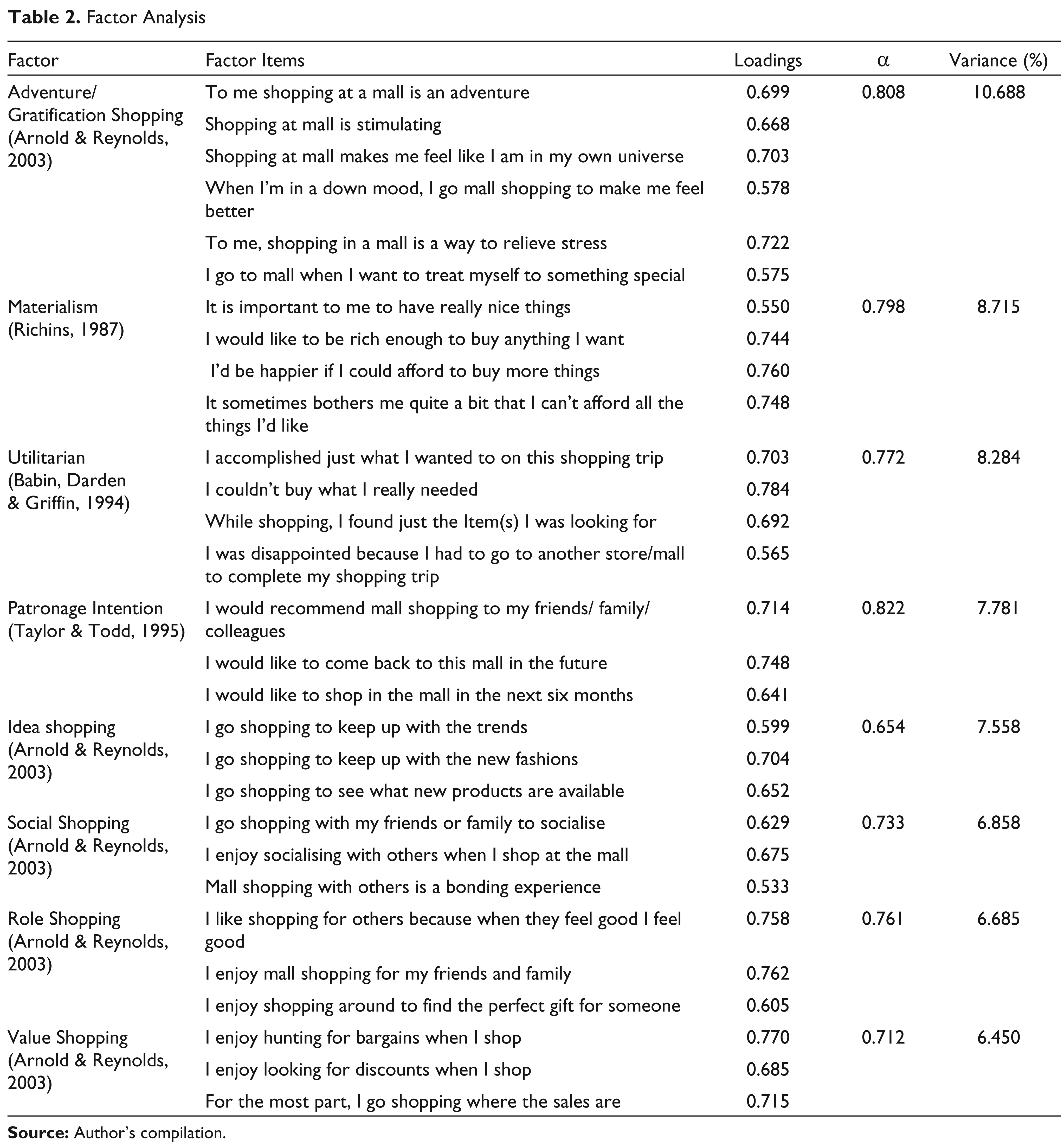
Data analysis was carried on using 535 complete filled questionnaires. The factor analysis was conducted to verify if the items converged into factors as in prior research and to confirm the applicability of the scales to the Indian consumers. Exploratory factor analysis was performed employing varimax rotation. The value of KMO measure was 0.864 and it confirmed the correctness of the factor analysis. The Barlett’s test established the correlation among the items (χ2 = 7052.158, p < 0.001). Eight factors having Eigen values above one were extracted and they accounted for 63.018 percentage of total variance (see Table 2).
Factor loadings above 0.50 are practically significant (Hair, Black, Babin, Anderson & Tatham, 2009) hence factor loadings above 0.5 were considered for analysis. The first factor extracted had a high loading (above 0.5) of items related to ‘adventure’ and ‘gratification’ aspects of hedonic shopping (α = 0.808). This factor was responsible for 10.688 percentage of variance and saw the convergence of Arnold and Reynolds (2003) ‘adventure’ and ‘gratification’ into single factor as in an earlier study of O’Brien (2010). The second factor included the items of ‘materialism’ (α = 0.798). Items of the ‘utilitarian motivations’ loaded on the third factor (α = 0.772) and the items related to ‘mall patronage intention’ converged on the fourth factor (α = 0.882). The fifth factor had items related to ‘idea shopping’ loaded on it (α = 0.654) and the sixth factor comprised of items related to ‘social shopping’ (α = 0.733). The seventh factor showed the emergence of ‘role shopping’ aspect (α = 0.761) and the eight factor had items related to ‘value shopping’ loaded on it (α = .712). The factor analysis results established the convergent and discriminant validities for the constructs. The Cronbach’s alpha values confirmed the reliability of the constructs.
To understand the role of utilitarian, hedonic and materialism motivations in predicting the mall patronage intention hierarchical method of multiple regression analysis was performed. The results showed the support for all the hypotheses and elucidated that the three motivations significantly predicted mall patronage intentions.
The regression analysis produced seven models (see Table 3). The first model showed that materialism was a strong predictor of mall patronage intention (R² = .085, p < 0.001). The R² value in the first model revealed that the independent variable ‘materialism’ accounted for 8.5 per cent of variance in the prediction of mall patronage intention.
Factor Analysis
Source: Author’s compilation.
The β value (0.294) shows the materialism as the significant contributor for mall patronage intention. The results of ANOVA test display the significance of materialism in the regression model (F = 50.307, p < 0.001). It indicates that materialism is an important motivator for mall shopping and is a salient predictor of mall patronage.
In the model 2, ‘adventure and gratification’ aspects of hedonic shopping were introduced along with materialism. Both the variables, namely, ‘adventure and gratification’ and ‘materialism’ surface as significant predictors of mall patronage (R² = 0.157, p < 0.001). Both these variables are responsible for 15.7 per cent variance. There is increase in variance with the entry of ‘adventure and gratification’ in the model. It suggests that as the ‘adventure and gratification’ motivation increases the mall patronage intention also increases. ‘Materialism’ and ‘adventure/gratification’ have respective β values of 0.294 and 0.266, which explain the corresponding contribution of these motivations to the model. The results offer substantiation for the effect of the ‘adventure and gratification’ measure on the mall patronage.
Regression Results—Mall Patronage Intention

Source: Author’s compilation.
The third model tested the addition of variable ‘social shopping’ along with ‘materialism’ and ‘adventure/gratification’. The three variables collectively were responsible for 18.6 per cent of variance (R² = 0.186, p < 0.001). It indicates that the three variables were salient predictors of ‘mall patronage intention’. The variable ‘social shopping’ had a β value of 0.172, which exhibited the contribution of the variable to this model.
The fourth model demonstrates the predictive efficacy of ‘utilitarian’ motivations for mall patronage intention (R² = 0.209, p < 0.001). The utilitarian motivations along with materialism, adventure/gratification and social shopping show the predictive regression of this model (β = 0.152, F = 35.072, p < 0.01).
The R² for the fifth model shows that the addition of independent variable ‘role shopping’ along with the earlier considered variables account for 22.9 per cent of variance. The β value of 0.141 shows the contribution of ‘role shopping’ to the model. The ANOVA test for the model explains that the predicted regression by ‘role shopping’ is significant (F = 31.431, p < 0.001). Thus it implies that shopping for others serves as an important motivation for mall shopping.
The sixth model demonstrates the addition of the ‘value shopping’ motivation to the variables in the fifth model. The motive ‘value shopping’ to the model shows the relevance of it in predicting the consumer intentions and behaviour. It has demonstrated that self-image perception plays an important role in affecting mall attitude and behaviour (F = 28.664, p < 0.001).
The seventh model has all the motives included in it with a total variance of 24.7 per cent (R² = 0.257). The ANOVA test shows that the hedonic, utilitarian and materialism act as significant motivators for mall shopping intention (F = 25.980, p < 0.001).
Discussion
The results of this research reveal that utilitarian, hedonistic and materialistic aspects motivate mall shopping. The factor analysis demonstrates that among these motivations the ‘adventure and gratification’ emerge as the most important reasons for mall shopping patronage. The results support the earlier studies (Kaur & Singh, 2007; Khare, 2011) that Indian consumers are hedonically motivated. The mall management should design the mall ambience so that it satiates the adventurous and gratification goals of the consumers. It would be necessary for malls to have pleasing environment and to offer additional opportunities for fun and adventure. The mall interiors and services that provide a space for stress relief and mood improvement could be key attractions for the customers. Malls incorporating multiplexes like cinemas, food courts and children play zones are becoming places for family holiday (Srivastava, 2008). The presence of recreational facilities would augment the shopping experience and help in converting the footfall into sales.
Materialism has emerged to be the main predictor of mall shopping intention (β value = 0.294). The rising affluence has led to proliferation of materialistic values, which could act as significant contributors for consumption. This corroborates the earlier observations that Indian consumers are increasingly adopting materialism (Lysonski & Durvasula, 2013). Materialism would affect customer satisfaction if the products bought represent owners’ social status and social recognition (Richins, 1994; Wang & Wallendorf, 2006). Global luxury brands that are symbolically self-expressive and demonstrate financial accomplishment are purchased in quest for self-enhancement. This necessitates that the mall management ensures the presence of global brands and symbolic tenants in their premises. The promotional advertisements should highlight the importance of mall shopping as an expression of material possessions and financial success. Mall managements in India could promote mall shopping as a way to gain attention and to augment conspicuous consumption.
Utilitarian shopping serves as another important motivator for mall shopping intention. Traditionally Indian consumers being utilitarian in their approach, the malls should incorporate the entire product range to fulfil the utilitarian shopping goals. The hassle free one stop-shopping environment along with convenient layout would facilitate quick shopping thus providing utilitarian value. Mall management must pay close attention to factors that increase consumers’ value in the mall and provide for safe parking, information counters and empathetic customer care. This will facilitate convenient shopping and further amplify the consumers’ self-ability shopping beliefs.
India being a collectivistic society (Hofstede, 2001) socialising and buying for others are important components of daily life. The mall infrastructure should provide sufficient scope for social goal fulfilment. Spacious food courts along with ample seating capacity would quench the customers’ desire for socialisation. The mall management could foster socialisation by arranging frequent customer meets and fests within the mall. This could serve another mall selling proposition for the companies. The role-shopping motive could be filled by promoting the mall as a place for shopping mavens for their self-image congruence. Innovative bargain schemes could satiate the value shopping pursuit of the customers. The well-informed promotion campaigns regarding bargains and price discounts could augment the mall footfall of value seekers. The customers seeking idea-shopping value should be identified and be regularly informed about the latest trends and fashions.
Conclusion
The study provides theoretical contribution to the research repository by proving that materialism plays a vital role in predicting the retail patronage. It extends the earlier classification of mall shopping motivations with the addition of materialism as another important motivation. The emergence of malls along with changing customer incomes and needs has changed the Indian retail sector. The companies are trying to comprehend the retail behaviour. This study underpins the various motivations that spur the Indian mall shopping behaviour. It is assumed that the study’s findings would facilitate decisions for better mall management. Further the incorporation of these motives as inputs for the mall marketing strategies could positively impact customers’ derived shopping value, satisfaction and loyalty.