



Abstract
In the current era of digital infusion, customer behaviour is highly fluctuating. This has resulted retailers to be in a confused situation. The current need of the situation is to understand this change in customer behaviour and strategise accordingly. The purpose of the current study is to investigate the drivers of the channel choice, in relevance to travel industry. The study presents a conceptual model that reflects the antecedents to customer channel choice in travel industry. The article is based on a qualitative research analysis using semi-structured interviews to systematically collect and analyse the data. A sample of 25 retailers and 27 customers were selected and interviewed. A grounded theory approach has been adopted to generate a conceptual model. The article identifies several antecedents to channel choice in travel industry. Factors such as customer awareness, urgency of purchase, promotions and facilities have been highlighted and elaborated through the three-staged coding process. The other antecedents of the channel choice that have been highlighted through the verbatim are catchment area, family influences and affordability. In travel industry, channel structures have been well-studied. These studies dominantly focus on the players of the channel or the role of the middleman. The current study is unique in the way it explores the channel choice of customers after understanding both the extremes of the channel, that is, retailers and the customers. Also the methodology used is unique in its own way.
Introduction
In recent era, we have witnessed more digitisation (Leeflang, Verhoef, Dahlström, & Freundt, 2014), and emergence of digital platforms has led to a shift of pure offline to multichannel platforms. A trend pointed out by Chakravarthi Narasimhan that channels are blurring highlights that it is really difficult to identify pure digital or physical channel players. This is because the way customers are behaving towards these changes is abrupt. The way the shoppers are behaving is continuously changing. Researchers are trying to analyse these reactions and thus the research on omnichannel retail environment is picking up pace. Recently a special issue of Journal of Retailing classifies the research in omnichannel into three groups: (a) impact of channels on performance, (b) shopper behaviour across channels and (c) retail mix across channels. The scope of the current article is to evaluate the channel choice phenomenon of customers in travel and tourism industry. In a country like India where the number of foreign tourist’s arrivals were 8.8 million in 2016, domestic and foreign combined tourist visits in 2015 were 1431.97 million with an annual growth of 11.6 per cent and reached to 1613.55 million in 2016 further increasing by 12.68 per cent (India Tourism Statistics, 2017).
Travel Industry is one of the fastest growing industry in India. With the introduction of many online players such as MakeMyTrip (MMT) and Goibibo.com, the travel convenience has increased to a greater extent. In a digital era where from travel planning to implementation is all online now, the overall time taken by the customer to plan the travel has reduced to a greater extent. And not only the global or national players are trying their hand on digital platforms but also the regional and the local emerging players are entering into this. The number of options available in terms of service providers has really increased and hence impacted the convenience of the customers. When we talk about channel choice, the phenomenon is not new, however, the introduction of technology and digital platforms has increased the customer awareness. It is now a daily routine for a customer to select and swap channels for shopping across categories. This has led to increased difficulties for companies involved in travel industry to predict the customer swapping behaviour. Hence, the companies need to be present at all channels and provide a seamless experience. This has increased difficulties for the local and regional players who tend to be in this business since generations in a single channel. As clearly quoted by a local travel agency retailer, operating with bricks and motor format, ‘People used to come very often whenever they had to book tickets and also take advices to plan a travel. Now they do not. The number of people coming to us has decreased. They know how to do it online now’.
This clearly indicates that the introduction of new technologies, rapidly changing customer’s demand and variety of choice made available has changed the way customers used to choose their channels. This in turn increases the challenge of the market travel agencies which have to constantly adapt themselves as per the customer’s demand and provide multiple services and offer services better than their competitors (Farag, Schwanen, Dijst, & Faber, 2007). The emergence of new tourism services and products, coupled with a rapid increase in tourism demand, have driven the wide-scale adoption of ITs in general, and in particular, the internet as an electronic intermediary. In other words, the internet serves as a new communication and distribution channel for e-travellers and suppliers of travel services and products. This new channel has also enabled tourism businesses to improve their competitiveness and performance.
In the current research, we try to explore the antecedents to channel choice in travel industry. This exploration will guide us to create a conceptual model which would include multiple facets from retailers and customers both. This study would be a guiding path for the travel agents (middleman) and the online travel platforms, such as MMT, Yatra and Goibibo.com, to understand how customer selects the channel before making a purchase. Customer orientations and tasks in channel selection will be captured.
Literature Review
Indian tourism is expanding day by day and it can be seen as the way foreign tourist’s arrival in India is increasing. In 2014, the foreign tourist arrivals in India were 7.67 million and 10.2 per cent growth was seen from previous year and in 2015, foreign tourist’s arrival in India reached 8.02 million again growing to 4.5 per cent compared to previous year and further increase of 9.7 per cent is seen taking the tally of foreign tourists arrivals to 8.8 million and it is estimated to grow at 15.6 per cent and reach to 10.1 million in 2017 (India Tourism Statistics, 2017). Tourism in India is third largest foreign exchange earner for the country and accounts for 9.6 per cent of the country’s GDP, contribution of tourism sector to Indian GDP stood at US$ 71.53 billion in 2016 and it is expected to reach US$ 147.96 billion by 2027 (World Travel & Tourism Council, 2017). Indian tourism is not only growing in terms of foreign tourist’s arrival but also in case of domestic tourist’s arrival. Domestic and foreign combined tourist visits in 2015 was 1431.97 million with an annual growth of 11.6 per cent and reached to 1613.55 million in 2016 further increasing by 12.68 per cent (India tourism statistics, 2017). India being an attractive destination for tourists has seen a plunge in the year-on-year growth. Also, the innovations and digital technologies coming in has changed the face of travel and tourism. Keeping the growth of the sector in mind and the changing face of the shopping interface, many researchers have tried to understand the impact of ICT on travel and tourism industry.
The rapid advances in computing power, use of mobiles and connectivity is of no surprise that majority of modern disruptions are basically of digital nature (Productivity commission, 2016). There are many small firms entering the market and offering inferior but technology-oriented services at cheaper rates to the consumers. The same has been applied in tourism players. These digital disruptions are having a deep impact on the tourism and hospitality industry and these disruptions are leading to a change in the consumer behaviour as well (Hughes, 2018). These digital innovations are in the form of Online Travel Agents’ (OTA’s) apps and bots, helping the customers in online bookings, trip planning and reviewing the trips and nowadays more than 50 per cent of the hotel bookings are done online (Net, 2015). Our primary aim was to understand from the local retailers (offline) that whether the new channel innovations have impacted their business or not and in what sense. As we see around, these technologies have led to inception of many small and online platforms which have made consumers task easy. Several digital platforms such as Goibibo.com, MMT, TripAdvisor, trivago N. V., Cleartrip and many more offer various range of services with lower transaction costs and reduced information irregularities. The digital revolution has the power to both create and destroy occupations and more importantly the digital disruption will lead most of the people lose their jobs (Chai, Eccleston, Hardy, & Tinch, 2017). But it is not as simple as it looks. Challenges for single-channel brick stores are increasing. As customers are behaving differently with multiple channels, the task of retailers is even more challenging.
According to Skallerud (2016), the customers today are multichannel shoppers and these shoppers are more innovative in their approach than bricks and mortar shoppers, they have positive attitudes and they are not confined to using single channel they prefer going for multichannel and try new products. Moreover, with emergence of multiple platforms of shopping, the industry has seen a tremendous shift from offline buying to online buying. Some studies have pressed that it would be beneficial for multichannel retailers to integrate their assortments and offer more of their products online and lesser number of products offline (Helke, 2018). The most focused challenge is information integration and coordination of resources to provide a seamless customer experience. Without a strategic fusion and purpose, multichannel initiatives can take the organisation nowhere.
Channel Choice Behaviour of Customers
Channel is the point of contact where both business and customer interact among themselves (Neslin et.al, 2006). In travel industry, consumer choice decision are those decisions which a consumer take to buy a product or service among the variety of channels that are available to him—it may be offline as well as online channels (Richards, 2015). The emerging multichannel retail of bricks and mortar store and online channel has led to complexity in the buying behaviour of the customer and also has led to differences in their channel choice as different channels are available to them for purchase (Alba et al., 1997; Peterson, Balasubramanian, & Bronnenberg, 1997). Social media, digital platforms and other emerging forms of online communications have enormous impact on travel behaviour of customers and also on the planning process of travellers (Xiang, Magnini, & Fesenmaier, 2015). The interactive technologies and the use of mobile technologies is making the travel purchase decision more complex and is creating an interconnection among different channels. Thus, the channels which the travellers are using for their purchase decision is becoming more and more important for the retailers (Lamsfus, Wang, Alzua-Sorzabal, & Xiang, 2015).
The current generation customers have more options to choose from, so retailers need to be cautious to understand the customer buying phenomenon. Which in turn will help them understand the customer preferences for different channels. Like when does a customer buy from online versus offline? Is it really important for a retailer to be omnipresent? These questions will help the local retailers and the travel online brands carefully design the channels based on the customer involvement and preferences. This article extends research on tourism distribution channels, a topic dominated by studies of providers and intermediaries, by addressing the usage of multiple channels from the customer’s view point.
Development of Internet Channel in Travel and Tourism
The tourism product can be characterised as intangible, experiential and perishable. Traditional marketing, distribution and, subsequently, customer services related to the product relied upon the so-called ‘intermediaries’ (e.g., tour operators and travel agencies), other agencies such as destination marketing organisations (DMOs) as well as media channels to connect and engage with travellers. As such, product distribution and customer services were limited in their scope and reach in the pre-internet era (Xiang et al., 2015). Internet has been a platform that has facilitated continuous technological innovations and given platforms to multiple business channels which has altered the competitive landscape of travel industry in India. Continuous technological advances with the changing preferences of the customers have expanded the range of channels that tourism suppliers were using to distribute their products, and nowadays, distribution through multichannel has become common. Customer travel planning has seen a tremendous shift with inception of these multiple channels (Xiang et al., 2015).
Customer’s awareness in India has increased and thus they choose their channel depending upon their preference. Each channel or path to the market may appeal to different segments, suit some products more than others and have a simple or complex structure. We can see customers who do most of their research using internet but end up buying from a travel agent. And also see customer who now completely rely on online platforms for their travel planning. So broadly, customer’s journey is divided between two channels, that is, online as well as offline channel (Neslin & Shankar, 2009). Sternthal and Craig (1982) argue that marketing channels should be viewed as an orchestrated network that creates value for the user or consumer through the generation of form, possession, time and place utilities. Depending upon the value the customer gains from these channels, they choose the channels. The goal of this article is to review recent developments in customer shopping preferences in travel industry and then synthesise these findings to suggest the scenario as to when do customers choose online platforms versus offline platforms.
Research Methodology
The literature in context of channel choice in travel industry is scanty. Although plentiful of work has been conducted on distribution and role of middleman in the travel and tourism industry, but none of these studies talk about customer’s perspective. The study adopts a qualitative approach based on the grounded theory approach (Corbin & Strauss, 1990). A grounded theory is characterised through the systematic collection and analysis of data related to a specific task or a phenomenon (Strauss & Corbin, 1998). Very few studies could be found in the field of channel choice behaviour which have applied grounded theory. Since the focus of the current study is on examining the channel choice behaviour of the customers, we decided to select our sample from a tourism rich state in India, that is, Jammu and Kashmir (J&K). The number of tourist visits in J&K for the year 2016 were 8.43 million and 7.30 million until October 2017 (India Brand Equity Foundation, 2018) and ranked 12th in domestic tourists visits and 17th in foreign tourists visits in 2016 (Thadani, 2017). For the current study, we targeted the customers themselves and the travel retailers having an offline or online channel or both. The Research Questions (RQ) for the current study were as follows:
RQ1: Changes in the customer shopping preferences with new channels of shopping coming into the picture. RQ2: When does a customer prefer online channel over offline channel in travel planning?
The travel agents as well as the customers were selected from the Jammu province of J&K, India. Semi-structured in-depth interviews were conducted for collecting data. The interviews were conducted by the authors. The interview questions are appended in Appendix 1. A total of 25 unstructured interviews of the travel agents (vendors) who were directly linked with the travel services (ticket bookings, hotel bookings, vehicle bookings and customised packages) were interviewed. We stopped at 25, when the data coming to us seemed to saturate. Data saturation means that with the continuous collection and analysis of additional data, no new concepts are developed and additional data do not require changes in conditions, characteristics or consequences of the existing categories (Strauss & Corbin, 1998). Also, 27 customers having exposure of all channels were selected through simple random selection. We approached around 50 customers at different locations such as ticket-booking stores (local ticket agents) and travel-planning stores (Thomas Cook). Each interview was conducted and converted into the verbatim which means it was recorded in the same manner as the interviewee said. The set of interviews were initially started by asking the retailers and the customers about their willingness to participate in the discussion. All the interviews were done with one person at a time and was started when they were ready to participate in the discussion. Also, to satisfy the retailer and customer queries of discussion, both the customers and retailers were informed about the objective of the study and were told that why this interview is happening. These qualitative based interviews helped generate research dimensions which, in turn, lead to development of a conceptual model (Creswell, 1998).
Data Analysis
The recorded interviews were first converted into a verbatim by writing in similar manner as they responded which, in turn, was subjected to grounded theory based analysis (Glaser & Strauss, 1967). A total of four independent investigators read the transcripts which helped us check the validity of the data. They conducted open coding of these transcripts, which generated qualitative statements that showed a general behaviour of channel choice of customers. The general statements were thereafter searched for in existing literature on the subject in order to identify whether the codes could be related with any theme from the relevant literature. Thereafter, a round of axial coding (Strauss & Corbin, 1998) was conducted to sort the descriptions into 67 first order statements. The details of the emerged subthemes, concepts and the categories have been shared in Table 1. The emerged conceptual model is given in Figure 1.
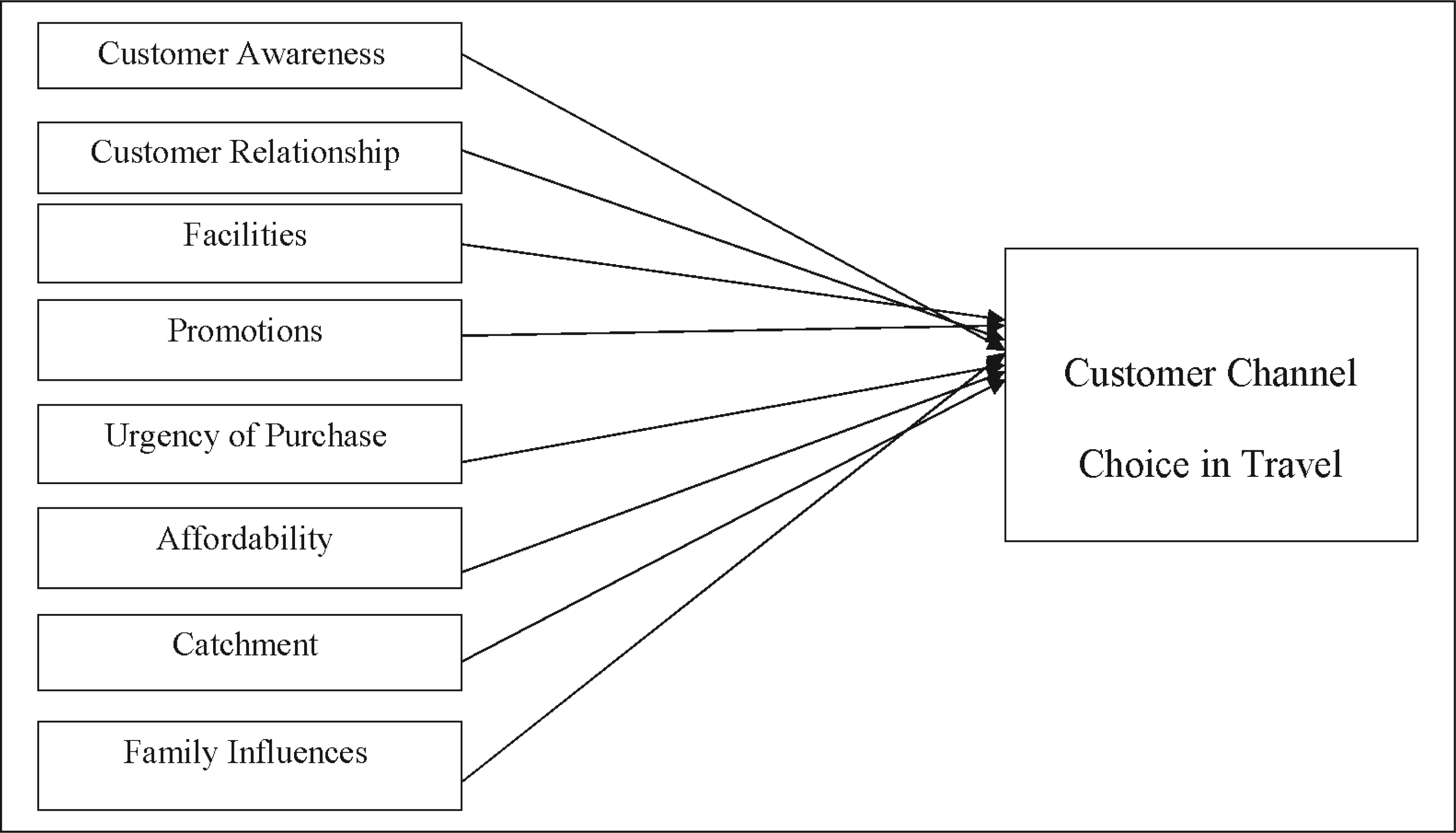
Conceptual Model of Channel Choice Behaviour of Customers in Tourism Industry of J&K
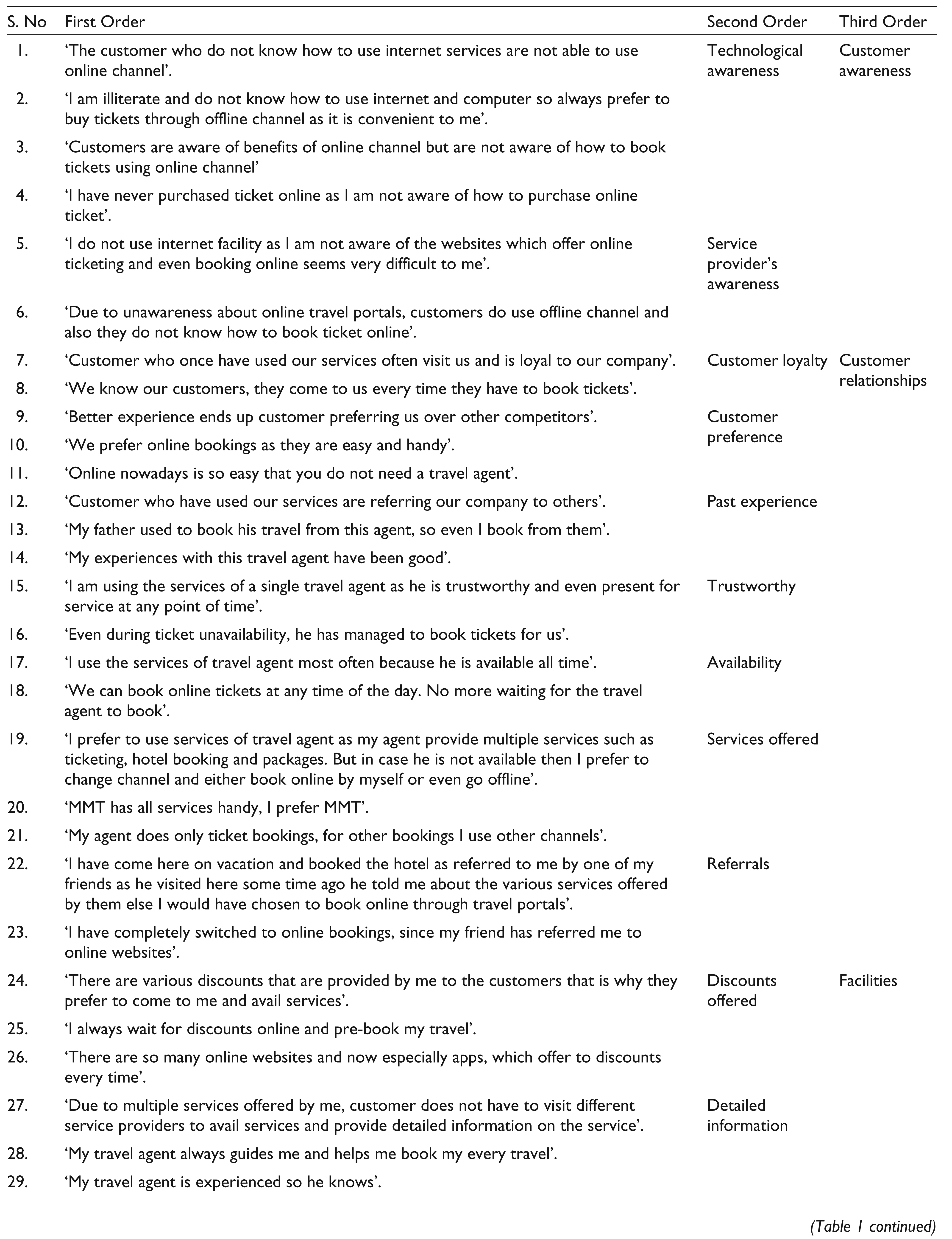


The constructs which have emerged from the qualitative interviews of the retailers and customers are summarised as follows:
Customer Awareness
Retailer: Young customers tend to shop more from online portals. They know what all is available online. But the older ones still come to us.
Customer: Everything is available in mobile nowadays, why to go to an agent to book our travel.
The younger the customer, the more chances that he/she uses online portals for planning the travel. The older ones still rely on conventional methods of ticket bookings and still visit agents for it. The newer generation is much more technology savvy and easily gels up with the new ways of travel planning. Moreover, the availability of internet and mobile applications has made them a frequent user of online channels.
Customer Relationship
Retailer: I have customers who have been visiting my store since last 10 years. We share a strong bond, and I usually book tickets for them at the lowest available prices. These customers will not switch; they trust me.
Customer: I usually book my travel through a travel agent. He is kind of family, I just give a call and tell him about the travel details and he manages rest of the things. My father used to visit a travel agent for ticket bookings and do I. We trust him.
Customer relationship is a very important variable for un- organised retail sector. In current era, relationship management is primarily used in the surroundings of technology. However, in case of unorganised retailers, where use of technology is not to that much extent, the retailers use the traditional method of maintaining relations with the third party. Same is the scenario in travel industry. People who have been booking tickets with the travel agents, still prefer to go to the same agent as they have developed a trust and a relationship factor. Also, since these agents have a retail store, customers personally visit the store and hence have a trust factor.
Facilities
Retailer: I provide multiple services like ticketing of bus, train and air, hotel bookings, tour packages and taxi services therefore customer prefers me because they get all facilities at one place. Also for some customers I offer special discounts.
Customer 1: The travel agent I visit books all types of tickets. Even sometimes I just give him a call and he books my tickets. He books my tickets on credit also.
Booking tickets online is a better option as you can compare prices and book the best price available. Also you get so many discounts every time you book. Online portals are one shop stops.
Customers easily get attracted to retailers which provides all facilities at one stop. The young generation does not want to explore and waste time in visiting a retail store and talk to a travel agent before booking tickets. Rather they would prefer an online website where they would get all the facilities. Also discounts are one of the main motivations for them to book tickets and other packages online. In the era of competition, all the travel brands available online provide discounts in order to attract and retain the customer. Moreover, the loyalty points, have compelled the customer to comeback and use these points as money for the next purchase. However, the senior citizens or the customer who have been a loyal customer of a travel retailer store or a travel agent would prefer them over any online website. They still rely on these travel agents as they feel a personal touch and get all the solutions at one stop. A human interference is very important to these customers as travel still is concerned very personal to a person.
Promotions
Retailer: Our main promotion is word of mouth. Our customers do not leave us as they feel satisfied with the services. However, small promotions during peak season is important, as it attracts new customers and they do not go to our competitors. Also these online retailers nowadays offer many discounts and do a promotion, so we also need to think about it as our customers might get deviated.
Customer: I never used online services but the advertisement of MakeMyTrip on television and seeing the discount offered by them on hotels, I chose to try online channel.
Promotions have been the prime tool to attract more customers and to aware customers about the new products. The existing travel retail stores lack at the promotions and advertisement side as compared to the online brands. The strong promotions of the online portals have led many customers to try online services and also shifted their channel choices. Since the advertisements of the travel retail stores are less, the customers coming from outside cities do not have any knowledge about their existence. Hence they tend up either choosing online channels or chose a travel agent which is in their vicinity. Hence, these local retail stores tend up dealing with a very narrow customer base.
Urgency of Purchase
Retailer: Customers who want tickets in tatkal usually come to us. Also when they want bookings at a particular date and cannot alter it.
Customer: I rely on my travel agent whenever I want urgent bookings. I know he will do it for me. In such cases, you cannot trust online channels, but yes in other situations I do book tickets form online portals.
Travel is not just related to enjoyment where you usually plan things. Urgent travelling needs can also arise which are completely unplanned. Customers usually prefer a travel agent in such situations, as they trust him. So, we can easily assume that in situations of urgency, the travel retail stores are the primary channel. When primary channel is unavailable, then customer think of switching. Which means online portals should also think in direction and add features which help customers during urgent situations.
Affordability
Retailer: Customers coming to us always ask for affordable and low-price travel plans. They usually come with a budget in their minds.
Customer: I always prefer channel from where I am getting cheap and quality services like if discounts are offered at online travel portals then I book from there or else if someone has referred me to someone who will offer me discount. I am a middle-class person; price matters a lot to me and I switch channel only when I get lower prices.
Price of the service affects the channel choice of the customer to a greater extent as a customer prefers to choose a channel which is affordable. The customers have a pre-planned budget and they do not want to exceed that. In such situations, online portals easily attract customers by their readily available discounts. The travel agents need to think in this directions, as they know their clients and should customise the travel plans accordingly.
Catchment
Retailer: The customers who live nearby are my regular customers and I know they will come to me not another travel agent.
Customer: I book from a single travel agent as he is near to my location and book tickets whenever I need. I prefer going to travel agent who is near to my house only when I am not able to book tickets online.
Customer catchment area emerged as a theme during interviews as both retailers and customers said that catchment also affects the channel choice as if travel agent is near to the residence of some customer, he/she prefers to him. This also can be a reason for channel switch, because if the travel agent is not available, the customer rather than travelling to other agent would prefer to go online. Customer limits to a specific catchment which also hinders the retailer services to expand. The customer base remains limited. Whereas, such problems are not faced by online vendors. The retail stores can also open up their own websites and thus this would help them retain customers.
Family Influences
Retailer: Generation gap matters a lot. Whenever an elderly person is accompanying a younger customer, he has to listen to what his elder is saying. The number of younger audience coming to us has decreased.
Customer: I am a planned person and I always pre-book tickets whenever I am travelling, for that online is the best option. My father prefers to personally visit the store and buy services as he thinks there are many hidden charges and transaction fraud in online channel.
Family members influence the final decision in a traditional family structure in India. The elders in the family usually prefer a travel agent and want the younger ones also to visit the same. In compulsion, the younger generation also tends to visit the same travel agent. However, in such scenarios, channel switch is very common. The younger generation prefers the online bookings as compared to the retail stores.
Conclusion
This study investigated channel choice in the travel and tourism market in India. The major contribution of this study is to identify the variables distinguishing between the categories of shoppers that shop across different channels and to understand the situations of channel preference. This study is contributing to a growing stream of literature about the factors associated with channel choice in the travel and tourism market. We know that the multichannel retail platform in travel industry has given customers a wide scope to switch among channels according their preferences. With the data collected from the respondents, we could divide the customers into three sets: ‘the multichannel shoppers’, ‘the store stickers’ and ‘the multichannel swappers’. The multichannel shoppers used multiple channels for planning and finally shopped from online platforms. Whereas, the store stickers were the ones who knew about the other channels but still preferred the store based formats for final shopping whereas the multichannel swappers are the ones who swapped among channels for information collection and final purchase, depending upon their need and ease.
Results confirm that a significant difference lies between these three types of shoppers in terms of demographics and their shopping preferences. The consumer channel interface for all three segments can be explained well in the Appendix 2. The multichannel shoppers are the youngest pool of consumers and are professionals with exposure of technology. Whereas, the store stickers belong to high age groups and find risk in switching channels. The multichannel swappers consisted of a blend of consumers lying in the age of 25–40 years. Awareness level of the multichannel shoppers is more than the store stickers, thus making them more technology savvy and adaptable to the new ways of travel planning. However, the influence of store stickers is much more on multichannel shoppers, so if they are planning a trip together, they need to follow the conventional channels of purchase. The availability of internet and mobile applications has made the younger audience a frequent user of online channels but the final decision-making still remains with the adults in the family. Conventional customers easily get attracted to offline retailers which provide all facilities at one stop. Whereas, the younger generation finds more value in planning the travel through online channels. Features such as loyalty points, easy cancellation and cashback have attracted a lot of new customers to contemporary channels such as mobile app and websites. However, these online portals have to work hard to retain their loyalty and also attract the store stickers.
The discussion with the customers and retailers has reflected upon the pressure that the retailers possess. The role of retailer is not just confined to a service provider but as a facilitator to create a value throughout the buying process. This indicates a tremendous opportunity for the budding retailers, which can be leveraged to create healthy relationship with the customers. Retailers need to provide a seamless shopping environment to the customer which would help them not only in initial planning but also booking the requirements. The current study has tried to explore customer opinions and choices they make across channels and has constructed a conceptual model on customer perspective of channel choice behaviour in tourism industry. Customers consider multiple criteria in the decision-making process (Kumar et.al, 2017).
Results also indicated the influence of catchment on channel choice. It was observed that the localities with stores having booking facilities are the first preference choice of the customers, whereas localities with minimum choices do not search for offline stores instead prefer online bookings. However, affordability acts as a very dominating factor here. Households with lower income perceive online bookings as costly and risky. Such customers have a very strong relationship with the travel agents. These customers trust them and believe that the agent would suggest the best to them. Risk in dealing with online platforms is still high among the customers. The discussion with the retailers indicated that the bandwagon of multichannel shoppers is increasing and thus influencing the footfall of retail stores. Other contemporary methods are being adopted at a very fast pace. This reflects that the conventional travel agents need to work on the way their operation styles. Also, they need to stress more on their value adding benefits such as promotions, discounts and customer relationship. The current study methodologically generates a model based on retailer (travel agents) and customer opinions towards channel choice. This study is a base to further validate this model which would help the conventional and the contemporary retailers to sustain in the market and satisfy customer needs.
Footnotes
Declaration of Conflicting Interests
The authors declared no potential conflicts of interest with respect to the research, authorship and/or publication of this article.
Funding
The authors received no financial support for the research, authorship and/or publication of this article.
Appendix 1
Following are questions asked in an interview:
What channel do you prefer while booking for any trip? Have you ever used the services of a travel agent? Do you prefer booking from single travel agent or multiple agents? Which channel as per you is more effective? Will you switch channel if your preferred channel is unavailable? What factors affect your channel choice decisions? Do you prefer using the same channel if once felt inconvenient?
Appendix 2
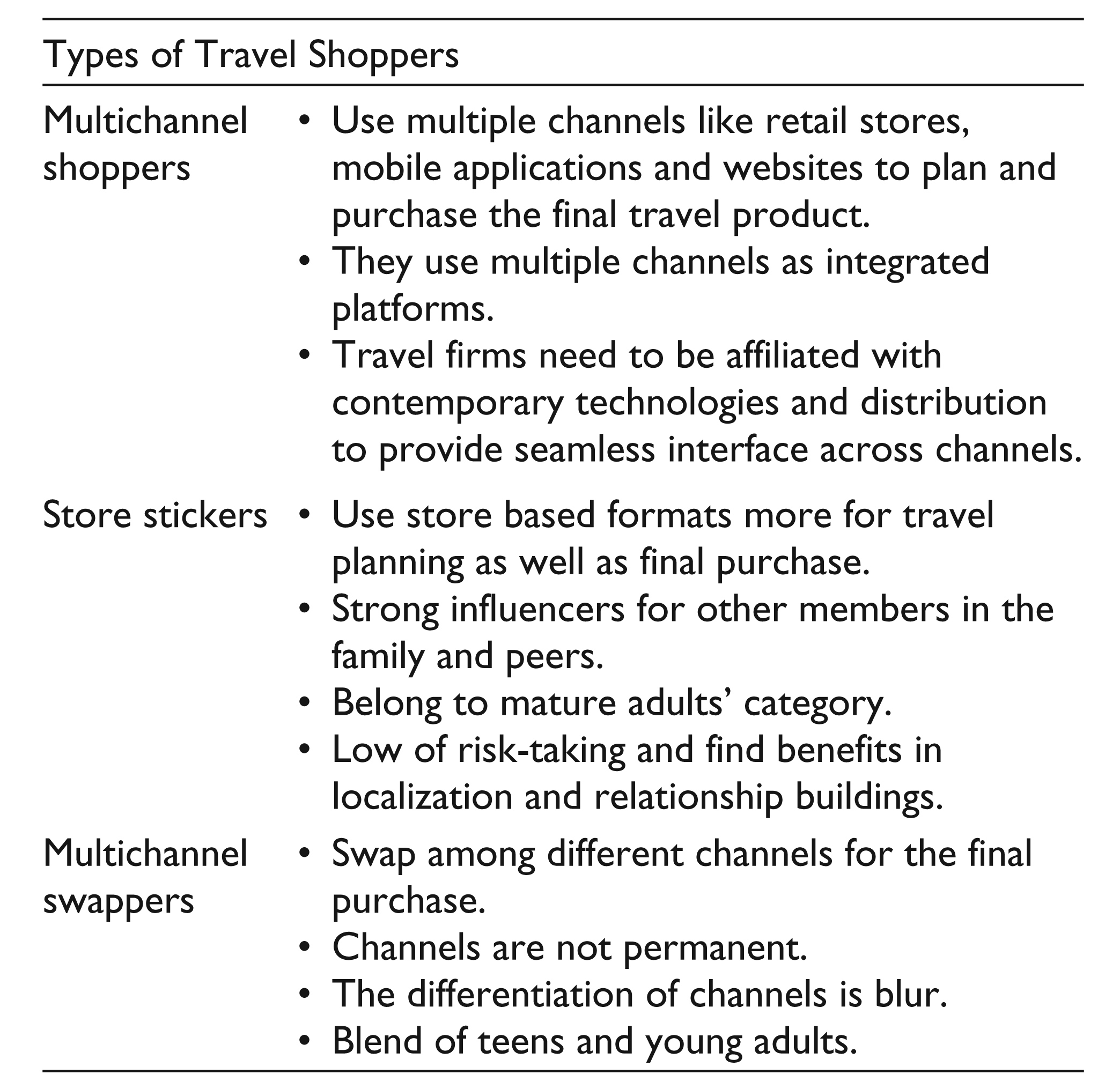
| Types of Travel Shoppers | |
| Multichannel shoppers | • Use multiple channels like retail stores, mobile applications and websites to plan and purchase the final travel product. • They use multiple channels as integrated platforms. • Travel firms need to be affiliated with contemporary technologies and distribution to provide seamless interface across channels. |
| Store stickers | • Use store based formats more for travel planning as well as final purchase. • Strong influencers for other members in the family and peers. • Belong to mature adults’ category. • Low of risk-taking and find benefits in localization and relationship buildings. |
| Multichannel swappers | • Swap among different channels for the final purchase. • Channels are not permanent. • The differentiation of channels is blur. • Blend of teens and young adults. |