




Abstract
Rural entrepreneurship could be the solution for the problems of poverty, migration, economic disparity, unemployment and underdevelopment associated with rural areas and backward regions. Previous literature on rural entrepreneurship is mostly focused on European countries and on the USA. Some work has been done in Indian settings which is mostly focused on South India, but those results can’t be generalise for hilly districts which have a very tough geographic location. The objective of this study is to find the factors which affect rural entrepreneurship in hilly areas. Qualitative content analysis and thematic analysis were used to serve this purpose. For this study, 15 successful rural entrepreneurs were interviewed from the hilly state of Uttarakhand, India and thematic analysis was performed on their responses. Results revealed various motivating factors for rural youth to become an entrepreneur. The major problems and challenges faced by a rural entrepreneur while starting a new venture were transportation cost, lack of skilled labour, choosing a place for doing business, financial problems, etc. The results of this study might benefit the existing body of knowledge and could serve as a guide for future research in the area of rural entrepreneurship.
Introduction
Global entrepreneurship has flourished over the last 50 years. Major changes in the political environment, economic systems and cultural interactions have created an environment in which entrepreneurship has become a significant factor in regional economic development, global geopolitics and even cultural change. Due to a shortage of employment prospects, people are moving from rural regions to urban ones, and young people in rural areas have few opportunities for development. This issue not only causes emigration from the countryside but also puts excessive strain on the amenities and infrastructure of the cities. Rural entrepreneurship is a possible solution for all these issues. Rural entrepreneurship promotes self-employment, creates more job and income-generating options for locals, and leads to a greater income distribution while also maximising the use of local resources inside the confines of rural regions.
Rural entrepreneurship gave hope to the rural youth to stand on their own, especially in the hilly states of India. These states are different in comparison to others because of their geographical location. It is difficult to set up industries in hilly areas and create job opportunities. The government has initiated various programs to promote rural entrepreneurship in these tough areas. One of such state is Uttarakhand, in India, located at the foothills of the Himalayan Mountain ranges. It is largely a hilly State, having international boundaries with China (Tibet) in the north and Nepal in the east. Uttarakhand is divided in two divisions, Garhwal and Kumaon, with a total of 13 districts. In Uttarakhand, more than 66% of the population lives in rural areas (more than 80% in hill districts) (Negi, 2019).
In the Kumaon area of Uttarakhand, the ‘Udhyam’ rural entrepreneurship initiative seeks to promote business among remote village populations. With the correct assistance, Udhyam business owners may employ local residents and boost the local economy. Apart from this Department of Rural Development, the Government of Uttarakhand has initiated Rural Business Incubator (RBI). RBI is a cooperative initiative created to aid young people with creative business concepts, fresh start-ups and nano companies in achieving their professional objectives. By offering different forms of assistance, mentorship and training, these centres assist the incubators in finding solutions to the issues that are frequently related to operating or beginning their entrepreneurial journey. In order to improve the entrepreneurial abilities and job prospects, the National Bank of Agriculture and Rural Development (NABARD) and the Uttarakhand government are establishing institutions there. There are currently institutions in a few districts, including Pithoragarh, Pauri, Almora and Haridwar, and the government has pledged to establish them in the remaining districts over the next few years. The young people would receive training in farming, dairy development, maintenance and other conventional trades.
Despite of various efforts for rural entrepreneurship, the district wise Gross Domestic Product of hill districts like Almora, Bageshwar, Champawat, Chamoli, Pauri, Tehri, Pithoragarh, Rudraparyag and Uttarkashi is less than 40% of that of the plain districts like Dehradun, Udham Singh Nagar and Haridwar (Negi, 2019). This is a serious concern, as a lot of efforts being done to boost rural employment but the output is not up to the mark. The author has chosen this problem and developed the following two objectives for the study:
To identify problems and challenges of rural entrepreneurs in hilly rural areas. To explore various methods of promotion available to rural entrepreneurs in hilly rural areas.
Literature Review
Rural entrepreneurs defined as individuals who are self-sufficient, adventurous, self-directed, strong-willed and imaginative in their efforts to create new jobs in rural areas (Adewumi & Keyser, 2020). Rural entrepreneurship prioritises rural industrialisation with a focus on meeting the needs of rural residents through the creation of jobs and rural development (Ihejiamaizu, 2019). Rural entrepreneurship not only generates revenue for the community but also improves possibilities, mobilises resources and discourages agricultural activity, all of which help rural residents live better lives. Rural entrepreneurial growth is, however, constrained by a number of factors, including a lack of appropriate and skilled labour, financial resources, infrastructure and market prospects (Adewumi & Keyser, 2020; Chakmraborty & Barman, 2015).
The level of scholarly interest in rural entrepreneurship has increased significantly during the past 10 years (McElwee & Smith, 2014). Special interest research groups have proliferated, and journal papers have multiplied. Although there have been an increasing number of fascinating studies from developing nations, this is mostly a European phenomenon (Baumgartner et al., 2013; Newbery et al., 2017). Scholars in North America focused more on rural business as an outgrowth of agriculture or tourism and viewed US-based entrepreneurs more remote than those in Europe, suggesting that rural entrepreneurship may be undervalued (Besser & Miller, 2013). Indian scholars explained rural entrepreneurship as progress in growth and development that fulfil the needs of rural areas and their people, especially the poor (Chakmraborty & Barman, 2015; Harendra, 2010).
Despite advancements in technology, rural communities continue to face numerous issues. First, there is a dearth of fundamental resources like trained labour, improved infrastructure and more expansive market prospects (Meccheri & Pelloni, 2007). There may be more opportunities for these rural entrepreneurs to grow, thrive and realise capital output inside these rural economic markets if these factors could be enhanced. As a result, there are many unexplored business prospects in rural areas (Chakmraborty & Barman, 2015).
Rural entrepreneurs are trying hard to make their ventures successful. The major problem comes in the form of marketing practices. According to a study done in Ghana, networks and ties with consumers, adherence to religious communality and participation in practical social support and interdependence are all characteristics that rural micro and small business owner-managers value when it comes to marketing practices (Blankson et al., 2017). For consumer marketing in rural areas, firms must adhere to the following three key principles: a thorough awareness of subsistence consumer psychology, social embeddedness and entrepreneurial empowerment. Rural firms need to define a framework for their marketing strategy if they want to engage in subsistence markets. Alternative marketing tactics have evolved in the literature in addition to the 4Ps, including acceptability, affordability, availability and awareness (4A) and customer value, customer costs and customer communication (4Cs) (Sridharan & Viswanathan, 2008). One District One Product is a marketing strategy discussed in the research conducted in Malaysia (Kader et al., 2009; Kamarudin & Wahid, 2017). In the 1970s, Oita prefecture pioneered the One Village One Product (OVOP) programme, which was later implemented in Malaysia in the early 1990s (Kamarudin & Wahid, 2017).
Another aspect emerging in marketing rural businesses is the use of online channels and social networks. Rural business owners that use online channels can reach a wider market; their operations are financially self-sufficient and can take advantage of the possibilities of nearby natural resources (Yaşlak et al., 2021). In addition, social media was mentioned as a cutting-edge marketing technique to encourage interactive, cooperative and individualised relationships with clients and stakeholders in recent studies. These contacts helped small enterprises grow their consumer bases and strengthen employee loyalty. Additionally, mutually beneficial interactions with stakeholders facilitated the development of social capital through the exploitation of social media material. Although many small businesses find it difficult to integrate social media because of operational, economic, infrastructure, legal and regulatory, and psychological issues. However, the support of governmental policies and planning is required to increase this influence on a regional level (Son & Niehm, 2021; Yaşlak et al., 2021).
Although few papers discuss the marketing aspect of the output of rural corporations, there is a lack of work done specifically to hilly areas. This area needs to be explored more to find out various techniques which could help rural entrepreneurs to market their products.
Methodology
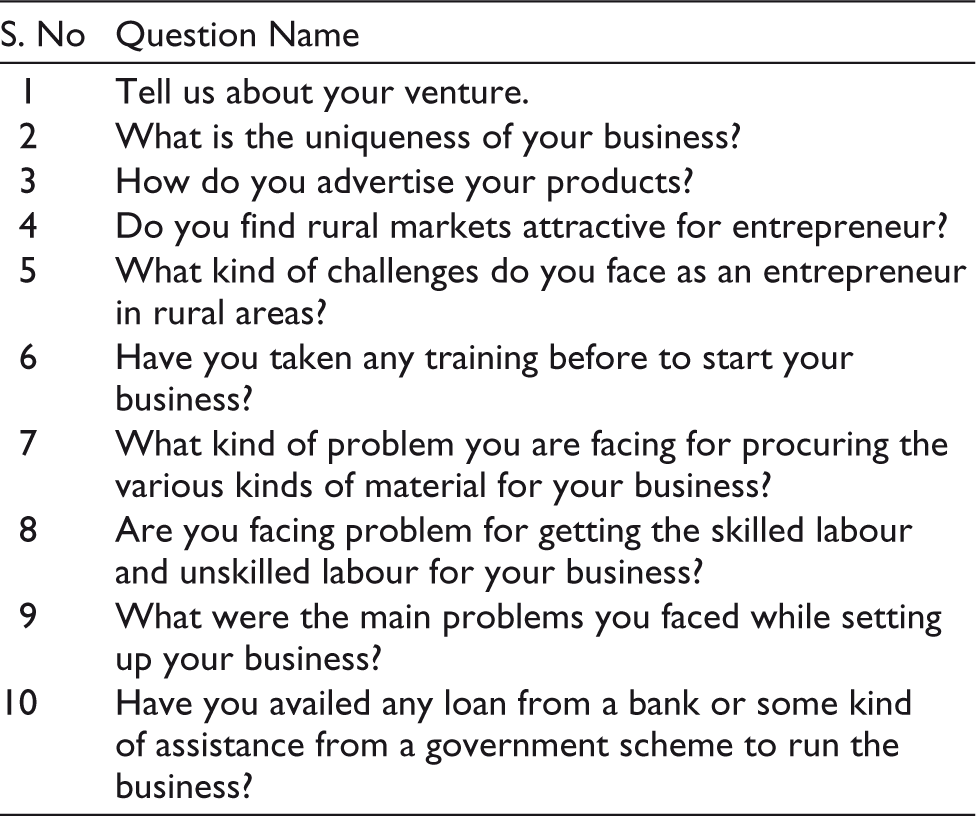
The report chose an exploratory study with 15 rural entrepreneurs functioning in Uttarakhand, India, and used the grounded theory’s open-ended methodology. Personal interviews were conducted and recorded in written form. An open-ended questionnaire containing 10 questions was used to collect information regarding various challenges faced in finance, marketing, production, promotion, human resources, socio/personal factors and government assistance. During the interview, information on government initiatives on rural entrepreneurship in Uttarakhand state was given and respondents were asked whether they are getting any benefit from those initiatives. The interview was conducted in Hindi language and then the researcher translated those statements into English. Their responses were noted down and a further soft copy was prepared for analysis purposes. The questions used to get information is given in Table 1.
Questions for Personal Interview.
A manual thematic analysis was performed to identify major themes. In this initial stage of thematic analysis, information was gathered from a variety of rural entrepreneurs and recorded in written form. A specific phrase for the written responses that defines the entire paragraph was identified in the second step. To reduce the amount of codes and group them into recognisable themes, the data were read and reread numerous times in the following stage. The codes were analysed, categorised into different primary topics and a specific pattern was discovered. Additionally, the codes that were not important enough to the study were removed. In the last step, the themes were written in the form of data. Initially, 79 codes were identified. After the discussion with experts and referring literature, 35 codes were identified. These themes were further classified into three major categories.
Data Analysis and Interpretation
The demographic profile of the respondence is shown in Table 2. Out of 15 entrepreneurs, 14 were male and 1 was women rural entrepreneur. The average age of the respondents was 30 years. In total, 46.6% respondents had basic school level education, 26.6% were undergraduate, 20% were postgraduate and 6% had some diploma. Around 53% entrepreneurs were associated with family business and 47% had started their own venture.
Demographic Profile of Entrepreneurs.

Thematic Analysis Results
To find the main themes, a manual thematic analysis was done. Information was initially received from rural business owners and written down. The written responses have a certain phrase that sums up the entire paragraph. The data was examined and reread multiple times in the subsequent step in order to limit the number of codes and combine them into recognisable themes. The codes were examined, divided into various key categories and a certain pattern was found. In addition, codes which were not critical to the study were eliminated. The themes were written in the form of data. Following tables presents different themes identified and their frequency of occurrence. Table 3 presents the major themes promotion methods.
Promotion Methods.

The codes like word-of-mouth communication and social media emerges as main codes based on the following statements:
We don’t do anything for advertisement. If customer is happy with us he tells others to buy from our store. People tell each other about us and sometimes during any offer is going on we write a post on Facebook, WhatsApp or Instagram.
Table 4 presents major theme ‘attraction for rural entrepreneurship’. The rural youth wants to start their own venture. Less establishment cost, low competition, social causes (stop migration, improving standard of living), funding from government schemes, interaction with friend who lives in cities, employment crises during the pandemic are a few reasons for this.
Attractions for Rural Entrepreneurs.
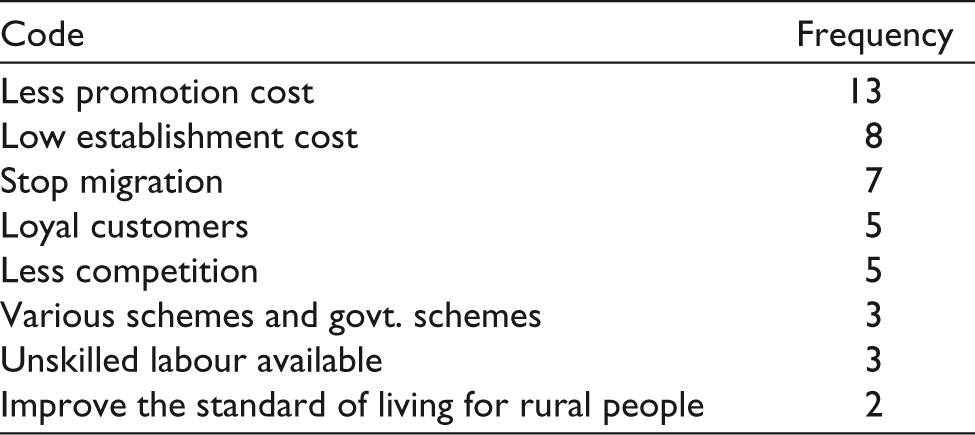
The codes presented in Table 4 are based on the following statement:
Our customers are loyal…we don’t spend much on promotion. Unskilled labour is available in the market but a lot of efforts required to train them…. I feel good if our own people earn something, improve their standard of living.
Table 4 presents major theme ‘problems’. Transportation cost in hilly area, unskilled labour, high labour cost, poor roads, warehousing problem, lack of training, paperwork, etc., emerges as problems for rural entrepreneurs.
Problems and Challenges Faced by an Entrepreneur.

The codes presented in Table 5 are based on the following statement:
The biggest issue is transportation cost…nothing is available in hilly areas…everything is coming from plan area and transportation is very expensive…apart from this training of labour is very difficult, storage is also an issue…government documentation work is difficult and without it getting loan is difficult.
In addition to these themes, we found something very interesting, around 80% of the entrepreneurs had not taken any formal training from any local/national institutes. Also, most of them (67%) have not opted for any formal source of financing. The major sources of financing for those rural entrepreneurs were friends and relatives.
Conclusion
The aim of this article was to explore the problems and challenges of rural entrepreneurs in hilly areas and to explore promotional methods available to rural entrepreneurs in these places. With 15 rural business owners, an exploratory study that followed the interview method was carried out. Figure 1 represents the output of the thematic analysis.

The major themes emerged out of the results of thematic analysis were promotion methods, attraction towards rural entrepreneurship and problems related to rural entrepreneurship. First, the major contributor in the promotional method theme were word of mouth communication (Kapur et al., 2014; Markley et al., 2007) and social media (Kurniasih et al., 2022; Son & Niehm, 2021; Yaşlak et al., 2021). Word of mouth is significantly more important in creating brands in rural India than in urban areas. Marketing messages can be reinforced by gaining the confidence of reputable educators, medical experts and other prominent members of the community. However rural businesses may greatly boost consumer involvement with social media advertising. There are both immediate and long-term advantages to this kind of involvement. Social capital is an important intangible resource in rural marketplaces, and social media interactions help to generate it (Son & Niehm, 2021).
The second theme that came out was attraction towards rural entrepreneurship. The major contributor to this theme were less establishment costs, low competition and social causes (stopping migration and improving standard of living). Less establishment cost (cheaper building, insurance and workforce) and low competition were identified in previous work conducted in Europe (Imedashvili et al., 2013). Apart from this other attractions in favour of entrepreneurship in rural areas emerge out were to resolve numerous societal issues, such as low living conditions, unemployment and social conflict, which contributed to the rise of rural entrepreneurship (Pangriya, 2019; Rodriguesa & Francob, 2021; Sá et al., 2019).
The final theme that emerged is problems related to rural entrepreneurship. Transportation costs in a hilly area, unskilled labour, high labour cost, poor road conditions, warehousing problem, lack of training, funding issues and red tapism were the major contributing codes for the problem (Asian Development Bank, 2014; Hettige, 2006; Viswanathan, 2021).
Managerial Implication
When considering the possibilities of being a successful entrepreneur, there are undoubtedly some barriers that must be addressed. This article attempted to identify the challenges and concerns associated with the potential of rural entrepreneurship. It also attempts to focus on the fundamental challenges faced by rural entrepreneurs, particularly in the sphere of product marketing, as well as promotion methods. In light of this, this research paper will guide future researchers in the field of rural entrepreneurship and will add value to the existing literature.
Footnotes
Declaration of Conflicting Interests
The author declared no potential conflicts of interest with respect to the research, authorship and/or publication of this article.
Funding
The author received no financial support for the research, authorship and/or publication of this article.