



Abstract
The rapid expansion in population and mass consumption has led to the emergence of many environmental problems. Environmentalism has become an important social and corporate issue, which has led to green movements for the conservation of the environment. This study is designed to examine the determinants of the green purchasing behaviour among Indian consumers. For this purpose, data were collected from 412 consumers using the structured questionnaire. Descriptive statistics and classic linear regression are used to test the proposed hypotheses. The result shows that environmental concern, perceived environmental responsibility and environmental awareness are positively related to the green purchasing behaviour.
Keywords
Introduction
Green purchasing rose to prominence with the growing deterioration of the environmental conditions and overexploitation of natural resources. Environmental degradation has become a dominant political, business and academic discourse in the last few decades. Consequently, the phenomenon of green consumer behaviour has evolved as a new paradigm of marketing discipline for marketers and researchers in the realm of contemporary consumer research. Green purchasing behaviour is understood as a practice of purchasing only those products and services that are less harmful to the environment and society (Chan, 2001). Green consumers prefer products where the environment is at the centre of product design, material sourcing, manufacturing processes and consumption of the product (Srivastava, 2007). Moreover, green consumption focuses on the recyclability of products and that are beneficial for the environment (Mostafa, 2007).
There is a greater realisation about the need for green consumption among consumers. Consumers are more willing to purchase green products and contribute towards environmental protection (Yeung, 2005). The demand for environmentally friendly products has increased over a period of time, making it a distinct consumer segment for companies. Around 75% respondents from India are willing to pay more for firms that are socially responsible. This has led to a shift in the thinking of corporate managers towards eco-friendly products.
Marketers have realised the need and value of green marketing due to the catastrophic effect on the planet and natural ecosystem. The issues, like global warming, air pollution, waste generation and natural disasters, are declining the quality of life on the planet. There is a dominant opinion that the major source of environmental damage comes from the non-sustainable practices adopted by business firms (Huang & Rust, 2011). The corporate firms are reeling under pressure from different sections of society to adopt eco-friendly processes and products. The state intervention, greater awareness and pressure from different stakeholders have led to green operations and the offering of green products that are less hazardous and are energy efficient (Menon & Menon, 1997).
Indian has been grappling with serious environmental issues, such as pollution, waste and land degradation. The unplanned growth of the Indian economy has resulted in huge damage to the natural environment (Widmer et al., 2005). The report of the World Economic Forum has ranked India at 155 (out of 178) in terms of air quality. ‘Due to the possibility of coming under the scanner of regulatory bodies, Indian companies have started incorporating green management practices and even disclosing more environmental information’ (Uddin Khan, 2016). In this context, researchers such as Saxena and Khandelwal (2010) anticipated that the future belongs to those Indian firms that address the issues of the environment. The demand for green products is increasing and making green consumers’ important segment for marketers.
However, the literature on the green purchasing behaviour is scant and makes it difficult for markets to develop a proper strategy to cater to the green consumer segment. Few studies have focused on the green purchasing behaviour in the Indian context from the perspective of product differentiation (Punyatoya, 2014). Considering the enormous untapped potential of green marketing in India, this study examines the antecedents of green purchasing behaviour from the perspective of cognitive factors, such as environmental awareness, environmental concern and related responsibilities (Jaiswal & Kant, 2018). It is important to understand the attitude of people towards green marketing and explore the various antecedents of green purchasing behaviours. It is expected that a better understanding of these factors would greatly help green marketers in dovetailing their strategies.
The present study would contribute by analysing the determinants of the green purchasing behaviour from the consumers’ cognitive perspective. Further, it would focus on the environmental discourse and how it shapes the green consumption pattern among the young Indian consumers.
This article is structured as follows. The next section reviews the extant literature and development of hypotheses. The third section, Research Methodology, explains the data sources, sample of the study and techniques used. The fourth section presents the results of the study, followed by and Discussion and Implications in the fifth section. Finally, the limitations and direction for future research are presented in the sixth section.
Review of Literature
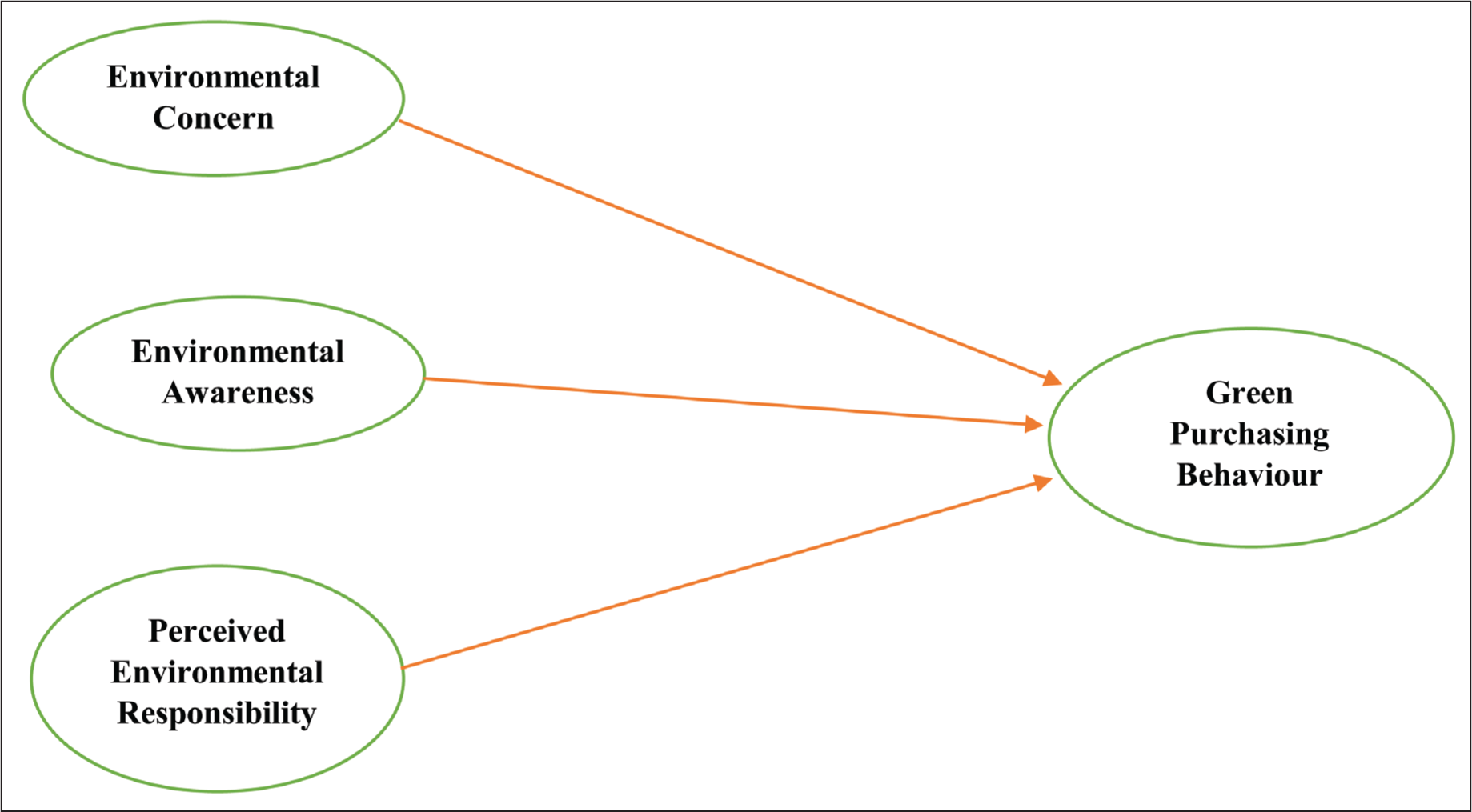
In recent decades, the growing awareness of climate change and its impact on human lives has received considerable attention (Kim & Han, 2010). Environmental issues, such as acid rain, pollution, greenhouse effects and weakening of the ozone layer, have led to the emergence of many environmental problems. Researchers argue that the severity of environmental issues is influencing the consumers’ consumption pattern and business functioning (Manaktola & Jauhari 2007). Witnessing a positive approach of customers towards green products, organisations have started embracing the green marketing practices in their production and marketing activities (Keegan et al., 1995). Companies are trying to promote their green image to have a good market perception and cater to the needs of the environmentally sensitive segment. This has led to a transition from conventional marketing to green marketing, thereby reducing the environmental impact of the company’s products and processes. Indian consumers are increasingly conscious about the importance and value of sustainable and environmentally friendly behaviour (Kant & Jaiswal, 2017). The discourse around the environment has been shaping the preferences and tastes of consumers and the corporate world. It effectively creates a consciousness among the masses to contribute towards the environment by taking self-responsibility and consuming eco-friendly products. Researchers state that cognitive factors, such as environmental awareness, responsibility towards the environment and concern for the environment, are important factors to drive the green purchasing behaviour (Figure 1).
Proposed Conceptual Model.
Environmental Concern and Green Purchasing Behaviour
Environmental concern has been understood as the degree of worry and willingness to be part of the environmental solution (Hassan, 2014). It is usually related to the emotions and knowledge level as well as readiness to change the behaviour (Straughan & Roberts, 1999). The environmentally sensitive people do not tolerate the slight variation in the environment, and they actively participate in the programmes for environmental conservation (Hassan, 2014; Kim & Choi, 2005). In the present scenario of environmental damage, corporate managers and consumers are expected to show greater environmental sensitivity. Environmental concern has been a vital variable in the studies concerning green consumption. Studies have observed the positive relationship between environmental concern and green purchasing behaviour (Kinnear et al., 1974; Roberts & Bacon, 1997). Kim and Choi (2005) observed that concerned customers are more willing to purchase green products than those who are least concerned about environmental problems. Bamberg (2003) found that environmental concern has an indirect influence on customers’ purchase intention. Kilbourne and Pickett (2008) observed that environmental concern and green purchasing behaviour are closely related. Muralidharan and Xue (2016) also observed that environmental concern directly influences the purchasing decisions of the customers. Thus, the above discussion supports the following hypothesis for the Indian consumers.
H1: Environmental concern has a positive impact on the green purchasing behaviour.
Environmental Awareness and Green Purchasing Behaviour
Environmental awareness refers to people’s knowledge about the environment and the importance it has for human beings (Kollmuss & Agyeman, 2002). The level of knowledge enjoyed by consumers about the environment motivates them to consume eco-friendly products and make sense of the eco-information. Customers’ awareness about the environment is central to the environmentally sensitive behaviour and green purchasing behaviour. Researchers have found the positive correlation between customers’ awareness of environmental issues and green purchasing behaviour (Barr, 2003). In the past, numerous researchers have studied a wide range of issues regarding environmental awareness among customers and their green purchasing behaviour. Roberts (1996) states that a high level of environmental awareness distinguishes green customers from non-green customers. Environmental awareness has a profound impact on the customers’ willingness to pay for green products. ‘The levels of knowledge enjoyed by the customers about environmental issues tend to transform customers into price insensitive to offer premium prices for green products’ (Amyx et al., 1994). The study by Rejikumar (2016) on 188 retail consumers found that environmental awareness is a vital antecedent to the green purchasing behaviour. Punyatoya (2014) found that environmental awareness has a positive impact on trust and purchase intention. Hence, environmental awareness holds great importance in green behaviour. The following hypothesis is framed for empirical testing in the Indian context.
H2: Environmental awareness has a positive impact on the green purchasing behaviour.
Perceived Environmental Responsibility and Green Purchasing Behaviour
People who are willing to follow green marketing practices and remain responsible for the sustainable environment are the agents of environmentally responsible behaviour. The ‘perceived environmental responsibility’ relates to the consumers’ obligations to improve the environment and ensure that their activities have no detrimental impact on the environment. Perceived environmental responsibility results from the sense of responsibility towards various issues and challenges of the environment. The individual responsibility related to the environment is reflected in the consumers’ willingness to spend on those products that are environmentally viable. Extending the logic of the ‘norm activation theory’ to the green consumerism context, perceived environmental responsibility can be reasonably conceptualised as a form of personal moral obligation towards the environment. In a research work, Lee (2009) found that in Hong Kong, environmental responsibility is a vital determinant of the green purchasing behaviour. Sinnappan and Rahman (2011) found that those Malaysian customers who perceive higher environmental responsibility show more green purchasing inclination. To better understand the role of perceived environmental responsibility in the context of India, we postulate the following hypothesis:
H3: Perceived environmental responsibility has a positive impact on the green purchasing behaviour
Research Methodology
Data Collection
The primary aim of this study is to understand how environmental characterisation influences the attitude of consumers towards green purchasing behaviour. We used a questionnaire to collect the data related to the selected variables that consist of environmental awareness, environmental concern, perceived environmental responsibility and green purchasing behaviour. Data for the study were collected from 412 respondents. The lead author distributed 500 questionnaires among the graduate/postgraduate students of the Kashmir University. It is the premier educational institution in the state of Jammu and Kashmir. Overall, the response rate was 82.4%. The main reason for selecting postgraduate/graduate students is to avoid the understanding and awareness bias. In developing countries, like India, understanding and awareness regarding environmental issues are limited. So, young students are selected for this survey, given that they have been taught ‘environmental science’ at the graduation level and they understand this concept thoroughly. This course is important in improving eco-literacy and shaping the consciousness related to the environment. Moreover, these students are familiar with green marketing given their affluent socio-economic and educational background. The students were selected randomly at the time of visit to avoid any prejudice or bias.
The study used descriptive statistics and classical linear regression to test the proposed hypotheses. The data analysis was done with the help of SPSS 20.
Measures
The survey instrument has been developed after a painstaking review of the existing studies and the related concepts. A structured questionnaire was developed that comprises information related to demographics and the main construct. The first section collects the demographic information of the respondents that pertains to gender, age, educational qualifications and monthly family income. The second section collects the information related to environmental concern, perceived environmental responsibility, environmental awareness and green purchasing behaviour. The items for this study have been taken from the existing scales on these constructs. The literary presentation of adopted items was modified to ensure that the scale is understandable to the local respondents. The ‘environmental concern’ was adapted from the study by Bamberg (2003). Seven items were used to measure this construct. ‘Perceived environmental responsibility’ was measured by adopting the scale of Lee (2008, 2009). Six-item scale was used to measure this construct. Five items of ‘environmental awareness’ were drawn from the study of Lee (2011), and five items were used to measure this construct. Green purchasing behaviour was measured by adapting the scale of Lee (2008). The construct was measured using the four items from the particular study. Five-point Likert scale was used to assess information on these constructs. Respondents were asked to select from the following options: 1 = strongly disagree, 2 = disagree, 3 = neutral, 4 = agree and 5 = strongly agree.
The questionnaire was checked for face and content validity before the final data collection. First, the questionnaire was sent to two experts, who are well-versed with the technicalities and other issues of the questionnaire. The suggestions by these two experts were incorporated into the questionnaire. Further, this questionnaire was given to different consumers to check if they understood clearly the statements of the questionnaire.
Data Analysis and Results
Reliability Analysis
Table 1 presents the descriptive statistics and the results of Cronbach’s α. The descriptive statistics show that all four variables have similar mean scores with small dispersion values. The mean score of environmental concern is (M = 5.55, SD = 1.34), environmental awareness (M = 5.41, SD = 1.36), perceived environmental responsibility (M = 5.30, SD = 0.97) and green purchasing behaviour (M = 5.04, SD = 1.04). Overall, the descriptive statistics show stable mean and dispersion among the selected constructs. Further, the preliminary data testing is carried out to check the consistency and reliability of the data. Cronbach’s α is used to check the consistency and reliability of the data. The analysis was done with the help of IBM-SPSS 20. Results in Table 1 show that Cronbach’s α for all the selected variables is more than the minimum threshold limit of 0.70 (Nunnally & Bernstein, 1994). Therefore, we can further our analysis given that all variables have adequate reliability.
Mean, Standard Deviation and Reliability.

Table 2 presents the demographic profile of the respondents. Out of the 500 questionnaires, 412 were fit and appropriate for the analysis, leaving others out that had missing or wrong information. The sample consisted of 56.4% as males and 43.6% as females. 34.4% are in the age group of 20–25 and 54.8% in the age group of 25–30. 10.6% are in the age group of above 30. Around 45.4% were from the postgraduation course, and 27.5% were from graduation. 27% have above postgraduation degree. Around 19.5% respondents belong to families having a monthly income below ₹20,000 and 26.1% having an income slab of ₹20,000–40,000. Further, 30.5% are in the income group of ₹40,000–60,000, and 22% have income above ₹60,000 grades. The main focus has been on young consumers, given that they are aware and conscious about the pressing global and local issues. Further, the young population shapes the purchasing behaviour of the society and constitutes a heavy spending group. Hence, young consumers were surveyed to explore the determinants affecting green buying behaviour.
Demographic Profile of the Respondents.

Multiple Linear Regression
The study used multiple linear regression to test the proposed hypothesis. It measures the direction and size of change in the dependent variable by the independent variables. In this study, we test the influence of environmental concern, environmental awareness and perceived environmental responsibility on the green purchasing behaviour. The result in Table 3 shows that the product–moment correlation is 0.52, which depicts that green purchasing behaviour is strongly associated with environmental concern, environmental awareness and perceived environmental responsibility. Further, the result shows that the variance in the dependent variable due to the independent variables is 27%. The p value is significant, which depicts that independent variables have a strong influence on the green purchasing behaviour of consumers. The ANOVA results in Table 4 suggest that the overall model is significant and possesses satisfactory explanatory power. Hence, we could proceed to the next step to analyse the data.
Table 5 details the results of the regression analysis, which tests the influence of three independent variables on the green purchasing behaviour. The result shows that all three independent variables (environmental concern, environmental awareness and perceived environmental responsibility) have a positive and statistically significant impact on the green purchasing behaviour. Specifically, hypothesis 1, saying that environmental concern has a positive impact on the green purchasing behaviour, is supported (β = 0.07, p > .05). Similarly, environmental awareness shows a positive and significant impact on the green purchasing behaviour (β = 0.24, p > .01). The results corroborate with H2. Furthermore, hypothesis 3, that perceived environmental responsibility is positively related to the green purchasing behaviour, is also supported (β = 0.37, p > .01). So, the results are consistent with the deductions stemming from the literature review. The environmental discourse around personal values is able to generate demand for green purchasing.
Model Summary.

ANOVA.

Regression Analysis.

***p = .01; **p = .05; *p = .10.
Discussion
This study is significant work in examining the environmentally conscious consumers and their purchasing behaviour. The study contributes to the literature by analysing how environmental discourse shapes the green purchasing behaviour. It was observed that young consumers in India are driven by different cognitive environmental factors. The findings reiterate that environmental consciousness and knowledge of environmental issues promote a favourable attitude towards green products (Laroche et al., 1996).
Specifically, environmental concern shapes the green purchasing behaviour of the young consumers. It implies that the greater the concern for the environment, the more likely customers would buy green products. Lee (2009) opined that the green purchasing behaviour is usually intrigued by the emotional factors related to the environmental concern, such as ideas of human nature harmony, love for the planet and social responsibility. The concern for the environment is an important factor in the consumers’ willingness to purchase green products. These findings resonate with the studies of Verma and Chandra (2018) and Arısal and Atalar (2016).
Environmental awareness has a positive and significant influence on the green purchasing behaviour. Individuals’ knowledge about the environment can be a precursor to adopting the green purchasing attitude. The main barrier to adopting the green purchasing behaviour is the lack of required environmental awareness (Chan, 2008). This implies that increased environmental knowledge could lead to more enlightened ecological behaviour. The findings reiterate that knowledge about the environment leads to a favourable attitude towards green products (Laroche et al., 1996). This state of mind is defined by the theory of efficacy expectations, which states that people integrate the information with abilities and outcomes to guide their behaviour and efforts (Bandura, 1977). The same result has been found by Amyx et al. (1994) and Rejikumar (2016). Among the predictors, perceived environmental responsibility has been an important predictor of green purchasing behaviour. Furthermore, perceived environmental responsibility also contributes to shaping the green purchasing behaviour of Indian consumers. Individual responsibility towards the environment has an important influence on driving green purchasing behaviour. Young people are actively taking responsibility than older people to conserve the environment (D’Souza et al., 2007).
Young Indian consumers value contributing towards the conservation of the environment symbolising the elements such as protecting the environment, social responsibility and concern for humanity (Uddin & Khan, 2016). Involvement and awareness of young consumers are pivotal for the protection of the environment, as revealed by the regression analysis. This study is important to understand the psyche of young Indian consumers, and the results would benefit marketing practitioners and academic researchers alike.
Conclusion and Implications
This article identifies the antecedents of the green purchasing behaviour of the Indian young consumers. The result shows that all three independent variables (environmental concern, environmental awareness and perceived environmental responsibility) have a positive and statistically significant impact on the green purchasing behaviour. The managers need to understand the challenges and factors of green purchasing behaviour to get young consumers involved in sustainable consumption. This is a large consumer segment and has great potential for the business firms. Taking cue from the study of Singh (2011), who opined that 50% of Indian consumers are environmentally conscious, Indian managers need to strategise the business operation and cater to this important consumer section. Marketing managers should translate the likings of consumers towards green products into actual purchases by presenting the environmental and social benefits of these products. Thus, the potential for green marketing is huge, which can be effectively addressed to cater the consumers by providing them with pro-environmental products. The focus should be on the environmental features associated with the product that can positively impact ecological conservation.
Further, the study shows that environmental discourse is important to promote the green purchasing behaviour. The policymakers should cultivate this kind of thinking among consumers by promoting ecological education and provision of more information about green products. The government should create awareness to promote environmental consciousness among consumers. It should rationally and emotionally make people understand the environmental issues and collaborate in protecting the environment. This will give them a sense of environmental responsibility. Different initiatives, such as tree planting, can be organised to give consumers a sense of participation and empowerment. Educational institutions can also make efforts to educate the people and instill a sense of responsibility. It can go a long way in promoting sustainable consumption behaviour.
Limitations and Directions for Future Research
The study needs to be understood within a context with certain limitations, which could provide a basis for further research. First, the study has tested the green purchasing behaviour from the perspective of environmental consciousness. There are other moral, cognitive and social factors that contribute to the green purchasing behaviour. The model can be experimented with other constructs. Further, the study was focused on the young consumers who are well educated and are well versed with environmental issues. Future studies need to be conducted in other age groups. The study is cross-sectional in nature and needs to be understood in a large spectrum. It limits the information on the long-term impact of the variables and factors reviewed. The panel data analysis may give a better understanding of this work. Further, this study has only considered three environmental factors and that is not an exhaustive list. This narrow measurement can be broadened by incorporating a few more environmental factors.
Footnotes
Declaration of Conflicting Interests
The authors declared no potential conflicts of interest with respect to the research, authorship and/or publication of this article.
Funding
The authors received no financial support for the research, authorship and/or publication of this article.