



Abstract
Numbers of universities are increasing in developing economies. With a rise on the universities in developing economies, there is a call for more research on the role of universities in developing entrepreneurs. This article aimed at understanding the kind of support, which university students in developing economies need to engage in self-employment. The study recruited 230 students, who were provided with questionnaires during class sessions. Students were allowed to carry questionnaires and fill them in their hostels. After two weeks, the questionnaires were collected through the assistance of class representatives. Likert scale was used in the questionnaire with 5-point itemized scale. Factor analysis technique and varimax rotation method were employed for data analysis. Scree plot was used to evaluate the number of factors significant for the study. Four factors namely business education support, compulsory training, resource support and moral support loaded significantly. The results of the study can inform the ways in which university students want their institutions to assist them to become entrepreneurs.
Background
There is a consensus that universities play a great role in shaping entrepreneurs of tomorrow through training, consultancy and research. However, recently due to unemployment challenge more is expected from the universities around the globe in the form of support and connecting their graduates with the markets and financiers. However, little has been researched on the role of universities in developing entrepreneurs (Davey et al., 2016). As Walter et al. (2013) argue, four levels of university administration namely entrepreneurship education, entrepreneurship support programmes, industry ties and research orientation can influence the intentions of the students to start his or her own business. In spite of this finding, we need to understand more on the nature and specific kind of support graduates in developing countries are expecting to receive from the universities.
According to Bergman et al. (2016), the contexts in which students develop intentions are not the same. Thus, it is very important to understand the support students need for them to be self-employed. In that regard, the current article focuses on the kind of support university students in Tanzania would require, this is because students are mainly constrained with financial limitation, lack of knowledge of running business and lack of access to markets among others. Specifically, the study intends to answer the questions what support university students in developing countries such as Tanzania would require enabling them to engage in self-employment.
Previous studies on students’ entrepreneurship focused much on education, which is provided by universities and policy issues that could enable universities to play this role (see Mian, 1996a). We acknowledge the importance of the previous efforts; however, we see that there is a need of understanding how universities students see these efforts with a focus on developing economies. Therefore, the current study intends to understand the kind of support the universities may provide in developing entrepreneurial skills that meet students’ needs in Tanzania.
It is estimated that 10 million graduates are produced by 668 universities in Africa and half of them are not employed (ACET, 2016). Tanzania is one of the countries in Africa whose graduates have severe unemployment problem. International Labour Organization shows that 21.8 per cent of the youths are unemployed in the country. However, this statistics does not show how many graduates are among these unemployed youths. AfDB (2016) estimated that 10–12 million youth entre the labour market in Africa while the continent creates only 3.1 million jobs; this means many youths are unemployed. In this situation, it is very important to find out how best would graduates be supported to engage in self-employment. Very specifically, it is important to understand the kind of support students in developing economies require to boost their entrepreneurial spirit.
Previous studies on universities’ students entrepreneurship in developing economies focused much on the role of education provided in developing entrepreneurship (Ahmad et al., 2014) for students who intended to engage in self-employment (Malebana, 2012), barriers to students start-up business (Katundu & Gabagambi, 2016) and the role of higher education in fostering entrepreneurship (Kilasi, 2013). In general, previous studies focused much on the impact of education in developing entrepreneurs and focused less on how and what kind of support could be provided to students from students’ point view. Anderson (2011) contributed to this knowledge gap through a conceptual paper, which is based on the role of universities in developing entrepreneurs in China. However, the paper was not based on empirical findings. The purpose of the current study is to understand what is considered as the most important support by students in building their capacity to become entrepreneurs.
This study intends to fill this knowledge gap focusing on students at the Sokoine University of Agriculture (SUA) in Tanzania. Specifically, this study intends to answer the following research question: How do students perceive entrepreneurship education and support in promoting their entrepreneurial skills? To answer this question, we relied on the theory of self-efficacy as proposed by Bandura (1989) and used factor analysis for data analysis.
Graduate Unemployment Situation in Tanzania
Up to 2018, Tanzania had 101 higher learning institutions that include private and public institutions. In 2016/2017, 48,133 students graduated from different higher learning institutions in the country (TCU, 2018). If those from non-higher learning institutions are included, the number is likely to be higher. On the other hand, the country is estimated to produce 60,000 job opportunities. In this situation, self-employment is one of the suggested solutions to unemployment problem.
Furthermore, it is estimated that more than 700,000 young people join the labour market each year in Tanzania (see Nandonde & Liana, 2013). Nevertheless, the country generates about 60,000 job opportunities each year, which are created in the private and public institutions (Gregory, 2017). This shows that unemployment will not be solved soon if students will not be capacitated to engage in self-employment activities.
In general, entrepreneurs in Tanzania are characterized with lack of finance, premises, business, financial and entrepreneurial skills. These challenges also face students’ entrepreneurs in the country. In this regard, to improve their performance students need more support. However, literature on the kind of support student entrepreneurs need focused much on other kinds of entrepreneurs notably women entrepreneurs (Bekh, 2014; Moos et al., 2014; O’Neill & Viljoen, 2001). However, these studies did not indicate the kind of support that student entrepreneurs need. In this respect, it is very important to indicate the kind of support student entrepreneurs need in order to design a package that can influence graduate to engage in self-employment.
Student entrepreneurs in Tanzania face many challenges structural and financial challenges. Structural challenges such as lack of access to premises to locate their business limit student entrepreneurs to engage in self-employment. Other challenges that graduates face in Tanzania include the lack of communication skills, which limit their entrepreneurial ability (Amani, 2017). In general, much needs to be done to support graduate engage in self-employment in Tanzania. However, less is known on the areas where students’ need support.
In this regard, it is very important for students to start entrepreneurship activities while they are at the universities. As a response to this challenge, many entrepreneurship programmes have been initiated by different universities in the country. For example, at SUA incubation centres have been developed with an intention of supporting students to engage in value chain activities in agribusiness. In spite of these efforts, few students prefer to start their own businesses activities in the country. This background prompted the current study with a view of understanding the kind of support, which university students need to enable them join self-employment activities in the country.
Literature Review
Entrepreneurship spirit entails more than just attending theoretical classes. This means that after training, students need some support, which may enable them to engage in self-employment. In general, different universities have started courses on entrepreneurship; however, many graduates who join self-employment enterprises are not performing. This means we need to understand more kind of support graduates want to prepare them become good entrepreneurs while at the universities.
Research on the kind of support, which university students perceived as important for them to engage in entrepreneurship varied. For example, Kraaijenbrink et al. (2010) show that the concept of support is highly favoured by students who want to engage in self-employment than those who want to be employed. While Saeed et al. (2015) found that business education support is very important in influencing graduate entrepreneurship self-efficacy. In general, the findings do vary depending on the business context and the nature of the education background of the student.
We argue that in developing economies, both types of support could be important due to the nature of students in these economies. For example, it is reported that more than 50 per cent of graduates in East Africa Community do not have important skills for the job market (Ihucha, 2014). This means if a graduate is not fit for a job opportunity; it is likely that he/she would not be ready even for self-employment. Therefore, we argue that perhaps both types of support (i.e., self-employment and business education) would be important to enable students engage in self-employment in developing countries; we recognize however that, this would also depend more on the sector an individual likes to engage and his/her education background.
Students in Tanzania have gone through different contexts making them demand different kinds of support. For example, while it is understood that access to finance is very difficult in developing economies, in the same countries some graduates who accessed financial resources failed to continue with their business. This suggests that even though in some studies university graduates may show financial support as a requirement, but this may not guarantee success in their business endeavours, due to varied nature of businesses. As Saeed et al. (2015) argue, it is very important to understand the perception of the support university students want for them to engage in self-employment. The current study focused on the kind of support, which university students want for them to be self-employed.
There are different theories used in understanding students’ perception towards university support. One of the theories is self-efficacy theory proposed by Bandura (1986). Self-efficacy is the inner belief of an individual on his or her ability to perform certain activities. In general, a human being has a tendency of developing some intentions on certain activities, which take time to be behaviour. One of them is engaging in self-employment. The assumption here is that some of the students could develop interest in entrepreneurship; however, it might take them sometime to develop that behaviour. In that regard, they need some support and encouragement. However, we need to understand which areas or what kind of support may enable them develop self-employment behaviour. Markham et al. (2002) argue that, self-efficacy is central to human functioning, and is based more on what people believe than on what is viable.
There are different means that can help build self-efficacy among students. First self-efficacy can be developed through entrepreneurship education and mentoring that provides the opportunity for students to develop their business plan and start small activities. Second approach in boosting self-efficacy among student is the creation of supportive environment, for example, by offering such resources as network of individuals to provide specific expertise in areas such as marketing, finance or accounting (Sadaat et al. 2014). However, the problem of entrepreneurial education is the failure to understand what is needed or required by students due to lack of research that investigates the kind of support needed by students.
Previous studies have recognized the value of support on the development of entrepreneurship among students. For example, entrepreneurship education has been associated with enhanced attitude to engage in self-employment (Krueger & Brazeal, 1994). Once graduates get out of the university, they are faced with financial constraints and lack of premises to locate their business at start-up stage; thus, it is likely they need more support than financial management skills. This means that education alone may not enable an individual to engage in self-employment, if he/she is not in a position to have access to premises to start his or her operations. In this respect, there is another support which many graduates may need such as workshop or incubation programmes.
As a result, many programmes have been introduced by universities focusing on supporting students to engage in self-employment. Despite these efforts, the number of students who are engaged in self-employment is not significant. As Kraaijenbrink et al. (2010) argue, it is very important to measure the university students’ perception on the support provided by a university.
Furthermore, empirical evidence shows that university support policies and practices can motivate students into engaging in entrepreneurship. Such support could be such as technology transfer (Mian, 1996a), incubator (Mian, 1996b) and university venture fund (Lerner, 2005). However, the support, which is needed by entrepreneurs in one sector or country, may not always be same as the one required by entrepreneurs in another sector or country. Therefore, it is very important to understand factors, which are student entrepreneurs prefer as support focusing on Tanzanian business environment.
Methodology
Sample and Sampling Procedure
This study selected students of SUA in Morogoro. Non-probability convenience sampling technique was used for data collection. The technique is suitable and economical for an exploratory study (Zikmund, 2003). The researchers requested the assistance of class representative in collecting data. This study used a sample of continuing students at Sokoine University in investigating their perception on the support provided for which 230 respondents were recruited.
Measurement Variables
Various measurements were suggested by researchers to understand student entrepreneurship. To address the student perception on universities support for engagement in entrepreneurship, this study relied on literature from Kraaijenbrink et al. (2010) and Saeed et al. (2015). In general, there are four suggested issues related to the role of university on student entrepreneurship, which are education support, development support, business development support and institutional support (See Sadaat et al., 2015). The questionnaire used in this study had two major parts: the first part was on demography and whose questions included age, gender and degree programme; and the second part was on students’ perception towards the support provided by the university in the development of students’ entrepreneurship. The second part of questionnaire consists of 12 statements on itemized 5-Likert scale (1 = strongly disagree to 5 = strongly agree) about students’ perception towards the university’s support in the development of students’ entrepreneurship. In particular, the statements were ‘I think university business club are very important’, ‘I think entrepreneurship training should be made compulsory’ and ‘I would like to see university support students’.
Factor Analysis Technique
Principal components and Varimax rotational procedures were used throughout this study to identify measures for the sample taken. Many studies in tourist image destination used factor analysis for data analysis. Examples include Nandonde (2012), who used factor analysis to understand factors, which influence consumers to select fair trade coffee in the UK and Nandonde (2015) who looked at tourist destination image in Tanzania. In the current study, factors with more than 1 Eigen value were used; and those below one were dropped. The Eigen value 1 criterion is generally accepted and respected in social science as the basis for excluding or including factors (Anderson, et al., 1998; Kaiser, 1960). As Anderson et al. (1998) suggest, factor loading should be based on the sample size, whose suggested cut-off level was 200 (see Anderson et al. 2010, for details). In this research, decision rules were applied to select variables, which were required to be at least ±0.5.
Findings
Demographic Profile
The study recruited 230 respondents: 60 per cent were males and 40 per cent were females. Individuals with the age range from 20 to 30 years comprised 82.2 per cent of the respondents; those between 31 and 40 comprised 13 per cent; those at the age range from 41 to 50 years comprised 4.3 per cent and those above 50 years comprised 0.1 per cent of the total respondents. The largest number (73.5%) of the respondents comprised direct students and 26.5 per cent were in-service students.
Student participants in the study came from 18 different degree programmes, namely, BSc Agricultural Economics and Agribusiness (23%), BSc Forestry (17%), BSc Food Science and Technology (12.2%), BSc Tourism (11.3%) and Bachelor of Rural Development (11.3%). Other participants from other degree courses were ranged from 1 to 6 per cent.
Scale Reliability
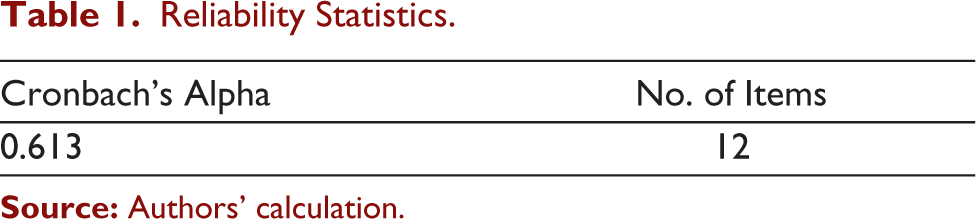
Scale reliability refers to the extent to which a scale can reproduce the same measurement results in the repeated trials. Random error produces inconsistent results in scale measurements leading to lower scale reliability (Bush et al., 2006). There are various techniques, which can be used to test reliability of the scales; this study used Cronbach’s alpha (coefficient alpha). Bush et al. (2006) suggest a Cronbach’s alpha valued at less than 0.6 as unsatisfactory. Nunnally (1978) suggests a threshold level of equal to or greater than 0.50 for exploratory research work. This research used Cronbach’s alpha threshold of 0.613 as indicated in Table 1.
Result of Factor Analysis
Reliability Statistics
Principal Component Factor Analysis with Varimax Rotation for Images of Tanzania
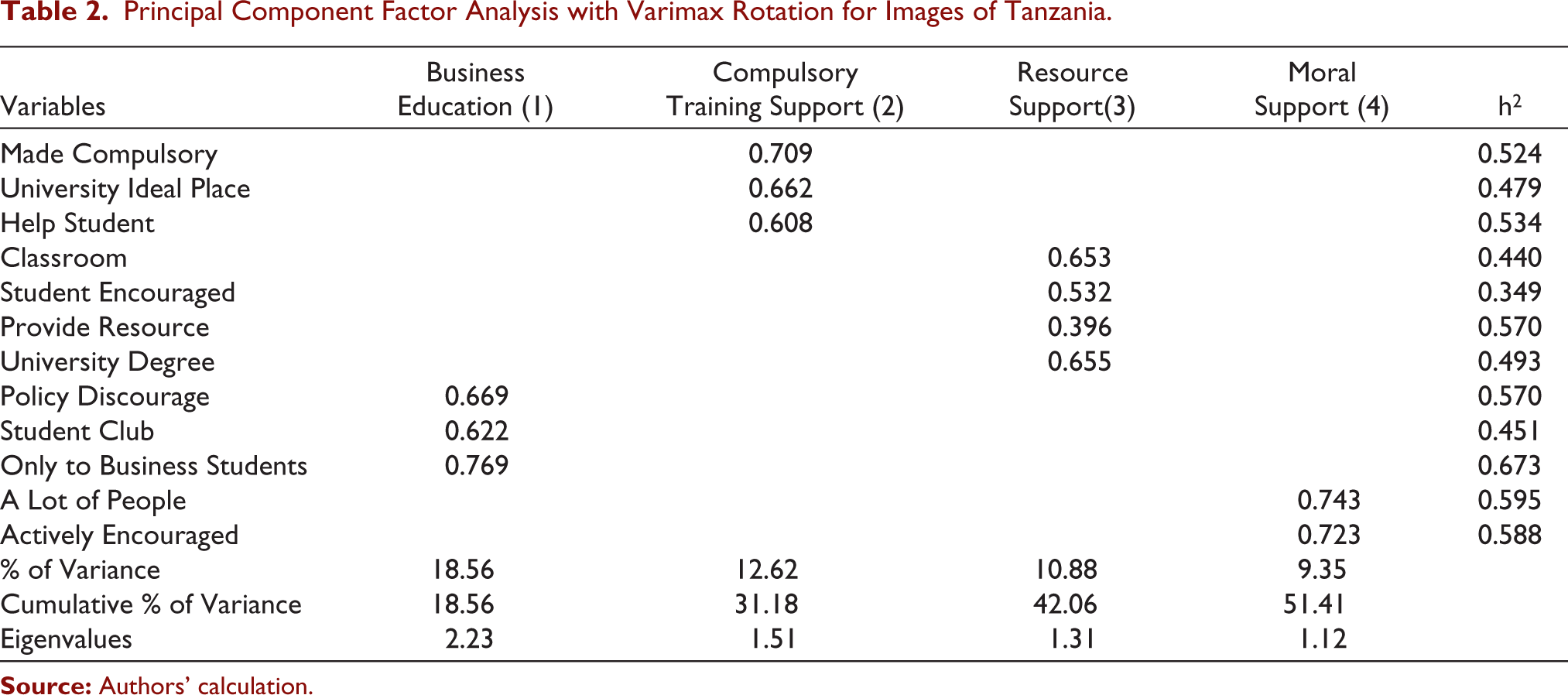
Factor one named as business education support. The findings show that respondents perceive business education support as needed by student entrepreneurs. Previous studies indicate that entrepreneurship education support is one of the important factors that may influence an individual to engage in self-employment (Hahn et al., 2017). However, business courses have been designed only for business-oriented students in many universities around the globe. Previous studies show that there is a need of introducing business subjects to students in hard science courses to enable them to develop more business ideas (Kwong & Thompson, 2016). This is perhaps attributed to the nature of the course such as agribusiness entrepreneurship, which is currently available at SUA. This suggests more entrepreneurship oriented courses such as ‘entrepreneurship for engineers’ and entrepreneurship course for non-managers should be designed and start to be offered. This would minimize the bad perception of looking at the entrepreneurship course as designed only for students taking business-oriented degrees such as BSc Agricultural Economics and Agribusiness.
Factor two was compulsory training support. The explorative findings show that students would prefer entrepreneurship course as a compulsory course to all degree courses offered at the university. Our findings are similar with the findings of previous studies including Kraaijenbrink et al. (2010) who found that education support is a very important factor in the development of entrepreneurship. In general, this suggests that entrepreneurship course needs to be mainstreamed in other degree courses, which are offered at the university. This correlates with the factor number one, which suggests that students perceive entrepreneurship course as designed for business students only. Therefore, we argue that it is very important to mainstream entrepreneurship course to non-business oriented courses but has to be discipline specific oriented. For example, entrepreneurship for veterinarians would be different in some respects from an entrepreneurship course, which has been designed for foresters.
Factor three was resource support. Previous studies (e.g., Alves et al., 2019) have shown show that university support is very important in stimulating entrepreneurial behaviour among students. Forms of resource support, which University may provide, can be in the form of networking and access to technologies through incubation. The study indicates that one of the significant factors of the role played by university has to be availability of resources. This would make possible for young graduate entrepreneurs to start their dream jobs by using the existing resources provided by the university at incubation centres. Different programmes, which were introduced at the university such as EPINARV programmes that offer some support to SUA’s students to start their business in different ventures. In addition, there is SUGECO initiatives that support agribusiness incubates to start up their business by using university resources. In general, the issue of resource can be in different dimensions such as tangible resources and intangible resources.
It can be easy for students to have access to intangible skills such as tacit knowledge on poultry keeping from their professors unlike the case with financial resources. However, this suggests that it is very important for universities to have more focus on the provision of both tangible and intangible resources for the support of agribusiness entrepreneurs to engage in self-employment.
Factor four is moral support from university community. Our finding is similar with the findings of previous studies such as Neneh (2017), that shows that moral support is very important for the establishment of self-employed enterprises. Moral support can be in the form of financial, emotional, or instrumental support. The current study shows that students perceive university as having a role of providing moral support for their entrepreneurship initiatives. Previous studies (e.g., Welsh et al., 2016) have shown that moral support may lead to negative and positive effects due to a number of issues. Negative because in some cases, students may feel they are obliged to their teachers for a number of decisions, which may later limit their innovations because they received moral support.
Overall, graduates are facing many challenges in their business operations such as lack of capital, premises and practical knowledge on business operations. In order for them to engage in business, they need a lot of moral support that may support them to succeed in their initiatives. Some of these moral supports are needed at the early days of their business operations and even in the conception of their business ideas. This kind of support can be through encouragement in their self-employment initiatives and through purchasing their services or products. Another support can be connecting them with potential financiers and link them with other institutions that support entrepreneurs to start-up and or grow.
Discussion
The main aim of this study was to understand the kind of support, which might influence university students to engage in self-employment in developing economies. We tried to understand this by using factor analysis focusing on SUA’s students in Tanzania. Our findings show four kinds of support, which are considered important by students in helping them engage in self-employment. These include moral support, resource support, compulsory training and business education support. The researcher believes that if a university is equipped with sufficient resources (financial, technical and human resources) and provide compulsory training then students can be more transformed into job creators rather than job seekers.
Our findings are in line with the findings in the previous studies that show that training itself may enable students to engage in self-employment, but much support is needed to influence them to engage in self-employment. Our results have indicated that business education support is one of the supports that students want to enable them to engage in self-employment. Currently in Tanzania, some organization such as Deloitte have started a programme of sharpening graduates business ideas with the aim of making them feasible and support them to engage in self-employment as one way of minimizing graduate unemployment in the country (Kasumuni, 2016).
Our findings have shown further that some factors, such as resources supports and moral supports, are very important to be considered by university in motivating students to engage in self-employment. Although previous studies have contradictory findings on business support, the current study shows that business support is highly needed to students to enable them to engage in self-employment. Overall, business education can focus on communications skills, salesmanship skills and customer care. These are areas, which in most cases limit performance of a good number of entrepreneurs.
Students’ expectation is to get moral and material supports that change their minds as per the self-efficacy theory which state that changes initiated by individual students with what they believe can become and excel in business ventures. This suggests that universities have a role to play by focusing on areas where students need moral supports for them to engage in self-employment in developing economies.
Contribution
Our study makes some important contribution to the theory and literature that focus on the support undergraduate students want to engage in self-employment. Using self efficacy theory our findings are in line with the findings by Bandura (1967) who observe that the social support can influence an individual to engage in entrepreneurial activities. The study has shown that the kind of support university students need include moral support, resources support and business education support.
By knowing that in developing economies countries such as Tanzania, the chances of getting jobs are very rare and unemployment rate is increasing, we need to encourage more students who decide to engage into self-employment by buying their products or their services. More has to be done to support non-business-related students to have appropriate business skills that would enable them to engage in self-employment. Universities can design activities such as inviting guest lecturers from the industry and connecting students with mentors who are in business operations.
Furthermore, we have managed to show that self-efficacy and intention to engage in entrepreneurial activities are also influenced by university environment and training facilities. Our findings suggest that self-efficacy can be activated in different ways such as moral and business support. Although there is inconsistence on the nature of education that may influence an individual to engage in entrepreneurship (see Piperopoulos & Dimov, 2015), the current findings show that students would like to get more education in business. Some of these skills could relate to financial skills, sales and entrepreneurship skills.
In the light of the findings and considering the previous studies showing that business education support may influence students to engage in self-employment (see Kraaijenbrink et al., 2010), we can conclude that initiatives which have been taken by some universities in Tanzania such as creation of incubation programme and introduction of business courses to non-business students are highly commendable. Our study shows further that some of the trainings have to be compulsory to non-business students that may enable them to develop business ideas while they are still at the university. In general, more has to be done to make business courses available to non-business university students in developing countries including Tanzania.
To enhance the culture of self-employment, universities in African including Tanzania can continue with training and providing students with opportunities of conducting feasibility studies, writing business plans, listening to guest speakers with experience in business and taking part in business internship in some firms with interest in the same business areas (Saeed et al., 2015). Some universities in Tanzania have started to do this; however, our study showed that more is needed to strengthen their activities.
Limitations of the Study
As an exploratory endeavour, the current study has some limitations. First is that our study relied on the ongoing undergraduate students to look at the kind of supports these students would prefer the university to provide them to be entrepreneurs. We suggest that perhaps those who have graduated might have different feelings on what would enable them to engage in self-employment. Therefore, it is important for future studies to collect data from graduates who are in real life. These might express their feelings, which may later enable universities improve their curriculum. Furthermore, future research can focus on understanding the kind of entrepreneurship education support that may motivate low motivated students such as female students to engage in self-employment. Currently, literature shows that subjects in business studies are many and it would be ideal to see which ones have more impact on self-employment among students in developing economies.
Second, our study is based on the selected students and a good number of the students who participated in the study were those who were studying BSc Agribusiness. Thus, our findings might have been influenced by views of the respondents with some basic training on the entrepreneurship courses. Future studies can include students with no background or any training in business-related courses; it would be interesting to find out the kind of support these students consider as important.
Practical Implications
Our findings have some important implications in terms of the support universities can provide to support undergraduate students engage in self-employment. The findings suggest that if our target is to increase the number of students engaged in entrepreneurship activities then moral support, business education support, resource support and compulsory training support are very important.
For example, for moral support, university can design programmes that may support students get comments and platform to implement their ideas. Very specific moral supports can be in the form of encouraging them and buying their services or products.
Furthermore, university can design more different resource supports. In practice, resource support can be in the form of access to land and machinery that may be paid. Some universities in Tanzania have introduced incubation centres to enable students start practicing business while they are at the university. However, these kinds of initiatives are not mainstreamed in the academic assessment; therefore, an individual has to engage in these sessions at her/his own risks.
Footnotes
Declaration of Conflicting Interests
The authors declared no potential conflicts of interest with respect to the research, authorship and/or publication of this article.
Funding
The authors received no financial support for the research, authorship and/or publication of this article.