



Abstract
Changing gender stereotypes is an essential topic among researchers since the 1970s. The debate on this subject continues in the twenty-first century. Some researchers argue that gender stereotypes have not changed, since it is supported by some solid theoretical foundations and its inherent nature of social interpretation. Moreover, there are gaps in the existing literature, regarding who gets the relative advantage on gender stereotype change and the different outcomes of changing gender stereotypes. Hence, this article reviews the changing gender stereotypes in three perspectives: whether it is prevalent in the whole contemporary world, who gets the relative advantage in gender stereotype change and the realities reflected by the outcomes of changing gender stereotypes. Before these three perspectives, we provide a comprehensive understanding of the definitions, origins and components of changing gender stereotypes. The lack of which may have been an underlying cause of confusion about the concept and its realities. Therefore, this article seeks to evaluate the changing gender stereotypes to provide insights into changing gender stereotypes in the contemporary world, the realities of changing gender stereotypes and directions for future researchers.
Introduction
A society’s beliefs about the appropriate roles for men and women regarding the division of paid work, homework and childcare are often referred to as gender role attitudes, gender ideology (Davis and Greenstein, 2009) or gender stereotypes (Attanapola, 2004; Berridge et al., 2009; De Silva & Priyashantha, 2014; Eagly et al., 2020). Social psychologists state that such gender stereotypes are formed by men’s and women’s assumed attributes (Eagly & Karau, 2002; Ragins & Sundstrom, 1989). Thus, men are assertive, independent, rational, competitive and decisive (Hoyt et al., 2009). In contrast, women assumedly show concern for others, warmth, helpfulness and nurturance (Hoyt et al., 2009). In most research, such distinct traits are labelled as agency and communion (Bakan, 1966; Diekman & Eagly, 2000; Eagly et al., 2020; Sczesny et al., 2019; Williams & Best, 1990). Hence, the agency is the male stereotype, and communion is the female stereotype (Abele, 2003; Eagly et al., 2020; Sczesny et al., 2019). Instead, some researchers emphasize ‘competence’ (e.g., intelligence) rather than ‘agency’ since these traits are correlated (Cuddy et al., 2008). Based on these assumed traits, there is a typical arrangement of neo-traditional labour division, whereby women perform most domestic work, accounting for the caregiver role, and men engage in employments, playing the breadwinner role (Bianchi et al., 2014).
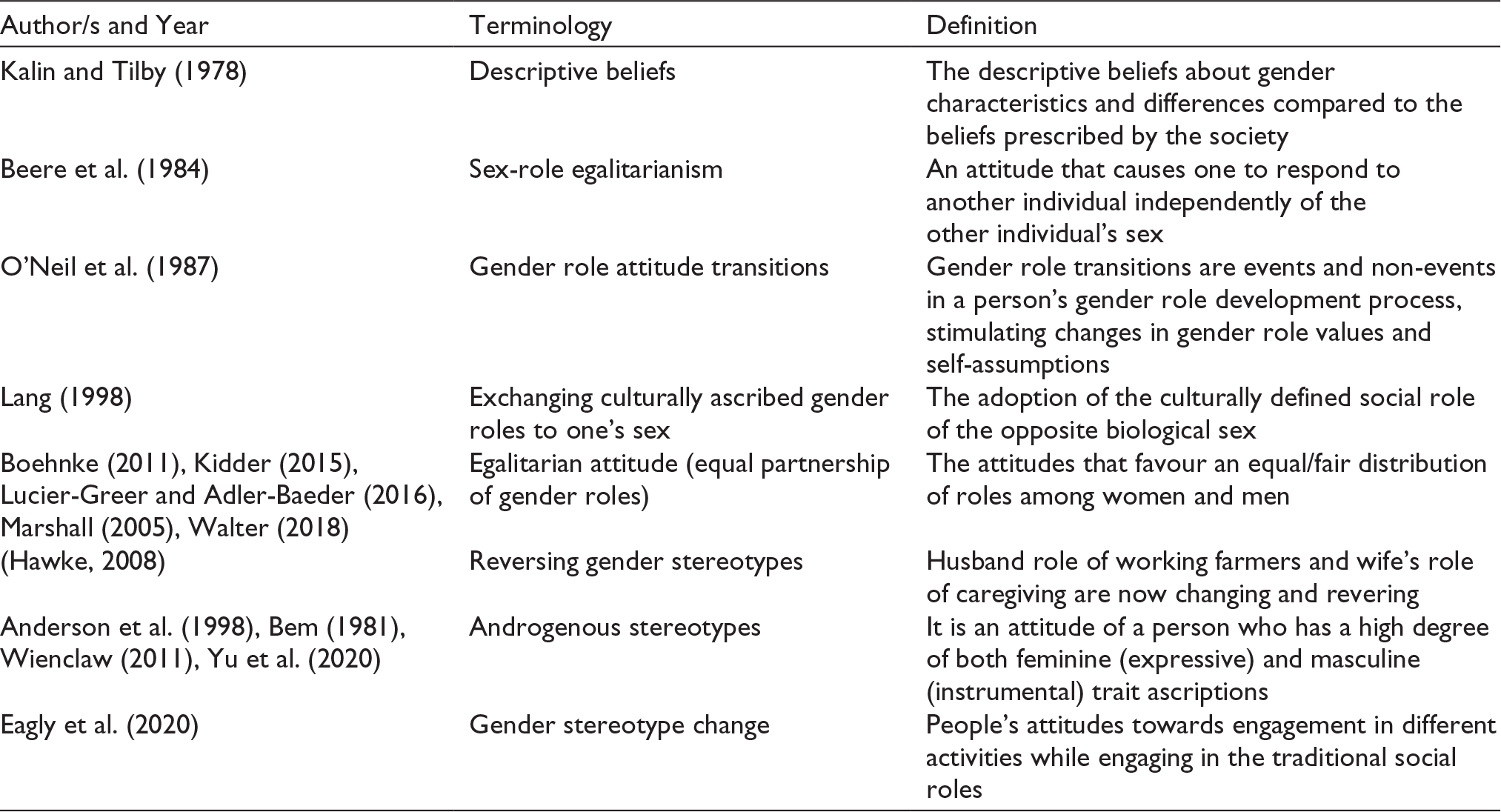
The contemporary world of work has consequenced in females entering into the labour force activities in every region of the world (World Bank, 2011). That has resulted in people having multiple roles as employers, employees, volunteers, friends, spouses and siblings (Najeema, 2010). Thus, both men’s and women’s traditional roles have become much more complex than ever before. This complexity has resulted in a revolution in gender roles that would follow changing gender stereotypes over the past 50 years (Blau & Kahn, 2006; Mergaert, 2012). Changing gender stereotypes refers to egalitarian gender attitudes (Boehnke, 2011; Kidder, 2015; Lucier-Greer & Adler-Baeder, 2016) or attitudes towards the equal share (Marshall, 2005) of gender roles of men and women regarding the division of paid labour, household activities and childcare activities (Walter, 2018; Table 1).
Definitions for Change in Gender Stereotypes
Nevertheless, some researchers in this area argue that such a change in gender stereotypes is questionable (Rudman et al., 2012; Rudman & Glick, 2001). The argument is backed by solid theoretical foundations such as confirmation bias, illusory correlation, cultural lag hypothesis and self-fulfilling prophecies (Haines et al., 2016). All of which provide factual justifications for sustainability in attitudes of gender differences. Moreover, most studies on gender stereotype change were conducted in the latter part of the twentieth century. The question of further change or the stability of gender stereotypes in the early decades of the twenty-first century remains open. Moreover, we know that there are role-related traits to succeed the role performances. There is an argument that biologically, females are communion and males are agentic (Abele, 2003; Eagly et al., 2020; Sczesny et al., 2019). In the context of both males and females playing multiple roles in changing gender stereotypes, there is a question whether who gains the relative advantage in those traits? We need to address that question as well. Instead, changing gender stereotypes has resulted in many outcomes upon family structures, the health of employees, work settings and the economy. Researchers have different views as to whether these outcomes have generated positive or negative outcomes. In this context, there is a need to compile and evaluate gender stereotypes in the extant literature to identify the contemporary world’s insights, reflect on the realities of changing gender stereotypes and provide future research directions. To provide a theoretical foundation and answer for these concerns, we provide three perspectives in this article. For each of these three perspectives, we offer insights for future research directions as well. Before presenting them, a comprehensive definition, origin and the components of changing gender stereotypes are given first, the lack of which may have been a cause of confusion about the term (Kozlenkova et al., 2014) of changing gender stereotypes.
The first perspective evaluates changing gender stereotypes to determine whether it is prevalent in the contemporary world. Researchers on gender studies have mixed arguments, in which some state that gender stereotypes are inequal (Ellemers, 2014; Van Laar et al., 2019), and it is stable over time (Haines et al., 2016). While on the other hand, researchers argue that gender stereotypes are evolving, and we are now in the era of changing gender stereotypes (Eagly et al., 2020). In this respect, we attempt to highlight that gender stereotype change is a common phenomenon in almost every country globally. Hence, future research should focus on this area since it continuously evolves, and its socialization forces are becoming increasingly multifarious (Brown & Stone, 2016). In the second perspective, we address the relative advantage in gender stereotype change, for men and women, regarding its contents of agency and communion. We attempt to state that we are in the era of changing gender stereotypes, where men and women should have both agency and communion traits for being successful in their role behaviours. In this perspective, based on some researchers’ findings, we attempt to state that women tend to gain communion and competence, while men are still gaining agency traits in their role’s performances. However, there is a need for further research to identify the same pattern that exists cross-culturally. The third perspective focuses on the realities reflected from the outcomes of changing gender stereotypes. Depending on the nature of the outcomes, we categorize them into four areas: economic, family, work and health. We argue that more negative outcomes to employees’ families, work and health are from this perspective. Instead, there are positive outcomes only for the economy since women have entered labour market activities. These findings also provide future researchers an insight into this categorization. They need to ascertain whether the pattern exists over time since gender stereotypes constantly evolve, and socialization forces become increasingly diverse (Brown & Stone, 2016). Future researchers can also find remedies to overcome such negative outcomes and make the positive outcomes more productive.
Changing Gender Stereotypes
As highlighted in the social role theory, gender stereotypes stem from peoples’ observation of men and women in their social roles (Eagly et al., 2020; Koenig & Eagly, 2014). Contrary to this view, an argument highlights that gender stereotypes are formed based on biological sex differences (Rangel & Keller, 2011). Nevertheless, Eagly et al. (2020) highlight that gender stereotypes stem from social roles. Hence, the social role theory provides a theoretical basis for predicting the changes in gender stereotypes that would follow the changes in the social role distribution between men and women (Haines et al., 2016).
Concerning the possible shifts in gender roles, the major cause affected therein is women’s employment opportunities (Eagly et al., 2020; Haines et al., 2016). Notably, factors like social and economic developments (Attanapola, 2004; Boehnke, 2011; Eagly et al., 2020; Zosuls et al., 2011) and the structural changes (welfare and dual-earner policy configurations) have caused a reduction in gender differences (Mergaert et al., 2013) in most of the countries that have promoted female employment participation. The United Nation’s initiatives for women (human rights, gender equality and nondiscrimination, and women in development programmes) (Benería et al., 2015) also promoted women’s employment opportunities in most countries. The increased employment opportunities have resulted in new family patterns (Oláh et al., 2018). That, in turn, has consequenced the inability of couple relationships, declining fertility rates and women’s economic independence (Oláh et al., 2018), which have an iterative effect on further female employment participation. Moreover, labour market developments, rising educational demands and greater flexibility of work arrangements are also associated with females’ employment participation (Oláh et al., 2018). This female employment participation has had a profound impact on changing the gender stereotypes of both men and women over time across different countries in the world (Brandth et al., 2017; Mergaert et al., 2013; Oláh et al., 2018). Specifically, various terminologies have emerged in the extant literature to denote this gender stereotype change, which are presented in Table 1.
As one of the earliest definitions, changing gender stereotypes are descriptive beliefs about gender characteristics and differences rather than their prescriptive beliefs implied by society (Kalin & Tilby, 1978). However, most other definitions highlight the expectation of an equal share of gender roles between men and women. To denote that, the most common terminology used has been gender role egalitarianism (Boehnke, 2011; Kidder, 2015; Lucier-Greer & Adler-Baeder, 2016; Marshall, 2005; Walter, 2018). Instead, in some research, sex-role egalitarianism (Beere et al., 1984) or androgenous stereotypes (Anderson et al., 1998; Bem, 1981; Wienclaw, 2011; Yu et al., 2020) has been used. Additionally, some other definitions highlight gender role attitude transitions (O’Neil et al., 1987), reversing gender stereotypes (Hawke, 2008) or the performance of culturally ascribed roles of the opposite sex (Lang, 1998). However, whatever definition is presented, one thing highlighted is that almost all definitions project that the traditional gender stereotypes have changed. That is generally termed as gender stereotypes change (Eagly et al., 2020), in which both men and women have attitudes for multiple gender roles to be shared.
The Components of Changing Gender Stereotypes
As changing gender stereotypes have evolved from gender stereotypes, researchers have tended to use the same ‘agency’ and ‘communion’ components in gender stereotypes to the components of changing gender stereotypes (Eagly et al., 2020; Hentschel et al., 2019; Sczesny et al., 2019; Williams & Best, 1990). Agency is a quality of being assertive, competent, independent (Haines et al., 2016; Meeussen et al., 2020), competitive and ambitious, orienting one’s mastery and goal attainment (Eagly et al., 2020). Communion, on the other hand, is a quality for being caring, warm, social and kind (Haines et al., 2016; Meeussen et al., 2020) or compassionate, warm and expressive, which orients people to others and their well-being (Eagly et al., 2020). Moreover, researchers also term the same components as competence and warmth, where competence refers to the perceived ability to be successful at tasks that are accorded high status and prestige in culture, and warmth refers to the target group’s socio-emotional orientation towards others (Eckes, 2002). Instead, there are some instances where researchers have used masculinity and femininity (Abele, 2003; Bem, 1981; Broverman et al., 1972; Diekman & Eagly, 2000; Garcia-Retamero et al., 2011; Haines et al., 2016; Lueptow et al., 1995; Rucker et al., 2018; Sczesny et al., 2019; Twenge, 1997; Williams & Best, 1990). Even these two components used in the literature by different terminologies interchangeably, the most common form of components is the agency and the communion (Berkery et al., 2013; Broverman et al., 1972; Eagly et al., 2020; Haines et al., 2016; Hentschel et al., 2019; Sczesny et al., 2019; Williams & Best, 1990). Hence, the traditional view of gender stereotypes holds that the agency prevails in male stereotypes, and communion prevails in female gender stereotypes (Eagly et al., 2020; Haines et al., 2016). Moreover, in terms of competence and warmth, men are very high in the agency but low in communion; in contrast, women are low in competence but high in warmth (Eagly et al., 2000; Williams & Best, 1990). Hence, as per the traditional stereotypes, men are ascribed to play the breadwinner role, while women are ascribed to perform caregiving and domestic-related activities (Eagly et al., 2020; Haines et al., 2016).
Since the contemporary realities report that people’s gender stereotypes have changed in which women do men’s work and vice versa, both men and women should have both agency and communion characteristics together to be successful in their role performances (Bem, 1981; Berkery et al., 2013; Deaux & Lewis, 1984; Lopez-Zafra & Garcia-Retamero, 2012; Spence & Hahn, 1997). Thus, If men or women demonstrate both traits inherent in both agency and communion components, it implies that their gender stereotypes have been changed (Eagly et al., 2020).
Perspective 1: Are Gender Stereotypes Changing or Not?
In providing the answer to this question, some researchers argue that gender stereotypes are changing (Duehr & Bono, 2006; Eagly et al., 2020). In contrast, others say that it is questionable (Rudman et al., 2012; Rudman & Glick, 2001) despite a few differences in men’s and women’s roles in society (Haines, 2016).
There are many theories in favour of such a no-change prediction. The backlash and status incongruity hypothesis (Rudman et al., 2012) suggests that the backlash—(those who reinforce cultural stereotypes as normative rules)—often charge social and economic penalties to the vanguards (who support the gender stereotype change) (Rudman, 1998). In turn, vanguards may try to find preventive measures to avoid such penalties from backlash and instead confirm existing stereotypes (Haines et al., 2016). Additionally, perceptual bias theories such as the confirmation bias (Higgins & Bargh, 1987), illusory correlation (Hamilton & Gifford, 1976) and self-fulfilling prophecies (Snyder et al., 1977) also favour such a no-change prediction (Haines et al., 2016). These perceptual biases suggest that people can sustain gender roles due to subjective assumptions and social beliefs (Rothbart & Park, 1986). The cultural lag hypothesis suggests that gender attitudes and beliefs are likely to lag behind societal changes (Diekman et al., 2010). The essentialization of gender categories also suggests no-change prediction (Croft et al., 2015). Hence, all these support the argument of no change in gender stereotypes.
However, many studies revealed that gender stereotypes are changing (e.g., Boehnke, 2011; Eagly et al., 2020; Oláh et al., 2018). Researchers state that this belief is well developed in the literature (Lopez-Zafra & Garcia-Retamero, 2012). Notably, change in gender stereotype is not limited to one county or region, and studies prove that it is prevailing worldwide (Brown, 1991; Constantin & Voicu, 2015; Inglehart & Baker, 2000) with minor exceptions (Brown, 1991; van de Vijver, 2007). The idea that gender stereotypes are changing was confirmed by the studies conducted in Europe (Berkery et al., 2013; Boehnke, 2011; Garcia-Retamero et al., 2011; Lopez-Zafra & Garcia-Retamero, 2012), America (Alfieri et al., 1996; Beere et al., 1984; Bem, 1981; Broverman et al., 1970; Deaux & Lewis, 1984; Gill et al., 1987; Lueptow et al., 1995; Parelius, 1975; Spence & Hahn, 1997; Twenge, 1997; Zosuls et al., 2011), East Asia (Boehnke, 2011), Africa (Bosak et al., 2018) and the Arab world (Sikdar & Mitra, 2012). Moreover, some cross-cultural studies also confirm the prevalence of gender stereotype change in most countries (Brown, 1991; Constantin & Voicu, 2015; Williams & Best, 1990). Therefore, the arguments of ‘gender stereotypes no change prediction’ (Haines et al., 2016) or ‘gender stereotypes change is questionable’ (Rudman et al., 2012; Rudman & Glick, 2001) need to be revisited. Since gender stereotypes are continuously evolving and socialization forces are becoming increasingly diverse (Brown & Stone, 2016), further research needs to test whether the pattern exists over time.
Perspective 2: Relative Advantage in Changing Gender Stereotypes
This section focuses on analysing whether men or women get a relative advantage from changing gender stereotypes. As gender stereotype change consists of people’s attitudes about performing multiple roles (e.g., men do women’s roles and vice versa), they should have different role-related traits to succeed in their role performances. For example, when a woman performs managerial employment, she must demonstrate agency-related values and characteristics that most organizations are demanding (Vianen & Fischer, 2002). Thus, both men and women should have both agency and communion characteristics (Bem, 1981; Berkery et al., 2013; Deaux & Lewis, 1984; Lopez-Zafra & Garcia-Retamero, 2012; Spence & Hahn, 1997). Hence, who gets the advantage is determined in this article based on the components of changing gender stereotypes. For that, we used agency and communion rather than masculine/competence and feminine/warmth in this article, as they are the most commonly used terminologies (Berkery et al., 2013; Broverman et al., 1972; Eagly et al., 2020; Haines et al., 2016; Hentschel et al., 2019).
As the number of women entering the workforce continues to grow, sex segregation of occupations has declined (Blau et al., 2013). Female educational attainments have helped them enter into more male-dominated jobs and professions that offer relatively high prestige (Haines et al., 2016; Lippa et al., 2014; Meeussen et al., 2020) in different areas such as in science, technology, engineering and mathematics (The UNESCO Institute for Statistics, 2017). In particular, women in leadership positions demonstrate more agency characteristics against the traditional idea that women are high on communion characteristics (Haines et al., 2016; Meeussen et al., 2020).
Contrary to this, Eagly et al. (2020), based on the study conducted in the American context, state that there are increases in women’s communion and competence. Arguably, many women continue to be in jobs that require social skills and social contribution (e.g., service-related jobs), and those that require communion traits (Eagly et al., 2020). There are reasons for females to select more service-oriented jobs. The first being that people likely believe that women have a substantial choice about the occupations they pursue, thus increasing the possibility for choosing the jobs corresponding to their inherent traits (Jones & Davis, 1965). Another reason may be that even the women drew into more male-dominated occupations, many of these jobs are not agentically demanding (e.g., veterinarian, dentist; Roos & Stevens, 2018). Even when women occupy jobs requiring more agentic roles (e.g., lawyer and manager), they tend to put more communal variants of these roles (Levanon & Grusky, 2016). Due to these reasons, women’s increasing employment has possibly been driven by women’s stereotypes towards the gains in communion traits (Eagly et al., 2020). Moreover, the relative women’s educational attainment when compared to men has been significantly increased over the past 50 years, resulting in women increasingly obtaining opportunities to present in higher positions in most countries (The UNESCO Institute for Statistics, 2017; van Hek et al., 2016). Thus, by referring to the definition of competence trait (the perceived ability to be successful at tasks accorded high status and prestige in culture), educational attainment is represented by the ‘competence’ itself rather than the ‘agency’. Therefore, this high women’s educational attainment resulted in gaining more from the competence traits.
When women enter more jobs, men need to spend more time on family activities and children’s care (Oláh et al., 2018). This idea would imply a perceived change towards higher communion among men (Gustafsson Sendén et al., 2019). In the USA, men’s data on time spent on household activities are still 14% less than that of female involvement (U.S. Bureau of Labor Statistics, 2020). Moreover, Given changing gender stereotypes, it is interesting to study whether men might also make occupational choices requiring more communion traits. A study conducted in the American context reveals that the jobs that traditionally employ more men required physical strength, competition, analytical mathematical and technical skills (Baker & Cornelson, 2018). The study highlighted that American men tend towards agency traits demanding jobs and occupations, and the pattern has not changed during the past 30 years (Eagly et al., 2020). It means that men still behave with more agency due to prescribed stereotypical roles. In addition, it is evident that fewer men have moved into traditionally feminine, communal occupations in American (Eagly & Sczesny, 2019; Haines et al., 2016) and Belgian (Meeussen et al., 2020) contexts. Moreover, Van Grootel et al. (2018) state that men tend to underestimate the extent to which other men approve of men’s communal traits and behaviours. Hence, men’s under-representation in communal roles confirms that men still gain agency traits in their role performances.
In summary, this review highlights that women tend to gain communion and competence, while men are still gaining agency traits in their role performances. We reached this finding only from studies conducted in two countries (America and Belgium). There is a need for future researchers to take this perspective into more research cross-culturally. That is to confirm the idea of women’s gains in communion and competency and men’s in agency (Eagly et al., 2020; Meeussen et al., 2020). That will be an insight for an extended theoretical foundation in gender research of the future.
Perspective 3: Outcomes of Changing Gender Stereotypes
When examining the literature on outcomes of changing gender stereotypes, we found that the outcomes could be categorized into four areas: family, work, health and economic (Table 2). The different outcomes of these four aspects are analysed in this section.
Outcomes of Changing Gender Stereotypes
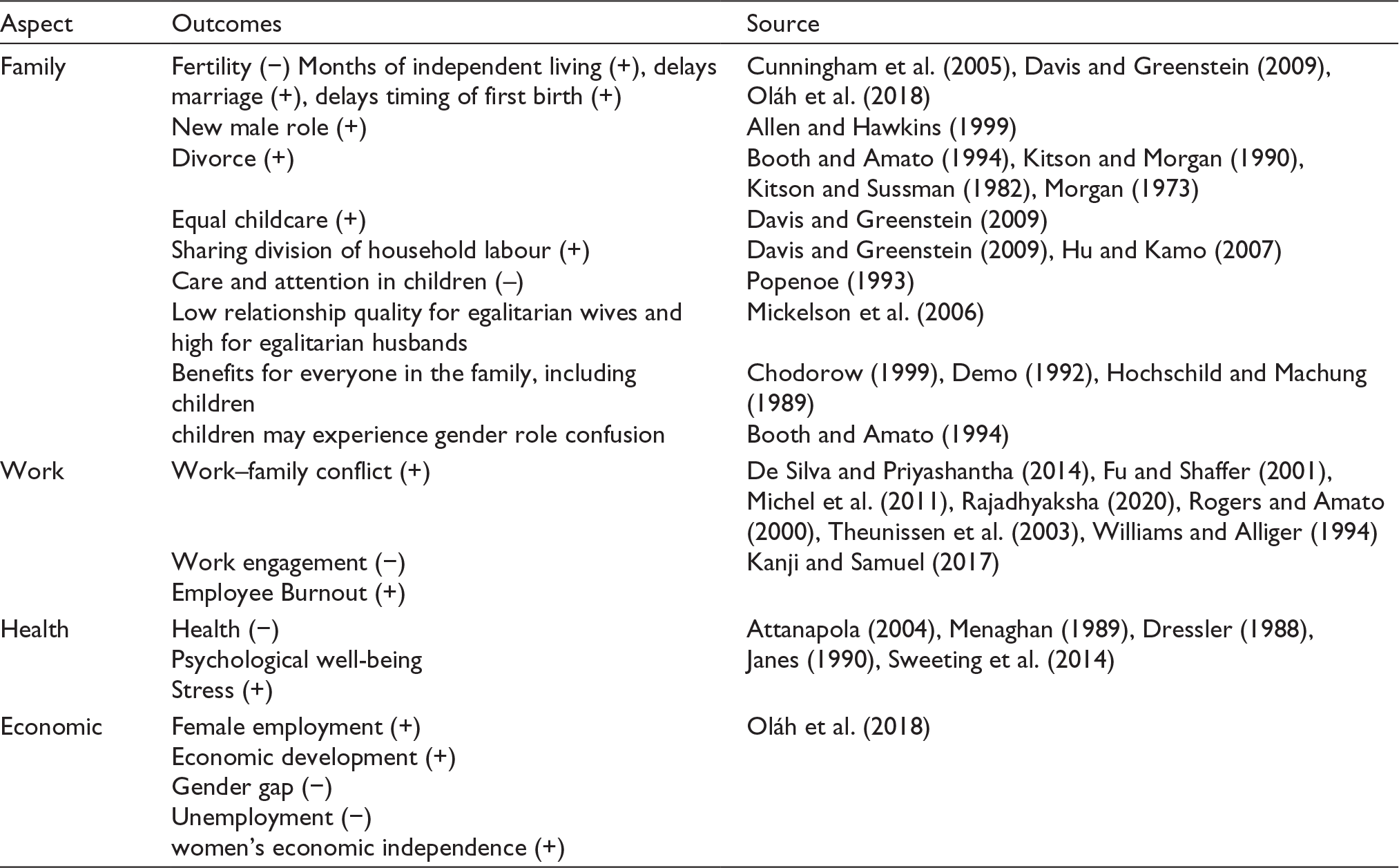
The outcomes categorized under family seem positive and negative by the outcome’s nature and their associated outcomes. Benefits for everyone in the family, including children (Chodorow, 1999; Demo, 1992; Hochschild & Machung, 1989), and equal participation of mothers and fathers in childcare activities (Davis & Greenstein, 2009) are positive outcomes based on changing gender stereotypes since the family and children benefit from this. The outcomes of men’s involvement in more household labour (Davis & Greenstein, 2009; Hu & Kamo, 2007) result in relationship quality of the couple (Goldscheider et al., 2014), increase women’s happiness (Cox & Paley, 2003), increase fertility (Pinnelli & Fiori, 2008) and result in less tendency to separate from the couple’s relationship (Oláh & Gähler, 2014). Moreover, the new male role for parental care for children (Allen & Hawkins, 1999) results in more benefits. For example, studies found that father’s involvement in child activities has generated more benefits such as better academic performance, higher levels of self-esteem and fewer behavioural problems of children (Flouri & Buchanan, 2004). Similarly, less involvement of fathers in children’s activities results in increased suspension rates from school, more frequent delinquent behaviour and higher reports of depression (Flouri & Buchanan, 2004; Schoppe-Sullivan et al., 2008). Therefore, those family-related consequences of changing gender stereotypes can be treated as positive outcomes.
The low fertility rates (Davis & Greenstein, 2009; Oláh et al., 2018) can be considered as a significant negative outcome of changing gender stereotypes. Because that, in turn, may result in low birth rates. Then, it may be a considerable challenge for finding labourers in future economic growth prospects and for the future existence of human beings in the long run. Women’s months of independent living, delayed marriage and delays in the timing of first marital birth (Cunningham et al., 2005) are other outcomes of changing gender stereotypes. One can argue that these outcomes are positive by nature if these outcomes lead to women’s better quality of life. However, since all these outcomes are associated with low fertility rates, and our concern is the labour force required for future economic growth prospects and the future existence of human beings, we tend to interpret them as negative outcomes. Low marital relationship quality (Mickelson et al., 2006), more tendency to divorce (Booth & Amato, 1994; Kitson & Morgan, 1990; Kitson & Sussman, 1982; Morgan, 1973), experiencing gender role confusion of children (Booth & Amato, 1994) and less care and attention in children (Popenoe, 1993) are also outcomes from changing gender stereotypes. As these outcomes’ names imply, they may have negative results for society and its existence. If these outcomes are frequent, It will be a problem for the development of a community. Hence, such outcomes are also considered to be negative outcomes, derived from changing gender stereotypes.
The second category of outcomes is work-related outcomes. One of such is the increased work–family conflict (Carlson et al., 2000; Carlson & Kacmar, 2000; Carlson & Perrewé, 1999; De Silva & Priyashantha, 2014; Fu & Shaffer, 2001; Michel et al., 2011; Rogers & Amato, 2000; Williams & Alliger, 1994). It can further lead to negative effects for the employees, such as work-related stress, depression (Allen et al., 2000) and sleep problems (Bowen et al., 2018). Hence, the work-related outcomes of changing gender stereotypes can be treated as negative. The lowered employee engagement levels when the spouse is working (Kanji & Samuel, 2017) and increased employee burnout (Bowen et al., 2018) can also be treated as work-related outcomes of changing gender stereotypes. When the employee engagement is low, it can badly impact the bottom-line results of a business (Macey & Schneider, 2008; Rana et al., 2014; Saks, 2006), like low financial performance through lower productivity, lower sales, lower customer satisfaction and lower employee well-being (Macey & Schneider, 2008; Rana et al., 2014; Schaufeli et al., 2002). Moreover, burnout is treated as the exact opposite of employee engagement in the literature. Hence, when employee engagement is low, burnout will be high. Then, the negative outcomes of employee engagement can be expected as low financial performance through lower productivity, lower sales, lower customer satisfaction and lower employee well-being (Macey & Schneider, 2008; Rana et al., 2014; Schaufeli et al., 2002). Indeed, burnout has direct negative impacts as higher withdrawal behaviours of employees (Schaufeli & Enzmann, 1998), low quality of work and deterioration of home life, emotional exhaustion, health-related problems and alcohol use (Maslach et al., 2001; Maslach & Leiter, 2006). In line with this information, it can be stated that the work-related outcomes of changing gender stereotypes generate negative results. However, there was no finding concerning the positive outcomes in the literature survey carried out.
The third category of the outcome of changing gender stereotypes is related to health. By nature, as the changing gender stereotypes consists of multiple role attitudes, people might struggle to fulfil their socially defined role expectations. In doing so, there might be a high tendency for them to be stressed (Dressler, 1988; Janes, 1990). Moreover, changing gender stereotypes results in lowering the three categories of health, such as the reproductive, productive and mental health of employees (Attanapola, 2004). A careful analysis of all these health-related outcomes reveals negative outcomes, and there were no findings relating to the positive outcomes found in the literature survey done.
Finally, the fourth category is related to economy. The significant contributor to changing gender stereotypes is females’ economic independence, reducing the gender gap and unemployment (Oláh et al., 2018). A careful analysis of this evidence proves that changing gender stereotypes only generates positive outcomes from the economic perspective.
In summary, our review reveals that changing gender stereotypes generates positive outcomes only for the economy and negative outcomes for the family, work and employees’ health. Therefore, it is necessary to find remedies to overcome these negative outcomes. It is useless to get economic benefits by harming the employees’ family, work and health due to the modern nature of gender stereotypes. The finding implies that future researchers need to find remedies to overcome these negative outcomes and make positive outcomes more productive. Furthermore, the negativity or positivity was derived in this perspective from the available literature. Then researchers can further test these findings, and arguments can be made based on the empirical evidence. In addition, future research needs to explore the consequences since gender stereotypes are constantly evolving, and socialization forces are becoming increasingly multifarious (Brown & Stone, 2016).
Conclusion
Changing gender stereotypes has been researched over the past 50 years. This article reviews the extant literature on changing gender stereotypes to provide insights into changing gender stereotypes in the contemporary world, the realities of changing gender stereotypes and the directions for future researchers. To achieve these objectives, we have analysed earlier research studies on changing gender stereotypes from three perspectives. The first perspective evaluates whether the changing gender stereotypes prevalent in the contemporary world implies that gender stereotype change is common in almost every country globally, with negligible exceptions. Second, the perspective of who gets the relative advantage in changing gender stereotype traits suggests that women tend to gain communion and competence traits, while men are still gaining agency traits in their performance roles. Finally, the third perspective evaluates the realities reflected from changing gender stereotypes, indicating that outcomes are categorized into four areas: economy, family, work and health. For three of them—family, work and health—there are negative outcomes. There are positive outcomes only for the economy as women’s participation in the labour market activities boosts the economy. Each perspective provides unique insights and suggests crucial future research directions.
In summary, the changing gender stereotypes, a research area that is around 50 years old, requires providing insights, realities and future research directions based on the extant literature. We anticipate that the changing gender stereotypes will keep evolving, and we hope that this article provides some direction for the researchers therein.
Footnotes
Declaration of Conflicting Interests
The authors declared no potential conflicts of interest with respect to the research, authorship and/or publication of this article.
Ethical Statement
We confirm that this article meets the ethical requirements, and that we have fully considered all foreseeable ethical implications of the research, both intended and unintended.
Funding
The authors received no financial support for the research, authorship and/or publication of this article.