



Abstract
A lack of job security and other challenges mark the circumstances of temporary agency workers (TAWs). Yet, data from 511 TAWs of the Indian information technology (IT) industry captured via a structured questionnaire revealed the presence of volition or TAWs holding temporary jobs by choice. The study was conducted in two phases. In phase one, logistic regression was used to differentiate between voluntary and involuntary TAWs. In phase two, multiple regression was used to analyse the influence of volition on work engagement–overall and its individual components (vigour, dedication, and absorption). Logistic regression analysis showed that TAWs who were younger, single, educated in smaller cities and had worked for less than a year with a client were more likely to voluntarily choose temporary work. Further, multiple regression analysis demonstrated that such volition significantly boosts TAWs’ work engagement, in line with Self-Determination Theory’s perspective on autonomous motivation. The predictive model of categorizing TAWs into voluntary and involuntary groups based on demographic and job characteristics will help client and staffing organizations design customized policies for each group and promote factors enabling voluntary selection of temporary work arrangements.
Keywords
Introduction
Alternative work arrangements continue to expand as firms seek flexibility through employment-at-will to meet changing business needs. Firms are increasingly adopting what is called workforce-on-demand (Spreitzer et al., 2017) with new emerging and gig technology, creating non-standard jobs (Mehta & Awasthi, 2019). Alternative work arrangements include flexibility in the employment relationship (e.g., temporary agency workers), scheduling (e.g., part-timers) and work location (e.g., teleworkers). The on-demand workforce has gained greater traction as COVID has pushed businesses to increase their temporary-to-permanent hiring ratio to 30:70 or 35:65 versus pre-pandemic ratio of 20:80 (Mint, 2021). Of all industries, the Indian information technology (IT) industry–characterized by project-based working and need for specialized/in-demand skills for short bursts–is particularly keen on alternative work arrangements, especially utilizing temporary agency workers (TAWs).
The Indian IT industry long leveraged the ‘bench model’, that is, recruiting employees in the anticipation of future projects and then benching them or not putting them to billable work immediately. But this model drove up costs for organizations, who have since sought less-expensive alternative staffing models. One such alternative is engaging TAWs through staffing agencies. Staffing agencies hire TAWs and then place them with client organizations for a fixed time. Thus, TAWs are employees of the staffing agencies but work for the agencies’ client organizations. There is therefore a triangular employment relationship between the staffing agency, client organization and TAWs. The staffing agency is the employer of record and is responsible for all regulatory and administrative requirements. This reduces associated costs for client organizations, also making it easier for the clients to tap into specialized skillsets. The number of TAWs in India has grown an estimated 6% annually, since 2017 (Indian Staffing Federation, 2017), evidencing the IT industry’s embrace of this tripartite model, given its cost and flexibility advantages.
However, this flexibility is based on a transient and transactional relationship between the TAW, the client and the staffing agency. The relationship is characterized by a lack of job security, lower pay and benefits for the TAWs, as well as negligible investment by either client or staffing agency towards TAWs’ career or skill development. This apparently disadvantageous situation for the TAW makes one wonder about the factors motivating individuals to accept such an arrangement.
Previous studies (De Cuyper & De Witte, 2008; Jong et al., 2009) have revealed varied reasons that encourage opting for and maintaining temporary employment. And, the reasons may be voluntary (e.g., greater schedule flexibility or freedom) or involuntary (e.g., lack of permanent jobs; Lopes & Chambel, 2014). The nature of motivation—voluntary or involuntary—influences outcomes, such as job satisfaction, job performance, work engagement, commitment, and mental health (Shahzadi et al., 2014). Thus, it is important to understand whether the TAW has accepted a temporary work arrangement voluntarily or involuntarily, and identify the demographic (e.g., gender, education, age, and marital status) and job characteristics (e.g., job function and tenure with the client) that determine voluntariness. Such identification may enable improved, customized talent management. Therefore, this article attempts to categorize TAWs as voluntary or involuntary, while answering:
What are the demographic and job characteristics that indicate TAW’s tendency to take up temporary employment voluntarily vis-à-vis involuntarily?
Further, there is a need to explore how voluntarily choosing temporary work arrangements (henceforth: volition) impacts TAW’s workplace well-being. Workplace well-being is often measured as work engagement, which affects work productivity and quality (Manion, 2009). TAWs are often hired for their scarce and specialized competencies that are critical to project success. Ignoring their well-being may not only create resource challenges for the present, but also for the future by generating bad publicity for the organization among the wider TAW community (Rajthilak et al., 2021). Exploring the relationship between volition and workplace well-being is therefore important. Thus, this article also seeks to address the question:
What is the relationship between volition and TAWs’ extent of work engagement?
Previous research on TAWs have examined the concept of volition and its drivers (De Cuyper & De Witte, 2008; Morris & Vekker, 2001). Some have also explored the implications of volition on outcomes such as job satisfaction and affective organizational commitment (De Cuyper & De Witte, 2008). However, research clustering TAWs into voluntary-versus-involuntary groups’ basis to varied exogenous factors, then also investigating the impact of volition on well-being, is scarce. Additionally, Hunefeld et al.’s (2019) systematic review of works on job satisfaction and mental health among TAWs discovered inconsistencies in the relationship between temporary working and these outcomes. The inconsistencies were considered likely due to the study samples being from diverse industries/occupations and due to unobserved confounding variables (Hunefeld et al., 2019). Indeed, many works did not seem to cover ‘important confounders’, such as age and tenure with client (Hunefeld et al., 2019). Further, Hunefeld et al. (2019) advocated analysing TAWs from the same country to account for national regulations, as well as focussing on a single form of temporary working.
This article seeks to address these various research gaps by (a) focussing on a sharply defined segment of TAWs, viz., those engaged through a staffing agency (a particular form of temporary working) by the IT industry (specific industry or occupation) of India (single nation), (b) grouping TAWs as voluntary or involuntary on the basis of demographic and job characteristics, and then studying the influence of volition on work engagement and (c) including relevant confounding variables, such as client support, staff agency support, perceived employability and self-efficacy (Ngo et al., 2015; Lopes et al., 2019).
Thus, this study can contribute novel and consistent findings to research on TAWs, particularly in the context of the Indian IT industry, which relies increasingly on TAWs and whose services underpin the operations of some of the largest corporations globally. The insights from this study may inform staffing and client organizations in adopting customized human resource policies that can differently motivate voluntary and involuntary TAWs to enhance their job performance.
Literature Survey
Presenting the chronology of themes in TAW research: Initial studies focussed on factors driving the demand for TAWs and comparing the working conditions of TAWs with that of permanent workers (De Cuyper & De Witte, 2007). Further, the studies investigated the impact of difference in the working conditions on TAWs’ outcomes such as job performance, job satisfaction, and mental health (Giunchi et al., 2015; Hakansson & Isidorsson, 2016). Most of these studies leveraged the job demand–resource model to identify various personal and job-related determinants associated with improving the outcomes. The determinants included referral-based recruitment of TAWs (Gonzalez & Rivares, 2018), self-profiling for informal learning (Preenen et al., 2015), training (Chambel & Sobral, 2015) and perceived organizational support (Lopes et al., 2019).
Having identified outcome determinants, the researchers next examined the psychological mechanisms (e.g., perceived employability and motivation) through which the determinants resulted in the improved outcomes for TAWs (Chen et al., 2017; Forrier et al., 2018; Swati & Rajthilak, 2021). In this context, works also investigated what motivated workers to opt for temporary arrangements. Various reasons for motivations were identified (Bernasek & Kinnear, 1999; Casey & Alach, 2004; De Cuyper & De Witte, 2008; Hardy & Walker, 2003; Kunda et al., 2002; Morris & Vekker, 2001). This led to categorizing reasons as voluntary versus involuntary (De Cuyper & DeWitte, 2008), or intrinsic versus extrinsic motivation (Benedetti et al., 2015) or autonomous versus controlled motivation (Deci & Ryan, 2000). It was further found that intrinsic or autonomous motivations boosted well-being (Lopes et al., 2019) and reduced organizations’ worker monitoring costs (Chen et al., 2017).
Recently, most TAW-related studies are conducted from the client and/or staffing organizations’ perspective. They explain how enhancing their social skills (Galais & Moser, 2018), offering them staff or client support (Giunchi et al., 2015), ensuring organizational justice (Connelly et al., 2011) or providing them training (Chambel & Sobral, 2015), work identity (Winkler & Mahmood, 2018) and competence development (Woldman et al., 2018) may enhance TAWs’ effective commitment towards client/staffing organizations and their engagement level.
Notably, most works that identify the reasons for accepting temporary work tended to ignore the nature of the occupation. For example, those engaged in low-skill work may seek temporary arrangements for reasons different from those engaged in high-skill work. And these differences alter job-related behaviours. Additionally, TAW-related studies largely examine samples covering diverse industries, thus ignoring industry-specific working conditions that may impact employment choices. Further, the studies predominantly focus on European countries with their employment regulations differing from those of India. And, employment regulations significantly determine employment preferences (Hakansson et al., 2020). Therefore, this article intends to focus on workers in a single occupation (technology work), industry (IT), country (India) and form of alternative work arrangement (temporary agency work). Articles related to the determinants and consequences of volition among TAWs were reviewed to develop this article’s conceptual framework.
Conceptual Framework
Volition Among Temporary Agency Workers
Volition or a worker’s freely choosing temporary employment has been frequently examined, given volition’s positive effect on the worker’s psychological outcomes (De Cuyper & De Witte, 2008). In this context, some have identified the reasons driving volition among TAWs. The reasons include family needs, economic incentives, supplemental income (Bernasek & Kinnear, 1999), opportunity for self-improvement, distance from office politics, learning from job variety (Casey & Alach, 2004) and personal preferences (De Cuyper & De Witte, 2008). Meanwhile, temporary work as a means to attain permanent employment (Hardy & Walker, 2003) and unavailability of a permanent job (Kunda et al., 2002; Morris & Vekker, 2001) are the chief reasons for forced/involuntary acceptance of temporary work arrangement.
This study adopts De Cuper and De Witte’s (2008) dichotomy of voluntary versus involuntary motives for accepting temporary work and operationalizes voluntary TAWs as those who ‘opted to be a contract employee or subcontractor with free choice’ and involuntary TAWs as those who accepted temporary employment only because a ‘permanent job was not available’.
Meanwhile, some works have examined the characteristics of TAWs that may help determine the ones more likely to seek temporary employment. Morris and Vekker (2001), for instance, found that married persons, younger individuals, non-citizens and those enrolled in school sought temporary employment for reasons of flexibility or lack of permanent opportunities; but the findings were not specific to voluntarily choosing temporary work. Kirves et al. (2014) observed that temporary workers largely tended to be women and younger persons, though again volition was not investigated. Underthun and Aasland (2018) stated that motivation differs between migrated and non-migrated groups as compared to the national background. Chambel and Sobral (2019) observed that TAWs mostly opt for temporary arrangement involuntarily, but outsourcing work more voluntarily. Overall, it is hypothesized that:
H1: Demographic characteristics influence temporary agency workers’ volition, that is, voluntary selection of temporary employment.
Effect of Volition on Work Engagement
Self-determination theory (SDT), a mega theory on human motivation and well-being, identifies two types of motivations—autonomous and controlled (Deci & Ryan, 2000). Autonomous motivation is when a person is driven to willingly perform an activity because they find the activity as intrinsically satisfying, consistent with their sense of self or important for achieving personal goals (Deci & Ryan, 2000; Gagne & Deci, 2005). In contrast, controlled motivation is when an activity is driven by external rewards/punishments or the involvement of ego/self-esteem, such as feeling shame if the activity is not performed (Deci & Ryan, 2008). Of the two forms, autonomous motivation is associated with greater persistence, better performance and superior psychological well-being (Deci & Ryan, 2008). Further, SDT identifies the need for autonomy (sense of choice in action) as one of three basic, inborn psychological needs that also include the need for competence (feeling effective) and relatedness (feeling belongingness) (Deci & Ryan, 2000). These needs are universal, and their satisfaction boosts well-being (Deci & Ryan, 2000). Thus, that which promotes autonomous motivation would satisfy the basic need for autonomy and result in positive outcomes (Deci & Ryan, 2000), including work engagement (Gagne & Deci, 2005)—the focus of this article.
Work engagement is a ‘positive, fulfilling work-related state of mind’ that is ‘persistent and pervasive’ and comprises vigour, dedication and absorption (Schaufeli et al., 2006). Vigour stands for elevated levels of energy, resilience and persistence in the face of hurdles, and willingness to exert effort; dedication is a deep involvement in one’s work and feeling inspired and proud of it; while absorption is when one derives joy from working intensely and gets entirely immersed in one’s work. Madan and Srivastava (2015) found that work engagement leads to job satisfaction, even as basic need satisfaction, including the need for autonomy, enhances work engagement (Van den Broeck et al., 2008, 2010). Indeed, in Van den Broeck et al.’s (2010) work, the need for autonomy, vis-à-vis competence or relatedness, holds the greatest positive correlation with work engagement measured in terms of vigour.
In the context of TAWs, this article looks at autonomy or volition in the form of a worker freely choosing temporary employment. It is expected that such volition would satisfy the need for autonomy, thereby leading to well-being in the form of greater work engagement in aggregate, as well as increased levels of vigour, dedication, and absorption individually. It is therefore hypothesized:
H2: Volition or voluntary choice of temporary employment by TAW is positively associated with TAW’s work engagement. H2a: Volition or voluntary choice of temporary employment by TAW is positively associated with TAW’s work-related vigour. H2b: Volition or voluntary choice of temporary employment by TAW is positively associated with TAW’s work-related dedication. H2c: Volition or voluntary choice of temporary employment by TAW is positively associated with TAW’s work-related absorption.
Methodology
Research Design
The study was conducted in two phases. In the first phase, the objective of the study was to identify the characteristics of workers who were more likely to seek temporary arrangement voluntarily. For this, logistic regression was utilized given the binary dependent variable (De Coster et al., 2011) that separated TAWs as voluntary (VTAWs) or involuntary (IVTAWs). The second phase involved testing the influence of volition on employees’ work engagement—work engagement overall, as well as its individual components of vigour, dedication, and absorption. Multiple regression was used for the second phase, with work engagement measured as a continuous dependent variable (Hair et al., 2014).
Sampling
Cross-sectional data were collected using a structured questionnaire. The top-ten staffing agencies, for example, Randstad and TeamLease, located in major IT hubs of India, that is, Chennai, Bangalore, Hyderabad, and Pune were targeted. The agencies that consented to participate were briefed about the study and requested to approach their agency workers engaged with IT clients via email to solicit voluntary participation in the survey. Participants were assured that their responses would be kept confidential and used solely for academic research purposes. The initial set of participants was selected purposively. This set helped obtain further samples, supporting snowballing for additional data collection.
In 2017, there were 260,000 IT TAWs in India with the numbers expected to grow to 330,000 by 2021 (Indian Staffing Federation, 2017). Thus, at the time of the study in 2018, there were an estimated 275,968 IT TAWs in the country. Based on Cochran’s formula with 5% margin of error, 95% confidence interval and an assumption that 50% of these TAWs were voluntarily engaged in temporary employment, the required sample size was 384. However, to ensure smooth group analysis, 550 respondents were targeted with atleast 150 being VTAWs. Finally, 511 completed questionnaires were received at a response rate of 93% and the sample consisted of 170VTAWs and 341 IVTAWs.
Questionnaire Design and Measures
The questionnaire had two parts. The first part captured volition and demographic information such as job function, job role, gender, age, generation (Gen X, Y or Z on the basis of year of birth), highest education, place of education (tier-1, -2 or -3 on the basis of city classification by Reserve Bank of India Classification of Cities, 2011), marital status and tenure with the current client organization. The inclusion of gender, age, education, and tenure as variables align with previous works on TAWs (Chambel & Sobral, 2019; De Cuyper & De Witte, 2008). The second part of the questionnaire captured work engagement, client organization support, staffing agency support, self-efficacy, and employability.
Work Engagement
The dependent variable, work engagement was measured by adapting nine items from Schaufeli et al.’s (2006) scale that includes three items each for vigour, dedication and absorption. A sample item of the scale was ‘At client organization, I feel bursting with energy in the current project’.
Client Organization Support
Kroon and Freese’s (2013) 8-item scale was used, with items measuring support in terms of fairness, career development opportunities, encouragement, and network for collaboration. A sample item was ‘Training offered by client organization makes me in demand in the outside market’. The inclusion of client organization support finds support by previous works, such as Lopes et al. (2019), which found that perceived client organizational support boosts TAWs’ well-being via increased autonomous motivation.
Staffing Agency Support
The authors developed a new, 4-item scale to measure the concept. The scale covers support for resume building, providing information about various job opportunities, soft skill trainings and opportunity to work on various projects. A sample item of the scale was ‘Staffing agency provides opportunity to work in a variety of IT projects’. Perceived agency organizational support has also been found to improve TAW well-being by increasing autonomous motivation (Lopes et al., 2019).
Self-efficacy
Five items adapted from Luthans et al.’s (2007) scale were used. The scale measured if the worker was confident of solving difficult problems, could use technology to handle unforeseen situations, was able to remain calm when facing problems, was capable offinding the best solution to any problem and was confident of handling hurdles. Self-efficacy enhances work engagement, with the relationship mediated by perceived employability (Ngo et al., 2015).
Perceived Employability
The 16-item scale by Rothwell and Arnold (2005) was adapted to measure TAWs’ perceived employability. The scale measures internal employability (six items) and external employability (10 items). A sample item was ‘I have good prospects as regular employees because they value my personal contribution’. Perceived employability improves work engagement (Ngo et al., 2015).
Data Analysis
Two analyses were performed, the first to determine worker characteristics associated with volition in TAWs, and the second to explore the relationship between volition and work engagement.
Chi-square and Logistic Regression
To identify the demographic characteristics that may affect volition in TAWs, chi-square tests and logistic regression were performed. For the logistic regression, the dependent variable was Voluntariness, which was coded as 1 = voluntary and 0 = involuntary.
The model follows:

where X = all regressors; AGE (age in years): 0 if 21 to 30, 1 if 31 to 40 and 2 if greater than 40 EDU (education): 0 if undergraduate and 1 otherwise GEN (gender): 0 if male and 1 otherwise JF (job function): 0 if IT support and1for core IT GENT (generation): 0 for Gen X (born in 1964–1982), 1 for Gen Y (1983–1996) and 2 for Gen Z (post 1996) MS (marital status): 0 if married and 1 otherwise POS (place of study):0 if tier-1 city (population 100,000+), 1 for tier-2 (50,000 to 99,999) and 2 for tier-3 (20,000 to 49,999) COT (tenure with current client organization): 0 if less than 1 year, 1 if 1–2 years and 2 if more than 2 years
Multiple Regression
To examine the effect of volition on work engagement and each of its three components of vigour, dedication and absorption, a multiple regression analysis was performed. The four models are as follows:
where,
SAS: staffing agency support COS: client organization support EMP: perceived employability SE: self-efficacy EDU: education—undergraduate (base)or other GEN: generation—Gen X, Gen Y (base) or Gen Z JF: job function—IT support (base) or core IT
Results
Sample Distribution
Of the 511 Indian IT TAWs whose data were analysed in the study, just 170 (33%) were voluntary and the rest 341 were involuntary. By education and job function, the breakup was somewhat more even: 292 (57%) undergraduates versus 219 postgraduates, and 270 (53%) core IT workers versus 241 IT support talent. TAWs were working in various roles, including as mobile applications developers (18%), data security administrators (18%), software engineers (17%), web developers (17%), business analysts (16%) and network engineers (14%). By generation, Gen Y or millennials formed the majority at 272 (53%), followed by Gen Z at 184 (36%) and Gen X at 55. With regards to the place of study, most, that is, 237 (46%) were from tier-3 or small cities, followed by 148 (29%) from tier-2 and 126 from tier-1 cities or metropolitans. Among the respondents, the majority or 285 (56%) were single while 226 were married. In terms of tenure with the client organization, 214 (42%) TAWs had spent less than a year, 235 (46%) had put in one to two years and 62 held tenures exceeding two years.
Chi-square Test
Among the demographic characteristics considered, only age, place of study, marital status, and tenure with the client organization were significantly associated with volition among TAWs according to chi-square test results. Meanwhile, education, gender, job function, and generation were not significantly correlated with volition. The details are captured in Table 1.
Chi-square: Demographic Characteristics and Volition Among TAWs

Logistic Regression
Results of the logistic regression are presented in Table 2. Similar to what was observed in chi-square correlations, age, place of study, marital status, and tenure with the client organization are significant determinants of volition in TAW, or whether a TAW has taken up temporary working voluntarily.
Logistic Regression: Demographic Characteristics and Likelihood of Voluntary Selection of Temporary Employment by TAWs
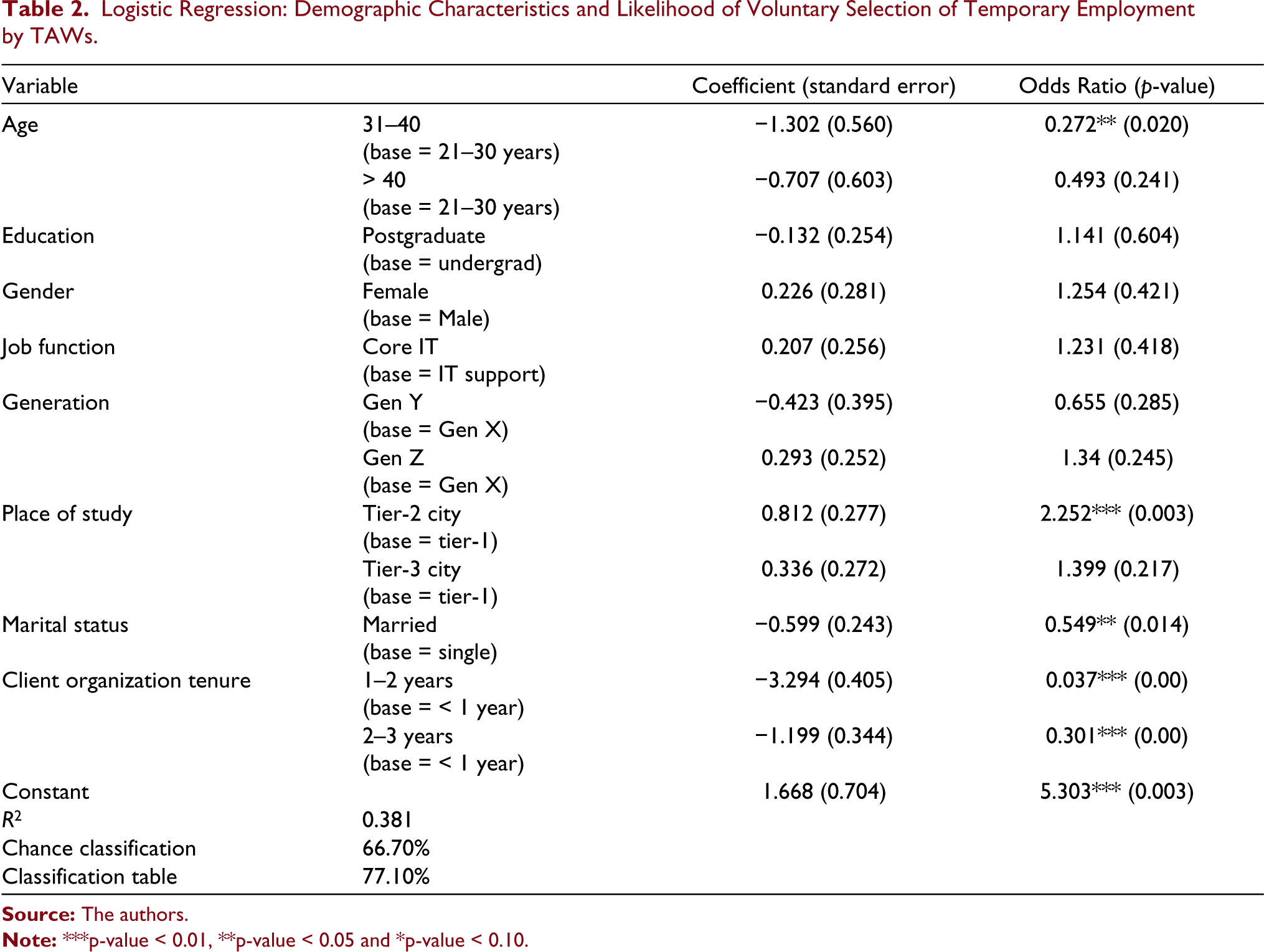
All else constant, against the base age group of 21–30 years, older TAWs are less likely to opt voluntarily for temporary employment. The odds of those aged 31–40 years voluntarily choosing temp work is 73% lower than those aged 21–30 years. Meanwhile, TAWs who studied in tier-2 cities are 2.25 times more likely to take up temporary working voluntarily than those educated in tier-1 cities. The probability of married TAWs voluntarily choosing temporary employment was 45% times less than those who were single. Finally, greater the tenure with client organization, the less likely the TAWs were to voluntarily seek temporary work. Compared to those with less than a year’s tenure with the client, the likelihood of volition among those with 1–2 years of tenure and more than two years of tenure was 96 and 70% lower, respectively. Overall, logistic regression results support H1.
Multiple Regression
For the latent constructs used in the four models to test H2, H2a, H2b, and H2c, Table 3 displays the mean, standard deviation, correlation, and Cronbach alpha.
Mean, Standard Deviation, Correlation, and Cronbach’s Alpha for Latent Constructs
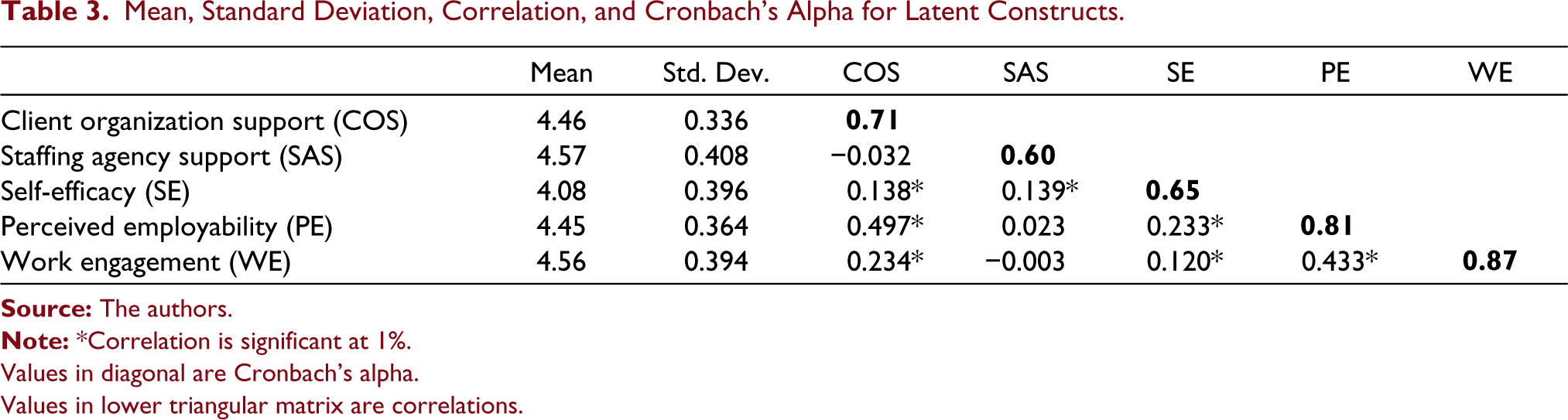
Values in diagonal are Cronbach’s alpha.
Values in lower triangular matrix are correlations.
Next, four separate multiple regression analyses were performed, one for each model described previously. The absence of multicollinearity was noted for model 1 with variance inflation factor (VIF) ranging from 1.01 to 1.44, that is, less than the threshold of 10. Given the same set of regressors, multicollinearity may be considered non-problematic across all four models. Also, homoskedasticity was confirmed for each model with scatterplots. Further, the absence of common method bias was confirmed with Harman single factor test that yielded a total cumulative variance of 21.8%, which is well within the acceptable limit of 50% (Podsakoff et al., 2003).
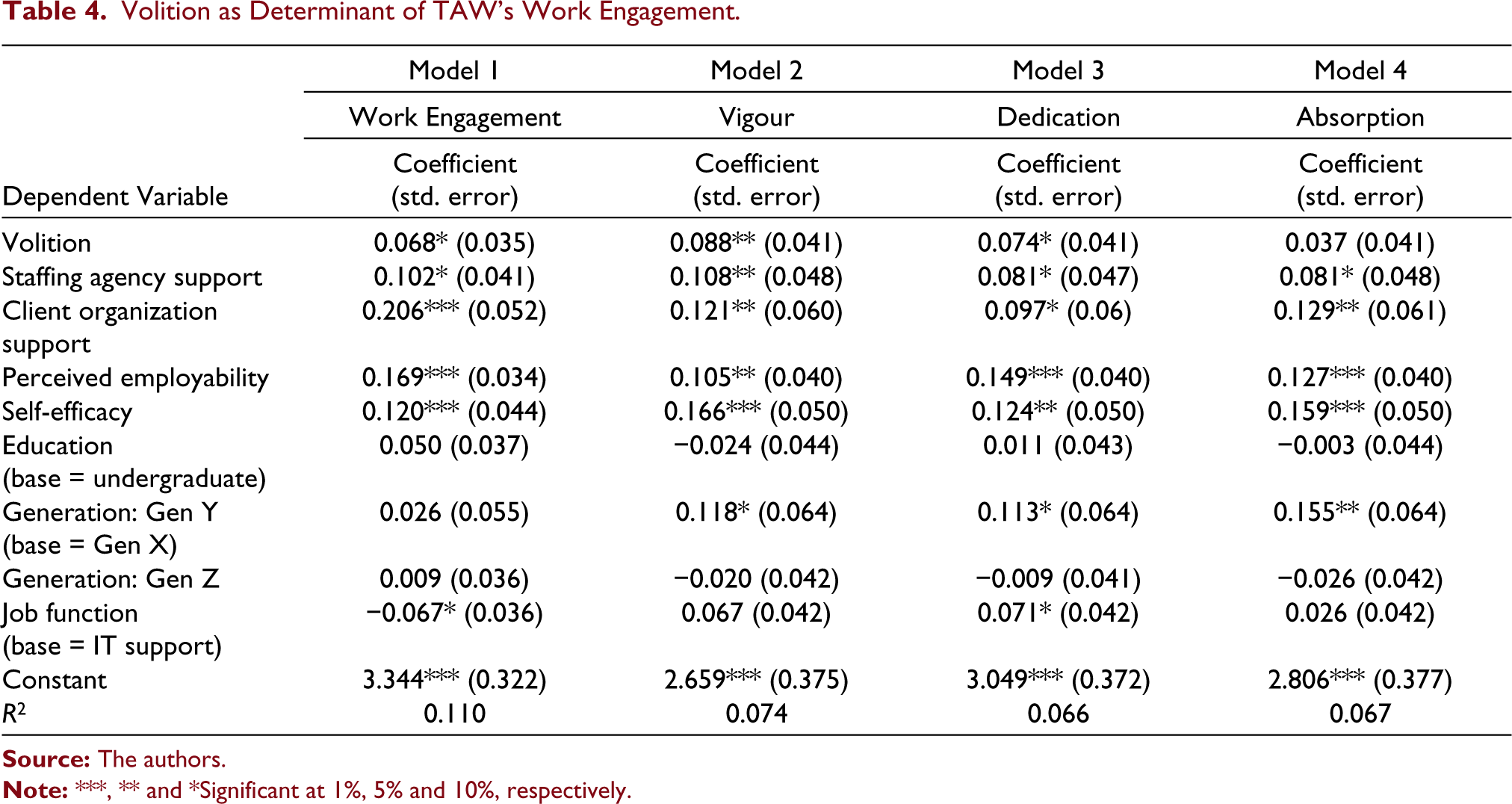
Results of the multiple regression analyses are displayed in Table 4. Models 1–3 support hypotheses H2, H2a, and H2b—volition among TAWs boosts overall work engagement, as well as the vigour and dedication components of work engagement. In model 4, it is seen that while volition is positively related with the absorption component of work engagement as anticipated in hypothesis H2c, the result is not statistically significant. Staffing agency support, client organization support, perceived employability, and self-efficacy are also positively and significantly related with work engagement, as also each of its three components of vigour, dedication, and absorption.
Volition as Determinant of TAW’s Work Engagement
Discussion and Implications
Globally, across industries, organizations’ reliance on TAWs has been rising, as temporary workers offer greater workforce flexibility at lower costs. This article focussed specifically on TAWs engaged by the Indian IT industry and examined the determinants and implications of volition or voluntary choosing of temporary employment by TAWs.
In terms of determinants, it was found that certain demographic characteristics significantly predicted volition. Those who were younger (aged 21–30 years), single, educated in smaller (not tier-1) cities and with shorter tenures with the client organization were more likely to voluntarily choose temporary employment. These findings concur with those of Morris and Vekker (2001), who had found younger persons (16–22 years) were more likely to opt for temporary work. A study by PricewaterhouseCoopers (2011), found that millennials, that is, those aged below 30 years, were more likely to accept jobs from organizations offering flexible work schedules and multiple roles, with the majority of millennials prioritizing work–life balance and jobs supporting personal growth. Further, Bidwell and Briscoe (2009) also found that single men were more likely to opt for a temporary arrangement than married men, especially those with children. Additionally, this article’s finding of those with shorter tenures with the client being more likely to have voluntarily taken temporary work aligns with the findings of Chambel and Sobral (2019), who too found volition declining with greater tenure.
This study also revealed that volition enhances work engagement among TAWs, especially boosting their vigour and dedication. These findings are consistent with the findings of Lopes and Chambel (2014), which observed a positive relationship between autonomous motivation and work engagement. The result is consistent also with research based on the Self-Determination Theory that suggests that feelings of volition boost work engagement (Van den Broeck et al., 2008, 2010).
Further, looking at control variables, this study found that staffing agency support, client organization support, perceived employability, and self-efficacy significantly boost TAW work engagement. These findings concur with those of Lopes et al. (2019) and Ngo et al. (2015). Lopes et al. (2019) observed that staffing agency and client organization support improved TAWs well-being by enhancing autonomous motivation, in line with the Self-Determination Theory. Meanwhile, Ngo et al. (2015) found self-efficacy enhancing work engagement by increasing workers’ perceived employability.
The results of this study hold significant managerial implications for both client organizations and staffing agencies that engage TAWs in the Indian IT industry. Work engagement is an important predictor of work quality and productivity (Manion, 2009). In turn, work engagement is enhanced by volition, even as volition is predicted by demographic characteristics of age, marital status, and place of education.
Staffing and client organization should be aware that some TAWs opt for temporary arrangements voluntarily, while others take up such work involuntarily. The demographic features identified in this study as predictors of TAWs’ volition or lack of it will help organizations determine the appropriate interventions for each type of TAW (voluntary/involuntary). With younger, single and small-town TAWs being more likely to voluntarily choose temporary arrangement, such TAWs may be assigned projects that offer greater work autonomy, flexibility and variety. Further, one-on-one career discussions may be held with voluntary TAWs to understand their meaning of career success, and then they may be assigned projects aligning with their skills and interests/values. This may sustain voluntary TAWs’ motivation to retain temporary work. On the other hand, involuntary TAWs, who tend to be older and educated in tier-1 cities, may be put on projects that enhance their perceived employability. Staffing agencies may also help involuntary TAWs transition towards permanent employment by supporting them with resume building and sharing client feedback on their project performance and career potential.
Meanwhile, for involuntary TAWs, who tend to be those with longer tenures with client organizations, the clients may help enhance the TAWs’ employability. Clients may do so by offering the involuntary TAWs opportunities to enhance social skills, socialize with permanent employees and network. Additionally, given voluntary TAWs are more likely self-driven, clients may restrict close monitoring of work to involuntary TAWs, thereby reducing overall monitoring/supervision costs. Clients may support voluntary TAWs with assignments that offer autonomy, schedule flexibility and an opportunity to exhibit skill variety. Such support may enhance voluntary TAWs’ work engagement, thereby performance.
Conclusion
Determining the demographic characteristics that drive volition in Indian IT TAWs and establishing the relationship between such volition and work engagement, this article makes multiple contributions. Practically, the study helps organizations predict which candidate opting for temporary work arrangement likely does so voluntarily. The work also demonstrates the best ways to support both voluntary and involuntary TAWs so as to enhance their levels of work engagement, thereby ensuring work quality and productivity. Academically, the article addresses several gaps in previous research on TAWs, as observed by Hunefeld et al. (2019). It does so by being based on a sharp definition of TAWs, thus tackling challenges arising due to heterogeneous samples in earlier research. The study also includes several meaningful confounding variables that were lacking in prior works. Additionally, this article uniquely combines classifying TAWs into two groups based on volition, then establishing the consequences of volition for work engagement.
Limitations and Future Research Scope
Avenues for future research can arise from addressing the limitations of this research. For instance, this study is based on cross-sectional data, thus there remains the scope for performing longitudinal studies that track changes in TAWs’ motivations and attitudes over time. This could establish the relationship between motivation and work outcomes more effectively. Researchers could also include other confounding variables such as organizational climate (Jyoti & Sharma, 2013) or personality traits (Judge et al., 2002) while examining the relationship between volition and work engagement. Additionally, future research on TAWs and volition could contrast the effect of presence versus absence of volition on measures of well-being versus ill-being. Cross-industry comparisons may also prove insightful, especially in determining the specific worker characteristics that predict the likelihood of their voluntarily choosing temporary employment in their respective industry sectors.
Footnotes
Declaration of Conflicting Interests
The authors declared no potential conflicts of interest with respect to the research, authorship and/or publication of this article.
Funding
The authors received no financial support for the research, authorship and/or publication of this article.