



Abstract
This study aims to analyze the mediating effect of personality traits in the relationship between entrepreneurial start-up motivations and small and medium enterprises (SMEs) growth. A gap has been identified in the literature, particularly in the indirect association of critical factors that may be beneficial to the growth of SMEs. In this study, a cross-sectional survey design was used because data were collected once in a time. Furthermore, structural equation modeling (SEM) was used to analyze data obtained from 367 SMEs’ owners. The findings indicate that entrepreneurial start-up motivations such as a desire for achievement, financial rewards, social recognition and a desire for independence are positively and significantly related to SMEs’ growth. Also, entrepreneurial start-up motivations positively and significantly influence personality traits among entrepreneurs. It was found that there is a significant link between personality traits and the SMEs’ growth. Additionally, the findings indicate that personality traits mediate the relationship between entrepreneurial start-up motivations and SMEs’ growth. The study’s findings have implications for the practices and theories in the entrepreneurship context.
Introduction
In the body of literature, there are repeating questions among researchers as to what makes some entrepreneurs own small and medium enterprises (SMEs) more successfully than others and why does the survival rate vary across SMEs while operating in a similar environment? (Fatima & Bilal, 2019; Nikolić et al., 2019). It is also evident that past studies attempting to investigate business start-up motives have dwelled on investigating the direct effects without paying proper attention to other vital mediating factors, which might increase and shape the start-up motives for the growth of SMEs (De Silva, 2010; Isaga et al., 2015). This has resulted in a need to investigate how other factors such as personality traits may mediate relationships between entrepreneurial start-up motivations and the growth of SMEs. Despite the challenges associated with performance, SMEs are widely regarded as an essential strategy for many nations’ economies (Mashenene & Kumburu, 2020). The empirical evidence from throughout the world indicates that the pervasiveness of SMEs has captured the world’s attention. Since the 1950s, the fundamental concept, created at the end of the nineteenth century, that large enterprises are the most important economic supporter has been challenged (Wang, 2016). Given their high labour intensity, SMEs play a critical role in the global economy’s growth with a constant contribution to the economy through generating a significant number of jobs offering creative processes, promoting technological advancement, organizational innovation, income generation and economic competitiveness (Kooli, 2021; Nikolić et al., 2019).
Even though SMEs are the backbone of the economy, one of their most common problems is the high exit rate (Nikolić et al., 2019). Previous studies have indicated that many newly established SMEs exit the market within a short period after their launch (Ndiaye et al., 2018). For example, the literature indicates that only 42.4% of SMEs in 2013 were still trading 5 years later in 2018 in the United Kingdom. In South Africa, 75% of SMEs fail to establish themselves, while in Uganda, one-third of newly founded SMEs fail to survive their first year (Muriithi, 2017). Also, according to statistics, China welcomes 15 million new SMEs each year, yet about 10,000 SMEs quit the market. It is estimated that 60% of SMEs fail within 5 years and 85% within 10 years. Their average life expectancy is barely 2.9 years (Tang et al., 2020). Looking at these rates, one would conclude that, although SMEs in developing and developed countries have low survival rates, SMEs in developing countries have higher failure rates than those in developed countries.
Past studies have tried to connect these exit rates with various challenges that affect SME’s growth, especially in developing countries (Isaga et al., 2015; Muriithi, 2017). These challenges include financial difficulties, buyers set price instead of sellers, monopolistic features of markets, a lack of business management knowledge and regulatory systems (Karki & Risal, 2021; Kooli, 2019). Also, small businesses face challenges in supplying new products to suit consumer demand in specific areas (Mehdi et al., 2021). Other challenges are vulnerable to environmental change, unregulated digital ecosystems, low fixed prices and less negotiating power among entrepreneurs (Chaturvedi & Karri, 2021; Karki & Risal, 2021; Mafimisebi & Ogunsade, 2021).
Apart from that, there is a growing consensus that poor entrepreneurial start-up motivations are another alarming challenge to the high exit rate among entrepreneurs. Most newly established ventures are not defined by the inner motives that drive entrepreneurs to start a business. Hence, researchers have categorically identified that established SMEs’ success depends on factors that motivate entrepreneurs to start or create a new business (Trusić et al., 2017). In psychology, motivation is defined as the emotional force that propels people to act. It is also defined as the process by which an individual’s effort is directed and sustained toward achieving specific objectives (Okangi, 2018).
In a nutshell, motivational factors such as the desire for achievement, the desire to continue a family tradition, financial rewards, social recognition, being your own boss, creating your own job, the desire for decision-making, the desire to become wealthy and the desire for independence all play a role (Abadli et al., 2020; Carsrud & Brannback, 2009; Kooli, 2019; Staniewski & Awruk, 2015; Stephan et al., 2015). However, the literature suggests that entrepreneurial start-up motivations among entrepreneurs alone cannot explain the SMEs’ growth. Indeed, those with inner motives need essential personality traits to succeed in business (Sarwoko & Nurfarida, 2021). This is because business operations do not only depend on motivations; they need essential and robust personality traits for entrepreneurial aspiration (Murugesan & Jayavelu, 2017). It means that personality traits predict several business results because a firm’s performance is born from the inciting actions of a founder with unique traits who combines experience and knowledge, transferring the required energy to the firm for it to continue its route (Franco & Prata, 2019). Further, personality traits shape motivation and create the best means for entrepreneurs to act toward the goal. Hence, personality traits can intervene to promote a positive relationship with growth if the entrepreneur intends to expand the business due to their motivation to start it (Ali, 2019).
Nevertheless, regardless of the importance of personality traits in explaining the growth variation of SMEs, past studies have not scientifically qualified their effects on the relationship between entrepreneurial motivation factors and the growth of SMEs. That is to say, little empirical research has been carried out to test the mediating role of personality traits systematically. This relationship is important because characteristics of the entrepreneurs defined as personality traits such as risk-taking propensity, internal locus of control, tolerance for ambiguity, innovativeness and self-efficacy could be important determinants of SMEs’ growth if related to entrepreneurial motivational factors. Additionally, in the Tanzanian context, several studies conducted are relatively minor concerning identifying entrepreneurs’ motivation factors and personality traits and their effects on SMEs’ growth. For example, Okangi (2018) provided empirical evidence from Tanzania on the existence of a link between groups of entrepreneurial motivation factors and the growth of firms without adequately involving other essential personality traits as a mediator for the relationship. Also, Abdallah et al. (2020) investigated additional underlying motivational dimensions by broadening the distinction between opportunity, necessity and mixed motivations without extending the links between these motivational factors and the growth of SMEs with personality traits as mediators.
Similarly, Eijdenberg et al. (2021) investigated the cyclical nature of entrepreneurial motivations in Tanzania’s emerging economy and their relationship to socio-demographics and needs fulfilment without considering the influence of personality traits on the relationship between entrepreneurial motivation factors and the SMEs’ growth in Tanzania. Even though a body of literature has demonstrated the influence of entrepreneurial start-up motivation on SMEs, experience suggests that SME growth is not imperative in most developing nations. If purposeful actions to improve their growth are not implemented, SMEs will continue to have a low survival rate and will not be able to deliver the desired results. Therefore, in this line of thinking, the present study contributes to the literature on entrepreneurship in two significant ways. First and foremost, when it comes to developing nations, particularly Tanzania, existing knowledge in the literature about entrepreneurship motivations is quite limited. Essentially, it is important to establish factors that characterize entrepreneurial start-up motivations that can predict SMEs’ growth.
Second, this study investigates the mediating effects of personality traits in the relationship between entrepreneurial start-up motivations and SMEs’ growth. Surprisingly, as previously noted, scholars have paid less attention to personality traits as mediating factors in enhancing entrepreneurial start-up motivations for SME growth. However, if it is widely agreed that entrepreneurial start-up motivations alone are insufficient to ensure SMEs’ effective growth, personality traits may play a key role in ensuring that entrepreneurial start-up motivations are appropriately managed to boost SMEs’ growth, because individual entrepreneurs, especially their characteristics, could explain a considerable amount of the growth variance between SMEs (Isaga, 2018). As a result, this study explains why it is vital to include indirect links, which were previously overlooked by earlier studies that focused solely on direct ties.
Literature Review
The Desire for Achievement and Growth of Small and Medium Enterprises
According to McClelland (1961), a person’s determination to succeed should be the defining characteristic of an entrepreneur. A strong desire to achieve success exists in them, as they seek personal fulfilment and accomplishment due to their efforts. Entrepreneurs who are more motivated to achieve their goals, according to his theory, are those who seek to solve their problems and set goals for themselves with the intention of attempting to achieve those goals through their efforts. As a result, they have a strong desire for success, are more likely to start their businesses and outperform those who have a weak desire for success in terms of financial performance (Isaga et al., 2015).
Many studies have discovered a link between the desire for achievement as a planning tool and the performance of SMEs (Kooli et al., 2019). According to Fatima & Bilal (2019), entrepreneurs with a strong desire for success can compete in business-related tasks, resulting in higher productivity levels. Hansemark (2003) noted that the desire to be successful appears to be a logical prerequisite for starting a new business and this appears to be the case in this instance as well, because the desire for achievement is the driving force behind success. Based on this, it is rational to hypothesize that
Financial Rewards and Growth of Small and Medium Enterprises
Financial rewards are a critical variable that encourages new entrepreneurs to start businesses in developing countries. As noted by previous studies, this is because the vast majority of new entrepreneurs are motivated to start their businesses to earn an adequate income for themselves (Abadli et al., 2020; Isaga et al., 2015). It has also been discovered that the desire to generate money is the most crucial motivator and a significant factor for people to engage in entrepreneurial activity (De Silva, 2010; Shava & Chinyamurindi, 2019). Most entrepreneurs who begin their businesses with essential goals are later motivated by pull motives such as financial gain. Similarly, De Silva (2010) stated that the primary entrepreneurial start-up motivations for the growth of SMEs are a lack of opportunities for advancement in the job, an inability to earn a higher income, or being dissatisfied with receiving a fixed salary as financial reward. According to Cassar (2007) upon examining the career reasons of actual entrepreneurs over time, they discovered that, when the response is obtained after the venture has begun operations, the importance of wealth and financial success as explanations for motivation to engage in entrepreneurial activity decreases significantly.
In addition, a study by Radipere (2015) indicated that some entrepreneurs are not motivated to start their own businesses because of ‘more money’. This suggests that financial rewards are undervalued as motivators for entrepreneurs to engage in venture activity. Moreover, a study of motivation by Swierczek and Thai (2003) discovered that the need for economic security is not a more effective motivator than the desire to succeed in Vietnam. Based on the inconsistencies presented, it is hypothesized that,
Social Recognition and the Growth of Small and Medium Enterprises
Maslow (1943) postulated that motivation is the consequence of an individual’s attempt to meet physiological needs, safety needs, a person’s need for love, affection and belongingness, and their need for esteem and self-actualization. It assumes that these requirements may result in internal pressures, impacting their actions and judgments. Generally, in business venturing, the hierarchy of needs is directly tied to an entrepreneur’s level of aspiration and growth. It appears that the desire to be recognized or to have pride of ownership is essential in motivating people (Rahman et al., 2015). Being surrounded by the need for social recognition might motivate entrepreneurs to help them attain their ambitions and become more successful. This idea is supported by Scheinberg and MacMillan (2012), who noted that some business owners are motivated to create and operate a successful business by a desire for respect, social standing, recognition and attention. These requirements might be characterized as the social or participatory component of the esteem requirements (Stoll & Ha-Brookshire, 2012). Despite these positive relationships, some studies have pointed out that desire for recognition is not a determinant of starting a successful business venture because desires such as achievement and income generation are superior to recognition (Radipere, 2015). It is essential to hypothesize that,
The Desire for Independence and Growth of Small and Medium Enterprises
According to Scheinberg and MacMillan (2012), entrepreneurs find a necessity for the desire for independence because of the craving to make crucial decisions that will significantly impact their entrepreneurial activities and the performance of their enterprises in general. In their desire to make crucial decisions that will significantly impact their entrepreneurial activities and the performance of their enterprises in general, the vast majority of entrepreneurs express a desire to make those decisions. This is also supported by Radipere (2015), who posted that some entrepreneurs start their own businesses to have the enhanced freedom and independence that comes with being their own boss. In addition, people who work for themselves reported being happier.
Moreover, Shava and Chinyamurindi (2019) discovered a correlation between the majority of entrepreneurs and their desire to make significant independent decisions that substantially impact their entrepreneurial activities and the success of their businesses. However, some research has found that the desire for independence has a negative and inconsequential link with the desire to become an entrepreneur and, consequently, the drive to build one’s business (Shava & Chinyamurindi, 2019). This has also been noted by Riquelme and Lanqawi (2016), those who compared different motives and discovered that the need for independence made only minor contributions to their level of accomplishment. Also, De Silva (2010) discovered that the need for independence as a start-up motivation is not a determinant of growth. Due to these mixed results, this study hypothesized that
Entrepreneurial Start-up Motivations and Personality Traits
Individuals are motivated to create businesses for various reasons, and their motivations frequently overlap (Isaga et al., 2015). As a result, entrepreneurial motivation may vary significantly between countries and even continents, depending on their level of development. Entrepreneurial start-up motivations such as a desire for achievement, financial incentives, social recognition, and independence have positively impacted a company’s survival and growth. On the other hand, a gap has been observed (Isaga, 2018). The link between declared entrepreneurial start-up motivations and the growth of SMEs is inadequately and insufficiently understood. This is contributed by the fact that most studies are based on developed countries. Subsequently, the relevance of the majority of the conclusions in developing countries is questionable.
McClelland’s human motivation theory assumes that every individual has three primary driving motivators: affiliation, power and achievement needs. These inner motivators are not born; they are developed over time due to exposure to various cultures, environments and life events (McClelland, 1961, 1965). The results can differ from one location to another, depending on the entrepreneurs’ nature. According to this theory, these motivators are higher in individuals who set goals. When a need is strong, behavior that leads to satisfaction follows. Organizational goals such as profitability, respect, power, income, wealth, business experience, ideas and recognition can motivate individuals to behave in a business-like manner.
Nevertheless, personality traits defined as entrepreneurial behavior do not have a single motivation; behavior that is motivated toward an end (needs) tends to recur. This falls into the same league as the entrepreneurial event theory by Shapero and Sokol (1982), which emphasizes three areas of entrepreneurship. The first displacement is the occurrence or circumstance that results in a change in behavior being seen. This can manifest itself in the form of anything unwanted, such as a lack of job satisfaction, or anything favourable, such as earning rewards. When entrepreneurs identify and evaluate an opportunity, they should consider the most desirable and achievable outcome. Second, perceived desirability is defined as the degree to which an individual considers the feasibility of establishing an entrepreneurial enterprise to be appealing, and the perceived feasibility of an entrepreneurial venture, on the other hand, refers to how confident an individual is in their ability to launch and operate an entrepreneurial venture. While the first and second elements (displacement and perceived desirability) present the entrepreneurial start-up motivations, the third element (perceived feasibility) is more of the personality traits, a perception of available resources, such as financial and human resources, as well as associated information that is needed to make the venturing business prosper.
Overall, it can be concluded that a business start-up’s motivation is a necessary but not sufficient prerequisite for success (Hansemark, 2003). When confronted with a problem, creative business professionals tend to assume personal responsibility for the situation. Wealth and well-being will always be within reach for people motivated by their work to succeed in their careers. Innovative individuals in their thinking usually seek ‘complicated’ objectives while simultaneously taking ‘discounted risks’ in business. In addition to having the resources and determination to succeed, they also have a clear grasp of attaining their goals. Entrepreneurs who are inspired to start and operate firm enterprises must have extra motivating factors such as competitive conditions, internal capacities and competencies for their enterprises to be successful. When a goal is achieved, the individual’s motives alter positively (Isaga, 2018). It is therefore hypothesized that
Personality Traits and the Growth of Small and Medium Enterprises
Entrepreneurs’ personality traits are defined as patterns of thoughts, attitudes and actions that distinguish them from others in various contexts. These factors may be essential in determining who is successful and who is not. However, there has been little research on this topic in Africa, particularly in Tanzania (Isaga, 2018). Furthermore, the majority of past research on personality traits and business success has yielded conflicting results because of the ambiguous relationship between personality traits and SME performance (Asah et al., 2015; Bajwa et al., 2017; Pinho & de Sá, 2014; Yan, 2010). Some of these researchers have questioned the application of personality traits, claiming that most items describing personality traits lack convergent validity, implying that they can lead to unpredictable results. In a similar vein, researchers in this category argue that these personality traits should not be generalized. Each entrepreneur in a specific geographical location may have various personality traits, resulting in diverse effects. Despite these objections, there is some evidence that entrepreneurs’ traits are one of the elements impacting SME performance (Adomako et al., 2016; Isaga, 2018). This is because personality traits related to entrepreneurial business performance have emerged as a critical component in promoting the firm’s strategy. They are also connected with the ability to predict entrepreneurs’ conduct and individual personality differences, which might result in behavioural variances (Franco & Prata, 2019; Sarwoko & Nurfarida, 2021). The importance of personality traits in an SME’s success cannot be neglected from this perspective. There is a need to conduct research that uses various personality traits to fit specific business environments. It is reasonable to hypothesize that
Mediation Role of Personality Traits on Entrepreneurial Start-up Motivations and the Growth of Small and Medium Enterprises
A gap has been identified in the literature, mainly in the indirect relationship of critical factors that may be beneficial to the growth of SMEs. In particular, the indirect association of personality traits may help explain the relationship between entrepreneurial start-up motivations and the growth of SMEs and solve the inconsistencies presented in entrepreneurial start-up motivations. Apart from that, many types of research have been done to examine the motivations of individuals who want to start their own businesses in the western world (Brush, 1986; Edelman et al., 2010), with only a small amount of attention being paid to this topic in Africa, with inconclusive results (Isaga et al., 2015; Shava & Chinyamurindi, 2019). Consequently, due to these ambiguous findings, it is necessary to introduce personality traits to understand better how entrepreneurs can sharpen their motivations for starting their businesses to achieve rapid growth.
Fundamentally, theorists believe that differences in personality traits serve as the foundation for differences in ability between individuals in general. Thus, a combination of personality traits associated with entrepreneurial start-up motivations may produce favorable results in the growth of SMEs. According to Ajzen (2005), when considered as characteristics of entrepreneurs, personality traits can have a long-lasting impact on a wide range of trait responses that are critical for enriching entrepreneurial activities. Additionally, according to the resource competency-based theory, organizational success is heavily influenced by competency (which in this study was defined as personality traits) because it provides skills that can be applied to solve practical entrepreneurial problems and increases the likelihood of SMEs growing in the process. Accordingly, it is expected that personality traits will assist in unlocking the value defined by entrepreneurial start-up motivations and allow SMEs to grow more quickly. It can be hypothesized that
Conceptual Framework
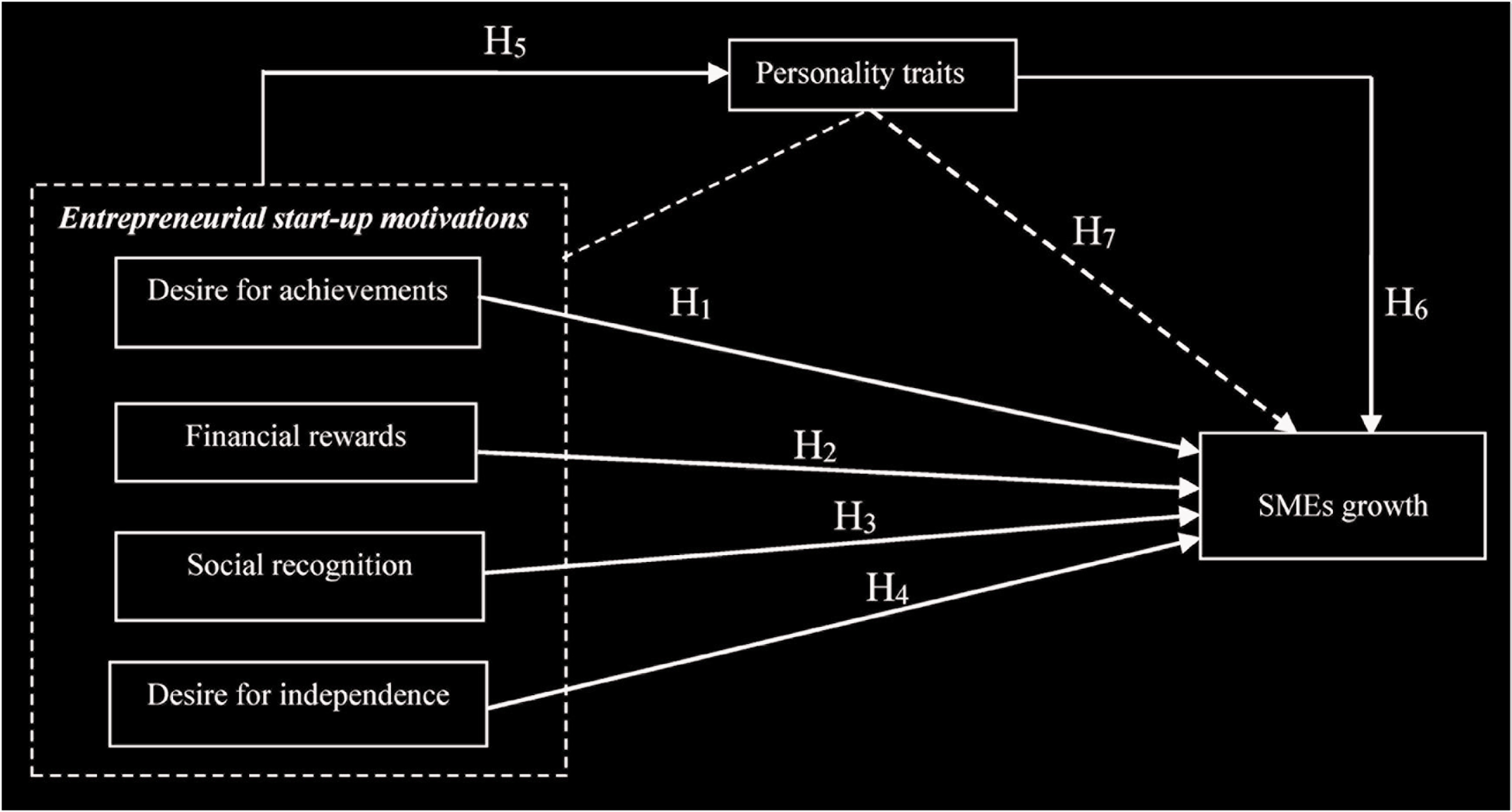
Figure 1 shows a conceptual framework of the relationship between entrepreneurial start-up motivational factors and SMEs’ growth, with personality traits serving as mediators. The present conceptual framework identifies two basic models. The first demonstrates a direct relationship between entrepreneurial motivation factors: desire for achievement, financial rewards, social recognition, desire for independence and SME’s growth. The second model demonstrates an indirect relationship between entrepreneurial start-up motivational factors and SMEs’ growth, with personality traits serving as a link between the two. Due to a lack of studies and inconsistencies presented in the literature review, the starting point is that, while entrepreneurial start-up motivational factors are critical for SME growth, personality traits are thought to be in an excellent position to improve SME growth when they act as a mediator between entrepreneurial start-up motivational factors and SME growth. This implies that simply being motivated is insufficient to take an SME ahead.
Methodology
Area of Study
Tanzania’s capital city, Dodoma, served as the study area. The reason for selecting this city is that it is strategically placed in the heart of Tanzania, making it a vital link between all of the country’s regions. Furthermore, it is the fastest-growing city in Tanzania, having a reasonable number of SMEs (Mashenene & Kumburu, 2020).
Study Design, Approach and Population
The study used a quantitative approach because it tested the causal effects relationship between entrepreneurial start-up motivations, personality traits and the growth of SMEs as presented in the hypothesis. It also used a cross-sectional survey design, which helped collect data once at a given time, in which structured questionnaires were used to obtain information from respondents. (Creswell, 2014). In addition, the research process involved a literature review of which theories and empirical studies further assisted in developing hypotheses and conceptual frameworks. Finally, the study’s population included only owners of SMEs because they were found to have rich and relevant information for this study. Also, in most developing countries, most SMEs are managed by the owners themselves.
Pilot Study
A pilot test was also conducted with the final version of the structured questionnaire. The owners of 19 (5% of 384) SMEs were chosen using a snowball sampling technique. The structured questionnaire was fine-tuned throughout the pilot test. During this test, some errors in the items used to develop the questionnaire were detected. Thus, the questionnaire was modified once more to incorporate thoughts (that the researcher considered reasonable) to ensure validity and reliability. Finally, the most improved version of the structured questionnaire was used to collect data.
Sample Size and Sampling Procedures
The snowball sampling technique was used to select subjects. This technique is appropriate when there is a lack of an established database of respondents. Given the nature of most SMEs in developing countries, including Tanzania, it was not easy to have a clear registered and active list of SMEs from the responsible government authorities. The sampling procedure involved two steps: first, the existing potential identified owners were approached. Second, owners identified in step one were used to provide referrals to recruit other owners of SMEs. A saturation point was reached at a sample size of 367 SMEs. The selection was based on the years of operations, and the inclusion criteria were those with at least 5 years of operations. It was important to consider years of operation because most SMEs do not survive beyond 5 years since their establishment. This sample size was calculated using the infinity formula since the population was unknown,

where n means sample size, z means standard variate = 1.96 for a 95% level of confidence, p means the proportion of the largest population = 50%, q = 1 − p and d means the degree of accuracy at 0.05. Thus, n = (1.96)2 × (0.5 × 0.5)/(0.05)2 = 384. The questionnaires administered were 367 meaning that, the response rate was 95.57%.
Measurement Items
The questionnaire allowed respondents to quickly interpret the questions and make comments based on their perceptions of the situation. This enabled more accurate responses to be provided. Participants’ ratings of the independent, mediating and dependent variables were given a five-point Likert scale. The first construct is the desire for achievement. It is defined as a person’s craving for the significant accomplishment of goals and maintaining high standards of behavior. Four items were adopted from Fatima and Bilal (2019), Isaga (2012) and Isaga et al. (2015), with minor modifications in accordance with the scope of this research. Second, financial rewards are all financial ways of compensation received in exchange for the efforts of entrepreneurs and their commitment, abilities and work completed. Again, four items were adopted from Fatima and Bilal (2019) and Isaga et al. (2015), with minor modifications in accordance with the scope of this research.
Social recognition is described as the act of making entrepreneurs feel more active, engaged and successful in their endeavours while achieving a respectable standing in the community at large. Four items were adopted from Isaga et al. (2015), with minor modifications in accordance with the scope of this research. The desire for independence is defined as a feeling of self-worth and self-esteem obtained by financial, emotional, social, professional and personal achievement. Five items were adopted from Isaga et al. (2015) with minor modifications in accordance with the scope of this research. Finally, personality traits are the characteristics or behaviors that can distinguish entrepreneurs from the general population in terms of their capacity to engage in entrepreneurial activities effectively. Ali (2019) defined personality traits as involving the big five traits. These are extraversion, agreeableness, conscientiousness, neuroticism and openness to experience.
In contrast to the other big five personality traits, openness to experience allows people to be sensitive to positive and negative situations. It is thus associated with opportunities to learn new things, provide creative ideas and try new things. Therefore, this study adopted five openness to experience items from Ali (2019) and Sarwoko & Nurfarida (2021), with minor modifications in accordance with the scope of this research. SME growth is defined as increasing sales, income, market share, inventory costs and consumer preferences. Six items were adopted from Isaga (2012) with minor modifications in accordance with the scope of this research. Items are presented in Table 1.
Measurement Items

Data Analysis
There were two major stages involved in the analysis. The confirmatory factor analysis (CFA) was the first step in which the items which are presented in Table 1 were associated with the constructs of entrepreneurial start-up motivations (desire for achievement, financial rewards, social recognition and needs for independence), personality traits (PT) and SMEs growth (SG) were verified in latent models to depict the overall pattern of observed variables. Following the CFA, the hypothesis testing among variables, on the other hand, was managed through the use of path analysis techniques. There were also four models used in the path analysis: the first model was used to examine the relationship between all four constructs defining entrepreneurial start-up motivations and the growth of SMEs, the second model was the relationship between entrepreneurial start-up motivations and PT, the third model presented the relationship between PT and the growth of SMEs, and the fourth model was used to examine the mediating effect of PT on the relationship between entrepreneurial start-up motivations and the growth of SMEs. The following are the regression models that have been developed:

where α is a constant, β1, β2, β3 and β4 are coefficients of X1, X2, X3 and X4 (desire for achievement, financial rewards, social recognition and desire for independence) which are entrepreneurial start-up motivations, while ε is the error term. The second model is presented as follows:

where α is a constant, β5 is the coefficient of X5 (entrepreneurial start-up motivations obtained after combining items of desire for achievement, financial rewards, social recognition and desire for independence), while ε is the error term. The third model is presented as follows:

where α is a constant and β6 is the coefficient of X6 (PT), while ε is the error term. The fourth model is presented as follows:

where α is a constant and β5 is the coefficient of X5 (entrepreneurial start-up motivations), while ε is the error term. However, compared to the first three equations, this equation involves β6, representing the coefficient of X6 (PT), which acts as a mediator of the relationship between entrepreneurial start-up motivations and the growth of SMEs.
Results and Discussion
Respondent’s Characteristics
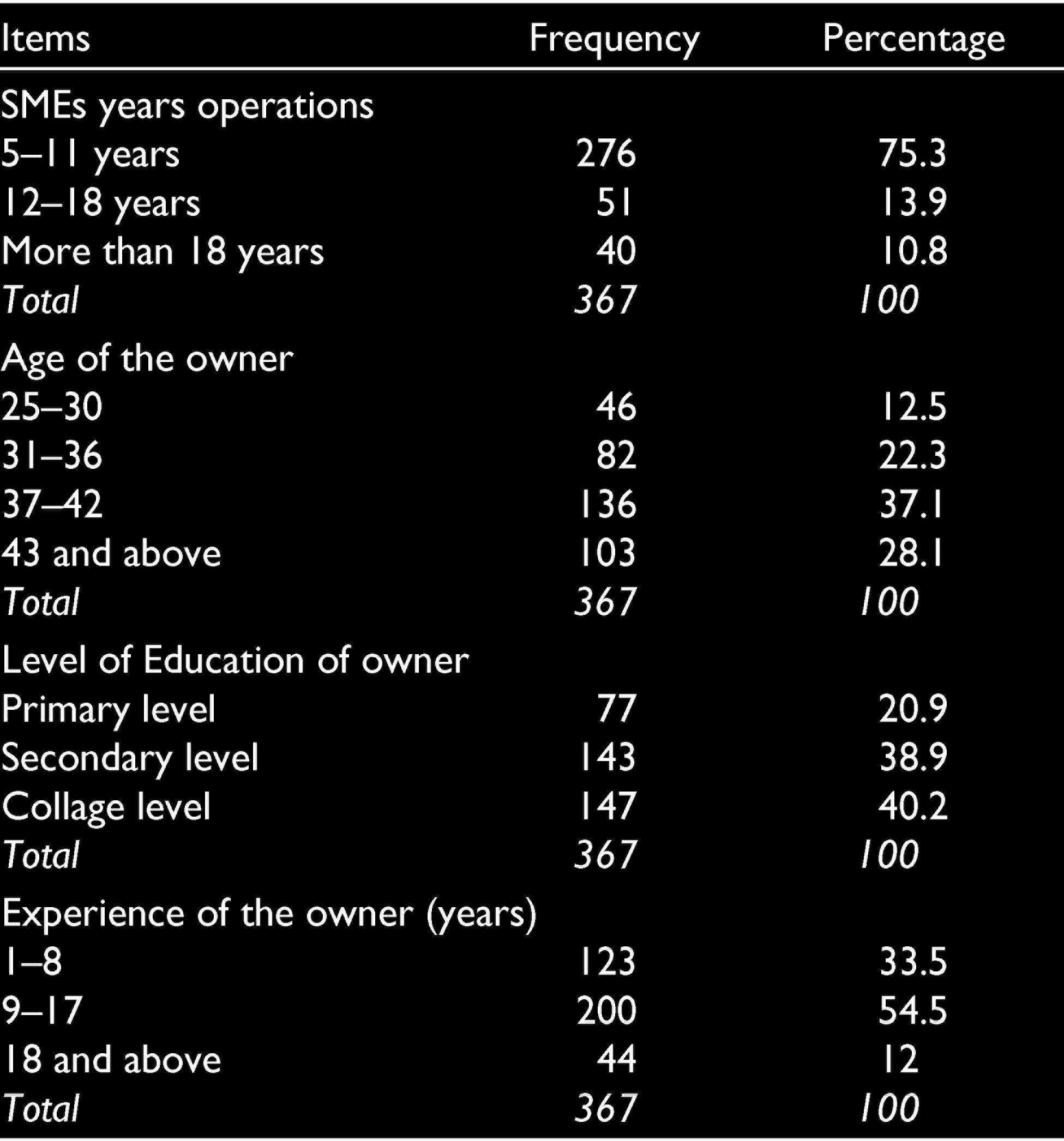
Table 2 indicates that most SMEs have operated for between 5 and 11 years, with 75.3% (f = 276). In addition, most owners of SMEs have an age range of 37 and above, with 65.2% (f = 239). This indicates that most of the owners interviewed are mature enough to operate small-scale businesses. Additionally, most SMEs have a college-level of education with 40.2% (f = 147) and a secondary level of education with 38.9% (f = 143). This shows that the majority have at least a secondary level of education that can foster business management creativity. On the other hand, most owners have had at least 9 years of business operation experience, with 66.5% (f = 244).
Respondent’s Characteristics
Measurement Model
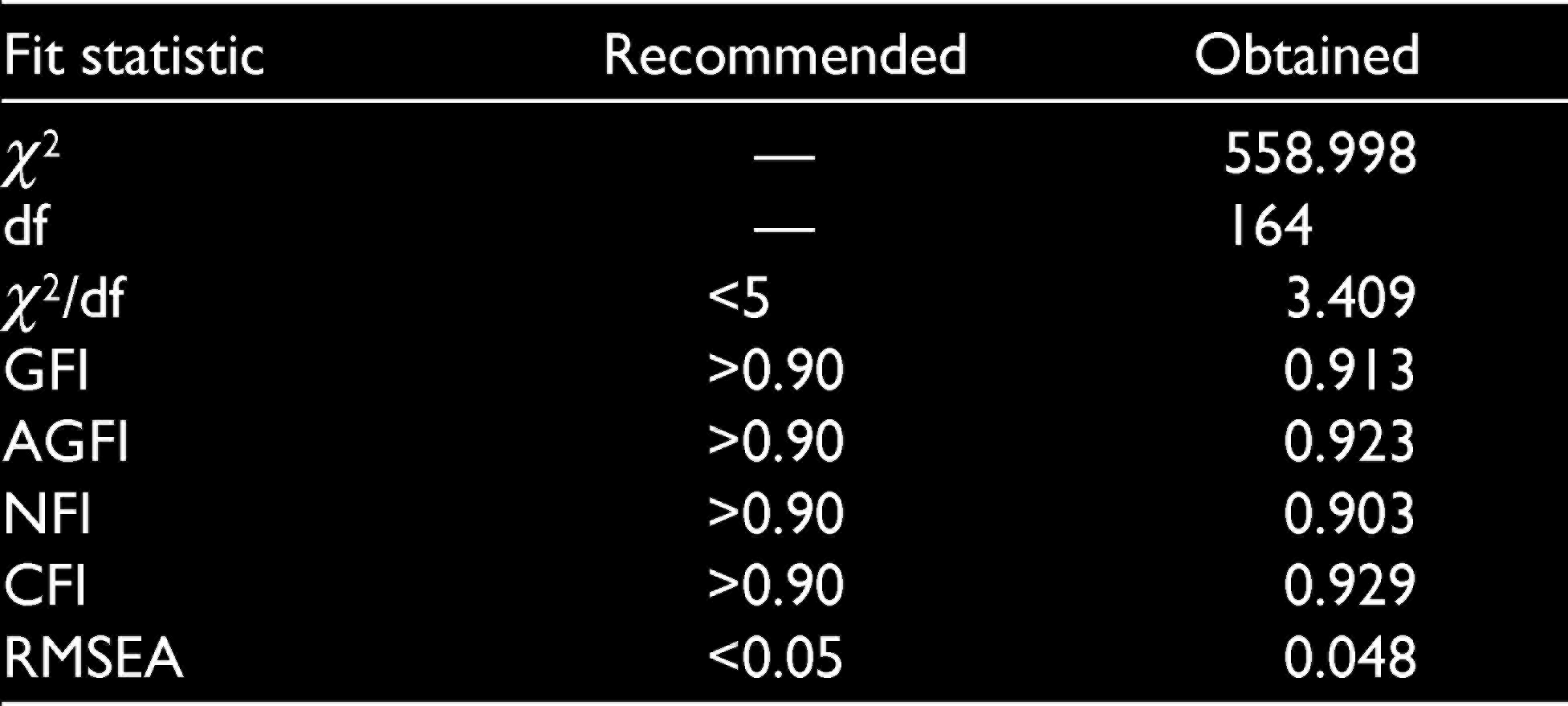
This study used chi-square, goodness of fit index (GFI), adjusted goodness of fit index (AGFI), normed fit index (NFI), comparative fit index (CFI) and root mean square error of approximation (RMSEA) to test the fitted model of entrepreneurial start-up motivations. The fit statistics of the proposed model are presented in Table 3. All values of the fit model were nearby those used as cut-off points showing that the proposed CFA model better fits the data. The fit statistics obtained are also recommended (Hair et al., 2010; Kline, 2011; Schinka et al., 2003).
Model Fit Indices
Common Method Variance
According to Podsakoff et al. (2012), concerns about common method variance occur when the variance of responses is characteristically attributed to the single measurement method used. In this study, there is a possibility that common method bias emerged because the model constructs and items were measured using self-reported information from the same respondents. Therefore, to check for common method bias, Harman’s one-factor test from Podsakoff et al. (2003) was used, of which all latent items were subjected to exploratory factor analysis (EFA). The rule of thumb was that all factors should explain less than half of the variance (<50% of the variance). The results indicated that the un-rotated factor amounted to 31.6% of the total variance; hence, common method bias was not a concern in the data.
Validity and Reliability
In this study, composite reliability, convergent validity and discriminant validity were used to assess the validity and reliability of the items. As indicated in Table 4, the composite reliability was achieved because all items had values above 0.7. Also, the convergence validity was achieved because the average variance extracted (AVE) of the constructs ranged from 0.661 to 0.840. For convergent validity, AVE should be greater or equal to 0.50. Therefore, this finding provides good evidence of the presence of convergent validity. This means the constructs explain much more variance in the construct indicators than the measurement error.
Validity and Reliability
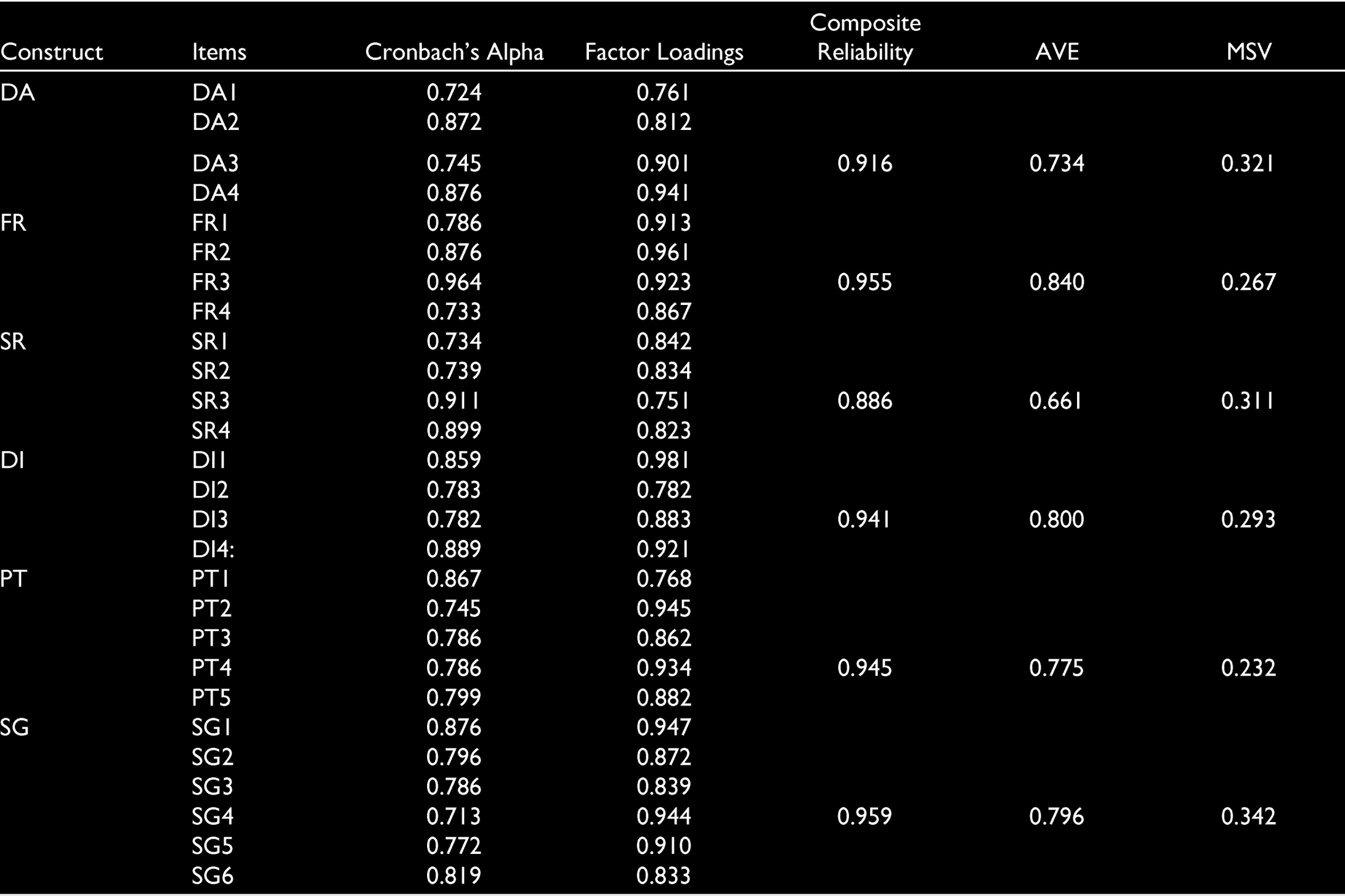
Regarding the discriminant validity, the maximum shared variance (MSV) was less than AVE, with a minimum of 0.267 and a maximum of 0.342. This indicates that there is discriminant validity. Additionally, the objective of reliability is to reduce errors and biases in a study. In this case, the study used Cronbach’s alpha approach to assess internal consistency. This reliability coefficient identifies the degree to which responses are consistent across items within a measure. In this case, the study considered a value of 0.7 or more to indicate that the tool is reliable (Kline, 2011; Raykov, 1997). The findings in Table 4 suggest that all items had values above 0.7.
The Direct Effects
After the measurement model satisfied the requirements for CFA, construct validity, convergent validity, discriminant validity and reliability, the structural models were developed to measure the direct and indirect effects. Table 5 shows that desire for achievement (DA), financial rewards (FR), social recognition (SR) and desire for independence (DI) have a positive and significant relationship. Specifically, all four of these constructs were regressed against SG. The results on DA indicated β = 0.359 and p-value = 0.000. Thus, a unit increase in DA was found to increase SG by a factor of 0.359 (35.9%). As a result, hypothesis H1 was supported. Similarly, FR had β = 0.505 and p-value = 0.006. These findings mean that increasing one unit of FR increases SG by a factor of 0.505 (50.5%). Hence hypothesis H2 was supported. Additionally, findings on SR revealed that it has β = 0.314 and p-value = 0.000. This further indicates that increasing SR by one unit will increase SG by a factor of 0.314 (31.4%). Therefore, hypothesis H3 was supported.
Path Regression Estimates for the Direct and Indirect Relationships

Also, the findings show that increasing the DI by one unit will increase SG by a factor of 0.293 (29.3%). Furthermore, this construct was found to have a significant relationship with a p-value of 0.028. This means that hypothesis H4 was supported. Also, the findings show that the influence of the entrepreneurial start-up motivations (ESM) on the PT was found to have β = 0.311 and p-value = 0.000. Then, a unit increase in ESM was found to increase PT by a factor of 0.311 (31.1%), and hence, the hypothesis H5 was supported. Finally, the findings indicated that the influence of PT on SG was positive and significant with β = 0.256 and p-value = 0.000. This suggests that one unit increase in PT increases SG by a factor of 0.256 (25.6%); hence, hypothesis H6 was supported.
The Indirect effect (Mediating Effect)
Before examining the mediation effects of PT on ESM and SG, the items used to measure DA, FR, SR and DI were merged to generate the ESM. Following that, the mediating effects were examined using the process mediation test developed by (Hayes, 2018; Preacher & Hayes, 2004). The bootstrap upper and lower limit confidence intervals are 0.2734 and 0.0651, respectively, as shown in Table 6, implying no zeros (non-negative limits) in the 95% confidence interval. Hence, H7 was supported. This means that PT is another critical determinant of SG, primarily when used to improve ESM.
Process Mediation Output

Discussion
In particular, the study looked at the mediating effect of personality traits on the relationship between entrepreneurial start-up motivations and the growth of SMEs. This study also determines the direct influence of entrepreneurial start-up motivations on the growth of SMEs, the influence of entrepreneurial start-up motivations on personality traits and the influence of personality traits on SMEs’ growth. Generally, the study seeks to contribute to the current knowledge gap about the factors that can impact the growth of SMEs. The study’s finding is that direct and mediation effects are both necessary and sufficient for the growth of SMEs. The results showed that entrepreneurial start-up motivations such as the desire for achievement, financial rewards, social recognition and the desire for independence have a positive and significant relationship with SME’s growth. Therefore, the study found support for the contention that entrepreneurs with higher entrepreneurial start-up motivations are more likely to see their businesses grow. The plausible explanation is that entrepreneurial start-up motivations inspire entrepreneurs to start their businesses. They provide a means by which entrepreneurs can struggle and put all their efforts toward attaining set goals defined in their start-up motivations. The findings add to the existing literature on entrepreneur personality traits by demonstrating that it might be extremely difficult to surmount the hurdles of starting and operating a successful SME without having personality traits. According to the research, most successful SME owners have successfully operated their SMEs based on personality attributes. They can combine things they are passionate about into their SMEs’ day-to-day operations.
Furthermore, these motivations can help them identify and explore new opportunities, improving SME growth. In other words, the growth of SMEs is more likely to be found amongst entrepreneurs with a high need for achievement, a desire for financial rewards, a need for social recognition and a desire for independence. However, according to the statistical results, for entrepreneurs to have a more significant impact on the growth of SMEs, the presence of personality traits is crucial. The outcomes of this study demonstrate that the growth of SMEs is an inclusive process and that its success is dependent on proper interactions between entrepreneurial start-up motivations and personality traits. Thus, entrepreneurs with certain personality traits are expected to perceive issues as challenges and opportunities, have strong risk preferences and enjoy uncertainty and flexibility. Additionally, entrepreneurs with personality traits tend to have powers to shape their entrepreneurial start-up motivations. Although the findings indicated positive and significant associations in indirect relationships, it is clear that entrepreneurial start-up motivations alone are not the only factor for the growth of SMEs; entrepreneurs need to have personality traits that can help them effectively run their businesses. Specifically, the study’s findings revealed that being open to new experiences is generally seen as a good personality trait. To put it another way, open entrepreneurs have a stronger intrinsic motivation to learn new things in order to expand their SMEs faster. They want to learn about new business techniques and gain a better understanding of how businesses operate. Furthermore, they are eager to try new things, which may help them better adapt to and thrive in a changing corporate environment. Entrepreneurs with a high level of openness, on the other hand, are more likely to be creative than their competitors since they are more inclined to pursue creative accomplishments, engage in diversified thinking, and participate in creative ideas. Aside from that, they are regularly pressed to learn new concepts and broaden their understanding of business processes. Being open to new experiences was also linked to better levels of business intelligence.
Also, the mediation effect of personality traits could mean that entrepreneurs with certain defining personality characteristics have a greater level of result orientation, which could aid them in pursuing growth. According to Ajzen (2005), personality traits can persistently influence the broad range of behavioral responses related to firm performance. Correspondingly, personality traits offer skills that can be applied to solve practical problems as they arise and increase the attainment of established goals. Accordingly, entrepreneurial start-up motivations may have only a minimal or no impact on the growth of SMEs if personality traits are absent from the mix. In addition, theorists believe that differences in personality traits serve as the foundation for differences in ability between individuals in general.
Accordingly, it is expected that personality traits will assist in unlocking the value defined by entrepreneurial start-up motivations and allow SMEs to grow more quickly. This is in line with earlier findings and assertions that personality traits impact SME performance through other variables (Adomako et al., 2016; Gomezelj & Kuce, 2013; Isaga, 2018). Their findings show that taking risks, such as being not afraid to put money into a business that might fail, generating new concepts, providing proper solutions to a problem and setting goals consistently and successfully are the most critical personality traits for shaping entrepreneurial start-up motivations.
Generally, the findings from this study indicate that the success of the entrepreneurial process is determined by the owner’s motivation for starting the business and the personality traits that enable them to run it successfully. Essentially, after starting a business venture, the entrepreneur works tirelessly to develop products and services that are competitive in the market. During this stage, the business begins to earn income and achieves long-term growth and profitability. In general, entrepreneurs should place a greater emphasis on their entrepreneurial start-up motivations, which can aid them in transitioning from the planning stages to the implementation phase. The premise behind the association between personality traits and SME growth is that, in order for consumers to begin adopting a product on the market, entrepreneurs must develop a variety of growth tactics. This is due to the fact that there are so many competitors that are already present in the marketplaces at this point that it is necessary to develop innovative and fresh strategies in order to get competitive advantages. When a well-established product begins to grow in popularity and competition begins to arise, possible competitors are always aware of the success and strive to maintain their places in the industry. Thus, different personality traits are required for overcoming the competition and successfully improving SME operations because challenges in the progressive stages necessitate the interactive nature of the key personality traits after the owner has been motivated to establish a business.
Conclusion
This study addresses the problem that the majority of new SMEs do not last long enough to cover their expenses and generate profits for their owners. Entrepreneurial start-up motives and personality traits were highlighted as significant areas that needed to be addressed to improve SMEs’ survival rates through increased growth. As a result, both entrepreneurial start-up motivations and personality traits were important contributors to SMEs’ growth. The study contributes to the entrepreneurial process by demonstrating that entrepreneurial start-up motivations and personality traits significantly influence SME growth. This information can help to enrich the information on entrepreneurial processes such as idea generation and business formulation, opportunity development, planning evaluation and business growth. In fact, the transition from one phase to the next in the entrepreneurial process is heavily influenced by the founders’ motives and personality traits. Therefore, entrepreneurial start-up motivations and personality traits are necessary for the entrepreneurship process because they present a course of action that includes identifying and evaluating perceived opportunities and bringing together the resources required for the successful formation and operation of new business ventures. Once established, business ventures become a cyclical process of identifying possibilities and making strategic decisions about allocating finite resources to pursue value-added opportunities.
Practical Implications
First, the study findings imply that different types of support are required by entrepreneurs based on their motivations for starting their businesses in the first place. Therefore, various policies related to entrepreneurship should be encouraged under the current guidelines to improve the personality traits of entrepreneurs. Improving personality traits such as risk-taking on actions that have the power to shape the future of the business, risk-taking on putting money into the business, generating new concepts, believing in one’s solution to problems and skills in setting goals are essential for improving start-up motivations and hence increasing the growth rate of SMEs. Second, training based on entrepreneurship can increase innovation in implementing strategies that improve entrepreneurial motivations. The findings imply that personality traits obtained through training can improve start-up motivations in better shape. This joins the conclusion by (Abadli et al., 2020; Kooli, 2020). It also supports the findings by Omrane et al., (2018), who noted that limited skills and energy among new business owners might cause entrepreneurial burnout and hence stressed the need for the personal accompaniment of training support. Therefore, personality traits attained through training may act as the key attribute for solving entrepreneurial challenges. Third, for the actors in the business, this provides an understanding of several strategies related to personality traits that can help them cope with competitive environments. The majority of SMEs, especially in developing countries, have been either less than able or unable to take advantage of the benefits of entrepreneurial motivation. So, this study will pave the way for how owners of SMEs can use personality traits to increase growth.
Theoretical Implications
The current study has come up with critical implications for advancing entrepreneurship theory. The findings provide evidence that McClelland’s human motivation theory, entrepreneurial event theory and resource competency-based theory are critical theories in studying entrepreneurial start-up motivations, personality traits and the growth of SMEs. McClelland’s human motivation theory provides a foundation for understanding how entrepreneurs can achieve their goals by directing their motivation toward entrepreneurial activities. While the first two elements of entrepreneurial event theory (displacement and perceived desirability) focus on entrepreneurs’ intentions to successfully establish entrepreneurial ventures, perceived feasibility focuses on how entrepreneurs can make their ventures profitable. Similarly, resource competency-based theory is based on the fact that physical resources alone do not guarantee the growth of firms; competencies (in this study, defined as personality traits) are essential for success. In the absence of these theories, it would be difficult to explain the relationships between entrepreneurial start-up motivations, personality traits and the growth of SMEs.
Scope for Future Research
This study has some limitations that offer a promising avenue for the scope of future research. First, it involved data collected using a cross-sectional survey design, which did not include the time trends. With time, some variables, especially personality traits, can be changed. Second, there is a possibility that some business owners can attend training that can shape their entrepreneurial start-up motivations and increase the growth of their businesses. So, further studies may consider the longitudinal design.
On the other hand, this study did not specify the specific type of SME. Instead, it included owners of all local Tanzanian SMEs, especially in Dodoma city. The study suggests that future studies should look at specific SMEs because entrepreneurial start-up motivations and personality traits might differ across different SMEs.
Furthermore, only the owners of SMEs provided data on entrepreneurial start-up motivations, personality traits and the growth of SMEs. As a result, it is suggested that future studies include data from both owners, managers and employees. The data gathered from more than one source is predicted to be useful to both researchers and practitioners in understanding how others perceive the relationship between elements of entrepreneurial start-up motivations, personality traits and SMEs’ growth. Additionally, the current study has used entrepreneurial start-up motivations for SME growth based on the new venture’s development and not the existing one. Thus, future studies can consider those in operations and wish to start another business. In this way, SMEs’ growth can continuously influence the business motivation factors.
Footnotes
Declaration of Conflicting Interests
The author declared no potential conflicts of interest with respect to the research, authorship and/or publication of this article.
Funding
The author received no financial support for the research, authorship and/or publication of this article.