



Abstract
This study proposes a mixed methodology to analyze the social conversation around two digital marketing trends: the metaverse and artificial intelligence (AI). The aim of this research is to find out which actors are leading the social conversation around the metaverse and AI on X.com, in order to identify which types of companies or entrepreneurs are setting new trends in digital marketing and to what extent they reproduce gender biases. Methodologically, data mining was used to collect messages through its application programming interface and their subsequent processing. All posts tagged with the hashtags #Metaverse and #AI, along with their Spanish translations, were downloaded. The total sample comprised 123,580 posts from 45,622 different users. Subsequently, the content was analyzed using digital ethnography to establish who is leading the conversation and what are the emerging themes. The results show that the companies leading the conversation are digital projects or recently created start-ups; among the users with the most likes, retweets or replies, there are no large innovative companies. In the case of content creators, those who receive the most likes are characters created with AI that represent highly sexualized and objectified women.
Introduction
Digitalization serves as the fundamental catalyst for change in contemporary societies, economies and financial systems (Masera, 2023). The business landscape has been reshaped due to the emergence of emerging technologies such as cloud computing, big data, artificial intelligence (AI), the Internet of Things and blockchain (Ratten, 2024; Soni et al., 2020). Within this digital landscape, the metaverse and AI stand out as the forefront digital marketing trends of 2023 (Marr, 2022).
But along with the new opportunities for business and progress, previous studies have identified widespread gender biases in AI systems, which influence outcomes in areas such as hiring (Jennifer and John effect), research, healthcare, advertising or criminal justice (Buolamwini & Gebru, 2018; Datta & Bhattacharya, 2023; Nielsen et al., 2017; Obermeyer et al., 2019), translating the gender issues of the physical world to the cyber world (Al-Marghilani, 2022). In fact, recent research on machine learning and databases employed by AI systems acknowledges that gender biases in research are underexplored and require further attention (Shrestha & Das, 2022; Tannenbaum et al., 2019).
However, previous studies on social conversation analysis on Twitter to explore new business opportunities or predict user behaviour largely neglecting the gender perspective (Akkuzukaya, 2022; Barbosa et al., 2023; Hagemann & Abramova, 2023; Kraaijeveld & De Smedt, 2020; Saura et al., 2022). As such, understanding the dynamics of social discourse on platforms like X.com concerning AI and the metaverse becomes crucial, as it not only reflects current societal trends but also exposes the gaps in research regarding the impact of these technologies on gender dynamics and societal norms.
The aim of this research is to find out which actors are leading the social conversation around the metaverse and AI, through the analysis of the hashtags #IA and #Metaverse (in English and Spanish) on X.com, 1 to identify which types of companies or entrepreneurs are setting new trends in digital marketing and to what extent they reproduce gender biases.
One of the main contributions of this research article lies in the analysis of participants in the X.com discourse on the metaverse and AI. The discovery that it is emerging companies and digital initiatives, rather than established tech giants, leading discussions on these trends indicates a shift in the key players dominating social conversation in the innovation realm. Additionally, it is worth noting the prominence of AI-created influencers, which, far from embracing diversity, predominantly portray highly sexualized and objectified female characters, highlighting the perpetuation of gender stereotypes in digital environments.
To address the topic of new trends in digital marketing through analysis of the social conversation on X.com about the metaverse and AI, and achieve the objectives, the literature review covers three key areas: the emergence of the metaverse, AI in new digital realities and new virtual realities on X.com. We then describe the mixed-methods approach, which incorporates quantitative analysis through data mining and qualitative analysis through digital ethnography. Next, we present the main findings, classified by user typology, and discuss them in relation to the existing literature and the objectives of this study. Finally, we outline the implications, divided into theoretical and managerial aspects, highlighting practical applications and academic contributions. The ‘Limitations and Future Direction’ section addresses the limitations of the study and proposes areas for future research.
Literature Review
The Arrival of the Metaverse
The metaverse, concept born in 1992 by science fiction writer Neal Stephenson (Rendueles Calvete, 2022), is a fully immersive virtual environment where people meet to play, socialize and work together (Chen et al., 2023). This idea, which burst onto the scene in 2022, sees major companies such as Meta, Microsoft and Epic Games competing to create the most user-friendly interface (Laeeq, 2022). The metaverse uses AI and blockchain—digital technologies underpinning the digital currency system (Pu et al., 2023)—to create digital environments (Yang et al., 2022) and real-world user interaction spaces by combining Virtual Reality (VR), Augmented Reality (AR), social networks and blockchain (Buchholz et al., 2022). This is what has been called the three-dimensional Internet or the Internet of the future (Dixon Jr, 2023). According to Statista (2023), this new digital environment is expected to be worth more than $936.6 billion by 2030. In the business world, especially in the world of digital business, new opportunities are being explored to generate profits, hence the considerable growth of the metaverse today (Floridi, 2022).
The metaverse actively uses multiplayer online games, blockchain applications, digital virtual twins, AR/VR technologies and NFT (nonfungible tokens)–based shopping (Nari̇n, 2021). Specifically, the NFT market, originally derived from the Ethereum token, was the first blockchain technology to achieve international prominence (Dowling, 2022) and continues to grow steadily (Wang et al., 2021). It is becoming one of the world’s leading digital economies (Kong & Lin, 2021), being ‘CryptoPunks the largest single traded market in NFTs’ (Dowling, 2022, p. 1).
Within the metaverse, cryptocurrencies have become the essential economic system of the digital world (Castañeda Giraldo & Correa Morales, 2022), created to provide a solution to the new realities, are used to buy NFT and are the ones that allow entry into the metaverse (Belk et al., 2022). Interrelated technologies enable the sustainability of the metaverse and are key to digital marketing today (Datta & Bhattacharya, 2023). For companies, interacting with consumers in a metaverse is attractive given the importance of experiential marketing and influencing the consumer’s relationship with brands (IAB, 2022). As a result, one of the areas already most engaged with extended reality (XR) is the marketing department, with the creation of digital cufflinks—a virtual model designed to accurately reflect a physical object (Xie & Wan, 2023)—being one of the most important strategies in the marketing department, as it is the format that delivers better results for the user-brand experience (Buchholz et al., 2022).
The mass roll-out of metaverses is expected to reduce fraudulent activities and facilitate cross-border payments (Dubey et al., 2022). Since the DAO (Decentralized Autonomous Organization), created to govern in the metaverse, has begun to expand its cultural influence (Linuo, 2022), fostering the incorruptibility of transactions through open-source blockchain networking (Gadekallu et al., 2022).
The metaverse offers the possibility to create personalized avatars and exercise their power to build a more just, equal, and sustainable society, reducing inequalities influenced by race, gender, disability and property (Duan et al., 2021). But one of the main dangers of the metaverse is the need to create regulations to keep users safe (Qin et al., 2022). Within these dangers, due to the possibility of creating highly realistic experiences, it is the sexual interactions within them that pose the greatest risk of sexual abuse (DeLuca, 2022) and ‘rape of avatars’ (Bankless Times, 2023), affecting younger people in particular (González Cámara, 2022), especially girls and women. ‘Metaverse users that experience sexual harassment in the virtual universe can suffer from psychological effects as a result of such virtual harassment’ (Dhelim et al., 2022, p. 6). Allegations of sexual harassment in the metaverse are a reality that 61% of adults say they are concerned about (Bankless Times, 2023), driving the creation of the #MeTooVerse. Among the risks linked to these new technologies are the experiences of VR pornography, which generates a serious emotional impact when produced with realistic avatars (Cijntje & Gisbergen, 2023).
AI in the New Digital Realities
AI is revolutionizing various socioeconomic aspects, from business to the economy and society at large, transforming experiences and relationships between citizens and stakeholders (Loureiro et al., 2021). In the case of the digital marketing industry, in today’s business environment, it is increasingly important for organizations to focus on creating value and gaining competitive advantage (Enholm et al., 2021), start-ups being the paradigmatic case of companies that include AI technology as part of their innovative and different business models (Weber et al., 2022).
AI demonstrates its potential through the ability to optimize existing processes, leverage the effects of automation, information and organizational transformation, and detect, predict and interact with humans (Soni et al., 2020). From data collection and analysis to content personalization and task automation, AI is transforming the way businesses interact with their customers and how consumers interact with brands (Wamba-Taguimdje et al., 2020).
Investment in AI has shown an upward trajectory over the last six years and should be maintained in the coming years (Li, 2023). However, these effects are not yet reflected in business. According to Ransbotham et al. (2019), seven out of 10 acknowledge that the impact of AI has been minimal or non-existent to date, and fewer than two out of five say they have seen business benefits from AI in the last three years.
Barriers to AI adoption can be economics (support infrastructure and costs), technology (support infrastructure, data availability, problem selection and model reuse) and social factors such as dependence on non-humans, job security, lack of knowledge, safety, trust and lack of multi-stakeholder perspective (Cubric, 2020), although most of the AI products sold today have been around for a long time (Ponce Cruz, 2011).
This situation may change with the emergence of ChatGPT, an interactive chatbot developed by AI company OpenAI, which was launched on 30 November 2022 and already had more than one million users in five days (Kirmani, 2023). ChatGPT’s ability to create human-like language and perform complex tasks has made it an important innovation in the fields of AI and natural language (Lund & Wang, 2023), but their human-like psychological potential remains largely unexplored (Rana, 2023; Rao et al., 2023).
Due to the popularity of ChatGPT, alarm bells have been ringing about gender or racial bias in AI-based systems (Singh & Ramakrishnan, 2023; Walther et al., 2023). As such, much research indicates that it is critical that developers and users of the tool take steps to mitigate these risks and biases to ensure that ChatGPT is used in compliance with ethical, moral and responsible values (Hariri, 2023; The Lancet Digital Health, 2023).
Studies reveal that AI, with its huge global impact, reproduces gender biases, caused by a lack of diversity in programmers, mostly men, and reproducing existing social gender biases (Nadeem et al., 2022). While AI has also helped in the development of models for monitoring reports of sexual violence, it has also helped in the development of models for monitoring reports of sexual violence (Hassan et al., 2020) contributing to the creation of a more egalitarian world; the reality is that, already in the study of Nass et al. (1997), people rated male-voiced computers as more competent than female-voiced computers, associating the masculine with technology and computer issues and the feminine with love and relationships. Stereotypes have not been overcome in the digital environment today (Adá-Lameiras & Rodríguez-Castro, 2020; Blanco-Ruiz, 2022). The gender biases of these new technologies are manifested in a very problematic way for women in sexual environments, as unequal power relations are still evident, reinforced by new technologies that threaten egalitarian relations, such as the (female) synthetic human (Björkas & Larsson, 2021).
The New Virtual Realities on X.com
One of the most widely used social networks for communication between users is Twitter, which is the focus of intense debate on the metaverse (Bhattacharyya et al., 2023). In the recent study by Sun et al. (2023, p. 15), after analyzing more than 129,000 tweets generated in South Korea about the metaverse, it was found that in this country, it was ‘over-enthusiastic compared to other countries through government-led projects’. The most used hashtags associated with metaverse on Twitter are NFT, NFTS, GAMEFI and BSC (Tunca et al., 2022). The influence of networks such as Twitter is so great that the value of NFTs depends on the opinions, expectations and perceptions that are shared about them (Qian et al., 2022). According to Akkuzukaya (2022), the tweets analyzed show mainly positive and neutral opinions. This fact explains Facebook’s interest in becoming a leader in the development of this technology (Hayawi et al., 2024).
Studies reveal that Twitter has great predictive power for a wide variety of events (Kraaijeveld & De Smedt, 2020). Within the metaverse and AI, Twitter is analyzed for the advantage of having immediate access to news that can predict future movements, for example in the financial sector (Colianni et al., 2015). Specifically, the analysis of Twitter comments on cryptocurrencies, according to marketers, is mainly positive, influencing society in a favourable way (Rouhani & Abedin, 2020). According to Şaşmaz and Tek (2021), positive correlations have been found between the number of tweets posted and the different cryptocurrency prices.
The analysis of opinions drawn from comments posted on networks, such as Twitter, is currently one of the areas of greatest interest in the business and academic fields, which, according to Alba-Cepero et al. (2022), is paying particular attention to the gender biases shared in them. Given that more and more explicit and implicit sexist content is being disseminated in digital environments that have serious consequences on the lives of girls and women, it is necessary to identify and make them visible, in order to develop strategies to control and eradicate these biases. One of the strategies available to detect them is by using deep learning approaches (Rodríguez-Sánchez et al., 2020).
Methods
Research Design
The complexity of the objective requires the combination of quantitative and qualitative dimensions (Blanco & Pirela, 2022). On the one hand, for the quantitative analysis, data mining is used to identify two main issues: the actors and the relationships between them in the context of the social network X.com, as the most important information network worldwide (Nisar & Prabhakar, 2018). This type of study, using data mining, has a long history in the study of opinion trends or climates of opinion (Congosto, 2015; Gualda et al., 2015; Hagemann & Abramova, 2023), digital marketing (Barbosa et al., 2023; Saura et al., 2022) and social behaviours (Cárdenas, 2021; Martínez-Pastor et al., 2023) and has also been combined, in a mixed way, with qualitative methodologies (Maya-Jariego et al., 2021).
Second, the qualitative analysis analyses the content of the conversations established by the most popular users, through digital ethnography, to establish who is leading the conversation, what relationships are established between the different nodes and what are the emerging themes.
To achieve the objectives and address the problems by applying the mixed methodology for social network analysis, this study addresses the following two research questions:
RQ1: Which actors are leading the social conversation about the metaverse and AI? RQ2: What are the main topics that are disseminated through the accounts of these main actors and to what extent do they reproduce gender biases?
Quantitative Analysis: Data Mining
To find out who is leading the social conversation, the classic methodology in data mining has been used (Sued, 2020) which is divided into four stages: data collection, data cleaning, data processing and data visualization. Thanks to the processing of quantitative data, it is possible to identify the accounts (actors) that lead the social network (in this case, X.com). The first step is data collection. To obtain the data, and their relationships, we used the application programming interface (API), Twitter API, during the month of April 2023. All tweets tagged with the hashtags were downloaded. In #Metaverse #AI, and its translation into Spanish #Metaverso and #IA, English is the most widely used language on the Internet, and Spanish is the third most used language, behind Mandarin Chinese (Forbes, 2021). The second step is data cleaning. The hashtags analyzed were used by many users in their messages, so the decision was made to discard all messages that were not in English or Spanish.
The total sample consisted of 123,580 tweets, posted by 45,622 different users (see Table 1). The following information was stored for each tweet: Id, conversation_i, created_at updated_at, text, author_id, retweet_count, reply_count, like_count.
Sample.
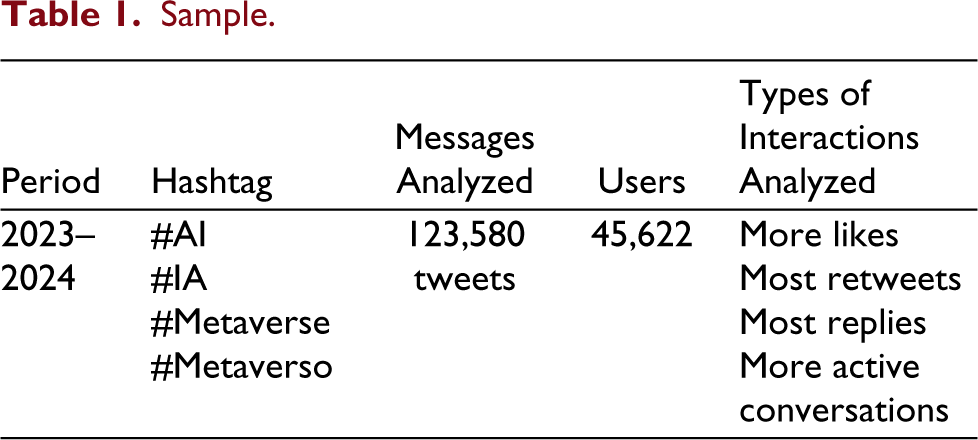
The third step is the processing of the data obtained. The tweets were stored in a MySQL database for ease of use, as well as aggregate searches and queries. In this way, the users with the most likes, retweets and replies were collected from all of their posts, which were then analyzed manually (see the Qualitative Analysis: Digital Ethnography section).
Since X.com assigns each tweet, a conversation identifier that is common to all replies to a message, all tweets that formed conversations with the highest number of messages, that is the most active conversations, were also identified. To avoid the loss of a message when a user replies to another user without including the hashtags studied, the API was queried again for the conversation ID retrieved from the initial message, thus avoiding the loss of those replies.
Once the IDs of all authors were retrieved, the profile information of each author was collected from the API and stored in another MySQL table. The author information recorded is as follows: created_at, updated_at, description, name, profile_image_url, followers, following, number_of_tweets, is_verified.
The last step is the visualization of the data. To visualize the data, a web application was created in Vue.js that launched the queries to our API developed in Python. The vue-d3-network component was used to represent the network structure. Subsequently, those data that allowed a clear representation of the network were represented by graphs. The representation of the network by means of graphs is based on two elements: the nodes, which usually represent network entities (in this case X.com users), and on the other hand, the edges or links that represent the connections between the nodes (Goldenberg, 2021).
Qualitative Analysis: Digital Ethnography
Within the qualitative dimension, an exploratory study was carried out within an interpretative framework, following the Standards for Reporting Qualitative Research (O’Brien et al., 2014). Based on the information obtained from the data mining, an iterative process of interpretation was carried out among the members of the research team. Digital ethnography was used, since, according to Astudillo-Mendoza et al. (2020, p. 246), it has established itself as one of the most widely used methodologies in digital environments and feminist studies, allowing researchers ‘to understand how patriarchal power relations can be subverted or confronted and to identify the strategies that are used’.
The use of data mining to identify user communities and their interactions around certain hashtags is what defined as ‘metafields’ (Airoldi, 2018), that is temporal assemblages (Deleuze & Guattari, 1987) of dispersed communicative contents, aggregated according to their metadata. These new fields of digital ethnography do not only focus on context but also use metadata to gain a deeper understanding of how the community functions in a social network around a topic.
After processing and visualizing the data, a list of users whose tweets were updated at least 10 days frequently was established. This list was based on three characteristics of the X.com social network that allow us to identify the most popular users: the users with the most likes, the most retweets (RTs) or the most replies to their tweets. The list of users who initiated the conversation with the highest number of interactions was also added to these popular users, as this relationship can be visualized in a graph, as well as checking whether it coincides with the most popular users according to the KPIs.
For the classification of the users, the method of coding was followed by Ruiz-Olabuenága (2022), whereby two primary categories were created: business and content creators. And six secondary categories: metaverse, DAO, crypto, AI, Blockchain, NFT. In addition, an analysis was carried out to identify bots among the most popular users. This classification was carried out following the indications of the studies on Fake News (Acker, 2018; Madrigal, 2019; Stella et al., 2018), which states that if the following four criteria are met, the user is classified as a ‘bot’.
Account and profile name
Photo, biography and account details
Followers and interactions
Posts and activity
In addition, a gender perspective has been introduced into digital ethnography, as outlined in the objective of this study, because it represents an essential and indispensable part of addressing the way in which gender biases are reproduced in new technologies and how these impact on the lives of girls and women (Piedra, 2019).
As Airoldi (2018, p. 663) points out, in digital ethnography of social networks, it is worth starting from a key premise: ‘in both meta and contextual fieldwork, online ethnography studies not only a medium and its users, but also social and cultural phenomena that are no less “real” than those observable offline’.
Ethical Aspects
The research carried out does not deal with basic personal data of the users or of special protection according to the data protection law in Spain and Europe. Therefore, the informed consent of these users has not been required. All information and metadata analyzed were obtained from open and public profiles on the social network Twitter and do not contain any personal data. The data have been stored in our own servers and have been encrypted so that only the researchers involved in the research have access to them.
Findings
A total of 123,580 tweets from 45,622 different users were analyzed, which allowed us to identify the most popular users within the Twitter social conversation on metaverse and AI. Twenty-five users with the most likes, 25 users with the most retweets and 25 users with the most replies were selected. These are common KPIs to measure the performance of users in a social network. Twenty-five users who had initiated the most active conversations were also added to this selection.
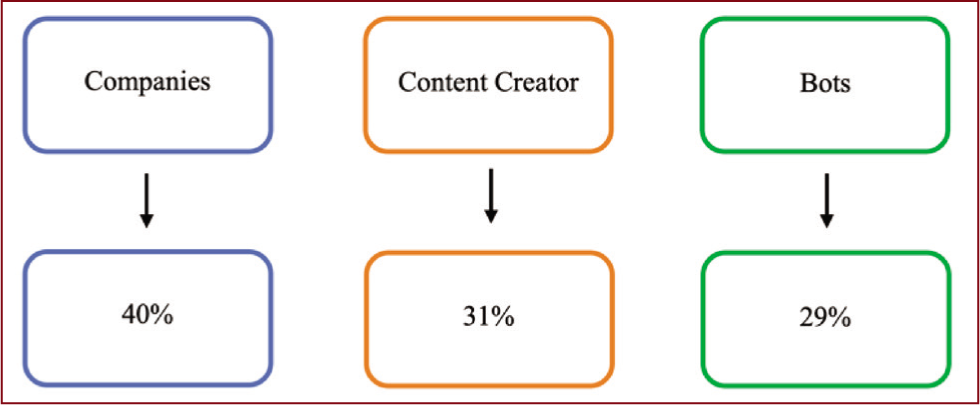
A total of 72 users were identified, of which 22.22% appeared in two or more categories simultaneously. Of the users analyzed, 40% were businesses, 31% were content creators and 29% were classified as bots (see Figure 1). Although there is not necessarily a direct relationship, it is relevant to note that only 29.16% of the identified users are verified.
Types of Users Analyzed.
Users with Most Likes
The users who receive the most likes within the social conversation on X.com related to metaverse and AI are content creators who are based on the creation of characters through AI (see Table 2). This type of user accumulates 68% of the likes generated by the most relevant users in the conversation. Only two users related to the metaverse, video games were found and five users related to the business sphere (experts in start-ups, blockchain or crypto).
Description of Users with Most Likes.

An analysis of the content produced by the users with the most likes shows that these AI-designed characters are mostly highly sexualized women, whose content is often classified by X.com as ‘age-restricted adult content’ or ‘This content may not be appropriate for persons under the age of 18’ (see Figures 2 and 3).
Komi Altest, User with More Likes.

DreamgirlAI, Content Creator who Appears in all Categories: More Likes, More RTs and More Replies.

Users with the Most Retweets
The users who receive the most retweets within the social conversation on X.com about metaverse and AI are companies related to blockchain, metaverse, DAO, cryptocurrencies and NFT, reversing the trend of the previous group. In this case, it is the companies that accumulate 68% of the retweets of the users analyzed (see Table 3). The content creators with the most retweets are led, to a greater extent, by expert influencers in the fields of marketing, cryptocurrency trading, AI and companies that create metaverses. Although there is still a presence of AI-created characters with sexualized female content, it is not as massive as in the likes category.
Description of Users with Most Retweets.
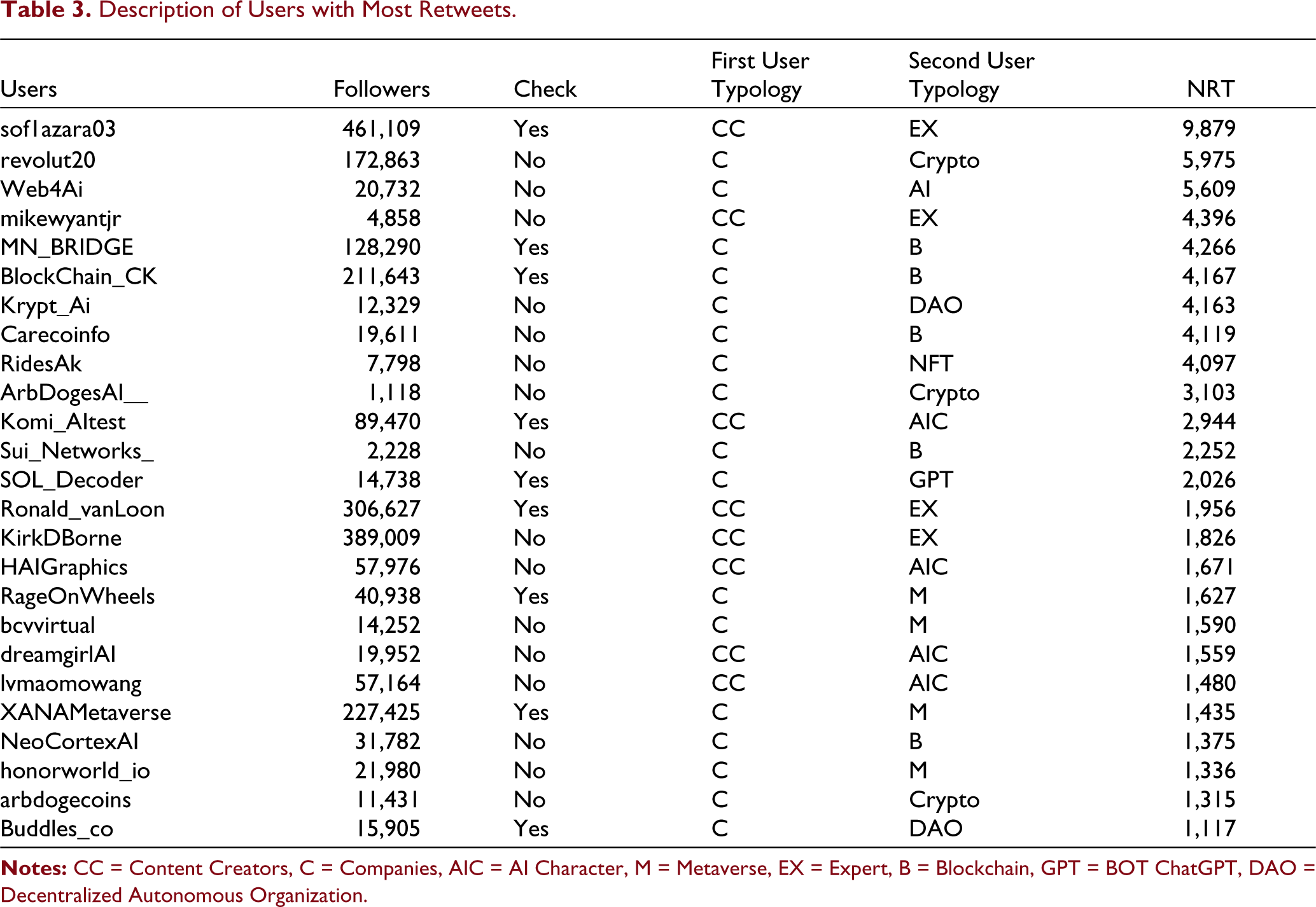
Sixteen per cent of the users with the most retweets are dedicated to the metaverse and the creation of communities in their own universes; 25% work on blockchain developments, and specifically, there are also companies that, as they point out in their content, offer services related to the DAO, NFT or information on cryptocurrencies. In the latter case, it is worth noting that among the users with the most retweets, there are accounts related to memecoins, such as Dogecoin, driven precisely by trends in social networks and which are having an impact on the crypto ecosystem.
Users with the Most Replies
Eighty-eight per cent of the users who receive the most replies within the social conversation on X.com related to metaverse and AI are companies that are again related to blockchain, metaverse, DAO, cryptocurrencies and NFT, following the trend of users with the most retweets (see Table 4). Specifically, blockchain-related companies account for 24% of the analyzed users with the most retweets, followed by metaverse companies, which account for 20%. There are also companies related to cryptocurrencies, the NFT market and DAOs.
Description of Users with the Most Replies.

Under this KPI appears, for the first time, a media organization, absent among the users leading the conversation on X.com. It is also worth noting that other types of organizations appear, such as RippleReefs, a company with a social purpose to protect marine environments through the sale of NFTs.
More Active Conversations
Figure 4 shows the architecture of the network formed by the users who participated in the 25 most active conversations (with the highest number of responses). The size of the nodes is proportional to the number of users analyzed. The 25 users who started the most active conversations have a very low number of followers (less than 50 followers), except for four users who are between 1,620 and 88,500 followers. This is one of the indicators used in the analysis for the identification of bots, which resulted in 84% of the users who started an active conversation being suspected of being a bot. Only the user of MatrixAINetwork, a metaverse development company, is an account that is verified (in the graph, the node is blue) and is part of the conversation, but almost in isolation (see Figure 4).
The users who Initiate the Most Active Conversations (with the Most Replies from Other Users). The Links Represent Interactions Between Users, and the Size of the Node is Proportional to the Number of Followers.
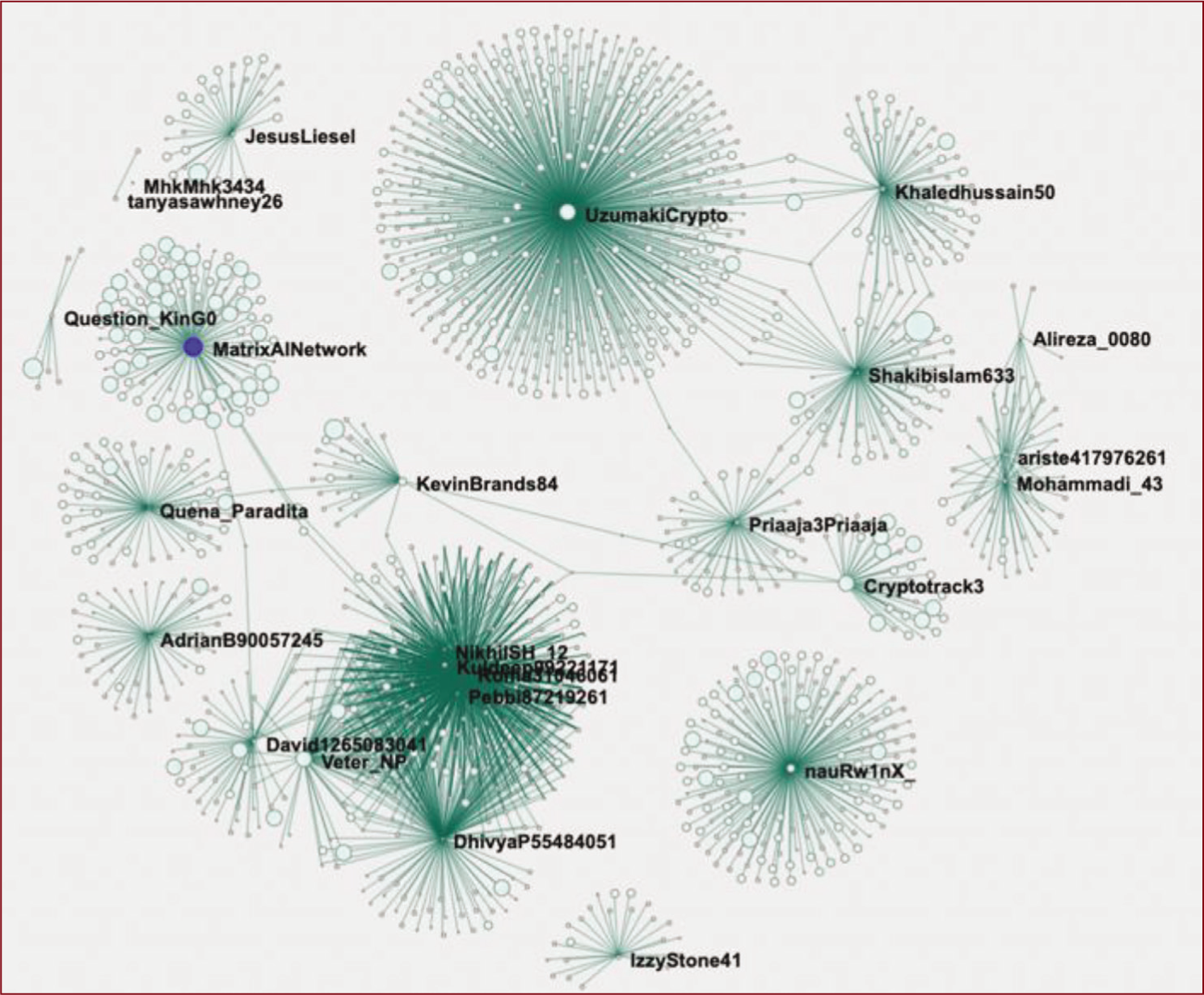
The lines connecting the nodes are responses between the user who started the conversation and other users. The clusters indicate isolated topics (groups of users conversing around a topic). The other three users that do not fit the parameters of the bot analysis are Veter_NP, Cryptotrack3 and UzumakiCrypto (who occupy the centrality of the network conversation). The only one who has a stronger relationship with the users who have been classified as bots is Veter_NP. The most popular topic of conversation is cryptocurrencies.
These data confirm that the social conversation around cryptocurrencies is highly influenced by bots, which, according to the graph, feedback to each other generating noise on Twitter.
Discussion
As noted above, social networks, especially through the opinions shared on Twitter (or X.com), represent a predictive tool that helps to understand what is happening in the market (Rouhani & Abedin, 2020). First, the results of the quantitative study of 123,580 tweets tagged with #Metaverse #AI or #Metaverse #IA produced by 45,622 different users have allowed us to identify the 72 users leading the social conversation on Twitter about metaverse and AI. To carry out this analysis, we used the usual KPIs in social network analysis (Ferrer-Serrano et al., 2020) to understand the context studied: retweet, reply, likes and most active conversations. Second, the qualitative analysis of the 72 users and their activity confirmed that 40% were companies and 31% were content creators, of which 16 users could be identified as influencers given that they appeared in two or more contexts.
To answer RQ1 on who leads the conversation, among the users with the highest number of likes, it is confirmed that they are linked to the creation of AI characters. These AI characters are hyper-sexualized women and in attitudes, on numerous occasions, of sexual availability, which results in many of these users being classified as pornographic content. The objectification of women through new technologies is evolving towards increasingly hyper-sexualized representations, which involve considering women as objects/things and thus dispossessing them of the traits that distinguish human beings from objects, such as warmth, competence and morality (Heflick et al., 2011). The glorification of the sexual dimension, especially the image of women, has become chic and is leading to what has been described as the ‘pornification of culture’ (McNair, 2002), allowing a discourse on sex as an object of consumption to take hold, bringing women’s and girls’ bodies as a product (object) into the market, and eroticizing violence against them (Alario-Gavilán, 2018). Moreover, they create an idea of sexuality for young people that is transmitted through these pornified messages, increasingly present in new technologies, on unrealistic, violent, and misogynistic foundations typical of fiction (Save the Children, 2020). Therefore, in relation to RQ2, the data show the clear objectification of women, as can be seen in Figures 2 and 3.
In contrast, when analyzing the context of the KPIs of retweets and replies, the situation is reversed. In these cases, it is the companies that lead the social conversation. This can be explained by the fact that retweeting or replying to a tweet implies a higher level of engagement (Hernanz Fernández, 2022) as these messages appear on the user’s timeline. However, the data from this research show that the companies leading the social conversation are not large innovative companies – as the Boston Consulting Group study shows (BCG Global, 2023) – but are digital platforms or start-ups, many of them newly created.
The possibilities of the metaverse range from social gatherings, hobbies as well as research, e-learning, virtual staffing or product development (Almarzouqi et al., 2022; Buchholz et al., 2022). However, Damar (2021) points out that these products will not fully materialize for another 15–20 years. Proto-metaverses already exist today and need to be reflected upon in terms of social effects, issues of trust, privacy, bias, misinformation, law enforcement as well as the psychological aspects linked to addiction and the impact on vulnerable people (Dwivedi et al., 2022).
The actors leading the social conversation around the metaverse are companies, and their activity is closely linked to blockchain, and it is common for these companies to also tweet about this topic and incorporate it into the description of their business lines. Among the companies leading the conversation are XANAMetaverse (with more likes), Rage on Wheels or Blockchain Valley Virtual (with more RTs and more replies), but there are no content creators among the leaders of the conversation about the metaverse. Although these actors are promoting universes independent of each other, authors like Agrawal (2023) point to the importance of promoting constructive convergence and continuing to keep these new digital environments open.
On the other hand, the social conversation around AI is more diversified, more heterogeneous, and it is common to find both companies and content creators among the actors leading the social conversation around AI and its multiple developments. Data are similar to those published by Nguyen et al. (2022). Although investment in AI is not new but has been on an upward trajectory for the last six years, it has been with the emergence of OpenAI and the ChatGPT (Nur Fitria, 2023) when there has been an upsurge in social conversation (Google Trends, 2023). The actors in the social conversation related to AI are companies related to DAO, AI bots, ChatGPT or cryptocurrency trading, and if they are content creators, they are subdivided into two categories: influencers in the field of business and economics or characters created by hyper-sexualized AI, 100% of whom are objectified women.
As per the study by Dwivedi et al. (2022), social conversation around the metaverse is associated with NFTs. But this is not only the case for the metaverse, it also appears in account about AI. However, while the actors leading the conversation in relation to the metaverse are more oriented towards video games and the design of unique experiences for customers/users, the actors leading the conversation related to AI-based developments are more oriented towards specific business solutions (healthcare, cryptocurrency trading and DAO AI, among others). This is in response to RQ2, which addresses the topics that the leading players are spreading.
At this point, it is worth mentioning that, due to the relevance of networks such as X.com, the value of NFTs depends on the opinion, expectations and perception that is shared about them (Kapoor et al., 2022). The same situation occurs with the value of cryptocurrencies, which is highly influenced by the opinion of social networks; in fact, both among the actors leading the conversation and among the topics on which the conversations are based, cryptocurrencies have a very important presence. Indeed, among the actors, there are users related to the DoggeCoin memecoin, according to the data provided by Lansiaux et al. (2022), who show their relevance in digital environments such as Twitter. Furthermore, an analysis of the most active conversations (with the highest number of responses) shows that almost all the conversations are about cryptocurrencies and that, of the users who initiate them, the indicators used in the analysis to identify bots indicated that 84% were suspected of being a bot. They indicated Shen et al. (2019) that tweets posted influence Bitcoin’s profitability, showing that the number of tweets significantly influenced cryptocurrency trading, hence the importance of generating conversation around them.
Finally, the actors leading the social conversation are made up of companies and content creators. In the case of companies, they are made up of digital projects or recently created start-ups; among the users with the most likes, RTs or replies, there are no large innovative companies. In the case of content creators, although there are influencers related to the field of economics and business, those who receive the highest number of likes are characters created with AI that represent highly sexualized and objectified women. This shows the need to create egalitarian representative models in digital environments, as, at present, they continue to reinforce gender stereotypes and biases. They may be the solution, but they are now part of the problem.
In terms of the themes of the social conversation, the relevance of the association between NFTs, the metaverse and AI was once again noted. However, we do observe a tendency towards a different theme among the actors who are mostly linked to the metaverse and the actors who are linked to AI. The former talk about topics more oriented towards video games and the design of unique customer/user experiences, while the latter focus more on concrete business solutions and cryptocurrency trading. As noted in previous studies, the study of social conversation has shown that cryptocurrency topics are highly influenced by bots.
Implications
Theoretical Implications
The research findings have different theoretical implications. This work shows, in an innovative way, who is leading the social conversation in relation to digital marketing trends, in one of the main social networks worldwide. Therefore, one of its main theoretical implications is to contribute, significantly, to the understanding of the social conversation related to the metaverse and AI on X.com. It is one of the first works to analyze which entities lead this debate and examine the extent to which gender stereotypes are perpetuated in that cyber discourse. It presents, as one of the major theoretical implications of this research, that it is not the big tech giants that are leading this conversation, but rather it is start-ups and AI-generated content creators who are leading the social dialogue on metaverse and AI, showing a shift in the global landscape.
Furthermore, data analysis shows that AI is worryingly generating highly sexualized content about women, which has a significant share in the current discourse, highlighting the need for greater awareness of gender stereotypes and the hypersexualization of women in today’s cyberculture. This article presents data showing that the actors involved in social conversation, in digital spaces, and the content they produce, need greater action to address misogynistic discourse towards women.
Managerial Implications
The main practical implications of this research work focus on the need to combat the symbolic violence suffered by women in digital environments. This violence still persists in areas as innovative and current as the metaverse and AI. After shedding light on the reproduction of gender stereotypes in digital spaces, the need to create egalitarian representative models in digital environments is shown, since, at present, they continue to reinforce gender stereotypes and biases. They may be the solution, but they are now part of the problem.
It is important to note that, although they are not in the majority, there are also actors such as RippleReefs whose purposes are not only lucrative but are framed in the social perspective that authors such as Feki et al. (2022) want to give to new digital developments, integrating NFTs in charitable and humanitarian causes, or works such as that of Li (2023) focused on the development of the green industry driven by the digital financial industry. Combining VR with real-life problems would help to improve the social imaginary of the younger generations, who are mainly formed and informed through digital spaces. Since, following the study by Us et al. (2022), the activity carried out in social media on ecological issues helps to promote environment-friendly lifestyles, this could be extrapolated to combat stereotypes and the objectification of women in today’s cyberculture.
Limitations and Future Direction
This research work presents a series of limitations that make possible the continuity of the study in the future. This research work analyses data from the social network X.com; however, although it is a space that allows understanding the public discourse (Thelwall et al., 2011) and socioeconomic (Bollen et al., 2011), it has geographic and demographic limitations, as well as it may not reflect 100% of digital marketing trends and their social implications. In addition, another of the limitations of this research work is the use of a quantitative methodology that has not allowed it to delve into the context of the tweets published.
Therefore, as future lines of research that would help address the topic from a more global approach, we contemplate analyzing other social media platforms and other data sources to show a broader and more comprehensive view of who is leading the social conversation about the metaverse and AI. Likewise, as a future line of research, we intend to conduct a qualitative study of the content (text and image) of the tweets that will help to understand not only who is doing the social conversation around two digital marketing trends (metaverse and AI) but what is being said and how that information is presented.
Footnotes
Declaration of Conflicting Interests
The authors declared no potential conflicts of interest with respect to the research, authorship and/or publication of this article.
Funding
The authors disclosed receipt of the following financial support for the research, authorship, and/or publication of this article: This work was supported by the State Research Agency (Spain) under grant PID2019-106695RB-I00/AI-GENBIAS/ 10.13039/501100011033.