



Abstract
Abstract
This article works out a Cournot duopoly where firms take price as given, but it is not the same price that is taken for given by each firm; it depends on individual expectations about opponent’s behaviour as are shaped by the business cycle. Yet, the result of this interaction is a Cournot equilibrium as if the calculations were based on the same price. It is not the price that would be assumed in the absence of expectations. Expectations make inverse-U-shaped reaction curves peak at higher output levels relative to peaks in their absence, implying a lower price vis-à-vis that which is taken for granted in the traditional analysis. And, output levels are higher because they reflect optimism for the course of the economy. In the static context of the analysis, a Cournot equilibrium comes about as if the business cycle is at each peak. Policy-wise, the message is that observed price variations in an oligopoly do not necessarily indicate Bertrand competition despite the possibility that dynamic interaction may lead to outcomes other than the Cournot one; but it will be about disequilibrium and unstable outcomes.
Introduction
The Cournot duopoly has been examined exhaustively. It is a topic of microeconomic concern and such is the concern underlying its investigation from a dynamic point of view as well (Matsumoto, 2017). The purpose of this note is to add some macroeconomic flavour by introducing into the basic model one way according to which the state of the economy might reflect upon the expectations about the opponents’ behaviour. In the next section, firms take price as given, but it is not the same price that is taken for given by each firm; it depends on individual expectations about opponent’s behaviour, as are shaped by the business cycle. This is the point where the present model departs from the standard Cournot duopoly. The third section concludes with policy message of the analysis.
Formal Considerations
Assume that the demand for a perfectly homogeneous good, Q, is iso-elastic, meaning that the consumer expenditure for this good is constant, so that:

This good is produced only by two identical but competing firms,

rather than Equation (1).
Under the same unit costs, k, profits are:

with reaction functions:

Hence, in the absence of expectations, that is, when

with equilibrium price

where

The extrapolation parameter, b, is in any case positive.

Parameter

Now, inserting Equations (7), (8) and (9) in Equation (6) yields that:

Inserting Equation (10) in Equation (4) gives the reaction functions when

In Figure 2, the curves from the beginning of the axes are those in the absence of expectations, the grey curve is that under (
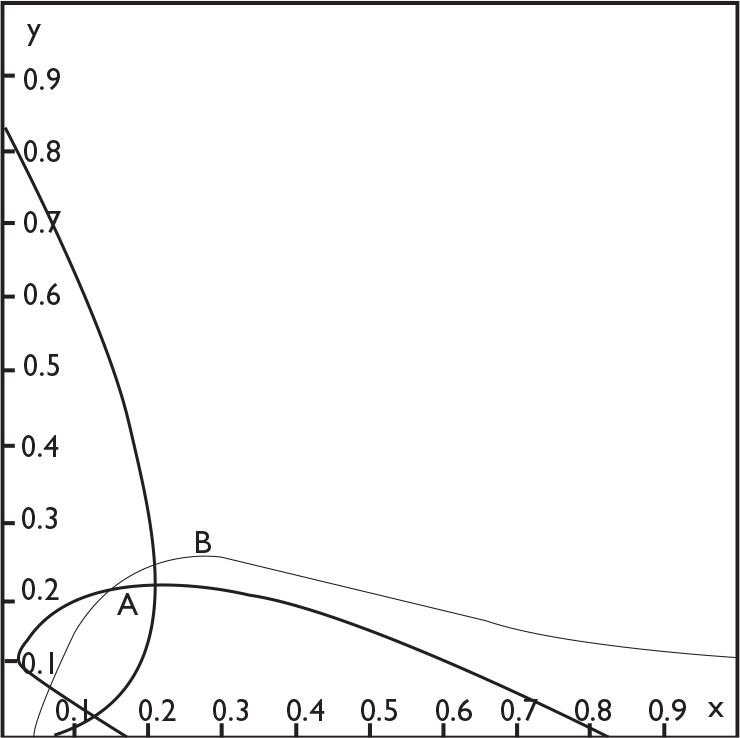
The point is that Cournot-like interaction along the business cycle produces a Cournot outcome. Even though calculations by each firm are made by taking each for granted a different price—the one shaped by the differing expectations of each firm, which in turn are influenced by the state of the economy—the equilibrium configuration comes up as if the calculations were based on the same price. But it is not the price that would be assumed in the absence of expectations. Expectations make reaction functions peak at higher output levels relative to the peak in their absence, implying a lower price vis-à-vis that is taken for granted in the traditional analysis. And output levels are higher because they reflect optimism for the course of the economy; only then it makes sense to compete. After a recession, during which reaction functions have become linear and there is no interaction between the two firms at all, the functions start rising for both firms capturing the optimism in the economy. In fact, one might argue that these linear parts are not components proper of the reactions curves, suggesting that firms do not operate at all before a minimum of sales can be ensured. They peak at the peak of the business cycle and only afterwards start declining. They cross at these peaks, indicating that only then rivalry can stop, alas temporarily. In the static context of the analysis, a Cournot equilibrium comes about as if the business cycle is at each peak, but in a dynamic framework, the peak is only temporary.
Conclusion
Even more complex expressions will arise if the
Acknowledgement
This article has benefited from the useful comments and suggestions of an anonymous referee.
Declaration of Conflicting Interests
The author declared no potential conflicts of interest with respect to the research, authorship and/or publication of this article.
Funding
The author received no financial support for the research, authorship and/or publication of this article.