



Abstract
I examine an extension of the Burdett and Judd ([1983]. Equilibrium price dispersion. Econometrica, 51[4], 955–970) model whereby the consumers with positive search costs experience search regret disutility. First, I focus on the non-sequential search equilibrium in which the said consumers randomize between searching for one price and searching for two prices. When the disutility is significant (a) the spectrum of parameters for which this dispersed price equilibrium can be sustained widens significantly compared to the setting with no disutility; (b) this dispersed price equilibrium is unique and stable in contrast to the multiplicity of dispersed price equilibria of this type which arise in the original model; and (c) in the stable dispersed price equilibrium of this type the consumers with positive search costs respond to the possibility of search regret disutility by increasing their equilibrium search intensity. Second, I concentrate on the noisy sequential search equilibrium in which the reservation price is endogenous. When the search cost takes relatively high values, then compared to the setting with no disutility (a) the set of parameters for which this dispersed price equilibrium is supported may become significantly smaller; (b) the reservation price decreases; and (c) the consumers with positive search costs choose the same search intensity.
Introduction
Burdett and Judd (1983, hereinafter BJ83) in their seminal theoretical contribution presented a dispersed price equilibrium with non-sequential search. In this equilibrium, consumers randomize between searching for one price and searching for two prices and always purchase the product under examination with probability one after incurring the search costs. However, there is always positive probability that the price that will be paid will be slightly lower than the willingness to pay, and, consequently, only a part of the search-cost expenditures will be recouped indirectly through this positive surplus captured by consumption. In other words, BJ83 generate endogenously probabilistic search regret. It is possible that in hindsight the consumers find themselves in a position in which they would have been better off had they avoided entirely the procedure of search in the first place. 1
In the original BJ83 formulation all consumers have positive search costs, whereas there exists a continuum of firms. Janssen and Moraga-González (2004) introduced consumers with zero search costs into BJ83 and examined a general supply structure. Even with consumer heterogeneity, though, the equilibrium wherein the consumers with positive search costs randomize between searching for one price and searching for two prices always generates endogenously probabilistic search regret.
In this paper, I examine an extension of the BJ83 model whereby search regret causes a negative emotion to the consumers which is measured by a parameter as disutility. I analyse the impact of search regret disutility both on the BJ83 non-sequential search equilibrium and the BJ83 noisy sequential search equilibrium. In my model, I assume a perfectly competitive supply structure. Throughout this paper, consumers with positive search costs and consumers with zero search costs may coexist.
As far as the BJ83 non-sequential search equilibrium is concerned, I find the following results when the disutility is significant: (a) the spectrum of parameters for which this dispersed price equilibrium can be sustained widens significantly compared to the setting with no disutility (see Tables 1 and 2); (b) this dispersed price equilibrium is unique and stable in contrast to the multiplicity of dispersed price equilibria of this type which arise in the original BJ83 model (see Tables 1 and 2); and (c) in the stable dispersed price equilibrium of this type the consumers with positive search costs respond to the possibility of search regret disutility by increasing their equilibrium search intensity (see Tables 1 and 2). The latter result holds even when the disutility is not significant (see Tables 1 and 3) and means that both the profits and the social welfare decrease when the emotions of consumers are taken into account. Intuitively, in the stable non-sequential search equilibrium, the consumers with positive search costs attempt to decrease the probability of search regret as the search regret disutility increases. This is accomplished by an increase in the search intensity, which also increases the net pay-off of the consumers with positive search costs (see Table 4).
With regard to the BJ83 noisy sequential search equilibrium, it should be stressed that even in the presence of search regret disutility, probabilistic search regret does not occur for all values of the search cost. Therefore, in my treatment, I emphasize the high values of the search cost that lead to probabilistic search regret (see Assumption 1). By introducing search regret disutility to the BJ83 noisy sequential search environment (a) the set of parameters for which the noisy sequential dispersed price equilibrium is supported may become significantly smaller (see Tables 5 and 6); (b) the reservation price decreases (see Table 7); and (c) the consumers with positive search costs search once. As consumers with positive search costs use the endogenous reservation price rule, any firm that charges a price higher than the reservation price captures zero demand. In equilibrium, no firm will ever charge a price higher than the reservation price, similarly to the standard BJ83 noisy sequential search set-up. The reservation price decrease in response to the possibility of search regret disutility can be brought into parallelism with the increase in the search intensity in the non-sequential search environment. In the sequential search environment, the consumers with positive search costs again attempt to decrease the probability of search regret and bring about the desired result through the decrease in the reservation price. Importantly, any increase of the value of the search regret disutility parameter, either from a zero level to a positive level or from a nonzero level to a higher level, decreases the reservation price. This leads unambiguously to lower expected prices and lower probability of search regret; however, it is not clear whether the consumers with positive search costs are better off or worse off. Simulations suggest that the net pay-off of the consumers with positive search costs may either increase or decrease when the search regret disutility parameter increases (see Table 7). The analytical treatment of the BJ83 noisy sequential search model with search regret disutility presents technical difficulties. In the environment with search regret disutility, the noisy sequential search equilibrium is not supported for all values of the search cost for which it is supported in the environment without disutility (see Tables 5 and 6).
Literature
The present paper is related to the literatures on regret and on consumer search. An analytical treatment of search regret has not emerged hitherto in the interdisciplinary literature on regret. 2
The notion of regret, broadly defined, has attracted great attention as it appears already in the epic work Odyssey attributed to Homer (Elster, 1984). Notably, the notion of regret has been connected to the notion of commitment. The decision-maker who anticipates that in the future he will engage in an action which will lead to regret had better commit himself not to be able to engage in this action (Schelling, 1984). Overall, there is significant research on regret that spans marketing, management and economics. For instance, see Filiz-Ozbay and Ozbay (2007), Syam, Krishnamurthy, and Hess (2008), Shih and Schau (2011), Nasiry and Popescu (2012), Jiang, Narasimhan, and Turut (2017), and the references therein.
A duopolistic version of BJ83 can be modified to generate both probabilistic full search regret and probabilistic partial search regret. Such a modification would have the assumptions that there exists consumer heterogeneity in regard to search costs and non-sequential search is ordered. In more detail, when the consumers with positive search costs search once, a particular firm is selected. In the dispersed price equilibrium, this particular firm chooses the price that equals the maximum willingness to pay with positive probability. See Wilson (2010) for a sequential search model with ordered search.
The literature on consumer search is comprehensively surveyed by Baye, Morgan, and Scholten (2006) and Anderson and Renault (2018). In this literature, the possibility of search regret and the disutility it may cause have been overlooked, although search regret occurs with positive probability, for example, in all types of the non-sequential search equilibria studied by Janssen and Moraga-González (2004). Similarly, to one of my results, Galeotti (2010) finds a unique dispersed price equilibrium in a duopolistic non-sequential BJ83 framework with social networks.
This paper proceeds as follows. The next section presents the main assumptions of the model, the fourth and fifth sections provide the analysis and the sixth section concludes the paper. The proofs of the Propositions of the main body of the paper are presented in Appendix A. Appendix B presents a variant of the BJ83 noisy sequential search model with no search regret disutility.
The Model: Main Assumptions
Let N denote the number of firms. The industry is perfectly competitive, that is,
Non-sequential Search
In the non-sequential search approach, each consumer with positive search costs must decide how many prices will be observed before observing any of them. The analysis is focused on the BJ83 dispersed price equilibrium whereby the consumers randomize between searching for one price and searching for two prices. 4
Janssen and Moraga-González (2004) have shown that in the BJ83 non-sequential search equilibrium with consumer heterogeneity, the cumulative distribution function according to which the firms set prices cannot be defined explicitly for general values of the number of firms, and therefore the probability of search regret cannot be computed. The cumulative distribution function is defined explicitly only when
Analysis
My result is presented in Proposition 1.

then there exists a dispersed price equilibrium whereby all firms set prices according to the symmetric atomless cumulative distribution function
The probability of search regret for the consumers with positive search costs who search once is equal to
Simulations – Non-sequential Search Benchmark Parameters: v = 100, λ = 0,
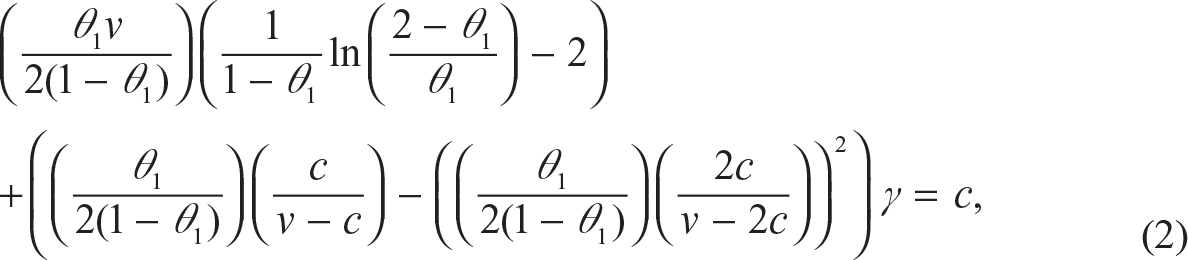
. For the parameter combinations of this Table Equation (2) admits two solutions: the stable
and the unstable
. The left-hand side (LHS) of Inequality (1) both for the stable and the unstable
takes values higher than the search cost.

Simulations – Non-sequential Search with Search Regret Disutility Parameters: v = 100 ,
,
. For the parameter combinations of this Table Equation (2) admits two solutions: the stable
and the unstable
. The left-hand side of Inequality (1) for the stable values of
takes values higher than the search cost. The left-hand side of Inequality (1) for the unstable values of
takes negative values.

Simulations – Non-sequential Search with Search Regret Disutility Parameters:
,
,
. For the parameter combination of this Table Equation (2) admits two solutions: the stable
and the unstable
. The left-hand side of Inequality (1) both for the stable and the unstable
takes values higher than the search cost.

Tables 1 and 3 demonstrate that when the parameter γ is zero or more generally low, then all values of θ1 which satisfy Equation (2) also satisfy Inequality (1), that is, the unstable solutions of Equation (2) are accepted as equilibria of the game. On the contrary, Table 2 shows that when the parameter γ is high, the unstable solutions of Equation (2) do not satisfy Inequality (1), and therefore these solutions are not accepted as equilibria of the game. 5
The economic mechanism behind the uniqueness result is that when γ increases, the unstable solution of Equation (2) increases (see Tables 1–3). In turn, an increase in the unstable solution of Equation (2) increases both the expected price and the probability of search regret.
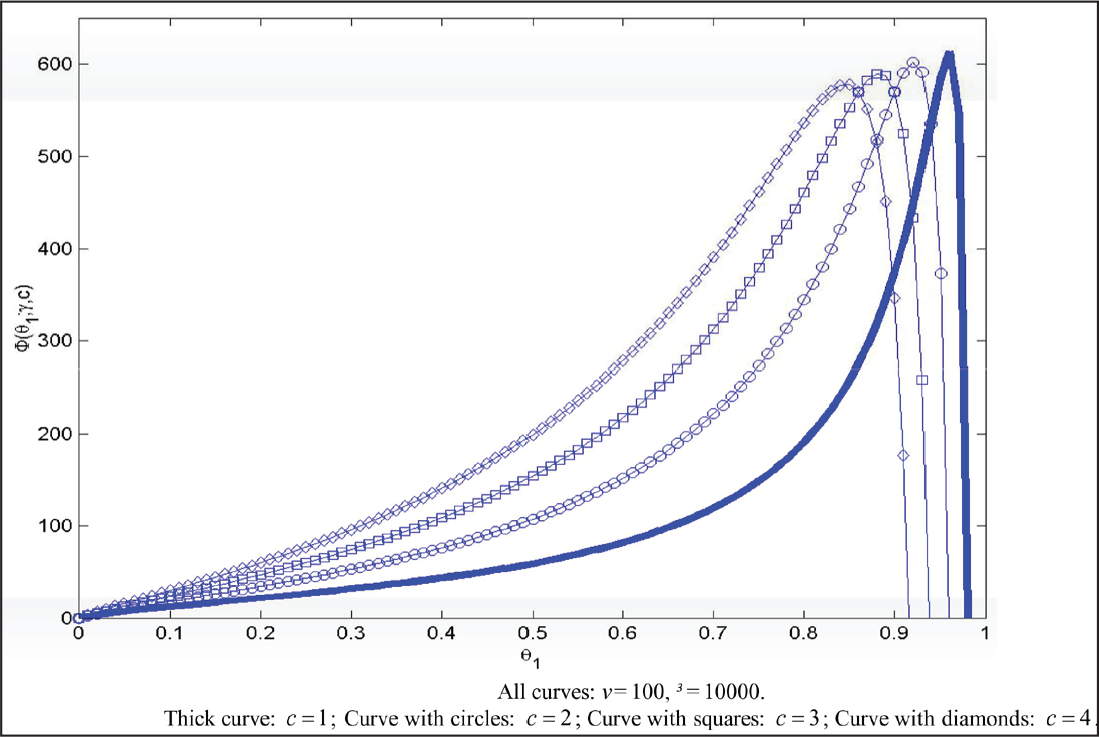
Simulations – Non-sequential Search with Search Regret Disutility Parameters:
, c = 1,
. For all values of
, the Net Payoff is computed for the stable
.

Noisy Sequential Search
The main assumptions of Section 3 continue to hold. The noisy search approach proposed by BJ83 is as follows. The representative consumer with positive search costs by incurring the search cost once receives an unknown number of price quotes; the probability any particular number of price quotes will be observed is known. In the BJ83 original model, by searching once, a consumer with positive search costs observes one price with some probability, two prices with some probability, three prices with some probability, and so on until infinity, that is, a consumer may observe infinite prices with positive probability by searching once. In this paper, I follow Cason and Friedman (2003), and I assume that by searching once, a consumer with positive search costs observes one price with probability 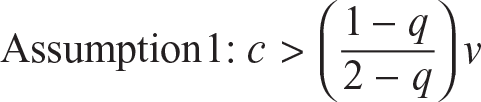
The rationale for this restriction is that when
In Appendix B, I show that Assumption 1 leads to probabilistic search regret when γ = 0. In the setting with disutility, generic parameters that do not satisfy Assumption 1 could lead to multiplicity of equilibria in the specific sense that two reservation prices could exist; one reservation price below v – c and one reservation price above v – c. Extensive simulation exercises reveal that for

and let B denote the expression

Analysis
The noisy sequential search equilibrium is characterized in Proposition 2.
(a) (b) (c) (d) 
then there exists a unique equilibrium. The reservation price of the consumers with positive search costs is
In Proposition 2, the reservation price belongs to the interval (v–c, v) and the lower bound of the support is lower than v–c (see condition (c)). 7
The reservation price equals v whenever Equation (3) does not admit a solution in (v – c,v) and conditions
Simulations – Noisy Sequential Search with No Search Regret Disutility (Probabilistic Search Regret) Parameters:
,
,
,
. The upper bound of the support is 80, the lower bound of the support is approximately equal to 26.6, and the expression
is approximately equal to 33.3. For probabilistic search regret to occur, according to Proposition B.2, the search cost must satisfy
. The Inequality
is the participation constraint for the consumers with positive search costs.

Simulations – Noisy Sequential Search with Search Regret Disutility Parameters:
,
,
,
. For the case
, c = 50: the reservation price is approximately equal to 87.075, the lower bound of the support is approximately equal to 29.025, the probability of search regret is approximately equal to 0.37, and the net payoff of the consumers with positive search costs is approximately equal to -3.66; that is, the conditions (a)-(c) of Proposition 2 are satisfied, and the condition (d) of Proposition 2 is not satisfied. For the case
, c = 45: the reservation price is approximately equal to 55.38, the lower bound of the support is approximately equal to 20, the probability of search regret is approximately equal to 0.003456, and the net payoff of the consumers with positive search costs is approximately equal to -7.25; that is, the conditions (a)-(c) of Proposition 2 are satisfied, and the condition (d) of Proposition 2 is not satisfied.

Simulations – Noisy Sequential Search Parameters:
,
,
,
. For all positive values of
in this Table, the conditions (a)-(d) in Proposition 2 are satisfied. For
, the conditions in Proposition B.2 (Appendix B) are satisfied.

As mentioned in the Introduction, the intuition for the reservation price decrease in response to an increase in γ is that the consumers with positive search costs attempt to decrease the probability of search regret. Indeed, when the reservation price decreases, the probability of search regret decreases, the expected prices decrease and the lower bound of the support decreases. Similarly, to the non-sequential search environment, an increase in γ creates a positive externality, as the consumers with zero search costs purchase the product at lower price. In contrast to Table 4, Table 7 shows that an increase in γ does not necessarily benefit the consumers with positive search costs.
Conclusion
I revisited the BJ83 model by introducing search regret disutility. In the presence of disutility, the consumers with positive search costs through their behaviour try to decrease the probability of search regret. This is true both in the non-sequential search approach and in the noisy sequential search approach. In the non-sequential search approach, the consumers increase their search intensity when the disutility increases. In the noisy sequential search approach, the consumers with positive search costs decrease their reservation price when the disutility increases. Furthermore, when the disutility takes very high values, multiplicity of the non-sequential search equilibria disappears. An interesting theme would be the impact of search regret disutility on the social welfare with non-sequential search when new firms enter the industry. Unfortunately, as mentioned in the ‘Non-sequential Search’ section, in the BJ83 equilibrium with consumer heterogeneity, the cumulative distribution function cannot be defined explicitly for general values of the number of firms, and therefore the probability of search regret cannot be computed. Nevertheless, one could examine whether other types of equilibria that do not appear in the original BJ83 model and its extensions exist in the presence of search regret disutility.
Appendix A: Omitted Proofs (Main Body)

This expected profit is analysed as follows. The firm captures the consumers who observe only one price with probability 
As N increases, the term 
and the pay-off from incurring the search cost twice equals

Also, note that in equilibrium, the probability of partial search regret when one price is observed is strictly positive and lower than one. The same holds in equilibrium for the probability of partial search regret when two prices are observed. In equilibrium, the consumers with zero search costs obtain pay-off equal to

The reasoning is that if the lowest price from another search is lower than v – c, then the representative consumer with positive search costs gains not only from the decrease in the price but also from not incurring the lump sum expenditure γ. The reservation price p* is the solution z* to Equation (A.2)

A is described in the main body of the paper and represents the probability
Appendix B: Noisy Sequential Search (BJ83)
Perfect Competition with No Search Regret Disutility (γ = 0)
Assumptions
The assumptions described in section ‘The Model: Main Assumptions’ of the main body of the paper hold, and the set-up is the same as the one described in section ‘Noisy Sequential Search’ of the main body of the paper. The only difference is that γ = 0.
Analysis
First, I show that when the search cost is relatively low, that is, when

The right-hand side of Equation (B.1) is the expected benefit from search and equals
