



Abstract
Risk perception is a crucial component in evaluating the rationality of smoking decisions, but there are few studies that have examined its effect on the smoking of smuggled cigarettes. The purpose of this article is to empirically investigate whether risk perceptions affect the smoking of smuggled cigarettes in Taiwan in the context of socio-economic status. Since risk perception may be endogenous with regard to smoking smuggled cigarettes, the endogenous switching model is utilised to evaluate the effect of risk perception in relation to the smoker’s being concerned with health risks and tobacco quality. Our empirical results indicate that smokers with higher degrees of risk perception are less likely to smoke smuggled cigarettes. In addition, the relevant characteristics of the socio-economic status of smokers, such as weekly cigarette expenditure, gender, age, and whether or not they reside in the southern region of Taiwan, are also statistically significant in terms of smoking smuggled cigarettes. Therefore, the public health authorities in Taiwan should actively broadcast information on the fatal consequences of smoking smuggled cigarettes, thereby enhancing the smoker’s risk perceptions in regard to smuggled cigarettes.
Introduction
Different individuals are characterised by heterogeneous perceptions of risks and divergent risk preferences, which may partially explain the different choices made by smokers. In particular, risk perception is a crucial component in evaluating the rationality of smoking decisions. However, even though risk perceptions regarding smoking have been thoroughly discussed in previous economic research, there have been very few studies that have sought to understand the effect of such perceptions on the smoking of smuggled cigarettes. Therefore, the purpose of this article is to empirically investigate whether risk perceptions affect the smoking of smuggled cigarettes in Taiwan.
The previous literature related to smoking risk has tended to focus on two main issues: (a) mortality risk in smoking, and (b) the effect of risk perception on smoking behaviour. The former addresses the consequences of risk exposure to smoking. Viscusi (1998) indicates that the annual risk of death from smoking is double that of cancer from all causes and is 33 and 67 times greater than the risks of motor vehicle accidents and work accidents, respectively. In addition, most smokers neglect the risks of lung cancer and stroke resulting from smoking based on studies conducted in the US (Viscusi, 1990, 1991), Spain (Antoñanzas et al., 2000; Rovira et al., 2000; Viscusi et al., 2000) and Taiwan (Liu & Hsieh, 1995). The latter examines the relationship between risk perceptions and smoking behaviour. Most researchers find evidence that risk perceptions play an important role in the smoker’s decision to smoke cigarettes (e.g., Antoñanzas et al., 2000; Liu & Hsieh, 1995; Lundborg, 2007; Lundborg & Andersson, 2008; Lundborg & Lindgren, 2004; Rovira et al., 2000; Viscusi, 1990, 1991; Viscusi et al., 2000). Unfortunately, none of the previous research explores the effect of risk perceptions on smoking smuggled cigarettes due to limitations of the data. Therefore, this article attempts to fill this gap in the previous literature by investigating the influence of risk perceptions on the decision to smoke smuggled cigarettes in Taiwan.
Furthermore, Viscusi (1991) and Liu and Hsieh (1995) estimate the interrelationship between the decision to smoke and risk perceptions using a two-stage approach based on the smoking decision or risk perceptions that interact with each other endogenously. Unlike Viscusi (1991) and Liu and Hsieh (1995), Lundborg and Andersson (2008) however argue that the socio-economic status associated with smoking is unlikely to affect smoking mortality risk perceptions since for young smokers health effects are not likely to have become an issue. Consequently, the status of smoking is not endogenous in relation to the smoker’s risk perception. This is very similar to the smoking behaviour of those who smoke smuggled cigarettes because most Taiwanese smokers do not have much experience of purchasing or smoking such smuggled cigarettes. Based on this viewpoint, the status of smoking with regard to smuggled cigarettes is not endogenously related to the smoker’s risk perceptions, a setting that differs from those of both Viscusi (1990) and Liu and Hsieh (1995).
By considering risk perceptions to be endogenous through the smoker’s self-learning process and then being reflected in the individual’s smoking decision, this article’s main contribution is to utilise the endogenous switching model to evaluate the substantial effect of risk perceptions on a smoker’s concerns regarding health and the quality of smuggled cigarettes. Such endogeneity arises as unobserved individual characteristics that affect the likelihood of formulating risk perceptions are found to be highly correlated with unobserved heterogeneity in determining smoking decisions. If risk perception is treated as being exogenous in a smoking equation without testing taking place, then the estimates may be subject to a potential bias. For example, Bratti and Miranda (2010) applied the endogenous switching count model to identify the effect of education level on cigarette consumption, and concluded that the education level is endogenous in relation to smoking. Switching regression techniques are used not only in economics but also in medicine (Scott et al., 2004), biology (Iero et al., 2003) and psychiatry (Pollio et al., 2000). Specifically, the risk perception specified in this article is treated as the dummy, which differs from Viscusi (1990), as well as Liu and Hsieh (1995) who treat it as a continuous variable. I attempt to treat risk perception as an endogenous switching state in responding to the smoking of smuggled cigarettes in Taiwan.
To date, few studies have been conducted that focus on the behaviour of smokers who choose to purchase smuggled cigarettes, not to mention the understanding of the effects of risk perceptions. One reason for this is that respondents are hesitant to answer questions that deal with illegal activities. This is true in Taiwan as well, where most of the literature has focused on how the increases in cigarette prices affect consumption. However, a few recent studies have found that socio-economic factors, such as the degree of addiction, personal income and level of education, play a strong role in individual decision-making. Tsai et al. (2003) as well as Lee and Chen (2005) researched why Taiwanese smokers purchased counterfeit cigarettes and found that the major impetus was to avoid the high cost of legal cigarettes. Moreover, Tsai et al. (2005) found that levying a health surcharge on tobacco caused cigarette prices to increase, which encouraged low-income smokers to turn to counterfeit cigarettes to maintain their smoking habits and control expenditures.
Such patterns have been noted in communities around the world. For example, Wiltshire (2001) investigated counterfeit cigarettes in two different socio-economic neighbourhoods in Edinburgh, Scotland, and found that smokers with lower incomes purchased counterfeit cigarettes to reduce their smoking costs. Taylor (2005) studied the Hull and East Riding region in Yorkshire, England, and found that people who purchase counterfeit cigarettes are heavy smokers, live in low-income areas, and have high levels of addiction. Most of them do, however, have a job.
Data
The data used in this study were collected over the period from April to July in 2004, with smokers aged 15 and above in various cities in Taiwan being the research targets. The smuggled cigarette consumption was examined across 23 cities in Taiwan based on the male smokers to female smokers’ ratio and the populations of each city through phone interviews. Here, smokers are defined as people who have smoked at least 100 cigarettes in their lifetime, and who currently smoke daily or several days in a week. Smuggled cigarettes are defined as illegal cigarettes on which taxes have not been paid or which do not have the Tax Paid label, and brands may be imported or local. In the phone interviews, respondents were asked, ‘In your history of smoking, have you ever smoked smuggled cigarettes?’ The number of effective observations was 1,236. Of the 1,236 interviewees, smokers who had smoked smuggled cigarettes were defined as interviewees having smoked smuggled cigarettes and having smoked more than 100 cigarettes in their lifetime. In order to evaluate the effects of risk perception on smoking smuggled cigarettes, this article uses two categories representing the risk perceptions associated with smoking smuggled cigarettes: (a) risk perception regarding quality: respondents were asked whether they were worried about the quality of smuggled cigarettes. (b) Risk perception regarding health: respondents were asked whether they knew that the smuggled cigarettes were harmful to health. Both risk perceptions are binary responses.
Econometric Method
Endogenous Switching Model
Endogenous switching models for binary variables are used in the empirical analysis and are represented by the following equations:


where i is an indicator for individuals (i = 1, 2, …, N),
Burnett (1997) proposes the two-step approach to deal with the joint determination of two binary choice variables. However, Rivers and Vuong (1988) present a two-step procedure for a probit model in which the right-hand side variables are endogenous and continuous variables, rather than being binary variables. Greene (1998) also indicates that the estimator for the two-step approach would be potentially inefficient because it does not account for the correlation between the error terms in the two equations. Consequently, Greene exhibits a consistent, fully efficient estimator for this model that is based on the relationships among the joint, conditional and marginal probabilities:

where BVN denotes the cumulative distribution function of the bivariate normal distribution. After inserting the variables and introducing the two parameter vectors, it yields

where SN denotes the distribution function of a standard normal distribution. For




The likelihood functions from Equation (5) to Equation (8) can be summarised by the following formulations (Greene, 2003):

where

Empirical Specif ication
In order to evaluate the effects of risk perception and the socio-economic status of smokers who are inclined to smoke smuggled cigarettes, the empirical model is specified as in Equation (11). Furthermore, we investigate the influences of the socio-economic factors of smokers on their personal risk perceptions, and the model is specified as Equation (12):


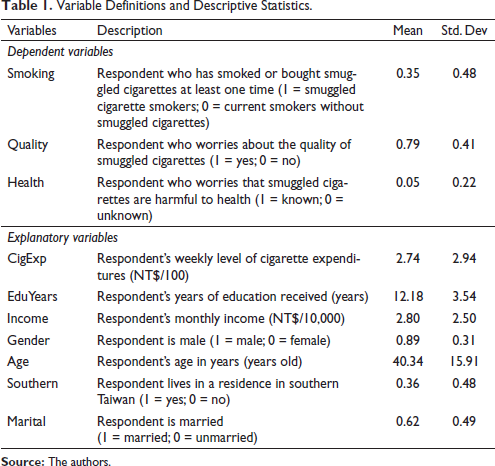
where Si indicates that a respondent has smoked or bought smuggled cigarettes at least one time (yes = 1; no = 1). CigExp i refers to the weekly level of cigarette expenditures of respondents. Due to the coefficient scalar, we have divided expenditures by 100. EduYears i refers to the years of education received by a respondent. Income refers to the respondent’s monthly income divided by 10,000. Gender i denotes whether the respondent is male or not (1 = male; 0 = female). Age i indicates the age in years of a respondent. Southern indicates whether the respondent lives in southern Taiwan or not (1 = yes; 0 = no). Marital i refers to whether the respondent is married or unmarried (1 = married; 0 = unmarried). RP i represents the respondents’ risk perception with regard to Quality or Health 1 in the case of smuggled cigarettes. All detailed variable definitions and explanations are presented in Table 1.
Variable Definitions and Descriptive Statistics.
Empirical Results
For the purpose of comparing the endogenous switching model with the exogenous switching model, we begin the empirical analysis by estimating the probit model while treating risk perceptions as exogenous variables. The estimation results are reported in Table 2. In Table 2, Model 1 provides the estimation results with regard to risk perceptions of quality that have negative and statistically significant effects on the decision to smoke smuggled cigarettes. The findings indicate that when the respondent is worried about the quality of smuggled cigarettes, his or her probability of smoking smuggled cigarettes will be reduced. Furthermore, we also evaluate the kinds of socio-economic factors that influence a smoker’s personal risk perceptions with regard to smoking smuggled cigarettes in Model 2. The results show that the age is positive and significant with regard to the smoker’s risk perception. This implies that those more advanced in age tend to be more worried about the quality of smuggled cigarettes. Besides, respondents who do not live in southern Taiwan reveal much concern with regard to the quality of smuggled cigarettes. Furthermore, the effects of gender are both negative and significant, which implies that female smokers are more likely to be worried about the quality of smuggled cigarettes than male smokers. In Model 3, the estimation results indicate that risk perceptions with regard to health have positive but statistically insignificant effects on the decision to smoke smuggled cigarettes. In Model 4, we estimate the factors regarding the smoker’s socio-economic status that influence his or her risk perceptions and find that the effect of age is both negative and statistically significant.
Probit Model Results of the Effect of Risk Perceptions and Socio-economic Status on Smoking Smuggled Cigarettes.

In observing the endogeneity arising from the unobserved individual characteristics affecting the risk perceptions of smokers being correlated with unobserved heterogeneity determining the decisions to smoke smuggled cigarettes, we regard risk perceptions as being endogenous in relation to smoking behaviour. The estimation results for the endogenous switching models are provided in Table 3. Model 1 of Table 3 presents the estimation results for risk perceptions in terms of quality. In this structure, quality is negative but statistically insignificant in terms of smoking smuggled cigarettes. Weekly cigarette expenditures, gender, age and southern residence are each significant and have the same signs as in the case of the exogenous switching model. However, the correlation coefficient
Endogenous Switching Model Results of the Effect of Risk Perceptions and Socio-economic Status on Smoking Smuggled Cigarettes.
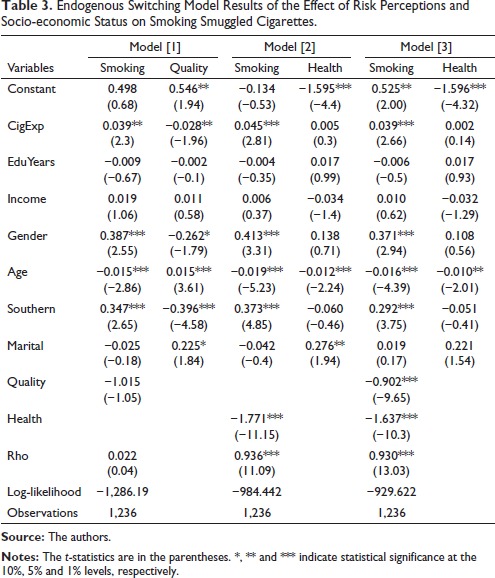
The estimation results regarding the risk perceptions of health based on the endogenous switching model are shown in Model 2 of Table 3. In contrast to risk perceptions regarding quality, the correlation coefficient
According to the estimation results in Model 1 of Table 3, risk perceptions with regard to quality are more appropriate as an exogenous variable, and so I treat the quality variable as being given exogenously in the smoking smuggled cigarettes equation with endogenous switching on health. The results are shown in Model 3 of Table 3. In this model, it is found that the endogenous structure still remains, while the correlation coefficient is also positive and statistically significant. It is noted that risk perceptions with regard to quality and health are important determinants of the decision to smoke smuggled cigarettes, due to both the negative and statistically significant coefficient. This finding is also consistent with the results regarding the relationship between risk perception and the smoking decision reported by Viscusi (1991), Liu and Hsieh (1995), Viscusi et al. (2000), Lundborg and Lindgren (2004), and Lundborg and Andersson (2008). The effects of risk perceptions imply that smokers with higher degrees of risk perception would be less likely to smoke smuggled cigarettes. Besides, focusing on the coefficients for health and quality perceptions indicates that there is a stronger effect on health perceptions than on quality. Furthermore, the variables related to the socio-economic status of smokers, weekly cigarette expenditure, gender, age and southern residence are also statistically significant and give rise to similar results as before.
Conclusions
Risk perception is an essential component in evaluating the rationality of smoking decisions, but there are few studies that have sought to determine its effect on the smoking of smuggled cigarettes. The purpose of this article is to empirically investigate the influence of risk perceptions on the smoking of smuggled cigarettes in Taiwan. Since risk perceptions may be endogenous in relation to smoking smuggled cigarettes, we utilise the endogenous switching model to evaluate the effect of the smoker’s risk perceptions in regard to health risks and tobacco quality. The effects of these risk perceptions imply that smokers with a higher degree of risk perception will be less likely to smoke smuggled cigarettes. In addition, the related socio-economic status of smokers, weekly cigarette expenditure, gender, age, and whether or not the smoker resides in southern Taiwan are also statistically significantly related to the smoking of smuggled cigarettes.
In considering that endogeneity arises from unobserved individual characteristics affecting the risk perceptions of smokers being correlated with unobserved heterogeneity determining the decisions to smoke smuggled cigarettes, we find that smokers’ risk perceptions are endogenous in relation to the likelihood of smoking smuggled cigarettes. These findings have important implications for public health authorities, which should consequently disseminate more information regarding the risks associated with smoking smuggled cigarettes. According to the results confirming the effects of health and quality perceptions, the public health authorities have been active in providing information on the harmful effects of smoking to enhance smokers’ risk perceptions. Recently, anti-smoking communication campaigns and regulations requiring health warning labels have been implemented globally in order to encourage smokers to refrain from smoking or to reduce their cigarette consumption (Dunham & Marlow, 2003). Typically, lung cancer serves as a proxy for all other smoking-related health risks referred to by Viscusi (1990, 1992), Hu et al. (1995), Liu and Hsieh (1995) and Hsieh et al. (1996). Hence, the health authorities have to actively propagate the hazardous results of smoking smuggled cigarettes in order to enhance the levels of smokers’ risk perceptions.
One of the ways to reduce smoking is to control the cigarette price by increasing the price of the cigarette product through tobacco taxation. However, one of the main reasons for the prevalence of cigarette smuggling is the government’s levy on legal cigarettes, which makes the price of smuggled cigarettes relatively lower (Bate et al., 2020). Smokers tend to buy smuggled cigarettes with lower prices, because it contains higher levels of toxic heavy metal substances such as the lead and thallium (Pappas et al., 2007) while causing greater health damage. In addition to the supply-side perspective, government agencies can strengthen the investigation of smuggled cigarette to curb the supply of smuggled cigarette, and they can also reduce smuggled cigarettes through demand-side approaches. To enhance the public’s risk awareness by strengthening the harm of smuggled tobacco products through the health education of smoking cessation and medical treatment. Only in this way, the implementation of the tobacco tax policy could achieve the effect of healthcare.
Footnotes
Declaration of Conflicting Interests
The authors declared no potential conflicts of interest with respect to the research, authorship and/or publication of this article.
Funding
The authors received no financial support for the research, authorship and/or publication of this article.
