



Abstract
This study investigates the gender wage gap in the Indian labour market by analysing a range of human capital components, including education, work experience, cognitive and technical skills and occupational choices, using data from the India Human Development Survey 2011–2012. We employ the recentred influence functions (RIF) regression and Firpo, Fortin and Lemieux (FFL) decomposition techniques. The results from the RIF regression analysis underscore the significant role of education, work experience, skills and occupation in wage inequality. While education and English language proficiency lead to widening wage inequality for both men and women, the effects are much larger for the latter. Next, the FFL decomposition unveils a positive gender wage gap, indicating potential favourable returns for women’s qualifications and skills, yet it exposes a concerning wage structure effect suggesting women are often employed in lower-paying jobs. These results suggest that enhancing education and skills among women can be important tools in reducing gender wage inequality.
Introduction
Gender wage inequality has been a prominent topic in labour economics, with the existing literature highlighting various reasons for such disparities worldwide. Human capital components have consistently emerged as crucial drivers of wage inequality, supported by extensive theoretical and empirical evidence. This paper aims to contribute to the literature by incorporating these human capital components in the context of gender wage inequality. The study utilizes data from the IHDS 2011–2012 survey to specifically examine a comprehensive set of classical and novel human capital components, including education, work experience, cognitive skills, technical skills and the field of occupation. Becker’s (1964) pioneering classical human capital theory attributes a significant portion of gender inequality in wages and employment to differences in human capital between genders. Education, recognized as a key measure of human capital, is widely regarded as the primary driver of labour market outcomes and wage returns (Azam et al., 2013; Blau & Kahn, 2017; Goldin et al., 2006; Mincer, 1958; Mincer & Polachek, 1974; Refeque & Azad, 2022; Schultz, 1995). However, recent studies have indicated a decline in the marginal return to education in recent years (Cha & Weeden, 2014), influenced by gendered employment preferences (Lips, 2013), the concave relationship between wage returns and education (Colclough et al., 2010), low female representation in science and engineering disciplines and the self-selection of males into these fields associated with higher wage returns, which contribute to occupational segregation and gender wage inequality (Beede et al., 2011; Black et al., 2008).
There is also an alternative way of examining the effect of education. For instance, Beland et al. (2016) found that mobile phone bans lead to increased performance, particularly among previously low-achieving students. Joshi and Barnes (2021) studied the impact of a low-cost postsecondary enrolment intervention on earnings and found that Career Compass increases postsecondary enrolment. Barnes et al. (2022) showed that increasing human capital may not necessarily reduce crime among high school seniors. Another widely recognized driver of wage inequality is the difference in labour market experience. Work experience is often used as a proxy for labour productivity, and women with shorter work experience are presumed to have lower productivity, resulting in lower wage returns and contributing to the gender wage gap (Kimhi & Hanuka-Taflia, 2019; O’Neill & Polachek, 1993; Olivetti, 2006; Refeque & Azad, 2022).
Cognitive abilities have been acknowledged as a factor in gender wage inequality yet have received limited attention in the labour market literature. The strong computational skills exhibited by men contribute to gender wage disparities (Anspal, 2015; Hanushek et al., 2015). Foreign language skills, particularly English language proficiency, significantly impact wage returns in countries like India (Azam et al., 2013; Refeque & Azad, 2022), leading to gendered wage inequalities resulting from disparities in English-speaking abilities. In addition, soft skills and non-cognitive traits also play a role in wage disparities (Duncan & Dunifon, 1998; Fortin, 2008), while technical skills, represented by computer skills, serve as another driver of wage differentials (Refeque & Azad, 2022). Consequently, gaps in technical skills contribute to wage inequality between men and women. Furthermore, the choice or preference of occupation also influences the gender wage gap. Occupational and industry segregations (Blau & Kahn, 2017; Vieira et al., 2005), individual occupational preferences and tastes (Gibbons & Waldman, 2004), as well as occupation and industry-specific skills and abilities, along with firm-specific attributes, contribute to differences in the occupational distribution between males and females (Lazear, 2009; Sullivan, 2010; Zangelidis, 2008). Consequently, the passion and preference for certain occupations are largely determined by individual skills and abilities, resulting in gender-based wage disparities across different occupations. Additionally, Hansen et al. (2015) and Alesina et al. (2013) explored gender roles in the labour market, while Hazarika et al. (2019) found a significant relationship between historical ecological conditions and present-day gender disparities. Jha et al. (2023) studied how historical agricultural and ecological factors influence contemporary attitudes towards women’s rights and abilities.
Despite the extensive research on gender wage inequality, there is a research gap concerning the specific role of classical and novel human capital components in explaining wage disparities in the Indian labour market. Previous studies have often focused on individual factors in isolation, without considering the combined effect of multiple human capital components. This study addresses this gap using household data by comprehensively analysing the influence of education, work experience, cognitive skills, technical skills and field of occupation on gender wage gaps in India. We do not incorporate additional socio-demographic factors that might influence gender wage inequality because our objective is to identify the role of human capital components in explaining gender wage disparity. Introducing more variables could hinder the isolation of human capital’s contribution to explaining gender wage inequality in India.
Further, while existing literature has explored the determinants of wage inequality, disaggregating the wage gap into wage structure effects and coefficient effects using recent econometric development can be insightful. We use the Firpo, Fortin and Lemieux (FFL) decomposition framework (Fortin et al., 2018) to provide a deeper understanding of the specific contributions of human capital components to wage inequality between men and women in India. This paper employs a dual empirical approach. First, we examine the role of human capital components in explaining wage inequality for the total sample and separately for men and women by using recentred influence functions (RIF) regression models. Second, by applying the FFL decomposition framework, we identify the gender wage gap and break it down into wage structure effects and coefficient effects by utilizing distributional statistics Gini and variance. Applying the reweighted FFL-OB-Gini/variance decomposition method to wage structure effects and coefficient effects, we identify the contributions of human capital components towards wage inequality.
The rest of the paper proceeds as follows. In the next section, we provide the sources of our data and outline our empirical methodology. The third section provides the results and the fourth concludes.
Data and Methods
Data
In this analysis, we use individual-level data from the India Human Development Survey-II (IHDS-II) for 2011–2012, a national survey conducted by the University of Maryland and the National Council of Applied Economic Research in New Delhi. The IHDS is a multi-topic survey that includes 42,152 households in 1,420 villages and 1,042 urban neighbourhoods across India. It aims to deepen our understanding of human development in India by examining a wide range of human development issues and their underlying causes. One of the key strengths of the IHDS is its comparability with many other surveys, both in India and internationally. Desai et al. (2009) identified that the survey design and methodology of the IHDS have been carefully crafted to ensure that its estimates are reliable and comparable to those of other well-known surveys. For example, the IHDS sample distribution on urban residence, caste and religion closely mirrors that of the National Sample Surveys and the National Family Health Surveys. This suggests that the IHDS data can be used alongside these surveys to analyse trends and patterns in human development outcomes in India. Moreover, the IHDS has been designed to address some of the limitations of other surveys, such as the Indian census. While the census provides valuable demographic information, its focus is more limited compared to the IHDS, which covers a broader range of human development issues. By combining a randomly selected panel sample with a refresher sample, the IHDS is able to provide more reliable estimates of human development outcomes.
The extant study focuses on individuals between the ages of 15 and 65 who reported working for a wage or salary. The survey provides information on hourly wages, education attainment, experience,1 English language skills, computer skills, occupation types and other control variables. To account for heterogeneities of state and rural/urban regions, we control for regional and rural/urban effects. Table 1 provides descriptive statistics for the variables utilized in this study.
Descriptive Statistics (Between Male and Female).

Method
We use the recently developed RIF decomposition method by Fortin et al. (2018). In this method, the gender wage gap is explained by differences in observable and unobservable characteristics of men and women. Unexplained components capture differences in labour market returns to human capital variables and other covariates. In the FFL framework, the dependent variable (RIF) is transformed into the independent variables through regression, and the effect of marginal changes in the distribution of the independent variables on distributional statistics (variance and Gini) of the dependent variable is measured. The FFL framework consists of estimating a regression of a transformation of the dependent variable (RIF) on the independent variables and measures the effect of the marginal changes in the distribution of the independent variables on the marginal changes of distributional statistics (variance and Gini) of the dependent variable.
Let Qi(wG) be a Gini or variance of the unconditional wage distribution of men or women, wG. To decompose the difference in wages between men and women for Gini of wage distribution,

where
In this method, decomposition is based on RIF regressions, so the mean values are moving from conditional to unconditional estimates of the moments of the distribution of


where
Results
We employ the RIF regression technique to estimate wage inequality separately for men and women, utilizing two commonly used inequality measures, namely, the Gini coefficient and the variance of wages. Subsequently, the FFL decomposition technique has been applied to analyse the wage inequality gap between men and women, with a focus on understanding the impact of human capital factors on the wage disparities between the genders.
Estimated RIF Regression Results
The findings from the estimated RIF regression are presented in Table 2, revealing the significant influence of human capital factors on wage inequality between men and women. Specifically, the results indicate that education plays a crucial role in shaping wage inequality, with an increase in education leading to higher wage inequality for both genders. However, the impact of education on wage inequality is relatively stronger for women compared to men. Moreover, the effect of education on women’s wage inequality surpasses that of the overall sample. These results are consistent with previous studies conducted in developing countries (Atencio & Posadas, 2015; Chi & Li, 2008). Work experience also contributes to wage inequality, albeit slightly more for women than men. Skill factors, such as cognitive abilities and language proficiency, have a significant impact on wage inequality. Specifically, English language skills are associated with increased wage inequality in India, particularly among females. Similarly, computer skills contribute to wage inequality, with a greater effect observed among women.
Determinants of Wage Inequality: RIF Regression of Inequality Measures.
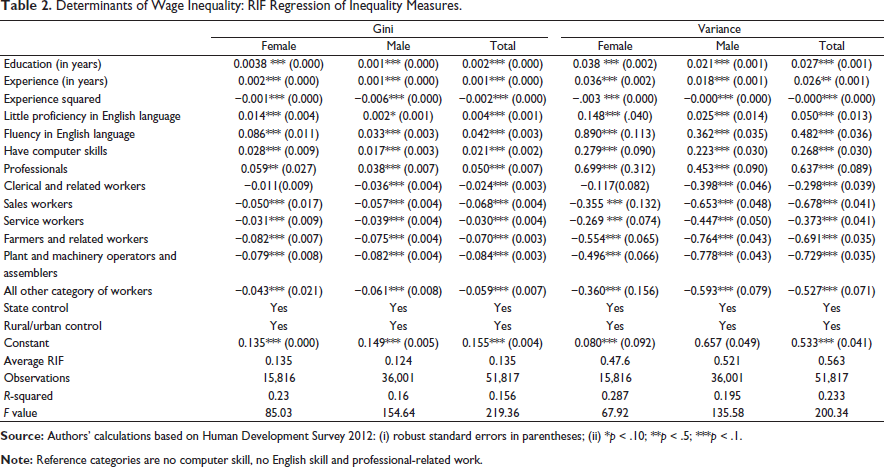
The results highlight the growing importance of English language proficiency and technical skills in India, perhaps due to government-led liberalization policies and the digital revolution. Considering the influence of human capital variables, including education, experience, English language proficiency and computer skills, it is evident that skill-related factors significantly contribute to wage inequality for both men and women in India. Labour markets pay great dividends for skills and abilities of the workers (Khatun & Saadat, 2021). Linguistic proficiency in English (Azam et al., 2013; Refeque & Azad, 2022) and computer skills (Borghans & Weel, 2004; Krueger, 1993) might have a significant impact on labour market earnings. Furthermore, the type of occupation also plays a role in creating wage inequality. Executive-related jobs increase wage inequality for both genders, but the effect is more pronounced for women. On the other hand, clerical occupations reduce wage inequality, particularly for men. Sales-related jobs have a negative impact on wage inequality, with a greater effect observed among men. Occupations such as service-related jobs, agriculture-related jobs, manufacturing-related jobs and agriculture-related jobs also exhibit a negative influence on wage inequality, suggesting a smaller wage distributional change in these occupations compared to professional allied occupations.
Estimated Results of Decomposition
The decomposition results are reported in Table 3, showcasing the gender gap in wage earnings at the mean. As anticipated, the FFL decomposition reveals a positive gender gap in wage earnings. However, the estimated decomposition results of the gender wage gap highlight contrasting effects: the coefficient effect is negative, while the wage structure effect is positive. The negative coefficient effect indicates that women may potentially receive higher wage returns for their human capital components, such as education, experience, English language skills and computer skills, compared to men. These factors play a role in reducing the gender wage gap in India. If women were compensated equally to men based on their qualifications and skills, while keeping other factors constant, the gender gap would reverse or even disappear. It is noteworthy that these factors contribute to a 9.37% reduction in the gender pay gap in India.
Estimated Gender Wage Gap and Its Decomposition.

The covariate effects on gender wage inequality reveal interesting patterns. Within the coefficient effect, covariates such as education, English language speaking skills, computer skills, executives, services and farm-related occupations have a negative impact. Conversely, within the composition effect, covariates such as experience and occupations, such as sales and production-related works, show a positive effect on gender wage inequality. Returns to education are found to be higher for women compared to men, contributing to a reduction in gender wage inequality. If women were compensated equally to men based on their educational attainment while keeping other factors constant, the gender gap for women would be reversed by 18.1% in India. Skill factors, such as fluent English skills, also play a role in reducing gender wage inequality, leading to a 4.9% decrease. However, the returns to having little fluent English skills do not significantly impact wage inequality. Additionally, computer skills contribute to a 6.12% reduction in gender wage inequality, emphasizing the importance of technological knowledge in labour market outcomes and the gender wage gap. Recent studies in the gender gap literature have highlighted the significance of various factors, including education, job experience, labour market characteristics, skills, tasks and skill matching of workers, in explaining gender wage inequality (Budig et al., 2021; Christl & Köppl-Turyna, 2020; Passaretta et al., 2023; Quadlin et al., 2023; Rita Pető & Balázs Reizer, 2021). Our study builds on this literature, particularly focusing on developing countries like India, by adding additional skills components such as English proficiency and computer skills to the gender gap analysis.
Furthermore, if women were paid the same as men in executive, service and farm-related occupations, it would reduce gender wage inequality. Conversely, certain occupations, such as sales and production-related work, are characterized by higher gender wage inequality (see Table 4). Specification error pertains to potential inaccuracies in the decomposition results resulting from the underlying model not fully encompassing the wage determination process. It accommodates unobserved or omitted variables that could impact the estimation. In this context, while a positive coefficient of specification error may emerge, its significance remains valid as our objective is to discern the contributions of human capital components in elucidating gender wage inequality in India.
RIF Oxaca–Blinder Extended Decomposition Results with Reweighting Method.

The estimation of FFL decomposition using the reweighting method helps obtain the wage structure effect in the ‘unexplained’ part of the decomposition of gender wage inequality. The positive wage structure effect suggests that women may be perceived as less qualified or skilled compared to men. In other words, if women possessed the same human capital as men while all other factors remained constant, the gender wage gap would increase by 14.95%. This indicates that less qualified and less skilled women are often employed in lower-paying jobs than men. Consequently, due to their limited educational attainment and skills, women find themselves in a more vulnerable position within the labour market. This situation exposes them to wage discrimination, as their qualifications and skills are undervalued compared to men.
In Table 4, the covariates associated with the wage structure effect point to a negative impact of education, experience and occupational choice on wage inequality. If women had equivalent educational qualifications to men, their gender pay gap would decrease by 5.6%. Furthermore, work experience reduces gender wage inequality by 17.51%. However, English-speaking skills do not significantly contribute to the wage structure component of gender wage inequality. Conversely, computer knowledge increases the gender pay gap in the country, resulting in a 3.25% increase if women have the same computer skills as men. Among various occupations, clerical roles display a notable and positive association with gender wage inequality in the country, indicating that women in these occupations face wage disparities compared to men.
The reweighting errors highlight the potential limitations in simulating counterfactual scenarios through adjustments to characteristic distributions, which could impact the precision of the decomposition results. Despite these errors, the analysis still provides meaningful insights into the role of various factors, including human capital components, in explaining gender wage inequality. The implication of this finding is that the government needs to prioritize increasing education and skills among women. Higher educational qualifications and improved skills would enable women to attain better returns in the labour market, even when their education and skills are equivalent to those of men. Therefore, by enhancing education and skills, India can move towards reducing the gender pay gap.
Concluding Remarks
In this paper, we use household data to examine the gender wage gap in the Indian labour market. Using the RIF regression and FFL decomposition techniques, we identify several factors influencing wage inequality between men and women in India. The results of the RIF regression analysis show that education, work experience, cognitive skills and technical skills significantly contributed to wage inequality. Notably, education plays a crucial role in shaping wage disparities, with a stronger impact observed for women. Our results also highlight the influence of English language proficiency and computer knowledge on wage inequality, indicating a need for attention in these areas. Moreover, the type of occupation was found to be a contributing factor to wage inequality. Executive-related jobs were associated with increased wage inequality, particularly affecting women.
The FFL decomposition results further emphasize the role of human capital components in gender wage inequality. While the coefficient effect indicates that women may receive higher wage returns for their qualifications and skills compared to men, the wage structure effect reveals a concerning trend. The positive wage structure effect suggests that women may be perceived as less qualified or skilled than men, leading to their employment in lower-paying jobs. These findings highlight women’s vulnerability in the labour market and the presence of wage discrimination based on their qualifications and skills.
Our results, therefore, indicate that increasing education and skills among women is crucial to address the gender pay gap in India. The Indian government could consider policies aimed at enhancing women’s education and technical skills, such as expanding access to quality education, providing vocational training programmes and promoting STEM education for women. Enhancing educational qualifications, improving technical skills and providing equal opportunities in occupational choice can lead to better labour market outcomes for women. By implementing policies and initiatives aimed at narrowing the gender gap in education and skills, India can effectively reduce gender wage inequality. Enhancing women’s education and technical skills can have other advantages such as an increase in economic growth and lower economic inequality, sometimes through a lower gender inequality (Cuberes & Teignier, 2014; Hassan & Cooray, 2015; Nelson & Goel, 2023). Additionally, promoting occupational diversification and eliminating occupational segregation might be useful in reducing women’s concentration in lower-paying occupations.
Footnotes
Availability of Data and Material
The data used in the study are available on request.
Declaration of Conflicting Interests
The authors declared no potential conflicts of interest with respect to the research, authorship and/or publication of this article.
Funding
The author received no financial support for the research, authorship and/or publication of this article.
