




Abstract
Rather than looking at coalition formation as a single-shot game, this article attempts a more dynamic analysis by exploring the interactive processes between different experiments over time. Comparing coalition experiments since 1996, it finds that there is an inbuilt tension in the nature of the coalition formations in India. India’s federalized party system created a distinctive coalition formation pattern in which territory played a significant part. Its coalitions primarily involved the coming together of two types of parties, polity-wide and single-state parties. The organizational logic of the two categories of parties is different and consequently the incentives that drive them vary. While their coming together in a coalition does help fulfil some ‘mutual needs’ there is also an element of competition about issues including how much and whose needs are being fulfilled. While polity-wide parties would prefer to govern alone or have a system in which the role of the coalitionable is negligible, this article argues that the combined effect of both federalization of the party system and an institutionalization of a coalitional system has decreased the possibility of single-party governments in the short run. The article also notes that incongruent majorities in the two houses, the need to get policy passed and the changing composition of the Rajya Sabha during the tenure of the Lok Sabha will encourage the formation of large coalitions and/or surplus coalitions.
Keywords
From standing isolated, unable to attract new support partners after the 11th General Elections to forming a surplus majority coalition government in May 2014, the Bharatiya Janata Party (BJP) has travelled a long way. So also has the politics of coalitions. Six successive coalitions after the scrappy experiment of 1996, the BJP is now an adept coalition-maker. Through this period, short-lived unstable multiparty governments have given way to coalition governments that have not only completed their term but have also been re-elected. Seven successive elections prior to this election did not produce any clear winners and governments were products of bargains between political parties before, during and after the elections. The BJP, in May 2014, became the first party in 30 years to have a majority of its own in the Lok Sabha. Yet, it has chosen to lead a coalition rather than go it alone. Why?
While polity-wide parties may still fancy single-party governments, that urge has been tempered by two distinctive features of the post-Congress polity (Palshikar, Suri & Yadav, 2014). This article argues that the combined effect of both federalization of the party system and an institutionalization of a coalitional system has decreased the possibility of single-party governments in the short run. The concept of federalization of the party system was first expounded by Arora (2000) based on his study of the three elections in the 1990s which inaugurated the coalition era to show how territorialization of parties had a distinctive impact on coalition formation. I argue that while the broad contours of federalization remain intact, the internal positioning of the components has undergone a distinctive shift, further reinforcing the possibility of coalitions.
At a second level, there has also been an institutionalization of a coalition system. The way parties work and interact with each other, their preferences, perceptions and the general discourse both during elections and otherwise, as well how they evaluate alternatives, their expectations and of course their strategies are all based on the broad understanding that no party is likely to command a majority on its own in parliament and would require the support of others. The understanding and internalization of the working of a competitive and federalized party system as well as an awareness of ‘how things work here’ has led to the politics of coalitions itself becoming normalized.
While federalization of the party system and institutionalization of a coalitional system will make coalitions stay, the structure of the coalitional system depends on the games within a coalition. The internal rearrangement of the federalized party system has sharpened the lines of conflict, between the coalition-makers and the coalitionable. The organizational logic of the two main categories of parties, the polity-wide who also happen to be the coalition-makers and single-state parties, who form the pool of coalitionable, is different and consequently the incentives that drive them vary. While their coming together in a coalition does help fulfil some ‘mutual needs’, there is also an element of competition about issues including how much and whose needs are being fulfilled. This means that the internal dynamics of coalitions must also be examined to comprehend the trajectory of coalition politics.
This article is structured as follows. The first section attempts to draw a framework to make sense of the institutionalization of a coalition system in India. In the second section, I map the federalization of party system focusing on specific features which reinforce the continuation of a coalitional system. The subsequent section presents a dynamic perspective of coalitions examining interactions between different coalition experiments since 1996. It finds that while coalitions have been taken for granted there is a tussle to shape the coalitional system to the needs of the main actors, the polity-wide and single-state parties. The final section summarizes and concludes.
Analytical Framework
I draw insights from three distinctive strands of literature including, the ‘nested-game’ framework, dynamic theory of coalitions as well as institutional change through layering to make sense of the trajectory of coalition politics in India. Most studies of coalitions tend to focus only on the co-operative dimension of the coming-together of political parties. However, mutual interests between parties alone do not give us the complete picture as any coalition is always characterized by both ‘cooperative and competitive tensions’ between partners (Tsebelis, 1988a). The ‘nested-game’ framework is a useful tool to explain this intra-coalition dynamics (Tsebelis, 1988b). Here essentially political parties are viewed as engaging in contradictory interactions in different arenas simultaneously. On one hand, there is the obvious inter-coalition/front competition. On the other hand, there is also an intra-coalition competition between the partners which is ‘nested’ within the larger inter-coalition competition. After all, interests of parties in a coalition are unlikely to be perfectly congruent.
This framework brings to the forefront both the choices that parties make as well as constraints that they have when operating in multiple arenas. My concern here is not about routine or particular differences between parties, but to draw attention to structural factors which cause tensions. Besides structural factors, there could be issue differences as well, which however is not considered here.
The second issue that this study flags is that no coalition formation ever begins on a clean slate. The past bears on the present of political parties. It may therefore be useful to look at the coalition experiments from a dynamic perspective linking experiences of different formations. This means the immediate electoral dimension alone might not have sufficient explanatory power. Therefore, rather than looking at the current National Democratic Alliance-II (NDA) government that formed in May 2014 as a stand-alone coalition formation, it may be useful to explore interactions with previous experiments.
In one of the early studies that introduced a dynamic element, Laver (1974) found, a party is more likely to be favourable to a particular coalition, alliance, linkage or relationship with a party from which it had benefitted in the past rather than towards one in which it had an unhappy experience. It follows that it is unlikely that parties who have been unreliable, have threatened or blackmailed or have generally been uncooperative will be accepted in future coalition arrangements as a first choice of partners, whereas, parties who have made constructive contributions may be treated as reliable partners. More recent studies have dealt with more varieties of linkages. 1
We also know that all parties constantly attempt to better their prospects, whether it is in terms of policy, office or votes (Müller & Strøm, 1999). If we agree that past experiences of successes and failures will influence future projections and moves, then it follows that parties are likely to attempt to maintain the status quo when it suits their advantage and subvert or overturn arrangements when they are at a disadvantage. Druckman (2008) notes that for ‘an approach to be genuinely dynamic, there must be some incorporation of the past and/or the future’. This perspective which moves beyond examining coalition formations as one-shot games and examining interactions between different experiments may not only enhance our understanding coalition politics but is also better equipped to capture the on-going tug of war within a coalition.
The two points made above are that there will be competition within a coalition and connections between past, present and future coalition experiments. This means that any institutionalized system is always a work in progress. While routines and mechanisms at one level provide solutions, at the same time in their very structuring they also selectively favour some actors and disadvantage others. Consequently, there will be attempts to tweak the existing system by some to increase or at least maintain the status quo and by others to overturn their disadvantages. Since the incentives that drive polity-wide and single-state parties vary, they prefer different coalitional designs. However, given the interdependence large-scale design changes are ruled out, yet this does not prevent subtle changes.
The concept of change through ‘layering’ (Streeck & Thelen, 2005) best captures the changing nature of the coalitional system. In the process of change through layering, old practices are not entirely neglected but new practices are introduced on top of or alongside the old. Theories of institutional change tell us that layering often takes place when those who want to change the existing pattern of interaction, lack the capacity to bring about the change. Consequently, they simply add new practices. At the same time, those who prefer the existing system can only preserve existing practices but are not powerful enough to prevent the introduction of new practices (Mahoney & Thelen, 2010, p. 17). This process of incremental change does not necessarily undermine the old practices, but they take the game in a different direction over time. Layering gives us some broad indictors to make sense of the trajectory of coalition politics.
Federalization of the Party System
The three quick successive elections of 1996, 1998 and 1999 were a turning point in the nature and pattern of government formation in India (see Table 1). The fact that governments that formed after the 1996 and 1998 elections did not complete their terms but constantly threatened to both self-destruct as well be shaken by exogenous factors led to questions as whether the incessant proliferation and/or ‘fragmentation’ of parties had begun to have ‘destabilizing’ effects (Frankel, 2000, p. 12). The popular consensus was that multi-party governments were undesirable as they were unstable and non-durable and it was also assumed that they were constantly embroiled in intrigue and unwelcome machination.
Multi-party Governments in India: 1996–2014

In this study a change in prime minister is considered to be a change in government.
Asking the question why rather than how many, Arora (2003) attempted to make sense of the messy picture and also explain the direction of the post-Congress party system. Using the concept of federalization, he argued that aggregate national election results do not reflect significant territorial variations in party support. Underlying this conceptualization is the idea of federalism as a principle of political organization also structures the organization of political parties. This organizational principle with territorially based governments allows political parties to concentrate on specific regions without having to spread themselves across the polity. It is this federal incentive that allows parties to concentrate in limited zones and yet be federally competitive that has encouraged a proliferation of political parties. As the configuration of parties varies from state to state, the numbers and the diversity of parties getting represented at the national level increased.
From the point of view of comparative politics, federalization is the opposite of the concept of nationalization (Caramani, 2004) which has often been used to explain the changes in European party systems. While nationalization captures the breaking down of the local and territorial dimensions and the homogenization of voting behaviour, federalization explains the heterogeneity and increasing distinctiveness of territorially based party systems. It highlights the fact that multiple (sub-national) party systems could coexist alongside a national party system.
Using the dimension of spread and concentration, Arora (2003) then made a distinction between three different types of parties, polity-wide, multi-state and single-state parties. This three-fold classification subsequently formed the basis for explaining coalition formation in India. While polity-wide and multi-state parties could become coalition-makers, the single-state parties formed the pool of coalitionable. This framework was subsequently revisited to include coalition formation in the subsequent elections of 2004 and 2009. Two criteria, based on election participation and results in both the Lok Sabha and legislative assemblies between 1996 and 2009 were used to identify polity-wide parties. First, polity-wide parties contest in at least two-thirds of the states. Second, they also win seats, even if it is only one in two-thirds of the states (Arora & Kailash, 2012). Parties that contest across states but fall short of this qualifying criterion are multi-state parties, whereas parties which contest in two or less than two states are single-state parties. The multi-state parties have been designated as national parties by the Election Commission (EC). Arora’s classification makes a distinction within the category of parties designated as national by the EC.
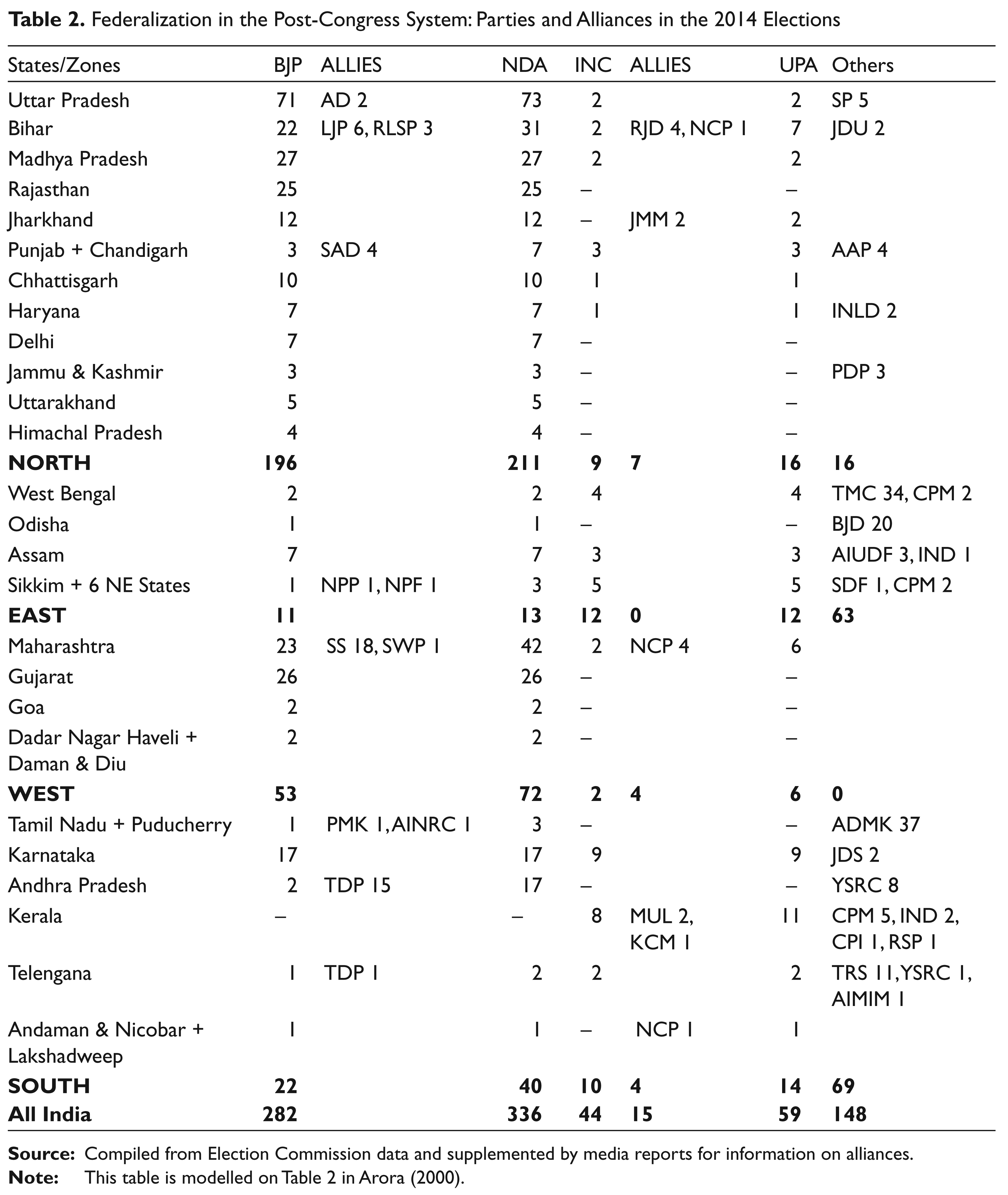
As can be seen in Table 2, the federalization pattern continued in the 2014 elections as well. Though the two polity-wide parties are the only parties that have been returned from across the zones, they too have zones of strength and weakness. For instance, the BJP may have obtained a majority of its own, but a high proportion of its seats come from the north and the west. Here it won 80 and 68 percent respectively of the seats on offer. The poor show by the BJP in the north and the west in the past had weakened its coalition-maker status. This variation in zonal strengths is likely to keep the polity-wide parties interested in the coalition game.
At the same time it can be seen in Figure 1, the trend in the change of the internal composition of the federalized party system has been sharpened. Since the inauguration of the coalition era, there has been a gradual diminishing of and the disappearance of multi-state parties. This disappearance has been matched by the increasing strength of single-state parties over the same period. Today, multi-state parties command less than 6 per cent of the vote share compared to a respectable 22 per cent in 1996. In sharp contrast, the category of single-state parties (and independents) obtained 44 per cent of the votes, which is much more than any of the polity-wide parties. It must also be mentioned that since 1999 every third Member of Parliament is a member of a single-state party.
Federalization in the Post-Congress System: Parties and Alliances in the 2014 Elections
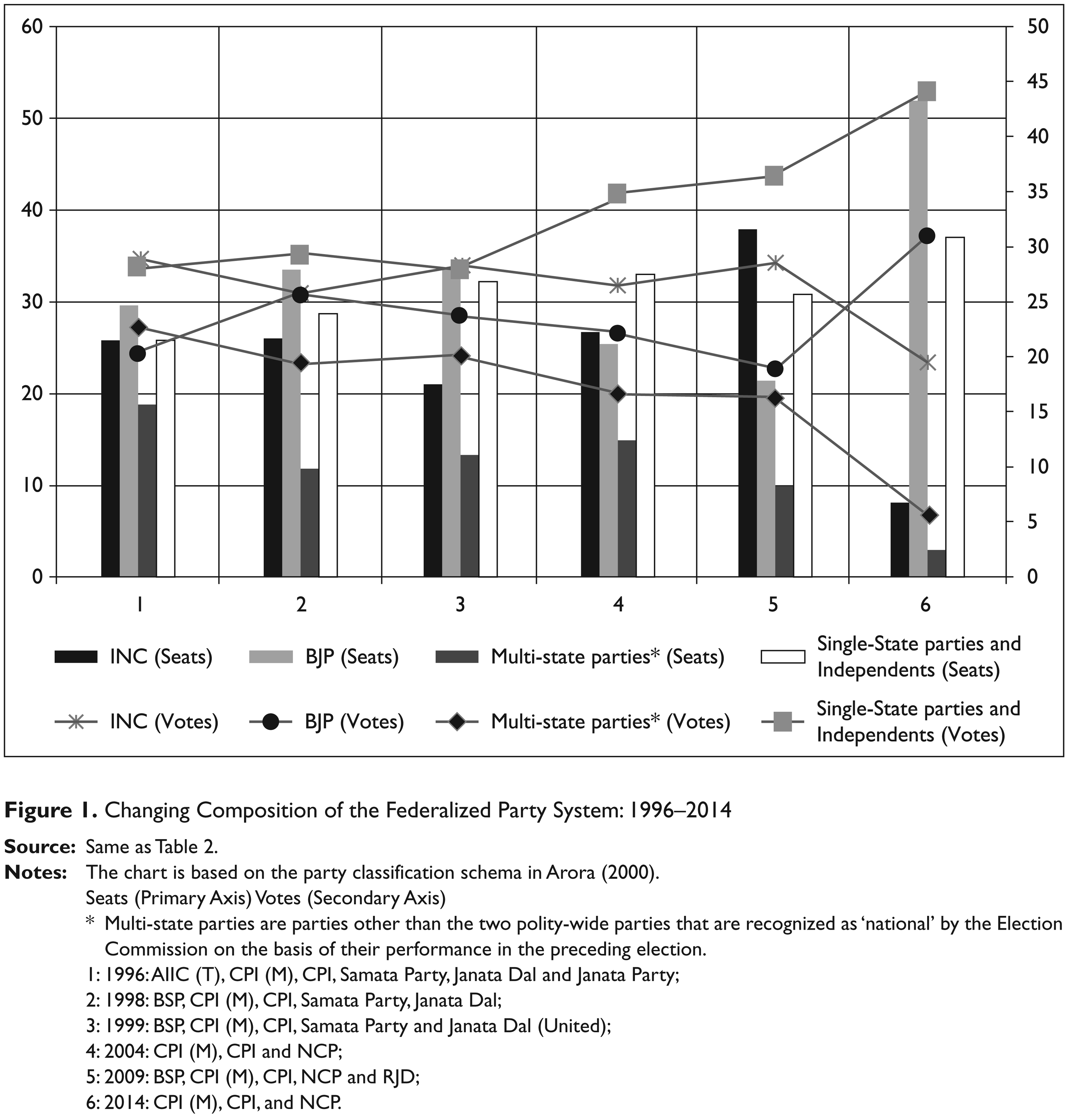
Multi-state parties were the early coalition-makers and their strength opened space for the so-called third fronts. It was the spread factor which allowed the Janata Dal (JD) to act as a coalition-maker, to be the node around which numerous single-state parties could come together. However, it is not that the parties themselves have been eliminated. Most of them have, over time, lost their multi-state characteristic and have been reduced to single-state parties. It was the ‘multi-stateness’ that allowed them to act as coalition-makers. Today’s nodes, the BJP and the Congress have followed the same JD model. Unlike the JD, the BJP and the Congress have gone about constructing alliances in a more systematic and organized way.
For single-state parties, despite their limited reach, alliances are a selling point in Lok Sabha elections. Alliances helped overcome the perception that state-based parties had a limited reach and therefore were only effective at the state level and thus counter the supposed advantage of voting a polity-wide or a national party. This strengthening of single-state parties at the cost of both multi-state and polity-wide parties is again a sure sign that government formation will continue to be dependent on alliances and coalitions.
To understand why single-state parties are keen to play a role at the federal level, it is important to note that there is a huge power differential between the centre and states. All institutional frameworks bear the scars of their birth, they ‘embed historical experiences into rules, and routines, and forms that persist beyond the historical moment and condition’ (March and Olsen, 1989, pp. 167–168). The circumstances, when the Constitution was framed, pushed India into adopting a strong-centre model of federalism (Austin, 1999). The political, economic and administrative powers of the central government make it extremely powerful (Chhibber, 1999, pp. 29–32). The states are not only dependent on the centre in many ways but are also constrained even in their own sphere.
Besides the power differential, which is probably inherent in any centre–state relationship, the structuring of the decisional process also matters. 2 States have very little space and opportunity to contribute to decision making at the national level. This is ironic especially since policy is implemented at the state level. The primary reason for this decision making differential is because in parliamentary federations, the parliamentary element dominates the federal dimension since federal principles were grafted on to the parliamentary model (Verney, 1995). Consequently, the principles that animate federalism sit uneasily with those of (majoritarian) parliamentary systems and are therefore not fully operational.
It is therefore not surprising that the territorial chamber, the Rajya Sabha which could have given the states some space, has also not been designed to be an effective representative of states. Furthermore, parties too have often used the Rajya Sabha to reward/punish members and have not allowed it to function as a federal device. Consequently, Rajya Sabha members have often owe primary allegiance to the party, rather than the state they represent. 3 At the same time, other institutions like the National Development Council, Inter-state council as well as ad hoc mechanisms like chief ministers conferences have functioned federally only to the extent that the ruling party/combine at the centre has allowed them.
At the same time, the initial practice of centre–state relations, greatly influenced by the one-party dominant system also strengthened the dominant centre model. When the Congress was challenged at the state level (1967–1989) it took a confrontationist stand against its challengers. The adversarial government–opposition relations, characteristic of a majoritarian parliamentary systems politicized centre–state relations. Centre–state relations soon inadvertently acted like glue for non-Congress parties to come together (Aruna, 2001; Austin, 1999). The main demands of the non-Congress parties who were in power at the state level during this period included, a greater say in decision making at the national level for states, lesser interference by the centre in state activities and greater financial resources to the states. However, there was no consensus to change the existing equations in centre–state relations. The Sarkaria Commission, which was set up to examine these demands among other things, did not recommend any overhaul but only suggested ways in which the centre and the states could work together in a more harmonious way within the existing framework.
The status quo on centre–state relations enhanced the incentive for single-state parties to increase their influence at the federal level, if only to ensure (or not ensure) smooth running of the government at the state level. It is therefore not surprising that since the 1990s single-state parties have attempted to increase their numbers in the Lok Sabha. New seat-sharing agreements were drawn up in which the single-state parties yielded lower number of seats to the polity-wide parties when in alliance as compared to the past. In the past, single-state parties had allowed polity-wide parties to contest a larger number in the Lok Sabha elections while reversing the formula for assembly elections. Now, the single-state parties wanted a greater share of the Lok Sabha seats as well. With no clear winners in elections, the bargaining power of single-state parties increased. In a centralized federal system, with governments dependent on support, single-state parties found a niche opportunity to shape centre–state relations.
This federalized pattern of party competition combined with the incentives of the first-past-the-post system of electoral laws encourages the coming together of polity-wide and single-state parties depending of course on state-specific competition patterns (Sridharan, 2004). For polity-wide parties, it is an opportunity to fill territorial gaps, whereas for single-state parties it is a chance to be heard at the centre. Yet, despite this mutual need, there is a degree of competition between partners, which essentially revolves around issues of control.
The greater the support the coalition-maker needs, the more vulnerable are they to the demands of supporters. The incentive for the coalitionable pool, now primarily composed of single-state parties is therefore to have weak coalition-makers. Despite the enormous differences within the coalitionable pool, the singular point of commonality among them is likely to be the prevention of the spread of polity-wide parties. On the contrary, coalition makers would prefer to govern alone in the first instance and if that is not possible then have an arrangement in which the role of the coalitionable is minimal. This tussle for control of the coalition between the two categories of parties will shape the nature of the coalitional system.
Towards a Coalitional System
The uncertainty of the competitive multi-party system has encouraged the emergence of a distinctive set of interaction routines between political parties. The repeated use of particular routines brought greater stability as well as predictability in inter-party relationships. Over time this has also helped institutionalize a coalition system. I understand institutionalization to mean two things. First, I believe it denotes ‘regularisation of patterns of social interaction’ (O’ Donnell, 1994, p. 57). At the same time, it is also a process, through which these patterns consolidate and achieve some degree of stability.
The coalitional system is characterized by a regularized pattern of interaction involving a mosaic of routines that range from simple seat adjustments and more formal seat-sharing arrangements to building fronts and alliances; they also include common programmes, arrangements for office sharing and policy compromises, synchronized behaviour, views and stands in parliament debates and votes, complex coordination and dispute resolution mechanisms and so on. These routines are not restricted to the period of elections alone, though it is during elections that their visibility increases.
Besides the visible knowledge of the mechanical effects of vote pooling there is also a not-so-visible substantial dimension, the knowledge of ‘how things work’. Parties have clear expectations from particular routines and also the knowledge of rewards of following particular actions as well as of punishments and negative sanctions arising from non-observance or deviance.
In an institutionalized coalition system, different parties know about each other and how they would act or behave; though this information may often be incomplete. There is also awareness of the strengths and weaknesses of other parties in terms of their support bases and areas of operation. Parties are also aware of the outcomes, in terms of advantages and disadvantages of using or not using particular routines. All this leads to a stable pattern of cooperation and competition, indicating that parties expect the interaction to continue into the future on the same lines.
The Eleventh Lok Sabha laid the foundations for a coalitional system in India. Many of the routines and practices of interaction between political parties can be traced to this period. The 1996 election was among the most competitive elections until then as more than 50 per cent of the constituencies were won with margins of less than 10 per cent (Kailash, 2014). In these elections there were no large alliances but only seat-adjustments between parties. The BJP, by virtue of having won the highest number of seats in the Lok Sabha, was first invited to form the government. However, since it was not able to get any support beyond its electoral partners, the prime minister resigned, once it was clear that the government did not have the numbers. This short experiment of less than a fortnight was a learning experience, not simply for the BJP but also for others.
The pre-1996 bargaining environment was a constrained one. The choice was between either the Congress party or a coalition that consisted of almost all the non-Congress parties. When elections were held in 1998 after the fall of the United Front (UF)-II government, the BJP attempted to redraw the contours of the party system. First, it pushed aside three contentious issues which had made it an untouchable, which included the construction of a Ram Temple in Ayodhya, abrogation of Article 370 which gave special status to Jammu and Kashmir and enactment of a Uniform Civil Code. Second, the party took a more pragmatic stand on coalitions and made it clear that it was willing to enter into alliances, especially in states where it had a weak or negligible presence. This changed stance dramatically transformed the party system and created what Arora (2003) called a bi-nodal system.
The germs of this softening and strategy can be traced to the closing speech of the prime minister during the vote of confidence in 1996, when he acknowledged his party’s weakness in terms of spatial spread and recognized the aspirations of the state-based parties and the need to take care of the interests of the states. 4 The party, in 1998, successfully tapped into the double disadvantage sentiment that single-state parties faced. On one hand, to be more effective at the state level, they needed to cooperate with the central government. However, the adversarial government–opposition relations made it difficult for the parties to even contemplate cooperation. On the other hand, on their own, with their numbers they could hardly influence decision making at the national level. Their alliance with the BJP allowed these state-based parties to overcome this double disadvantage.
By the time of the next election in 1999, the BJP formalized this arrangement by creating the National Democratic Alliance (NDA).The front itself had its own common programme called the National Agenda for Governance, which supposedly covered the interests of all its partners. This ‘bridging alliance’ strategy was an attempt by the BJP to overcome many deficiencies that led to the fall of the government in 1996 (Sridharan, 2005). It enabled the BJP to spread out, increase its own numbers, create a pool of supporters and, importantly, check the Congress, the other main polity-wide party. Arrangements which allow state-based parties greater say at the national level have since then become the main coalition-enabling component of India’s coalitional system.
The same logic of alliances held good in the 2004 elections as well. By this time alliances and coalitions had become normalized and were an integral part of the calculations of all parties. The Congress too had changed strategy; having taken a critical stand against coalitions in 1998 it adopted a more pragmatic stand in 2003.The Congress strategy was similar to that of the other coalition-maker, the BJP. In 2004, for the first time, there were two distinctive all-India coalition fronts, the Congress-led United Progressive Alliance (UPA) and the BJP-led NDA, both with their own common programmes. The alliances were state-specific and exploited the differential competition patterns in each state.
Before we go further, we need to note the emergence of another coalitional routine. The 1996 UF governments that formed after the fall of the BJP government brought a new dimension to coalition politics. They recognized that conflict was an integral element of any coalition, which needed to be managed. Importantly, they identified two potential levels of conflict, one, between the formal coalition partners and the other between the coalition and the external supporters. The UF put in place appropriate coordination mechanisms at both levels to bring greater coherence and also to take care of differences and disputes. The NDA government which followed further brought coordination mechanisms to the governmental level by introducing the Group of Ministers (GoM) mechanism. The NDA also took coordination mechanisms to the state level. The UPA-I government stepped up the existing coordination machinery by creating even more specialized bodies and also by having a more regular dialogue between the partners as well as the external supporters (Kailash, 2007). Coordination routines have since become a key part of the coalitional system.
The parties with the highest stakes in a coalitional system are the single-state parties. The polity-wide parties are in the coalition game simply to cover their territorial weaknesses and would prefer to govern without sharing power whenever the opportunity arises. To continue as coalition-makers, they would constantly attempt to cover more territory and increase their strength, which would also reduce the influence of single-state parties. The greater the numbers polity-wide parties win, the lower their interest in sharing power. However, for single-state parties, coalitions are the only game in town. Given the limited seats they contest, each one of them is aware they cannot form a government at the national level and they need to be in an alliance to have a say in national level decision making. Single-state parties will have to keep polity-wide parties tied down and dependent on them to ensure power sharing.
When coalitions began in a big way in 1996, the polity-wide parties needed the coalitionable much more and consequently the latter called the shots. For instance, the Congress supported the UF simply to prevent the BJP from cashing in. Similarly the pragmatic stand towards coalitions by the BJP first in 1998 and the Congress in 2004 was to prevent the other from gaining through alliances. If the polity-wide parties were at the receiving end of the coalitional system since 1996, things changed in 2009.
By 2009, it was almost taken for granted that single-party majorities would be difficult. This taken-for-granted feeling that a coalition government would form opened space for post-electoral negotiation and bargaining. Though seat sharing talks in fact began much before the announcement of elections, the discussions were more contentious, despite the existence of rival fronts. There were hard bargains between parties about both the number of seats as well the constituencies itself. Incomplete agreements did not seem to matter as parties appeared to anticipate further bargains after elections. Consequently, post-electoral negotiation now gets ‘layered’ on to the existing pre-electoral calculations. Post-electoral bargains always existed, but now it was accepted as ‘normal’ and became a part of the repertoire of coalition routines.
The Congress, in 2009, attempted to side-step a whole lot of first-generation coalition practices. It did not overtly disband them, but brought newer practices which ran parallel to the existing routines. First, it did not attempt to create an all-India front; rather it went for limited state-specific alliances and attempted to contest as many seats as possible. The idea that the polity-wide partner would be accommodative and play junior partner if required was set aside. At the same time, the state-based parties too did not want to give much away and attempted to tie the Congress down. Furthermore, the new delimitation proposals implemented before the elections also opened space for redrawing seat-sharing arrangements (Kailash, 2009). The other polity-wide party, the BJP also took almost the same path. The NDA had shrunk and a new third front (comprising of single-state and multi-state parties) also came up. Almost all parties and fronts now spoke of post-electoral discussions.
Post-electoral negotiations appear to be a win–win situation for all, but it particularly suits polity-wide parties for three reasons. First, it allows the coalition-maker to attempt to win as many seats as possible. Second, there is a wider pool of coalitionable parties to negotiate with without having to make any specific commitments. Finally, post-electoral negotiations potentially also reduce the number of partners who will have to be paid off.
This new layer of post-electoral negotiations was clearly a result of past experiences. Given the short-run of early coalitions it was assumed that electoral alliances were important. However, indiscriminate alliances with an eye on winning votes of confidence had created large alliances in terms of the number of partners, but they did not necessarily give them the numbers in terms of seats. Yet, when the government was formed, it was expected that all of them would have to be satisfied, irrespective of their contribution. What made the situation slightly more complicated was that in some states, many single-state parties joined together to create a bloc to increase their bargaining power vis-à-vis the coalition-maker.
In Tamil Nadu for instance, in 1998, the AIADMK brought together the PMK, MDMK, TRC and the Janata Party on a common front with the BJP. This alliance succeeded in winning all the seats in the state. All of them, barring the MDMK which chose to stay out of government had to be accommodated in the ministry. The BJP only just about managed to block the Janata Party’s claim and had to subsequently face the consequences. 5 The same pattern followed in 1999, when almost the same set of parties came together now along with the DMK to join the NDA. One of the parties, the PMK actually left the government as well as alliance midway in 2001 to join hands with the AIADMK to fight the assembly elections. The party returned to the government subsequently in 2002.The coalition-maker did not have much of a choice, given the then Lok Sabha composition.
Furthermore, the two coalition-makers, the BJP (1998–2004) and the Congress (2004–2009) had to also give up critical portfolios to satisfy the demands of allies. At the same time, it was an unwritten rule that parties selected their representatives to the cabinet and the prime minister often had little choice as to who came in and who went out.
While personality idiosyncrasies may not be useful in predicting future coalitional behaviour, past party actions does appear to count. For instance, the AIADMK’s antics in the 1998–1999 coalition ensured that it was not going to be a preferred partner. In 2010 when the DMK minister was indicted in the 2G spectrum allocation controversy, the AIADMK was quick to offer support, but the Congress ignored the offer. 6 The Congress had already got the wrong end of the stick when it tied up with the AIADMK to bring down the BJP led coalition in 1998.
The 2009 election results changed the distribution of power between the coalition-maker and the coalitionable. With its own increased numbers and lower number of pre-electoral allies, the coalition-maker called the shots and only the pre-electoral allies were accommodated in the ministry. Long-standing allies, like the RJD who had tried to trip the Congress by refusing to increase its seat share before the election were ignored post-elections, despite their support. Given the positioning of parties in the coalition system, the Congress knew the RJD had limited options and would have to bear the ‘punishment’. Similarly, unlike in the past, the coalition-maker allowed unsatisfied allies to exit rather than bend over backwards to retain them. In the UPA-II coalition, the AITC and DMK left and the coalition-maker did little to hold them back. The Congress had shown the same attitude in 2009, when it refused to go with the Left on the nuclear deal. All this was possible only because of an institutionalized coalition system. In an institutionalized set-up, actors have distinctive identities, roles, parts as well as ‘activity scripts for such identities’ (Jepperson, 1991, p. 147) and deviations from these fixed parts and paths usually invite censure.
With its increased strength, the Congress in the UPA-II further attempted to tune the system to its advantage. In the UPA-I, the various mechanisms for coordination had left the Congress with very little room to manoeuvre. In the UPA-II, the coalition-maker began to act unilaterally much to the discomfort of its allies. It refused to carry its allies along on a whole range of issues including, the Lokpal Bill, railway budget, National Counter Terrorism Centre, Central Sales Tax compensation, Teesta river water-sharing and foreign direct investment in retail, among others. It almost made the allies feel unwanted.
The coordination mechanisms were used, but only sparingly and over time probably only annually in the month of May when the UPA released what it called its report card to the people. The fanfare of coordination as in the UPA-I was clearly missing. The Congress was obviously attempting to break the shackles, without debunking the old system. It did not set aside coordination mechanisms; instead it invested them with a lot of symbolic importance and then simply ignored them. The absence of working coordination mechanisms not only gave the Congress a free hand but also prevented allies from coming together to corner the coalition-maker.
The 2014 elections were, in many ways, a continuation of 2009. The distinguishing feature of this election was that throughout the campaign, almost everyone had one eye on the post-electoral scenario. The Congress’s introduction of ‘post-electoral’ calculations had now become an integral part of the repertoire of coalition routines. Both polity-wide parties attempted to contest as many seats as possible, went in for calculated alliances and left a lot of space for post-electoral negotiations.
The BJP had, by now, learnt the importance of building an efficient coalition and its preparations began early with an intense focus on its own areas of strength. Besides its traditional partners, the party had a string of calculated alliances across the country. Unlike in the past, it was conscious not to increase the number of allies, yet it ended up with around 20-odd partners. However, a more careful look at these partners will reveal that while it refused to concede space in its areas of strength, it was stingy in areas where it had moderate influence and extremely liberal in areas of weakness. For instance, in Tamil Nadu alone the party had five allies. Similarly, it also tied up with a bunch of parties in the north-east. In the zones of weakness, the party preferred to ally with the second-rung parties rather than playing junior partner to the dominant state parties.
With a coalition system taken for granted, the single-state parties too now integrated post-electoral calculations into their strategy. In Tamil Nadu, Odisha and West Bengal, with the party system in their states ceasing to be competitive the AIADMK, BJD and the AITC refused alliances and went alone. Alliances had played a key role in these states in the past. It also appears that there was some tacit understanding between these three parties, the AITC for instance withdrew its candidate in Tamil Nadu and also spoke of a ‘federal front’. 7 In a coalitional system, they obviously believed they had better bargaining power as a bloc.
Today the coalition-maker is in complete control. While the BJP has included allies in the government, unlike in the past, not everyone has found a seat. Similarly, allies who sulked at not getting the right department or importance were also not consoled. More importantly, allies who could potentially take contrarian positions were kept out of key decision-making bodies like the Cabinet Committee on Economic Affairs (CCEA). 8 Further consolidating its position, other mechanisms which gave allies a space in decision–making, like the GoM mechanism have been disbanded.
Finally, why does the BJP head a surplus majority coalition despite having a majority of its own? While federalization and institutionalization of a coalitional system answers our question partially, it is also important to account for the institutional architecture of India’s parliamentary system. Insights from studies on the impact of bicameralism on coalitions show that political parties in parliamentary systems anticipate potential bicameral deadlocks when forming government coalitions (Druckman & Thies, 2002; Druckman et al., 2005). Governments may not need to win confidence votes in the upper house but, nevertheless, have to get policy through. Since the inauguration of the coalition era, there have always been incongruent majorities in the two houses. In this situation a party whose support may be redundant in the Lok Sabha may be crucial in the other house. Surplus coalitions therefore help take care of votes in the Rajya Sabha.
More importantly, studies have also shown that governments need to take care of ‘uncertainty’ in the upper house which could affect agenda-setting. Fortunato et al. (2013) found that the changing composition of the upper house during the life of the lower house will impact the legislative process if the distribution of policy preferences changes. In India, with one-third of the members of the Rajya Sabha retiring every second year and with different electoral calendars and party compositions in the legislatures across states, the composition will definitely vary across time. To govern effectively, coalition-makers will have to take care of the requirements of the Rajya Sabha as well. This may explain why India’s coalitions have been among the ‘world’s largest’ (Sridharan, 2012). Surplus coalitions and coalitions with a large number of parties basically recognize the potential change in the composition of the Rajya Sabha.
Summary and Conclusion
The emergence of a competitive multi-party system has made government formation and maintenance highly dependent on the interaction and bargains between political parties. From unstable and/or short lived arrangements, alliances and coalition politics have travelled a long way. The degree of alarmism that greeted coalitions in India has proved to be excessive. The early prognosis that coalitions in India would be ‘unstable and short-lived’, were unlikely to overcome shortcoming with experience and learn to work together and that instability could be mitigated (only) in particular types of coalitions’ (Sridharan, 1999, pp. 271–272) has not held. A dynamic perspective has shown that there has been a continuous learning process leading to the institutionalization of a coalitional system.
This study also found that incongruent majorities in the two houses, the need to get policy passed and the changing composition of the Rajya Sabha during the tenure of the Lok Sabha has encouraged the formation of large coalitions and/or surplus coalitions.
India’s federalized party system created a distinctive coalition formation pattern in which geography and territory played a significant part. Consequently, India’s coalitions primarily involved the coming together of two types of parties, polity-wide and single-state parties. While polity-wide parties contested and won across the country, single-state parties were basically confined to a particular state. Given the strong-centre framework, coalitions became the key mechanism through which single-state parties could have say in national level decision-making. At the same time for polity-wide parties, coalitions helped plug territorial gaps and also increase support in terms of numbers in parliament. While on one hand, the interests of the two types of parties matched, on the other hand, there is also a tussle for the steering wheel.
Rather than looking at coalition formation as a single-shot game, this article attempts a more dynamic analysis by exploring the interactive processes between different experiments over time. Comparing coalition experiments since 1996, it finds that there is an inbuilt tension in the nature of the coalition formations in India. This study found that while single-state parties are likely to act as defenders of the coalitional system, polity-wide parties would prefer a system where they have more control. Rather than trying to replace the coalitional system, polity-wide parties have introduced new routines over existing practices, thus pushing for change through a process of layering.
The new routines over a period of time changed the ways in which old routines structured behaviour. For instance, electoral alliances which at point of time were considered to be crucial for the success of a coalition became less important when coalitions became routinized or began to be taken for granted. New post-electoral negotiation routines not only reduced costs but also had the potential for much slimmer coalitions with lower payoffs. Similarly, coordination mechanisms which were used by single-state parties to control the coalition-maker were not out rightly abandoned but simply not used by the coalition-maker. This article found that polity-wide parties are likely to attempt to increase their strength to reduce their dependence on single-state parties. At the same time, single state parties will try to ensure that this dependence does not reduce.
While the federalized pattern of party system competition, the institutionalization of a coalition system and the requirements of a bicameral parliament make it difficult for polity-wide parties to wish away coalitions, there is no stopping them from undermining coalitions. At the same time, the increasing strength of single-state parties and their interest in maintaining the coalitional system is likely to act as a buffer against any rude shock.
Footnotes
Acknowledgements
I am grateful to an anonymous referee and the editors for helpful comments and observations. I also thank Vibha Attri, Lokniti-Centre for the Study of Developing Societies, for research assistance.