




Abstract
Kerala has one of the most stable party systems in India, and represents a clear exception to the Indian norm of volatility, instability and electoral change. In this article, we explore the geographical structure of this stability, and examine the extent to which current political divisions are a reflection of the divisions that existed at the inception of mass democracy in Kerala more than 50 years ago. First, we examine the extent to which historical legacies of party formation shape contemporary patterns of voting behaviour. Second, we examine the extent to which these historical legacies were established along social lines to do with caste, religion and class. Finally, we discuss the implications of these results.
Introduction
India is frequently characterized as politically unstable: elections are volatile, anti-incumbency is high and parties are dominated by charismatic leaders who garner votes by patronage and clientelism rather than pursuing programmatic policies. Against this backdrop, Kerala represents a sharp contrast to the pattern of party politics seen in many states around India. Kerala has a long history of party stability. Programmatic parties have emerged with clear policy goals. The famous Kerala development model, which prioritized expenditure on social amenities, has led to Kerala performing comparatively well on various indices of human development (Frank & Chasin, 1994; Ramachandran, 1998). Accordingly, Kerala is widely considered as an example of a successful social democratic model within the Indian context (Heller, 1999; Sandbrook, Edelman, Heller, & Teichman, 2006).
Kerala also exhibits a well-institutionalized party system. From its inception as a state in the 1950s party competition has been broadly structured along a Left–Right axis, with the coalitions led by the Communists generally to the left of the Congress. There has also been a high degree of party stability, and the political parties that contest elections have not changed very much since the 1960s. In 1957, when the first election took place in Kerala, the major players were the Communist Party of India (CPI), the Indian National Congress (INC), the Muslim League and the Socialists. Although the Socialists have since faded, most of the other major players remain the same.
Unlike most other Indian states, there has been a remarkable level of party continuity. Even when new political parties have emerged, they have tended to be the result of splits within existing parties, rather than from the formation of genuinely new parties. For example, in 1964, the CPI split into the CPI and the Communist Party of India (Marxist) (CPI (M)); and in 1965, the Kerala Congress was formed out of a split from the INC. 3 By contrast, the BJP, which has emerged as a genuine new force in many states in India, had never won a seat in Kerala until the 2016 assembly elections (when it won a single seat). Currently, the political competition in the state revolves around the Communist-led Left Democratic Front (LDF) and the Congress-led United Democratic Front (UDF).
In this article, we explore the sources of this political stability with reference to the structure of political alignments and social cleavage theory. In particular, we show that historical legacies related to the initial development of the Communist party within the state continue to exert a strong influence on contemporary patterns of political competition. The reason for this, we suggest, relates to the development of party organizations and intermediary organizations that have persisted over time.
Political Alignments and Social Cleavages
In the Western context, social cleavages are often thought to stabilize party systems. Lipset and Rokkan (1967) argued that cleavages were frozen at the time of the establishment of mass democracy in Europe, and have remained more or less constant ever since, at least until the 1960s, which was when their research was carried out. They identified four main lines of cleavage: centre/periphery, church/state, land/industry and owner/worker. Subsequently, Clark and Lipset (1991) have in essence argued that these old cleavage structures have been thawing, with a general decline in the role of social cleavages and the emergence of a more individualistic, less group-oriented basis to political behaviour.
The idea of social cleavages has informed much research on party politics in India generally, and in Kerala specifically. Historically, scholars have studied the social base of political parties in Kerala from two perspectives: caste/community and class/occupation. With respect to caste/community, the Communists have historically received strong support among the Dalits and the backward castes, such as Ezhavas (Gough, 1968; Nossiter, 1982). By contrast, Congress has tended to receive strong support among religious minorities, particularly the Christians (Nossiter, 1982). This is in part due to the strong anti-communist stance that was taken by the church (Mathew, 1989). Religious minorities have also tended to align with the Congresses coalition partners. The Kerala Congress also attracts support among Christians, particularly in the central Travancore region (Mathew, 1989). Meanwhile, the Muslim League draws most of its support from Muslims in the Malabar region located in the northern part of Kerala, particularly in the district Malappuram which was the theatre of the Moplah rebellion and is one of the few districts in India where Muslims are in a majority.
With respect to class and occupation, Communist support tends to be stronger in areas where there is a higher agricultural labourer to cultivator ratio (Zagoria, 1971), whereas Congress tends to be stronger in areas where cultivators dominate (Krishna Murthy & Lakshmana Rao, 1968). However, to a certain extent it should be noted that class and community are overlapping categories in Kerala. As Table 1 shows, during colonial times divisions in occupation, caste and land ownership tended to reinforce each other. Many of these divisions still persist.
Social and Economic Position during Colonial Times

Political alignments are often thought to derive from the policy stances of particular political parties (Evans & de Graaf, 2013). In the initial decades of democratic governance in Kerala, there were sharp policy differences between the Communists and Congress with respect to a number of issues like land reform and education, which carried both class and communal overtones. The communists advocated comprehensive land reform measures, which included the abolition of tenancy, redistribution of surplus land after setting a ceiling and the provision of hutment dwelling for the landless agricultural labourers. Although they were successful at implementing some of these policies, the redistribution of surplus land was firmly resisted by the Congress (Herring, 1983). With respect to education, Congress and Kerala Congress have always taken a strong position against any sort of interference in privately run educational institutes. This is a policy which is very important for the Christian Churches in the state (Mathew, 1989), and was the basis for a major mobilization against the Communist government in 1957 (Lieten, 1977).
However, since the 1980s, the policy difference between the major parties has narrowed and is not as polarized as previously (Palshikar & Yadav, 2003). Once contentious issues have become institutionalized within the constitutional framework, and have been broadly accepted by both camps, even when the UDF came to power. Politics has thus become less about party’s distinctive view on position issues and has become more about issues of governance. The issue of land reform has become a less salient feature of political discourse since a series of policies were enacted which abolished landlordism by granting ownership of land to tenants, and hutment dwellings for agricultural labourers. Similarly, other class-related issues that the Communists initially championed have become institutionalized in policy (Heller, 1999). Since the tripartite arrangements between government, workers and employers were formed in factories and other work places in Kerala, which gave workers a say in wage bargaining, Trade Unions have also become less militant, and now focus more on employment generation through increased productivity. Even with respect to the increased privatization of education, the Left has not attempted to try and change policy despite strong rhetoric against it. The salience of these class-related policy issues have therefore diminished as dividing lines between the main parties.
A slightly different approach emphasizes the geographical dimension of political alignments. According to Shin and Agnew (2002), electoral choices can only be understood in relation to the places in which political choices are exercised. This means, typically, local electoral districts or constituencies (Agnew, 1987). The strength of local party organizations, previous vote choices and distribution of resources influence the ways in which electoral choices are made. Parties are not simply electoral vehicles, but should be seen as intermediaries between state and society, channelling resources from centre to periphery and rewarding some social and territorial interests at the expense of others. The capacity of parties to penetrate social groups, or to create parallel organizations, has been a key factor in reinforcing group identity and interest representation, so as to strengthen and perpetuate the cleavage structure. Indeed, working-class support for the left may be regarded as a historical consequence of union penetration in leftist parties, thus creating a link between group identity and political support (see Mair, 1998).
According to Stein Rokkan (1977), segmentation is the ‘degree of interlocking between cleavage specific organizations active in the corporate channel and party organizations mobilizing for electoral support’. This idea of organized parties as vehicles for integrating and incorporating different social groups has a long history. Neumann (1956) argued that modern democracies could not survive unless democratic parties provided the kind of organizational integration offered by their non-democratic rivals and, in similar vein, Duverger (1964) regarded the emergence of mass parties as a positive step in democratic evolution, precisely because their locally articulated structures ensured a ‘closer and more faithful contact between the mass of the people and their ruling elites’. These local networks also served to foster political integration and channels of mobilization (Rokkan, 1966).
In one of the most comprehensive studies on the Communist movement in Kerala, Nossiter (1982) links support for the Communists in strongholds like Kasargode to the development of the party’s organizational machinery. Moreover, Oomen (1985) provides evidence of segmentation and shows how various agrarian organizations were linked to specific political parties: whereas rich and middle-class farmers were affiliated with organizations related to Congress and Kerala Congress; small farmers and agricultural labourers were affiliated with organizations associated with Communist parties.
This body of research suggests a number of hypotheses that might help to shed light on patterns of political stability in Kerala. According to social cleavage theory, one reason why party politics in Kerala has been so stable is because different social groups are closely aligned to different parties. That is, different social groups provide the foundation for stability. However, another possibility is that political stability has a geographic as well as a social foundation. That is, in places where party organizations first developed, political support has persisted over time. It is this possibility that we investigate.
Data and Methods
In order to examine these issues, we use data from the 2011 Kerala Assembly Election Survey, carried out by the Centre for the Study of Developing Societies (CSDS), Delhi. A total of 3,133 persons randomly selected from the latest electoral rolls were interviewed (after polling but before counting of votes) in 220 locations in 55 Assembly Constituencies spread across the state. The Assembly Constituencies and four polling booths within each sampled constituency were selected using Systematic Random Sampling. The interviews were conducted by specially trained field investigators. The respondents were interviewed face-to-face at their home, preferably alone. The voting question was asked using a dummy ballot paper and dummy ballot box.
The social profile of the respondents interviewed largely matched the demographic profile of the state. The sample of respondents was 50 per cent male and 50 per cent female. With respect to different social groups, the sample consisted of 3 per cent upper castes, 13 per cent Nairs, 21 per cent Ezhavas, 12 per cent OBCs, 8 per cent scheduled castes, 2 per cent scheduled tribes, 20 per cent Muslims and 18 per cent Christians.
Our dependent variable is reported vote choice in the 2011 Assembly elections. This has been classified into LDF voters, UDF voters, BJP voters and others. Communists and some minor parties are part of the LDF, while Congress, Muslim league, Kerala Congress and some other minor parties constitute the UDF. Our main theoretical variables of interest are class, caste-community and the historical legacy of the Communist party. For the general purposes of this article, we follow Kumar et al.’s (2002) measure of class and have grouped occupations into four main groupings: first, the salariat (subdivided into high and low), largely consisting of salaried employees with relatively secure and permanent employment in business corporations and the civil service (although also including self-employed professionals); second, the bourgeoisie or business class (subdivided into business and petty business), consisting of independents who are directly exposed to market forces and are not cushioned by the bureaucratic employment of the salariat; third, manual labourers (subdivided into skilled/semi-skilled and unskilled), with relatively high risks of unemployment and poor promotion prospects; fourth, agriculture (subdivided into farmers with more than 5 acres of land and ‘small’ farmers and agricultural labourers). To measure caste/community, we distinguish between five main groups: the upper-castes (subdivided into Nairs), the OBC (subdivided into Ezhavas), the scheduled castes and scheduled tribes, the Muslims and the Christians. To measure religion, we distinguish between Hindus, Muslims, Christians and others.
Lastly, to measure the historical strength of the Communist party, we link constituency level data from 1957 to present day constituencies. Due to various delimitation exercises, the constituency boundaries in 2011 differ somewhat from 1957. In most cases, these changes are relatively minor, and 29 out of the 55 constituencies are largely unchanged. For the remaining 26 constituencies, we use disaggregated units of geography to provide the closest match (see appendix). Because there is likely to be some measurement error we distinguish between four different levels of support, ranging from those places where the Communists did not have much of a presence in 1957 (where they received less than 30% of the vote) to those places where they had a strong presence in 1957 (where they received more than 50% of the vote).
Results
What factors, then, are associated with party support in Kerala? To what extent is vote choice structured by social cleavages to do with class, caste and religion, and to what extent is it structured by historical factors to do with the emergence of the Communist party at the inception of democracy? To answer these questions, we first examine the bivariate associations between each of these variables and vote choice, and then specify a multivariate logistic regression to explore the joint impact of social cleavages and historical legacies on contemporary patterns of political support.
Occupational and Vote Choice 2011 (Row Percentages)
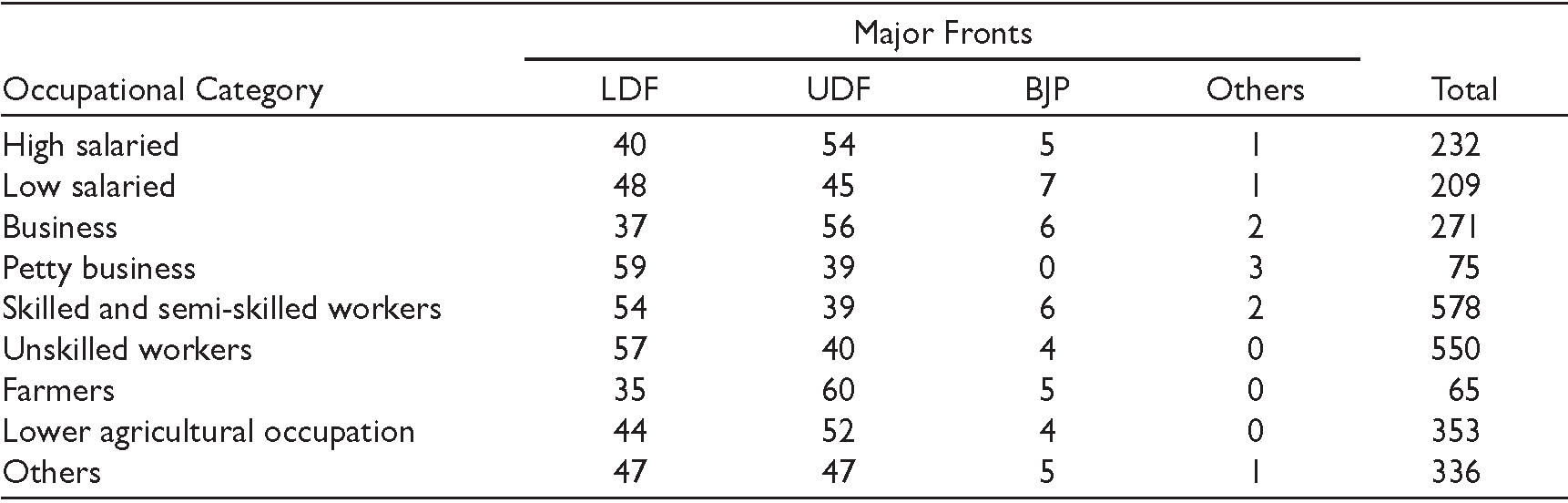
Table 2 shows the association between occupational class and vote choice. There is some evidence of a class divide: The Communists perform well among those involved in less secure occupations, such as the unskilled workers, skilled and semi-skilled workers and the petty business class. By contrast, the Congress (with UDF allies) performs well among those in more secure occupations, such as the high salaried, business and farmers. The difference in support for the Communists between the high salaried and the unskilled workers is about 17 percentage points. Although this represents a clear class divide, it is not as pronounced as the class divide in other countries, such as the UK, where the difference between these two groups was closer to 40 percentage points during the heyday of class politics in the 1960s (Heath, 2015).
Caste/Community and Vote Choice, 2011 (Row Percentages)

Table 3 shows the association between caste/community and vote choice. The communists do much better among the scheduled castes and Ezhavas than among the upper castes. The difference in support for the Communists between the SC and the upper castes is 16 percentage points. By contrast, support for the Congress (and allies) does not vary much by caste, but tends to be much higher among the Christians and the Muslims than it is among the Hindus (see Table 4). The difference in support for the UDF between Hindus and Christians is 36 percentage points (this holds even when the alliance partners are discounted).
Religion and Vote Choice, 2011 (Row Percentages)

There is thus a clear religious divide between the two main parties, that dwarves the effect of either class or caste. Differences in voting behaviour between religious groups are much greater than the internal differences within religious groups. Given the absence of communal tensions in the state, the salience of this divide is perhaps somewhat unexpected. Indeed, Kerala is often noted as a state where there are particularly good communal relations between religious communities.
Historical Legacy of Communist Strength in 1957 and Vote Choice, 2011 (Row Percentages)

Table 5 shows the association between the historical strength of the Communist party in 1957 and contemporary patterns of political support. People who live in areas where the communists did not have much of a presence in 1957 are substantially less likely to support the LDF than people who lived in former communist strongholds. The difference in support for the communists between people living in these different types of place is 17 percentage points. This difference is not as great as the divide we observed along religious lines, though is comparable to the divide we observed along caste and class lines. This indicates that the patterns of political conflict at the inception of democracy in Kerala are still—to a certain extent—reflected in contemporary patterns of party competition.
Multivariate Analysis
To what extent are contemporary patterns of political competition still shaped by historical legacies relating to the formation of parties in the state? Do these historical legacies still shape the geography of political support in Kerala—or are they themselves partly a reflection of the social divides within the state? Previous research on the social context of political participation has suggested that differences between places can be accounted for in two main ways. They may be the result of compositional factors, such as the different social and demographic make-up of the different areas or the result of contextual factors, relating to the structure of the social or political environment (Huckfeldt, 1979). That is, people living in some areas may be more likely to vote Communist because of the social composition of those areas (such as the high concentration of OBCs and SC) or they may be more likely to vote Communist because of the organizational networks established in those areas at the inception of democracy. The only way to distinguish between these two possibilities is to carry out multiple regression which simultaneously controls for both individual- and contextual-level factors.
To answer these questions, we specify a multivariate logistic regression which controls for individual-level factors such as caste, religion and class, and historical factors to do with the geographical distribution of votes from 1957. Are people still more likely to vote for the LDF in places where the communists first established themselves as a major force in 1957; and if so, does this legacy reinforce or cut across existing social cleavages?
The full model that we specify is as follows:
Logit (vote choice) = β0 + β1 * (Age) + β2 * (Sex) + β3 * (Occupation) + β4 * (Caste-community) + β5 * (Communist stronghold) + Ɛ
Table 6 displays the results of two models: The first model contains socio-demographic factors and the second model also contains the variable on historical communist strong hold. From Model 1, we can see that support for the LDF is significantly higher among OBCs and SCs than it is among Muslims and Christians; and is significantly higher among skilled and unskilled workers than it is among the salaried professionals. However, the other individual-level variables to do with age and gender are not significant.
Logistic Regression of Vote Choice, 2011
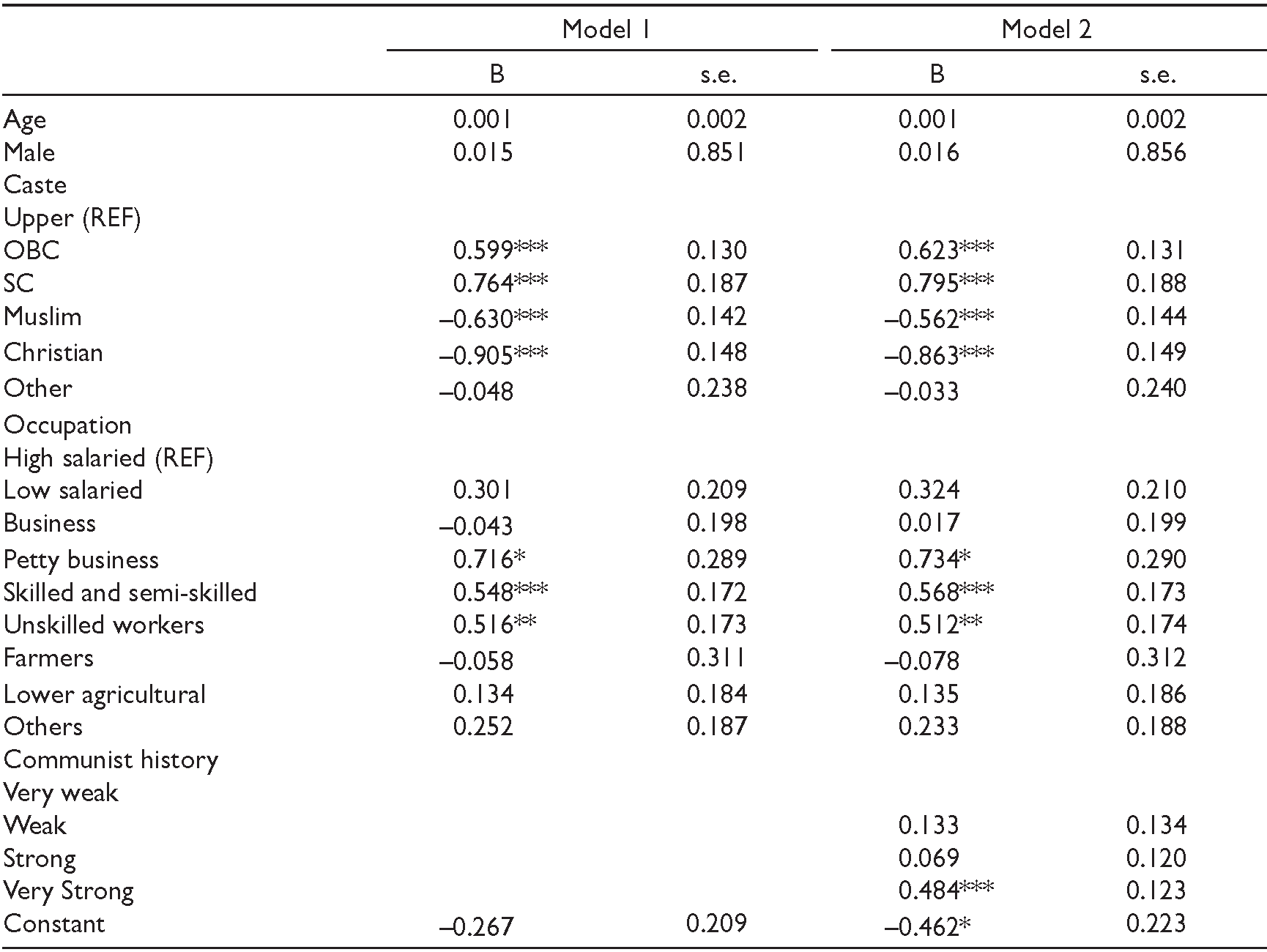
Turning to Model 2 we can see that the communist stronghold term is positive (b = 0.48) and highly significant. People who live in areas where the Communists first established themselves as an electoral force in 1957 are significantly more likely to still vote for the LDF over 50 years later. This indicates a remarkable degree of electoral continuity. Moreover, we can see that when we control for historical factors to do with the emergence of the Communist party the magnitude and significance of the individual-level factors to do with class and caste do not change. This indicates that the geographical cleavage cuts across the social cleavages rather than reinforcing them.
We can get a better idea of the relative strength of these different cleavages by calculating the predicted probabilities of voting for the LDF for different social groups and people living in different parts of the state, controlling for all of the other variables in the model. As previously mentioned, some of these cleavages overlap, and so this strategy allows us to examine the independent impact of each factor. For example, the probability of an SC voting for the LDF is 70 per cent, whereas the probability of a Christian of the same age, gender and class, living in the same part of the state voting for the LDF is just 31 per cent. This represents a difference of nearly 40 percentage points. Turning to class, the probability of a semi-skilled worker voting for the LDF is 58 per cent, whereas the probability of a high salaried worker doing so is just 45 per cent, everything else being equal. This represents a difference of just over 10 percentage points. Lastly, the probability of voting for the LDF is 59 per cent for someone who lives in an area where the Communists were very strong in 1957, compared to just 48 per cent for someone who lives in an area where they did not have much of a presence, everything else being equal. This also represents a difference of just over 10 percentage points.
These findings indicate that parties in Kerala are closely tied to social cleavages, and the caste-community cleavage in particular is very strong. As Heath (2005) shows, the strength of social cleavages in India are strongly related to electoral volatility, and so this is perhaps one reason why the party system in Kerala has been so stable over time. However, these findings also indicate that there is a clear geographic structure to contemporary patterns of voting behaviour that is shaped by the historical legacy of the communist party. This divide is similar in magnitude to the class divide.
Conclusion
Social cleavage theory has been applied to many developing democracies around the world; yet, in most cases, it has little explanatory power. In particular, there is little evidence to support the idea that party systems are frozen at the time of the inception of democracy. Most party systems in developing democracies are highly unstable, with an emphasis on change rather than stability. However, Kerala presents a rare exception to these cases. Not only is electoral competition in Kerala relatively stable, but this stability has a clear social structure and also a clear geographical structure, which can be traced back to the development of the Communist party more than 50 years ago. In those places where the Communists first established a stronghold, people still continue to support the party, irrespective of class and caste identities.
There are various possible explanations for this finding. But one explanation we can rule out. Given that the communists have tended to be more popular among some groups in society than others, we might expect that where these groups are numerous the Communists will do better. Thus, one reason why they did so well in some places in 1957 is perhaps because these were the areas where their natural support base resided. However, when we control for both historical legacy and demographic variables we see that history continues to matter. This suggests that we cannot reduce the impact of historical legacy to favourable demographic factors. So what then accounts for the enduring legacy of 1957? We suggest that part of the story relates to the development of party organizations and intermediary organizations which have persisted over time. One avenue for future research is to explore the structure of these overlapping cleavages in other states, and to examine the extent to which variations in the strength of historical legacies and social cleavages are linked to stability and volatility in general.
Footnotes
Appendix
Due to various delimitation exercises, the constituency boundaries in 2011 differ somewhat from 1957. In many cases there is a strong continuity, especially those constituencies which revolve around important urban centres. There are 29 constituencies like this. For the remaining 26 constituencies, we use disaggregated units of geography to provide the closest match. We did this by consulting the following documents: Delimitation of Parliamentary and Assembly Constituencies Order 2008, 4 and Delimitation of Parliamentary and Assembly constituencies Order 1956. 5 Out of the 55 constituencies, 29 constituencies mentioned above have the same name in 2011 and 1957 (including minor variations in spelling) and cover much of the same area, including the same main towns. Examples include Alwaye, Pattambi and Kollam. For the remaining 26 constituencies, we identified the municipalities and villages within the present-day constituency and matched these back to the constituencies they would have been located in in 1957. In many cases, this was relatively straightforward as the old constituencies were just subdivided into new smaller constituencies. This happened in regions like Mallapuram which experienced significant population growth thus requiring the formation of new constituencies. However, in two cases there was not a clear overlap between present-day constituencies and 1957 constituencies and we were unable to provide a match. Thus, Thiruvambady and Kovalam have been left out. Table A1 shows the constituencies that were matched.