




Abstract
This article attempts to analyse the political behaviour of the adivasi groups in Jharkhand as rooted in the interplay of their interactions with different religions, exposure to non-agricultural economic activities and diverse nature of association with the state. The questions considered for inquiry are: Is the political terrain in Jharkhand moving towards ‘detribalization’ of governance? And, what are the factors influencing the voting behaviour of the adivasis? The article argues that the ambivalences occupying the interstices of the intra-community political behaviour are crucial in deciphering the adivasi politics. Ostensibly, the political choices of the adivasi community are largely framed in accordance with their everyday interaction with the local state as well as remote experiences of the latter as evident in cases of resource grab. The article is based upon the close observation of events concerning adivasis, analysis of assembly election data as well as news in local and national newspapers.
Introduction
Adivasi politics, in general, is understood in terms of resistance against resource grab with very little being said about their myriad forms of interaction with the state, particularly through elections. Jharkhand, popularly perceived as an adivasi homeland, can help illuminate adivasi politics in retrospect and also to comprehend its prospect. Since its formation on 15 November 2000 till the year 2014, the state has been governed by adivasi chief ministers irrespective of their political affiliation. 2 Installing of a non-adivasi, Raghubar Das, as chief minister has more than symbolic importance as the new regime has ushered in ‘detribalization of governance’ which can be understood as a twofold process having both sociocultural and political aspects. Scholars like Das (1962, p. 231) have analysed detribalization as a sociocultural process of loosening social ties and changing cultural preferences among tribals largely owing to their interaction with other social groups. My intention, however, is to understand detribalization as a process in the political discourse of governance albeit not devoid of its inter-linkages with the sociocultural aspects.
To provide a specific meaning to the term ‘governance’ in context of the adivasis of Jharkhand, it would be better to mention few of the pointers from the People’s agenda. 3 The first demand states that the chief minister and his deputy as well as all the administrators who come in direct contact with the people should be local, and belong to a tribal group of the area. Second demand is that ‘tribal land should be restored and the leases of mines in the area should be taken away from non-tribals and given to local tribal groups’. The third demand relates to the cost of development and argues against displacement due to development projects. Finally, the organization demanded a committee comprising of leaders of the Jharkhand movement, intellectuals, representatives from minority communities and weaker sections, such as women, Scheduled Castes and Scheduled Tribes (STs), to oversee that their interests are not compromised. These pointers will be used to analyse the process of ‘detribalization of governance’ as the Raghubar Das government tends to overlook the standpoint of adivasi legislators affiliated to different parties while framing laws concerning the community. Another noteworthy feature is virulent attack upon existing laws which the adivasis consider to be crucial in protecting their culture and resources.
The initial experience of the state for adivasis in post-independence India was that of apathy, as integration into the statist system was through extraction and exploitation. However, the perception of politics as a means of amelioration inspired the adivasi leaders of Jharkhand in pre-independence India to demand a separate state. Despite almost 70 years of political socialization, the adivasi community seeks to interact selectively with the state by availing the benefits of affirmative action while at the same time ‘keeping the state away’ 4 in pursuit of their ‘sacral politics’ under the pretext of a separate identity and adivasi world view. Adivasi politics in the state of Jharkhand has been conveniently understood from two perspectives. First, their participation in the state-conducted elections which provides more insight into their electoral behaviour and political considerations, and second, the radical politics as evident in the resistance movements organized around the issues of assault on jal, jungle and jameen (water, forest and land). These two aspects of adivasi politics, however, shall not be studied in isolation as they overlap and have both refraining and fulfilling effect on each other. Furthermore, expansion of the Bharatiya Janata Party (BJP) in Jharkhand does not infer towards a shrinking social base of the Jharkhand-based parties who still manage to derive substantial support from the community by revisiting its politics and actively associating with the people on issues of resource grab and consequent resistance.
Against this backdrop, I attempt to answer questions like: How do we interpret the political behaviour of the adivasis given the fact that they vote for wide spectrum of political parties? What are the various mechanisms through which the BJP has expanded its social base among the adivasi constituency? And finally, is the political terrain in Jharkhand moving towards ‘detribalization’ of governance? But the broader questions with which I wish to engage are: have we not stereotyped the adivasi question by relegating the problems faced by the community to their status as a ‘victim’ of statist development ideology? Will it be improper to argue that activists barely engage with the political aspects of adivasi society under the compulsion to establish the inviolability of ‘uniform’ adivasi identity? To a large extent, and significantly so, we have failed to accept adivasi politics as a more dynamic phenomenon rather than a fixed notion. In this article, I argue that the adivasis participate in the state-conducted elections as heterogenous groups whose political choice is contingent upon the nature of patronage received from political parties. Another visible trend is the linkage between resistance movements and Jharkhandi parties which mostly converts into electoral support for the latter.
In view of the questions posed above, the article is arranged into three sections. The first section of the article attempts to explore some misconceptions regarding adivasi politics and provide a much more nuanced view of the political behaviour of the community. As Hindutva politics not only has occupied the public imagination in state’s electoral scenario but also strives to become a social force, the second section analyses the rise and consolidation of the BJP. The third section examines the latest effort of Raghubar Das government as an attempt at gradual detribalization of the political terrain. Finally, I conclude by highlighting the major trends emerging in the state politics and the direction of adivasi politics. This article is based upon the observation of events concerning the adivasi communities. 5 Individual interviews and focus group discussions (FGDs) help to understand the community’s (adivasi) perceptions on the issues of politics, corruption, culture and non-adivasis. Apart from this, it uses the election data as compiled by the Centre for the Study of Developing Societies (CSDS) and Election Commission of India. The article also builds upon close following of the series of events occurring in Jharkhand and as covered in various local and national newspapers. Secondary resources such as articles, books and reports are used extensively to arrive at various analytical points.
Adivasis and Politics in Jharkhand
There are nearly 85 lakhs adivasis in Jharkhand, comprising around 26.2 per cent of the population (Census, 2011). At the time of independence, the adivasis constituted around 36 per cent of the population (Maharatna and Chikte, 2004) with a trend of gradual decline since then affecting negatively their political significance. There are around 30 different adivasi groups in the state, and they constitute a majority in the districts or part of districts identified as Scheduled areas. Apart from this, the adivasis also live in minor numbers in areas dominated by caste groups. The four dominant adivasi groups of Santhals, Oraons, Mundas and Hos constitute over 77 per cent of the adivasi population. Their voting behaviour is complex and can be understood from the myriad ways in which they associate with different political parties. Post-poll survey data from 2014 assembly election indicate that almost half of the adivasis who return themselves as Hindu have voted for the BJP and its allies (Kumar & Sardesai, 2015). However, a large number of Tribal Christians (42%) voted for the JMM. As far as the Sarna adivasis are concerned, they portray a fragmented pattern of voting with the BJP and JMM securing 25 per cent and 31 per cent votes, respectively. Regarding the voting preferences of various adivasi groups one can notice that a substantial number of the Oraons (47%) voted for the BJP, whereas the JMM managed to win around 40 per cent of the Santhal votes. As far as the Munda adivasis are concerned, almost a quarter of their votes went to the JMM and only 7 per cent went to the BJP with most of the votes going to the candidates fielded by parties other than these two or the Congress and JVM (ibid.).
Since its creation, the state has seen a change of guard nine times, with different regional parties as well as national parties forming coalition governments. A fractured mandate in favour of different national and regional parties along with independent candidates has ostensibly led to this political instability and opportunist coalitions. Jharkhand also has a long history of identity-based politics and voting takes place, mainly, along identities constructed around ethnicity, caste and religion.
Jharkhandi identity, even during the Jharkhand movement, remained a fluid notion which was refurbished several times in the backdrop of changing political situation. Of what started as a purely adivasi-centred movement eventually incorporated the early non-adivasi settlers, also known as sadans, and later on acquired even class dimension under the JMM. Prakash (1999) highlights the assertion of ‘proto-Jharkhandi’ identity created by the Western-educated adivasi leaders and comprising of local adivasi history, revolts and heritage. After the state formation, writing about Jharkhandi identity, Hebbar (2003, p. 49) argues that it primarily rested on the premise of resistance articulated for state formation and has now acquired a form, much similar to nation-builder’s notion, built around tribal versus non-tribal, isolation versus integration and tribal way of life versus exploitative outsider. She further states that ‘this archetype methodically dissociated the concerns of ‘culture’ from ‘nature’ or the management of natural resources, wherein protecting tribal culture was restricted to ensuring the survival of tribal arts and crafts’ (Hebbar, 2003, p. 49).
Apparently, identity politics is not lost after the formation of the separate state of Jharkhand and is presently struggling to acquire new meanings. The new identity not only equips the adivasis to contest the ‘judicious veto’ 6 —borrowed by the post-independent state from colonial state—in defining development but also laying claim to a notion of development in congruence with their own world view. The world view referred here encompasses a life lived in harmony with nature. The notion, in fact, is central in constructing an identity around ‘indigeneity’ which serves the twofold purpose of, one, laying claim on the resources in the wake of any assault, and two, establishing oneself as the real custodians of nature. Premised upon this notion, the anti-dispossession movements facilitate the adivasis in reasserting their status as citizens, and not merely subjects, by closely associating with political parties. However, activists have hitherto denied any close, or even remote, relationship of adivasi movements with political parties. This step looks like an attempt to follow the ritual of branding the anti-dispossession resistance movements as apolitical entity structured along the lines of new social movements or antiglobalization movements. Ironically, boasting upon the global linkages of the movement, the urban middle-class activists fail to take into consideration some of the real apprehensions expressed by the cornered voices from the ground (Kumar, 2016b). While contrary claims have been made by scholars like Basu (2012), I argue that anti-dispossession resistance movements in Jharkhand cannot be understood without looking into their association with mainstream politics. Political parties have played close, if not crucial, role in articulation of such movements which I shall analyse in later part of this section.
Yet another notion popularized by Alpa Shah regarding the political behaviour of the adivasis need urgent attention. According to Shah (2007), the adivasis participate in the state-conducted elections to ‘keep the state away’ and preserve their sacral politics as they necessarily view the state as exploitative institution. Shah argues that
While political scientists often interpret polling figures as evidence of some kind of commitment to the state, this article explores how and why Mundas, conventionally thought of as poor tribal people, see the state as foreign and dangerous and participate in local elections to keep it at bay. (Shah, 2007 p. 130)
This assessment hardly explains the fragmented voting pattern among the adivasis; the overtly divided social sphere; and, finally, their choice of the BJP in elections given the latter’s aggressive stand towards land acquisition. These aberrations in adivasi politics can be better explained by acknowledging the challenges in reframing adivasi identity in a context marked with contestation around resource grab; presence of both regional and national parties; and occasional state violence as a response to extremist forces.
The story of Jharkhand simply turns out to be a myth whenever the protagonists have attempted to retain the popularized adivasi imagery of an egalitarian, homogenous and nature-loving providential group. More than serving the interest of the adivasis, in the present situation, this narrative has only assisted the activists and politicians alike in reframing an adivasi imagery crucial for their politics. Deconstructing this image, scholars like Corbridge (1988, 2000) and Devalle 7 (1992) engaged with the exercise of providing a more nuanced view of adivasi society. Another name which can be added to this list is that of Ritambhara Hebbar who suggests that the government has to ‘acknowledge the diversification of tribal life in its politics. Concomitantly, it must seriously deliberate upon what constitutes the “tribal self/selves” and in the process seek direction on the future of governance vis-à-vis people and natural resources in Jharkhand’ (Hebbar, 2003, p. 50).
In a political discourse as divided as that of Jharkhand, there always rests a risk in issuing a statement on the political culture of a community. It is even riskier to place political behaviour on the terrain of some romanticized reflection of a particular community’s behaviour. For instance, evidence suggests that many adivasi legislators from the BJP and their adivasi supporters are targeted beneficiaries of both programmatic and non-programmatic schemes. This fact implies a rather different imagination of the state for the adivasis than what Alpa Shah seems to be suggesting. Finally, her phrase ‘keeping the state away’ hardly captures the political culture of the adivasis given the fact that their interaction with a centralized ‘modern’ state is as old as, if not older than, the mainstream Indian society.
Likewise, two assertions underlying Ipshita Basu’s account on Jharkhand are worth examining. One, which is explicitly mentioned, is that the political parties do not take up issues of resource grab as electoral matter, and second, also more implicitly referred to is the derogatory provisioning of state benefits like reservation to the adivasis, especially during BJP regime. Basu (2012, p. 1298) sounds convincing when she argues that the resistance movements are a rejoinder to state’s attempt at ‘distributive injustice’. But she fails to recognize the relationship between the movements and political parties when she argues that ‘radical resource-based agitations have been completely side-lined from the electoral scene’. She appears to overlook the long association of JMM with the Icha-Kharkai Dam movement, Nagri andolan, very recently, and even JVM’s association with anti-mining resistance movements in Badkagaon of Hazaribagh. Moreover, the JMM as part of coalition government led by Arjun Munda sided with the protestors in Nagri against land acquisition. Owing to this fact, I argue that the political parties are not absent from the discourse of anti-dispossession struggles. In fact, the discourse of resistance movements against resource grab is marked with the presence of at least three types of leaders: first, the local adivasi leaders without any political affiliation; second, adivasi leaders associated with different parties, mostly Jharkhand-based; and finally, the non-adivasi middle-class leaders who are largely identified as social workers and activists.
It is, however, the second assertion which requires closer attention given the fact that almost half of the seats reserved for ST legislators are won by the BJP even though a powerful discourse of adivasi identity politics and alternative political avenues exist in the state. If the adivasis are necessarily absorbed into Hindu fold in a derogatory manner, then it is not possible to argue that their conversion into any organized religion shall be derogatory. The only benefit of doubt to this assertion can be provided in the traditional standpoint of the Hindu organizations wherein they regard adivasis as ‘backward Hindus’. However, this does not seem to be true and this phenomenon should be rather judged on account of benefits received by the community in addition to reservation. For instance, rise of middle-class adivasis is often attributed to the modern education received through Christian missionary schools. Similarly, the association of adivasis with the BJP also has a material component giving rise to a ‘neo-middle class’, 8 an issue explored later in this section.
Corbridge’s (2000) account on adivasi middle class is quite relevant in exploring their political attitude as he argues that despite being the beneficiaries of state’s affirmative policies, a majority of the adivasi middle class has shown their inclination towards the Jharkhand-based parties. However, Corbridge also accepts that the Rashtriya Swayamsevak Sangh (RSS) played a significant role in building the grass-root base for the BJP. Taking a clue from this, I would like to further deconstruct the electoral pattern in Jharkhand which points towards a more complicated scenario. While most of the adivasi middle class can be reliably believed to be inclined towards the Jharkhandi parties, the BJP also enjoys considerable support among the adivasis. The post-poll survey data from 2014 assembly election indicate that the BJP while getting a majority of the Hindu votes also received almost 30 per cent of the tribal votes which is more by a percentage point than that of the JMM, considered to be a tribal ethnic party (Kumar & Sardesai, 2015).
To explore further the role played by Hindu-right organizations in helping the BJP consolidate its position among the adivasis it will be better to use the conceptual framework offered by Tariq Thachil in context of Chhattisgarh. Thachil (2011, p. 465) argues that non-state service provisions as provided by non-party social affiliates of the BJP like Vanvasi Kalyan Ashram (VKA), Vidya Bharati, Saraswati Shishu Vidya Mandir and others work outside the framework of patron–client relationship. These organizations engage the people through ‘quotidian social interaction’ and offer unconditional services, thus defining the electoral choices in favour of the BJP. However, the propensity of the BJP as a political party to widen its support base among the adivasi constituency can be conceptualized better by using the framework offered by Susan Stokes and others. Stokes, Dunning, Nazareno and Brusco (2013, p. 19) uses the term ‘clientelism’ as a ‘non-programmatic distributive strategy’ 9 under which ‘parties distribute benefits to individuals and attempt to hold them accountable for their votes’. In the case of BJP, a strategy almost similar to ‘subcontracting’ 10 occurs to be used more as I noticed that the people who had bagged contracts for village roads and other projects due to their proximity with BJP legislators were not only loyal voters but also mobilized support for the party. It is also argued that in advanced democracies the quid-pro-quo understanding is absent wherein political parties are not embedded in social networks but are more distant from voters (Stokes et al., 2013, p. 8). Taking this difference as a vantage point it can be argued that due to the presence of non-political BJP affiliates in the sociopolitical discourse the former can extract very accurate information about the voters and plan its clientele strategies 11 accordingly. It can be, hence, argued that the adivasis (mostly the tribal Hindus) supporting the BJP largely comprises of a beneficiary of one of the clientele strategies 12 or its combination as well as a section alienated from the oft-repeated but never fulfilled pledge of the Jharkhandi parties.
Furthermore, adopting the theory of ‘resource curse’ scholars have argued that even central welfare funds are not utilized completely by governments in Jharkhand with a view to reaching the governed through direct benefit transfer (Nathan & Dayal, 2009). Political leaders tend to ignore the welfare of the people because they believe that the resources required to keep their political fortune alive can be garnered through allocation of mining leases to companies. Moreover, the leaders are also confident of receiving political support from their respective constituencies due to kinship, community and other parochial factors. This strategy, however, seems to be more useful for the Jharkhand-based parties. But, are the adivasis entirely confident in the stance taken by the BJP? This is an important question given the fact that the BJP also happens to be a staunch votary of neo-liberal growth and ‘development’ which mostly goes against the adivasi interests. This is where another strand of adivasi politics enters the scene.
A group of professionals from the adivasi middle class, who largely owe improvement in their position to the state’s affirmative policies, in association with another group of adivasi or non-adivasi activists, reconstruct an adivasi identity consolidating the resistance movements. Activists such as Dayamani Barla, Gladson Dungdung and Xavier Dias associated with organizations such as Jharkhandi Organisation for Human Rights (JOHAR), Jharkhand Mines Area Coordination Committee (JMACC) and others apart from being sympathetic to the Jharkhand-based parties also visualize a political revival of the latter through resistance to private ‘development’ projects. The aversion of this particular class can also be understood given the fact that the policy of state’s compensatory discrimination will not apply to the private sector jobs. This will reduce the chances for the adivasi middle class getting absorbed as they have to compete with the outsiders for job. Thus, the political discourse in Jharkhand is defined in such a way that the BJP along with its own adivasi supporters is poised against an adivasi middle-class group sympathetic to Jharkhand-based political parties. However, the bigger conceptual problem relates to the basis on which different adivasi groups associate themselves with either of the above-mentioned political factions.
While the BJP derives support from a section which is less worried about the conventional adivasi world view and rejoices in the benefits accruing from their association with the state, the Jharkhand-based political parties has to depend upon the foot soldiers who perceive neo-liberal development as a threat to the adivasi way of life. The local political parties also face the dilemma of sticking to the antiglobalization ideology as well as the responsibility to garner resources necessary to satisfy the growing aspirations of its supporters. These are the structural problems which dissuade the local political parties from adhering to an ideological position which completely eschews the neo-liberal paradigm of development, whereas the BJP as an open votary of neo-liberal development paradigm enjoys the traction required to maintain and expand its political capital.
Adivasis and Hindutva Politics
One frequent phenomenon in the politics of Jharkhand was the co-option of Jharkhand-based parties by the parties ruling at the centre. This evoked distrust among the people and provided elbow room for other political parties like the BJP to spread their influence. Apart from the gains from its all-India rhetoric of Ram Temple at Ayodhya, two interrelated phenomena can be attributed to the rise of the saffron wave in Jharkhand. On the one hand, the RSS—the cultural wing of the BJP—engaged with the delivery of services such as health and education, in the predominantly adivasi areas (Corbridge, 2000). On the other hand, it further exploited the already existing rift between the Sarna (ancient adivasi religion) and the Christian adivasis (Basu, 2012; Louis, 2000; Sundar, 2006). This strategy is a replication of the RSS module applied in the adivasi areas of Madhya Pradesh, 13 Odisha, and elsewhere. However, in such analysis we should also take into account the different facets of interaction between the adivasis, the state and the mainstream society which has historically shaped their behaviour. 14
Concomitantly, understanding the rise and consolidation of the BJP in the political discourse of Jharkhand is crucial to comprehend the adivasi and non-adivasi divide as well as adivasi politics in the State. Let me begin by stating a simple fact. Even though the adivasi population in Jharkhand, as per Census 2011 is around 26 per cent only around 13 per cent are recognized as ‘others’, that is, presumably Sarna 15 adivasi (Census, 2011).
Whenever an adivasi aligns with the Hindu-right wing party, it is assumed that a cultural assimilation is accomplished on some derogatory basis (Basu, 2012). While this assumption is not entirely misplaced a more feasible answer has to be found in the finitude 16 of social conditioning of a section of the tribal middle class who due to their close proximity to the Hindus have started imitating many Hindu practices but without sharing the same religious consciousness which their Hindu counterparts hold. To understand the interaction between religion and communities one needs to analyse the myriad ways in which this interaction takes place. Almost half a century earlier anthropologist Tarak Chandra Das (1962) pointed out that the interaction between the adivasis and Hindu religion takes place through ‘absorption’ in which the former is free to retain the original faith but starts imitating the caste practices of the latter. However, the interaction between the adivasis and Christianity takes place through conversion wherein they have to adopt a new fold and its tenets. Nevertheless, the issue of how the interactional factor and its hybridity unfolds in popular discourse are contingent upon the form it acquires in its interaction with politics. In fact, if we consider Shah’s (1988, p. 268) account on the inclusion of kolis into the rajput fold, for political reasons, then we will realize that the marginalized communities also emerge as beneficiaries. And, more than the other terms of inclusion it is the material benefits which initially appeals to the latter. But the recent shift in intercommunity relations and associated hostilities makes it necessary to understand the trajectory historically.
Since the mid-nineteenth century, Christian institutions like the Evangelical Church has been functioning in Ranchi. Moreover, Hindu social organizations have also been engaged in socio-religious activities at least since the mid-twentieth century. The role played by VKA is instrumental in pervading adivasi areas and life if not effecting adivasi absorption into the Hindu fold. The VKA has mostly relied upon the ashram schools in countering the proselytization attempts of the Christians. However, it will be unjust to attribute the rise of Hindu organizations to the provocation engendered by Christian missionary activities. While the objective of conversion cannot be side-lined, it must be conceded that the Christian mission not only organized the adivasis against their exploiters (mostly Hindu landlord and businessman) but also introduced them to modern education and state. Only in post-independence India, did the Hindu ‘cultural’ organizations came to take cognizance of conversion and took steps to counter it by active support of the presumably secular Congress governments in the states 17 (Sundar, 2006). It should be remembered that the process of socialization has a longer history and the adivasi youths happen to be a product of this programme entrenched into their lives since childhood through school curriculum and training into Hindu idioms. Thus, the process of Hinduization depends upon many symbolic approbations and is captured well by Nandini Sundar who stated that ‘There is a proliferation of Hindu visual imagery, carefully planned to expose children to Hindu idioms’ (Sundar, 2006, p. 377).
In Jharkhand, there is a substantial adivasi population which practices Christianity. However, the rise of Hindutva politics in the last two to three decades has provoked the ancient adivasi religion Sarna to enter into conflict with the adivasis converted to Christianity and revive itself against ‘proselytizing’ Christian organizations (Yadav, 2013). A lineage to the present discourse of dividing social terrain between the Sarna and Christian adivasis has also been noticed by Nandini Sundar as she argued that
They (Adivasis acting as VKA worker) were told to look out for other organisations, which were evangelising, and to inform the Kalyan Ashram so that it could be stopped … the villagers were told to go easy with the Adi Dharm as it was an internal fight between Hindus, and watch out for the Christians. (Sundar, 2006, p. 381)
Amidst this conflict, the Hindu organizations are gaining sympathy from the Sarna Dharamgurus for the support provided to the latter by the former. By doing this, the Hindu-right wing has served the twin purposes of pulling the adivasis towards itself as well as curbing the spread of Christianity among the adivasis of Jharkhand. The latest strategy to be added to this turn of events is the positive approach of the Raghubar Das government towards the proposal to make Sarna as the only admissible religion for adivasis to avail reservation benefits in state jobs. 18
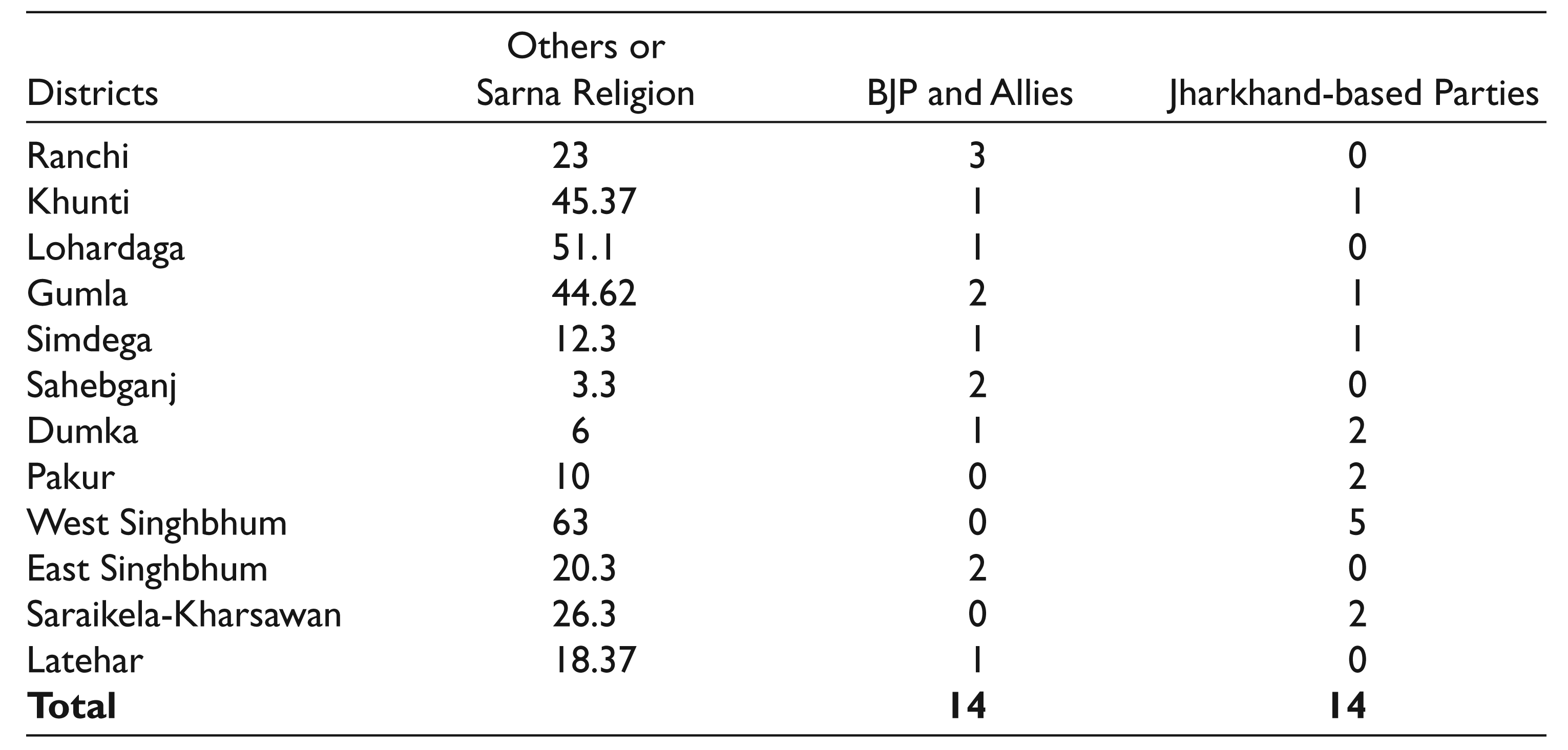
The penetration of the BJP into adivasi constituency can be further discerned from the micro facts of the legislative assembly elections conducted in 2014. An analysis of the election data reveals that Oraons as an adivasi group has shown preference for the BJP, whereas the Santhals have also voted considerably for the BJP. Moving further into the analysis of the 28 seats reserved for STs we can find that the ST legislators from BJP managed to win substantial number of seats both from areas having low and substantial Sarna adivasi population (see Table 1). However, the areas which witnessed hostilities around land and mineral resources, the adivasis have preferred to vote for Jharkhand-based parties (Kumar, 2015).
Scheduled Areas, Sarna Population and Seats Won by Contesting Parties and Alliances
It is suggested that because of being outside the traditional caste-hierarchy the absorption of adivasis in Hindu fold or the discrimination faced by them is not the same as that faced by Dalits (Teltumbde, 2011). While the truth in such assertions cannot be denied, I would like to use the concept of ‘finitude’, as used earlier, to provide a more nuanced view of absorption of adivasis into Hindu fold. In this context, it can be said that the integration of adivasis may not be as demeaning as it can be in the case of Dalits. But, to say that it is devoid of discrimination will not be correct either. A cursory glance will reveal a ‘new agenda’ under which the Hindu-right wing organizations follow a changed vocabulary in interacting with the adivasis. The former while not emphasizing upon the adivasis being backward Hindus, has provoked the Sarna adivasis against their Christian brethrens.
Detribalization of Governance
Governance itself as a process has acquired different meanings owing to the state’s agenda of intervention into society, or even retreat. At least six definitions of governance are identified and analysed by Kooiman (1999) with his own emphasis upon governance as sociopolitical exercise centred around ‘governing orders’ and ‘governing modes’. Whereas, the former aims at ‘conceptualising governors in terms of their activities’ the latter ‘aim at particular forms of societal interactions in which their activities takes place’ (Kooiman, 1999, p. 78). However, the definition of governance extracted from the ‘People’s agenda’ comes closer to the definition offered by Rhodes,
Self-organising, inter-organisational networks characterized by interdependence, resource exchange, rules of the game and significant autonomy from the state. (Rhodes, 1997, p. 15 as quoted in Kooiman, 1999)
This idea of governance is also commensurate with the provisions provided under several state laws such as Schedules V and VI of the constitution, Panchayat Extension to Scheduled Areas (PESA), Forest Rights Act (FRA) and so on. Interestingly, the idea of ‘increasing political legitimacy as a precondition for sustainable development’ also finds echo in the World Bank endorsed definition of ‘good governance’.
However, the turn of events since the last assembly elections, conducted towards the end of 2014, points to the initiation of a process of detribalization with the symbolic installation of a non-adivasi chief minister under the BJP-led coalition. 19 Given the fact that almost half of the adivasis have voted for the BJP, which is clearly a votary of the neo-liberal growth model and Hindutva politics, it becomes imperative to analyse the issue of ‘detribalization’ of governance. I attempt to analyse this theme by citing few examples like that of the domicile issue and the amendments in protective legislations like Chotanagpur Tenancy Act (CNTA) 1908 and Santhal Pargana Tenancy Act (SPTA) 1949.
To substantiate the issue of detribalization let us first engage with the domicile issue which has apparently stirred the hornet’s nest once again (Pandey, 2016). An earlier move by the Babulal Marandi government in 2001 to consider the 1932 land records as the basis to bestow domicile provoked a face-off between the adivasis and moolvasis on one side and the outsiders popularly regarded as diku on the other. This was challenged before the Ranchi High court which struck down the law in 2002. Since then, the state was in need of a domicile policy, and the recent attempt has been to resolve this lacunae by identifying almost everyone as a domicile who has been residing in the state since 1986. One way to interpret this move is to see it as stemming from the quest of the BJP to consolidate its social base among the immigrated population who are regarded as dikus by the adivasis. This step can further alienate the adivasis as they will not be able to even find the loose linkages that the state affirmative measures ensure. Apparently, the rare ways and means through which adivasis comprehend the state and its institutions will be snatched away if a compromise in domicile is invoked. Owing to the fact that adivasis in Jharkhand have benefited from affirmative policies there arose an assertive group of middle-class adivasis who remain crucial in taking up issues concerning the community.
In the context of the attempt that has already been made to scrap the Special Area Regulation (SAR) courts used for reclaiming adivasi rights on illegally transferred land, I would like to draw attention to the proposed amendment in the CNTA and SPTA, relaxing the provisions on compensation for adivasi land in the wake of acquisition. The Raghubar Das government has moved an ordinance with the intention to amend Sections 21, 49 and 71 of the CNTA, 1908 and Section 13 of the SPTA, 1949. The said amendments will facilitate the unhindered acquisition of adivasi land for industries, malls and other purposes. This ordinance along with the proposed domicile policy has not only brought into the open fissures within the BJP-led coalition but has also given enough reasons for the entire opposition to unite against it. Moreover, discontent within the BJP is quite visible as State BJP President Tala Marandi and another legislator Shiv Shankar Oraon have explicitly expressed their concern over the ordinance. However, it is disheartening to see that while the protestors oppose the grant of mining leases to companies many illegal mining sites are operating under the protection and guidance of local state. The point being made here is that the adivasis look divided in the political discourse of Jharkhand, but the nature of politics and its historical lineages still confirm their solidarity on issues which may otherwise be considered trivial. Not really holding any direct relevance to the socio-economic problems of the poor adivasis, this fact ensures a possibility of retaliation typical of adverse situations like assault on jal, jungle aur jameen (water, forest and land). With the recent incidents at Khunti, Badkagaon and Ramgarh where the police resorted to firing on protestors it seems the strong political linkages which adivasis in Jharkhand used to enjoy is gradually fading away. Though the presence of Jharkhand’s adivasis in statist dispensation has largely kept at bay the state violence and brutality typical of other central and east Indian states the future looks uncertain at this given juncture.
Having pointed out the recent attempts to detribalize the governance in Jharkhand, I would like to argue that these strategies have apparently backfired as is evidenced by the fissures that have opened out within the ranks of the ruling government. The All Jharkhand Student’s Union Party (AJSUP), the pre-poll partner of the ruling coalition, has openly opposed the moves on amendments in case of the domicile policy and hold a somewhat wavering stand on CNTA and SPTA as several moolvasi groups are in favour of amending these protecting legislations. 20 While compromise with issues of daily governance and the associated corruption is an accepted fact in Indian politics, deviation from the core political position goes against the pragmatism warranted by politics. The position held by the AJSU on domicile and protective land laws are in line with this pragmatism as it aims not to annoy its moolvasi social base. In a somewhat similar situation, JMM as the coalition partner had earlier deterred the Arjun Munda led government in 2011 to go ahead with the contentious land acquisition in Nagri. 21 Despite BJP’s success in denting the adivasi vote base the party can ill-afford to forget that the Jharkhand-based parties have not lost their ground entirely (Kumar, 2015). In fact, wherever the discourse is polarized around the assertion of adivasis as social and political forces against the corporate forces assaulting their traditional livelihood resource base has largely seen the return of adivasi leaders from Jharkhand-based parties (ibid.). As far as detribalization is concerned, it is not yet an accomplished fact. The continued salience of the adivasis in the state politics of Jharkhand depends upon their capacity to solve the convoluted political situation and act together as a constituency.
Conclusion
With the formation of Jharkhand, a long-drawn struggle for political self-determination has come to an end. But even a cursory observation reveals that the formation of Jharkhand has hardly resulted in the greater good of ordinary adivasis. Moreover, the formation of the state is itself considered to have been the result of manoeuvring by a Hindu-right wing party at the Centre yielding to dikus’ political hold over a resource-rich territory. This is not to say that the adivasis have not benefitted with the formation of Jharkhand. In fact, the phenomenon of the emergence of elites among the adivasis got a shot in the arm with state formation. A regime of ‘decentralized corruption’ has propitiated even those who are peripherally linked to the state machinery. However, the meta-narrative of development has the potential to agitate the sociopolitical domain and, usually, takes the shape of protest movements which themselves have a very rich repertoire.
It is important to understand that the nature of politics in Jharkhand is not comprehendible under a framework which exclusively emphasises formal institutions. Despite the evolving scholarship on Jharkhand, there is a major lacuna in the analytical framework of state-community interaction. While the internal dynamics of the community has been explored, it has become a self-contained exercise. Some of the common notions which, hence, inform this essay are that adivasis are not one homogenous group either culturally or materially. The differences observed in their political behaviour are, or can be, substantially less governed by issues of adivasi identity than that of other identities such as religion and caste. Furthermore, in understanding the state-community interaction, social dynamics has been largely ignored.
The analysis presented in the preceding sections indicates that the adivasi politics has acquired a unique form in Jharkhand wherein the community’s loyalty stays divided between the Hindu-right wing BJP and the Jharkhand-based parties. Assertions of identity in confrontational situations are largely a result of articulation of adivasi identity, which, when observed more closely, stays divided along intra-group lines. Despite all these limitations, however, adivasi politics offers a ray of hope by showing some sign of retaliation against the onslaught of predatory economic forces as well as against the abominable attempts of culturally assimilative forces. Adivasi politics in Jharkhand is different from other central and East Indian States as it rules out the aloofness of adivasi politics from the mainstream politics largely under the influence of political economy of the state. Finally, the contentious form, which adivasi politics in Jharkhand has acquired, throws open a challenge to engage with the real picture of emerging political frame and the more insidious trends pervading the community itself.
Footnotes
Acknowledgements
I would like to thank Prof. Suhas Palshikar for his initial comments on the manuscript and the two anonymous reviewers. Crucial aspects of this paper were also developed through discussions with Prof. Supriya RoyChowdhury, Prof. Asoka Kumar Sen and Dr. Tannen Neil Lincoln. I sincerely thank them and submit that any anomaly in the article is entirely mine.