




Abstract
In the state of Uttar Pradesh, Dalits have largely been elected only from the reserved seats, and their representation from non-reserved seats has remained negligible. Apart from ensuring political presence, how do reserved seats impinge on the Dalit politics within the constituency? Who determines the election outcome in the reserved seats? The article argues that in the reserved seats of the State of Uttar Pradesh, Dalit votes remain at best adjunct votes, to the core support base of the respective parties. There is evidence of systemic political backlash from non-Dalit voters against Dalit voters in reserved constituencies. Various parties play a significant role in orchestrating this backlash to help their candidates win. The weak position of the Bahujan Samaj Party (BSP), the party of Dalits in the reserved seats, is an indication of such a backlash. This backlash is largely aimed at the dominant Dalit group, the Chamars, who are treated as political untouchables by one and all, across caste and class.
Introduction
The election of Dalits in reserved constituencies was part of the larger inclusive agenda of the post-independent Indian state. It ensured the political representation of a hitherto marginalized group of people in state and national politics. In fact, in the state of Uttar Pradesh, Dalits have been elected only from reserved seats. Parties have largely refrained from giving tickets to Dalits in unreserved seats. Even Bahujan Samaj Party (BSP), a party of Dalits, has relied on non-Dalit candidates in unreserved seats. So it would not be wrong to say that the political representation of Dalits could be maintained only through the provision of reserved seats. Having accepted this, the article moves forward with the constituency-level analysis of the nature of Dalit representation.
Reservation of seats means that only Dalit candidates can stand from those seats. Constituencies reserved for scheduled castes (SCs) are single-member electoral districts where voters from all caste groups may vote (joint electorate). Though efforts have been made to place the quotas in areas with high concentration of SCs, they are spread across the state, and SCs still tend to form a minority in any given constituency. In Uttar Pradesh, the bulk of SC constituencies contain between 16 and 36 per cent of those belonging to SCs.
Critics of Indian quota system have argued that political reservation may crowd out the representation of other groups particularly after the abolition of double-member constituencies 1 in 1961. However, Jensenius (2012), in her study, shows that people neither feel democratically empowered nor disenfranchized by living in a constituency that is reserved for SCs. Mori and Kurosaki (2016) show that in a reserved constituency, where only members of the disadvantaged castes can stand for election, voters of the disadvantaged castes are encouraged to vote. But how far does this empowerment translate into effective group representation, especially when Dalit candidates have to woo non-Dalit voters whose interests are often divergent in the state of Uttar Pradesh? Do Dalit votes determine election outcome in the reserved seats? Mori and Kurosaki have indicated that political reservation changes party choice of the other group of voters and they tend to cast their vote for the party mainly supported by upper caste voters. If we contextualize this finding in Uttar Pradesh, we find that this ‘other group of voters’ is equally attracted towards party of backward castes. We see here that the parties that could successfully mobilize non-Dalit votes along with Dalit votes in reserved constituencies manage to win more easily (R. Verma, 2009). Though caste is just one factor that determines electoral choice, it is nonetheless a very significant factor (Osborne, 2001). We limit our analysis to caste, as it plays a significant part in determining the choice of candidates by parties. This insistence on caste by parties, in turn, has an impact on the voter’s choice (Jaffrelot & Verniers, 2012).
Party Representation and the Dalit Question
The design of quota system ensured that the mainstream parties remained the strongest contenders in the reserved seats. A quick look at the trend of party representation on the reserved Lok Sabha seats of Uttar Pradesh reveals the dominance of Congress until 1977. The Congress party in Uttar Pradesh built its support by accommodating and aggregating the interest of wide sections of the agrarian and urban society. However, this wider support did not reflect in its leadership pattern in general. The leadership was drawn from locally dominant classes in rural society and from professionals and businessmen from the same class, leaving out the middle and backward castes (Hasan, 1989, p. 257). Under the leadership of Charan Singh, this section questioned the traditional upper caste domination represented by the Congress. It led to the formation of Bharatiya Lok Dal (BLD) (later Janata Party [JNP]) which articulated the interest of those peasant proprietors who had prospered through the Green Revolution and later started seeking political power on their own to legitimize and further increase their gains (Hasan, 1989, p. 259). In 1977, BLD won all the reserved seats in Uttar Pradesh. The backward caste or agrarian class movement (the prime basis of BLD/JNP) could not completely sweep away the Dalit base of the Congress, as there was inherent contradiction in the interest of Dalits and backward castes in the state. In fact, the rise of middle and backward castes such as Jats, Ahirs, Kurmis and Gujars intensified conflicts between Yadav and Kurmi land owners and the landless Dalit agricultural labourers (Hasan, 1989, p. 265). Congress once again started capturing reserved seats, though there was the exception of the JNP getting eight seats in 1980, due to its pro-poor populist agenda (Brass, 1990; McMillan, 2015). Congress was able to maintain its hold over reserved seats as it was an umbrella organization, and there was no other party that could claim to represent the interest of the Dalits per se. Post-1990, this story changed. The mobilization of the lower and backward castes through instruments of political parties got a push after the second democratic upsurge (Yadav, 1996, pp. 96–99) of 1990s. During this period, three contenders appeared on the scene in Uttar Pradesh—BSP, Bharatiya Janata Party (BJP) and Samajwadi Party (SP). This was the phase of religion-based and identity-based politics. The cleavages between the Dalit and the other backward castes (OBCs) deepened during this period. The BSP wanted to exercise complete sway over ‘bahujan samaj’, but ended up consolidating its hold over the Dalits, especially the Chamars and the Jaatavs. The lower Dalits, called the ati-Dalits, namely, the Pasis and the Bhangis, went with the BJP or the Congress. With the coming of Mayawati, Dalits consolidated behind BSP, and the battle between the SP and the BJP centred on OBC votes (Verma, 2007, p. 169). While Yadavs rallied strongly behind SP, BJP mobilized smaller Dalit backward castes to its camp. In this phase, we see parties with minimal support bases amongst the SCs have managed to win reserved seats in Uttar Pradesh, despite the SC voters’ general preference for other parties (McMillan, 2015). How far does this thwart or sideline Dalits in the reserved seats? Is this simply an impact of Dalit votes getting dissipated across parties as all the contenders are Dalits or a result of some deliberate design of non-Dalits to put their weight behind a specific Dalit group, thereby controlling the outcome?
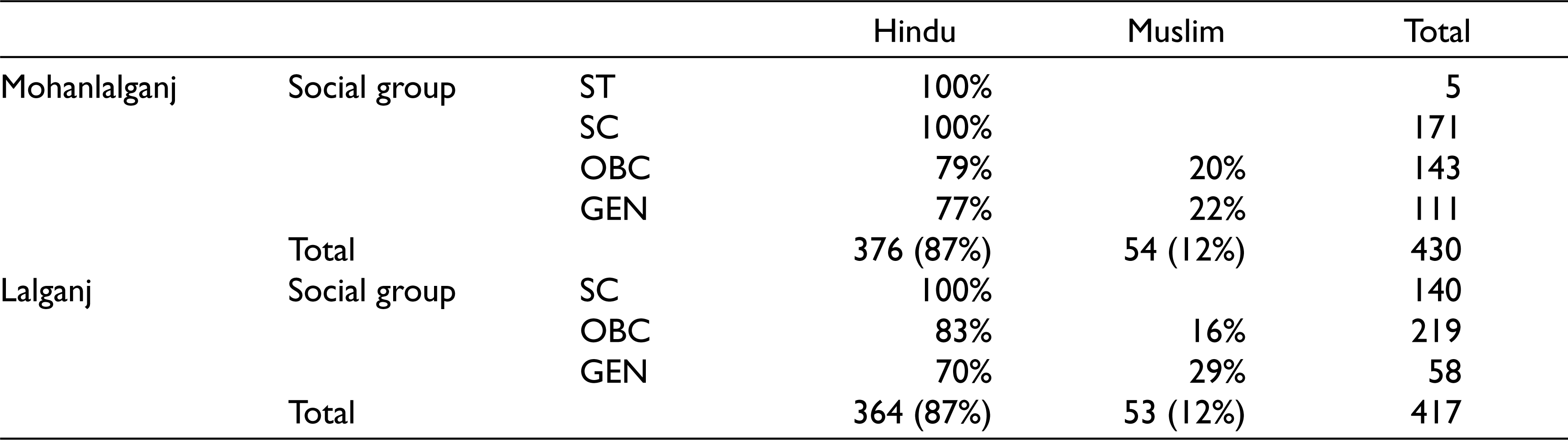
We attempted to examine these questions in two reserved constituencies, namely, Lalganj and Mohanlalganj, that exhibited substantial increase in BJPs vote share (2014 and 2017) and were earlier strong bastions of BSP or SP or left parties due to large number of Chamar/Pasi, Yadav and Muslim voters. The sudden emergence of BJP in these constituencies gives us an opportunity to see whether there is any shift of Dalit votes across parties. The method of systemic random sampling was followed to select 6 booths from each constituency and subsequently 12 to 14 respondents from each booth on the basis of voter list. Randomly selected respondents were then contacted to fill the questionnaire. Table 1 gives the details of respondents from each constituency.
Simultaneously, qualitative data were collected from the constituencies to understand processes at work. People were interviewed for their political preferences, their understanding of social justice and perspective towards secularism, policy of reservations, their perception of other caste groups and take on issues of governance. These interviews were recorded and later transcribed to capture narratives that gave some useful insights.
Number of Respondents in Two Constituencies
Lalganj Lok Sabha
Lalganj Lok Sabha constituency came into being in 1962. As per the estimates of 2011 census, out of total 2,236,530, 96.8 per cent is rural and 3.19 per cent is urban population. Out of the total population, SCs and Scheduled tribes (STs) form 25.74 per cent and 0.12 per cent of the electorate, respectively. In this constituency, Chamars outnumber other caste groups with a population of nearly 349,000. Again, the population of Muslims and Yadavs is almost equal at 246,000 and 268,000, respectively. The next in numbers are Thakurs followed by Rajbhar and Bhumihar (Amar Ujala, 2017).
The Lalganj Lok Sabha constituency in Azamgarh district has remained central to the politics of Eastern Uttar Pradesh. Azamgarh occupied a central place in anti-Congress politics and is known for its Dalit-OBC and Muslim political consolidation. By 1962, the anti-Congress sentiment had gained ground in Uttar Pradesh, and in this constituency, we see that Praja Socialist Party (PSP) not only gave a tough fight to Congress but also won this seat by securing 37.49 per cent of votes. In the next two elections, Indian National Congress (INC) managed to regain and hold this seat. The Congress dominance is again challenged in 1977 in line with the overall political developments in the state, and BLD won the seat with 74 per cent vote share. Though BLD won this seat, the candidate was an old Congressman (Ram Dhan who won the previous two elections on a Congress ticket). It was this shift of a leader that brought in the Dalit votes for BLD. Ram Dhan went back to Congress in the subsequent election of 1980 but remained a runner up. The vote share difference among parties in this election was slim, with JNP (S) winning the seat, pushing JNP to second and INC to the third position. This can again be looked as case of non-Dalit backward caste consolidation in a Dalit seat. The possibility of large shift in the Dalit vote towards JNP was slim due to inherent contradiction between the OBC and Dalit interest in the state. The Dalit vote at best got divided between the Congress and JNP (R. Verma, 2009, p. 96) In 1984, Congress got the sympathy vote, and its vote share increased substantially and it won the seat with a 54.53 per cent vote share. With the increasing backward caste mobilization, we see Janata Dal winning this seat in the next two elections (1989 and 1991). From 1996 onwards, we see SP and BSP taking over the anti-Congress, backward and Dalit politics space created by Janata Dal and other parties. For another four elections, BSP and SP alternatively won this seat. All along, BSP maintained a vote share of over 30 per cent (except in 1991 and 2014). So, the possibility of a split in Dalit vote across parties remained weak. It is important to mention here that all this while BJP remained the third largest player and its vote share ranged from 21 to 27 per cent. The presence of BJP and SP here is an indication of strong base for non-Dalit consolidation. The year 2014 became the real turning point when the BJP won the seat with a vote share of 36 per cent. The possibility of a shift in Dalit votes seemed possible during this election but whether it happened or not will be dealt with later in the article. Figure 1 gives an idea about this change in the vote share of major political parties in Lalganj Loksabha since 1991.

A similar picture emerges in the Vidhan Sabha elections. Congress dominance is intermittently broken first by PSP, later by Bharatiya Kranti Dal (BKD), JNP and Lok Dal. But as mentioned in the previous section, these breaks did not indicate any major shift of Dalit voters from Congress. The possibility of division of Dalit votes among parties always remained slim during this period. These shifts can be seen as galvanization of backward caste towards the socialist parties. Post 1991, Congress disappeared from the scene and BSP and SP managed to secure 11 seats each, while BJP secured 2 seats and JNP 1. Again, the strong position of SP can be looked upon as largely the function of consolidation of OBC and Muslim votes.
In the above stated context, it would be interesting to see what was happening at the level of com-munity in terms of political representation. If we look at the caste profile of the winning and the losing candidate in Lalganj Lok Sabha seat, we find that until 1991, all the candidates were Chamars. It is only in 1996 that a runner up candidate is a Pasi from SP and after that, a Pasi candidate wins the seat in 1998 and 2004. With the coming of BJP, one more community comes to the fore and Neelam Soankar, a Khatik community member, becomes the runner up. She wins the seat in the subsequent election of 2014.
Similarly, a look at the representation of various communities across the Vidhan Sabhas reveals that it was Chamars and Pasis who secured representation from the reserved seat, and on the general seat, upper caste candidates (Thakurs, Brahmins and Muslims) maintained their dominance before 1991 and subsequently Yadav took over. This is in line with the emergence of backward castes as a strong political contender. Rajbar and Nishads soon followed Yadavs. In Figure 2 we see that out of the 51 elected representatives elected to Vidhan Sabha from the 5 assembly constituencies since 1951, 18 upper caste candidates won. If we add Muslim upper caste to this list, then the tally becomes 27. In 24 seats left, 4 were Dalits (1 Pasi and 3 Chamars), 3 14 Yadavs, 5 Rajbhar and 1 Nishad.
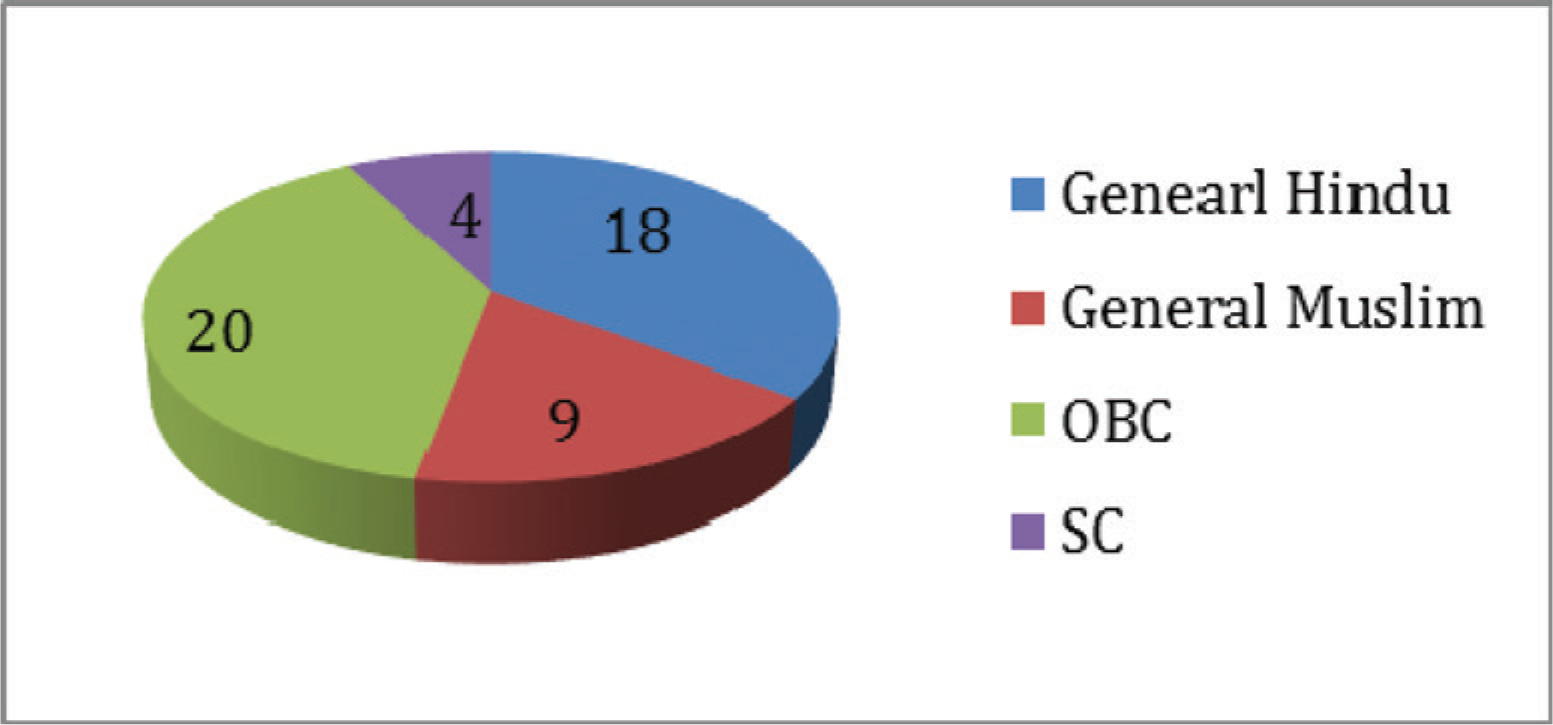
In the post-Mandal period of 1990s, we see that out of the above 20 OBCs, 16 came in this period. This happened at the expense of general caste representation.
The political emergence of smaller Dalit communities in reserved constituency can also be looked upon as a positive trend as it loosened the hold of numerically dominant Dalit community, namely, Chamar, Jatav and Pasis over these constituencies. The dislocation of power from centre towards the periphery is a sign of vibrant democracy. Politicization of the ati-Dalits and the backward castes was the strategy of SP and other socialist parties, but it was BJP that practiced it. The BJP had to counter BSP as well as SP, the party of Dalits and also the party of backwards. Therefore, it went head on to not only mobilize non-Chamar and non-Yadav Dalits, but also turned Chamars and Yadavs into new untouchables. It carefully selected community that could be homogenized into the Hindu fold and worked towards its cultural assimilation (Narayan, 2006, 2009; Ramaseshan, 2017). For example, in Lalganj Vidhansabha, BJP selected its candidates from Pasi community though Chamars are dominant in number. Likewise in Didarganj constituency, they gave ticket to a person of Vishwakarma caste in 2017 election. In Ataraulia, they gave ticket to a candidate from Nishad community. All of them gave a tough fight to the winning candidates from Chamar, Rajbhar and Yadav community in the respective constituencies.
The attempt of BJP and Rashtriya Swayamsevak Sangh (RSS) to project the Dalits as saviours of Hindu dharma and to include Dalits in its fold through the discursive strategy of linking Rama with Dalit myths, legends and caste heroes did impact Dalits, but it did not lead to a large-scale shift of Dalit votes towards BJP (Pai, 2014). The sweeping victory of BJP in the 2014 and 2017 elections was rather a sign of consolidation of non-Dalit voters against the Chamars and Yadavs.
A look at the data from the field reveals that there has been a slight shift in the BSP and SP vote bank but this shift has only marginally touched their respective core voters. Our data state that 94 per cent Chamars voted for BSP in 2017 and SP received 90 per cent votes of Yadavs. Likewise, the second largest SC community, Pasis, too voted for BSP (50%), and only 28 per cent voted for BJP. Overall, 88 per cent of SC vote went to the BSP while the corresponding figure for the BJP was only 5 per cent. 4 It is to be noted that this was Assembly elections and, therefore, the prospect of BSP forming the government was high and hence the SC community largely remained with BSP. The shift to BJP was higher in the parliamentary election as per our data. In 2014, BJP has managed 13 per cent of SC vote and BSP’s vote share was 83 per cent. 5
Non-Yadav OBC communities show a major shift in their political allegiance. They shifted from their earlier choice of SP or BSP to BJP. The most significant amongst these was the shift of Maurya, Rajbhar, Kewat, Kumhar and Badai. Overall, 58 per cent of Mauryas voted for BJP, while 33 per cent went with SP. Also, 68 per cent Rajbahars went with BJP, while SP retained 17 per cent and BSP 14 per cent. Similarly, 55 per cent of the Kewat community opted for BJP, while rest of votes were equally divided between SP and BSP. Likewise, 46 per cent of the Kumhar community chose a BJP candidate over SP that managed 38 per cent of their votes. Overall, SP received 46 per cent vote of the OBC community, and BJP came a close second, by receiving 44 per cent votes of the OBCs. BSP lost major chunk of its OBC vote bank and received only 8 per cent vote of the community.
Our data further indicated that in the parliamentary election of 2014, the difference in BJP and SP’s vote share was even larger with BJP receiving more than half of the OBC vote (54%) and SP retaining only 37 per cent of the OBC votes. BSP position was more or less the same at 7 per cent vote share. The impact of communal polarization was visible as Muslim votes were largely cornered by SP and BSP only received some votes from the Ansari (31%), Sheikh (22%) and Pathan (33%) communities.
Thus, we see that in spite of a strong competition, the vote banks of mainstream parties remain more or less stable. Again, like all other groups, Dalits too are voting en bloc. However, it is the choice of mainstream party like Congress earlier or SP and BJP later that determines who gets elected, a candidate of the dominant Dalit group or the smaller Dalit group.
Mohanlalganj Lok Sabha
Mohanlalganj (SC) Parliamentary Constituency—Lok Sabha (34)—is located in Lucknow and Sitapur districts of Uttar Pradesh. It came into being in the third general elections of 1962. As per the estimates of 2011 census, out of total 2,695,769, 75 per cent is rural and 24 per cent is urban population. The SCs and STs stand at 34.14 per cent and 0.1 per cent, respectively, out of the total population. In this constituency, Pasis outnumber other caste groups with a population of more than 3 lakhs followed by Yadavs (288,000), Muslims (215,000), Jatavs (133,000), Thakur, Brahmin, Kurmi and Lodh (Amar Ujala, 2017).
From 1962 to 1977, Congress maintained its dominance in this constituency. In 1977, Lokdal won this seat riding on the anti-Congress wave in the state. But this change proved to be temporary, and in the seventh election of 1980, Congress regained this seat. Congress relied on the combination of Dalit Muslim and upper caste votes for its victory here. Like elsewhere, the assertion of backward caste politics led to the defeat of Congress in the 1989 by Janata Dal. This was again largely a consolidation of non-Dalit votes in favour of a winning party. In the decade of 1990 and afterwards, we see two parties BJP and SP taking over this constituency. Figure 3 shows the vote share of major political parties on this seat since 1991. From 1991 until 1998, BJP held this seat. In the election of 1998, SP won the seat and retained it until 2009. In 2014, BJP gave the ticket to popular Left Party’s candidate Kaushal Kishore and secured this seat. BSP never won this seat in spite of having the highest proportion of SC votes in the constituency.

If we look at party-wise details in Vidhan Sabha elections, we find that in the post-Congress era, BJP and SP won this seat thrice each, and surprisingly, BSP could never capture this seat. BLD and Janata Dal were the only two other parties to win the seat, once each. Though BSP could never win this seat, it remained a powerful contender and was the runner up many times. BSP did gain some foothold in the assembly elections. In Vidhan Sabha elections, BSP registered victory 5 times, BJP 4 times (out of which 3 seats were won only in 2017), SP 15 times and Congress 14 times (all before 1993 elections).
Mohanlalganj has always remained a citadel of Pasi politics in the Awadh region of Uttar Pradesh owing to their large concentration. It is in this constituency that we see inter-Dalit rivalry between the two most dominant Dalit groups in Uttar Pradesh. The Pasis have zealously maintained their political edge over Chamars here, by moving from one party to the other. The rivalry between these communities goes back to the feudal days when Pasis used to be the lathi-wielding guards of the zamindars, who perpetrated violence against the Chamar labourers. The Pasis have willy-nilly aligned themselves with BSP but they always feel like second-class citizens of Jatav movement (Vij, 2010). Owing to this perception, few amongst them have voted for SP and also BJP. All the parties, including BSP, primarily gave ticket to a Pasi candidate. The Pasi voters of this constituency have voted more for their own community leaders, and their party choice is often determined by possibility of winning the election. Pasi leaders have moved from one party to another taking away a fraction of community with them to the parties they join. For example, Kaushal Kishore, a leader with strong backing of Pasi community, was expelled from Communist Party of India (CPI) in 2001. He then floated his Rashtravadi Communist Party (RCP) and contested and won the assembly election from the Malihabad seat in 2002. He was made minister of state in Mulayam Singh Yadav government (2002–2003). RCP later developed close ties with Congress, and he contested Lok Sabha election on a Congress ticket from Mohanlalganj seat in 2004. He contested and won the 2014 election on a BJP ticket.
The Pasi vote always remained divided, and along with the other non-Dalit groups, they have always been in a position to determine the electoral outcome. So, SP’s victory was possible with support from a section of Pasis, some backward castes and Muslims while BJP’s victory came about with support from Pasis, backward castes and its core base among upper castes. This is also revealed in the data that we collected from the field.
As per our data, in the 2014 parliamentary elections, Chamars largely sided with BSP (81%) but Pasis remained divided between BJP (38%) and BSP (49%). 6 The percentage of Chamar voters opting for BSP increases slightly to 87 per cent when we look at preference of voters for 2017 Assembly elections. Likewise, larger number of Pasi voters opted for BSP (64%) and the support for BJP came down to 22 per cent. This may be due to greater possibility of BSP forming the government in the state. 7
The preference for BJP is clearer in the OBC community. Our data reveals that Yadavs, like Chamars, largely remain with their core party SP (77%). All other non-Yadav OBCs preferred BJP in the 2014 election. The emerging winning combination is non-Chamar and non-Yadav voters that are showing increasing inclination towards BJP. Our data reveal that the general Hindus have preferred BJP and General, and OBC Muslims have preferred SP in Lok Sabha elections of 2014 and assembly elections of 2017. Thus, in spite of the divided Dalit vote (Pasi), the election outcome is determined by consolidation of non-Dalit voters.
A picture of Pasi dominance is also seen in Vidhan Sabha seats. In Mohanlalganj Vidhan Sabha, all the elected representatives except one have been from the Pasi community. Only in the elections of 1985, a Congress representative from Khatik community managed to win this seat defeating a Pasi candidate of Lok Dal. But this has not been repeated until now. Similarly, from Sidhauli Vidhan Sabha, mostly a Pasi representative had been elected. Only in the elections of 1980, 1985, 2007 and 2017, a non-Pasi represented this seat. In 1980 and 1985, Ramlal of BJP from Chamar community won this seat. Again, in 2007 and 2017, BSP gave ticket to Hargovind Bhargav who is a Chamar and he won the seat. The third reserved constituency of Malihabad was a general seat for the two elections of 1957 and 1962. In both these elections, a Brahmin candidate Rampal Trivedi of Congress won this seat. From 1967 onwards, when this seat was declared reserved, we see a dominance of Pasi community irrespective of the party. This dominance of Pasi community was broken in 1993 by a Chamar candidate Gauri Shanker of SP. He remained MLA for two terms—1993 and 1996. In 2002, Kaushal Kishore, a Pasi by caste, who was once a leader of CPI, won this seat. In 2007, Gauri Sanker was again elected but on the ticket of BSP. In the re-election of 2009, a Chamar candidate Siddharth won this seat. Again, in 2012, SP’s Pasi candidate Idal Rawat regained this seat. In 2017, wife of Kaushal Kishore managed to win this seat. If we look at the data, out of total 19 assembly elections (including two by-elections of 1984 and 2009), we find that 13 times a Pasi candidate won this seat and only 6 times a non-Pasi (largely Chamar) managed to win the election from Malihabad Vidhan Sabha.
It is interesting to note here that unlike other reserved constituencies, in Mohanlalganj, we do not see the emergence of smaller Dalit communities in leadership position. The political bet has always been on the Pasis or Chamars. Even BJP did not resort to giving ticket to a candidate of other smaller Dalit communities. One probable reason for this could be the fluidity of Pasi voters and its leader that enabled parties to create their own political alternative. The Pasi leadership was able to create the sense of relative deprivation with respect to Chamars in other smaller communities much before it resonated in other constituencies. Here, way back in the early years of identity politics, Kaushal Kishore formed Parakh Sangh to counter upper caste politics of BJP and the Dalit politics of BSP. It was primarily an attempt to consolidate Pasi, Rajbhar and Khatik community in one platform. Other small OBC communities like Noniya were also part of it.
The Systemic Backlash against Dalits in Reserved Seats: Why and How?
In the preceding sections, we see that the election outcome in a reserved seat is primarily determined by the consolidation of non-Dalit votes. It is true for Lalganj where Dalits rally behind BSP and also for Mohanlalganj where Chamars and other Dalits support BSP and Pasis remain divided between BSP and other parties. It is indeed the intercommunity rivalry within the Dalit (like between Pasis and Chamars) that creates space for the non-Dalit to play a decisive role. But the autonomy of choice essentially lies with the non-Dalits and not with the conscious Dalit (small or large) subcommunity, and this ultimately thwarts Dalit representation on the reserved seat. The mobilization of smaller or other non-dominant community in a reserved constituency by political parties appears to facilitate democratic participation, but in reality the danger of co-option looms large. While the parties attempt to co-opt the smaller communities, non-Dalit voters simultaneously exercise their weight behind a candidate whom they can control through their party. Opting for a Chamar candidate on a BSP ticket is looked upon as suicidal by the upper caste as shared by many respondents in the field. The Chamars are the new political untouch-ables in the reserved constituencies. This is nothing less than a systemic backlash, which was subtle or dormant during the Congress period and surfaced sharply post-1990s, as Dalits became political power to reckon within the State. Accepting a Dalit as leader in the reserved constituency has come with a cost, the cost of non-Dalits remaining not merely politically relevant, but powerful players in deciding who wins the political battle. The problem emerges when the dominant Dalit groups, who have acquired the political acumen over a period of time, is deliberately marginalized by mainstream parties. Whatever little progress achieved by the symbolic presence of Dalits in the mainstream politics through reservation is thwarted by such non-Dalit electorate consolidation.
Parties remain significant in orchestrating such consolidation, and in the last two elections under study, it was the BJP that successfully captured the anger of non-Dalits against the dominant Dalit group. BJP strategically used its discourse of development to project an image as a party above caste and class while simultaneously highlighting relative deprivation of other communities vis-à-vis Chamars and Yadavs. Our data reveal that the most important issue while voting is development. Around 83 per cent respondents said that they voted for development, 9 per cent voted for law and order, 3 per cent voted for social justice and merely 2 per cent voted against communalism, in 2014 and 2017 elections. Again, if we look at the reason for voting BJP, then we see that 44 per cent of the people voted for it to support development. Though development holds the imagination of voters, what it signifies remain elusive. For some, it has something to do with getting jobs, for others, it is availability of labourers and for yet another group, it is a share in reservations. Some thought it manifested access to scheme like Ujjwala (Free gas connection and cylinders) and Jan Dhan Yojna (Deposit Scheme) of the Central government. Some of our upper caste respondent, who voted in favour of BJP in the name of development, shared that development means easy availability of labourers. They resented schemes like National Rural Employment Guarantee Act, 2005 (NREGA) and Public distribution system (PDS) that increased the bargaining power of the labourers. Again, the upper caste BJP voters felt that other parties do region-specific development based on their own calculation of caste and religion. For OBC respondents, development was tantamount to availability of electricity, roads, sugar mills and government jobs. On many of these parameters, SP performed well (74% felt hospital facility improved and 82% felt Akhilesh Yadav’s government has improved the pace of development) but it was not looked upon as the vanguard of development by the respondents in these elections, except by the Muslims. Again, for the SC community, the most important parameter of development seemed to be political representation and law and order. BSP was ranked highly by its supporters for maintaining law and order (46% supported it for this and 30% supported BSP for favouring Dalits).
This fascination for the idea of development was supplemented by a sense of relative deprivation. The domination of Yadavs within SP and of Chamars within BSP turned out to be a disadvantage for them as it showed non-Yadav OBC and non-Chamar Dalit voters that they have been left behind these two communities in the race for development. This in turn made Chamars and Yadavs a new category of political untouchables.
A 70-year-old respondent from Pasi community shared,
We prefer to give vote to the member of our own community (Pasi) irrespective of the party. When BSP comes to power, gautams (Chamars) can be seen everywhere. They get vote from all the people of Dalit community but benefits are reaped by Gautams.
Again, a Pasi respondent of Albda village (Sidhauli Vidhansabha), who was a daily-wage earner, could clearly demarcate the difference in law and order situation during the Samajwadi and BSP governments and believed that Mayawati is a good administrator but still showed his preference for BJP during 2017 assembly elections. He shared:
I will vote for Modi ji as he has done a lot of work for us … When the BSP is in power, people say it is your government but only people of Raidas community corner benefits. Benefits go to the Raidas community and we get abuses from all others.
Complaints about the strict implementation of SC/ST Act during the BSP regime was common across all non-Dalit castes. It acted as the unifying force that complemented the anti-Muslim discourse of the BJP and consolidated all others against BSP and SP. An upper caste analysis of Dalits winning the election on the BSP ticket from a reserved seat was intriguing. A 45-year-old Thakur respondent shared:
If a candidate of BSP wins from this seat and BSP also forms a government at the state, then it would be hell. In such a scenario, even if you address a Pasi and Chamar by name or any other general local pronoun, SC/ST Act would be invoked. Then neither your MLA would give you an ear nor the police inspector, who would then become a slave of Chamars. After 2007, 13 cases of atrocities against SC–ST were registered in our village. Thakurs had to seek the mercy of Chamars and Pasis. They also had to give money to them. Therefore, we want the BJP to win, or even SP would be good but definitely not BSP. If BSP wins, then our voice would neither be heard by the MLA nor by the party.
The above narrative explains the weak position of BSP in the reserved seats where upper caste voters form a consolidated front with non-Dalits to ensure the victory of a Dalit candidate from other parties. Just as the non-Chamars Dalits were mobilized against the BSP, non-Yadav OBCs too rallied against the SP. A Kurmi graduate respondent shared:
Development did take place, roads, electricity and other facilities were made available, but for whom? Only for the Yadavs and Muslims. Lohiya villages were marked. Who lives there? Muslims and Yadavs. Government can make a boundary wall for a graveyard, but temple cannot be constructed. Electricity supply is for 24hrs during Ramzan month. Give 24hr supply on Diwali too … and you already know of reservation, in the police force all Yadavs were inducted. Now everywhere you see Yadavs are standing with a stick in hand.
The strategy of labelling SP as the party of Yadavs and Muslims and BSP as the party of Chamars was used to consolidate the non-Yadav and non-Chamar votes by the BJP. For example, in Nizamabad, the constituency where Dalits (largely Chamars) followed by Yadavs and then Muslims are dominant in terms of population, we could see this strategy at play. Though respondents across caste groups admit that SP and BSP when they came to power have done developmental work, they were quick to point out that the major benefits were taken away by Chamars, Yadavs and Muslims. A Bhumihar respondent, who is a retired government teacher, shared:
Samajwadi party has done lot of work in this area but only for Ahirs and Muslims. From jobs to contracts and land redistribution, everything was done in their favour. Earlier, all this was done by the Thakurs and Bhumihars. My son applied for the post of constable and he was not selected, as he could not get sufficient marks. But a Chamar candidate with similar marks would be selected. What would be the scenario when this Chamar candidate becomes a constable? Crime would increase. How will someone who could never defend themselves, defend others? If Maya and Mulayam could do anything, they will only talk of Ahirs and Muslims. Other people can go to hell. But look at BJP, they talk of everyone, Ahirs and Thakurs and all others.
Taking everyone along here essentially means addressing the concerns of non-Dalit Hindus. The interest of Dalits gets automatically addressed by giving them leadership positions, however notional it may be. The more assertive a community becomes, the stronger the backlash, as is the case of Chamars.
During the Congress regime, the question of non-Dalit consolidation against the Dalits was not relevant due to the paternalistic hold of Congress that adjusted the Dalit and the non-Dalit interest under the leadership of the upper caste. This was also made possible due to the low level of political consciousness of the lower caste voters. With the revolt of backward castes that were first to come out of the Congress, the non-Dalit consolidation first became visible on the reserved seats. The victory of BLD, Lok Dal and later Janta Dal in the reserved seats, however temporary, signified this. The emergence of identity politics gave further push to this non-Dalit consolidation. In reserved seats, the fight for OBC vote remained crucial during this phase. This gave an advantage to SP in the reserved seats along with the strong backing of Yadavs and Muslim. The BSP, identified with Chamar voters, always had to seek the support of the other groups (OBC and Upper caste) to win. In order to counter SP and BSP, the BJP went ahead went ahead with a non-Dalit consolidation that was essentially anti-Chamar and anti-Yadav. In 2014 and 2017 elections, this systemic backlash against Dalits remained disguised behind the discourse of development that appears to be caste and class neutral. It is further supplemented by cultural politics of Hindu consolidation.
Conclusion
The Indian quota system was designed to incentivize SC politicians and simultaneously promote their integration into mainstream politics by making them accountable to SC as well as non-SC voters. The idea was to create a balance between the interest of Dalits and the non-Dalits without institutionalizing the social cleavage. However, this created its own politics of exclusions and empowerment.
The successful mobilization of Dalits by the BSP in Uttar Pradesh has certainly aroused their political consciousness. It is with this awakened self that they have now turned their eyes inwards. The fact that Chamars and Yadavs were able to get most out of the reservation in politics and jobs was due to the fact that they were more literate and powerful within the Dalits and OBC group. Now, BJP has been able to transform this relative advantage of Chamars and Yadavs into a disadvantage for other Dalit and OBC groups through its own discourse of development. In its discourse, BJP has been continuously highlighting that a huge section within the Dalits and OBCs has missed the bus of development. Thus, BJP is making Chamars and Yadavs the new political untouchables in the process. In the reserved seats, this easily translates into wider consolidation of non-Dalit voters behind a right wing party along with splinter Dalit groups. The consolidation of BJP in the reserved constituencies is not a result of any major shift of Dalit votes in favour of the BJP. It is rather a reflection of the consolidation of non-Dalit and non-Yadav votes in favour of the BJP that gave it a major electoral advantage. Further, in the reserved constituency, we see a distinct resentment of OBCs and general community against the BSP from the very beginning, which can be looked upon as the reflection of a systemic backlash against Dalits and the party of Dalits. This resentment spills over to the most dominant Dalit community, that is, Chamars, who are looked upon as the main gainer of Dalit politics in the state. In reserved constituencies, Muslims have also largely behaved like other communities in terms of showing anti-Chamar and anti-BSP voting pattern. Therefore, in spite of continued support of the Dalits (primarily Chamars), BSP is not in a strong position. This has two implications for the Dalits. First, the dominant Dalit caste gets politically sidelined in the reserved seats; second, the splinter Dalit groups align with a non-Dalit party, pursuing an elusive development, for which they will be pitted against a larger group of non-Dalits.
Footnotes
Acknowledgements
This article is based on some of data collected for this study. We also extend our thanks to the reviewers of the article who helped us to strengthen our argument.
Declaration of Conflicting Interests
The authors declared no potential conflicts of interest with respect to the research, authorship and/or publication of this article.
Funding
The authors disclosed receipt of the following financial support for the research, authorship, and/or publication of this article: We thank Indian Council of Social Science Research (ICSSR) for funding the research on Changing Dynamics of Electoral Politics in Uttar Pradesh.