




Abstract
Why do some upper caste respondents view Dalit socio-economic conditions as a consequence of a lack of effort by Dalits, while others see it as a consequence of systematic discrimination and exclusion of Dalits from opportunities across generations? What explains this variation? This forms the central question I explore in this article. Two commonly held explanations for much of the observed upper caste behaviours towards Dalits also explain the divergent opinions held by upper caste respondents on the reasons for current Dalit socio-economic conditions. Using individual level data from the Politics and Society between Elections survey, I find that a negative bias toward Dalits that arises when upper caste respondents perceive themselves as more hardworking than Dalits and a perception of the relatively favourable treatment of Dalits by government officials significantly explain differences in upper caste opinions. Persistent inequalities reinforced by denying the historical burden borne by Dalits over centuries ultimately renders social change meaningless and democratic deepening a pipe dream.
Introduction
Caste, a system of power, domination and unequal social recognition is inextricably linked to political, social, economic and cultural life in India. A source of enormous privilege for some and crushing disadvantage to others, ‘the caste into which one is born remains among the most important determinants of life opportunity’ (Mosse, 2018, p. 423). A voluminous body of social science research shows that caste continues to significantly shape structures of opportunity and exclusion; of discrimination and violence in overt and covert ways; in public and private spaces; in education, occupation and livelihood choices; in governance and state-citizen interactions; across rural and urban geographies; and in market as well as non-market interactions. Caste identity with its markers of inherited status and privilege is at the heart of how individuals and communities value themselves and others, the ways in which they unmake or make their identity, the sorts of discourses that get articulated, and who gets to do so.
Why do some upper caste respondents view Dalit socio-economic conditions as a consequence of a lack of effort by Dalits, while others see it as a consequence of systematic discrimination and exclusion of Dalits from opportunities across generations? What explains this variation? This forms the central question I explore in this article. Drawing from extant scholarship, I test two explanations for the reasons upper caste respondents attribute to current Dalit socio-economic conditions. The first explanation relates to upper class prejudice towards Dalits. Upper caste respondents who perceive themselves ‘superior’ to Dalits are likely to hold a set of views about the reasons for Dalit conditions different from those who do not see themselves so. More specifically, a negative bias increases the likelihood that an upper caste individual views Dalit socio-economic conditions a result of a lack of effort by Dalits. The second explanation focuses on the perception within upper castes of the relatively advantageous treatment of Dalits by state officials in interactions between the state and citizens; that is, upper caste respondents who perceive Dalits as being treated favourably by officials in government offices are more likely to see Dalit socio-economic conditions a result of lack of effort. I statistically test the hypothesized relationships using individual-level data from the Politics and Society between Elections 2017–2019 (PSBE) survey.
The results show that among the upper caste, respondents who see the upper castes as more hardworking relative to Dalits (i.e., hold a negative bias against Dalits) are 14 per cent more likely to attribute the low levels of Dalit socio-economic development to a lack of effort among Dalits. Conversely, upper caste respondents who see Dalits as more hardworking relative to themselves (i.e., exhibit a positive bias) are 6 per cent less likely to do so. Similarly, upper caste respondents who perceive unfair treatment by the state are also more likely to subscribe to the view that Dalits are not trying hard enough. Economic class has a partial effect—the middle class is more likely to believe that Dalits do not exert enough effort, while rural respondents are less likely to do so. Other factors such as age and gender have no systematic effects on upper caste perceptions.
The structure of this article is as follows. Following this introduction, the second section describes the dependent variable of this study—the reasons upper caste respondents attribute to Dalit socio-economic conditions—and relates the empirical observations to recent scholarship on caste identity in the social sciences. At the end of this section, I outline a set of expectations drawing from extant research. The second section focuses on the empirical tests of the relationships hypothesized in the previous section. Here, I outline the empirical strategy and statistically test the stated expectations using a logistic regression model with data from the PSBE survey. The final section concludes the analysis with a discussion of the results and its implications for politics and society in India.
Caste Views on the Reasons for Dalit Socio-economic Conditions
The PSBE survey asks all sampled respondents to choose one of two statements that capture the reasons for the current socio-economic conditions of Dalits. The statements are as follows: (statement 1) ‘Generations of unfair treatment has made it difficult for Dalits to improve their economic conditions’ and (statement 2) ‘Dalits are not trying harder. If they tried harder, they will be better off’. These two statements capture divergent perceptions that an individual might hold as explanations for the current socio-economic conditions of Dalits. The first suggests generations of unfair treatment of Dalits as the source of Dalit impoverishment. This statement locates the historical burden of Dalit identity as the primary reason for the Dalit condition. The second statement presents a contrary view, one that denies the historical production of caste and points to a lack of effort among Dalits as the reason for their lack of advancement. It is entirely possible that a respondent believes that the reason is a combination of both statements. Faced with only two distinct (i.e., opposing) alternatives, respondents are forced to consider the statements and choose the one that is more salient to them or lies closest to their true opinion (Converse & Presser, 1986).

Figure 1 presents the proportions of respondents who choose the two statements in the three following groups among Hindus: (a) upper caste, (b) dominant caste, Other Backward Classes (OBCs) and (c) non-dominant caste, OBC groups. 1
It comes as no surprise that compared to other groups, Hindu upper castes are most likely to attribute Dalit socio-economic conditions to a lack of effort by Dalits (49%). Dominant caste Hindu OBC respondents are less likely to hold the opinion that Dalits lack effort (45%), and while the non-dominant caste Hindu OBC respondents are most likely to recognize the weight of history, a sizeable proportion (40%) also see Dalits as lacking effort.
Scholarly research on the caste system—its history, evolution and operation across space and time—has produced extraordinarily rich insights. These studies have examined caste through multiple disciplinary lenses, employing diverse methods. Ethnographic narratives, for instance, have excavated the horrific experiences of violence, abuse and exclusion in Dalit life in unforgettable detail. In addition to granular accounts of lived experiences, studies have also explored the nature of caste attitudes, social and political relationships between jatis, at the individual and other aggregated levels of analysis. While the small-n design of these studies limits our ability to draw general conclusions, these works provide fertile ground from which to mine testable expectations. Studies using large-n data (such as NSSO, NFHS and IHDS) while identifying broad patterns in outcomes and behaviours tend to focus on themes such as citizen access to public services or the distributional effects of welfare schemes, affirmative action and related socio-economic policies. Largely absent is an examination of the underlying attitudes and perceptions that give rise to preferences for unfair treatment and specific forms of behaviour such as caste-based discrimination.
Why do some upper caste respondents view Dalit socio-economic conditions as a consequence of a lack of effort by Dalits, while others see it as a result of systematic discrimination and exclusion of Dalits across generations? Do these patterns extend to other groups such as the dominant caste OBC and non-dominant caste OBC respondents?
The body of scholarly work on caste is vast, and I provide only a brief summary here. Of particular relevance to this study is the finding that how individuals perceive and understand (their own and other) caste identities and subsequently articulate that identity has morphed over the 70 years since independence. And more specifically, this change among the upper castes is reflected in the shifting bases for upper caste objections to Dalits as well as the redistributive policies aimed at redressing historical injustices against Dalits. These findings provide a useful starting point and motivate the focus on upper caste opinions and the central questions examined in this article.
Deshpande (2013) suggests that having successfully converted their ‘traditional caste-capital’ into ‘modern capital’ such as financial assets, higher educational qualifications, significant and lucrative positions in manufacturing and services and so on, upper castes have adopted an ‘ideology of castelessness’ in which ‘upper caste subjects see their caste identities as incidental or irrelevant’ to their material and related achievements (p. 39). The emergence of an upper caste ‘voice and a sensibility that is beginning to believe in its own castelessness’ (p. 39) has allowed them to disavow the role of their inherited caste privilege in their own lives, ‘transcend’ caste and lay claim to ‘merit’. Subramanian (2015) refers to a similar process as the ‘transformation of historical privilege into modern merit’ (p. 293). Malghan (2020) notes that elite technocratic educational institutions (referring to the Indian Institutes of Management) are ‘sites where the ancien régime institutions of ritual exclusion fuse seamlessly with more secular structures of exclusion’. The broader point these and other scholars studying caste make is that caste-based structures of privilege and exclusion persist in modern institutions, and with tragic effects.
Therefore, in order to understand caste in its modern reincarnation, Deshpande (2013, p. 39) claims that it is ‘necessary to understand not only how a particular caste habitus might block or limit these chances, but also how another such habitus might enlarge or amplify life chances. Recent social science research offers us many accounts of the former but almost nothing of the latter’. Subramanian (2015, p. 296) echoes a similar point stating that there is a
need for work on how caste operates at the other end of the spectrum … the proliferation of work on lower castes that shows the increasing significance of caste, not simply as a discrete unit based on birth but as a consolidated socio-political category, has not led to parallel work on how upper castes are similarly consolidating in multiple arenas and through a variety of discursive registers.
In the remaining part of this section, I undertake a brief survey of the literature and specify hypotheses that link two key factors to upper caste perceptions that Dalits lack effort. These are as follows: (a) a negative bias towards Dalits within upper castes that arises when upper caste respondents perceive themselves as more hardworking than Dalits and (b) a perception of unfair treatment among upper castes that supposes favourable treatment of Dalits by state officials over upper castes in vertical (citizen-state) interactions.
As noted earlier, it is widely recognized that caste, as a form of inherited status and privilege, persists in India. Ethnographic research, case studies and large-n survey analyses of caste and its consequences clearly show that despite anti-discrimination laws (e.g., the Protection of Civil Rights Act (1955) and the Prevention of Atrocities Act (1989)) and affirmative action policies that seek to ensure equal citizenship rights, fair representation in political office and access to education and employment opportunities, Dalits continue to face exclusion, discrimination and violence. Discriminatory behaviours and practices against Dalits are found in schools (Desai et al., 2010), housing markets (Thorat et al., 2015), private hiring (Bannerjee et al., 2009; Jodhka & Newman, 2007), labour markets (Deshpande, 2017; Harriss-White et al., 2014; Thorat & Newman, 2010), access to networks and capital (Deshpande, 2017), access to mid-day meal schemes and public distribution systems (Thorat & Lee, 2005), healthcare (Acharya, 2010), and across myriad spheres of human life. While the injustices of the caste system and the need for redressal are enthusiastically supported by upper castes in public discourse, an important reason for persistent caste-based discrimination is the continuing presence of prejudice that informs upper caste perceptions of Dalits in India (Pandey, 2013, among others).
Much of the theoretical work on discrimination has its roots in race-based prejudice in the USA. These ideas, however, also find purchase across a broader domain, notably caste community identity and gender. Caste-based discrimination and unfair treatment in India have been understood in terms of how social and cultural norms frame perceptions (of an individual or group) and produce prejudicial notions of the ‘other’. Drawing from economic (for instance, Akerlof & Kranton, 2010; Becker, 1956) and social psychological (Allport, 1954; Blumer, 1958) theories, Thorat et al. (2016), for instance, locate the origins of caste-based discriminatory behaviours and practices in caste prejudice, that is, the production of a stereotypical image of oneself (or one’s own caste group) as superior in relation to another. A prejudicial view thus arises when an individual (belonging to the upper caste) assigns a higher ‘value’ to a member of one’s own caste group over members of other caste groups.
Modern structures of prejudice tend to mark as Dalits as ‘undeserving’ or ‘lazy’ or ‘intellectually inferior’, while upper castes lay claim to ‘merit’ and ‘knowledge’ (Deshpande, 2013; Subramanian, 2015, among others). While notions of ritual purity and pollution are rarely invoked, upper caste superiority over Dalits is articulated through a discourse about habits, industry, intelligence and even cleanliness (Still, 2013), although Thorat and Joshi (2015) and Coffey et al. (2018) show that untouchability is still practised by nearly 44 per cent brahmin and 18 per cent forward caste households and by more than 50 per cent of non-Dalit households, respectively. As Jodhka and Newman (2007, p. 4130) observe, ‘the explanation of poverty and disadvantage in the lower castes has shifted away from the pollution taboos and enforced exclusion: towards institutions that certify talent’; for example, private employers look for candidates from ‘good family backgrounds’, who are ‘fluent in English’ possessing ‘soft skills’ and ‘cultural sophistication’—all markers of upper caste privilege, while rejecting potential Dalit candidates (Jodhka & Newman, 2007). Similarly, academic faculty at premier institutions distinguish between students who are ‘gifted’ with ‘raw intelligence’—a clear reference to upper castes—and those that are ‘coached’, referring to students from rural backgrounds, with a lower proficiency in English, and typically belonging to lower castes (Subramanian, 2015). Upper caste landlords cite ‘non-vegetarianism’ and ‘lack of hygiene’ as reasons for not renting to Dalit home-seekers (Thorat et al., 2015). Dalit women are branded ‘sluts’, of ‘bad character’ and ‘lustful nature’, and are accused of entrapment in instances where a Dalit woman marries an upper caste man (Chowdhry, 2009). More generally, cross-caste interactions reflect an unstated upper castes ‘caste-feeling’ (Still, 2013) or an ‘inner-mind’ (Guru & Sarukkai, 2012) towards Dalits, which expresses itself outwardly as acceptance but masks a deeper internal disgust and judgement.
Beginning in the late colonial period and picking up steam since the 1950s, caste-based political mobilization has fundamentally also altered the distribution of political power in India. While Dalit political activism can be traced to back to the late nineteenth century (Gorringe, 2013; Rao, 2009), a widespread lower caste political mobilization in the late twentieth century has been a defining feature of India’s political development (Varshney, 2000). The rise of caste-based state parties, their electoral successes and subsequent political consolidation has significantly empowered lower castes. While this is seen as primarily an OBC revolution (Jaffrelot, 2000), the emergence of Dalit Panthers and political success of the Bahujan Samaj Party in Uttar Pradesh have also transformed Dalit politics (Pai, 2013). This is reflected in an increase in political participation, both electoral and non-electoral, among the lower castes and classes (Jaffrelot, 2003; Yadav, 2000), a growth in lower caste representation in many State legislatures as well as the Lok Sabha, the emergence of a Dalit middle class and an increase in bureaucratic representation (Chandra, 2000), greater opportunities in educational institutions and public sector employment (Thorat et al., 2016), higher targeted welfare spending in food, health, water, housing, public service provision (Banerjee & Somanathan, 2007) and employment guarantee schemes (Carswell & De Neve, 2014). Patron–client relationships between upper and lower castes mirroring traditional caste relationships have been replaced by newer political and organizational ties, formal and informal, across lower caste politicians. Democratic politics has, most importantly, provided lower castes the opportunity to fight prejudice and upper caste political domination.
While the growing political influence of the lower castes in state institutions has resulted in some but not widespread social and economic gains for the lower castes, the political dominance of the upper castes has waned, their control over state bureaucracies weakened, accompanied by a loss in their privileged access to state resources and state protection (Witsoe, 2011). This aggressive assertion of lower caste identity through politics has had an impact on how upper castes perceive lower castes and Dalits in particular. The new-found economic and political mobility of Dalits (albeit marginal) (Ahuja, 2019) has resulted in upper castes feeling ‘palpably insecure’. As Chowdhry (2009) notes, upper castes speak of the ‘humiliation’ they face when they have to make petty requests to the Dalit officers for gaining certain favours (Chowdhry, 2009). Varshney (2000, p. 4) notes, ‘it is the upper castes, beneficiaries of the caste system for centuries that typically wish caste did not exist when a lower caste challenge appears from below’. He adds a politically frustrated ‘anglicised, globally linked upper-caste elite’ has ‘bemoaned the rise of new plebeian politicians, holding them often responsible for the decline in political standards’ (p. 12). Critics of affirmative action claim that replacing merit with caste-based criteria in candidate selection to educational institutions and in public employment encourages inefficiency and mediocrity. In addition, by focusing on caste rather than economic criteria, the reservation policy is seen as skewing its benefits towards the wealthier lower castes and ignoring those who have the most need for access and opportunity. Upper caste objections to reservation policy (since the adoption of the Mandal Commission recommendations) are thus framed as the end of meritocracy, or caste appeasement, or an outcome of vote bank politics (Jayal, 2015, Jodhka & Manor, 2017); for instance, Subramanian (2015) notes that upper caste ‘claims to merit must be understood, not simply in terms the transformation of capital, but as responses to subaltern assertion’ (p. 293). The political power transition between the entrenched upper castes and ascendent lower castes has produced a perception among upper castes that state institutions favour the lower castes, including Dalits, and treat upper castes unfairly.
Hypotheses
Based on the above discussion, I outline two key expectations in the following hypotheses:
Empirical Strategy: Data, Variables and Model
This section first describes the variables, the data source and the coding rules to create the dependent and independent variables used in this analysis. I then present the statistical model employed to test the hypothesized relationships outlined earlier.
The data for the empirical analysis come from the PSBE 2017–2019 survey. I convert survey responses into a set of dichotomous dummy variables that take on values of either 1 or 0. As noted earlier, the dependent variable is constructed using the forced choice statements that asks if Dalit socio-economic conditions are a result of historical burden or a lack of effort among Dalits. I code responses that choose lack of effort as equal to 1. Remaining responses (i.e., those who choose historical burden) are coded as equal to 0. All responses with no opinion are considered as missing.
In order to test the Bias Hypothesis, I generate a measure of bias using the following question: ‘On a ladder of 10 steps where the 1st step stands for extremely lazy and the 10th step stands for extremely hardworking, on which step from 1 to 10 would you place the following community?’ Respondents are asked to place upper castes and Dalits on this scale. For each respondent who answers the question, I take the difference between the value they attribute to upper castes and Dalits; that is, the value a respondent attributes to Dalits on this scale is subtracted from the value the same respondents assigns to upper castes. The resulting values range from -9 to +9. Negative values indicate that a respondent views the Dalit community as relatively more hardworking than upper castes (e.g., a value of -9 indicates that a respondent sees Dalits as extremely hardworking and upper castes as extremely lazy). Similarly, a positive value indicates that a respondent views upper castes as relatively more hardworking than Dalits (e.g., a value on +9 implies that a respondent sees Dalits as extremely lazy and upper castes as extremely hardworking). A value of 0 indicates that a respondent views both groups as equally hardworking or lazy. Using this difference, I create three dummy variables: Neg.Bias that takes a value of 1 if the difference is positive (and 0 otherwise), No.Bias that takes a value of 1 if the difference is 0 (and 0 otherwise) and Pos.Bias that takes a value of 1 if the difference is negative (and 0 otherwise). In the model I estimate, No.Bias serves as the reference category. This variable measures how upper castes view their own attributes in relation to those of the other caste group and, hence, captures the relational nature of prejudice.
In the sample, approximately 38 per cent upper caste respondents are characterized by a negative bias, that is, they hold the view that upper castes are more hardworking than Dalits. About 22 per cent hold the opposite view, that is, they see Dalits as more hardworking than upper castes. And about 31 per cent see both as equally hardworking. Nine per cent of the respondents do not have an opinion.
In order to test the unfair treatment hypothesis and measure perceptions of preferential treatment by the state towards a specific caste group, I use the question: ‘Which group do you think government officials will treat better: Upper caste or Dalit?’ Response categories include: (a) upper castes treated better, (b) Dalits treated better and (c) both treated equally. I create three dummy variables: UC.Better that takes a value of 1 if the response is ‘upper castes are treated better’ (and 0 otherwise), Dalit.Better that takes a value of 1 if the response is ‘Dalits are treated better’ (and 0 otherwise) and Equal.Treatment that takes a value of 1 if the response is ‘both treated equally’ (and 0 otherwise). In the model I estimate, equal treatment serves as the reference category.
In the sample, about 27 per cent of upper caste respondents see upper castes as being treated better by government officials. Five per cent think that Dalits are treated better, and 56 per cent think both groups are treated equally. Twelve per cent do not express an opinion.
Respondent socio-economic and demographic characteristics are also likely to influence the dependent variable and are included as control variables. These are economic class, gender, region (whether a respondent lives in rural or urban India) and age. Economic class is captured with four dummy variables that identify the type of housing in which a respondent lives: informal settlement or slum housing, kuccha housing, mixed housing and pucca housing. Rural respondents are given a value of 1, while non-rural voters take 0 (rural). All women respondents are coded as 1 and others as 0 for the gender variable (women). Respondent age is measured using three dummy variables: Ages 18–35, ages 36–55 and ages 56 and above.
Descriptive statistics for all variables used in this study are presented in Table A1.
In order to estimate a multivariate statistical association between upper caste perceptions for the Dalit conditions and the set of independent variables of interest, I specify a logistic regression model that takes the form:

where P(Vi = 1) is the probability that an upper caste respondent views lack of effort as the reason for Dalit socio-economic conditions, and the term ln[P(Vi = 1)/(1 - P(Vi = 1))] is the natural log of the odds (Long, 1997; Pampel, 2000). Xi represents the set of socio-economic and demographic characteristics of the respondent including economic class, rural location, women and age group. Bi represents a respondent’s relative assessments of whether upper castes or Dalits are hardworking (Neg.Bias and Pos.Bias). Di measures a respondent’s perceptions of whether Dalits or upper castes are treated better by government officials (Dalit.Better and UC.Better). In the next section, I present and interpret the estimation results. Note that all proportions are weighted by state population to account for differences in size.
Results and Discussion
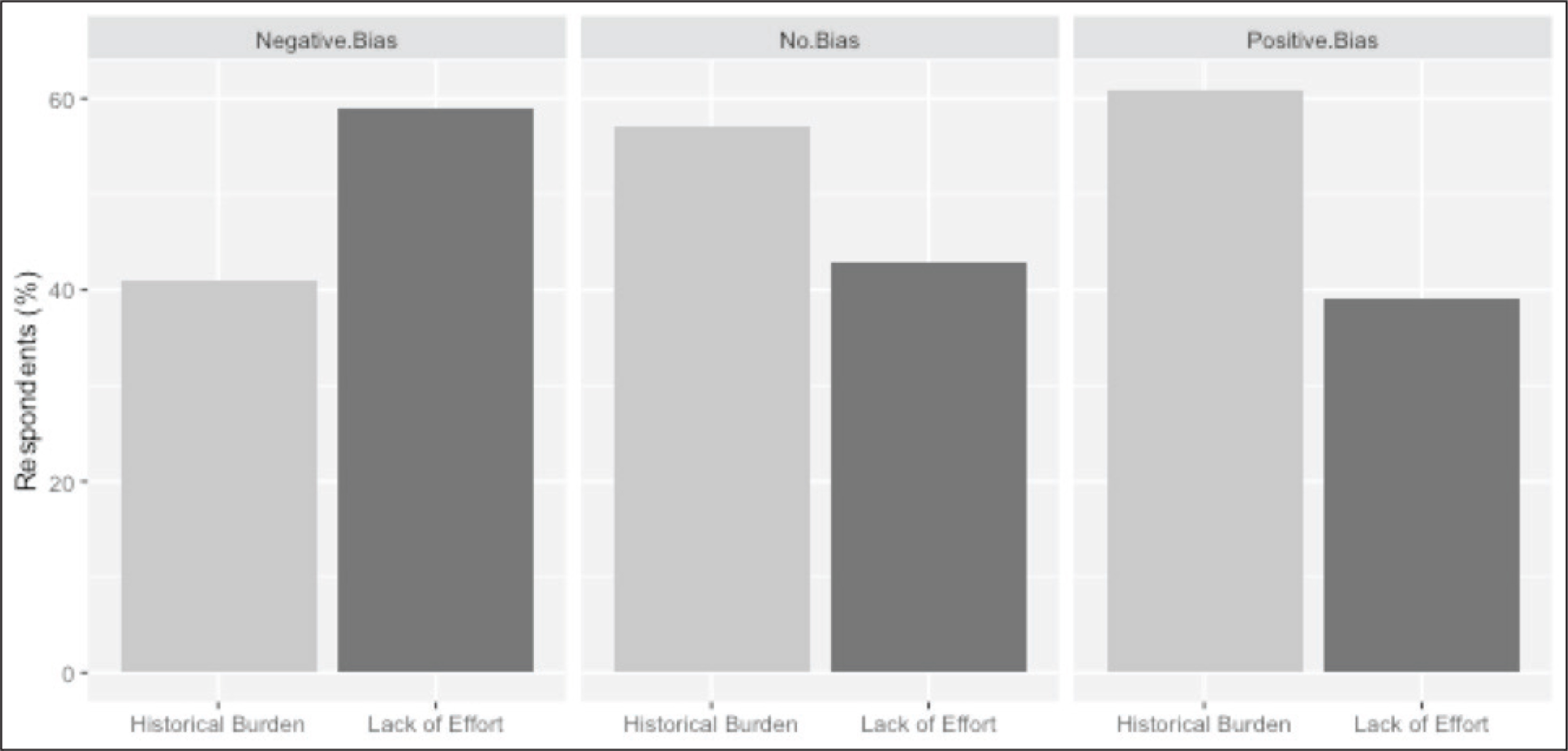
I begin the statistical exercise by presenting cross-tabulations between the dependent variable and the key independent variables of interest. Figure 2 presents the relationship between the dependent variable and bias (Neg.Bias, No.Bias and Pos.Bias).
Note that among upper caste respondents who view both groups as equal, approximately 43 per cent hold the opinion that Dalits lack effort. Among those who exhibit a positive bias, the proportion drops to about 39 per cent. However, among those who exhibit a negative bias, the proportion of upper caste respondents citing Dalit lack of efforts increases to 59 per cent. The likelihood of an upper caste respondent choosing statement 2 decreases by 4 percentage points when bias is positive (compared to those with no bias) and increases by 16 percentage points when bias is negative.
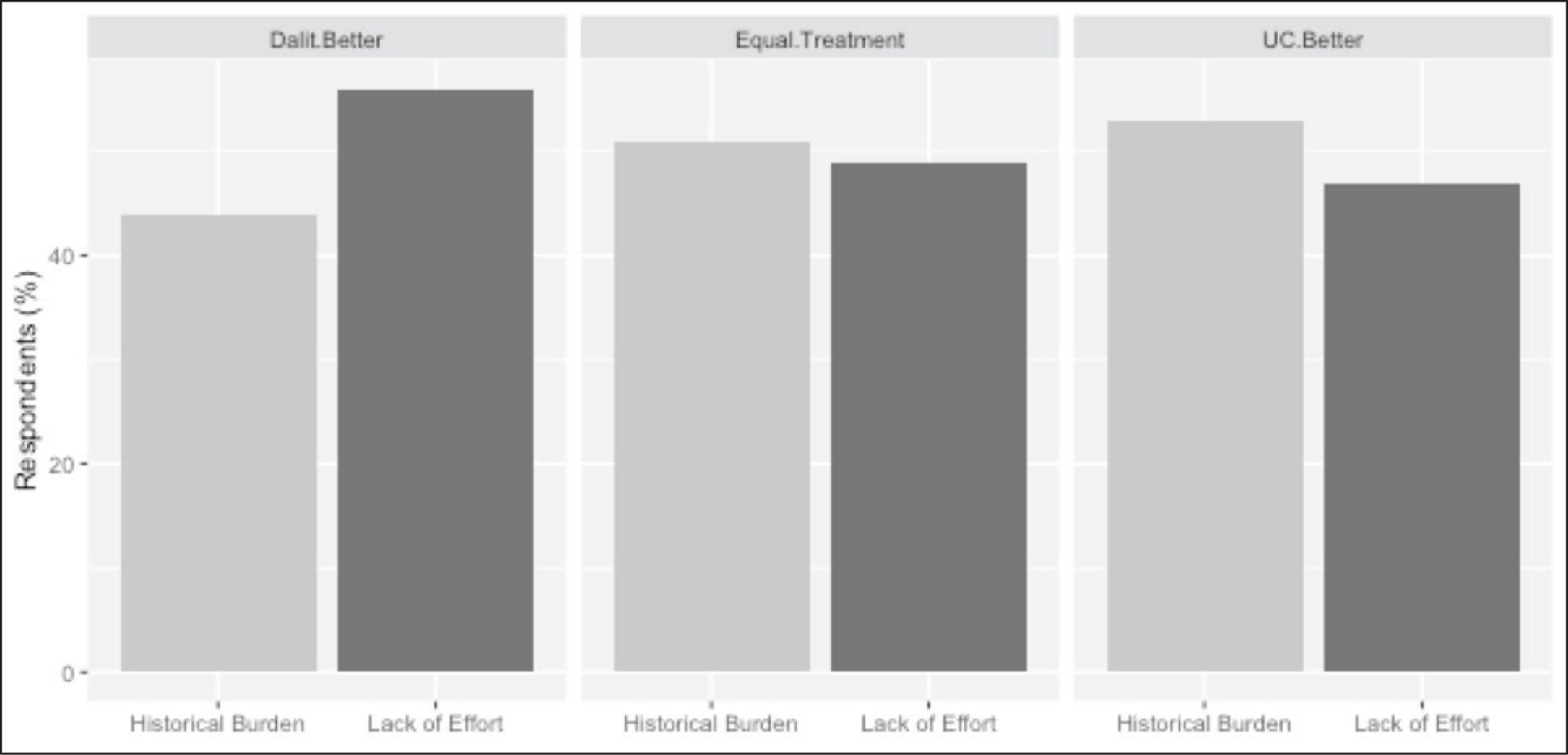
Figure 3 presents the relationship between the dependent variable and perceptions of treatment by government officials (Dalits.Better, Equal.Treatment and UC.Better).
We see that among upper caste respondents who think that both groups are treated equal by government officials, approximately 49 per cent choose statement 2. Among those who perceive upper castes as being treated better, the proportion drops to 47 per cent. This proportion increases to 56 per cent among those who think Dalits are treated better; that is, the likelihood of an upper caste respondent choosing statement 2 decreases by 2 percentage points when the respondent perceives better upper caste treatment by government officials (compared to those perceiving equal treatment) and increases by 7 percentage points for those who perceive better treatment of Dalits.
The above empirical assessments provide preliminary evidence for the hypothesized relationships between upper caste perceptions of the reasons for Dalit socio-economic conditions and the independent variables of interest: bias and unfair treatment. Respondents who hold a negative bias are more likely to choose lack of effort, and those with a positive bias less are likely to do so. Similarly, respondents who think Dalits are treated better by government officials are more likely to choose lack of effort, and those who see upper castes treated better are less likely to do so.
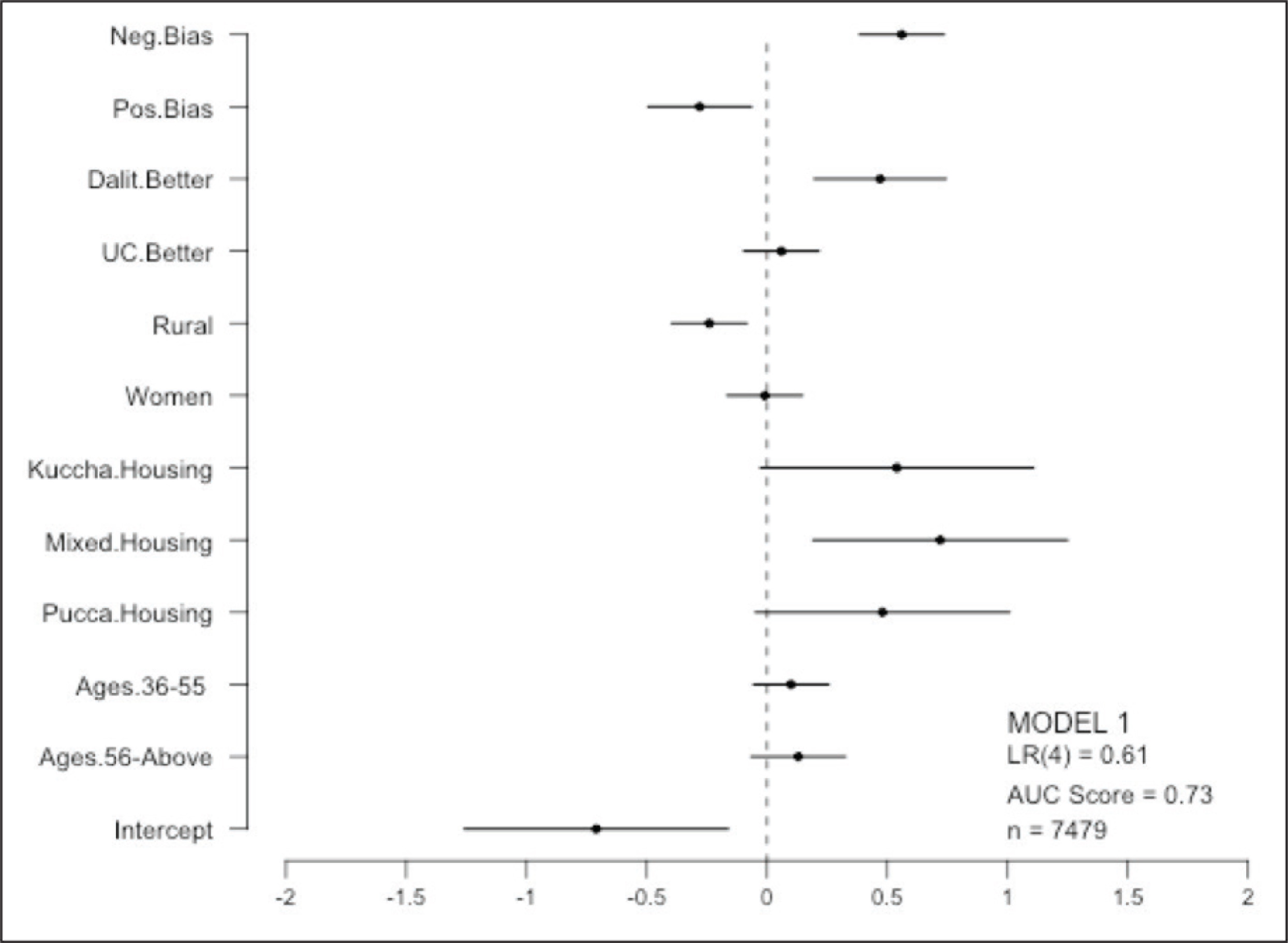
Figures 4A and 4B present the results of a logistic regression that tests the validity of the hypothesized relationships in the presence of other factors such as respondent socio-economic and demographic characteristics. In Figure 4A, the dots represent the point estimates (i.e., coefficients), and the horizontal line passing through the dot indicates the 95 per cent confidence interval computed using robust standard errors. A coefficient is considered statistically different from zero, that is, statistically significant, if its confidence interval does not intersect the vertical dashed line, representing 0 (Kastellec & Leoni, 2007). Figure 4B presents marginal effects of the independent variables as probabilities.
Controlling for respondent socio-economic and demographic characteristics, the key independent variables have statistically significant effects in the expected direction on the perception that Dalits lack effort. Figure 4A shows that respondents who exhibit a negative bias are more likely to view Dalit socio-economic conditions as a result of lack of effort relative to respondents who report no bias. Conversely, respondents who are positively biased are less likely to do so. Note that the coefficient for Neg.Bias falls to the right of the vertical line and that for Pos.Bias falls to the left. Neither confidence interval intersects the vertical 0, indicating that the effects are statistically different from 0 or systematic. Similarly, the perception that Dalits are treated better, relative to upper castes, by government officials also increases the likelihood that a respondent views Dalits as not trying hard enough. This effect too is statistically significantly different from 0. However, the perception that upper castes are treated better does not lower the same likelihood, that is, the effect is not statistically significant.
Among the control variables, economic class has mixed effects. Respondents from mixed type housing are more likely to subscribe to the view that Dalit socio-economic conditions are an outcome of lack of effort relative to respondents in informal housing. Respondents from other housing types are not different from respondents in informal housing. Rural respondents are less likely to hold the above view compared to urban respondents. Respondent age and gender have no statistical effects.
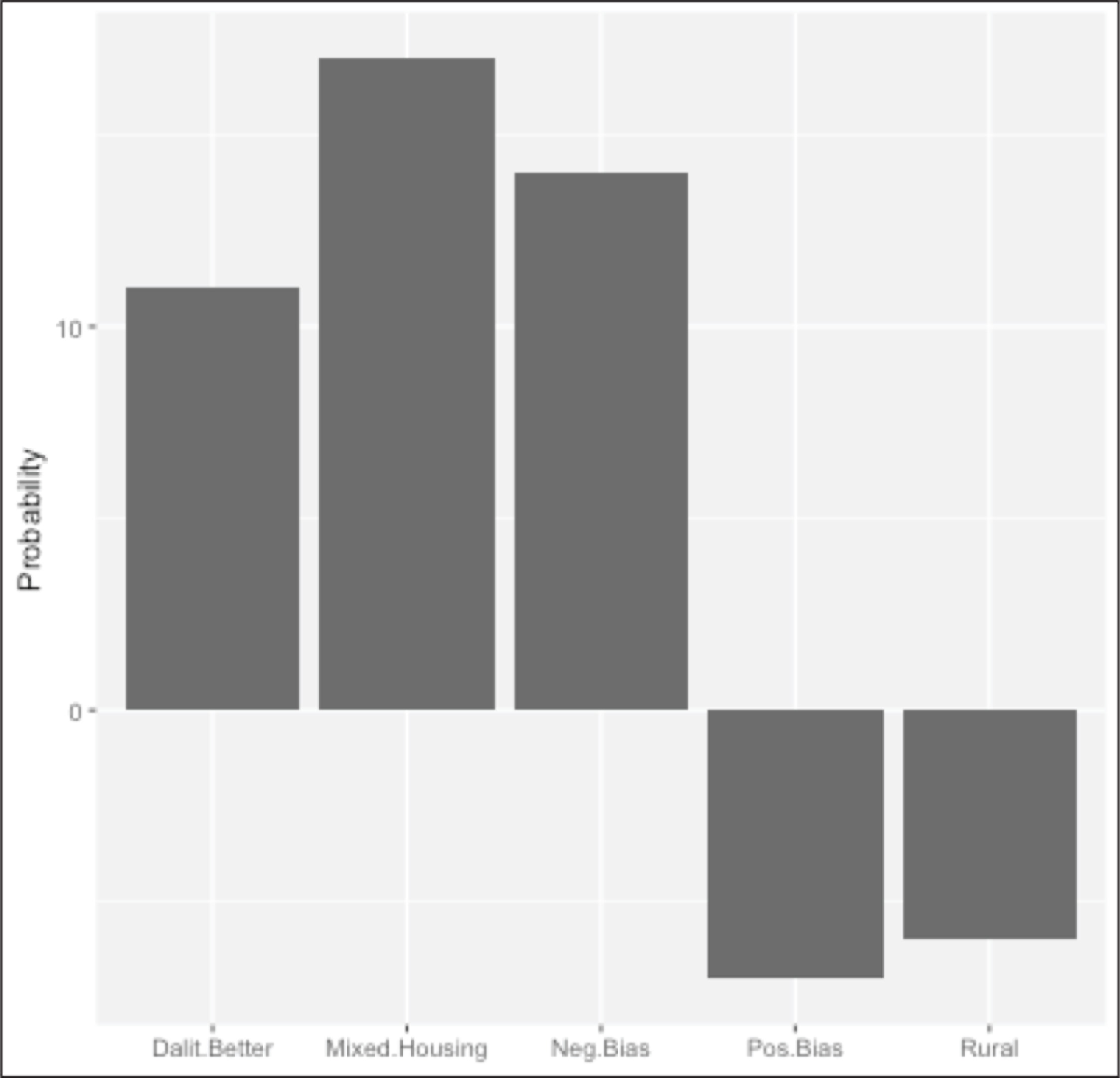
The substantive effects of significant independent variables are presented in Figure 4B as probabilities. Note that the negative values of the probabilities (in Figure 4B) represent a negative effect on the dependent variable (i.e., lowering the upper caste opinion of the lack of effort of Dalits). The probabilities indicate that a negative bias has a strong and significant effect.
Respondents who hold a negative bias are 14 per cent more likely to subscribe to a view that supports a lack of effort by Dalits relative to respondents who exhibit no bias. A positive bias lowers this likelihood by 6 per cent. Similarly, a perception that Dalits are better treated by government officials increases the same likelihood by 11 per cent compared to those who see both groups treated equally. Respondents from mixed type housing are 17 per cent more likely to subscribe to the above view relative to respondents in informal housing, and rural respondents 6 per cent less likely to view Dalit socio-economic conditions as an outcome of lack of effort. 2
While the primary focus of this article is the opinion expressed by respondents who identify as upper caste, I extend the analysis to examine the opinions of the dominant and non-dominant caste OBC respondents. Given that dominant and non-dominant caste OBC outrank Dalits in the social and ritual hierarchy and, therefore, likely to consider themselves as ‘upper caste’ relative to Dalits, I expect their views regarding Dalit socio-economic conditions to exhibit correlations identical to those outlined in the hypotheses earlier; that is, dominant caste and non-dominant caste OBC respondents who exhibit a negative bias are more likely, relative to those who see both as equally hardworking, to hold the view that the low levels of Dalit socio-economic development are a result of a lack of effort among Dalits, and those who believe Dalits are treated better compared to the upper caste by government officials are more likely, relative to those who think both groups are treated equally, to view Dalit socio-economic conditions as a consequence of a result of a lack of effort among Dalits. The results of the analyses, when extended to the dominant and non-dominant caste OBC respondents, are reported in Tables A2 and A3.
For dominant caste OBC respondents, a negative bias increases the likelihood that a respondent views Dalits as lacking effort by 12 per cent. This likelihood is about the same, 12 per cent for non-dominant caste OBC respondents. While the effect of a negative bias is consistent with expectations for both groups and statistically significant though weaker in magnitude relative to upper caste respondents, the effects of a positive bias exist only for the dominant caste OBC respondents. Those who exhibit a positive bias are 6 per cent less likely to view Dalits as lacking effort. The unfair treatment hypothesis finds only partial support, and only among non-dominant caste OBC respondents. Those who think that upper castes are treated better than Dalits by government officials are about 5 per cent less likely to hold the opinion that Dalit socio-economic conditions are a result of a lack of effort compared to those who think that both groups are treated equally. Results are not significant for the dominant caste OBC groups. Among the dominant caste OBC, rural respondents are 6 per cent more likely to view Dalits as lacking effort compared to urban respondents. Other variables such as economic class, age and gender have no effects in these models.
Conclusion
In this article, I empirically examine the reasons upper caste individuals attribute to the relatively low levels of material and human development among Dalits in India today. What factors account for the observed variation in upper caste responses? I find that two commonly held explanations for much of the observed upper caste behaviours towards Dalits also explain why some upper caste respondents view Dalit socio-economic conditions as an outcome of Dalits lacking effort of industry while others believe it to be a consequence of a historical burden. The first is a negative bias towards Dalits that arises when upper castes perceive themselves as more hardworking relative to Dalits. The second is a perception of unfair treatment towards upper castes by government officials and better treatment of Dalits. The results of this analysis using PSBE data are consistent with recent scholarship on caste. They show that modern attitudes and opinions about the reasons for the relatively low levels of social and economic development among Dalits mirror traditional caste prejudices but are articulated in newer and modern forms. Similar patterns are obtained when the analysis is extended to include dominant and non-dominant caste OBC groups.
Recent decades have witnessed a political momentum among Dalits not only through electoral participation but also through civil society-based anti-caste activism. Focusing on caste as a structural cause of poverty and inequality, activists have sought to integrate Dalit human rights into the development debate. Dr. Ambedkar forcefully declared in 1948 that, ‘Constitutional morality is not a natural sentiment. It has to be cultivated. Democracy in India is only a top dressing on an Indian soil which is essentially undemocratic’. Dalits continue to face denial and exclusion, hate and violence, restricted access to new opportunities and limited occupational mobility as well as ‘dignity humiliation’. Indeed, persistent graded inequality reinforced by denying the historical burden borne by Dalits over centuries ultimately renders claims of social change meaningless and democratic deepening a pipe dream.
Footnotes
Acknowledgements
I thank Srikrishna Ayyangar, Sandeep Shastri and an anonymous reviewer for their thoughtful comments on an earlier version of this article. All errors remain my own.
Declaration of Conflicting Interests
The author declared no potential conflicts of interest with respect to the research, authorship and/or publication of this article.
Funding
The author received no financial support for the research, authorship and/or publication of this article.
Appendix
List of dominant caste OBC (entrenched castes): Jat (Hindu), Reddy, Kamma, Kapu, Marathas, Patidar, Lingayat, Vokkaliga, Gujjar, Thevar, Yadav, Kurmi, Vanniyar and Nair.