



Abstract
Media is an integral part of any society. In modern societies where it has grown so much, it becomes very important to pay attention to the role of media in constructing the social. This article discusses how the role of press in establishing the hegemony of the modern-industrial west works through the politics of news, establishing the hierarchies in the politics of knowledge in general and therefore also in the project of development. It argues that in post-colonial societies, the latter includes a process of marginalization of already existing knowledge systems, for long and more commonly referred to as ‘traditional knowledges’. Exploring initiatives in creating counters to mainstream media, the article also invites a problematization of the category of ‘alternative media’ as a true alternative presenting peoples’ perspectives on development.
Keywords
Introduction
In an increasingly mediatized world, communication becomes the axis of human life. From language to communication technologies ranging from print to internet, as McLuhan et al. (1967) argue, media not only alters but creates a distinct social reality. Media historians like Innis (1950, 1951) argue that media is instrumental in rise and fall of empires. Use of any media requires specific skill sets that change with the change of media. Through controlling media, formation and dissemination of knowledge can be controlled resulting in larger socio-economic-political changes.
The advent of mass communication prompted radical changes in human society. Pre-modern knowledge systems marked by decentralized, face to face, oral communication (referred to in this article as Already Existing Knowledge Systems or AEKS) were marginalized by a more abstract form of mass communication—the print. This was characterized by centrally organized production of information and knowledge for mass consumption, the hallmarks of modernity and modern institutions, as argued by scholars like Thompson (1995) and Anderson (1983).
This article argues that, the print medium, also helped establish the hegemony of modern knowledge systems, as media plays a key role in defining, disseminating, legitimizing and thereby, making any knowledge hegemonic. It offers a preliminary investigation of the role of media in creating a particular discourse on ‘development’, which rests on this hegemonic knowledge and aims to be a contribution to the politics of knowledge in development argument. It will unpack the instrumentality of the print media through an analysis of rural/agrarian reporting in the mass media—both mainstream and alternative. The rural in the mainstream media is generally seen as traditional and non-modern and therefore represented very differently from modern-urban. To explicate the approach of mainstream print media towards the rural, this study focuses on farmers’ representation in it. Farmers constitute the largest part of rural population, are also the carriers of AEKSs and have been strong enough to make their voices heard even in urban spaces (the farmers agitations of the 1980s and 2020–21 can be seen as examples), and yet are not considered important in the modernization discourse of development. 1 The rural/agrarian in the English and Hindi mainstream press occupies very limited coverage both in terms of space as well as themes and issues. Vipul Mudgal (2011) shows that the mainstream press gives only 2 per cent space to rural news, within which 36 per cent goes to violence and accidents. My study (2016) confirms that they consider the rural/agrarian obsolete and unfit for modernity. On the contrary, alternative print media presents the perspective of AEKS and offer a critique of the very foundation of the institutions of the modern state and economy and thus of modernity itself.
Through an analytical framework, of the politics of knowledge, Banerjee elucidates how AEKS have the potential for solving problems generated by modern knowledge systems (2021). This article discusses the role of media in all five arenas of knowledge production discussed by Banerjee. While the sections on historical context and policy formulation touch upon the role of media in marginalizing AEKS and establishing the supremacy of the modern knowledge systems, the sections on political-economy and collective actions explicate the same through a detailed study of cases from both mainstream and alternative media. Focusing on political-economy and collective action provides an opportunity to discuss two different press worlds and media as a site of contestation between two discourses of development. It is important here to underline the fact that the spectrum of the print media in India, like anywhere else, is wide and vibrant. Between the two ends of profit oriented mainstream media and alternative media challenging the ideology of modernity, there are a range of publications, adhering to different issues and ideologies. Each such publication tries to create a distinct public sphere by providing the readers a specific ideological lens. Viewed from the politics of knowledge perspective however, most such alternative publications, while providing critiques of state and economy, rarely discuss the fundamental idea of modernity manifested through these political-economic institutions; it seems to be a given in most alternative media. For instance, Ninan’s (2007) discussion on press penetration in the Hindi heartland as a significant extension of the modern public sphere, misses that this extension does not democratize the rural public as it is one way flow from cities to heartland. The press rarely discuss peoples’ issues from the ground up and more importantly, generates aspiration to be modern-urban, rather than providing solutions from an alternative rural base. A powerful alternative media publication Khabar Lehriya 2 that truly tries to create a public sphere with feminist-dalit sensitivities, does not really challenge the concept of modernity and development. Similarly, many left and dalit publications take modernity as unquestioned and therefore can hardly be defined as alternative from AEKS standpoint.
This article takes one case, The Times of India (ToI) (Delhi Print edition), from the mainstream print media representing the modernist idea of development and one case from the spectrum of alternative print publications that fits the AEKS perspective, Samayik Varta (SV).
The last section on epistemology problematizes the understanding of alternative print media itself by underlining the problems faced by most of their publications and tracing these problems back to the idea of modernity informing the dominant development discourse.
Historical Context
The presence of communication systems in the complex of social–political and economic institutions manoeuvres, if not controls, the power equations of a given society, themselves becoming a site of contestation between various power structures. Literature on the history of media helps to arrive at a better understanding of the aspects of knowledge creation, dissemination and legitimation which form the core of the politics of knowledge debate. Harold Innis argues that at a mega level, every change in the empire is linked with the change of media systems of their times and contribute to different characters of the empire. New media challenges the dominant communication system affecting established power structures, paving the way for new power equations and establishments (Innis, 1950). On the other hand, McChesney (2008), Eisenstein (1979) and Thompson (1995), discussing the linkages between modern state, capitalist market and mass media, argue that despite the crucial role media plays in determining power hierarchies, it gets less attention than deserved.
Print crucially changed the face of communication in the modern period, in that, the message ‘became independent of face’. The abstraction of message and absence of personal contact contributed to the idea of individualism and earlier modes like interpersonal communication became less relevant for knowledge creation and dissemination (Eisenstein, 1979; Thompson, 1995). Gellner emphasizes that print medium was the primary factor in the creation of the modern nation-state whose very characteristics ‘engenders the core idea of nationalism’ (Gellner, 1983, p. 126). Anderson (1983) famously argued that ‘nation’ as ‘imagined community’ could only come into existence with print technology and print capitalism. The primary features of a modern economy are standardization and large-scale production. To generate appreciation for and create demand for new modern commodities, a change of perception/attitude was required. Mass media fulfilled this by sheer reproductive ability of a message along with standardized language, education, aspirations and attitudes—commodification of the message itself. Economic historians Dittmar (2011) and Baten and van Zanden (2008) show a close link between printing and economic growth through historical data. 3
The implication of print medium’s central role in processes of homogenization, standardization and commodification for the modern nation-state and modern economy proved fundamentally antithetical to AEKSs, based in local ecologies for local consumption, with a worldview of keeping balance in nature and a propensity to be within the reach of most people (Banerjee, 2021).
Public Policy
The print medium was used by political power during the colonial period in India to alter the social of the colonized and replicate the ‘political’ and ‘economic’ of Great Britain in the colonies. In the west, new scientific subjects and disciplines, changes in the education system and the elite taking the lead in studying them not only contributed to the diminishing of religious education but also helped ‘vernacular’ languages establishing their dominance, by printing modern educational material in them (Thompson, 1995). Thus, these languages became the prime carrier of all modern knowledge, leading to the marginalization of AEKS. Contrary to this, colonies faced dominance of one language—English as carrier of modern knowledge—while role of ‘vernaculars’ was largely constricted to producing recreational material resulting in the sidelining of ‘vernaculars’ as a medium to create and disseminate knowledge.
The colonial state opted for a two-pronged policy towards print media, favouring publications helping in maintaining the dominance of their rule and censoring those questioning or criticizing them. Further, it favoured missionaries for an education system through a network of English education institutions with uniform syllabi providing ‘scientific knowledge’ (Kalapura, 2007, emphasis added), for which textbooks were printed in English. Thus, the definition of knowledge became co-terminus with modern disciplines and the association of English with them established its superiority. Missionaries were also printing text in vernacular Indian languages but those texts were largely limited to theological and philosophical treatises, but this changed in the nineteenth century. 4
Thus, most pre-colonial modes of communication were rendered inauthentic and so the traditional knowledge systems existing in forms of ‘vernacular’ texts, folklores and songs, etc., were pushed out of the knowledge regime. Equally, those coming from the classical written knowledge traditions in India were pushed to margins. Kaviraj (2005) argues how Sanskrit no longer remained the language of the power elite because the character of power itself changed. Kaviraj’s argument can be extended to knowledge systems beyond Sanskrit language and Shastrik traditions as well. Thus, the process of establishing the hegemony of the modern west came through two interlinked routes—political power and English language—and print mass media played a central role in providing the channels. This systematized the marginalization of AEKS—including localized knowledge systems.
The knowledge question and print medium scenario in colonial India can be also understood through the conceptual tools of ‘inner’ and ‘outer’ domains (Chatterjee, 1993). It can be inferred from both Kaviraj and Kalapura’s work that the ‘vernacular’ languages focused more on the ‘inner’ domain—culture, philosophy and religion while the ‘outer’ domain—the domain of public policy, economy, rationality and scientific knowledge is represented by the west. The Indian elite, under the impression of western education also took it as given and did not question the ‘knowledge’ frameworks coming from the west and that they were not an organic part of Indian societies. 5 Most thinker-activist leaders of the freedom movement were highly impressed by the western civilization and its idea of development and dreamed of replicating it in free India.
It is important to understand that the materiality of AEKS in pre-colonial society is dialectically opposite of the knowledges created in the modern-industrial west. While the former is characterized by decentralization, local consumption and production and sensitive towards ecological balance, the latter is by centralized production for mass markets, individual profit and neglect for environmental concerns. This has also led to a growing un-democratization of knowledge in society by concentrating decision-making powers in few hands. Yet the belief that economic prosperity directly resulting from the material basis of modern production would solve sociopolitical problems, dominated the thought process of the post-colonial leadership, across ideologies. Debal Deb calls it the western idea of developmentality and argues how the colonial campaign of development is unquestionably accepted by ‘post-colonial idioms of development’ (Deb, 2009).
Political Economy
This section discusses two ideas: how mainstream mass media, as an active player in the project of modernity, aligns itself with modern market and the state in order to first, homogenize and prioritizing the aspirations of people towards being consumers rather than citizens; and second, constituting a hierarchy of knowledges such that AEKS and the voices of the people associate with them are marginalized. Thus, it has structural problems in being a voice of the people, and also indicates the embedded biases of modernity towards traditional knowledge and occupations. The work of many scholars like Chomsky (1997) and McChesney (1999, 2008) provides the bedrock of this argument. In the light of this argument, this study analyses representation of farmers and agriculture in the most circulated English daily in India—ToI spanning three decades—1980 to 2009. Nine sample years were selected between 1980 and 2009 in which the weeks and days are divided to ensure equal representation of all weeks and days. 6 The perspectives from which this analysis will be presented are: themes, placement of the news, the sources, text analysis of reportage, the news styles and format and the creating of a new business model for the print media. The themes most repeatedly discussed in the newspaper were observed and 19 themes including farmers’ poverty, farm production and procurement issues, drought, flood, irrigation, land acquisition and farmers’ movement, relationship with tribal communities, issues of the environment, loan waiving, etc., were listed in the code-sheet prepared. Any news item that did not fall under these categories but mentioned farmers or agriculture was categorized as ‘none of the above’ (referred to as ‘other’ in this article). The first, most important conclusion of the study showed that most news stories about farmers and agriculture were traced under the ‘other’ category. A significant number of stories either do not mention sources or come from official sources. Also, a reduced coverage on this on opening the newspaper industry to Foreign Direct Investment (FDI) in 2002 is seen.
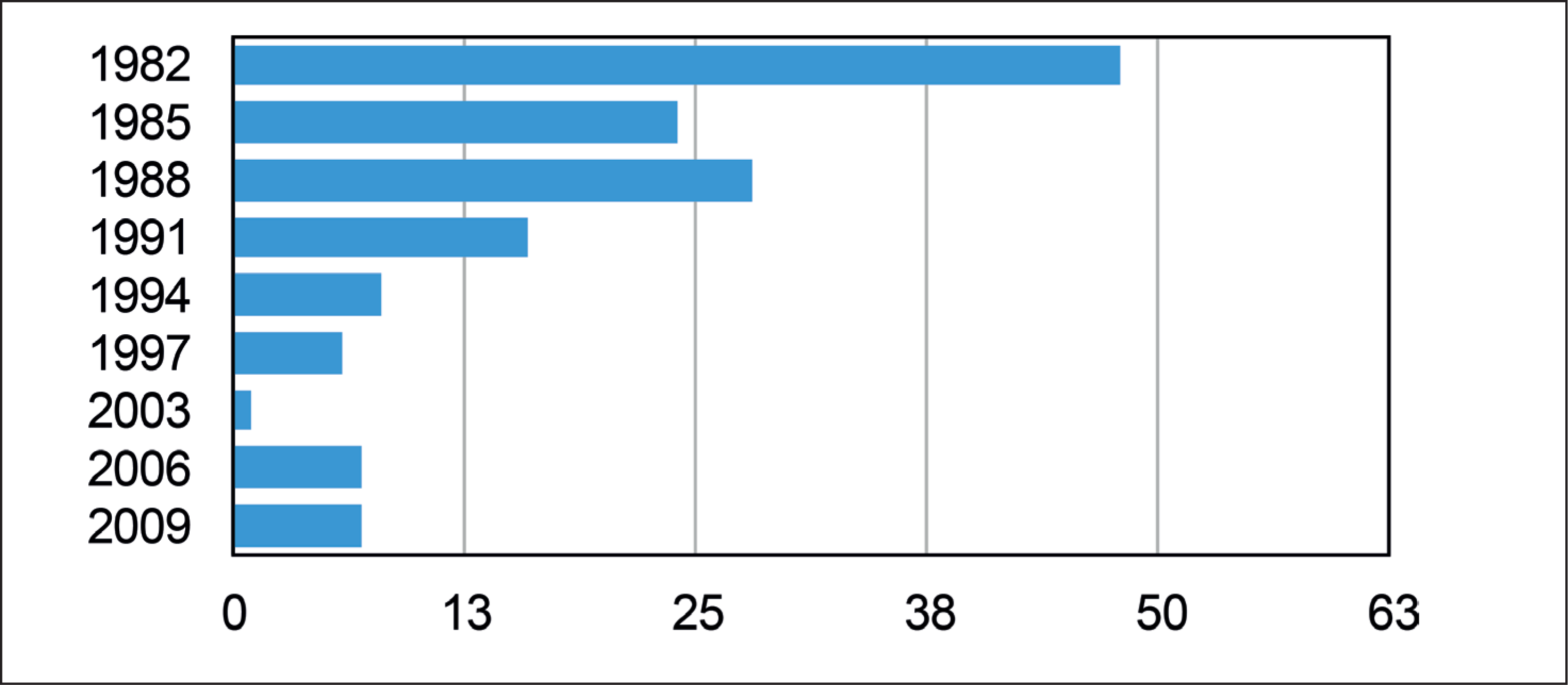
The table given in Figure 1 shows a constant decrease in the news items on farmers and agriculture, about less than 50 news stories on more than 50 per cent of the population. 7 The increased number in 1988 was due to the panchayat held by the BKU at Boat Club in Delhi. While this itself is enough to expose the ‘democratic’ nature of the mainstream media, a closer look at the above statistics shows a worse picture.
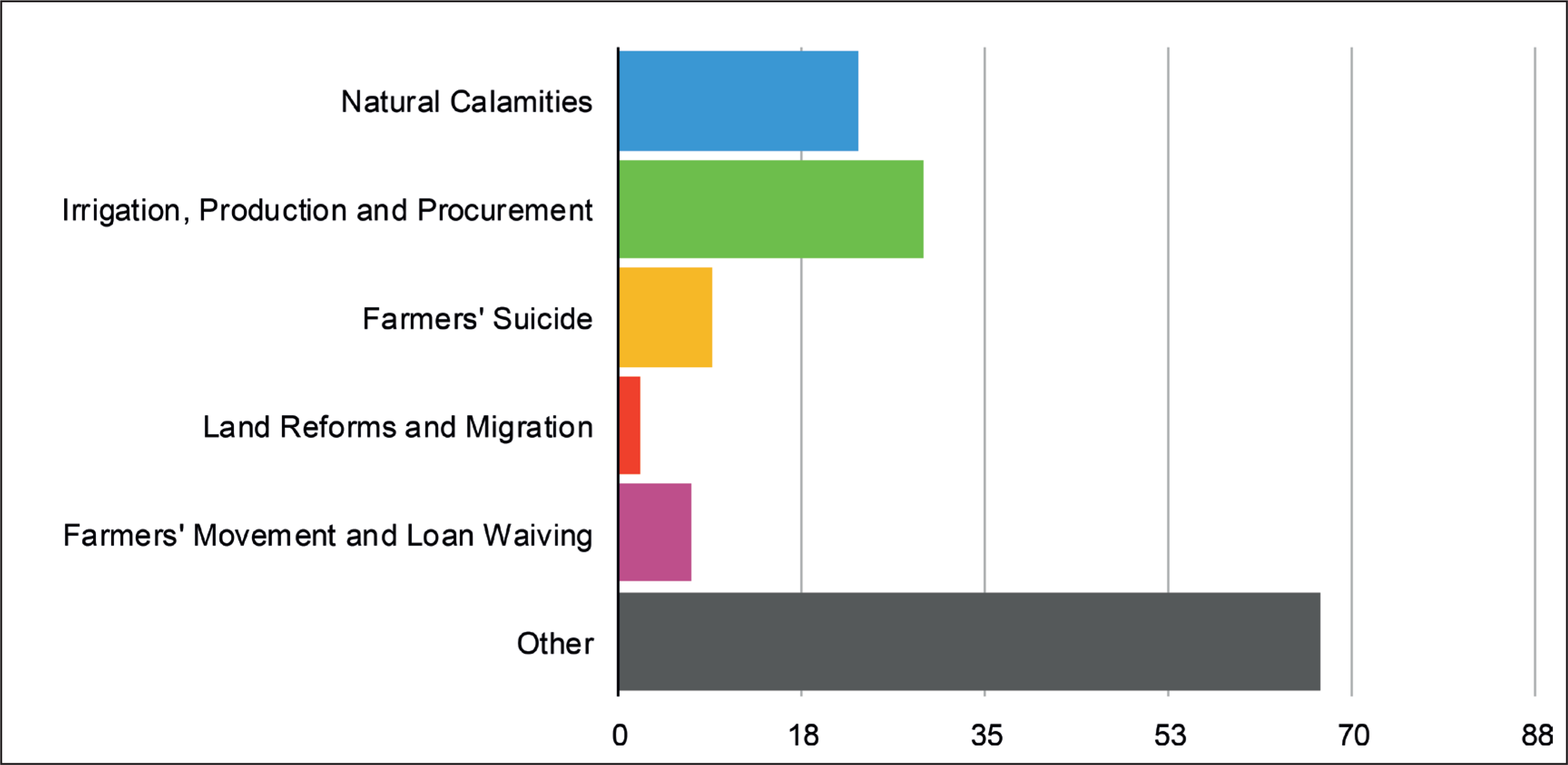
A discussion on the themes under which farmers and agriculture are covered (Figure 2) shows a significant number of news items covered as ‘other’, indicating that the newspaper, while providing space to farmers and farm issues, does not discuss issues most relevant to them. For example, there is a single column news on the union agriculture minister asking scientists to convince farmers to grow more pulses (ToI, 19/04/1982) or the director of the Food and Agriculture Organization reportedly saying that ‘poor farmers must grow more food to avoid famine’ (ToI, 20/03/1985), ‘Tau and the art of tourism’ (ToI, 06/01/1991), mockingly discusses the order by the then deputy Prime Minister, Devi Lal, to offer discount in five star hotels to anyone who comes wearing a dhoti, while ‘Tikait rising on the crest of agitation’ (ToI, 31/08/1991) describes M. S. Tikait’s popularity as he could level frequent and violent agitations in order to create political clout. Such news are covered without any background and largely gave news space to persons than issues.
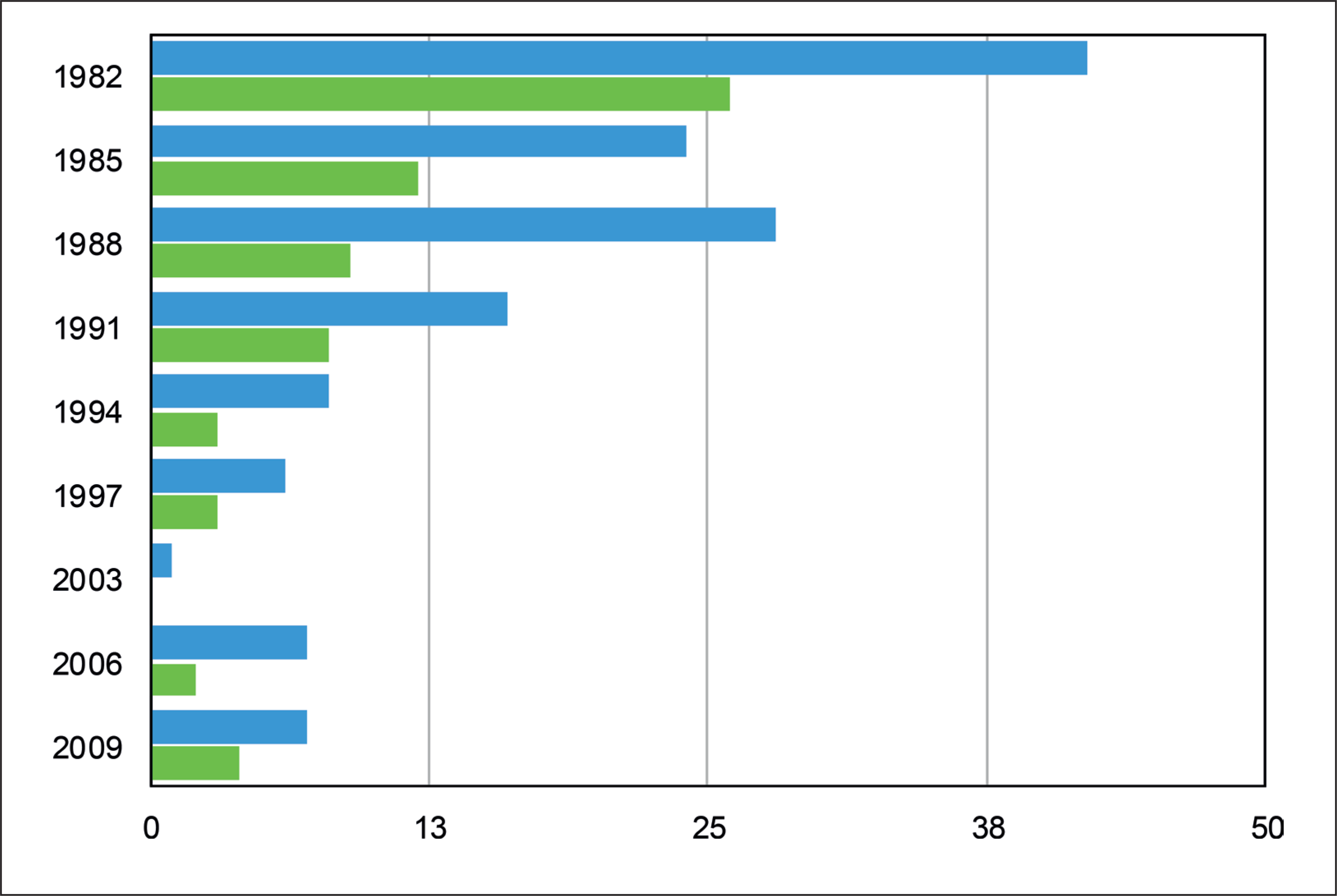
This is also evident in a year-wise distribution of the category ‘other’ (Figure 3). Even in 1982, when the highest number of stories were recorded, 67 per cent of the total coverage were of the category ‘other’. In subsequent years too, the proportion remained more or less the same.
Another very important aspect of news analysis is the ‘source’ of the news (Figure 4), a reflection on the newspaper’s effort to provide information from various perspectives and stakeholders. My study shows that most news items on farmers and agriculture are either without source or with official sources like high-ranking executives or experts in the government. The table in Figure 4 indicates that the newspaper rarely considers a perspective other than that of the state.

Apart from this, the editorial coverage of ToI had 3 editorials and 9 articles. Of the three editorials, two focus on making agriculture more scientific and building an industrial support system for Indian agriculture. One covers Meerut agitation by BKU criticizing the protest, arguing that Tikait’s support comes from the traditional community sources and that his ‘shrewd’ attempt of ‘wooing’ Muslims and Dalits is only due to acknowledgement of the fact that only Jats cannot create a successful agitation, never discussing the demands of the protestors. Such assumptions in an editorial are completely devoid of sociological understanding of the region, agriculture as occupation and community, never raising adverse effects of modernization of agriculture on environment and employment, routinely discussed in various academic works including Vandana Shiva (1989) and Sau (1988). 8
Apart from the quantitative analysis of ToI showing increasing absence of farmer and agriculture, the text analysis of the reportage presents this dismal representation of farmers and agriculture with negative connotations. The coverage of the 2009 farmers’ protest in Delhi not only does not voice farmers demands and opinion, it portrays farmers as a ‘nuisance’ compelling the state to concede to its demands because of vote bank politics. While trying to paint farmers as ‘anti-social’ elements, the newspaper discusses their demands only twice in the coverage of two days, against basic journalistic principles.
The first day of the protest was covered with a front-page headline ‘Kisan Jam’ with a subtitle ‘Farmers Run Riot in the Heart of Capital’ (ToI, 20/11/2009). The story explains that ‘For three hours they ran riot in the heart of city—Connaught Palace damaging public property looting shops and teasing women with cops watching silently…’. Use of expression like ‘holding city to ransom’, or ‘mayhem broke’ suggests that farmers had a complete disregard for the city and its people. Page 4 covered the protest under the heading ‘Caned! City Under Siege’ said that the farmers ‘ruled the city from morning to early evening’ and ‘threatened to camp in the city if the government fails to address their concerns’. While the concerns of farmers were not discussed, a lot of long quotes showing the suffering of ‘Delhites’ were quoted in detail. Another news story ‘Ajit, Tikait heap threat on threat to teach Delhi a lesson’ (ToI, 20/11/2009, page 2) suggests that the protest was being used by the political leaders to teach a lesson to the then Uttar Pradesh state and the Union government. ‘Central Delhi Feels the Heat: Traffic Thrown Out of Gear’ ToI, 20/11/2009, page 2, talks about the severe traffic jam the farmers’ protest had caused on an important day. The coverage of this protest can be considered representative of the coverage in the mainstream media, as most dailies shared a similar approach. There is not a single quote on, or opinion of the farmers who came to protest to explain why they were here and why they were doing what they did.
ToI presents a typical example of mainstream media in a rapidly globalizing world where all elements of the communication system—techniques, news styles and format—are increasingly dominated and informed by the western news media. This has a ripple effect in the Indian news economy compelling almost all the other mainstream newspapers to follow (Jagannathan, 2012). It also practiced the concept of ‘audience commodity’—media selling its readers/viewers to its advertisers (Smythe, 1981). Bhaskar Das, a BCCL board member explains the company’s philosophy saying, ‘his (Vineet Jain’s) mind was clear on what business we were in. We knew we were in the business of aggregating a quality audience. Before that we just sold the advertising space’ (Jagannathan, 2012). Advertisers require a market friendly media that can aspire people to be consumers and therefore contentious issues, depressing news and challenges to existing power structures should be avoided, keeping readers feeling important and happy, to be able to consume advertisers’ products (Udupa & Chakravartty, 2012). Farmers are neither readers nor primary consumers of these and thus both farmers and their issues are increasingly marginalized in the mainstream news space.
However, the political-economy approach does not entirely explain the negative representation of farmers, especially ‘protesting farmers’. It lies deeper with the mainstream media identifying the ‘traditional’, ‘feudal’ and ‘irrational’ for not understanding the worth of modernization of agriculture through the open market and hence innately opposed to modernization of the economy and the development paradigm. This, to them, justified the negative reporting. Unlike many traditional practices like Ayurveda making their way to the market, farmers are in a more confrontational relation with the modern state and market, seeing marketization of farming as damaging economically and socially and their large numbers enable them to pose an opposition to both, therefore also treated with antipathy by the mainstream media.
In looking for an alternative media space that would be critical of the liberal state and market, many scholars like Allen (1985) and Sparks (1985) posed their faith in the socialist press, controlled media outlets for the purpose of building organizations for radical transformation. However, this idea of the press proved to be limited for peoples’ expressions beyond the ‘working-class press’ paradigm. Experience shows that the both liberal and socialist press fell short in providing space to AEKS, because of their shared commitment to the common modernist frame of knowledge and their common dislike and rejection of the AEKS characterized by pre-modern features challenging the modern system of production, distribution and consumption. Hence, there was a vital need for an alternative media, that does neither have stakes in the market nor the limited scope of radicalization of the working class. This led to a wide range of alternative media like z-magazines, radical media, movement media, citizen media, etc.
The next section takes this discussion to how certain collective actions in the sphere of media communication, challenged the western hegemony of development discourse and come very close to supporting AEKS.
Collective Actions
Many media scholars and activists thus posit their faith in alternative media for two reasons. First, as indicated before, because the mainstream media characterized by five filters (Chomsky & Herman, 1988) rules out the possibility of critical engagement with the state or market. Second, given the basis of the logic of production and consumption on the basis of which AEKS run, their interests can never be served by a typical mass media. While mainstream media is defined by its well-defined institutional hierarchy, centrally operated professional staff and by its profit orientation, alternative media is marked by small-sized media ventures largely run by untrained people. Yet the faith of scholars in their political potential is due to their association with and support to local systems of production and consumption, ideologically opposing the dominant ideology of development of the state (adopted from the modern-industrial west) and seeking to articulate alternative perspectives to it (Atton, 2002). Given that it does not have stakes in the market, it is thus free to discuss peoples’ agenda. A study of one such alternative media publication—Samayik Varta (SV) helps us understand the role of alternative media in a critical engagement with the dominant development discourse.
This magazine was set up with an objective of playing the conscience keeper of the Janata Government (1977–80) but soon turned its vehement critic, in the light of the government’s moving away from the ideals of M. K. Gandhi, Jayprakash and Lohia. Throughout the 1980s, 1990s and 2000s, the magazine provided not only an alternative political vision, it also tried to project voices of various social movements by establishing a bridge between their activists and intellectuals. The most important critique of the government presented by it was about political-economic issues—debates on development discourse and critical analysis of government policies on agriculture, small scale industries, dastkari, extraction of natural resources in tribal areas, etc. Locating development in its sociopolitical context, outside an exclusive economic sphere, SV constantly analysed it from the lens of caste, gender, education and language.
The magazine periodically moved its centre of publication, from Calcutta (1978), Benares (1984), Muzaffarpur (1989), Benares (1994), Delhi (1998), to wherever there was a more committed team. While each change brought a different flavour to the layout and format, ‘Andolan Samachar’ (Movements News) remained a constant feature of the magazine, something no mainstream media organization, despite the resource pool at its disposal, is able to carry, as the voice of people. This column contained news from Tapsili Jati-o-adibasi Sangathan resistance in North Bengal (October 1984) to farmers’ protests in Karnataka (February 1984) and Punjab (April 1984) to protest by women students against sexual harassment (September 1979), protests held by fishermen displaced due to projects like the Tava dam fighting for their right to livelihood (September 1996). Along with the movement news and special articles on different aspects of development, SV introduced a new column ‘Samayiki’ in 1998, in which it published critiques and discussion on the consequences of neoliberal policies being introduced then. This put the ideological orientation of the magazine squarely in perspective.
Further, the neglect of rural development also formed its core. Articles like ‘Grameen Vikas: Upeksha aur Uske Parinam (Rural Development: Neglect and Its Consequences), (February, 1989); ‘Chote Udyogon ke liye Maut Ka Sandesh hai Khuli Aayaat Vyavastha’ (Open Import Policy is Death Message to Small Scale Industries) (May, 2000); ‘Vikas ke Vaikalpik Sootra’ (Alternative Aphorisms for Development) (June, 1997); ¡®Sampoorn Kranti ke Arthik Adhaar’ (Economic Basis of the Total Revolution) (April, 1991) argue that industrial development could only increase inequality amongst Indian population and so that an egalitarian society is only possible with an alternative development perspective. This approach to development also explains SV’s vehement critique of GATT and WTO and its faith in the farmers’ movement as it believed that farming and farmers would be the base of the alternative development.
In 139 issues, SV published 191 articles and one special issue on agriculture. This number, unlike the ToI does not include articles where agriculture is just mentioned. 9 SV critiqued the Indian state opting for liberalization (its take on the Dunkel Draft) but also the traditional left’s lack of understanding of the Indian context and faith in modern development. It took on the opposition of Marxist scholars to neoliberal policies of the Indian state arguing that their endorsement of development limited their opposition, and their understanding of the importance of peoples’ protest and especially protests by farmers. ‘Kisan Andolan aur Baudhhik Adhoorapan’ (Farmers’ Movement and Intellectual Bankruptcy) (January, 1989); ‘Tikait aur Professor’ (Tikait and Professor) (May–June, 1989) are cases in point. 10 It argued that is the responsibility of the intelligentsia that it gives voice, vision and a theoretical perspective to numerous democratic protests, instead of criticizing the movements of lacking it. Pattnaik wrote, ‘Tikait is an uneducated farmer who has hardly visited any other place than his own village or state. He is protesting against his own plight and the plight of his fellow farmers. Expecting him to come up with an ideological solution of problems of the entire farming community, …is unfair’. He suggests that this is the job of academics to develop an ideological understanding and support the democratic movement, while discussing their drawbacks and providing solutions to make them more inclusive and democratic. Trained to subscribe to the modern idea of development, Indian intelligentsia rarely manage this, specially with regards to farmers’ movement. Articles like ‘krishi kshetra aur ‘Krishi Kshetra aur Upyukt Taknoliji’ (Agricultural Sphere and Appropriate Technology) (October, 1978); ¡®Bhartiya Prishthabhoomi me Adhunik Takneek kee Unupyuktata’ (Incongruity of Modern Technique in the Indian Context) (May–June, 1993); ‘Nayi Arthik Neeti aur Swadeshi Taknoliji ka Vikaas’ (New Economic Policy and Development of Swadeshi Technology) (May, 1992); ‘Shiksha evam Rozgar¡̄ (Education and Employment) (October, 1981); ‘Hamari Jeevanshaili se Juda Hai Paryavaran ka Savaal’ (The Question of Environment is Linked with Our Lifestyle) (June, 2001) are just representative of the critique it has to offer.
SV also regularly published articles on language and education maintaining that a radical change in language and education policy was required. Education in Indian languages is essential to enable people to confront the problems emerging from their own context and offering with solutions from the same. Sunil’s article ‘Gaay Nahi Cow: Hindi Bhashiyon Par Angrezi Kee Savaaree’ (Cow not Gaay: English Language Riding the Hindi Speaking People) (September, 2007) explains how understanding one’s own culture in foreign language brings a foreign perspective, thus creating problems. Superior status of English is not only an obstacle in nation-building but also misinforms our perspective of development as we tend to replicate the idea of western development. Many other articles by Krishna Kumar and Pawan Gupta reiterate the same point. The principle issue is that India has diverse cultural practices, a range of attires and dialects, in numerous ways of sharing joys and sorrows. Gupta asserts that the mindset to establish uniformity is dangerous and threatening to them, resulting in glaring inequalities. ‘Modernity has a very small and narrow list—almost similar way of life, limited festivals and one language—English. In a nutshell dreadful uniformity. Uniformity brings competition. Diversity does not have competition, cannot have competition’ (Gupta, 1998, p. 26).
SV truly represents alternative media not only in its ideological orientations but also in its organizational structure and modus operandi. This aspect of the magazine highlights the challenges alternative media face as in, SV does not have a full-time salaried staff to run the magazine and depends on the dedicated volunteers to carry on the magazine, resulting in the team changing frequently, with the magazine left only with few people to run. Limited financial means implied its inability to hire professionals at least to make the magazine more appealing. The most important problem however remained to reach out to people outside its own ideological frame. According to Raj Kishore, editor of another small magazine ‘Doosra Shanivar’, ‘we are heard only by those who already sympathize with us’ (personal interview, October, 10, 2012). All these factors led to the closing down of a truly alternative media initiative.
Epistemology
Locating the mass media as an integral part of the modernity project, considering it a prominent actor rather than merely a channel of information dissemination, invites a more nuanced understanding of mainstream mass media and alternative media with regards to the politics of knowledge in development.
Print media developed legitimacy initially by being the crusader of modernity against the institutions of pre-modern Europe and by supporting the modern political-economic institutions. Replicating this in India has implications for the politics of knowledge in development debate, in that mainstream media is instrumental in establishing the hegemony of modern science and dealing with development at abstract levels. For instance, reportage on consumption, from agricultural produce to products of daily use, are based on ‘studies’, advertisements using the ‘rhetoric’ of the ‘scientific’ to make products more authentic. Data related to development issues only come to readers as numbers to give it an abstract, rational and objective image.
Also, to authenticate news further, experts from universities and other specialist organizations that are trained in modern disciplines, are used. McChesney (2008) and Chomsky (1997) both argue that contextualization and human face is avoided in favour of neutrality. That business pages in most newspapers increasingly present information in a ‘scientific’ manner means actually that they avoid critical analysis, or an alternative perspective that the beat for analysing development-related stories is gradually disappearing from newspapers’ offices (Anand, 2007), which seems to suggest that there is no alternative to the present development discourse in mainstream media.
Alternative print media on the other hand, while presenting an alternative vision of society, by challenging the dominant discourse of modernity and mainstream media, enters into an uneasy relationship with them. Its use of the same technology, language and training as that of mainstream mass media organizations, to create an alternative, poses many problems in its own production. Moreover, the audience of alternative media becomes a very challenging category itself. The audience of such media is supposed to be equipped with the same skill set in terms of standardization of language. Given that the audience ideally should be the marginalized people whose perspective this media aims to represent, the production process and consumption principle of print media limits its reach to them. Thus, the alternative presented through the same medium—print—as of the mainstream media, is bound to face problems both in production and consumption. So, while the alternative media exposes the politics of news and consequently the politics of knowledge in development, it provides partial answers from the perspective of AEKS, requiring, therefore, to be problematized conceptually.
Conclusion
If the politics of knowledge in development enables us to question the hegemonic development paradigm and invites us to discuss an alternative to the same, recognizing the role of media in it would bring greater understanding. That media has been an active agent in the construction of western knowledge systems, creating dominant languages as medium of communication and mass media technologies, enables us to understand why existing alternative print media options prove to be mostly partial successes. The analysis of media in the framework of the politics of knowledge in development allows us to go beyond the existing categories of mainstream and alternative media and to think of communication as a more horizontal, exchange-based system that could create real ‘subaltern counterpublics’.
Footnotes
Declaration of Conflicting Interests
The author declared no potential conflicts of interest with respect to the research, authorship and/or publication of this article.
Funding
The author received no financial support for the research, authorship and/or publication of this article.