



Abstract
This article attempts to examine the combined impact of caste and class on voting choices. By using data from National Election Studies conducted by Lokniti from 1996 to 2019, the article seeks to situate the findings in the larger temporal frame of a quarter of a century. This allows us to also examine if changing patterns of party competition affect the impact of caste–class combined. The article argues that two patterns emerge: one is the consolidation of the more privileged social sections in terms of class and caste and the other is the dispersal of the less privileged. The latter, by virtue of their political dispersal, are unable to shape as a political force in both electoral politics and in agenda setting. This finding is partly an extension of the earlier findings that politics of backward castes hit a dead-end and politics of the poor never emerged as an all-India political alternative. Together with the earlier experience, the findings in this article throw light on the limits of democratization and on the prospects of politics of the less privileged sections across the country.
Literature on India’s voting behaviour has often believed that the social background of voters matters considerably in shaping a voter’s party choice. This is not very extraordinary because of the close links between social variables and their relationship with material interests of individuals. Among factors that influence voter choices in Indian elections in this manner, caste is often presented as an important one. A relatively less explored question is whether and in what way caste interacts with another equally important factor leading to inequalities and stratification—class. An emerging scholarship on the relationship of class, economy and voter choices helps us understand the possible patterns of class and vote (Sridharan, 2014; Suri, 2009). So, it is not easy to discard class as a key determinant of how voters choose to vote. But if both class and caste happen to impact the voters, how do these two factors interact between themselves? In this article, we present long-term patterns of caste–vote relationship and aim at exploring whether social location in terms of caste and class together offers us a more satisfactory explanation of how voters vote compared to focusing on either caste or class in isolation as the determinants of vote choice. We further argue that besides divergent political choices, India’s politics witnesses divergent and contrasting patterns of consolidation/dispersal among different social groups. While this may help explain why the politics of poor does not become successful and why backward politics tends to get fragmented, this finding alerts us to the limitations of the democratic upsurge of the 1990s and the difficulties in concretizing politics of the poor and underprivileged.
Context of the 1990s
We situate our findings in the overall context of competitive politics of three decades since the late 1980s (1989–2019), known as the ‘post-Congress polity’. This is partly because the data that we present is mainly from the 1990s and after, but equally important because there was a major departure in the pattern of competitive politics around 1990. While there have been some exercises in explaining voter choices going back to the 1960s and connecting that to the 1990s as in the case of Heath and Yadav (2010), it may be a better strategy to first explore explanatory frames for the politics of the 1990s and then search for a more broad-based theory of Indian voting behaviour.
In view of this, it may not be out of place to quickly recap the significance of the 1990s as far as competitive politics in India is concerned. In a nutshell, the 1990s marked a decisive departure from the previous politics centred on the Congress party. As is well known, that decade showcased the many emerging and newly consolidating fault lines along which political competition would shape for a long time to come. It is only to be expected, therefore, that voter mobilization would take place on the basis of these newly shaped cleavages.
The decline of the Congress was important for the simple question as to what direction the structure of party competition would now take. The 1990s began with all the trappings of multi-party competition. Subsequently, that competition slipped into a tentative bipolarity, thanks to the formation of the two coalitions led by the BJP and the Congress, respectively. That process of coalition-building ensured somewhat stable majorities in the Lok Sabha, but it also meant that voter mobilization would assume a paradoxical nature. On the one hand, the severe competition led to the intense mobilization of sections of the voters. But on the other hand, the necessity to form grand coalitions also meant that issue mobilization would remain constrained or even muted. Thus, while the BJP had to temper its Hindutva mobilization due to necessities dictated by the coalition, the mobilization of OBCs too remained incomplete once the OBC parties of North India got involved in all-India coalitions. As a consequence, poor farmers, lower OBCs, Adivasis and less politicized sections of the Dalits were not adequately mobilized, despite the requirement of the system to bring them into the political process as key social forces having importance in times of intensified competition. In other words, the democratic upsurge (Yadav, 1999) detected in the 1990s did not materialize beyond its early manifestations.
In a striking parallel to the 1970s, when the post-emergency election effectively postponed any possible mobilization of the poor and the underprivileged as an electoral force, in the late 1990s and onwards, debates over communalism and then the controversy surrounding Gujarat violence deferred indefinitely the mobilization of the backward classes, even though the rhetoric was already integrated into the political discourse of electoral competition. The introduction of economic ‘reforms’ was yet another possible platform on which the poor and those adversely affected by the reform process could be mobilized. But despite many negative rumblings against reforms, no party could bring that issue at the centre stage of its political agenda because of the preoccupation with other issues and also because of the expectations generated by reforms. In fact, the mainstream backward caste parties lacked an economic or class agenda, and they were entrenched in caste-based political mobilization of voters. By the late 1990s, it was already observed (Sheth, 1999) that caste or caste bloc was not an isolated social phenomenon; that it was getting entangled with the process of class formation in a complex manner and that every caste/caste bloc was internally getting stratified along class lines to such an extent that caste- or class-mobilization was becoming far too difficult. 2
The decade of the 2000s ‘normalized’ 3 electoral competition and many of these trends resulted into relative erosion of sharp mobilization and receding the possibilities of radical democratic assertions by the downtrodden castes. While caste continued to be relevant as a basis for electoral appeal and choice, it was often noted that there was something in addition to caste that mattered. It has been, for instance, said that voters expected that development concerns be addressed along with addressing the issues of caste (Kumar, 2015; Mishra, 2015). While the rhetoric of development represented class-based concerns of different classes and sought to build a coalition of middle and lower classes, it often avoided class-specific mobilization. In fact, while the rhetoric of social justice facilitated caste mobilizations, rhetoric of development tended to avoid/obfuscate class-based mobilizations.
This gave an impression that caste is the important factor in explaining voters’ political choices and class is not very relevant, although the importance of economic issues and economic outcomes has been underscored repeatedly during the past 25 years. The election of 2004 was an important landmark in this connection because the BJP chose to emphasize, through its ‘India Shining’ campaign, not just the macro-level performance of the economy but also the increasing importance of middle classes, while the Congress through its euphemism of ‘aam admi’ came close—after more than three decades—to bring the poor to the centre of political mobilization, albeit indirectly. Subsequently, the class became salient, again indirectly, in the election of 2014 when development (vikas) and ‘acchhe din’ sought to firmly combine the middle and the lower classes in a coalition that would witness a historic debacle of the Congress party and also a setback to caste-based mobilizations. The outcome of the 2019 Lok Sabha Election somewhat tends to flatten these factors since the BJP was able to improve its vote share among both sections, the backward castes and the poor voters.
Thus, while class seems to matter and caste seems to remain relevant, is there space for arguing that they both combine in helping us explain the voting behaviour of the Indian voters during this tumultuous time? Looking back at the two decades (1996–2019), can we expect a continuation of those patterns for a fairly long duration as a characteristic of the voters in India? In other words, what kind of social alignment with parties can we imagine and expect?
The Caste Factor
The 1990s did not invent the salience of caste in democratic politics. Many scholars were aware of this in the early post-independence period. If the initial debate was about the role of caste across the tradition–modernity axis, since the late 1960s, the emergence of caste blocs as important players in shaping the destinies of parties and candidates in electoral politics began to attract scholarly attention, beginning with insightful cases studies brought together in ‘Caste in Indian Politics’ (Kothari, 1970). The fieldwork mainly conducted by sociologists during the late 1960s and early 1970s resonates with the relevance of caste at the micro-level both as a point of reference and a basis for mobilization (Srinivas & Shah, 2007). Following the early exhortations by Chhotu Ram, efforts were made to bring together middle peasant castes that were more or less on the same footing in terms of social hierarchy. This combination in the context of North India became popular by the acronym AJGAR, representing Ahirs, Jats, Gujjars and Rajputs (though the Rajputs were not really a part of the equations carved out in the 1960s and later) (Jaffrelot, 2003, p. 288). In response to the growing alienation of many middle peasant castes from the Congress party, Indira Gandhi devised the strategy of relying more on the bottom of the social hierarchy combined with the support from minorities and the upper castes. This ‘coalition of extremes’ was also tried much later by Digivijay Singh in Madhya Pradesh, while during the 1980s, Madhav Singh Solanki crafted a state-specific coalition of Khatriyas, Dalits, Adivasis and Muslims. In Karnataka, Devraj Urs sought to checkmate the Lingayats by bringing together Vokkaligas and backward castes. Much later, Karnataka witnessed another attempt to circumvent the prowess of the Lingayats through the AHIND coalition that seeks to bring together the minorities, backward castes and Dalits. In other words, whereas the folklore of electoral politics often stopped at the allegiance voters allegedly retained in favour of their own castes, thus resulting in caste-based considerations and localization of the effect of caste, political parties realized the limits of such local play of caste and strategized on building caste blocs. During the 1990s, this exercise was manifest in the efforts to build an ‘OBC constituency’ in many states, along with efforts to create a mega-platform consisting of OBCs and Dalits. While the former took the shape of parties like the RJD and SP seeking to become mainly OBC parties, the latter was represented by political alliances between OBC parties and Dalit parties such as the SP–BSP alliance in Uttar Pradesh or the BRP-Bahujan Mahasangh experiment in Maharashtra. Works such as Jaffrelot (2003), Vora (2004) and Jaffrelot and Kumar (2009), summarize the emergence of OBC politics and the impact it had on the composition of the political elite.
The first glance at the data on voting patterns among various caste–communities reflects that different communities have different party preferences while voting in the elections. For instance, upper caste voters generally rally behind the BJP and dominant castes, mainly land-owning communities, prefer state parties. Dalits and Adivasis were supporting the Congress in the 1990s but have shifted their preferences to the state parties since the 2004 Lok Sabha Election. However, a new trend was observed among Adivasi voters—from the 2014 Lok Sabha Election onwards, they seem to be voting for the BJP (Table 1).
Voting Patterns of Various Caste–Communities 1996–2019.

However, a larger picture emerges once we start disaggregating the voting patterns by various socio-demographic filters. The common myth which was broken after analysing the time series election data, is that the Dalits and Adivasis are a homogenous bloc and vote in the same direction. The writings explaining the voting behaviour of the communities, such as Dalits, Adivasis and OBCs, argue that there is no vote bank called Dalit, Adivasi or OBC. Various socio-economic factors, such as level of educational attainment, occupation and economic class, shape the voting patterns of these communities (Mishra et al., 2014; Palshikar, 2007; Vaid, 2009; Verma, 2009). Once these communities move upwards on socio-economic hierarchy, their political behaviour resembles with their counterparts from other communities. It was observed that upwardly mobile groups from these marginalized communities seem to be more inclined to vote for the BJP (Palshikar, 2007, p. 114). One common argument drawn from these writings is that the economic class of the voters of the marginalized communities determines their vote choice; when caste interacts with economic class, we notice intra-community differences in party preference.
There are two different ways in which the relationship between caste and vote choice is imagined. One, there is a belief that at the all-India level, certain patterns obtain—that a particular caste group is supposed to be more likely to vote for a particular party. Therefore, when in a given election, this does not seem to be the fact, it is seen as a ‘shift’. As Table 1 shows, this is not an entirely wrong or unattractive approach. If we look at the Adivasi voters, during 1996 and 2004, they did vote more for Congress—not just in substantially large proportion but also disproportionately more than the average support Congress received during that period. This is true even in 2014, when 28% Adivasis voted for Congress, while the party’s average vote was a mere 19%. This is also true of the ‘upper castes’ who tended to vote for the BJP.
Two, and perhaps relatively more sensibly, caste–party linkages can be established in a robust manner at the state level. That is why Table 1 shows large proportions of most caste groups voting for ‘other’ parties which mostly include parties that are confined to specific states. This is in tune with the arguments about the state being the main theatre of politics and the level at which political choices were made during this period (Yadav & Palshikar, 2003, 2008). We show this through illustrative data from four states, Bihar, Tamil Nadu, Uttar Pradesh and Andhra Pradesh (Appendix Tables 1A–D, available online).
Beyond Caste
The logic behind analysing voting behaviour on caste basis or on the basis of caste groups is often persuasive. Individuals are grouped on caste basis not merely in a horizontal sense but they are grouped vertically on the basis of ritual, cultural and socio-economic advantage. Thus, there is an implicit principle of hierarchy and privilege that informs caste/caste groups. In this sense, caste-based analyses are not merely ‘sociological’ analyses; they are also analyses of how social inequalities and hierarchies shape political configurations and how this fact produces caste-based politics.
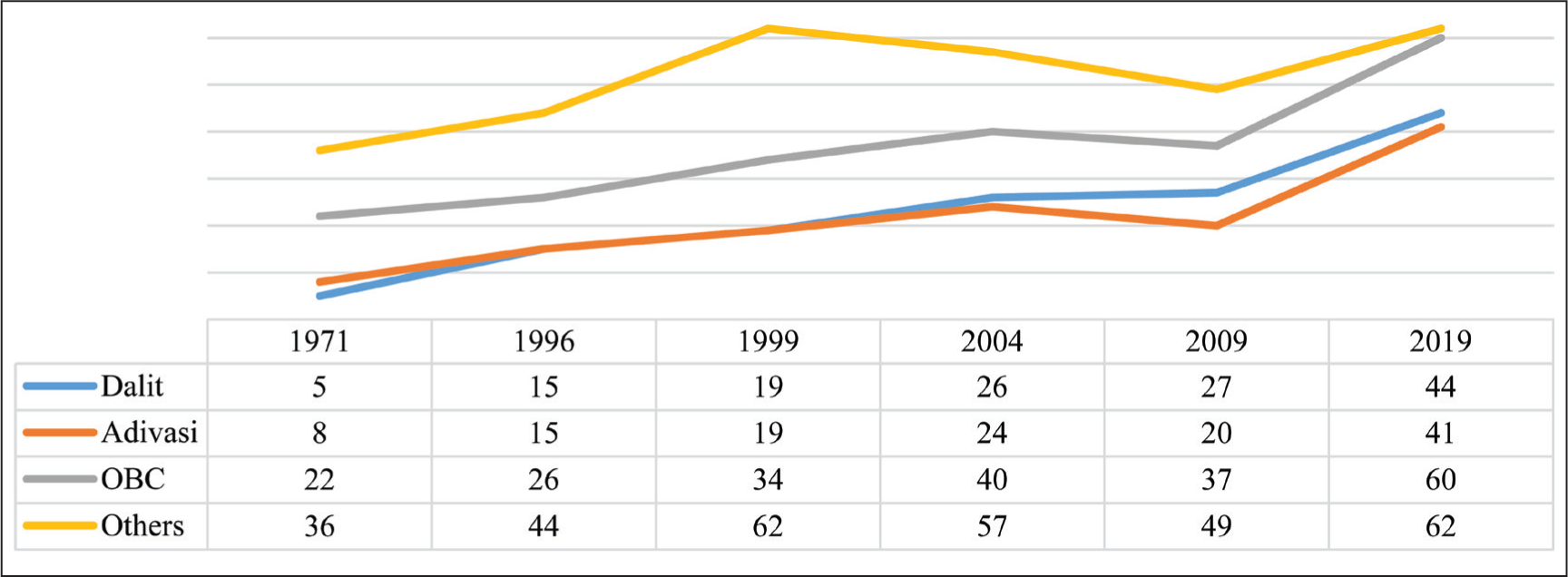
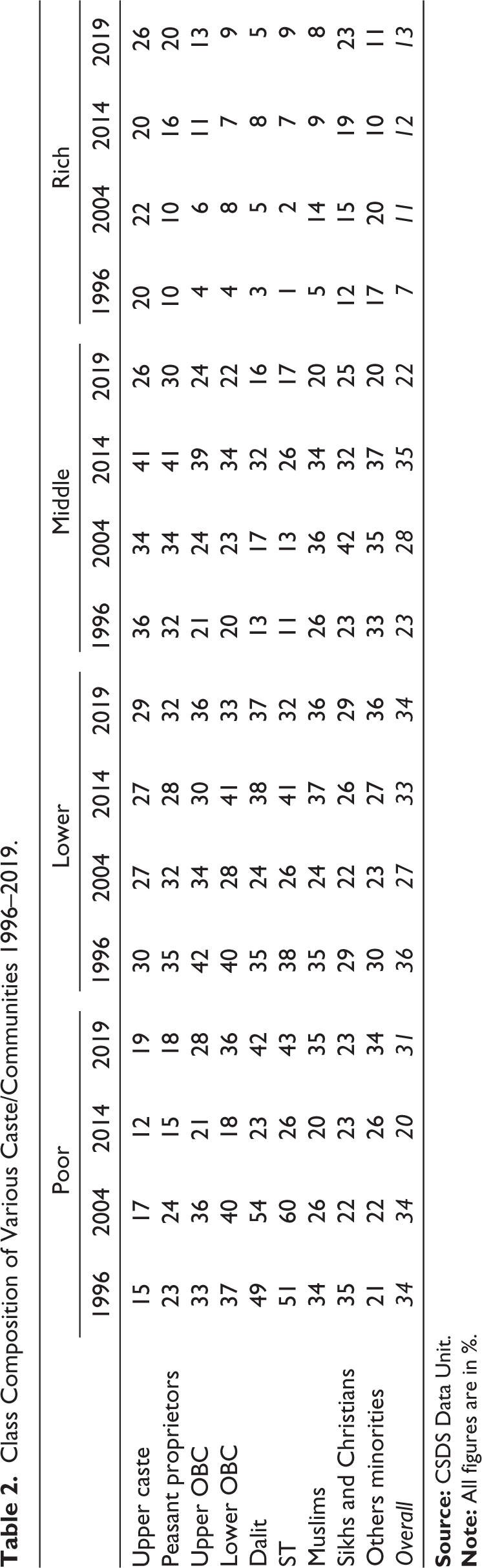
However, though important and salient, these political configurations could not be considered in isolation from the material location of individuals from various castes. Though historical injustices and inequalities would tend to place persons from oppressed and backward castes more or less at the same levels of material deprivation, the trajectory of capitalist development and state intervention produced internal differentiations among every caste irrespective of its traditional social location. This is what we mentioned at the beginning as the inevitable entanglement of caste with class—caste and class did not remain independent or isolated categories of social stratification; they instead began to interpenetrate. Through the limited impact of modern, post-independent industrialization, the affirmative action policy (mainly producing educated, aspirational youth), urbanization and other factors, small sections of persons engaged in white-collar occupations, persons with middle to high incomes began to constitute the ‘middle class’ among the traditionally underprivileged castes. Dalits and Adivasis who were mainly considered as the poor have started asserting their upward mobilization in the 1990s. In 1971, 5% of the Dalits and 8% of the Adivasis considered themselves as ‘middle class’ and this consciousness/assertion had started expanding thereafter. The latest available data from 2019 post-poll survey indicated that this assertion of middle class status is greater among Dalits than Adivasis (Figure 1). As Table 2 shows, the class composition of different caste groups is quite different.
This process defied the fossilization of caste–politics interaction on predictable lines. Caste appeals, however emotive, began to lose their attraction for those who had been able to transform their economic conditions. It is not yet clear whether middle-income persons from backward or oppressed castes retain caste affinities or whether caste identity gets overshadowed by their newfound class locations. But the question worthwhile to probe is this: Does this process breach the possibility of voting merely/primarily on the basis of caste/caste group and therefore, does this open up new possibilities of configurations based on combined disprivilege of caste and class? More importantly, should not investigations into voting behaviour take into account the possibility of combined effects of absence or presence of privilege? We believe that this line of investigation would not only help us better understand voting behaviour, it would also help us to identify to what extent competitive politics facilitates space for the politics of the underprivileged.
To empirically test this possibility, we constructed a new variable based on the combination of caste and class as markers of privilege or absence of privilege. While the variable ‘Socio-Economic Status’ is familiar in analyses of voting behaviour, our variable is slightly different from this; in that we do not take into account education. Our class variable already incorporates income, occupation and or place of residence. We basically intend to test the effect of combining membership of caste/caste group with membership of class thus constructed. We call this as the socioeconomic privilege variable (SEP). ‘Privilege’ is understood here in terms of advantage regarding resources, symbolic values and social prestige as well as opportunities to enhance status. We believe that caste privilege and class privilege both contribute to these advantages and conversely, absence of caste and/or class privilege indicates a socially and structurally imposed inability to exercise control over resources, values, ideas and prestige.
The variable of SEP was constructed after clubbing social location and economic stratum of the respondents and was classified into four categories namely highly privileged, moderately privileged, less privileged and underprivileged. Privilege was understood in terms of location in caste hierarchy combined with location in class hierarchy. Individuals belonging to upper and intermediate castes are likely to enjoy automatic privilege because of the caste location and individuals belonging to upper and middle class also have an automatic advantage over individuals from the lower and poor classes. However, when caste advantage is combined with class advantage, such individuals emerge as more privileged than most while a combination of caste disadvantage with class disadvantage produces the likelihood of being underprivileged. The two middling categories of moderately privileged and less privileged persons are those where caste/class advantage is modest and disadvantage too is modest rather than extreme. Following this logic, the above-mentioned four categories were constructed.
Category of highly privileged was made after merging five categories of rich and middle class upper caste, rich and middle class peasant proprietor, rich and middle class OBC, rich & middle class Muslims and rich and middle class Sikhs and Christian. The moderately privileged category was created after including seven categories such as lower upper caste, lower peasant proprietor, rich and middle class lower OBC, rich and middle class Dalit, rich and middle class Adivasis, lower class Sikhs and Christian, and rich and middle class other minorities. The nature of this category is that it includes high castes having low economic status or lower castes having higher economic status. The less privileged category consists of eight groups—poor upper caste, poor peasant proprietor, lower class OBC, lower class lower OBC, lower class Dalit, lower class Adivasis, lower class other minorities and lower class Muslims. In this group, high castes with poor economic conditions and lower castes with low economic conditions were included. The fourth category, underprivileged includes seven groups—poor OBC, lower OBCs belonging to poor class, poor Dalit, poor Adivasis, poor Muslims, poor Sikhs and Christian and poor other minorities. These groups are socially and economically marginalized. Table 2 reports the share of each of these categories in the survey sample from 1996 to 2019.
Class Composition of Various Caste/Communities 1996–2019.
Socio-economic Privilege and Vote
Following the discussion in the previous section, we present here data from the National Election Studies (NES) from 1996 to 2019 about the voting choices made by different groups on the ladder of SEP.
Congress was traditionally considered as the party of underprivileged voters. Even during the period of its decline, this identity of the party remains more or less intact. Of course, the party did get more votes among the moderately privileged voters than the underprivileged voters in 2009. But with that exception, this trend continued till 2014 elections. However, in the 17th Lok Sabha Election held in 2019, the Congress marginally lost its support base among the underprivileged voters (Figure 2).

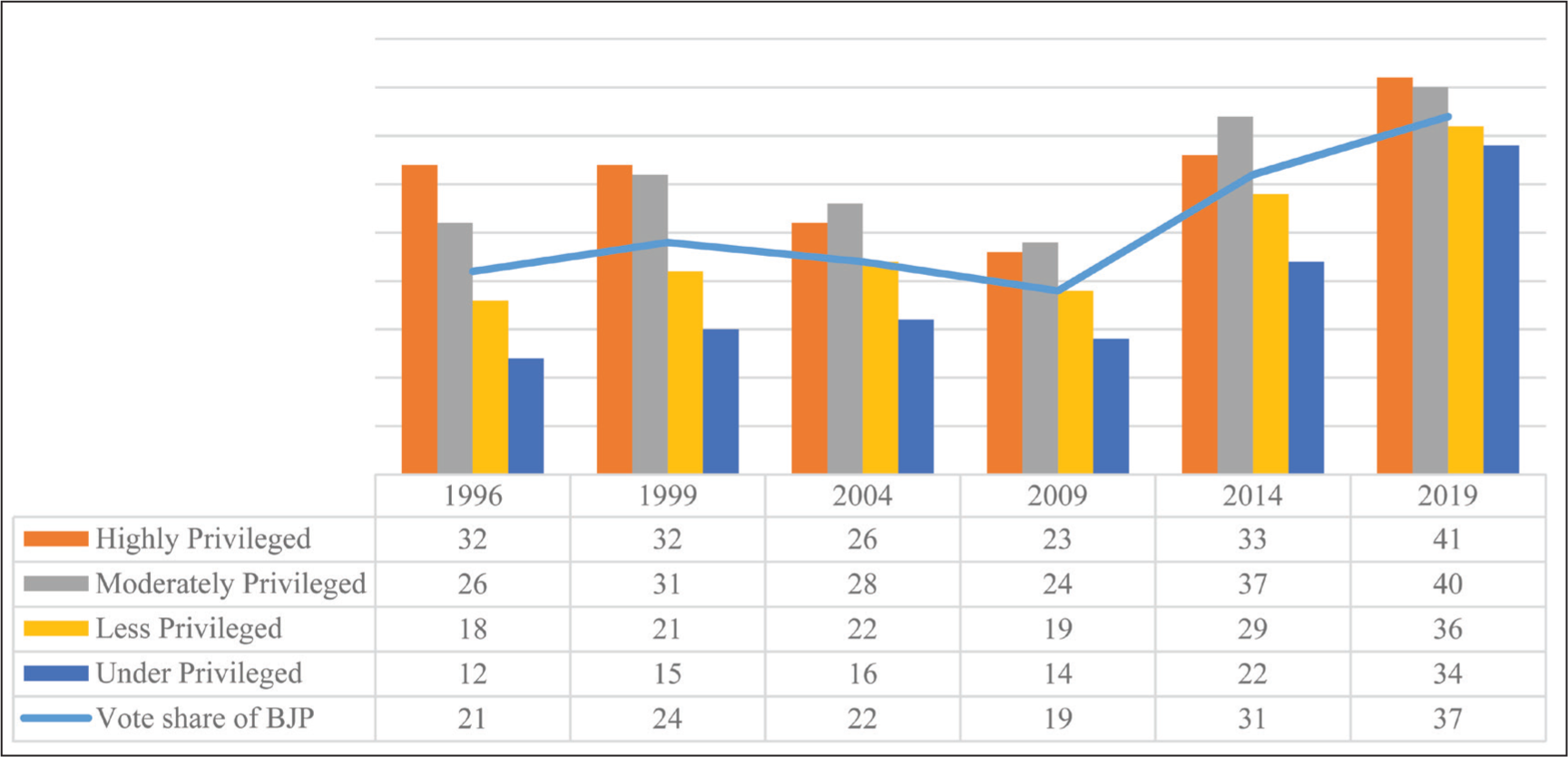
On the contrary, the BJP is seen as a party that represents the interests of highly privileged groups. The available data from the 1996 Lok Sabha Elections indicate that in the 1996 and 1999 Lok Sabha Elections, the BJP’s vote share was 1.5 times higher among the highly privileged group as compared to its total vote share. However, in 2004 and 2009, the moderately privileged group started supporting the BJP more than the highly privileged group and this trend continued in the 2019 Lok Sabha Election. The BJP also started penetrating the Congress’s core voters, that is, underprivileged voters. The data indicate that from the 2014 Lok Sabha Election, the underprivileged voters had shifted towards the BJP and in the 2019 Lok Sabha Election, almost one-third of the underprivileged voters voted for the BJP (Figure 3).
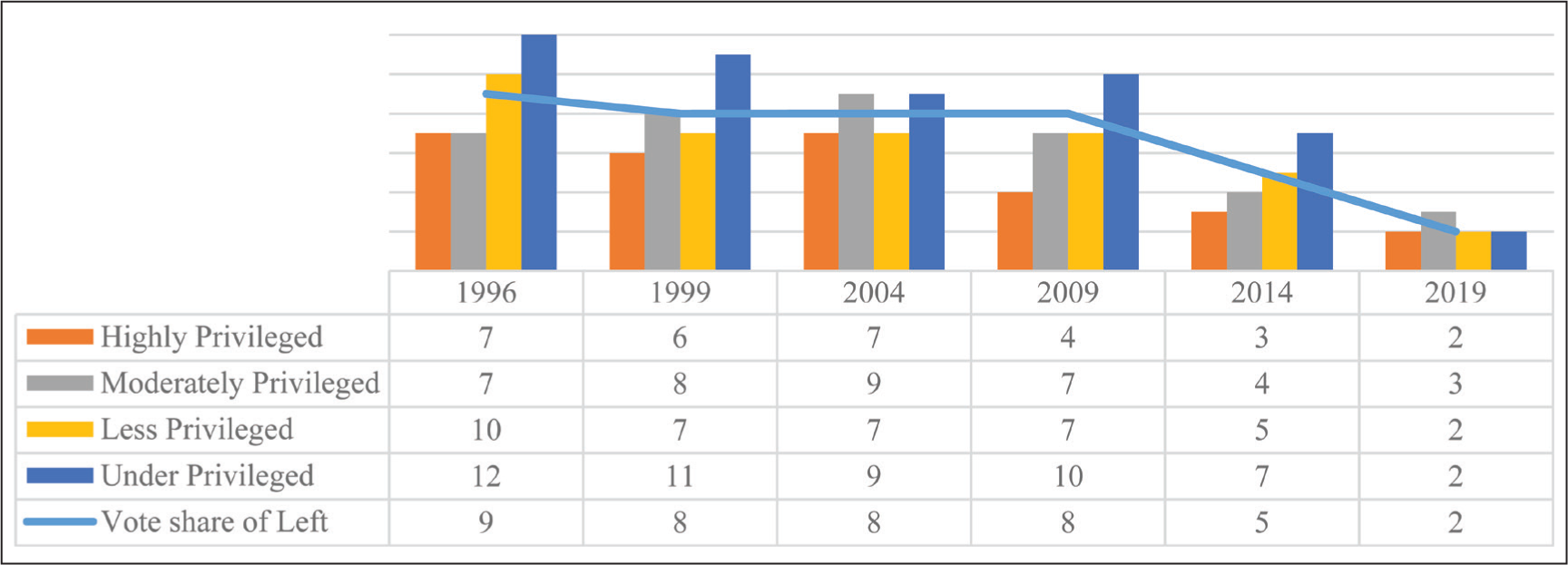
The Left parties, which cater to the interests of poor and marginal sections of society, were always supported by the underprivileged group of voters; but that section lost trust in the Left parties and turned towards other available alternatives (Figure 4). On the other hand, a caste-based party, the BSP has its support base among underprivileged and less privileged voters. This is mainly because of the strong overlap between caste-based disprivilege and class handicap that characterize the Dalits. Though in the 2014 Lok Sabha Election, it was also supported by a group of moderately privileged voters as its vote share among this group was higher than its overall vote share bagged in the 2014 Lok Sabha Election, but in the 2019 Lok Sabha Election, BSP also got support from the voters of highly privileged groups and its support declined among moderately privileged voters (Figure 5).
We have already emphasized the crucial role played by state parties in electoral politics since the 1990s. Many state parties are caste-based parties which take care of the interests of voters belonging to certain backward castes. Not surprisingly, data suggest that the state parties mainly get support from underprivileged and less privileged voters. However, during the 2009 and 2014 Lok Sabha Elections, the state parties were also getting support from voters from highly privileged groups. This shift can be explained through the prism of coalition politics as many of these state parties have allied with the BJP and contested elections under the banner of the NDA government (Figure 6). But during the 2019 Lok Sabha Election, the BJP overshadowed the state parties as their collective voter share declined from 41% in 2014 to 35% in the 2019 Lok Sabha Election. Nonetheless, state parties secured more votes from the underprivileged.

To see the effect of social economic privilege and vote choice, logistic regression models were used. Five models were used to see the effect of social economic privilege and vote for Congress, BJP, Left parties, BSP and state parties, respectively, with the same set of control variables—sex, age, level of educational attainment, locality and level of media exposure for all Lok Sabha Elections from 1996 to 2019. All models confirm that there is a strong relationship between social and economic privilege and preference for particular political parties, with some important exceptions. All models used for the Congress party were statistically significant except 2014 as goodness of fit test was not significant for that year as we could not infer any statistical result from that year. Contrary to the belief that Congress is a party supported by less privileged voters, our regression model shows that social and economic privilege has no effect on voting for the Congress in any year of Lok Sabha elections included in this study, except 2009 and 2019 elections where voters from moderately privileged group as compared to underprivileged preferred Congress over other parties in the election in 2009; and in 2019, voters from all other groups (highly privileged, moderately privileged and less privileged) as compared to underprivileged groups were more likely to vote for the Congress. This again showed that Congress lost support among its traditional vote base, the underprivileged. However, the level of educational attainment has an effect on preferring Congress over other parties in four Lok Sabha Elections—1999, 2004, 2009 and 2019. The probability of voters, with a low level of education voting for Congress is higher than highly educated voters. Education seemed to be the important factor for preferring Congress over other parties in the past elections—1999, 2004 and 2009 as the Wald value was the highest in the models of these years. In the previous elections, media exposure had no effect on choosing Congress over other parties until the 2009 Lok Sabha Election. In 2009, after education, the level of media exposure emerged as the second important factor and the findings indicate higher media exposure led to greater preference for the Congress; reversely in 2019, media had a negative impact on Congress vote. Voters highly exposed to media did not prefer the Congress over the other political parties and from the regression model, we can infer that level of media exposure was the important factor (Appendix Table 3, available online).

Second sets of regression models present the effect of social and economic privilege and voting for the BJP. The models were significant for all years except the 2009 Lok Sabha Election (the goodness of fit P value is .03 in 2009 which is less than .05; therefore, the model is not statistically significant). Statistically significant models for the BJP vote show a clear trend that voters with higher socio-economic privilege are more likely to vote for the BJP as compared to voters from the underprivileged group. Compared to other socio-demographic variables, the SEP has a greater impact on voting for the BJP in every Lok Sabha Election since 1996 as the Wald values are highest in each model. Figures from the regression indicate that in the 1996 Lok Sabha Election, the highly privileged group was the driving factor while voting for the BJP, whereas in other Lok Sabha Elections (1999, 2004, 2014 and 2019), it was the voters from the moderately privileged group who overwhelmingly supported the BJP over other parties. Other than SEP, the level of educational attainment, locality and gender also have an impact on voting for the BJP. Voters having higher level of education are more likely to vote for the BJP. Similarly, men are more likely to vote for the BJP (Appendix Table 4, available online). The BJP which emerged as an urban-based party has expanded its vote share in rural areas too. In the 1996 Lok Sabha Election, people residing in urban areas as compared to rural areas were more likely to vote for the BJP over other parties; however, since the 2004 Lok Sabha Election, BJP has been preferred over other parties by more rural voters than urban.
The next three sets of models are run for the Left parties, the BSP and the state parties for all six years (Appendix Tables 5–7, available online). For the Left parties, only two elections are statistically significant that are 1996 and 2019. For the BSP, models for each year were significant; and for state parties, the models for the 1996, 2014 and 2019 elections were significant. The models of voting for the Left, BSP and state parties indicate that their support base comes from mainly underprivileged groups. Over the years, they are getting their support from voters from underprivileged groups as compared to voters having higher socio-economic status. The significant difference in their vote share is that the Left parties are mainly supported by women, whereas the BSP gains support from male voters. Voters of the Left parties are mainly highly educated, whereas BSP voters have less education. Age and media exposure also act differently for Left and BSP supporters. Left parties get support mainly from elderly voters, whereas the BSP is supported by younger voters. Voters having higher media exposure support Left parties, whereas voters having low media exposure support the BSP in every election, except in the 2014 Lok Sabha Election where voters with higher media exposure voted for the BSP. Voters of state parties are not consistent; but these state parties bag support from underprivileged groups compared to voters with higher socio-economic privilege.
Concluding Observations
The preceding section helps in a better reading of the socio-economic variables in relation to making political preferences. It also helps us in identifying more or less long term and therefore possibly durable patterns emerging since the onset of the post-Congress polity. As we saw above, contrary to general impressions, the Congress is not a party of the downtrodden—not even when it went to polls with the slogan of ‘aam admi’. Moreover, the downslide of the Congress is mainly associated with the absence of the underprivileged classes from its social base on the one hand and the unwillingness of the more privileged sections on the other to shift towards the Congress. This situation corroborates to the description of fading of its ‘rainbow coalition’ from all sides (Heath & Yadav, 1999, p. 2528; Yadav, 2003). The advantage of using the interaction variable of socio-economic privilege is that we are now in a position to gauge the damage. It is already known that middle peasantry castes have been wary of the Congress for long and that upper castes have been won over by the BJP; what we now know is that when there is a combined absence of both caste and class privilege, the voter is less likely to vote for Congress.
Once we use the interaction variable, the BJP’s advantage among the privileged also becomes clearer. Again, survey evidence from NES1996 and NES1998 has already established the close association between the BJP and the upper caste voter; this was more than strongly showcased in the election of 2014 (Palshikar et al., 2014). But BJP’s real gain appears to be among moderately privileged and moderately underprivileged sections. Thus, when BJP is described as a party of the middle classes, it is not merely in ‘class’ terms but also in the sense that it draws its core support from the middle sections on both social and economic axes—from the middle and the lower middle. This explains how and why the BJP got votes from sections of peasant proprietary castes and even many non-peasant backward castes. In contrast, Congress’s advantage among underprivileged sections declined over the years; the party could not muster support from the underprivileged sections either in terms of caste or class. This ensured the downfall of the Congress during the entire period of 1996–2019 despite its temporary and contingent return to power for a decade during this same period. The combined strength of the moderately privileged and moderately underprivileged classes in our survey samples is quite large—thus the catchment area of the BJP is in itself quite robust.
The foregoing discussion draws attention to an important aspect of the electoral battles. While the objective classification of social groups according to their relative privilege may suggest that the moderately underprivileged and the severely underprivileged (less privileged) sections constitute 48% share on average (Figure 7), political mobilization does not necessarily shape the precondition of their unity. Thus, one key pattern that we can discern is the tendency among the moderately underprivileged classes to vote along with the moderately privileged voters and not along with the less privileged.

Their unity is, in other words, not a given; it is something dependent on politics. And, during the entire period of the post-Congress polity so far (1990–2019), politics around the question of social-economic privilege has not shaped adequately enough for these sections to be persuaded to come together behind any single political party or coalition. On the contrary, politics has isolated the less privileged by pushing the moderately underprivileged sections politically in an alliance with the moderately privileged. This paradoxical yet understandable combination has much to do with the political fortunes of parties that claim support from the less privileged. Along with the failure of parties in bringing together the moderately underprivileged and the less privileged, we also witness the fragmentation of the less privileged class. As reported above, the Left parties get more votes from the less privileged than from any other section, but this is true only of a few states—elsewhere, these parties do not have any existence. So, while absence of privilege can explain the votes of the Left; that is not a predictor of the vote by less privileged sections at the all-India level. Another party that was at one point seen as mobilizing voters from less privileged backgrounds was the BSP. But the experiment of the BSP to garner, first, votes of the Dalits and later both Dalits and lower OBCs did not succeed for long. The BSP failed to cultivate the underprivileged constituency in Uttar Pradesh just as it failed to consolidate the Dalit constituency nationally. All through this period, then, underprivileged votes increasingly tend to get divided among state parties. So, the second pattern that we see over time is the complete absence of political unity among the less privileged sections nationally. One may identify the state parties in many states which are major beneficiaries of votes of less privileged at the state level. Thus, ironically, the development that is often seen as a democratic development of the period characterized as post-Congress polity, namely, regionalization of party political space, or the rise of state as the theatre of political choices and political competition, has in the process subverted the possibility of politics of the less privileged classes.
Our analysis so far, takes us to two conclusions. One is that with its ability to attract voters across the spectrum of privilege, the BJP can strategically situate itself as the new party of the middle (including the lower middle). This keeps the party in political reckoning as a major claimant to electoral strength vis-à-vis most other parties. Second, this finding also draws attention to the difficulty of doing politics for and of the underprivileged. While the alliance between less privileged and the moderately underprivileged will prove tough and would require a great amount of political skills, the real issue that emerges is the political dispersal of the less privileged class. The underprivileged sections have no history of coming together and coming under the common umbrella of an all-India political instrument in the immediate past. This contrasts with the democratic upsurge that was witnessed in the 1990s. As has already been observed by Yadav and Palshikar (2009, p. 62), various factors operated as constraints on the further consolidation of ‘democratic upsurge’ but the least noted constraint has been the social configurations that ‘tamed’ the democratic upsurge of the 1990s. This was counterbalanced by the political activity of the upper sections of the society. Our finding now shows that simultaneous with the democratic upsurge, which represented the empowerment of lower strata and assertion of the interests of the underprivileged sections, since the late 1990s, the counterbalancing forces too were politically uniting and drawing toward a common political instrument in the form of the BJP.
Thus, going beyond the support enjoyed by various parties from different social sections, we argue that two contrasting processes mark electoral politics of the post-Congress polity—consolidation and dispersal. In terms of social alignments, we find that the privileged sections tend to align with a common party (along with the moderately underprivileged); and second, we notice consistent dispersal of the least privileged classes politically. They keep alternating among different parties at different elections and they also support state parties. While this may enable us to project a romantic picture that state parties are representatives of and protectors of the underprivileged, the reality of coalition politics does not allow state parties to consistently represent the interests of the underprivileged voters. Instead, the dispersal of the underprivileged voters ensures the disappearance of their constituency altogether. It is this isolation of the underprivileged in addition to their dispersal across parties that make the future of their politics and ability to mount a political challenge weak. Thus, we find that throughout the life of the post-Congress polity, the alignment of privileged sections with each other and with a particular party and the dispersal of underprivileged sections constitute the most critical dimension of electoral choices.
Supplemental Material
Supplemental material for this article is available online.
Footnotes
Declaration of Conflicting Interests
The authors declared no potential conflicts of interest with respect to the research, authorship and/or publication of this article.
Funding
The authors received no financial support for the research, authorship and/or publication of this article.
Notes
References
Supplementary Material
Please find the following supplemental material available below.
For Open Access articles published under a Creative Commons License, all supplemental material carries the same license as the article it is associated with.
For non-Open Access articles published, all supplemental material carries a non-exclusive license, and permission requests for re-use of supplemental material or any part of supplemental material shall be sent directly to the copyright owner as specified in the copyright notice associated with the article.
