




Abstract
In the 2019 and 2014 Lok Sabha elections, the Bharatiya Janata Party (BJP) enjoyed a significant appeal among the youth. However, in 2024, the stakes completely changed and the party ended up losing significant seats. This article explores political participation of youth in 2024 Lok Sabha elections and focuses on the central question: Is the youth still attracted to the BJP? Using data from National Election Study (NES), the article discusses how the youth have voted and the reasons behind their voting choice. The findings reveal that despite extensive efforts of political parties in carving out a youth constituency, none were truly successful.
Introduction
India stands out against international trends, with two-thirds of its population under 35 years (Malin & Tyagi, 2023; Mandhana, 2018). The broad contour of this massive demographic factor is very visible, making the youth a major constituent of the Indian population. While active participation of young (Attri & Mishra, 2020; Kumar, 2014) and first-time voters (Basu & Mishra, 2014) has been beneficial for the Bharatiya Janata Party (BJP) in the Lok Sabha elections, the international trends indicate a different story.
Research on established democracies has highlighted a declining trend in youth voter turnout. Studies from Canada and Britain suggest that young people are less likely to vote, showing increasing apathy and disengagement from traditional politics (Blais & Rubenson, 2013; Kimberlee, 2002; Pammett & LeDuc, 2003). Others indicate that while youth are interested in the broader politics, they feel a sense of political alienation and are often labelled as ‘disaffected’ due to their distinct political behaviour (Sloam, 2007). This characterization raises an important question about youth participation: Are young people really as disengaged as these studies suggest?
Some scholars argue that this perceived low involvement among the youth stems from their scepticism towards political systems, politicians and parties (Henn et al., 2005). Others suggest that political engagement increases with age and experience, influenced by life cycle or generational effects (Martikainen et al., 2005; Quintelier, 2007). Moreover, many young people prefer informal, cause-oriented political actions—such as political consumerism, protest politics, or online petitions—over traditional forms of participation (Norris, 2002). Despite varying levels of participation, youth involvement in politics can have significant electoral outcomes.
The impact of youth’s opinions and attitudes on elections have been documented in some cases. In the United States, studies have highlight how youth have been a contributing factor in shaping the outcome of the US presidential elections (Circle, 2016; Zhu, 2021) A study in South Africa recognized that youth vote had a bearing on both local and national elections (Bekker et al., 2022). In United Kingdom, the 2017 general election saw an exceptional surge in youth turnout, which coupled with other socio-political changes helped in significantly boosting the Labour Party’s performance (Sloam et al., 2018). These examples indicate that the youth play a significant role in shaping the democratic process and also reinforce the need to examine their influence on electoral politics, far more closely.
In India, youth as a distinct political category gained prominence only during 2014, thanks to the efforts of Election Commission of India (ECI), political parties and media (Kumar, 2014). It has been argued earlier that age has not been a significant cleavage in Indian politics by Yadav and Palshikar (2009), and the surge of youth support for new parties tends to fade after elections. However, it is also acknowledged that there is a generational effect for the BJP as it enjoys significant support of those aged under 25. Kailash (2023) further argues that generational change effect has been observed on party choices. While earlier generations preferred the Congress, for the BJP, the support among the post-Congress generation (those born after 1984) ‘would hold good for many years to come’ (Kailash, 2023, p. 222). The literature suggests that the generational effect corresponding with the larger demographic shift taking place in India appears to be working in the favour of the BJP, especially when it comes to those aged under 25. While such a scenario can prove to be extremely beneficial for the BJP, do we see any concrete evidence of this trend in previous elections?
It was during the 2014 Lok Sabha elections that the youth vote significantly tilted towards the BJP. At that time, the youth support was three percentage points higher than the party’s overall vote share (Kumar, 2014). This trend continued in 2019, with the BJP again receiving a significant youth vote, about four percentage points higher than its overall share (Attri & Mishra, 2020). By 2019, the BJP appeared to have established its appeal among young voters.
However, the stakes have completely changed in the 2024 Lok Sabha elections, with the BJP losing significant seats. In this context, did the youth continue to support the BJP, or did they shift their allegiance? How much did the youth vote contribute to the election outcome?
This study aims to explore the role of youth in the 2024 elections, focusing on the central question: Is the youth still attracted to the BJP in the 2024 elections?
The article draws data from Lokniti-Centre for the Study of Developing Societies (CSDS) National Election Study (NES) to examine the youth’s vote. It is divided in two sections. The first section explores youths’ political participation in 2024 Lok Sabha election examining their turnout and larger electoral participation. The second section examines the 2024 verdict and asks why the youth have voted for the BJP.
Youth Participation in 2024 Lok Sabha
Voting
The 2024 Lok Sabha election saw various stakeholders including the ECI and political parties going the extra mile to attract the young ones to vote. The ECI launched several campaigns like ‘Turning 18’ and ‘You are the One’ 2 in its bid to address urban and youth voter apathy while simultaneously celebrating election stakeholders including voters, political parties and voting staff. These initiatives were complemented by ECI’s expanded presence on social media platforms like X (Twitter), Instagram, YouTube and LinkedIn. This digital push aimed to meet the youth where they are the most active. Other creative campaigns like Chunnavi Kisse ‘Wordplay with ECI’, and ‘Polls with pixels’ used humour, storytelling and visuals to engage with a wider young audience. Additionally, through the Mera Pehla Vote, Desh ke Liye 3 initiative, the PM encouraged first-time voters to engage actively in the electoral process.
Political parties also actively engaged with the youth. Both the Congress and the BJP tailored their manifestoes to resonate with young voters. The Nyaya Patra (document of Justice) of the Congress emphasized on employment generation, apprenticeship programmes, social security for gig economy worker, youth startups, prevention of exam leaks and abolishment of the controversial Agniveer Scheme. In contrast, the Sankalp Patra (document of resolve) by the BJP focused on digital revolution and made promises about transparency in public exams, boosting economy though a thriving entrepreneurial ecosystem, infrastructure development and employment in manufacturing.
Youth wings of both parties were equally proactive. The youth wing of BJP, Bharatiya Janata Yuva Morcha (BJYM), engaged actively with first-time voters through campus programmes as part of Mera pehla vote desh ke liye. The ‘NaMo warriors’ initiative trained 50 colleges students to spread awareness about BJP government’s development efforts. In contrast, youth wing of the Congress distributed guarantee cards to about 10,000 household in every assembly segment, detailing promises made by Rahul Gandhi during the Bharat Jodo Yatra (Mukherjee, 2024).
Data from NES 2024 reveals that 62% of the first-time voters (aged 18–22 years) cast their vote in 2024 Lok Sabha elections. Combining the remaining 23–25 age group, an estimated total of 65% of youth have voted. The youth turnout varied across states. States like Karnataka, West Bengal, Kerala and Odisha witnessed relatively higher youth turnout, whereas Delhi, Haryana and Bihar had lower turnout. However, in 2024, youth turnout has not only declined by 2% as compared to 2019; it is also 2% lower than other age groups in 2024. Can this decline of 2% influence a party’s victory? What does earlier instances of youth turnout tell us?
Between 1999 and 2014, youth turnout across Lok Sabha elections was consistently low, trailing four or five percentage points behind the overall turnout (Table 1). This trend aligns with the larger international pattern of voter apathy among the youth (Blais & Rubenson, 2013; Kimberlee, 2002; Pammett & LeDuc, 2003). However, 2014 marked a turning point. An unprecedented surge in youth mobilization and turnout was observed, driven by offline activism against the Nirbhaya case and the anti-corruption movements against the United Progressive Alliance (UPA) regime. This was also the first election when the youth had overwhelmingly supported the BJP (Kumar, 2014). This trend corresponds the ‘youthquake’ observed in Britain in 2017, where higher youth turnout along with extensive offline and online activism amongst the youth contributed towards Labour Party’s performance (Sloam et al., 2018).
Turnout of Young Voters: 1999–2024 Lok Sabha Elections.
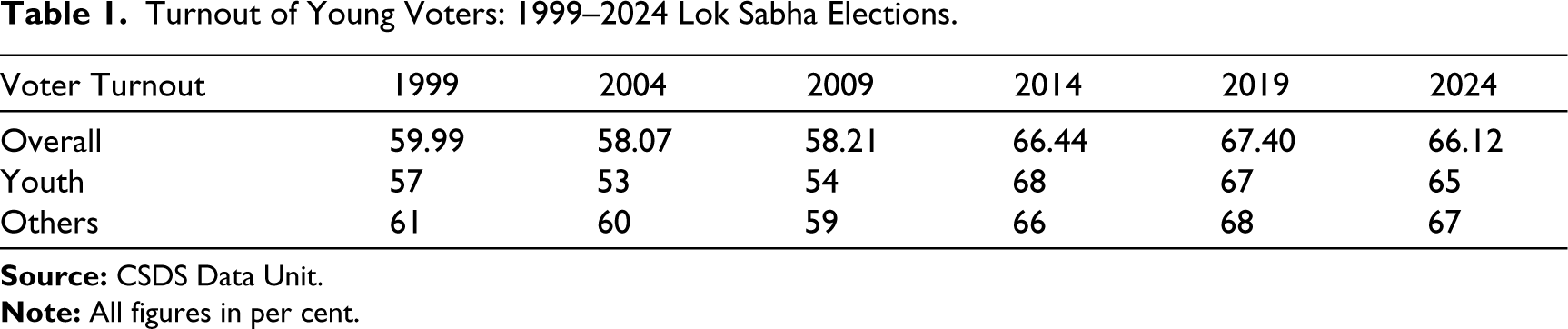
In 2019 Lok Sabha elections, youth turnout aligned with the overall turnout and the BJP again secured a significant youth vote. However, in 2024, youth turnout has declined marginally. While a direct link between youth turnout and voting patterns is difficult to establish, it is possible that this decline may have impacted the BJP’s prospects in the 2024 elections.
Political Participation
Recognizing how instrumental the youth were in the victories of 2019 and 2014 Lok Sabha elections, the BJP made youth a central focus in the 2024 elections. The party implemented a GYAN formula, targeting its four key segments: Garib (poor), Yuva (youth), Annadata (farmers) and Nari (women) and structured both government and organizational activities around these key segments. The party also encouraged the youth to voice their demands through the NaMo app. In a similar vein, the Congress focused on Yuva (youth), Nari (women), Kisan (farmers), Shramik (workers) and Hissedari (equality) with a strong emphasis on justice for all of these group. Both parties leveraged social media effectively, connecting with influencers and crafted narratives that resonated with the youth.
In addition to digital outreach, parties employed traditional methods wherein party representatives went knocking door-to-door asking for votes. NES data shows that the BJP representatives visited over half of the young voters’ houses, 9% more than the representatives of the Congress (43%). BJP clearly had a wider outreach. Among the household of the youth visited by the BJP, nearly half of them (47%) voted for the party, whereas 28% of those visited by the Congress did the same. In contrast, for the non-youth, both parties had similar outreach. However, the effectiveness of BJP was slightly lower, with 5% fewer non-youth voting for the party. This suggests that traditional canvassing method was more effective for the BJP among the youth voters. The relationship between door-to-door canvassing and vote choice was statistically significant.
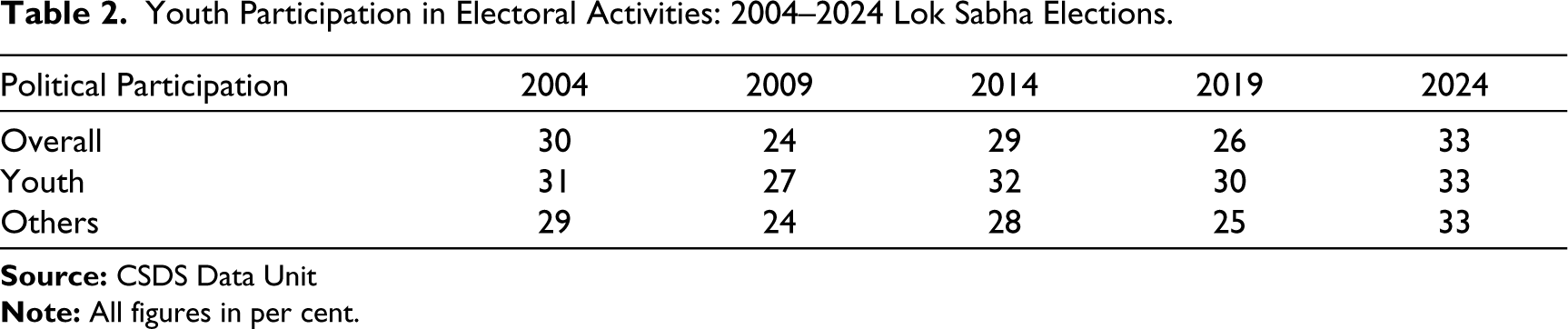
During the 2024 Lok Sabha elections, the youth were seen participating in electoral activities like processions, nukkad nataks, attending rallies, door-to-door canvassing and distributing election leaflets or posters. An index of ‘political participation’ was created to analyse participation of youth in electoral activities. 4 The findings suggest that one in every third youth was engaged in these electoral activities. Another notable finding was that the youth’s participation has consistently been slightly higher than other age groups or the overall participation across Lok Sabha elections. However, in 2024, the gap has significantly declined and youth’s participation levels match that of the other age groups (Table 2). This suggests a possible increase in disaffection amongst the Indian youth. When we break the index further, 13% of participating youth had low involvement, 11% had moderate involvement and only 9% had a higher involvement. 5 While higher participation can increase the probability of voting for a particular party, the data indicated no such patterns and the results were statistically insignificant.
Youth Participation in Electoral Activities: 2004–2024 Lok Sabha Elections.
The 2024 Lok Sabha Verdict
Both the BJP and Congress made extensive efforts to woo the young voters in 2024 Lok Sabha elections. However, one party was relatively more successful in winning the youth vote: BJP.
The youth vote in the 2024 Lok Sabha elections shows two prominent patterns. First, two in every five youth have voted for the BJP this time. Although the youth vote of the BJP marginally fell from 41% from 2019 to 39% in 2024, it is comparably higher than the non-youth vote and the party’s overall vote share (36.6%). Second, the difference between youth vote for BJP and Congress is 18%, a proportion far bigger than the difference between total vote share of both the alliances—National Democratic Alliance (NDA) and Indian National Developmental Inclusive Alliance (INDIA) bloc (10.2%) (Table 3). This suggests that the BJP continues to be more popular among youth than among other age groups.
Voting in 2024 Lok Sabha Elections.
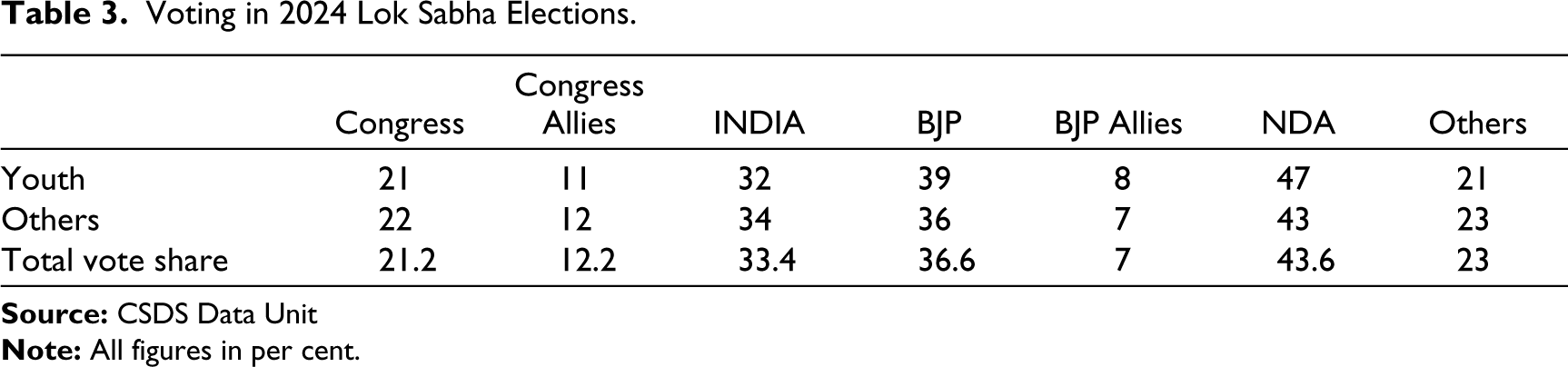
Due to these findings, two important questions come up: Is BJP’s appeal among the youth something new or has it always been the case? Has the Congress ever enjoyed a significant youth vote? The NES data reveals that the Congress has never decisively captured the youth vote, with its youth support consistently aligning with the party’s overall vote share since 2004. This suggests that the Congress has enjoyed a uniform support across all age groups rather than specific section such as the youth.
In contrast, the appeal of BJP among the youth has been comparably higher across elections. The NES data indicates that since 2004, the youth vote has consistently been slightly higher than (1 or 2%) the party’s overall vote share, and has also exceeded the non-youth support (Table 4). The difference was more pronounced during the 2014 and 2019 Lok Sabha elections, with youth support exceeding party’s overall vote share by three and four percentage points respectively (Attri & Mishra 2020; Kumar, 2014). However, in 2024, the youth vote is only 2% more than the party’s overall vote share, indicating that the party’s appeal among the youth has stabilized and returned to its previous levels. This suggests a decline in the BJP’s popularity among the youth.
Youth Vote for BJP and Congress: 2004–2019 Lok Sabha Elections.

The BJP also lost significant seats in 2024 Lok Sabha elections. This raises questions about potential demographic shifts among the youth vote that may have influenced the outcome. While we do examine these demographic shifts, we also look at potential variations in youth vote for the BJP/NDA across states to understand its impact on the overall result. The NES data points out that demographic factor like gender, class, media exposure and level of urbanity had no statistically significant relationship with youth voting choices. While social media and education were statistically significant, they did not reveal any clear patterns. However, significant differences emerged across caste communities and the states.
Amongst caste communities of the youth, the data indicates that the Congress has significantly lost its Scheduled Tribe (ST) youth vote, which was twice as much in 2019. The ST youth vote did split in 2024 between BJP and other parties, benefitting the former the most, with one in every two ST youth voting for the party. While the Congress has gained the Muslim vote by eight percentage points since 2019, the BJP appears to have lost its non-Muslim minority vote (Sikh, Christian and Jain) by 9%. In 2024, the BJP has maintained its hold over the upper caste youth which has not budged from 2019 election, with over half of the upper caste youth voting for the party. However, the party has noticeably lost its Scheduled Caste (SC) youth vote by five percentage points since 2019, while Congress and its allies have gained more than 9% of the SC youth vote. The INDIA bloc has also made significant gains in the other backward class (OBC) youth vote, shifting the support away from regional parties, though the BJP retained nearly half of the OBC youth vote.
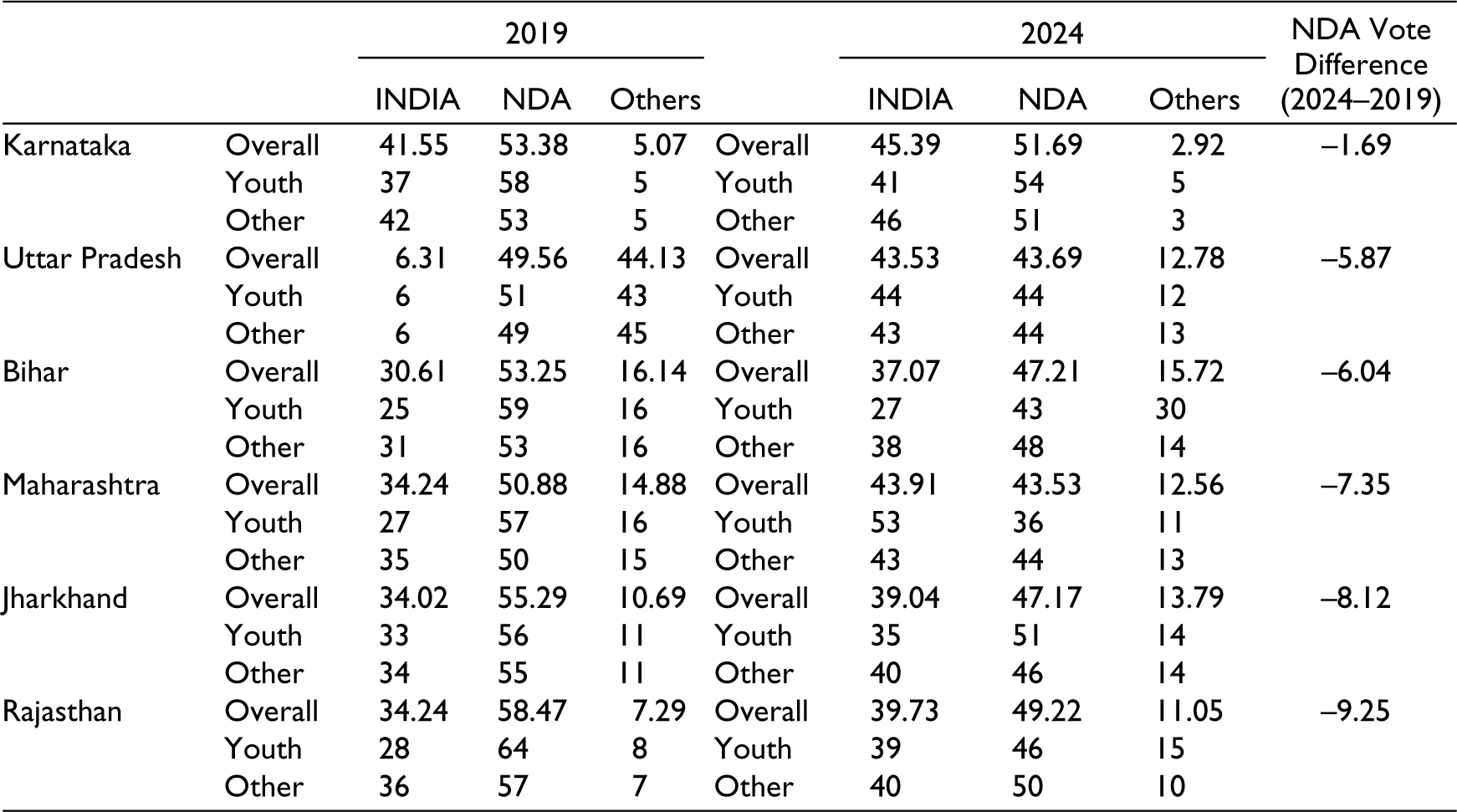
To understand variations of youth support across states, we analysed vote share of NDA and compared it with 2019. Only states with n<70 among youth were included (see Appendix 1). In Telangana and Odisha, the NDA has made significant gains (16% and 7% more vote share than 2019). In both states, the youth vote was relatively higher the party’s vote share and notably more than 2019. In Madhya Pradesh and Chhattisgarh, the BJP/NDA swept nearly all the seats, except one in Chhattisgarh. The youth was a significant contributor in this victory as their support for the NDA was more than 5% higher than the party’s overall vote share. Youth support in these states has remained more or less consistent since 2019. Moreover, in Kerala, Chhattisgarh and Madhya Pradesh, the youth vote for INDIA bloc was considerably lower than the alliance’s state vote share in 2024 and was comparable to 2019 elections
In these states, the BJP is emerging either as a strong contender or has maintained its support across both Lok Sabha elections. In 2024 elections, the youth has largely been supporting the winning party. However, in states where NDA has lost vote share, we see that the youth vote has also declined. In Uttar Pradesh and Bihar, the NDA lost about 6% vote share and the youth vote fell with it. Similar trends were seen in Rajasthan and Maharashtra, with the youth vote dropping significantly in Maharashtra as compared to 2019.
Three states stood as exceptions. In Jharkhand and Karnataka, youth support for the NDA was relatively higher than the alliance’s overall vote share, while support for the INDIA bloc was significantly lower among the youth. In both these states, NDA has not performed well and INDIA bloc gave a better performance. The most notable exception was West Bengal. Here, youth supporting the NDA alliance was 8% more than the alliance’s vote share in the state and this surge was noticeably more than 2019. This suggests that among the NDA voters, youth is far more enchanted by it than other age groups. This was opposite for All India Trinamool Congress, which derived its major contribution from other age groups.
Why the Youth Have Voted for the BJP?
Youth support largely aligned with the winning party, favouring the NDA/BJP wherever it performed well and choosing the INDIA bloc wherever it excelled. This pattern raises an important question: What drove the youth?
Leadership
Modi’s leadership has long been a decisive factor in general elections. His image as a strong and decisive leader, coupled with his unique appeal have earned him strong and consistent voter base across 2014 and 2019 Lok Sabha elections (Shastri, 2019; Shastri & Syal, 2014) Even in 2024, the elections were largely fought in Modi’s name, with his guarantees and larger than life image prominently featured on the billboards across the country (Landrin, 2024). A study indicated that out of 111 speeches delivered by Modi between March 17 and 15 May 2024, 56 speeches specifically addressed the youth (Das & Malik, 2024). But how successful was Modi’s candidature in attracting the young voters?
NES data reveals that Modi’s candidacy as the Prime Minister strongly resonated among the young with nearly half of the young voters (43%) favouring him as the PM. This figure was not only 3% higher than other age groups, but it was significantly more than those supporting Rahul Gandhi, with a 17-percentage point difference (Table 6). Despite a substantial gap, Rahul Gandhi’s popularity as PM has increased somewhat amongst the youth as compared to 2019, while Modi’s appeal has declined substantially (Table 5).
Preference as the PM in 2024 Lok Sabha.

Modi’s popularity varied across states. In states where NDA performed well and increased its vote share as compared to 2019, youth support for Modi as PM also rose. For instance, in Madhya Pradesh, Odisha and Andhra Pradesh, Modi’s appeal is significantly high as two-thirds of the youth prefer him as the PM. In Jharkhand, Chhattisgarh, Telangana and Gujarat over half of the young ones prefer Modi as the PM. In contrast, states where INDIA bloc outperformed its 2019 results, the youth tended to support Rahul Gandhi as PM. In Bihar, Maharashtra and Karnataka, one in every third youth supported Rahul Gandhi. Interestingly, in Uttar Pradesh, popularity of Rahul Gandhi exceeded that of Modi’s (41% vs. 32%, respectively).
It appears that Modi leadership factor as PM only appeared to be potent in the pockets where the NDA alliance had performed better than 2019 elections. However, did this influence youth’s vote choice?
Among the youth who preferred Modi as the PM, 72% voted for the BJP. Conversely, among the youth that supported Rahul Gandhi as the PM, over half of them voted for the Congress and another quarter voted for its allies (51% and 27%). This indicates that Rahul Gandhi’s candidacy was as effective in attracting young voters towards the INDIA bloc as Modi’s was for the BJP. Importantly, both of these relationships were statistically significant.
Satisfaction and Performance
Beyond leadership, the Indian youth have expressed significant satisfaction with the performance of the central NDA government over the past five years. NES data indicates that more than half of the youth are satisfied with the central government’s work, with about 27% being completely satisfied. This figure is 5% higher than the overall voters who are fully satisfied with the NDA. Net satisfaction among the youth, defined as those fully satisfied minus those fully dissatisfied, is twice that of older voters and 4% more than the average. While satisfaction levels largely prevail, the data also shows a growing displeasure with existing NDA among the youth. This can clearly be assessed from the fact that the net satisfaction has declined by 2% from 2019 to 2024 (Table 6).
Voter Satisfaction with NDA Government: Lok Sabha 2024 and 2019.
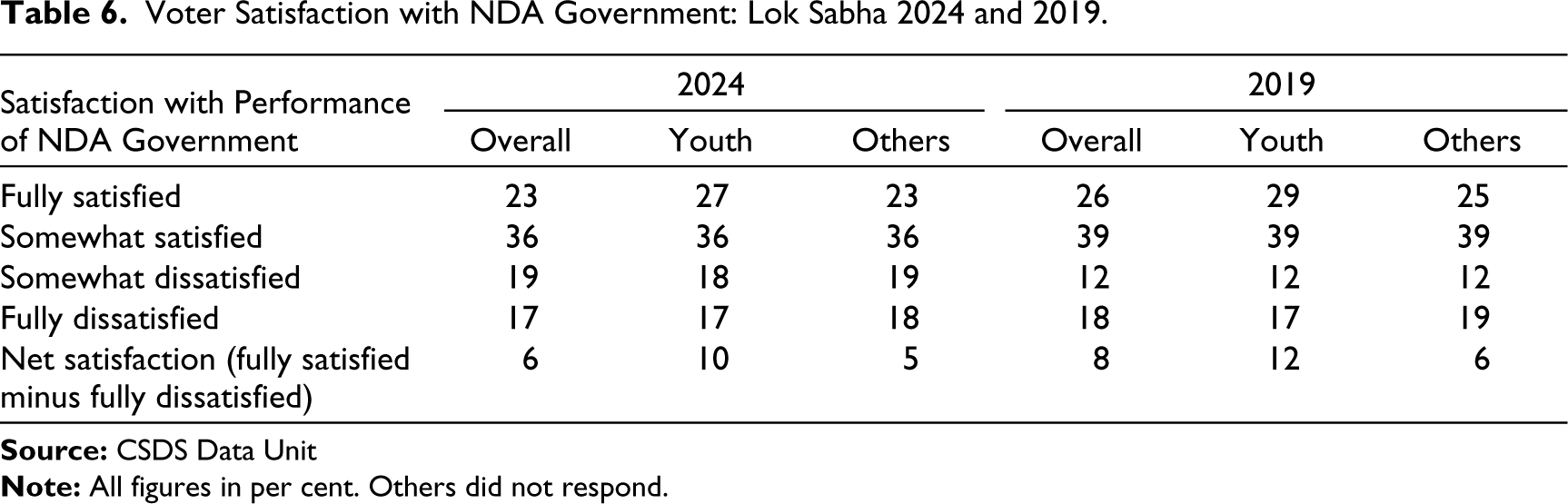
Across states we see a pattern with state’s performance of the NDA. Wherever the NDA has performed well as compared to 2019, the youth are highly satisfied. For instance, Madhya Pradesh and Chhattisgarh saw exceptional performance of NDA, about 8 in 10 youth were satisfied with NDA’s performance. Similarly, in Odisha and Gujarat, three-fourths of the youth were satisfied with the central government’s work. In contrast, poor performance of NDA corresponded with lower levels of satisfaction. In Maharashtra, Uttar Pradesh and Jharkhand, two-fifths of the youth are dissatisfied with the government.
To what extent did satisfaction levels affect the vote choice of the youth? Data revealed that among the satisfied youth (fully and somewhat), over half of them (55%) voted for the BJP, a Figure 3% higher than the average satisfied voter. In comparison, one in every three (35%) of dissatisfied youth (fully or somewhat) have voted for the Congress, with another-fifth voting for its allies (21%). Interestingly, 12% of dissatisfied youth have still voted for the BJP.
On the other hand, several works of the NDA government have contributed to this satisfaction. For the youth, the construction of Ram Mandir was the most appreciated work, with one in every five youth considering it to be a satisfactory action of the NDA government. Although this proportion was slightly less than other age groups, the Mandir itself had a significant impact on the youth voting. Among those who liked the construction of Ram Mandir, over half of the young ones supported the BJP, a Figure 4% higher than non-youth voters or the average (58% vs. 54% respectively). Other works appreciated by the youth included reduction in poverty, employment opportunities, initiatives of development and promoting Hindutva, each favoured by 6% or fewer youth, with corresponding popularity among non-youth voters. A corresponding popularity between youth and non-youth preferences on a large number of appreciated government’s work suggests that the youth vote is influenced by the broader sentiments affecting other age groups, rather than their own distinct concerns that satisfy them.
Conversely, some of the NDA government’s actions have led to disappointment. These include inflation and increasing poverty, disapproved by 18 and 9% of the youth respectively. Both of these figures are relatively lower than the average suggesting that they have impacted the youth but not in the same intensity as an average voter. Additionally, one-third of the youth also seem to be perturbed with growing unemployment, a figure that is 8% more than older voters (Table 7). The data indicates that among the youth perturbed with unemployment, 38% have voted for the BJP. In contrast, 20% have voted for the Congress and 18% for the Congress allies (38%—INDIA bloc). While the figures of those voting for BJP is comparable to the vote share of the party, it is 5% more for the INDIA bloc. This suggests that while a large proportion of youth continues to support the BJP, it also thinks that the INDIA bloc is better equipped to address this issue better than the BJP. The relationship between most liked and disliked government work and vote choice was found to be statistically significant.
Top 3 Liked and Disliked Works of the Government in 2024 Lok Sabha.

Discussion and Conclusion
The above analysis indicates that in the 2024 elections, the BJP or NDA seemed to garner youth support only in regions where they outperformed their 2019 results. Modi’s leadership factor (as a PM candidate) appeared potent only in those pockets where the youth were also largely satisfied with the NDA government. In contrast, the INDIA alliance performed better in states with rising dissatisfaction, with Rahul Gandhi candidature as PM emerging as a key factor swaying the youth vote in favour of the INDIA bloc.
However, this time, youth voting did not show any distinctive pattern. Their choices were shaped by the same issues that influenced other age groups, indicating that the larger sentiment swayed the youth vote rather than their own unique concerns. Their voices were not significantly different from others, as they seemed to participate in the broader narrative of issues rather than bringing in their own distinct concerns.
Moreover, falling levels of political participation and a marginal decline in turnout among the youth suggest a limit to BJP’s attraction for the youth. This, combined with a lack of distinct issues voiced by the youth, indicates that they were not a significant voting category in themselves during the 2024 elections. Despite the efforts of major political parties to carve out a significant youth constituency, neither succeeded in doing so. The youth vote leaned slightly more toward the BJP but that appears to be a larger blessing of the NDA’s performance. Though the BJP still continues to have an edge, the youth as a constituency may have waned and the advantage the party enjoys is only nominal this time as compared to the last two elections.
Footnotes
Declaration of Conflicting Interests
The authors declared no potential conflicts of interest with respect to the research, authorship and/or publication of this article.
Funding
The authors received no financial support for the research, authorship and/or publication of this article.
Appendix
NDA Vote Share Across States (n<70).

| 2019 | 2024 | NDA Vote Difference (2024–2019) | |||||||
| INDIA | NDA | Others | INDIA | NDA | Others | ||||
| Andhra Pradesh | Overall | 1.29 | 0.96 | 97.75 | Overall | 2.7 | 53.48 | 43.82 | 52.52 |
| Youth | – | 1 | 99 | Youth | 1 | 52 | 47 | ||
| Other | 2 | 1 | 97 | Other | 3 | 54 | 43 | ||
| Telangana | Overall | 29.48 | 19.45 | 51.07 | Overall | 40.1 | 35.19 | 24.71 | 15.74 |
| Youth | 35 | 21 | 44 | Youth | 36 | 38 | 26 | ||
| Other | 29 | 19 | 52 | Other | 41 | 35 | 24 | ||
| Odisha | Overall | 14.73 | 38.37 | 46.90 | Overall | 12.53 | 45.41 | 42.06 | 7.04 |
| Youth | 17 | 39 | 44 | Youth | 11 | 48 | 41 | ||
| Other | 15 | 38 | 47 | Other | 13 | 45 | 42 | ||
| Kerala | Overall | 47.24 | 14.8 | 37.96 | Overall | 45.13 | 19.2 | 35.67 | 4.4 |
| Youth | 42 | 22 | 36 | Youth | 40 | 18 | 42 | ||
| Other | 48 | 14 | 38 | Other | 46 | 19 | 35 | ||
| Chhattisgarh | Overall | 40.91 | 50.7 | 8.39 | Overall | 41.05 | 52.65 | 6.3 | 1.95 |
| Youth | 36 | 57 | 7 | Youth | 36 | 57 | 7 | ||
| Other | 42 | 50 | 8 | Other | 42 | 53 | 5 | ||
| Madhya Pradesh | Overall | 34.50 | 58.00 | 7.50 | Overall | 32.44 | 59.28 | 8.28 | 1.28 |
| Youth | 29 | 62 | 9 | Youth | 23 | 68 | 9 | ||
| Other | 36 | 57 | 7 | Other | 35 | 58 | 7 | ||
| Gujarat | Overall | 32.11 | 62.21 | 5.68 | Overall | 33.97 | 61.79 | 4.24 | -0.42 |
| Youth | 36 | 60 | 4 | Youth | 35 | 60 | 5 | ||
| Other | 32 | 62 | 4 | Other | 34 | 62 | 4 | ||
| West Bengal | Overall | 5.61 | 40.25 | 54.14 | Overall | 4.67 | 38.74 | 56.59 | –1.51 |
| Youth | 3 | 39 | 58 | Youth | 3 | 47 | 50 | ||
| Other | 6 | 41 | 53 | Other | 5 | 38 | 57 | ||
| Karnataka | Overall | 41.55 | 53.38 | 5.07 | Overall | 45.39 | 51.69 | 2.92 | –1.69 |
| Youth | 37 | 58 | 5 | Youth | 41 | 54 | 5 | ||
| Other | 42 | 53 | 5 | Other | 46 | 51 | 3 | ||
| Uttar Pradesh | Overall | 6.31 | 49.56 | 44.13 | Overall | 43.53 | 43.69 | 12.78 | –5.87 |
| Youth | 6 | 51 | 43 | Youth | 44 | 44 | 12 | ||
| Other | 6 | 49 | 45 | Other | 43 | 44 | 13 | ||
| Bihar | Overall | 30.61 | 53.25 | 16.14 | Overall | 37.07 | 47.21 | 15.72 | –6.04 |
| Youth | 25 | 59 | 16 | Youth | 27 | 43 | 30 | ||
| Other | 31 | 53 | 16 | Other | 38 | 48 | 14 | ||
| Maharashtra | Overall | 34.24 | 50.88 | 14.88 | Overall | 43.91 | 43.53 | 12.56 | –7.35 |
| Youth | 27 | 57 | 16 | Youth | 53 | 36 | 11 | ||
| Other | 35 | 50 | 15 | Other | 43 | 44 | 13 | ||
| Jharkhand | Overall | 34.02 | 55.29 | 10.69 | Overall | 39.04 | 47.17 | 13.79 | –8.12 |
| Youth | 33 | 56 | 11 | Youth | 35 | 51 | 14 | ||
| Other | 34 | 55 | 11 | Other | 40 | 46 | 14 | ||
| Rajasthan | Overall | 34.24 | 58.47 | 7.29 | Overall | 39.73 | 49.22 | 11.05 | –9.25 |
| Youth | 28 | 64 | 8 | Youth | 39 | 46 | 15 | ||
| Other | 36 | 57 | 7 | Other | 40 | 50 | 10 | ||