



Abstract
Abstract
Planning for promoting socio-economic development of marginalised people has emerged as a key function of Panchayats in India. This scenario is also found in the case of the scheduled areas of Odisha. On the basis of data collected from 300 households in two tribal districts of Odisha, this study argues that institutional arrangement and functioning of Panchayats have paved the way for formulation of decentralised development plans in these areas. The Panchayats have been playing a key role in the ways of formulating decentralised development plans and fostering the participation of tribal people in planning process. Many important issues related to socio-economic development of tribal people have been discussed in the meetings involving planning. Despite this, the goals of promoting socio-economic development of tribal people through formulating decentralised development plans have not achieved the desired results. Inadequate infrastructure and poor data management system at the Panchayat level and weak coordination among the various tiers have created hurdles in the path of formulation of decentralised development plans in the districts. It is on this basis, that this article suggests decentralised planning as a systemic process in the scheduled areas under the guidance of the Panchayats.
Introduction
The institutional arrangement and functioning of the decentralised self-governing institutions in recent years have witnessed a major shift in many countries in the world. Their increasing involvement in promoting decentralised development plans and addressing the development issues of weaker sections of people have been observed in many cases. In the contemporary era of development, these institutions have been playing a key role in formulating decentralised development plans and implementing development programmes in rural areas. These institutions are better to promote participation of weaker sections of people, in particular, the tribal people in the process of formulation, execution and monitoring of the local development plans and budgets. It is argued that the decentralised self-governing institutions on the basis of their knowledge on ‘time and place’ develop plans and programmes based on the local needs and preferences and implement these plans and programmes, considering the magnitude of social and political marginalisation of the people (Johnson, 2003). The decentralised development plans are tantamount of promoting sustainable socio-economic development. There are three important strategies through which decentralised governing institutions can promote sustainable socio-economic development of marginalised sections of people, in particular, the tribal people. These are (a) effective institutional arrangement, (b) inclusive decentralised development plans and (c) effective implementation of the socio-economic development programmes. Institutional arrangement is a key aspect of making decentralised planning process effective, and effective planning is a key strategy of promoting socio-economic development programmes effectively.
India has been witnessing the evolution and institutionalisation of the Panchayats in rural and tribal areas since the pre-independence period. The process of democratic decentralisation in India has witnessed a shift in the context of the evolution of local governments with the enactment of the 73rd Amendment Act in 1992. The case of formulation of decentralised development plans has received considerable attention in India as it is argued that effective grassroots-level plans are a key instrument of fostering effective implementation of socio-economic development programmes. The functioning of Panchayats as a unit of decentralised governance in India has brought the formulation of decentralised development plans into the forefront and has become a key function of these institutions. Article 243(G) of the Indian Constitution has made Panchayats responsible for preparation and implementation of plans for economic development and social justice in their jurisdiction. Under this provision, the Gram Sabhas have devolved powers for the formulation of plans and endorsement of such plans before sending of these plans to the Gram Panchayats (GPs) for resource allocation and execution. The District Planning Committees (DPCs) are institutionalised for preparing the integrated district development plans and budget for implementation of development programmes for the districts.
In the case of scheduled areas (areas defined under Article 244(I) of Indian Constitution), the process of formulation of decentralised development plans has been institutionalised in the context of institutionalisation of Panchayats in these areas. The enactment of the Provisions of the Panchayats (Extension to Scheduled Areas) Act (PESA Act) in 1996 has also to some extent emphasised the role of the Panchayats and the Gram Sabhas for formulation of decentralised development plans. It is mentioned under the Act that ‘the Gram Sabhas have mandatory executive functions and responsibilities to approve plans of the village Panchayat, identify beneficiaries for schemes for poverty alleviation and other programmes and issue certificates of utilisation of funds by the Panchayats’. The Act further spelt out the role of the Panchayats and the Gram Sabhas in the matters of development through managing natural resources and adjudicating decisions in accordance with prevailing traditions and customs (Upadhyay, 2010). While formulating the plans for the village Panchayats, the Gram Sabhas should provide adequate emphasis on the available community resources as well as the customary laws, traditions, customs and cultural identity of the tribal people. In the case of the scheduled areas of Odisha, the process of formulation of decentralised development plans has also become institutionalised with the institutional arrangement and functioning of Panchayats in these areas.
In the case of Odisha, particularly in scheduled areas of the state, the process of formulation of decentralised development plans has witnessed many changes with the institutional arrangement and functioning of Panchayats in these areas during post-73rd Amendment Period and during Post-PESA Act Period. The role of Panchayats in planning and implementation of development programmes have been enhanced over the years. Formulation of genuine and effective decentralised planning has been prioritised by the state government. The state government has also devolved power and authority to Panchayats for formulation of decentralised development plans. The central government under the Fourteenth Finance Commission (FFC) award period has also issued guidelines for formulation of Gram Panchayat Development Plan (GPDP) in all GPs, including the GPs located in the scheduled areas. However, in some cases, it is observed that the path of formulation of decentralised development plans has encountered many hurdles. The dilution of the decentralised planning process through promoting departmental and sectoral plans and political interferences in the process of formulation of plans through Panchayats have become two common features in decentralised planning. Inadequate infrastructure and poor data management system at the Panchayat level and weak coordination among the various tiers have also made this process more cumbersome in some cases. In some cases, the process has failed to create consensus among the various sections of people while developing long-term and short-term development plans through the GPs.
It is on this basis, this article unravels the process of formulation of decentralised development plans in the scheduled areas of Odisha while examining the case of Sundargarh and Koraput districts located in these areas. In recent years, many studies have been conducted to explore the working of Panchayats and their role in formulating decentralised planning in various states, including Odisha. However, the case of exploring formulation of decentralised planning in scheduled areas and involvement of Panchayats in formulation and implementation of decentralised planning has not attained much scholarly attention. It is on this basis, this article which is a product of PhD research work unfolded the case of decentralised planning in scheduled areas through examining the scenario of the districts of Sundargarh and Koraput of Odisha. The setting of this article focuses on the (a) institutional arrangements and formulation of decentralised development plans in the study area, (b) participation of tribal people in the planning process carried out by the Panchayats, (c) issues discussed in meetings held over planning and discussion on the tribal-specific development issues in these meetings and (d) overall implications of institutional arrangement of Panchayats on decentralised planning processes. In the conclusion section, few issues have been raised and suggestions offered to make decentralised planning as a systemic process in the scheduled areas of Odisha.
Objectives
The broad objective of this study is to understand the process of formulation of decentralised development plans in scheduled areas of Odisha and how the Panchayats as an instrument of decentralised governance have become instrumental in promoting tribal development through formulating plans and fostering participation of tribal people in the planning process.
Keeping this into mind, the specific objectives of the study are:
to explore the Working of Panchayats and their Role in Formulating Decentralised Development Plans in the Districts; to examine the degree of participation of Tribal People in Planning Process and the issues raised by them in the Grams Sabhas while formulating plans; to examine the issues discussed in the meetings held over planning and discussion on the tribal-specific development issues, in particular, the implementation of the Tribal Sub-Plan (TSP) in these meetings; and to shed light on overall implications of Decentralised Planning on Promoting Tribal Development in the Districts.
Methodology
Profile of the Sampled Villages and Households

Considering the functioning of the Panchayats in the scheduled areas of Odisha and objectives of the study, it was designed to cover the two scheduled area districts in Odisha, namely Sundargarh and Koraput from the two different regions, that is, the northern and southern regions of the state. A multi-stage sampling technique was applied for selecting districts, blocks, GPs and villages (Table 1). As a part of this technique, from both the districts, four blocks (two blocks from each district), eight GPs (two GPs from each block) and 16 villages (two villages from each GP) were selected applying the multi-stage purposive sampling technique. Three-hundred households from the districts were surveyed through a structured questionnaire. FGDs and in-depth interviews were conducted with various categories of respondents (Panchayati Raj Institution (PRI) members, functionaries and knowledgeable persons of the villages) as a part of collecting qualitative data.
Table 1 presents the profile of the sampled villages and households. It shows that from each district, 150 numbers of households and from each block 75 numbers of households were covered under this study. It further reveals that from Sundargarh district, 123 (82.0%) tribal households and 27 (18.0%) other (Scheduled Castes—SCs, Other Backward Classes—OBCs and General categories) households were covered through this study. Similarly, from Koraput district, 121 (80.7%) tribal households and 29 (19.3%) other households were covered.
Decentralised Planning in Scheduled Areas and Role of Panchayats: A Review of Literature
Since the last few decades, many scholars have been consistently trying to examine the various aspects of decentralised development plans in India. On this issue, a main focus that has laid down by these scholars is to unravel the role of Panchayats in formulating decentralised development plans in rural areas of India. Empirical literature on this issue can be broadly divided into two parts such as (a) status of decentralised development plans during pre-73rd amendment period (Aziz, 1993; Ghosh, 1988; Rao, 1989; Sambrani, 1978) and (b) status of decentralised development plan during the post-73rd amendment period (Fernandes, 2003; Mahi Pal, 2001; Mohankumar, 2002; Mukharji, 1993; Sharma, 2006; Vadiraju & Sangita, 2011). In both the cases, these scholars have tried to explore various dimensions of decentralised planning and role of Panchayats on this issue, though meagre attention (almost all no attention) is being provided to understand this process in scheduled areas of the country.
Examining the case of decentralised planning in India during the pre-73rd amendment period, when the Panchayats were not institutionalised, and decentralised planning was carried out sporadically across the country, many scholars, such as Sambrani (1978), Ghosh (1988), Rao (1989), Aziz, (1993), while studying on this issue, argued for effective institutionalisation of Panchayats and devolution of powers to these institutions for effective formulation of decentralised development plan. During this period, it was realised that ‘planning and democracy as instruments for structural change have not been tapped so far’ (Rao, 1989). Decentralised planning needs a number of essential preconditions like statutory measures to create sub-state-level governments with adequate devolution of resources and decision-making powers and political mobilisation of the weaker and the disadvantaged in rural areas (Rao, 1989). It was observed that in every succeeding plan, the area approach of planning has manifested itself in different forms: the community development programme, intensive agricultural area programmes, Panchayati Raj, special schemes for weaker sections, drought-prone areas, command areas, hill areas, tribal areas, etc. Yet, operational area plans have almost never been drawn up even when there was sufficient manpower in the states which have implemented democratic decentralisation with great zeal (Sambrani, 1978). Even if in the case of the states, where the PRIs were institutionalised, there were various other factors affected for effective formulation of decentralised development plans like coordination gaps (Ghosh, 1988) and prevalence of centralised planning (Mukharji, 1993). Although in some states model district plans were formulated, they could not be operationalised due to non-existence of people’s institutions at district or sub-district level (Mahi Pal, 2001). The results of these studies on the basis of pre-73rd Amendment Act scenario focused on deficit of local democratic institutions in rural areas and argued for rejuvenation of these institutions and linking them with decentralised planning process.
With the advent of the enactment of 73rd Amendment Act in 1992, the scope of empirical studies on this issue gained further scholarly currency and took a gradual shift, which can be observed from the works of the various scholars in the recent period. During this period, a firm conviction that emerged among the scholars that ‘the decentralised governing institutions or the Panchayats are better to formulate decentralised development plans since they possessed better information about the local area, local people and better informed about the needs of both the areas as well as the people’. During this period, the state governments of various states have also initiated to institutionalise PRIs and devolved powers to these institutions for effective formulation of decentralised development plans. For example, in the case of Kerala, the people’s planning programme launched in 1997 heralded a new approach towards development planning and participation of people in development programmes (Mohankumar, 2002). Considering these developments, many scholars during the post-73rd Amendment period have tried to examine various dimensions of decentralised planning and role of Panchayats for formulation of these plans. The results of these works have argued for the effective formulation of decentralised planning through addressing various key issues like (a) effective participation of people in the planning process and (b) effective implementation of these plans.
A main discourse associated with these scholarly works is formulating decentralised development plans through deepening local democracy. It was argued that the role of Panchayats for promoting decentralised planning through deepening democratic system is quite essential. They have to transform themselves into community institutions fulfilling a social contract with an all-inclusive participatory planning and associationalism as essential methodologies (Fernandes, 2003). It is also essential to strengthen the planning machinery at different tiers of Panchayats; integration of rural and urban areas at sub-district level; adequate administrative infrastructure at the decentralised level; and people’s participation and development, which have been overdue in the sphere of decentralised governance, planning and development (Mahi Pal, 2001). The creation and activation of DPC is also quite important for formulating effective decentralised development plan (Vadiraju & Sangita, 2011).
In the case of scheduled areas, exploring various dimensions of decentralised development plans and examining the role of Panchayats in formulating these plans have received inadequate academic attention because of two reasons like (a) historical and (b) political. From the historical point of view, these areas for many years were part of a separate administrative system under the British government. Further, during the post-independence period, planning (centralised planning) for the scheduled areas was conceived as an important instrument of the national-level planning process since the First Five Year plan period. The whole idea was to promote faster economic development in these areas. Concentrated efforts were also made to initiate ‘integrated approach of development’, which led to the emergence of the TSP during the Fifth Five Year Plan period. In the subsequent plan periods, implementation of tribal development programme through centralised planning received widespread importance, and such initiatives paved the way for the emergence of multiple tribal development agencies such as the Integrated Tribal Development Agencies (ITDAs) and other micro-level agencies and approaches like the Modified Area Development Approach (MADA). However, planning for the Scheduled Areas through a decentralised democratic institutional framework remained unattainable because of the strong presence of the bureaucracy-centric institutions like ITDAs, and powers devolved to these institutions for the formulation of plans for the scheduled areas under various tribal development programmes through a centralised approach. As a result of this, many scholars have focused on the working of TSP and role of ITDAs while giving scant attention on the issues of functioning of Panchayats and their involvement in decentralised planning process in scheduled areas during the post-73rd enactment era.
From the political point of view, when there was much emphasis paid to institutionalise Panchayats in various parts of India during the pre- and post-73rd amendment period, there was no special attention provided for institutionalising Panchayats in the scheduled areas. Though the enactment of the PESA Act in 1996 was a significant step towards institutionalising Panchayats in Scheduled Areas, the issue of implementation of this Act emerged as a key issue. This issue (issue of implementation) added a new discourse and embarked many scholars to focus on this issue. As a result of this, the other important provisions mentioned in the PESA Act like planning for socio-economic development through Gram Sabhas received inadequate scholarly attention. However, despite weak implementation of PESA Act and various discourses associated with the implementation of this Act, few steps were taken by the central government for effective formulation of decentralised development plans in scheduled areas through the Panchayats. For example, the Ministry of Tribal Affairs, Government of India, in 2003 issued guidelines (Government of India, 2003) to all the PESA states (nine states 1
The nine Panchayats (Extension of Scheduled Areas) Act (PESA) states are Odisha, Andhra Pradesh (including the state of Telangana), Chhattisgarh, Jharkhand, Madhya Pradesh, Maharashtra, Rajasthan, Gujarat, and Himachal Pradesh.
The overall results of review of literature pertaining to this subject enumerate a number of issues that are associated with decentralised planning and role of decentralised democratic institutions or Panchayats for developing decentralised planning as a part of economic development. However, scant attention has been paid to understand this process in the case of scheduled areas. Considering this, this article has attempted to address broad research issues. It has attempted to examine how the Panchayats are functioning in the scheduled areas, in particular in the two districts during post-PESA Act period and how are they involved in formulating decentralised planning in these areas?
In the following sections, the data collected from the two districts are presented, and the important issues are highlighted to address the research issues. In the conclusion section, the findings of the study have been summarised, and the key policy recommendations are highlighted on the basis of issues raised and discussed.
Results and Discussion
Institutional Arrangement of Panchayats and Their Role in Formulating Decentralised Development Plans
The process of formulation of decentralised development plans in the districts can be termed as outcome of the institutional arrangement and functioning of Panchayats in these areas during the post-73rd amendment era. The Panchayats in this era have emerged as the nerve centres of formulating plans at the village level. The institutional arrangement reveals that the Panchayats (GPs) and the Gram Sabhas are directly involved in the planning process. The Gram Sabhas have been playing a catalytic role towards this process. They are playing a key role in identifying beneficiaries for various development programmes and preparing and approving the GP-level plan and budget. The Gram Sabhas have created space for the people, in particular, for the tribal people to participate in the process of decision-making and planning for implementation of development programmes. Such a process has resulted in the institutional arrangement of the decentralised planning in the districts.
It was further revealed that the formulation of plans has become a key activity of the Panchayats in the recent period, and this scenario has evolved in the context of institutional arrangement and functioning of the Panchayats during the post-73rd amendment period. In this connection, many people have acknowledged that ‘earlier (before the institutionalisation of Panchayats and enactment of the Act) there was no systematic planning process for the villages and the Panchayats’. However, in the recent years, there are some changes that have taken place in the case of planning for the villages because of the institutional arrangement of Panchayats and their increasing involvement in the matters of polity and economy of the villages (FGD).
On this issue, in particular, on the issue of effective institutionalisation of Panchayats and devolution of powers to these institutions for making decentralised planning effective, some scholars (e.g., Rao, 1989) have already argued that ‘creating sub-state level organisations can make decentralised planning process effective’. The results of the study further validate this argument and further argue that apart from creating institutions, it is also required to devolve adequate resources and decision-making powers to make decentralised planning process effective.
Participation of Tribal People in Planning Process
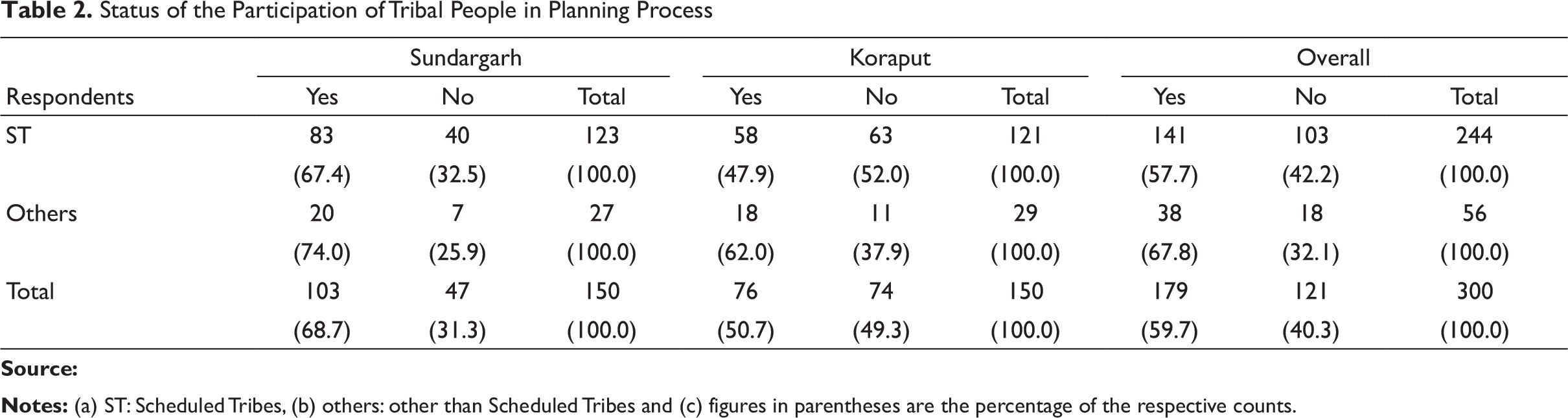
Status of the Participation of Tribal People in Planning Process
Participation of Tribal People in Planning Meetings Through Various Grassroots Institutions of Panchayats (N = 179)
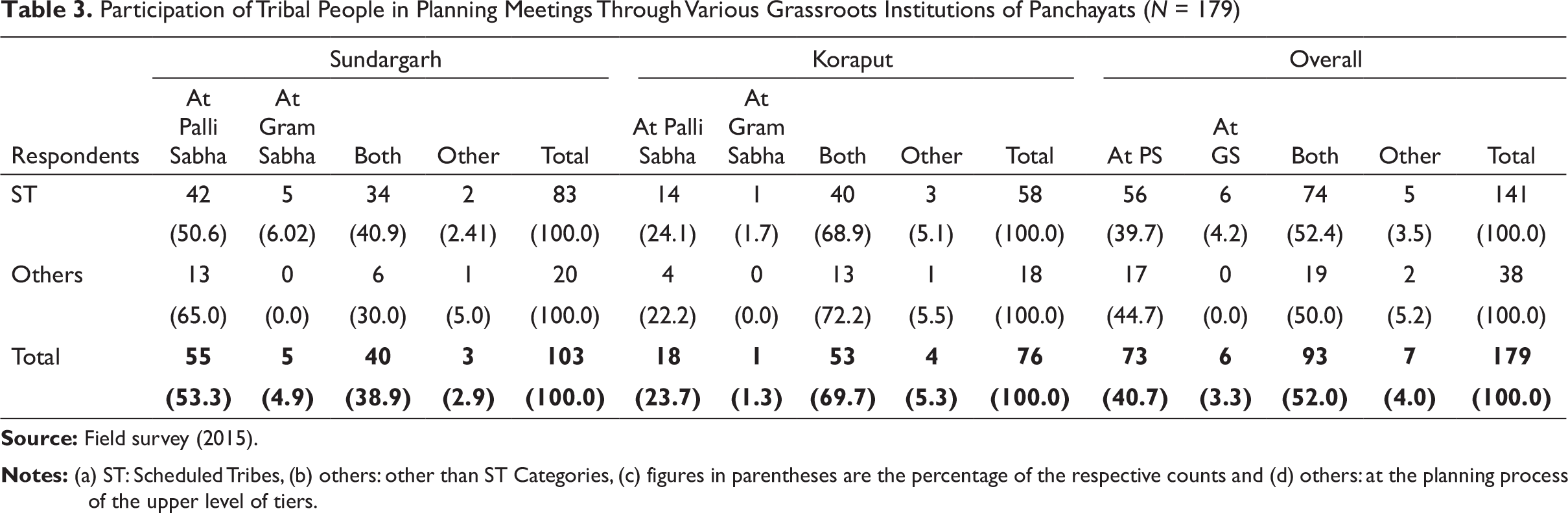
The nature and degree of participation of tribal people in the meetings held for planning through various grassroots institutions of Panchayats such as the Palli Sabhas (Village Assembly) and the Gram Sabhas show that ‘in many cases these people have participated at both levels such as at the level of Palli Sabhas (village or hamlet level) and at the level of Gram Sabhas (GP level) during formulation of decentralised development plan’. It is also observed that political mobilisation of tribal people through Palli Sabhas and Gram Sabhas have an impact on the degree of participation of these people in planning processes.
It further shows that 39.7 per cent of them have participated only at the Palli Sabhas, while 4.2 per cent of them have participated at the Gram Sabhas for the same purpose. However, their participation at both levels (at the Palli Sabhas and at the Gram Sabhas) is somehow impressive (52.4%). The overall trend shows that only 52.4 per cent of the tribal people are the actual participants and the participation of the remaining people is quite fluctuating because of various reasons.
Decentralised planning has become a key part of Panchayat, and it is held as per time schedule prepared by the Panchayats. This process has encouraged many people to participate in the planning process and suggest various works for the villages. On the issue of participation, some of the earlier research works also revealed that mass mobilisation of rural people through Panchayats and Gram Sabhas has given them confidence to articulate their needs and capacity to control the development process (Aziz, 1993; Rao, 1989). However, in this case, it is observed that Panchayats and Gram Sabhas have encouraged participation, but it is still not fully operationalised due to various reasons. There are many factors such as (a) distance of the Gram Sabha 2
Normally Gram Sabhas are taking place in Gram Panchayat’s (GP) Office.
Decentralised Planning and Discussion on Tribal Development Issues
Observation of Respondents on Tribal Development-Related Issues in the Planning Meetings (N = 179)

Observation of Respondents on Issues Being Raised and Discussed Related to Tribals in the Planning Meetings (N = 112)
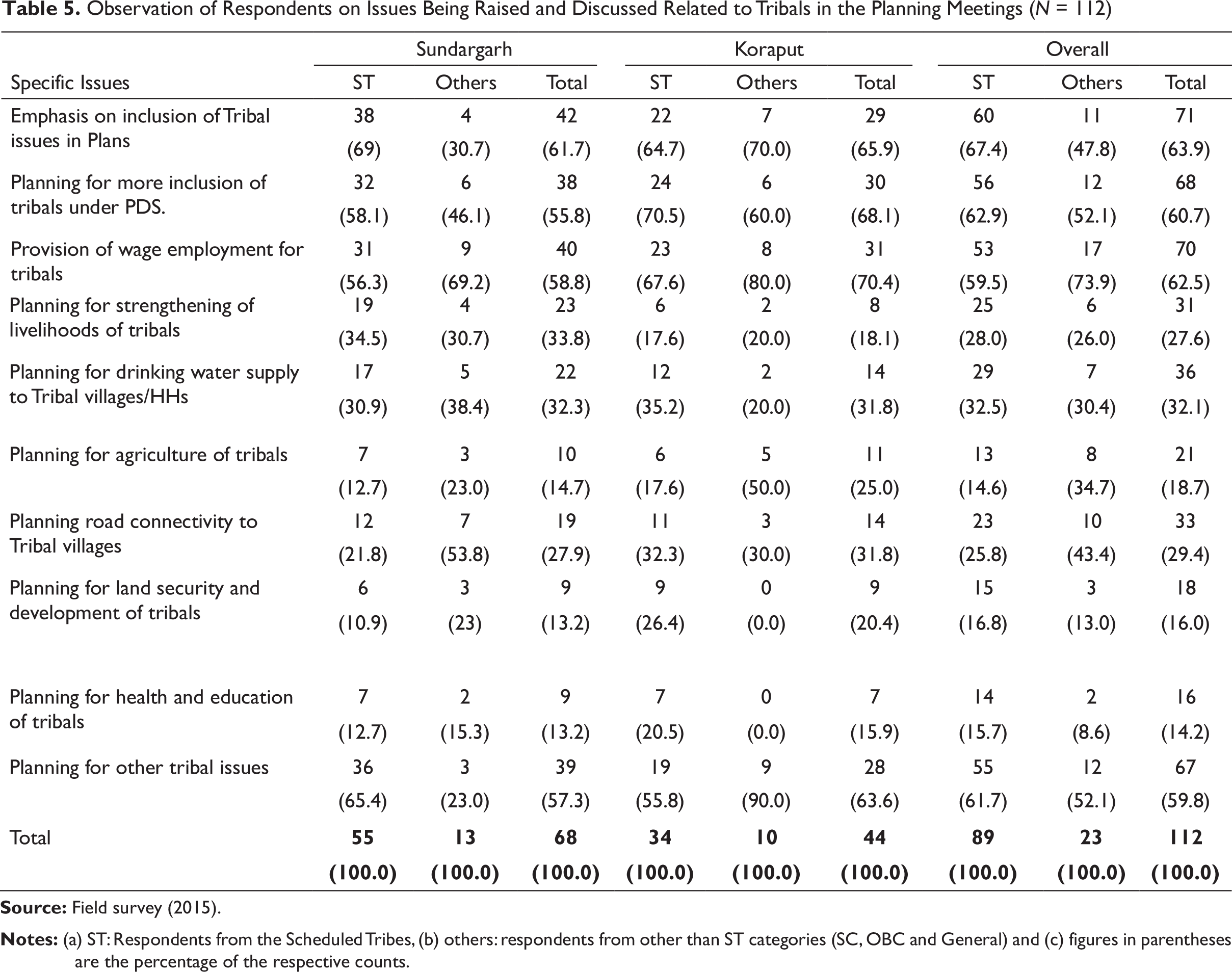
On the question regarding what are the issues discussed in the planning meetings, Table 5 presents the observations of the respondents on this aspect. It reveals that many respondents, in particular, the tribal people have observed the discussion of a range of issues in these meetings, which can be seen from the data table. The main issues are (a) inclusion of more tribal people in various schemes and programmes (63.9%), (b) inclusion of tribal people under food security programmes (60.7%), (c) strengthening livelihoods of tribal people (27.6%), (d) improving drinking water supply to the tribal households (32.1%) and (e) strengthening of agricultural system of tribal people (18.7%). With regard to improving road connectivity to the tribal villages and hamlets, it is observed that 29.4 per cent respondents observed the discussion of the same issue in the planning meetings. There was also discussion about providing more wage employment to tribal people under Mahatma Gandhi National Rural Employment Guarantee Scheme (MGNREGS). The other key issues like health, education and protection of tribal land from alienation have also been discussed in some cases. It has been realised by many tribal people of the villages that they have every right to avail more benefits from the development programmes being implemented by the Panchayats, and it can become possible through actively participating in planning and raising demand for their inclusion in the development programmes. This realisation has motivated them to participate in planning and raising issues affecting them (In-depth Discussion, Tribal People).This scenario has made the planning process participatory and inclusive in nature despite various lacunae associated with this process.
However, the basic issues of governance of tribal areas and issues of livelihoods and natural resources of tribal people have attained less attention in the process of discussion (FGD). The issues raised and discussed in the planning meetings are more or less confined within the purview of schemes and programmes of the central government and state government being implemented by Panchayats in the villages. The guidelines issued by the central government and state government are silent on inclusion of more tribal-related issues in the planning process, which is realised by many PRI Members and functionaries.
Involvement of Panchayats in Planning of Tribal Development Programmes Under Tribal Sub-plan
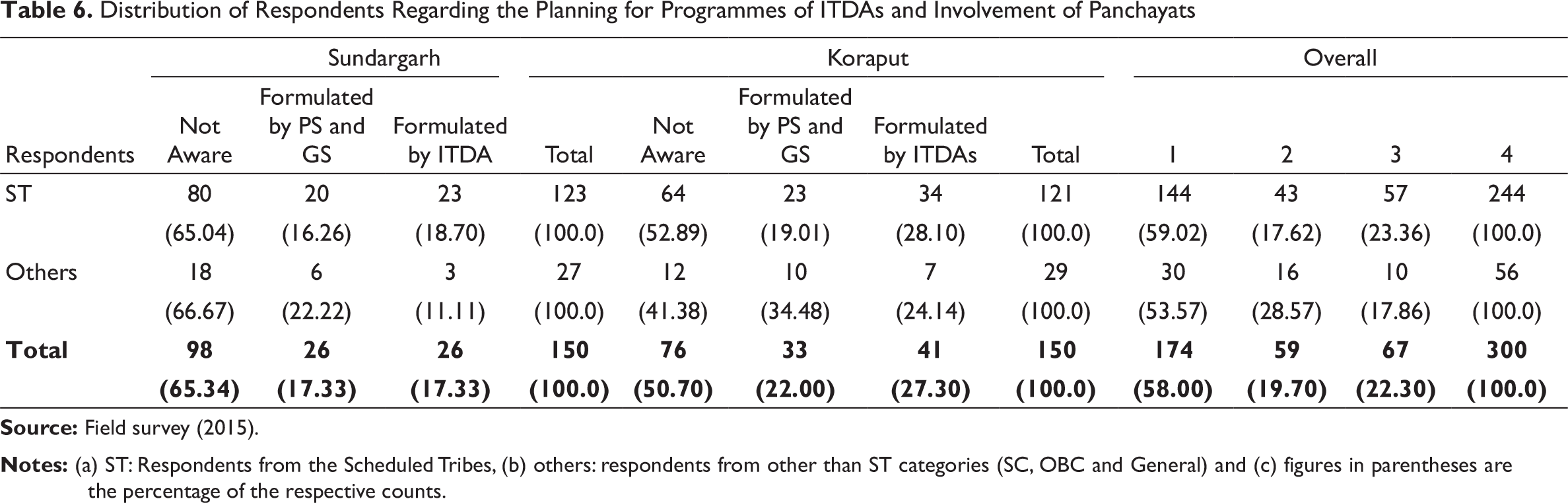
The two districts are part of the implementation of the TSP programmes, and for this purpose, the ITDAs have been institutionalised in the districts. In Sundargarh district, three ITDAs (Sundargarh, Panposh and Bonai) and two ITDAs (Koraput and Jeypore) in Koraput district are functioning and are involved in the process of implementation of a number of tribal development programmes. The involvement of Panchayats in the planning process of tribal development programmes implemented by ITDAs and awareness of tribal people on this issue are presented in Table 6. The result shows three important dimensions, which are associated with this issue. It shows that a majority of tribal people (59.0%) are unaware about the planning of the ITDAs and involvement of Panchayats with this process. It further reveals that 17.6 per cent of them are aware about involvement of Panchayats (Palli Sabhas/Gram Sabhas), while 23.3 per cent are aware that the plans are being formulated by ITDAs, and there is no involvement of Panchayats on this issue. In both the districts, tribal people are less aware on this issue than the other categories of people.
Being a part of scheduled areas and despite the presence of Panchayats in the districts, no sincere efforts have been made to terms of convergence between Panchayats and ITDAs in the districts. In maximum cases, there is no instance of preparation of plans of the ITDAs through the Gram Sabhas. People are not only unaware about planning but also various programmes being implemented by ITDAs in their villages. Our interaction with some ITDA officials on this issue revealed that the guidelines issued by the government are silent on formulation of plans through involving GPs and Gram Sabhas. When asked about the status of guidelines issued by Ministry of Tribal Affairs in 2003 (involving Gram Sabhas and GPs in planning process of TSP), many of them are unaware about this subject.
Role of Districts Planning Committee in the Process of Integration of Plans
Integrating decentralised development plans with state and national-level development plans is an important component of decentralised planning process. Formulation of development plan is not an isolated activity and not the responsibility of a single institution. It requires the involvement of multi-level democratic institutions for effective integration, resource allocation and implementation. In this context, the role of the DPCs is quite significant, which is mentioned under Article 243 ZD of the Indian Constitution. In the case of Odisha, including in the scheduled areas of the state, the DPCs are constituted 3
The District Planning Committees (DPCs) in the two sampled districts have been constituted since 2002 as per the Odisha DPC Act 1998 and Rules 2000.
In the case of the districts, the DPCs are being institutionalised and functioning since the year 2002 for the formulation and integration of the decentralised district plans and finalisation of the budget for these plans. They have become instrumental in the preparation and approval of short-term and long-term district development plans and budget.
Distribution of Respondents Regarding the Planning for Programmes of ITDAs and Involvement of Panchayats
Awareness Level of STs Regarding Functioning of the District Planning Committee

Local Democratic Innovations in Decentralised Planning
Through this study, it was attempted to make a case that innovative practices based on democratic principles are tantamount of making decentralised planning effective. In this context, it was observed through FGDs that the GPs and the Gram Sabhas have adopted various innovative democratic practices like (a) minimum attendance system in the meetings held over planning, (b) use of folk media for effective mobilisation of people, (c) integration with village-level formal and informal groups and organisations, and (d) forging partnership with non-governmental organisations (NGOs) for effective formulation of plans. In this context, these innovations have taken place because of the presence of grassroots political institutions like Gram Sabhas and their role in advancing participation of people in the planning process. These practices are being adopted to increase, diversify and deepen opportunities for participation of people (in particular, tribal people) in formulating development plans. These practices are adopted on the basis of existing local knowledge, awareness and social practices of people. Our interaction with many tribal people and elected members of Panchayats shows that these practices are based on various key elements of local democracy like mutual trust, cooperation, faith and belief.
Conclusions
The results of this study conclude that the modern political institutions (Panchayats) have been institutionalised for promoting economic development through formulating decentralised development plans, and it has become possible because of effective political process (institutional arrangement and participation) for achieving the goals of economic development. In the case of Sundargarh and Koraput districts located in scheduled areas of Odisha, the decentralised planning process has been grounded and progressing under the guidance of Panchayats. The participation of tribal people in the process of planning has been observed in many cases, which contributed to make planning as participatory in nature. As far as issues raised and discussed in the planning meetings, it was observed through this study that many issues which are affecting the economic conditions of poor people, in particular, the tribal people, have been discussed in the planning meetings. The issues related to promoting tribal development under TSP and role of ITDAs and their interaction with Panchayats have observed scant attention in the planning process. It is observed through this study that the planning process has become a key activity of Panchayats in these areas, which has affected the process of implementation of many schemes and programmes in these areas. The implementation of various schemes and programmes has positively influenced the economic condition of tribal people in many ways.
However, the initiative of developing a full-fledged participatory planning system has not achieved the desired goal. Though grassroots institutions like Panchayats and Gram Sabhas have been created, these institutions have not been able to achieve the desired goal because of inadequate devolution of resources and decision-making powers to these institutions and weak mobilisation of poor people, in particular, tribal people. It is quite true that putting participatory planning in statute book is not difficult, but more time is needed in making it operational in practice.
Integrating heterogeneous issues in decentralised planning and allocating resources for these issues have become a gigantic task for the Panchayats. The overall issues of economy of tribal people have not gained much traction in the decentralised planning because of excessive attention paid by Panchayats on implementing schemes and programmes of the central government and state government. After nearly three decades of the enactment of the 73rd Amendment Act and two decades of PESA Act, the case of formulating plans of TSP programme through Panchayats is still in a nascent stage.
So, it is, indeed, essential to make this process further effective in the scheduled areas under the guidance of the Panchayats. Considering the case of scheduled area and enactment of the PESA Act, it is important to issue a separate guideline for Panchayats of these areas for preparing decentralised planning. Fostering participation of the tribal people is tantamount to making the decentralised planning process effective, and this issue should get more attention in letter and spirit while formulating plans in these areas. It is important to maintain transparency in matters of identification of the beneficiaries for various schemes and programmes while formulating plans. The planning process should not be confined within the canopy of few schemes and programmes. There is a need of developing need-based and development-centric decentralised planning, which can promote sustainable socio-economic development of rural and tribal people. The achievements of the decentralised planning and role of Panchayats for this purpose need to be recognised through transforming these plans into development programmes and devolving adequate resources to Panchayats for implementing these development programmes in scheduled areas.
Footnotes
Declaration of Conflicting Interests
The author declared no potential conflicts of interest with respect to the research, authorship and/or publication of this article.
Funding
The author received no financial support for the research, authorship and/or publication of this article.