



Abstract
In India, the common notion towards cultivation is that it is commonly a male-centric activity. Women are a crucial resource in cultivation in rural India, but their contribution to cultivation is mostly disguised. Moreover, in India, large sections of women from economically and socially backward sections of the society are deprived twice, once for being born as a girl and once for being poor. The rural women in the coastal climatic zones have started to shift from being related solely to farming. This shift has been fuelled by various reasons such as less adequate knowledge of modern agricultural systems, physical drudgery of cultivation and the economic viability of the non-farm livelihood activities in the rural areas. In the coastal areas of West Bengal and Odisha, the scope of alternative livelihood is immense. Further, long-standing obstacles faced by rural women in terms of limited access to productive resources (land, credit, inputs, transport, extension services, storage, technical assistance and overall social prejudices) prevent them from adopting agriculture as their prime livelihood option. Moreover, recent studies on women in agriculture conducted in India and other lower-middle income and underdeveloped countries all point to the conclusion that women contribute far more towards agricultural production than has generally been acknowledged. The study has intricately focused on some key topics such as the access and control over land as a resource for women cultivator communities in coastal zones of West Bengal and Odisha and further to gather proper knowledge about the alterations of the livelihood of the women cultivators of the area. The study focuses on the differences between the two homogeneous communities living in close proximity showing different levels of alternative livelihoods and the relation between landholding and alternative livelihoods.
Introduction
In India, the common notion towards cultivation is that it is commonly a male-centric activity. Women are a crucial resource in cultivation in rural India, but their contribution to cultivation is mostly disguised. Moreover, in India, large sections of women from economically and socially backward sections of the society are deprived twice, once for being born as a girl and once for being poor. It can be often seen that women are paid less than a male even though a woman’s participation is no less than that of a man. Women in rural India devote 85.2 per cent of their time to unpaid activities, while men devote 26.5 per cent to the same. Out of the total time spent on unpaid and paid activities, men devote 73.5 per cent and women devote 14.8 per cent to paid activities (Ministry of Statistics & Programme Implementation, 2019).
Coastal rural areas in most of the lower-middle income countries mainly belong to the poorest of the poor section of the world’s population as the livelihood of these areas faces constant obstacles from different contexts. The rural women in the coastal and other subclimatic zones have started to shift from being related solely to farming. This shift has been fuelled by various reasons such as less adequate knowledge of modern agricultural systems, physical drudgery of cultivation and the economic viability of the non-farm livelihood activities in the rural areas. The alternatives to their current livelihood system are now playing a major role in the economic and social development of rural women in India. Coastal areas being an interaction point between marine and terrestrial systems are very much exposed to a variety of land and sea-based hazards, including the ones that originate from storms, flooding and erosions. The presence of diversity in the coastal ecosystem, landforms and land use makes their response to hazards highly complex, and some coastal areas are very much sensitive to damage. The importance of coastal zones is increasing because of high ecosystem productivity, increase in population size, increasing industrial development, intensive exploitation of resources and expansion of recreational activities.
Over time, it has also been found that women workforce extended their livelihood activities outside the walls of their household has developed drastically in rural areas than in urban areas (Kumar & Kumar, 2009). The women’s labour force has a very special significance in cultivation and its allied operations. In India, the dependency on women’s manual labour is a significant resource for activities related to cultivation. Rural women who are also called ‘farm women’ establish almost more than 50 per cent of the agricultural workforce (Sarungban, 2006).
The art and science of farming were first initiated by women. They are the ones who first domesticated cultivation practice. Men only went hunting and gathering for the need of food (Swaminathan, 2006). The present study aims to address and document the prevailing livelihood strategies based on available resources and to understand the feasibility of sustainable alternative livelihood strategies carried out by the women cultivators of the study area. Further, this study tried to explore the various reasons for choosing these alternative livelihood strategies.
Objectives
To obtain the pre-mentioned aims, the following objectives are considered for the study:
To study the alternative livelihood strategies and diversification of the livelihoods To understand the reasons behind opting for alternative livelihood strategies
Methodology
The study has been conducted in two neighbouring states of India, namely Odisha and West Bengal which can be seen in Figures 1 and 2. One specific district from each state has been purposively selected for the study. The purpose behind selecting Balasore from Odisha and Purba Medinipur from West Bengal is that these are the only two districts sharing the same coastline. West Bengal and Odisha are two of the easternmost states having a common shoreline. Being adjacent states to each other, West Bengal and Odisha share many characteristics in common such as social and cultural practices, soil type, climate, etc. Though having very similar characteristics, both the districts have their distinctive features to bifurcate them. Out of 12 blocks from the Balasore district, community development block Bhograi has been purposively selected.
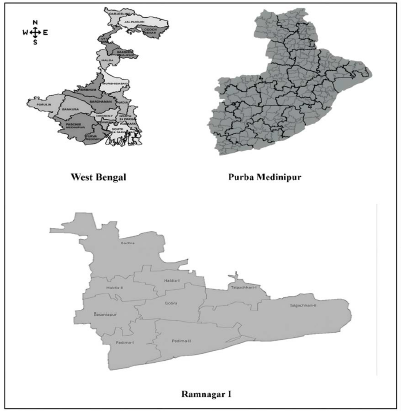

On the other hand, out of 25 community development blocks of Purba Medinipur, community development block Ramnagar I has been selected purposively. Two of the adjacent community development blocks have been selected for the study. West Bengal and Odisha only share their borders with these two blocks in the coastal area. From each of the blocks, two panchayats were selected for the study. The criteria for panchayat selections followed the same rule of being adjacent to each other; also, another aspect was that panchayats were supposed to be coastal panchayats having at least one side shared with the shoreline. In addition, it must have cultivable land and the panchayats must have at least 80 women engaged in cultivation so that it cannot be an activity that is least practised by the actively working women group. The term ‘women engaged in cultivation’ is justified if the person is engaged with active cultivation for at least 3 months of a calendar year. Panchayats selected are Padima I and Padima II of Ramnagar I block from West Bengal and Sahabajipur and Huguli of Bhograi block from Odisha. All the villages for the respective panchayats were covered for the study.
The sampling of the respondents was done through the purposive snowball sampling method. As it is a non-probability sampling technique, it required certain criteria to be met. The respondents have been selected based on certain fixed parameters; those parameters are: (a) All the respondents had to be women and (b) all the respondents had to be engaged in cultivation for at least 3 months of a calendar year directly or indirectly. A total of 361 respondents were found through the snowball sampling method till the members started repeating. The study was extensively done on the primary database collected through a survey with a structured interview schedule. Further, focus group discussions were also done to understand the community’s perspective towards cultivation and alternatives of cultivation.
Results and Discussion
Livelihood is the basis of creating a system to subsist. Livelihood scenario signifies the competencies, resources, income and deeds of people prerequisite to protect the rudimentary inevitabilities of life. Alternative livelihood is the progression by which rural families materialise a progressively assorted selection of attributes; assets such as physical, human, natural, social along with financial assets to subsist. It also embraces the admittance like an institution, social relation and organisation to these norms that define the existence gamed by the person or household to progress their customary of living. Diversification of rural livelihoods has essential insinuations on rural poverty. The reason behind this is that cumulative earnings, employment and productivity in solitary livelihoods like cultivation using orthodox methodologies have a propensity of missing their objectives (Ellis, 2000).
Types of Alternative Livelihoods
Various facets of alternative livelihood are prevalent in the area. The geopolitical surrounding of the area is significant to the magnitude of the alternative livelihood.
The proximity with the Digha–Sankarpur economic hub plays a distinct role in the alternative strategies adopted by the women cultivators of the area.
Large varieties of alternative livelihood strategies have been found in the study area apart from cultivation. From Table 1, it has been found that 23.55 per cent of the respondents do not have any alternative livelihood strategies. In West Bengal, the percentage of having no alternative livelihood is significantly less compared to Odisha. In Odisha, 30.46 per cent of the respondents are solely dependent on cultivation without having any alternative livelihood strategies.
Types of Alternative Livelihoods.
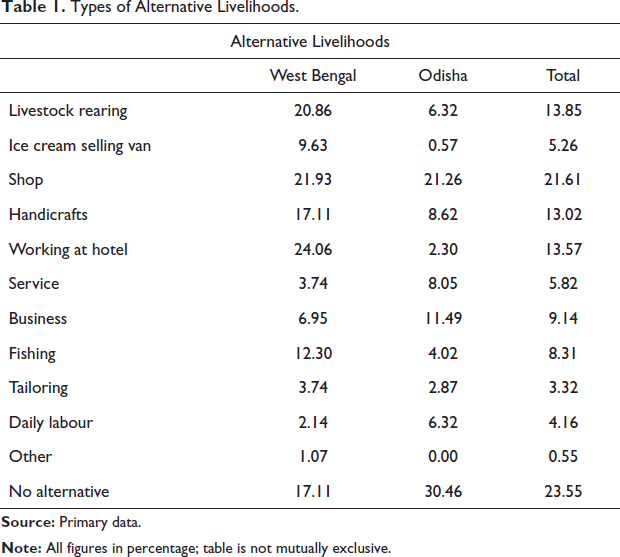
In the study area, it has been found that the majority of the respondents are operating a shop for additional income. Further, a large number of respondents possess multiple types of alternative forms of livelihood to promote additional income to their families. In Padima I and II of Ramnagar I, the single most availed alternative source of income is working at hotels of Digha and Sankarpur area with 24.06 per cent of women cultivators working in. Followed by having small shops with 21.93 per cent of women’s engagement, and livestock rearing is another large income-generating opportunity in the area with 20.86 per cent of women engaged with it. Livestock rearing is predominantly found in the Padima II panchayat. Other alternative livelihoods practised by the respondents are ice cream selling van, making handicrafts, servicing at different organisations, fishing, tailoring, working as non-agricultural daily labour, etc. In Huguli and Sahabajipur, the trend is altogether different from West Bengal, as there are not many respondents found actively participating in the hotel business. This is due to the obstacles in mobility and distance from the Digha–Sankarpur area. Further, it has been found that a large number of respondents of Sahabajipur panchayat initiate themselves in small seaside shops on Udaypur beach.
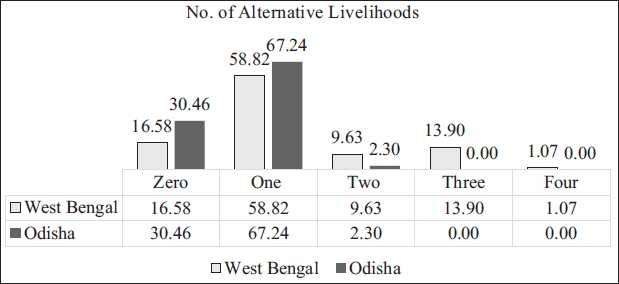
From Figure 3, it is evident that the majority of the population has only one alternative livelihood apart from cultivation. Further, it is also evident from the study that in Padima I and Padima II panchayats’ women cultivators practice more than one livelihood apart from being a cultivator. Although, alternative livelihood should not be renowned or measured in footings of the number of income-generating sources of a household. Nevertheless, the diversification should be measured on the degree of dependence or the diversification of income from those multiple sources. A family, for instance, may have half a dozen or more diverse foundations of revenue, yet 90 per cent of the overall income may come from just one or two of the revenue sources which cannot be described as a diversified livelihood.
The development of the Udaypur beach is to be taken care of by the authority focussing on the development of the local communities as the illicit activities (unauthorised selling of alcohol) are gaining popularity due to employment and income shortage in the area. Selling these substances is also considered to be one of the alternative livelihoods of Odisha’s women cultivators. This tendency is largely due to the tourists provoking such activity to happen in the area.
Livelihood Diversification
Livelihood diversification can be measured using diverse indicators and indices, such as Simpson index, Herfindahl index, Ogive index, Entropy index, Modified Entropy index and Composite Entropy index (Khatun & Roy, 2012). Numerous researchers have exercised the Simpson index to quantify livelihood diversification. This study charted the same because of its computational uncomplicatedness, robustness and wider applicability. The formula for Simpson index of diversification (SID) is
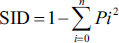
where ‘n’ is the total number of revenue foundations and ‘Pi’ is the income proportion of ‘I’th income source. The assessment of SID falls between 0 and 1. The index’s value is 0 if there is only one foundation of income. As the number of sources increases, the share of ‘Pi’ declines and does the summation of the squared portions. Hence, SID approaches to 1. Households with the most diversified income sources have the highest SID value. The least differentiated income sources have the minimum SID value. The higher the number of revenue sources as well as the more evenly dispersed the income portions, the higher the value of SID. The Simpson index of diversity is pretentious both by the number of revenue sources also by the spread of that income among different sources.
The value of the livelihood diversification index (SID) always ranges between 0 and 1 (Ahmed et al., 2018) and when there is only a single source of revenue existent, Pi = 1, then SID = 0.
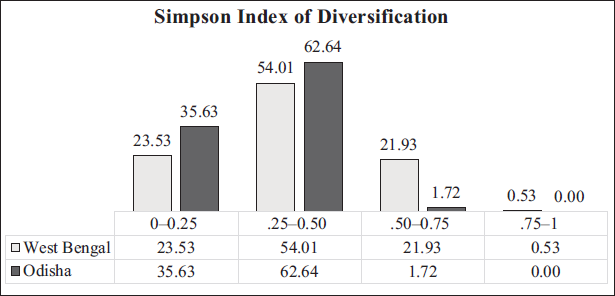
From Figure 4, it is evident that the majority of the respondents show a medium level of diversification. In addition, it has been found from the study that in West Bengal, the trend is extremely different from Odisha. In West Bengal, 21.93 per cent of the respondents show a high level of diversification compared to only 1.72 per cent of Odisha’s respondents. In West Bengal, even a few respondents show a very high level of diversification. In Odisha, it has been found that 62.64 per cent of the respondents show a medium level of diversification compared to 54.01 per cent of West Bengal’s respondents. From the study, it has also been initiated that 23.53 per cent of the respondents from West Bengal show a very low level of diversification. In Huguli and Sahabajipur, the story is worse, while 35.63 per cent of the respondents have a low level of diversification. This trend is mainly because the distribution of the income from these livelihoods is very disproportionate. In West Bengal, the income from all the livelihood sources is comparatively high from that of Odisha. This is mainly possible because of the proximity of the Digha–Sankarpur tourism hub. On the contrary, in the study area of Odisha, the trend is different due to the cultivation as a livelihood for women is mainly of unvalued work as the development of the tourism sector is less explored.

Landholding Pattern of Cultivators for Cultivation
Land is one of the most important and productive resources towards gender equity and equality. The land is extremely threatened in India. However, India has a terrestrial area of about 328 million hectares, which is the seventh biggest land area in the world. India is weighed down with a populace of 1,210 million as per the 2011 census, which propagated from 345 million in 1947 with an evolution rate of 1.76 in the past decade. Population density has amplified from 117 per sq. km in 1951 to 368 in 2011. The populace to land proportion makes land secretarial a substance interconnected to human improvement anxieties. As the stride of progress in non-farm engagement boulevards trailed overdue the population evolution, it enforced upon more than half of the populace to eke out their existence from cultivation and associated undertakings. Additional to this, the demand for land and additional natural capitals for non-farm use ascending from urban blowout and industrialisation has not solitarily emaciated the per capita obtainability of farming land in rural areas from 0.638 hectares in 1950–1951 to 0.27 hectares in 1998–1999. It overwrought its consumption, leaving upsetting significances on the eminence and sustainable use of land (Mitra & Banerjee, 2018).
Land is a very scarce resource in contemporaneous setup. With the global trend of modernisation and population blast in the recent decade, land is becoming more and more scarce. The infrastructural development towards urbanisation is heavily gulping the agricultural land. The same is true for the present study area, with the expansion of the Digha–Sankarpur tourism area, land is getting pricier and used for non-agrarian purposes.
It can be seen from Table 2 that 10.80 per cent of surveyed households own no land. 16.07 per cent of the surveyed population has less than 1 bigha of land, 52.91 per cent of people have 1–2 bighas of land, and 20.22 per cent of people have more than 2 bighas of land. The supreme portion of the sampled households has 1–2 bighas of land.
Landholding Pattern.
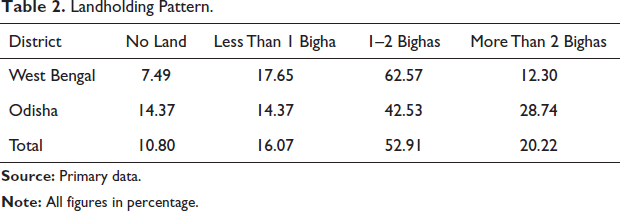
In West Bengal, it can be seen that 7.49 per cent of the surveyed population has no land of their own. 17.65 per cent of surveyed households have less than 1 bigha of land, 62.57 per cent of women cultivator households have 1–2 bighas of land, and 12.30 per cent of people have had 12.30 per cent of the land. This trend is noticeable in that West Bengal has very few households having more than 2 bighas of land for cultivation. The major contributor to this trend is land reforms done through Operation Barga, which took place in the late 1970s to early 1980s.
In Odisha, it can be seen that 14.37 per cent of people have no land of their own, 14.37 per cent of people have less than 1 bigha of land, 42.53 per cent of people have 1–2 bighas of land, and 28.74 per cent of people have more than 2 bighas of land. The betel leaf cultivators of the area generally possess a large share of the landholding in Sahabajipur panchayat, whereas in Huguli, the landholding pattern is by far pretty mixed. It can also be seen that more than 28 per cent of the population has land of more than 2 bighas. The notion of these large landholdings is because of less strict land reform movements in Odisha.
Further in the study, it can be seen that landholding of the households plays certain other consequences and correlates with far broader aspects. The livelihood of the women cultivators is very closely intertwined with the land, as land is one of the most important resources in the coastal economy.
From the study, it has been found that no rural cultivator women possess any land of their own. Access and control over land belong to the male members of the family. Although, some women cultivators have their own house as property but have no legal control over cultivable or non-farm landholding. The story is identical in all the panchayats. From this phenomenon, it can be concluded that there is still room for development for landholding patterns and scenarios.
Alternative Livelihood and Landholding
Land being the main resource for cultivation creates further importance in the life and livelihood of the cultivators. Land is one of the most precious resources in the world, particularly in lower-middle income countries such as India, due to the pressure to feed a vast population. The study encompasses the scenario and strategies of livelihood of the women cultivators of the coastal area; hence, the land is furthermore the most significant resource for generating livelihood of the women cultivators. Land plays a key role in the women cultivators’ livelihood as often in third world countries, women are the last entity to be entitled to be a stakeholder of land. However, household land is directly linked with agricultural productivity and income generation, which highly influences the life and livelihood of the respondents.
Correlation is a statistical extent that designates the amount to which two or more variables alter together. It is used to analyse the quantitative data collected during the survey. A correlation analysis has been conducted to understand if there is any relation (positive or negative) between the landholding of the household and the number of alternative livelihoods initiated. Correlation is a statistical stint restating the degree to which two or more variables interchange in harmonisation with one another. If the variables transfer in a similar course, then those variables are alleged to have a positive correlation. If they travel in contrasting directions, then they have a negative correlation. Correlation is an examination of the covariation amongst two or additional variables.
For the present study, Pearson’s correlation has been used to understand the relationship between alternative livelihood and the landholding of the households. Karl Pearson, a great statistician and biometrician, recommended the analytical technique for calculating the degree of linear connection between the two variables. It is the most widely accepted technique in practice and it is recognised as the Pearsonian coefficient of correlation. It is signified by ‘r’. The formula for calculating ‘r’ is
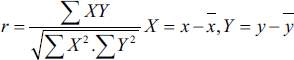
If the two variables incline to move composed in the same direction, then the correlation is called positive or direct correlation and it is represented in (+) numbers. If the two variables incline to move alongside opposite directions, then the correlation is called the negative (or) inverse correlation and it is represented in (–) numbers and 0 suggests no correlation.
From Table 3, it is found that land and alternative livelihoods are extremely interrelated with each other. Further, it shows a negative correlation between them in all the studied panchayats of West Bengal and Odisha.
Correlation Between Alternative Livelihood and Landholding.
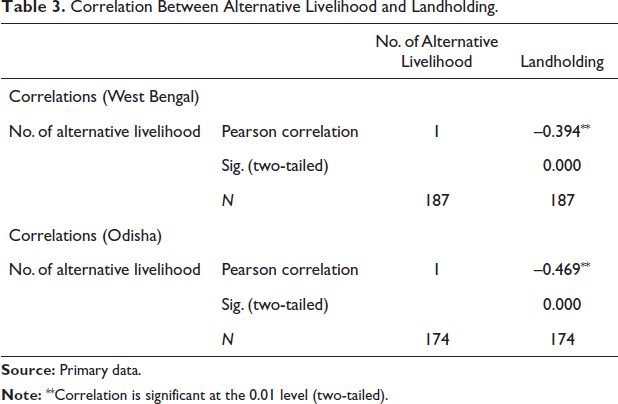
From the study, it is evident that land plays a crucial role in selecting the alternative livelihood for the women cultivators. As cultivation is a livelihood activity and the minimum requirement to perform the activity is the land, due to this fact, less land will inevitably force less production and less production means less income for the households. Also, from the focus group discussions, it has been found that large farm households do not seek other livelihood opportunities as cultivation only can take care of the family whereas the landless labourers, sharecroppers or small farm households seek further alternative livelihood for additional income. This is one of the primary reasons for the women cultivators of the area to start venturing into additional alternative income-generating possibilities. It is to be mentioned that unlike certain other parameters in the study, this trend is homogenous in nature for both states.
From the focus group discussions, it was found that majority of the women opted for alternative livelihood mainly due to landholding pattern and lean periods of agriculture which force the women engaged with cultivation to opt for newer alternatives.
A sustainable alternative livelihood includes the capabilities, assets (together with both physical and social capitals) and activities vital for an income of living. An alternative livelihood is considered sustainable when it can handle and recuperate from hassles and tremors, and uphold or augment its competencies and resources, whilst not undermining the natural reserve base (Scoones, 1998). In this case, it has been found that the women living in West Bengal show more resilience towards shock due to the number of alternative livelihoods and scope of alternatives. The market is more developed in the surroundings of Padima I and Padima II as Digha is very near the selected community.
Conclusion
Women in the study area actively participate in the cultivation activity, and it is a widespread phenomenon. Women cultivators of the area devote a considerable amount of time in their on-field activities to help their families financially. The susceptibility of the region to sporadic cyclones with high production damages likewise intensifies the threat to the study area.
More than 62 per cent of women are involved with more than one income-generating activity. A vast number of livelihoods apart from cultivation have been found in both the areas such as fishing, handicrafts, shops, cooking and services in hotels, non-agricultural labours, livestock rearing, etc. It is also found that the intensity of livelihood diversification is more in West Bengal compared to Odisha. This tendency is more prevalent in West Bengal because of the growth in the tourism infrastructure of Digha. Certain chief obstacles were found for women cultivators in the study area; one of the biggest among those is the lack of information and sources of receiving information regarding productive cultivation. Further notable problems are natural hazards, mental and physical well-being, soil quality, price-related barriers, market-related problems, etc.
From the study, it has also been found that there is a direct relationship between the landholding of the household and the number of alternative livelihoods of the respondents. The scenarios are negatively related in both the areas, more so in Odisha. This suggests that the less the landholding of the household, the more the number of alternative livelihoods of the women cultivators. It can be concluded that land being one of the major resources for cultivation plays a pivotal role in the selection of alternative livelihoods.
The correlation between shareholding of cultivable land and livelihood strategies directly shows that the alternatives grown by the women for their livelihood security to minimise the shocks. This trend opens another viewpoint which suggests the social independence of having multiple livelihood opportunities in the mentioned area.
The study concludes that in the study area, the majority of farm women workers play a significant role in the cultivation and support of their families in agricultural operations. Further, alternative livelihood is another part that plays a key role in their sustainability and empowerment. The coastal communities are extremely vulnerable to natural disasters and shock. The women cultivators have developed a mechanism to fight poverty by adding alternative income sources to their support. The livelihood strategies of the women engaged with cultivation are very diverse, and they will become further sustainable with proper measures.
Footnotes
Declaration of Conflicting Interests
The author declared no potential conflicts of interest with respect to the research, authorship and/or publication of this article.
Funding
The author received no financial support for the research, authorship and/or publication of this article.
