



Abstract
In rural Ghana, women encounter patriarchal values that restrict their access to productive agricultural lands. This undermines the productive capacity of women, affecting sustainable food production. Using mixed methods, we provide new insights into gendered land access in Northern Ghana. A sample of 228 household heads was surveyed from seven major communities across the study area. In-depth interviews were conducted with chiefs and women associations. Findings indicate that land-based decisions are mainly made by men as women were assigned to less fertile farmlands. As a result, women are disproportionately poorer and experienced occasional bouts of hunger. Outcomes of gendered land access were precarious, affecting poverty reduction, food security and women empowerment. The study recommends joint ownership of lands as a point of entry into customary land decision-making platforms by women. A deeper understanding of women’s land access dynamics in order to mainstream the same into land-sector policies was proffered.
Introduction
In agrarian communities, land remains a critical factor of production (Chirwa, 2004; Holden & Ghebru, 2016; Lambrecht, 2016; Myat Thu, et al., 2007; Pedersen, 2015) and is, therefore, considered as a source of wealth, power and authority (Spichiger & Stacey, 2014). Nearly every aspect of the Ghanaian rural dwellers’ livelihood is expressed in agricultural terms (Kasanga & Kotey, 2001). Agriculture employs a chunk of the population in rural Ghana, especially women and the youth, including both skilled and unskilled labour. This makes agricultural pursuits very important in promoting sustainable development.
Women constitute about 43 per cent of the agricultural labour force in Africa (SIDA, 2015), underscoring the need to think about women’s land access in agricultural production (Chigbu, 2019b; Chirwa, 2004). While land provides the most sustainable livelihood options for rural dwellers (Han et al., 2019), access to productive lands by women remains largely restricted (SIDA, 2015). Women only get secondary access to agricultural lands mainly from their husbands, fathers, sons and other male relatives (Agarwal, 2003; Chigbu, 2019b). In many instances, less fertile lands are assigned to women for agricultural purposes and within a defined period (FAO-IFAD, 2012). This limits the ability of women to use such lands as collateral for credit, expand their farms and invest in capital-intensive and modern agriculture to increase production (Han et al., 2019). As a result, rural women in Ghana are disproportionately poorer than their male counterparts. This has wide-ranging implications for women’s livelihood sustainability, food security and empowerment outcomes (Apusigah, 2009; Johnson et al., 2016; Meinzen-Dick et al., 2019).
While difficulty in land access by women is largely attributed to the long-established and entrenched patriarchal cultures that perpetuate male dominance (see Chigbu, 2019b; Deininger, 2005; Yaro, 2010), low educational levels and women’s lack of awareness of their land rights have contributed to its persistence (see Golla et al., 2011; Johnson, et al., 2016; Kidder et al., 2017). These patriarchal relationships have created the situation of ‘the haves’ and ‘the have nots’ in agricultural land access in rural Ghana. However, the outcomes of lack of access to land by women could influence women empowerment outcomes and negatively affect livelihood sustainability within the rural setup. This practice disrupts livelihood enhancement efforts, hampers productivity and affects global food sustainability significantly.
This study examines women’s access to agricultural lands in a typical rural setting; the Kpandai District of Northern Region, Ghana. The emphasis on women’s access to agricultural land leans on the backdrop of existing patriarchal relations in most parts of the Northern regions which regard land as ancestral inheritance. In this system, inheritance of land is mostly by the men to the disadvantage of women. It is, therefore, important to understand the land access dynamics of women to be able to make appropriate calls for it to be addressed towards promoting food security and sustainability among rural farmers. We, therefore, explore the lack of access to land by women and its implications for poverty reduction, food security and women empowerment.
Literature Review
Customary Land Tenure and the Theory of Access
The nature of access to land is always underpinned by the existing land tenure systems. In the case of Ghana, all land rights for agricultural use are governed by customary land tenure regimes (Kidido et al., 2017). Tenure system controls a ‘bundle of rights’ or interest over a piece of land (Kameri-Mbote, 2005). Land tenure is, therefore, the possession of rights associated with a parcel of land. Land tenure, therefore, is the ‘relationship, whether legally or customarily defined, among people, as individuals or groups, with respect to land’ (FAO, 2002, p. 3). Customary land tenure is landholding types that govern land according to customary laws and proceedings (World Bank, 2007). Customary land tenure system developed from traditions and accepted practices over a period of time in acquiring, using and distributing land. Customary land tenure system is dynamic and evolves over time. About 80 per cent of all lands in Ghana fall under customary ownership, making it the most important route to examine access to agricultural land.
Access is simply defined as ‘the ability to benefit from things’ (Ribot & Peluso, 2003). With its focus on ability rather than rights, access theory highlights the role of social relations that can enable or hinder people from enjoying benefits from land. In navigating the complex coalescence of access, Ribot and Peluso (2003) claimed that some people and institutions control resources while others must maintain access from the resource-controlled group. Access, therefore, is bundles and webs of power that enable actors to gain, control and benefit from resources. Access is dynamic and depends on the position and social relations of individuals (Bugri, 2013). The theory of access is best fit for women’s land access in Ghana because it shifts the conversation from ‘who has the right to land’ to ‘who can benefit from land’. Women in northern Ghana, therefore, only have access to land if they are able to maintain good relationships with male members of their family such as father, husband, son or male members. This creates a lot of inconveniences and problems such as tenure security and instances when the woman wants to expand the farm (Chigbu, 2019a). Since gendered land access exists at the micro and macro levels, it takes time to eliminate it. The emphasis on women’s land access could lead to some new benefits from land as efforts are being advanced towards formal documentation of land rights.
Conceptualising Patriarchy and Power Relations in Land Access
Patriarchy first emerged from the writings of Kate Millett, entitled ‘Sexual Politics’ in 1970. Millett (1970) used the power of fathers in the family as the background to argue that ‘the principles of patriarchy were twofold: male shall dominate female; elder male shall dominate young’. As one of the world’s oldest forms of domination, patriarchy has many definitions and applications among countries and societies (Chigbu, 2019a). For example, Mitchell (1974) used patriarchy to describe men’s ideology over women. Hartmann (1979) referred to patriarchy as historically specific male power over female and younger people. Patriarchy can also be defined to include a ‘system of social structures and practices in which men dominate, oppress and exploit women’ (Walby, 1989, p. 214).
Although patriarchy has been interpreted differently, all the definitions converge on the existence of men’s dominance over women in the family and the larger society (Lerner, 1987). Patriarchy, therefore, refers to a system, created and sustained through social structures in which men exercise authority over women in order to dominate and exploit them. The patriarchal system of men’s dominance exists both at the micro level (family) and macro level (society). It is, therefore, not surprising to find an association between women’s landlessness and patriarchy (Chigbu, 2019a; United Nations Women, 2015; World Bank, 2014). At the family level, for instance, Chigbu (2019a) explores four institutions that perpetuate male dominance. These include father power, son power, husband power and linguistic power. Father power explains the authority exerted on the female children by their father during their formative years (Chigbu, 2019a). The father exercises power over his daughters and wives to accept the authority of men. As a result, women learn to accept that their fathers, brothers and other male members of the kinship are key members while women are not. The second stage is called linguistic power, which is a societal orientation that ensures that women are taught to accept their position as inferior to the men in the social and political governance structure (Ntihinyurwa et al., 2019). Here, proverbs and folklores are used to illustrate male dominance. The next stage is called husband power, where the wives are given marital rules that make them accept the dictates of their husbands. After marriage, the husband becomes the new patriarch who controls the wife like how a father controls his daughter. The last stage is son power where male children exercise emotional and spiritual dominance over their sisters and mothers. The male children obviously grow to participate in decision-making at the expense of their sisters and mothers.
These power relations affect the ability of women to participate in decision-making regarding access to land (Chigbu, 2019a). This denial of participation in land-based decisions is the genesis of women’s landlessness in patriarchal societies (Han et al., 2019; Quisumbing & Maluccio, 2003). However, Meinzen-Dick et al. (2019) and FAO (2013) opined that enhancing women’s land rights and access could consolidate the gains made towards sustainable development.
Efforts aimed at breaking patriarchy and sustaining gender parity in land access have led to various concepts, including gender mainstreaming and women empowerment. Gender mainstreaming denotes an approach to policymaking that incorporates the interests of both men and women in decision-making (Kabeer, 2003). The concept was first introduced in 1985 at the World Conference on Women in Nairobi, Kenya. Gender mainstreaming acts to eliminate all forms of biases against women and to ensure equal access to opportunities. Gender mainstreaming works with the complementary term women empowerment, where the status of women is raised in society to ensure that they are able to make decisions about their own welfare and progress (Duflo, 2012; Kabeer, 2005). Land access is a key developmental factor in promoting women’s empowerment in agrarian communities (Kidder et al., 2017). Paradoxically, women have restricted access rights, restraining their productive capacities (Quisumbing et al., 1996). As a result, women have higher exposure to all forms of vulnerabilities including poverty, hunger and food insecurity than men (see Awumbila, 2006; Boakye-Achampong et al., 2012; Ogato et al., 2009; Razavi, 2000). To promote livelihood sustainability in rural areas, land access dynamics of women and the youth are critical.
Study Setting and Research Methods
Study Setting
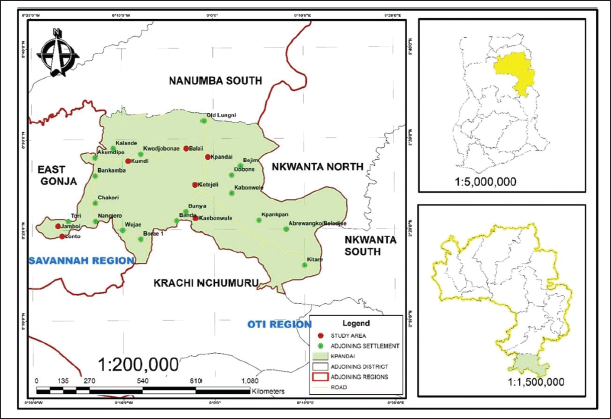
The study was conducted in the Kpandai District in the Northern Region of Ghana. The district lies in the south-eastern part of the Northern Region and shares boundaries with Nanumba South District to the North, Nkwanta North and South Districts to the East, Krachi Nchumuru District to the South and East Gonja District to the West (see Figure 1). The Kpandai District is one of the food baskets of Ghana, contributing to agricultural productivity in tuber crops, cereals, livestock and fish farming.
Location Map of Kpandai District.
The study district has a population of 108,816, with about 87 per cent of the economically active population engaged in agricultural production (GSS, 2014). The district’s population is made up of 50.54 per cent male and 49.46 per cent female. The Kpandai District is rural in nature with the rural population being 97,992 (90.1 per cent) of the total population in the district while the urban population represents 9.9 per cent. Annual rainfall in the district ranges from 1,150 to 1,500 mm, although with unpredictability of rains which poses a challenge to the farming activities. However, the district is endowed with major rivers such as Oti, Dakar and White Volta which are potential sources of water irrigation for agricultural production. Though skilled agriculture, forestry and fishery are predominant in the district with a higher proportion of men (92 per cent) than women (78.9 per cent), women were more engaged in craft and related trade (11 per cent) than men (2.6 per cent) (GSS, 2014). Apart from crop farming, which forms the major occupation in the area, livestock rearing was common and employed about 15,673 people among the total population of all workers. Crops that are popularly grown in the district include yam, cassava, groundnuts, soya beans, cowpea, maize, rice and sorghum. As the district lies in the tropical continental climatic zone, most of the economic activities revolve around agriculture and agro-based processing. Livestock rearing, poultry keeping and fishing are also common in the district.
Materials and Methods
The study adopted pragmatism philosophy as the underlying assumption, using mixed methods for the purpose of data triangulation and grounded evidence. To ensure district-wide representation, each of the seven settlements, which functioned as both the traditional seat and as the seat of the government administrative sub-centres (town/zonal/area councils), were included in the study (Table 1). The use of multiple localities was designed to glean different perspectives for a deeper understanding of the gendered land access, rather than for generalisation purposes.
Determination of Sample Size.

The actual fieldwork began after ethical clearance had been obtained from the university. Initial visits were made to the study area to seek official consent and to establish a rapport with the study participants and local stakeholders. During this process, efforts were also made to interact with some household heads, chiefs and opinion leaders.
According to GSS (2014), about 3,346 households were engaged in agriculture in the Kpandai District. Based on Slovin’s formula, a sample size of 357 household heads was targeted for the initial questionnaire survey. This figure was then proportionally divided among the seven major communities which were included in the survey. Upon return from the field, the questionnaires that were correctly filled and fit for the analysis were 228. At the community level, quota sampling was used to select the three different types of household heads: male-headed, female-headed and co-headed households in order to glean wider perspectives on the processes and outcomes of land governance through the survey. A household is described as co-headed if both the man and woman share equal responsibility for housekeeping arrangements, including providing food and income. However, due to the patriarchal social structure, this gender balance was difficult to achieve as majority of the households were headed by men. The purpose of the research was clarified and the respondents were ensured about their anonymity and their rights to terminate the proceedings any time they felt inconvenienced and/or uncomfortable. At the household level, convenience sampling was used to interview household heads who were handy and ready to participate in the study.
Due to high illiteracy rates, the survey questionnaires were translated into the local languages and the responses were recorded by the research team. The estimated burden time for each survey was one hour. The relatively high non-response rate largely emanated from repetitive fieldworks carried out by a large number of non-governmental organisations operating in the district which, according to respondents, had not yielded meaningful feedback. Nevertheless, initial analyses of the survey responses showed that beyond that number, additional surveys would not have yielded any significant new insight as the responses were becoming repetitive.
To further explore the issues emerging from the survey, 10 in-depth interviews were conducted with key members of the three identifiable women’s associations locally referred to as ‘Tikpan’ and the seven chiefs from the study localities. These respondents were purposively selected due to the wealth of knowledge they have on women’s land access. The results of the interviews were transcribed and interpreted to augment the survey results.
The quantitative data were coded and analysed using Statistical Package for the Social Sciences (SPSS) IBM version 21. Inferences were then made from the descriptive frequencies, means, averages, charts and tables that were generated. The qualitative data were analysed through thematic analysis and interpretive frameworks to give meaning to the quantitative values. Mix methods were used to explore multiple realities of the key stakeholders in gender and land access. The results of this study are not intended for generalisation to a wider context due to its adoption of a case study; it, however, has a strong urge for detailed discussion and contextual understanding.
Results and Discussions
This section begins with the analysis of demographic data which provides the context for interpretation of data on modes of customary land access, land-based decision-making process and outcomes of gendered land access. The outcomes reflect the consequences of gendered land access including implications for food security and poverty reduction.
Analysis of Demographic and Poverty Data
Table 2 shows that about 25.4 per cent of the respondents were aged 20 years and below, followed by those aged between 31 and 40 years. This relatively youthful labour force has the potential for agricultural sustainability once weaknesses in land governance are addressed and logistical support is provided to farmers. Consistent with GSS (2014) and Awumbila (2006), majority of the households (53.5 per cent) were headed by males, followed by female-headed (23.3 per cent) and co-headed households (20.2 per cent). Typically, the female household heads were aged above 50 years and were either divorced or widowed, hence encountered difficulties accessing productive agricultural lands with wide-ranging implications. Productive land was not accessible to this category because access to land by women is derived from male members of the household, usually husbands, fathers or sons. Majority of the respondents had never attended school (54.4 per cent) and so were engaged in agricultural pursuits (Table 2).
Profile of Respondents.

Modes of Customary Land Access
Due to the general lack of land title documentation and the fact that ownership of customary land is often traced through oral narratives, inheritance becomes readily available evidence of land ownership during litigations. According to the respondents, the notion that women are expected to be married off into different communities is used to deprive them of the ability to inherit lands. This section assesses the modes of customary land ownership (see Figure 2).
Despite the recent spikes in the commoditisation of lands, the study found that ‘begging’ and ‘gifts’ from fathers, husbands and other male relatives remain the readily available modes of land access by women, particularly female-headed households, widows and divorced (Figure 2). The following sentiments were expressed by a male household head in Kumdi (Respondent #KD-09) who illustrated the patrilineal inheritance of lands in the study area:
Access to land is restricted in this community…. It is only now that things are changing. Women can only access land indirectly from their fathers, husbands or other male relatives. They cannot inherit it because they will eventually be married away into different towns.
Another male respondent from Jamboi (Respondent #JB-017) similarly remarked that:
Even God made a man and then a woman out of a man. So, it is definite that men are the owners of land. Whatever portion we give to women should be appreciated. Women cannot claim any lands anywhere.
One of the chiefs in Lontoh Zonal Council (Respondent #LT-13) who attempted to justify gendered land access argues:
Land is a customary commodity, the inheritance of which has been passed from generation to generation. We did not create the system; we only came to meet it. However, our ancestors require that we protect our culture. We cannot, therefore, do things our own way.
The research showed that 97.4 per cent of the male respondents had access to land through inheritance within the existing customary arrangements while the females had secondary access to land through gifts, purchase and begging (see Figure 2). Typically, women obtain small portions of lands through begging from their fathers, husbands, brothers and other male members of the family (Figure 2). Unfortunately, lands obtained through these modes may have lost their soil fertility through intensive and progressive use and are typically unsuitable for staple crops production.
Modes of Customary Land Access in Kpandai.

Studies have linked land access to marriage in patrilineal societies of Africa and Asia (Han et al., 2019; Pedersen, 2015). While access to land was purely based on cultural, institutional and religious grounds, marriage was seen as a way to enhance access to agricultural lands by women. This is because women who leave their natal homes can have access to land through their husbands or other male members of their husband’s family. This is consistent with Han et al. (2019) in China, who found that marriage was influential in gaining access to agricultural lands among rural Chinese women.
In Table 3, male-headed households had access to more than two-thirds of the total land size available for farming. In fact, over 72 per cent of the male-headed households had access to land in excess of 10 acres, with 11 per cent having access to lands which are more than 3 acres. Co-headed households also had access to relatively larger tracts of lands. Table 3 shows that 22 per cent of the co-headed households had access to lands in excess of 10 acres while the rest had access to land about 3 acres. This suggests that marriage opens up opportunities for women as they could access lands through their husbands or other male relatives. This corroborates earlier findings by Alden Wily (2018) who argues that co-ownership of lands is the best way of ensuring land access by women, especially in patriarchal homes where change occurs at a slow pace.
Gendered Nature of Land Sizes Available for Production.

However, land access was more restricted to women, particularly the unmarried, divorced and widowed. The reason is that women get access to land mainly through male members of their families. Since the unmarried, divorced and widowed women fall out of the married group, their access to land is cut off or reduced. The implication is that the worth of a woman is still tied to marriage in most traditional societies. This resonates with Ribot and Peluso (2003) who claimed that some people or institutions control resources while others must maintain access through those who control resources. Land access in Kpandai is controlled by men through patriarchal institutions, as women have to fulfil certain conditions such as marriage or have a male child in order to benefit from land. About 70 per cent of the women who were interviewed had secondary access to lands, through the male relatives of their families. Also, 2/3 of women who were interviewed had their land sizes less than 3 acres. Women regularly complained that lands given to them were inadequate and could not support their farming activities. Due to the indeterminate period of land tenure and the inability to determine their preferred lands in terms of size and fertility, women were unable to grow perennial staple crops in larger quantities and could not invest in modernised and climate-smart agronomical practices. This corroborates earlier assertions by FAO-IFAD (2012) concerning access to land by women and agricultural productivity. Given the large number of women who are engaged in agriculture, lack of land access significantly influences food production and slows down poverty reduction efforts, a view similarly shared by Boakye-Achampong et al. (2012). As a result, Chigbu (2019a) and Bachange and Tchawa (2020) remarked that indeterminate tenurial arrangements undermine women’s efforts at sustainable food production (see Bachange & Tchawa, 2020; Boakye-Achampong et al., 2012).
Paradoxically, gendered land access which has been sustained throughout generations is co-created by men and women. As men create and sustain gendered access, women turn to tolerate it. This tolerance may indicate acceptance or lack of alternatives in ensuring women’s access to land. Men use existing social norms and institutions to entrench their interest in land, and coerce women not to challenge this position. While a few women disliked gendered land access, many saw it as ‘normal’ since it was supported by their customary laws and norms. A female respondent from Ketejeli Zonal Council (#KT-02) supported gendered access by arguing …‘Land belongs to men. We came to marry them without carrying land from our natal homes; we cannot, therefore, argue for equal share of their lands. At best, we appreciate whatever lands they give us’.
During the interviews, female householders argued that norms and traditions in gendered land access could be traced to wars and conquest which were led by men, not women. In support of their argument, a female respondent from Kumdi (#KD-03) quoted this popular local adage: ‘A woman came to drink cow milk, not to count cowries’ to wit, a woman came to help a man, but not to compete with him. If a woman becomes rich, it doesn’t make her the ‘Oga’ of the house. She is still under the influence of the husband…
When prompted, another female respondent from Lontoh (#LT-21) retorted... ‘We came to meet these practices. Since we know nothing about how they came to being, we cannot challenge them on the basis of modernisation’.
By refusing to challenge male dominance and social norms, women may be contributing to the processes of perpetuating gendered land access, a view similarly expressed by Chigbu (2019a) about rural land access in Nigeria. Another perspective could be that women do not have viable alternatives to challenge gendered land access due to social norms which exclude them from decision-making in society. Whatever the situation may be, gendered land access is increasingly being questioned as it opposes efforts towards the achievement of the United Nations’ sustainable development goals. A female household head from Kabonwule (#KB-21) questioned why land should revert to the man’s traditional family when a father dies without having male children by saying:
We were told by our forefathers that a girl belongs somewhere else, not to her natal home. Apart from a rich woman who may acquire land usually through purchase and bequeath same to her daughter, no man will allow their daughter to inherit their lands here. They claim the girl will take the property somewhere else when she marries. This is being unfair to women!… Both boys and girls work together in the family. However, when it comes to inheritance, only boys inherit lands from their fathers. There is the need for women’s access to and so as to ensure sustainable development...
Household Decision-making as a Construct in Land Access
Power relations in the household tend to follow the direction of male dominance and masculine superiority in decision-making across a wide range of choices. At birth, female children are socialised to accept male dominance in access and control of land which is the primary source of wealth in most rural areas. This affects the psychological and social behaviour of females as they grow up to accept the dominance of masculinity and to think of themselves as worthless members of the family (Chigbu, 2019a).
At the household level, major decisions with respect to land resources are generally made by men (Figure 3). Even when women were involved in land-based decision-making, they were likely to be passive participants, as they lack the bargaining power in making household decisions. The study found that 56 per cent of all land-based decisions are made by men without consulting women. Again, 35.8 per cent of land-based decisions are made by men in consultation with women (see Figure 3). Consequently, only about 8 per cent of women contributed to land-based decision-making at the household level. The ability to make land-based decisions indicates one’s power and ability to benefit from land access. Here, the family is being used as the first point of contact which socialises women to accept gendered land access by depriving them of the ability to make decisions concerning land. This decision-making process undermines women’s empowerment and their efforts made towards poverty reduction (Heckert & Fabic, 2013).
Land-based Decisions in the Households.

To understand women’s empowerment process at the household level, we explored six domains in household decision-making which indicate masculine superiority (see Figure 4). Among these domains, women were more likely to contribute to decisions involving household daily necessities. The gender norms that domestic duties are the sole responsibility of women reflected women’s power in decision-making regarding daily necessities (Figure 4). A chief in Jamboi argued ‘Women make decisions when it comes to daily necessities because it is their primary responsibility to maintain the home’. Men still dominated in major decisions concerning the purchase of durable goods, medical care choice for women and fertility choices. Again, decisions regarding job choice, social interaction and fertility choices were usually joint decisions. Clearly, male dominance in decision-making sets the tone for gendered land-based decisions.
Domains of Household Decision-making.

According to Chigbu (2019b), male dominance in household decisions formed the basis of men’s ‘superior voice’ that must always be obeyed without questioning. This operates perfectly through family institutions called ‘father power’, ‘linguistic power’, ‘husband power’ and ‘son power’ to perpetuate restricted access to land by women (Chigbu, 2019b). With respect to son power, there is a deeply ingrained mentality that sons would inherit their fathers. The study showed that mothers take delight in training their male children to be future patriarchs. A middle-aged woman in Tikpan group had this to say during the interview:
Every woman knows that men are the land owners in this village. As a result, women always pray to have a male child in order not to lose possession of the family’s land in the event of death of the husband.
Women who have male children, therefore, train them to take responsibility and act in the absence of the elderly men. This is because women can only have access to agricultural lands through a male member of their family. The male children, therefore, grow to assume responsibility as rightful owners of land with full access while the females must maintain good relations with the elderly male in order to have access to land.
Most of the major decisions in rural landscape revolves around land or land-related resources. During in-depth interviews, the women regularly indicated that they were not involved in decision-making with respect to land. A female respondent from Nkanchina/Balai (#NK/BL-17) pointed out:
When it comes to decisions involving land, women are not invited. Women themselves are considered as property to men in this community. Men usually refer to women by saying, ‘who owns you that you want to own property?’ When men pick a quarrel with their fellow man, you will hear things like; do you have a wife? (Indicating that they own women.
Another female respondent attempts to explain why it will be difficult for women to have equitable access to land as men leaned on the recurrence of communal violence, mostly land related. She argues that men usually put up courageous behaviours to defend their lands. If equity is guaranteed in access to land, an enemy town may pose a threat knowing that it is women who control the land. In defence of her statement, she said:
we (women) don’t have access to land because we cannot handle land conflicts within the same context that men do. Sometimes you will hear those men from this community are under attack by another community because the former has farmed on the latter’s plot of farmland. Sometimes, blood is shed and casualties recorded before the issue is solved. If women own land, some men can just match up in the neighbouring community and claim ownership of that land by force. Because they know women cannot fight like men do, they will take the land…
According to Kishor and Subaiya (2008), the DHS Questionnaires on gender studies in Africa give one of the best indicators (household decision-making) in measuring women empowerment. The descriptive statistics of women empowerment were computed and presented in Table 3 based on the recommendations of DHS Questionnaires on women empowerment. This was arrived at by calculating the means of the model that makes up decision-making power by men and women within the household. The model was carefully formulated for the purpose of measuring decision-making as the basis of determining the level of women empowerment in the households. Findings show that major household decision-making power rests in the men as women hardly participate in decision-making (Table 4). This shows that women empowerment at the household level is weak, which has consequences on promoting participatory decision-making. While this trend is expected in patriarchal societies, the fact that it perpetuates restricted access to land by women makes it problematic.
Statistical Description of Variables on Land Access and Women Empowerment.

The findings reveal that restricted access to land was inimical to women empowerment, hence making it difficult for women to contribute towards sustainable food production. The consideration of women as property, male dominance and the notion of land as a deity (a communal group that performs sacrifices to the deity, usually men, own the lands on which the deity sits) are mechanisms at the macro level that perpetuate patriarchy. In exploring the possible ways out, marital education gap (the difference between the husband and wife’s education) and formal land titles were identified as essential in promoting the security of women’s land tenure (Table 4). However, formal land titling must be progressive in order to achieve its intended purpose. Indicatively, lands that have title documents were less likely to be engrossed in disputes than those without titles. It was also observed in Table 4 that women who had higher levels of education were less likely to be deprived of land access. Though land tenure disputes were not common among women, restricted access hinders their contribution to sustainable agriculture production and women empowerment.
Outcomes of Gendered Land Access
The outcomes of gendered land access may have dire consequences for social progress and community development. Gendered land access has wide-ranging impacts as it affects social, institutional, economic and political aspects. To ascertain the outcomes of gendered land access, the respondents were asked to assess a set of statements as shown in Figure 5.
Outcomes of Gendered Land Access in the Study Communities (n = 228).

In Figure 5, over 76 per cent of the respondents agreed or strongly agreed that poverty was directly or indirectly linked to restricted land access. This corroborates with earlier findings of Kidder et al. (2017) and Johnson et al. (2016) that gendered land access exacerbates poverty and other forms of deprivation. According to Figure 5, about 76.1 per cent agreed that women contribute to household food supply and improved nutritional supplements. This agrees with previous studies that access to land by women leads to increased income flows in the households, thereby, leading to improved wellbeing (Boakye-Achampong et al., 2012; Cunningham et al., 2015; Kidder et al., 2017).
Again, the services of women are neither paid for nor appreciated as it is customarily right for a woman to do everything for her husband. However, there is a gradual shift towards the recognition of women’s role in harmonising the gains for sustainable growth and development. For example, a male respondent from Kabonwule (#KB 13) acknowledged women’s role in agricultural production by saying that:
‘Women in this community are supportive in the production of household food crops. For instance, apart from the major works that require much physical strength, women do the rest of the farm works such as planting, weeding, harvesting and processing’.
A female respondent in Tikpan Group from Balai (
The research found that about 39.4 per cent of the female household heads have faced seasonal food deprivations. We also found that most of the female household heads were landless or could only access infertile lands and so had limited farm products. During in-depth interviews, some female household heads revealed that they resort to begging for food during the lean seasons as they could not grow the requisite quantities of staple crops to last the year round. This study links seasonal deprivation of food in female-headed households to gendered land access. Bachange and Tchawa (2020) also remarked in their research that gendered land access affects the growth of staple crops, thereby impacting food security.
Conclusion
This study recognises that gendered land access has been sustained through patriarchy, social norms and traditions. This creates a kind of support system for male dominance in household decision-making. This dominance suppresses women’s voice in household and community decision-making. As a result, women barely contribute in land-based decisions, a situation that tends to perpetuate gendered land access. The underlying weaknesses in gendered land access have hampered societal progress and slowed down the achievement of gender empowerment and eradication of poverty and hunger. As a result, female-headed households were more likely to face seasonal deprivation of food than male-headed households. The study also acknowledges that a substantial number of women have been socialised to accept male dominance, which significantly undermines efforts towards women empowerment. Although some women acknowledged the dangers associated with gendered land access, they claim the voice of women has been gagged through patriarchy and social norms.
There is, however, a gradual recognition of women’s contribution and their role towards food security and the welfare of households. This gradual shift provides impetus for improving women’s economic empowerment, thereby accelerating agricultural production and economic growth. However, efforts at improving women’s land access must be buttressed by sustained customary acceptability and incorporated into land-based decision-making at the household and community-wide levels.
While acknowledging the difficulty in changing customary land laws and traditions, this study asserts that joint ownership of lands could be a point of entry, thereby introducing women into customary land decision-making. The reason is that some men are beginning to acknowledge the need for women’s land access, although they are not willing to change customary laws and traditions. When we begin from co-ownership (joint ownership), men may not readily contest this position, which will eventually pave way for women’s access to agricultural lands. After all, women empowerment is a process that must begin somewhere and gradually lead to full access rights in agricultural lands. We view this as important in advancing women’s access to agricultural lands in rural, patriarchal societies.
Footnotes
Declaration of Conflicting Interests
The authors declared no potential conflicts of interest with respect to the research, authorship and/or publication of this article.
Funding
The authors disclosed receipt of the following financial support for the research, authorship, and/or publication of this article: This research was sponsored by the Deutscher Akademischer Austauschdienst (DAAD) under the Network of Excellence for Land Governance in Africa (NELGA) with funding number 57432578. We are therefore grateful to NELGA/DAAD for sponsoring this research.
