



Abstract
Successful implementation of planned change efforts continues to be recognized as a major challenge for organizations. Following this problem, we argue the appropriateness of perceived organizational support in explaining non-managerial employees’ commitment to change. Data were collected from a sample of machine operators working in recently 5S implemented five Sri Lankan apparel organizations through a questionnaire survey. The results imply the importance of perceived organizational support by employees in order to foster their affective and normative commitment to change while minimizing negative effects of continuance commitment. This research makes a novel contribution to the change management literature by being among the first to examine perceived organizational support in commitment to change.
Keywords
Introduction
Employees’ Commitment to Change (CC) has a considerable impact on successful implementation of a change effort in an organization (Meyer, Srinivas, Jaydeep & Topolnytsky, 2007). However, the most prevalent factor for failed change projects is the lack of commitment of employees (Conner & Patterson, 1982). Though managers’ role is important in change initiative, lower level employees are often responsible for the actual implementation (Maitlis & Sonenshein, 2010). Literature highlights gaining ground level employees’ commitment to a planned change as a challenge (Lamsa & Savolainen, 2000).
In this backdrop of conceptual importance of CC, the most recognized framework is the three component CC model of Herscovitch and Meyer (2002). The majority of the research on CC, being based on three component CC model of Herscovitch and Meyer (2002, e.g., Cunningham, 2006; Machin & Bannon, 2005; Parish, Cadwallder & Busch, 2008; Shum, Bove & Auh, 2008), were conducted in Western contexts. A few research studies have been conducted in the South Asian context on dimensions of CC. For an instance, Meyer et al. (2007) studied the relationship between commitment components and behavioural support for a change in India. Also, Soumyaja, Kamalanabhan and Bhattacharyya (2011) tested the validity of the three component model in the Indian context. In addition, Kalyal and Saha (2008) focused on factors affecting public sector management employees’ CC in Pakistan. Thus, the CC phenomenon deserves further investigations specifically in South Asian context. Moreover, as our search results reveal, Perceived Organizational Support (POS) has not been taken as a predictor of three dimensions of CC. Therefore, owing to the deficiency in knowledge on CC in South Asian context, the objective of this study is to test the impact of POS on CC among Machine Operators (MOs) in private sector apparel manufacturing organizations in Sri Lanka.
Further, research on CC lacks in broader theoretical perspectives (Jaros, 2009), hence it is essential to bring a sound conceptual base to gain insight into CC. We draw on Social Exchange Theory (SET) in explaining the association between POS and commitment to change, thereby enriching the theoretical rigour of the research which is a forgotten endeavour of previous studies of CC. Therefore, this piece of work contributes towards the advancement of the phenomenon of CC with much needed theoretical rigour.
The article proceeds as follows. In the next section, we deduce hypotheses by examining the literature relevant to constructs (CC and POS) examined in the study and the theoretical lens (SET). We then elaborate the research method and measures adopted in this study. Following this, we present our results and discussion on association of POS on CC. Finally, we provide further research directions and conclusion.
Constructs, Theoretical Background and Hypotheses
Commitment to Change and Three Component Model of CC
The origin of the commitment to change concept lies in the concept of Organizational Commitment (OC). The term “commitment” is referred to as a “sense of being bound emotionally or intellectually to some course of action” (American Heritage Dictionary, as cited in Eisenberger, Huntington, Hutchison & Sowa, 1986, p. 500). Organizational commitment is a “psychological state that links an individual to the organization” (Allen & Meyer, 1990, p. 14). Allen and Meyer (1990) configured organizational commitment as a three dimensional construct which consists of Affective Commitment (AC), Normative Commitment (NC) and Continuance Commitment (CC).
Being based on the OC concept of Allen and Meyer (1990), Herscovitch and Meyer (2002) defined commitment to change as “a force (mind-set) that binds an individual to a course of action deemed necessary for the successful implementation of a change initiative” (p. 475). Commitment to change is unique and it predicts employees’ behavioural support for change better than organizational commitment (Herscovitch & Meyer, 2002). Though, some researchers (e.g., Hartline & Ferrell, 1996; Lau & Woodman, 1995) tend to conceptualize commitment to change as a unidimensional construct, Herscovitch and Meyer (2002) argued that it should be a three dimensional construct comprising of Affective Commitment to Change (ACC), Normative Commitment to Change (NCC) and Continuance Commitment to Change (CCC). As far as the commitment to change studies are concerned, the majority (e.g., Cunningham, 2006; Kalyal & Saha 2008; Machin & Bannon, 2005; Meyer et al., 2007; Parish et al., 2008; Shum et al., 2008) have borrowed the conceptual definition and the three component CC model of Herscovitch and Meyer (2002).
ACC refers to “a desire to provide support the change based on its inherent benefits” (Herscovitch & Meyer, 2002, p. 475). CCC is the “recognition that there are costs associated with failure to provide the support for the change” (Herscovitch & Meyer, 2002, p. 475). CCC takes place due to lack of alternatives and external pressure to go along with the change (Iles, Forster & Tinline, 1996). As a result of the nature of CCC, it is not regarded a voluntary supportive behaviour towards the change (Meyer et al., 2007). NCC is “a sense of obligation to provide support for the change” (Herscovitch & Meyer, 2002, p. 475).
Perceived Organizational Support
Organizational Support Theory (OST) proposes that when the organization is ready to care and meet employees’ socio-emotional needs, they develop the belief of perceived organizational support (Eisenberger et al., 1986). POS is defined as “a global beliefs about the extent to which the organization cares about their well-being and values their contributions” (Eisenberger et al., 1986, p. 501). As Eisenberger et al. (1986) noted, “to test the globality of the employee’s beliefs concerning support by the organization, we constructed 36 statements representing various possible evaluative judgments of the employee” (p. 501). POS indicates supervisory support, wide varieties of rewards and working conditions (Rhoades & Eisenberger, 2002), developmental opportunities to expand their skills (Wayne, Shore & Liden, 1997), autonomy in which they are received to carry out the job (Eisenberger, Rhodes & Cameron, 1999) and recognition from the top management (Wayne, Shore, Bommer & Tetrick, 2002). Hence, POS is diverse in its nature and it recognizes both economic and social exchanges between employee and the organization.
Theoretical Background: Social Exchange Theory
In this study, we argue POS as the composite determinant of employees’ commitment to change. In order to set a strong theoretical ground for POS and CC relationship, we bring Social Exchange Theory (SET) as the theoretical lens.
The core argument of the SET is the norm of reciprocity (Blau, as cited in Aselage & Eisenberger, 2003) that it is the inner obligation to repay towards another party since he or she is taken care of by that particular party (Gouldner, as cited in Eisenberger et al., 1986). More specifically, SET relates to employees’ readiness to pay back to the organization to achieve its goals as a result of the organization’s support towards them (Aselage & Eisenberger, 2003; Eisenberger et al., 1986). Change management literature suggests successful change implementation as a very important goal to be achieved by the organization (Wolf, 2008). From SET’s perspective, as per the reciprocal norm, employees will support the change implementation of the organization in the event where they perceive that they are being supported by the organization. Meanwhile, SET provides insight on what motivates employees to achieve important organizational goals (Aselage & Eisenberger, 2003). With this initial logic, we draw upon SET to explain the impact between POS and employees’ commitment to change.
In this section we draw evidence from the field of organizational commitment in order to strength the association between POS and CC dimensions. This idea seems simple but it is based on bold view shared by Herscovitch and Meyer (2002) that “despite the lack of research on the development of commitment to change per se, we can make inferences from the broader workplace commitment literature” (p. 484). Being based on this initial thought they extended the knowledge from workplace commitment to change commitment. Albeit the core essence of OC and CC are the same, these two constructs are unique in terms of the target (organization or change) towards the psychological bond and the action is directed by the employees. However as they revealed, “core essence” of commitment should be the same regardless of the target of that commitment. In organizational commitment literature, it has been repeatedly revealed that there is a strong positive relationship between POS and affective commitment to organization (Eisenberger et al., 1990; Rhoades, Eisenberger & Armeli, 2001; Shore & Tetrick, 1991; Shore & Wayne, 1993). Similarly, there is a positive relationship between POS and normative commitment to organization (Aube, Rousseau & Morin, 2007; Meyer, Stanley, Herscovitch, & Topolnytsky, 2002). Rhodes and Eisenberger (2002) revealed that POS and continuance commitment to organization had a small negative relationship. Thus, we argue as POS associates with organizational commitment that an association between POS and commitment to change should also exist.
Inclusion of Antecedents of Commitment to Change in POS
In this section, we review the factors affecting the three dimensions of commitment to change while arguing that most of the antecedents of CC are reflected within POS. Consequently, we use POS to represent the antecedents of CC in deducing hypotheses.
Job Security
As mentioned by Chawla and Kelloway (2004), job insecurity results in withdrawal behaviours such as reduced commitment and negative work behaviours. Therefore, job security has been identified as a determinant of change acceptance and commitment (Chawla & Kelloway, 2004). Eisenberger et al. (1986) include job security within POS as an employee’s perception of securing future employment in the organization. Kalyal and Saha (2008) found that internal employability, the perceived ability of an employee to secure the employment within the same organization, negatively associates with CCC and positively associates with ACC. The “assurance that the organization wishes to maintain the employee’s future membership is expected to provide a strong indication of POS” (Allen, Shore & Griffeth, as cited in Rhoades & Eisenberger, 2002, p. 700). Thus, job security is reflected from POS (Rhoades & Eisenberger, 2002).
Caring Organizational Climate
Machin and Bannon (2005) reveal that positive organizational climate positively relates to ACC and NCC, while an organizational climate which does not care for an employee’s well-being creates CCC. Therefore, the existence of a caring work climate should reduce the CCC and reinforce ACC and NCC. POS as a whole is a reflection of caring received by the organization (Armeli, Eisenberger, Fasolo & Lynch, 1998; Paille, Bourdeau & Galois, 2010). Greater organizational care creates stronger obligation in employees to reciprocate (Eisenberger, Armeli, Rexwinkel, Lynch & Rhoades, 2001). In contrast, if employees feel that they are not being well cared for, they would not feel high level of commitment to achieve organizational goals (Greenberg, as cited in Eisenberger et al., 2001).
Support Received from Supervisor
Supportive and satisfied relationship with employees and its managers create higher commitment during a change implementation, irrespective of the type or size of the change (Oreg, 2006). Employees who received support from their supervisors displayed higher level of ACC and NCC (Machin & Bannon, 2005; Parish et al., 2008) and lower level of CCC (Parish et al., 2008). Supervisor’s support is viewed by employees as a support from the organization. Employees feel higher level of POS when they experience support from their supervisors (Eisenberger, Stinglhamber, Vandenberghe, Sucharski & Rhoades, 2002). According to Yoon and Thye (2000), employees who feel POS reflect higher level of perceived supervisory support. POS indicates whether the employee has a contented relationship with their organization and its agents or not (Chung & Lee, 2005). Therefore, the presence of POS strongly indicates the presence of supervisory support and a high quality relationship between supervisors and the employee (Eisenberger et al., 1986; Kottke & Sharafinski, 1988).
Participative Decision-making
Participative decision-making entails considering employee’s inputs in the decision-making process (Chawla & Kelloway, 2004). It highly impacts on CC (Cornell & Herman, 1989). According to Cawley, Keeping and Levy (1998), participative decision-making would create strong positive attitudes within employees. Further, it has been identified that, participative decision-making is positively related to ACC and NCC (Machin & Bannon, 2005). The amount of involvement in decision-making is treated as a positive attribute received from the organization (Mathieu & Zajac, 1990). Employees’ ability to participate in decision-making is included within the POS (Allen, 1995). When the organization values employees’ opinions and suggestions, they develop the feeling of POS (Eisenberger et al., 1990). The POS questionnaire of Eisenberger et al. (1986) taps the extent to which respondents believe their opinions, suggestions and interests are cared by the organizations (Driscoll & Randall, 1999).
Opportunity for Promotion
Opportunity for promotion is the ability to move a higher status level in an organization (Martin, 1979). Such internal mobility is more strongly related to psychological commitment (Gaertner & Nollen, 1989). It has been identified that the opportunities for growth in one’s job positively relate to ACC and NCC (Machin & Bannon, 2005). Availability of the promotional opportunity is signaling positive judgment made by the organization towards its employees (Wayne et al., 1997). Moreover, “such reward decisions would generate feelings of obligation toward the organization as a whole” (Wayne et al., 1997, p. 87). Opportunity for promotion is included within the POS questionnaire (Eisenberger et al., 1986). The presence of a higher level of ability to grow in one’s career is considered to be an indication of POS. A higher level of POS serves as an instrument of enhancing affective commitment and reducing continuance commitment (Driscoll & Randall, 1999). Hence, such growth opportunities should enhance both ACC and NCC while reducing CCC.
Job Satisfaction
Satisfaction has been found to be positively related to important job related outcomes (Van Dyne & Pierce, 2004). Gardner, Dunham, Cummings and Pierce (1987) found out that there is a significant relationship between satisfaction and supportiveness towards change. Job satisfaction has an impact on positive feeling towards change (Yousef, 2000). It can be asserted from past research that there is a link between job satisfaction and commitment attitudes. Employees who are satisfied with their jobs are more likely to support change implementation (Yousef, 2000). A higher level of POS is a reflection of employees’ general satisfaction at work (Rhoades & Eisenberger, 2002).
Appreciation and Recognition
Machin and Bannon (2008) posit that appraisal and recognition are positively related to both ACC and NCC. Employee appraisal and recognition is also indicated through POS (Rhoades & Eisenberger, 2002). This aspect is included within POS as “recognize employee as a part of organization” and “appreciation of employee’s effort” (Eisenberger et al., 1986). This discussion leads to the conclusion that factors affecting dimensions of commitment to change are indicated within POS. Hence, instead of several factors, POS is used as a composite construct to predict employee CC.
Thus, based on (1) the theoretical background of SET, (2) the applicability of POS on three dimensions of CC based on the literature on the impact of POS on organizational commitment and (3) the argument that antecedents of CC are reflected within POS, we deduce the following three hypotheses.
Hypothesis 1: There is a positive association between POS and ACC.
Hypothesis 2: There is a negative association between POS and CCC.
Hypothesis 3: There is a positive association between POS and NCC.
Methods
Study Context and Participants
In order to collect empirical evidence, we purposefully selected five (05) apparel organizations which had implemented 5S (5S refers to a Japanese Management Technique which includes five activities of Sort/Seiri, Set in order/Seiton, Shine/Seiso, Standardize/Seiketsu and Sustain/Shitsuke. It is frequently implemented planned change initiative in manufacturing organizations to facilitate lean and Total Quality Management) practice in the recent past in Sri Lanka. Each organization employs a workforce of more than 1,000 employees. The respondents of the study were machine operators. In the labour intensive apparel industry, machine operators are working at needle point to contribute enormously to value addition of the business. Moreover, MOs affect the degree of success of 5S implementation, and they are directly affected by the 5S implementation. We adopted survey strategy and employed a self-administered questionnaire. We initially distributed 500 questionnaires. However, the survey resulted in 163 usable questionnaires which yielded a response rate of 32.6 per cent. Average age of the final sample respondents was 26.18 years (SD = 4.0). The majority of the respondents were women amounting to 85 per cent of the total respondents. Within this sample of 163 MOs, tenure of 34.36 per cent employees was less than one year and of 37.42 per cent employees between one to two years.
Measures
We used well established measures to measure CC and POS constructs. Responses were made using 7-point Likert type scale ranging from 1 (strongly disagree) to 7 (strongly agree). Both CC and POS measures were originally developed in English language. Therefore, to be suited to the targeted respondents (MOs) in the Sri Lankan context, we translated all the measures into Sinhala by following the back translation method.
Commitment to Change Scale
CC was measured by using Herscovitch and Meyer’s (2002) 18 item commitment to change scale. Out of 18 items, six items assessed the affective commitment to change (e.g., “I believe in the value of this change”), six assessed the continuance commitment to change (e.g., “I have no choice but to go along with this change”) and six assessed the normative commitment to change (e.g., “I would feel guilty about opposing this change”). As per Herscovitch and Meyer (2002), reliability of CC scale is high with Cronbach’s alphas ranging from 0.94 for affective commitment to change (six items) to 0.94 for continuance commitment to change (six items) and 0.86 for normative commitment to change (six items). In this study, we slightly modified the wordings of the original statement by replacing “this change” to “5S” since we focused on 5S change implementation (e.g., “I believe in the value of 5S”, “I have no choice but to go along with 5S”, “I would feel guilty about opposing 5S”).
Perceived Organizational Support Scale
POS was measured by using the original version of POS scale developed by Eisenberger et al. (1986). The original scale of POS consists of 36 measures with both positively coded and reverse coded statements (e.g., “This organization really cares about my well-being,” “This organization shows very little concern for me”). According to Rhoades and Eisenberger (2002), the original scale is unidimensional and has high internal reliability. The reliability coefficient (Cronbach’s alpha) was 0.97 and all the 36 items showed strong loading on the sole factor (Eisenberger et al., 1986).
Control Variables
Since the literature reveals tenure as an important determinant of commitment to change (e.g., Eisenberger, Armeli, et al., 2001; Eisenberger, Stinglhamber, et al., 2002), tenure was considered as a control variable. The number of years the employee had been with the company (i.e., tenure) was scored as less than 1 year (1), 1 to 2 years (2), 3 to 4 years (3) and more than 5 years (4).
Construct Validity
A separate Confirmatory Factor Analysis (CFA) was conducted using AMOS (Analysis of MOment Structures) 16 since the context of the present study is different from the original contexts of the measures. All factor loadings were significant (p < 0.005). Factor loadings and AVE (Average Variance Extracted) values are greater than 0.5 (Table 1), indicating convergent validity (Hair, Anderson, Tatham & Black, 1998). In addition to convergent validity, measures were tested for discriminant validity. Square roots of AVE values of each construct were higher than 0.5 and correlation among any pair of latent constructs. Thus, it proves the discriminant validity of the measures (Fornell & Larcker, 1981).
Estimations for Construct Validity
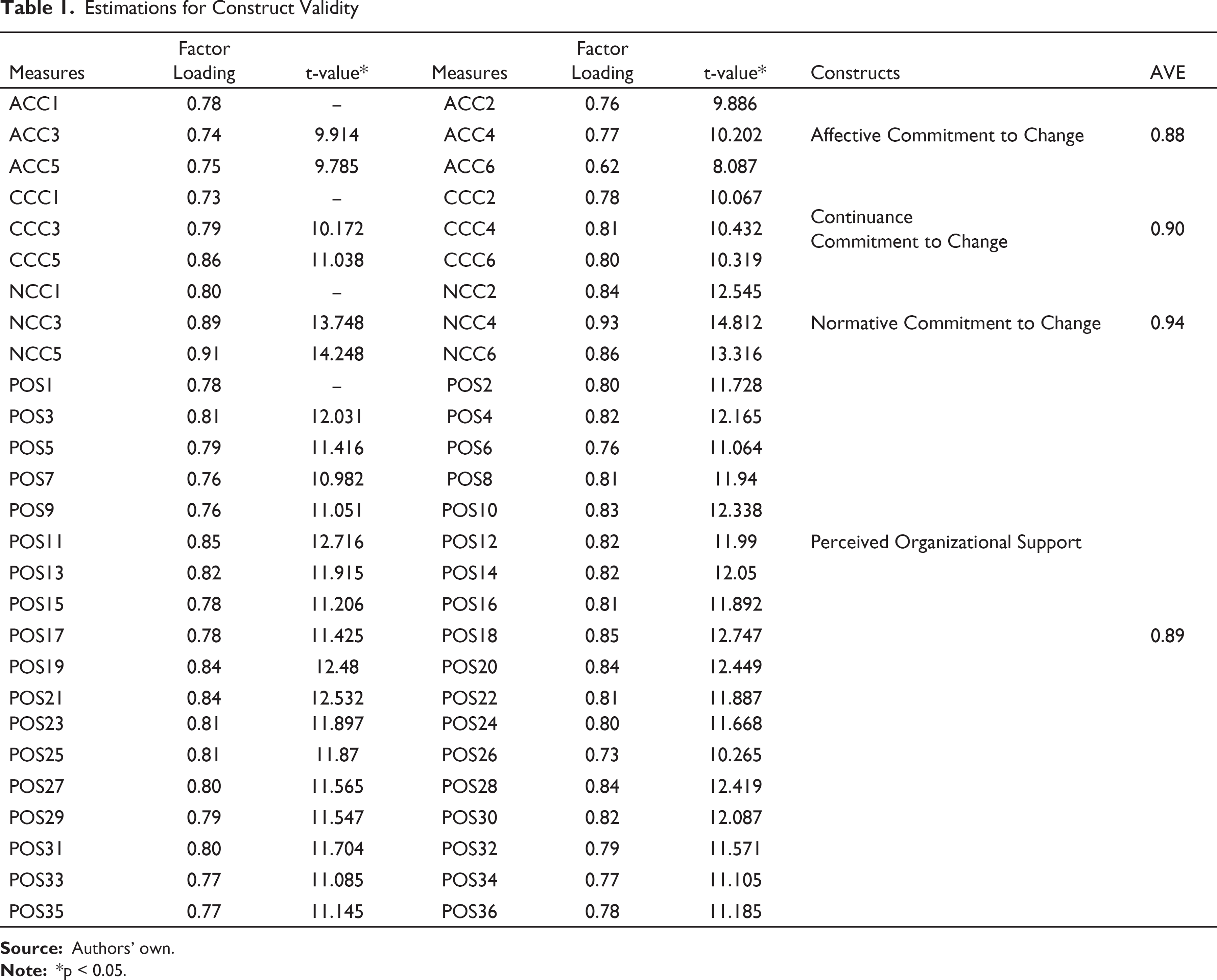
Further, the model was evaluated with absolute fit indices of Root Mean Square Error of Approximation (RMSEA) and Goodness-of-fit statistic (χ2/df). RMSEA below 0.8 (Hu & Bentler, 1999) and χ2/df less than 2 indicate an acceptable fit (Hu & Bentler, 1999). RMSEA of the model was 0.058 and χ2/df was 1.54. Comparative Fit Index (CFI), Normed Fit Index (NFI) and Tucker Lewis Index (TLI) greater than 0.9 reveal good fit (Hu & Bentler, 1999). The present model reported 0.967 of CFI, 0.915 of NFI, and 0.943 of TLI indicating acceptable fit. Hence, the results of CFA revealed the validity of the factor structure.
Testing for Common Method Variance
Collecting data from a single source would result in common method bias. In this present study MOs provided data for both CC and POS. Hence, the model was tested for common method bias. As suggested by Podsakoff, MacKenzie, Lee and Podsakoff (2003), in the first step a common latent variable was added to the measurement model. In the second step, all the observed variables were connected to that common factor. Then the model was run in order to yield the fit indices by using AMOS 16.0. Partitioning of the variance was done in order to find how much variance is explained by that latent method factor according to the instructions of Williams, Cote and Buckley (1989).
Results revealed that when the variance was partitioned, the method factor (with the common latent variable) explained only 2.26 per cent and the trait factors (without the common latent variable) explained 63.6 per cent. The variance explained by the method factor is smaller than the variance explained by traits factor model (Williams et al., 1989) and the variance explained by method factor does not exceed the 0.5 cut off level recommended by Hair et al. (1998). Therefore, the common method bias was not a significant source of the variance in data.
Results
Table 2 presents mean values, standard deviations, reliabilities, and correlations.
Means (M), Standard Deviations (SD) and Inter-correlations among the Variables
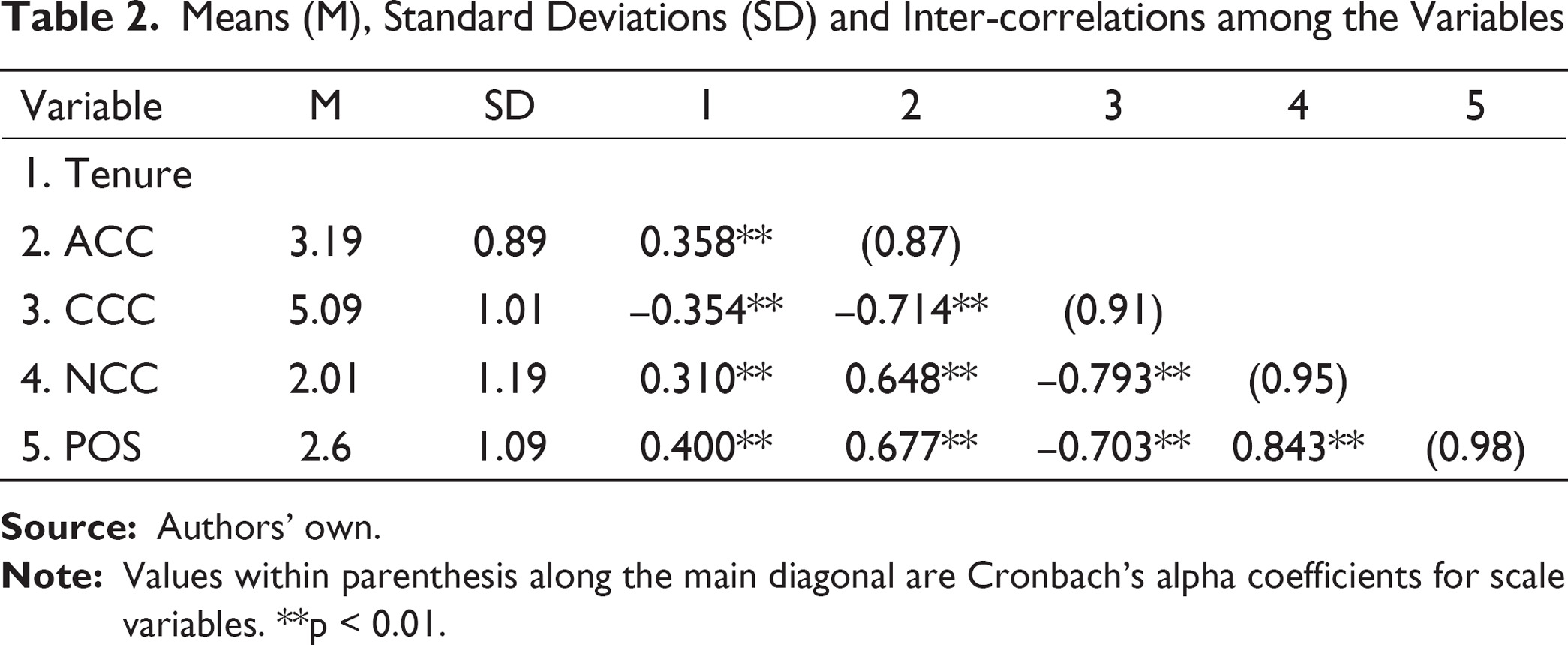
Cronbach’s alphas of ACC, CCC, NCC and POS in the present study were 0.87, 0.91, 0.95 and 0.98 respectively indicating high internal consistency. We used hierarchical regression analysis to test hypotheses. Tenure was entered in the first step followed by POS in the second step (Table 3). Hypothesis 1 stated that POS is positively associated with ACC. After controlling for tenure, POS was significantly and positively associated with affective commitment to change (ß = 0.58, p < 0.01). Hypothesis 2 predicted that POS was negatively associated with CCC. As predicted after controlling for tenure, POS has a negative and significant impact on continuance commitment to change (ß = –0.57, p < 0.01).
Regression Analysis on Affective Commitment to Change, Continuance Commitment to Change and Normative Commitment to Change (Controlling for Tenure)
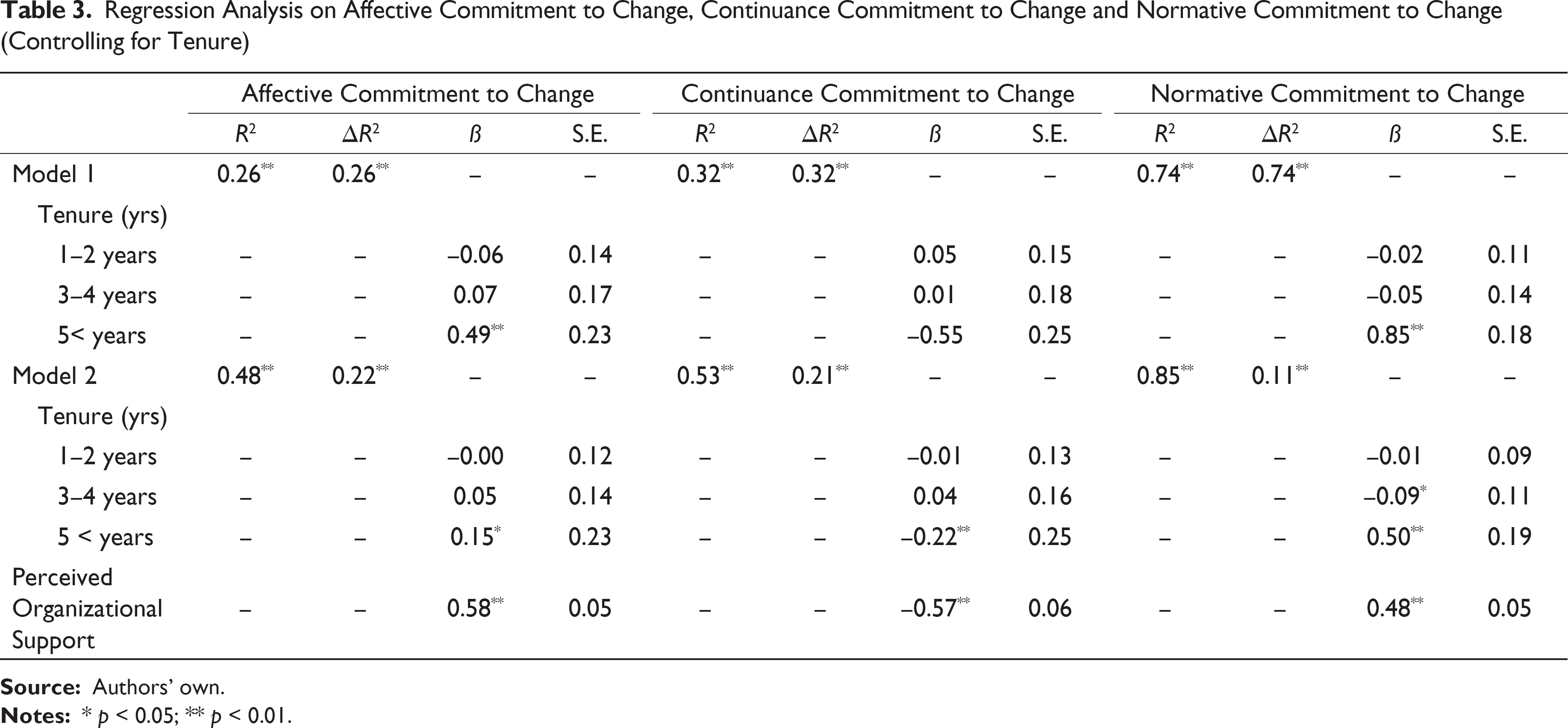
Finally, hypothesis 3 proposed that POS positively predicts NCC. As proposed after controlling for tenure, POS positively and significantly predicted NCC (ß = 0.48, p < 0.01). Hence, all the three hypotheses of this study were supported.
Discussion and Implications
Being based on the Social Exchange Theory (SET), the present study examined the role of POS in predicting three dimensions of CC of MOs in the Sri Lankan apparel industry. The study brings evidence that POS positively and significantly predicts ACC and NCC. At the same time, as hypothesized, POS has a negative impact on CCC. Overall, the reason for these findings can be explained with reference to SET. On the one hand, employees who feel the support from their organization develop affective and normative commitment profiles which are regarded as more favourable in change implementation. On the other hand, such perceived support should reduce more compelled and less desirable continuance commitment to change. Hence, the findings are in line with the reciprocity norm of SET.
As hypothesized, POS has a significant impact on ACC indicating that support received from the organization develops a sense of perceived worthiness of a change effort. This can be explained with antecedents of ACC found by previous researchers. Positive organizational climate (Machin & Bannon, 2005), trust in management, internal employability (Kalyal & Saha, 2008), quality of relationships with managers and job motivation (Parish et al., 2008) have been shown to be positively associated with ACC. These studies provide evidence for positive organizational circumstances resulting in ACC. An employee who feels more support (POS) has positive feelings about an organization. Hence, such positive feelings reflect positive organizational circumstances. Consequently, POS also results in ACC.
Also, POS can be a reflection of the antecedents of ACC explored by previous researchers. Furthermore, though the studies on POS and affective commitment to change are rare, the relationship between POS and affective commitment to organization has been explored by many. For instance, POS positively predicts affective commitment to organization (Armeli et al., 1998; Aube et al., 2007; Driscoll & Randall, 1999; Eisenberger et al., 1986; Eisenberger, Fasolo & LaMastro, 1990; Rhoades & Eisenberger, 2002; Rhoades et al., 2001; Shore & Tetrick, 1991; Shore & Wayne, 1993). Though OC and CC are unique, they are grounded in the same psychological background (Herscovitch & Meyer, 2002). Hence, in this study POS resulted in ACC being congruent to the association it had with affective commitment to organization.
This study found that POS negatively impacts on CCC which echoes some other studies. First, trust in management (Kalyal & Saha, 2008) and quality of relationships with managers (Parish et al., 2008) was found to negatively impact on CCC. Second, negative organizational climate is a predictor of CCC (Machin & Bannon, 2005). These research findings highlight that positive organizational circumstances are negatively associated with CCC. POS also reported to get the same direction since it incorporates positive organizational circumstances. In addition, organizational commitment literature also supports this finding. POS was found to be a negative predictor of continuance commitment to organization (Driscoll & Randall, 1999; Rhodes & Eisenberger, 2002; Shore & Tetrick, 1991). Perhaps, CCC is also negatively influenced by POS due to the grounded similarity between CCC and continuance commitment to organization.
POS had a positive effect on NCC. There are possible reasons for this finding. First, previous researchers found that positive organizational climate (Machin & Bannon, 2005) and the quality of relationships with managers (Parish et al., 2008) positively predict NCC. On the one hand, POS and antecedents of NCC are positive judgements about organization. On the other hand, antecedents of NCC are reflected in POS. Hence, POS showed the same results as found by Machin and Bannon (2005) and Parish et al. (2008). Second, POS was found to be a positive predictor of normative commitment to organization (Aube et al., 2007; Meyer et al., 2002; Shore & Tetrick, 1991). Though no research explained the association between POS and NCC, the current findings are supported by the established relationship between POS and normative commitment to organization.
Our findings contribute to the CC literature and POS in several ways. First, POS was brought as a predictor of three dimensions of CC in the light of SET which has not so far been considered by other researchers. Second, the present study empirically tested the three component commitment to change model in the Sri Lankan context and found that CC is a three dimensional construct as introduced by Herscovitch and Meyer (2002). Thus, this present study provides ground for expanding the applicability of the three component model in the South Asian context. However, in the Indian context, the commitment to change was reported as a four component model with NCC loaded into two factors (Soumyaja et al., 2011). As per Kalyal and Saha (2008) in the Pakistan context, NCC had to be omitted since it was not reliable. Perhaps, these contradictions may be the result of the contextual differences of sectors and the type of employees focused in the studies.
The findings of this research also have some practical implications. First and foremost, it reveals the importance of POS in developing desirable commitments (i.e., ACC and NCC) and reducing undesirable commitment (i.e., CCC) to change. Thus, in order to gain desired commitments towards a change and to inhibit undesired commitment during a change effort, the management needs to pay serious concern towards building POS of employees. Second, it seems many practitioners still try to encourage the commitment to change through superficial newsletters or speeches (Schneider, Brief & Guzzo, 1996) rather than finding a concrete solution. Hence, the current study emphasizes the importance of an exchange relationship, which will be a long-lasting solution to address the issue of employee commitment to change in organizations.
Limitations and Further Research
Some limitations exist in this study. First, data were collected from lower level employees of the apparel industry in Sri Lanka. Hence, generalizability for other industries and other staff categories in the same industry is less possible. Thus, we call for research that investigates the relationship between POS and CC at executive level employees in the same industry and in other industries. The second limitation of this study is the use of the cross sectional research design. Data collection at one point in time might hinder the assumption of causality. In order to establish causality between POS and CC future researchers may embark on longitudinal studies. Further, the conceptual scope of the study was limited to one independent variable. In order to understand the broader picture of the CC phenomenon, future researchers need to test a holistic model that is comprised of possible moderating and mediating variables between POS and CC in the South Asian context.
Conclusion
In conclusion, this study found POS as a significant predictor of three dimensions of CC in the Sri Lankan context. These findings suggest the importance of POS in developing voluntary supportive behaviours which are essential in successful change implementation. Thus, employees’ positive evaluation of an organization is associated with pro-change behaviours as suggested in SET.