



Abstract
Numerous researches in call centres indicate the negative psychological impact in the form of burnout experiences of the customer service representatives. The present study argues that burnout experiences do not always have a negative impact on the employee’s self-worth. The relationship is, instead, moderated by the impact of job-worth, which acts as a potential individual resource. The results of the present study conducted on 312 call centre representatives partially confirm our hypotheses. Results indicate that representatives who have high job-worth maintain their self-worth, even when emotionally exhausted. The results also show that employees possessing high job-worth, even with low personal accomplishments on their jobs, maintain their self-worth. We discuss the findings in the Indian call centre context from the perspective of self and identity literature and provide broader implications for practice and research.
Introduction
A significant proportion of the Indian workforce is engaged as customer service representatives or call centre employees (Curry & Lyon, 2008; Kasabov & Warlow, 2010; Mukherjee & Malhotra, 2006). The National Association of Software and Services Companies in India (NASSCOM) Information Technology–Business Process Management (IT–BPM) industry FY2015 performance review states that India has been able to retain its leadership position in business process outsourcing, despite competitive challenges presented by emerging off-shoring destinations such as Philippines, China and Singapore. While worldwide IT–BPM spend was USD 2.3 trillion, growing at 4.6 per cent over 2013, global sourcing of services grew by 10 per cent, and India continued to hold on to its leadership position with a 55 per cent market share. In FY2015, the Indian IT–BPM industry generated an estimated account for revenues of USD 146 billion, growing by 13 per cent over 2014 (NASSCOM, 2015). These services are largely delivered to off-shore destinations across the world through call centres.
For India this has been possible due to unique set of factors that multiply its value proposition. The key factors being unparalleled cost advantage and being world’s largest pool of employable talent (Mukherjee & Maheshwari, 2014). Despite these positive factors, the call centre jobs, as research suggests, are perceived negatively (Baumgart et al., 2002; Deery, Iverson, & Walsh, 2002). The key question then is: India being a massive hub for the call centre jobs, wherein more and more workforce opt for it annually, is it justified to state that it is only doing harm to the employees than good? The present study questions the negative generalization of call centre jobs for the Indian population by studying three broad issues:
If call centres are associated with negative work outcomes, then why do people opt for these jobs?
If these are high stress jobs then does it influence the workforce alike?
Have the previous studies on call centres missed the link of self-worth and job-worth?
Call Centres and Job Experience
Call centres have emerged as a valuable form of service provider. They deliver services in both domestic and transnational contexts (Das, Dharwadkar, & Brandes, 2008). A typical call centre job requires representatives to spend their working hours seated on their job desks and being in constant touch with the customers (Belt, Richardson, & Webster, 2000). It includes a variety of jobs on the basis of functionality, for example, customer care, sales, marketing, technical support, debt collection, etc. These functions are further segregated into technical, recovery and promotional calls. Call centres are also characterized as whether they specifically handle inbound or incoming calls versus outbound or outgoing calls. Blended call centres are capable of handling both inbound and outbound calls. Therefore, there are varied job experiences based on functionality in call centre jobs. The present research focuses on call centre employees who handle promotional inbound calling.
The Different Facets of Burnout
In the context of India, because of the abundance of English-speaking graduates (Batt, Doelgast, & Kwon, 2005; Budhwar et al., 2006), call centres are important source of employment generation. With differentiated labour markets utilizing more semi-skilled workforce, those employees who are getting more monetary benefits for their limited skills lead to greater self-expectations (Mukherjee & Maheshwari, 2014), thereby, it is expected that these would generate more positive experiences on the job.
However, among the primary issues that are usually reported on call centres are concerns of burnout. Studies state that these jobs involve burnout (Bakker, Demerouti, & Euwema, 2005; de Jonge et al., 2008; Heuven et al., 2006; Le Blanc et al., 2001; van Vegchel et al., 2004; Wilk & Moynihan, 2005) because of continuous customer interfaces which are emotionally demanding (Deery et al., 2002; Karatepe, 2010; Sliter et al., 2011; Yagil, 2008). According to the taxonomy of high burnout jobs, those involving emotional labour are categorized as “high burnout jobs” (Cordes & Dougherty, 1993). In service work, dealing with customers (in different moods) and emotional regulation are primary sources of burnout (Karatepe, 2010; Sliter et al., 2011; Yagil, 2008). The three key manifestations of burnout are: emotional exhaustion, depersonalization and depletion of personal accomplishment (Maslach & Jackson, 1984).
Emotional exhaustion is the state of depletion and fatigue which is reported as the main component of job burnout (Maslach & Jackson, 1984; Wright & Cropanzano, 1998). Malasch & Jackson (1984) reports that employees performing regulation of emotional display due to frequent client contact are likely to suffer emotional exhaustion. Numerous studies find that emotional exhaustion is related to negative work outcomes (Cordes & Dougherty, 1993; Cropanzano, Rupp, & Byrne, 2003; Lee & Ashforth, 1996; Swider & Zimmerman, 2010). Scholars have reported two key reasons for emotional exhaustion; first, the experience of tension from emotional dissonance and, second, the draining of resources while effort-fully acting (Hochschild, 1983; Wharton, 1993).
The second component of burnout is depersonalization. Depersonalization refers to the development of negative, callous or cynical attitudes towards clients (Zapf, 2002). Often, due to unpleasant client interactions, the employees resort to labelling clients in a derogatory way because they are unable to express their negative emotions in public (Schaufeli & Enzmann, 1998). Schaufeli and Bakker (2004) state that disengaged employees lead to uncaring attitudes and treat clients as objects. Depersonalization is a sub-construct of burnout and Zapf (2002) states that instead of adapting detachment to the situation, detachment becomes permanent and the person is chronically unable to feel what he or she should feel. Hollet-Haudebert, Mulki and Fourneir (2011) state that “Depersonalization, or the display of negative attitudes toward customers or coworkers, can also be a major problem for people who hold sales and service jobs that require sensitivity in interactions with customers and coworkers.”
Personal accomplishment is the third component of burnout and reduced personal accomplishment refers to the “feelings of incompetence and lack of achievement and productivity at work” and those employees who perceive reduced personal accomplishment, lack the ability and their confidence to perform (Maslach & Leiter, 2008, p. 498). Several studies have excluded personal accomplishment as a dimension of burnout (Brotheridge & Grandey, 2002; Demerouti et al., 2001; Le Blanc & Heyworth, 2007; Lee & Ashforth, 1996; Leiter, 1993; Schaufeli & Bakker, 2004), as they justify it with weak correlation with job burnout than emotional exhaustion and depersonalization. However, in the application of Maslach Burnout Inventory (MBI), reduced personal accomplishment has been considered as a significant component of job burnout (Choi, Cheong, & Feinberg, 2012; Maslach & Leiter, 2008). The belief that one is no longer able to achieve one’s goals in work with the clients is accompanied by feelings of inefficiency (Dixon & Schertzer, 2005; Mathieu, Ahearne, & Taylor, 2007; Sager, Strutton, & Johnson, 2006; Schaufeli & Enzmann, 1998). Therefore, we find that for call centre jobs that are laden by emotions, burnout surfaces as an inevitable factor.
Self-worth and Job-worth
Issues of self and identity have been researched by many philosophers and thinkers (Cooley, 1902; Goffman, 1959; James, 1950[1890]). Of late, studying self and identity from management and practitioner’s perspective is also gaining ground (Blustein & Noumair, 1996).
Theorizing Self-worth
Extant literature on the construct of self states that perceived self-worth is derived from self-esteem, which is the self-evaluation of one’s value, worth and importance (Rosenberg, 1965; Torrey et al., 2000). The multidimensional aspect of self is constructed through numerous facets of life experiences (Bracken, 1996; Harter, 1982, 1985, 1990; Hattie, 1992; Hattie & Marsh, 1996; Marsh, 1986, 1987; Mullener & Liard, 1971; Oosterwegel & Oppenheimer, 1993; Shavelson & Marsh, 1986). Self-theorists have maintained a multidimensional focus (e.g., Brackner, 1996; Harter, 1985; Marsh, 1986) and have retained the conceptualization of self-worth as self-esteem in their models and measures as the core idea (Crocker et al., 2003; Crocker & Park, 2004; Harter, Waters, & Whiteshell, 1998; L’Ecuyer, 1992; Marsh, 1986; Rosenberg, 1979; Shavelson & Marsh, 1986; Wolfe & Cocker, 2002).
Theorists from social constructionism have stated that in a social context, individuals derive a sense of self through their subjective experiences from various relational experiences and social roles (Cushman, 1990; DeCraemer, 1983; Gergen, 1991; Markus & Kitayama, 1991). In organizations, the specific job-related experiences provide the relational context, and the individual draws his or her self-worth through the social role as an employee. In call centres, customer interfaces provide the major relational context of job demands. Customer interfaces impact employee behaviour. For example, negative customer interactions are related to such undesirable outcomes as work aggression (Le Blanc & Kelloway, 2002). The unequal power in customer–employee interaction is the primary factor for aggression (Allan & Gilbert, 2002; Grandey, Dickter, & Sin, 2004; Hochschild, 1983). Any form of psychological abuse impacts the individual’s self-worth (Aguilar & Nightingale, 1994). Therefore, self-worth in the context of call centres emerges from a relational perspective (Harter et al., 1998; Lord & Brown, 2004; Sedikides & Brewer, 2001).
Continuous emotional demands from unpleasant work experiences in the relational context of call centres lead to emotional exhaustion and depersonalization, thereby leading to poor self-worth (Zapf et al., 1999). Past research has indicated that emotional exhaustion and depersonalization impacts psychological health of the employees (Greenglass & Burke, 1988; Maslach & Jackson, 1981), leading also to reduced self-worth (Rosse et al., 1991). Personal accomplishments also foster self-worth (Hansford & Hattie, 1982; Harter, 1983; Kohn, 1994; Purkey, 1970; Scheirer & Kraut, 1979; Smelser, 1989). While research suggests that higher self-worth acts as a potential predictor of psychological well-being, limited research has explored this as an outcome variable (cf. Steinberg & Figart, 1999), especially among employees engaged in emotionally taxing professions that involves burnout, such as call centre representatives.
Theorizing Job-worth
This in particular draws our attention towards career identity which is also an important part of one’s identity formulations (Kreiner, Hollensbe, & Sheep, 2006). Identity theorists have indicated the importance of identity for construction or formation of one’s career (Adams, Gullotta, & Montemayor, 1992; Curtis, 1991; Levin, 1992; Lifton, 1993; Lopez, 1992; Strauss & Goethals, 1991). According to identity–status paradigm, individuals continuously develop their identities and maintain their identity commitments (Stephen, Fraser, & Marcia, 1992) by also integrating career in their identities (Archer, 1989; Greene & Wheatley, 1992; Luyckx, Goossens, & Soenens, 2005, 2006). It is measured as an involvement in one’s career (Lobel, 1991) and is treated as an important personal resource, thereby contributing to the worker’s capacity to meet the varied interpersonal demands involved in the jobs (Wilk & Moynihan, 2005). Career identity in particularly is seen as an important employee resource when jobs are emotionally demanding, like those involved in call centres, and likely to contribute in reducing the likelihood of experienced negative impact on individuals and organizations (Wilk & Moynihan, 2005). Among employees undergoing burnout, their personal resources are otherwise spent, hence withdrawal behaviour sets in (Cole & Bedeian, 2007; Halbesleben, 2006; Hobfoll, 2002; Wright & Cropanzano, 1998).
The commitments towards one’s identity, acts as an essential individual resource which has also been related to the organizational and individual well-being (Berzonsky, 2008; Kunnen et al., 2008; Meeus et al., 2005). Researches have quoted that a strong sense of identity acts as a positive influence on well-being and serves as a buffer against negative psychological impact of self (Phinney, 1991). According to Ashforth and Humphrey (1993), identification with the work ensures high self-esteem. Organizations like call centres which relies heavily on emotion work have mostly been seen in a negative light (Baumgart et al., 2002; Deery et al., 2002; Holman, 2002, 2003; Lewig & Dollard, 2003; Taylor & Bain, 1999; Wallace, Eagleson, & Waldersee, 2000). Wharton (1993), with a notable exception, states that emotionally intense jobs do not uniformly create negative impact on frontline employees. In a populous country like India, wherein call centres supply millions of jobs both for skilled and semi-skilled task force (Batt, Holman, & Hotgrewe, 2009; Blinder, 2006), many of them tend to derive high sense of identity implying the degree of derived job-worth. Their reactions to self-worth because of job-worth will therefore be different than many others despite high burnout levels. The focus of the present study is to explore the role of career identity in the form of job-worth and its relation with self-esteem in the form of self-worth of employees in intense emotion-related jobs. For example, burnout leads to reduced self-worth which will be weakened by those workers who have high job-worth. However, for employees who have low job-worth, the relationship between burnout with lowered self-worth will likely be escalated.
Therefore, we propose the following hypotheses.
Hypothesis 1a: Job-worth will moderate the relationship between emotional exhaustion and self-worth such that the impact of emotional exhaustion on self-worth will become less negative as job-worth increases. Hypothesis 1b: Job-worth will moderate the relationship between depersonalization and self-worth such that the impact of depersonalization on self-worth will become less negative as job-worth increases. Hypothesis 1c: Job-worth will moderate the relationship between personal accomplishment and self-worth such that the relationship between personal accomplishment and self-worth will become more positive as job-worth increases.
Method
Participants and Procedure
A total of 312 call centre employees engaged in frontline services participated in the study. For data collection, human resource managers of various call centres were contacted. Out of eight contacted human resource managers, only two managers gave positive response and helped in running the survey in their organizations. Out of 500 distributed questionnaires in these two organizations, nearly 200 participants submitted their responses, thereby making the response rate of 40 per cent. The rest of the sample was contacted through snowball sampling method. Out of 350 questionnaires distributed through snowball sampling, 112 participants returned their responses; hence the response rate was 32 per cent. The total response rate was 36.7 per cent. The age of the respondents varied from 18 to 55 years. The mean age of the respondents was 26.19 years. Out of 270 respondents who reported their educational qualification, 4.8 per cent were higher secondary, 58.1 per cent were non-technical graduates, 14.4 per cent were technical graduates, 10.3 per cent were non-technical postgraduates, 9.6 per cent were technical postgraduates and 2.5 per cent of participants were technical diploma. The sample, therefore, mostly comprised of non-technical graduates. Out of 255 respondents who reported their work experience in their current company, the experience ranged from 0 to 36 months, in which nearly 63 per cent had a work experience ranging from 13 to 60 months. Among the employees, 183 were males (58.65 per cent) and 129 were females (41.35 per cent).
Measures
The key predictor variables, namely, emotional exhaustion, depersonalization and personal accomplishment were measured using Maslach and Jackson’s (1984) sub-scale of job burnout. The response scale for all three variables was based on the frequency of the experienced burnout (1 = once a month or less, 2 = once a week, 3 = several times a week, 4 = once a day and 5 = several times a day).
Emotional Exhaustion. Eight items of the Maslach and Jackson’s (1984) scale were used to measure emotional exhaustion. Sample items include: “I feel frustrated by my job,” “I feel like I’m at the end of my rope” (Cronbach’s α = 0.92).
Depersonalization. This was measured by five items of Maslach and Jackson’s (1984) scale. Sample items include: “I feel I treat some recipients as if they were impersonal ‘objects’,” “I worry that this job is hardening me emotionally” (Cronbach’s α = 0.77).
Personal Accomplishment. This was measured by 8 items of the same burnout scale. Sample items include: “I deal very effectively with the problems of my recipients” and “I have accomplished many worthwhile things in this job” (Cronbach’s α = 0.83).
Job-worth. This is the moderator variable which was measured using Carson and Bedeian’s (1994) career commitment scale. It includes the following two items: “My line of work/career field is an important part of who I am” and “I strong identify with my chosen line of work/career field.” The scale for the items was from 1 = “strongly disagree” to 5 = “strongly agree” (Cronbach’s α = 0.71).
Self-worth. The main outcome variable was measured using the Rosenberg’s (1965) self-esteem scale. Sample items included: “At times, I think I am no good at all” and “On the whole, I am satisfied with myself.” All the items were rated on a 5-point Likert scale where 1 = strongly disagree and 5 = strongly agree (Cronbach’s α = 0.75).
The control variables consisted of gender, age, educational qualification and years of job experience.
Analysis and Results
All the scales demonstrated good internal consistency, as Cronbach’s alpha of 0.70 is the minimum acceptable cut-off value (Nunnally & Bernstein, 1994). Table 1 contains the bivariate correlations, means and standard deviations of the study variables. Emotional exhaustion is negatively related to job-worth (r = −0.187, p < 0.001) and depersonalization does not show any significant relation with job-worth. Personal accomplishment is positively related to job-worth (r = 0.466, p < 0.001). Emotional exhaustion (r = −0.169, p < 0.001) and depersonalization (r = −0.147, p < 0.001) are related negatively with self-worth, whereas personal accomplishment is positively related to self-worth (r = 0.379, p < 0.001). Self-esteem and job-worth is found to be positively related (r = 0.311, p < 0.001).
Means, Standard Deviations and Inter-correlations of the Study Variables
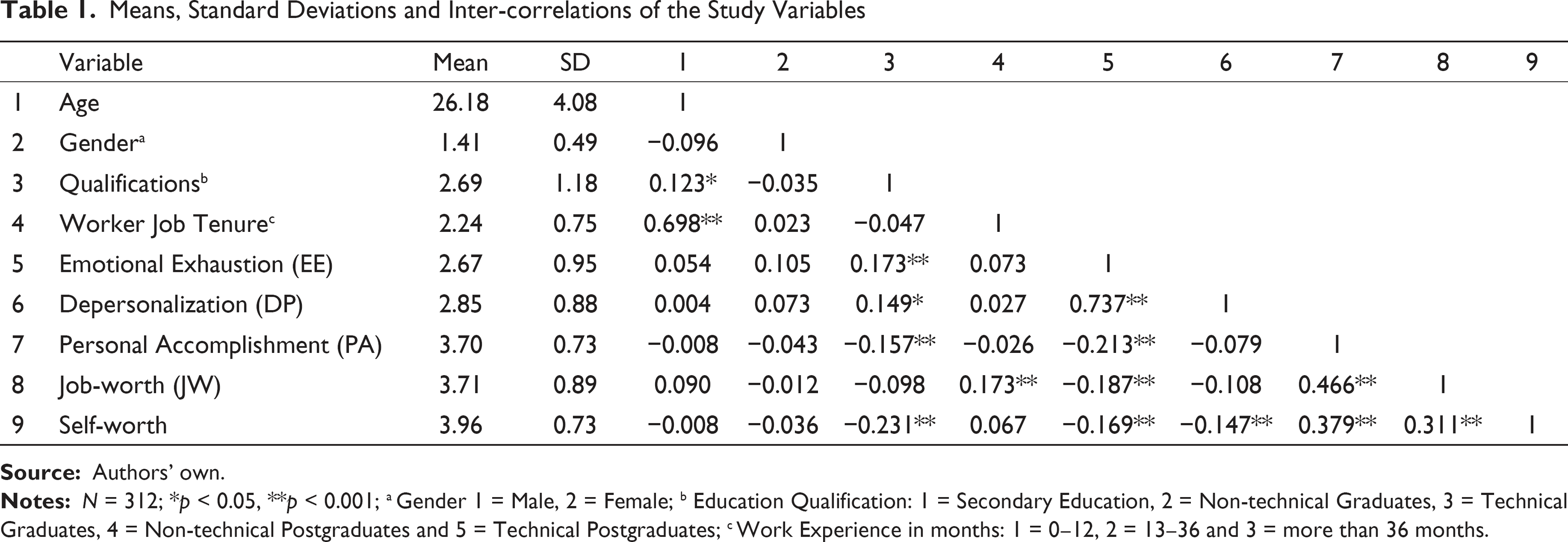
Hypotheses 1a, 1b and 1c were tested using three separate linear regression models. Different alternate models were tested, thereby generating best fitting model for the same. Linear regression is also often disposed to the problem of multicollinearity. Hence we tested the moderator models separately as well as together. Using the technique, we have generated four alternate models for each of the three burnout dimensions, with control variables, the independent variable, the moderator variable and all the variables in one model.
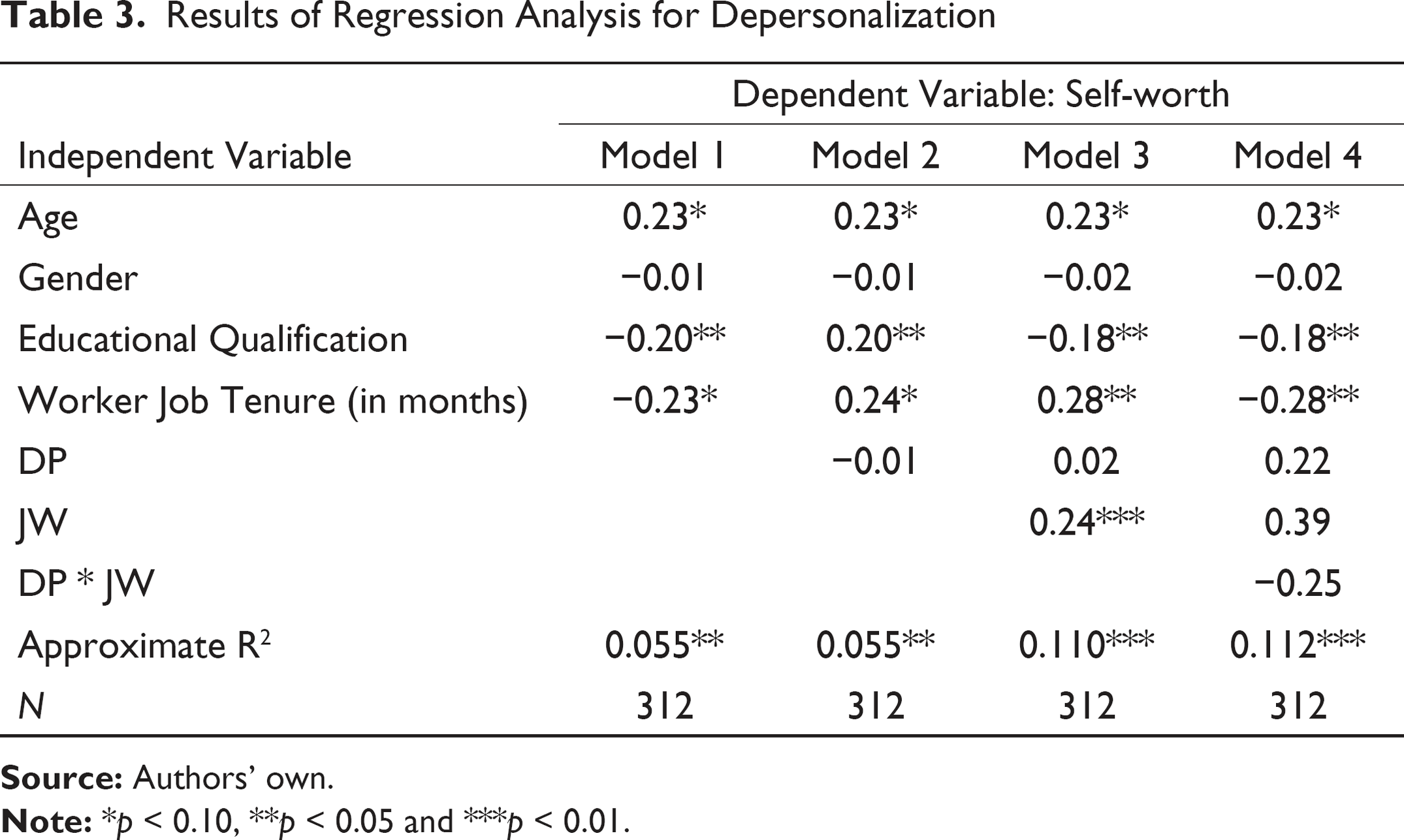
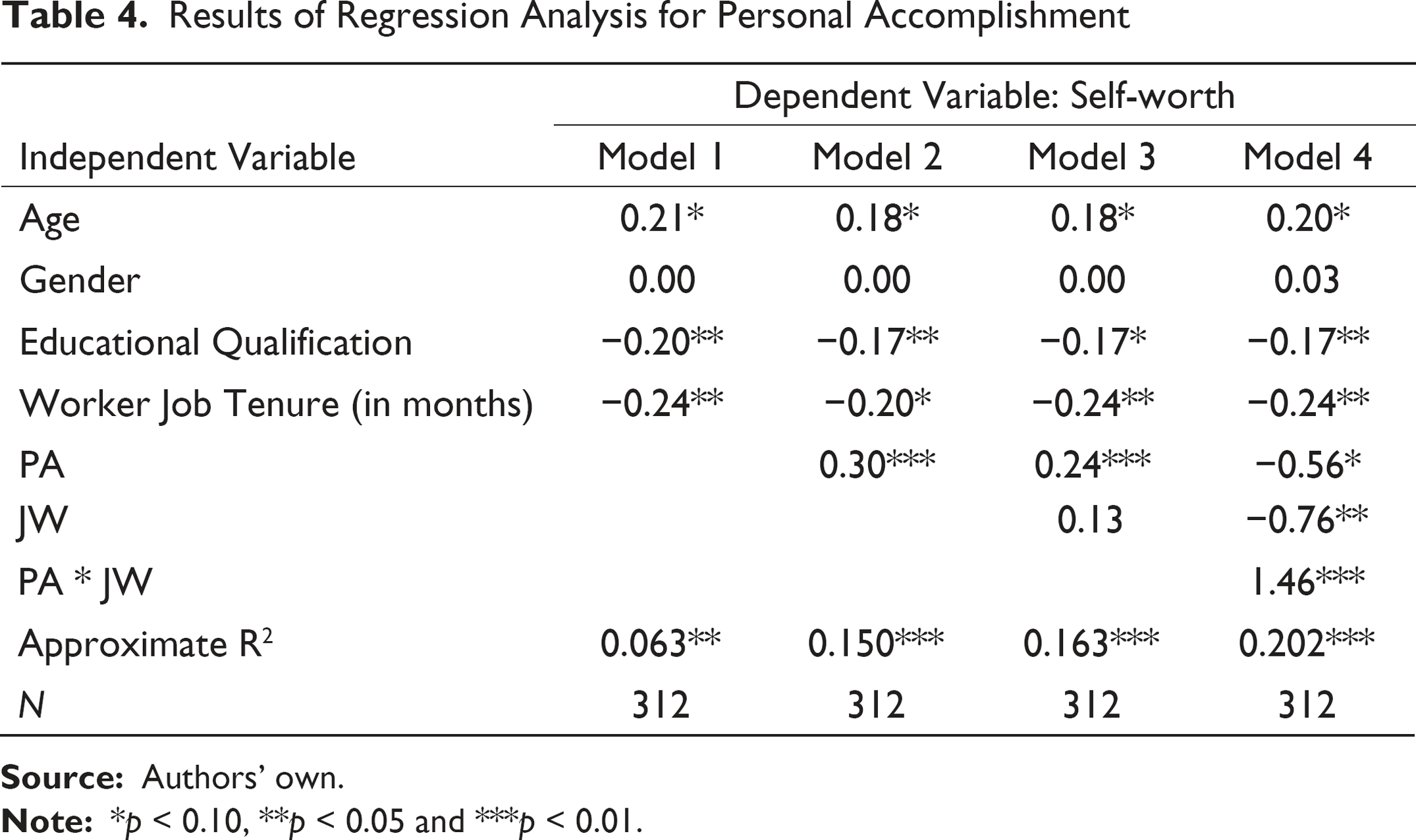
Tables 2, 3 and 4 contain the results of regression analysis for the Hypotheses 1a, 1b and 1c. Since depersonalization did not show any correlation with the moderator variable job-worth, therefore, the basic assumptions for moderator analysis was violated (Baron & Kenny, 1986) and Hypothesis 1b was rejected. We ran two separate models for two different independent variables, that is, emotional exhaustion and personal accomplishment, Hypotheses 1a postulated that impact of emotional exhaustion and self-worth will be moderated by the job-worth of the employee. The full model containing control variables, job-worth as moderator for emotional exhaustion and self-worth was tested (see Table 2). As indicated in Table 2, we find that job-worth moderated the relationship between emotional exhaustion and self-worth (β = −0.73, p < 0.01). Figure 1 graphically depicts this interaction. The interaction graph (Figure 1) indicates that self-worth is highest with low emotional exhaustion and high job-worth. However, high self-worth is maintained for those who have high job-worth, even though they suffer from experiences of high emotional exhaustion, which confirms Hypothesis 1a. Hypothesis 1c hypothesized that job-worth will moderate the relationship between personal accomplishment and self-worth. Results in Table 3 show that job-worth moderates the relation (β = 1.46, p < 0.001). Figure 2 graphically shows the interaction. The figure indicates that self-worth is highest when personal accomplishment is coupled with high job-worth. However, the graph shows that even if perceived personal accomplishment decreases on the job, high career identity helps in maintaining the self-worth of the frontline service agent.
Results of Regression Analysis for Emotional Exhaustion

Results of Regression Analysis for Depersonalization
Results of Regression Analysis for Personal Accomplishment


Discussion
The key aim of the present study was to examine the role of job-worth as a moderator in the relationship between job burnout and self-worth. The main contributions of the study are as follows:
Burnout Experiences
The first question that the study sought to answer was: Are the call centres negative jobs? Our results showed that for call centre jobs, the universal statement that burnout leads to negative impact on employee well-being is not always true. Those jobs which have high burnout experience may not always have an overall negative impact on the employees’ psychological well-being. Burnout has different dimensions, but the focus of researches has mostly been emotional exhaustion. The study states that job burnout have both negative as well as positive impact on employees. Emotional exhaustion impacts self-worth negatively as assumed and supported by research studies (Beer & Beer, 1992; Wilk & Moynihan, 2005). However, we also find that accomplishment experiences on the jobs also prevail and have equally positive impact on the self-worth of the call centre frontline employees. Hence, the generalized belief of only negative impact on the call centre jobs might not be a universally relevant proposition. As opposed to many studies which highlight emotional exhaustion dimension (Goldberg & Grandey, 2007; Lewig & Dollard, 2003; Witt, Andrews, & Carlson, 2004) for call centre jobs, the present study emphasizes on personal accomplishment dimension too.
Contribution of Job-worth—The Indian Perspective
The next three questions that the article focuses on were: If these are negative jobs then why do people opt for it? Does it have similar influence for the workforce and do we have some answers in the self-worth and job-worth link?
The answers are derived from contextualizing India and understanding the self-worth and job-worth link. There are millions of youth in India, who opt for these jobs because the jobs are in abundance and provides stable source of employment. The prime requisite for call centre jobs are not sophisticated training but English-speaking fluency, which is abundantly available. It is also debatable whether India is facing the problem of unemployment or of unemployability. But call centres have undeniably emerged as a boom in reducing the problems of unemployment and unemployability. A Indian Labour Report by an Indian private firm named Team Lease Services (2007) states that only 8 per cent youth are facing the problem of unemployment while 53 per cent employed youth are facing the problem of lack of skill, and the (2012) report further states that 58 per cent graduates suffer from unemployability. An alternative opportunity which knocks their doors are call centre jobs which are in abundance. Hence on the positive side, for the large section of youth, call centres have emerged as a new hope in generating employment. Hence, for them, the work demands and the related outcomes are probably more challenging than creating negative psychological well-being. We also know that call centres are typical places for high burnout jobs, but one needs to realize that India is also a place with huge population and abundance of educated unemployment (Mukherjee & Maheshwari, 2014). Due to huge unemployment, the workforce consists of range of skills which ranges from semi-skilled to highly skilled (Noronha & D’Cruz, 2007). If it is job mismatch for the highly skilled workforce, for a huge section of semi-skilled workforce, the job provides reasonably good alternatives, thereby providing a source for high job-worth. In call centre contexts, identity issues have been explored but from a different light. Identity studies had been concentrated mostly from transnational perspectives and geographical spaces (Hall, 1996; Kuhn, 2006; Kuhn & Nelson, 2002; Pal & Buzzanell, 2008; Shome, 2006). The present study has a different approach and explores identity from career identity perspective, mainly the derived job-worth.
Furthering this argument, the article explores the role of job-worth that acts as buffering mechanism. Job-worth has been labelled as a form of personal resource, which needs wider consideration in the workplace contexts (Lobel, 1991; Wilk & Moynihan, 2005). The identity–status paradigm states that more career commitments are maintained when individuals have high job-worth (Stephen et al., 1992). Therefore, the employees who have high job-worth will have more attachment towards their job roles. These jobs therefore differentially impact their self-worth, implying different consequences for different sections of employees. The study also supports the relational perspective on self, which mentions that employees create self-worth that emerges from having a sense of worth from a context (Harter et al., 1998; Lord & Brown, 2004; Sedikides & Brewer, 2001). Hence for those who have high job-worth, from the context, will likely have a positive impact on self-worth, despite burnout experiences, highlighting self-worth–job-worth link.
The study also maps the self and identity relationships, with relevant variables that are of concern especially at call centres. Moreover, previous literature on self lacks researches in the organizational perspective in treating self as an outcome variable. The study fills the gap and establishes that job burnout leads to an impact on self in the form of self-worth. It is of worth to note that the impact on self-worth is also a function of job-worth that employees derive. Hence, tagging call centres with blanket statements of “dark satanic mills” or “panopticons” (Fernie & Metcalf, 1998; Kinnie, Hutchinson, & Purcell, 2000; Taylor & Bain, 1999) would not always be correct. Hence, from mangers’ and practitioners’ perspectives in high burnout jobs, job-worth and career development strategies should be more interlinked and focused upon.
Limitations and Directions for Future Research
The key limitation of the present study is its scope. The research was conducted in the context of outbound promotional calling in India. Researchers may explore the interaction of different types of calls with different national contexts. Also, the year of data collection was 2011. Though call centres have undergone some changes, for example, inclusion of additional interactive voice response systems (IVRS) and growth of BPO establishment’s in additional destinations like Philippines and Singapore; however, a huge number of employees are still engaged in frontline promotional calling, in all these destinations. Reynoso (2016) mention that call centres delivering frontline services are still labour intensive, which highlights the stability of the basic form of call centre delivery process. Methodologically, researchers may consider testing the entire model with structural equation modeling for assessing its measurement and structural viability. By using three separate regression models, we provide preliminary evidence on the importance of job-worth as a critical moderating variable on the impact of burnout on self-worth.
Footnotes
Acknowledgements
The authors acknowledge and are grateful for the valuable contribution provided by Dr Ritu Tripathi, Indian Institute of Management, Bangalore that helped to strengthen the article and develop the final version.