



Abstract
Although repatriation adjustment is a matter for all re-entry groups, it is not clear if it is an issue for returning academics. The article aims to investigate whether the repatriation adjustment is a matter for academic repatriates. The study was conducted with 63 Sri Lankan academic repatriates who had been attached to a foreign university or academic institution for more than 1 year, had been involved in academic activities and, at the survey date, had returned within the past 2 years. One sample t-test, independent sample t-test and regression analysis were employed to test the proposed hypotheses. The article provides empirical evidence to show that repatriation adjustment is a matter for academic repatriates too. Academics who return to their home university experience less fit to their organization compared to their fit with their home organization before they had left. The article highlights that universities need to take necessary steps to develop policies and procedures to capitalize the knowledge and international experience of returning academics. The findings extend the current scope of literature on repatriation adjustment by identifying a new group of repatriates who are experiencing repatriation adjustment issues.
Introduction
The ability to attract and maintain top talent is rapidly becoming a key strategic issue in organizations in the knowledge era (Huisman, de Weert & Bartelse, 2002; van den Brink, Fruytier & Thunnissen, 2013). Achievements and continued existence of universities entirely depend on the ability to attract, develop and maintain highly talented intellectuals (Gilliot, Overlaet & Verdin, 2002; Lorange, 2006), and thus maintaining top talent has become a strategic concern for universities.
The labour market in academia has become more international than in the past, and some universities recruit talented academics in the global academic market. However, recruiting academics in the global academic market has created many challenges for recruiting universities. As universities are suffering from a shortage of talented people (Gilliot et al., 2002; van den Brink et al., 2013), the global market for them has become highly competitive and academics are more likely to move from a developing country to a developed country, and move from a low ranked university to a high ranked university. These trends are unfavourable for the universities that are in developing countries and are low in international rankings to recruit talented academics from the global market. Above all, universities expect their faculties to be committed and contribute to their university, but recruits from the international market may probably be less committed to their university (they may be highly committed to their field), and they tend to leave the university when they find better opportunity in other universities.
Therefore, to ensure their sustainable growth, many universities have taken responsibility and oversight for their staff (Enders & Kaulisch, 2006; Kaulisch & Enders, 2005), and invest large amounts of money to develop their talent pool. For example, governments or universities in Asian countries, such as Sri Lanka, Pakistan, Bangladesh and China, encourage academics to gain overseas experience. In such countries, universities have granted financial assistance and leave with pay to their academics during their stay overseas. Similarly, governments of other countries (e.g., Ghana and Iran) invest a substantial amount of money to facilitate their university academics to gain overseas experiences in teaching and research.
Background of the Problem
In Sri Lanka, the government and academia are very keen to upgrade their universities to reach a high international standard and meet national needs. Most importantly, the Sri Lankan government has attempted to increase the World University Rankings of Sri Lankan universities. In a bid to get universities to reach international recognition and make Sri Lanka a global knowledge hub in Asia, the Sri Lankan government has continued to invest much money in the development of human capital (HETC, 2013; Samaranayake, 2011).
Academics are encouraged by the government to gain international experience in research and teaching. The Sri Lankan government provides financial assistance for academics who want to engage in research and teaching offshore for a specified period. Also, many international scholarships such as the Commonwealth Scholarship, the Australian Leadership Award and awards from the South Asian Association for Regional Cooperation (SAARC) are available for Sri Lankan academics who wish to pursue their research and higher studies overseas. Furthermore, a World Bank assisted project, “Higher Education for the Twenty-first Century”, (HETC) also focuses on strengthening human resources in the higher education system by providing international experience to university academics (HETC, 2013). International experience is highly respected in Sri Lankan universities and is perceived as an opportunity to gain foreign exposure and experience. Perceived societal status increases with international experience, and thus, in addition to the government motivation, individuals are themselves motivated to gain international experience. This situation has fuelled expatriation of academics in Sri Lanka.
Before academics leave the country, in Sri Lanka, they need to sign an agreement with their university confirming that they will return to their home organization and serve for a particular period back at home university. Sri Lankan expatriates have strong family ties and are sentimental about their country (Anas & Wickremasinghe, 2010). Because of the bond agreement and family attachment, a reasonable number of academics return to their home university.
Repatriation issues of different re-entry groups, for example, corporate repatriates (Adler, 1981; Lee & Liu, 2007), students (Butcher, 2002), corporate repatriates’ spouse (Gregersen & Stroh, 1997; MacDonald & Arthur, 2005) and missionaries (Moore, Jones & Austin, 1987), have been discussed in the literature in different fields of study. These studies highlight that all re-entry groups experience repatriation stress and feel uncomfortable. Repatriates see the home context as unfamiliar, and they need to readjust and settle into that context. Particularly, the literature on corporate repatriation has stressed the importance of effective management of repatriation and highlighted the fact that unsuccessful management of repatriation leads to employees suffering from problems of adjustment which result in stress, loss of motivation at work and turnover intention (Birur & Muthiah, 2013; Black, Gregersen & Mendenhall, 1992; Kulkarni, Lengnick-Hall & Valk, 2010; Lee & Liu, 2007). This situation leads to adverse consequences; for example, high turnover and low performance were observed among repatriates.
Both corporate and academic expatriates live and work in new cultural and organizational settings; they adopt new cultural and organizational values and norms to perform well there (Richardson & McKenna, 2002; Richardson & Zikic, 2007). However, academic expatriates are substantially involved in teaching and scholarship, whereas corporate expatriates are engaged in management activities in their subsidiary companies. Although a vast and growing body of literature has investigated the return of corporate repatriates, the repatriation of academics has not yet been sufficiently discussed in the literature (Garson, 2005).
Particularly, in Sri Lanka, repatriation of academics was unnoticed so far. About the repatriation of university academics, it is not clear whether academic repatriates experience repatriation issues as corporate repatriates. Therefore, this study aimed to investigate whether academic repatriates experience adjustment problems if so, to identify whether repatriates personal variables influence repatriation adjustment.
Literature Review and Hypotheses Development
Repatriation is a transition from a host country to one’s home country after living overseas for a significant period (Adler, 1981; Kulkarni et al., 2010; O’Sullivan, 2002). Repatriation of different groups of people, for example, students and Peace Corps volunteers, had been discussed in the literature many decades ago. Since the 1970s, literature has been talking about repatriation of corporate employees (Howard, 1974; Jassawalla & Sashittal, 2011). Research on repatriation of corporate employees has been developed from its research roots in domestic relocation and expatriation literature; theory on repatriation was developed based on the work of adjustment theorists of relocation (Nicholson, 1984) and expatriation (Black, Mendenhall & Oddou, 1991).
Repatriation adjustment is the experience of reintegrating their earlier accustomed environment having stayed in different surroundings for a considerable period (Adler, 1981; Kulkarni et al., 2010). When repatriates enter into the home country/organization, they find significant differences to what they expected. The length of time and level of anxiety of adjustment may vary and it may take approximately 12–18 months for repatriates to fully adjust (Adler, 1981; Cox, Khan & Armani, 2013).
Employees are suffering from adjustment issues not only when they were overseas but also when they return to their home countries (Vidal, Valle & Aragón, 2007). Repatriates experience psychological discomfort, alienation, uncertainties and loss of control. Repatriates found that there is mismatch between their repatriation expectations and the reality they experience upon repatriation (Gregersen & Black, 1995; Hurn, 1999; Stroh, 1995). This mismatch can be due to mainly two reasons: (a) the failure of expatriates to follow changes in the home/organization during their absence and (b) changes within expatriates and their failure to realize the changes occurring within themselves (Hurn, 1999; Jassawalla, Connelly & Slojkowski, 2004; Stroh, 1995).
Changes in the home/organization may be in the form of structural and procedural changes. For instance, an organization might have been restructured, and communication channels might have been changed. In addition, supervisors and co-workers of repatriates are likely to have changed during their absence. Moreover, there can be changes in informal groups and organizational power politics.
During their overseas stay, expatriates are most likely to change (Hermans & Dimaggio, 2007; Kohonen, 2004, 2008). Expatriates are exposed to significantly different organizational and cultural environments, which provide expatriates with different stimuli that force them to change to adjust themselves to the context. Adaptation to this changes their behaviour and attitudes and broadens their outlook. Nevertheless, expatriates may not be aware of these changes. This situation can lead to developing inappropriate repatriation expectations, which create many uncertainties upon repatriation. Thus, upon repatriation, they may feel they are in a new place, feel uncomfortable and experience uncertainty and low fit with the context.
Upon repatriation, repatriates see the home context as unfamiliar, and they need to readjust and settle into that context (Adler, 1981; Lee & Liu, 2007). In the process of repatriation, adjustment repatriates attempt to reduce uncertainty and achieve a degree of fit with the different aspects of the home/organization context (Black et al., 1992; Judge, 1994). Better adjusted repatriates feel acceptance, well-being, and a psychological comfort and better fitted to the home context/organization.
Repatriation is considered as an intra-organizational transition (O’Sullivan, 2002) and “the developments of conscious and unconscious anticipations about the new setting are a natural part of any transition” (Louis, 1980, p. 336). Expatriates who develop right expectations about repatriation are more able to efficiently manage the adjustment process than those who do not develop right expectations (Adler, 1981; Black et al., 1992; Harvey, 1982; MacDonald & Arthur, 2003). However, repatriates develop unrealistic expectations about their repatriation. Hurn (1999) highlights that expatriates develop expectations about their personal and organizational life. Thus, before repatriation, repatriates do not take any steps to prepare themselves to manage the repatriation transition and return to the home country with unrealistic expectations. Contrary to their expectations, there are likely to be changed in the organization as well as in the general environment (Jassawalla et al., 2004).
A large body of literature on international assignment investigated repatriation of corporate employees and highlighted that corporate repatriates’ repatriation experience was stressful and repatriates feel uncomfortable and mismatch with the home context. Corporate expatriates are involved in management activities in their subsidiary companies, but academic expatriates are substantially involved in teaching and scholarship. However, academic expatriates live and work in new cultural and organizational settings; they adopt new cultural and organizational values and norms to perform well there (Richardson & McKenna, 2002; Richardson & Zikic, 2007).
Garson (2005, p. 324) noted that the experiences of both expatriation and repatriation of an academic are paralleled in the literature dealing with corporate expatriates and repatriates. When she talks about her experience as an academic repatriate, she says, “I realized that I had had an experience similar to those of managers who returned early from their overseas assignment”. Therefore, academic repatriates like corporate repatriates may establish unrealistic repatriation expectation and experience reserve cultural shock which creates academic repatriates to feel uncomfortable and mismatch with their home context/university. Therefore, I propose the following hypothesis.
The period of time overseas would logically be important variables in predicting repatriation adjustment. Empirical evidence also suggests that the period spent on an overseas assignment negatively influence repatriation adjustment (Black & Gregersen, 1991; Gregersen & Stroh, 1997; Suutari & Välimaa, 2002).
According to role transition theory, during the adjustment to role transition, employees absorb changes through altering their frame of reference, or values (Louis, 1980; Nicholson, 1984). The expatriation context provided repatriates with different stimuli that forced them to change themselves (Hermans & Dimaggio, 2007). The longer repatriates have been away, the greater the possibility that their expectation will be wrong (Baughn, 1995). Upon repatriation, after the long stay in a host country, repatriates experience greater mismatch between their expectations and the reality they see that creates uncertainty and stress and thus, find difficulties in re-integration to the home context (Black & Gregersen, 1991; Gomez-Mejia & Balkin, 1987). Therefore, it can be expected that the greater the period repatriates have been overseas assignment, the more difficult would be their repatriation adjustment.
As with the period spent on an overseas assignment, the time passed upon repatriation also has a substantial influence on repatriation adjustment. Empirical studies also found that time passed upon repatriation has a positive impact on repatriation adjustment (Black, 1994; Gregersen & Stroh, 1997). According to the uncertainty reduction theory, people are goal-oriented and act in a particular way to achieve their desired goals. In uncertain environments, to achieve their goals, they increase predictability (reduce uncertainty) and make sense out of the events they perceive (Berger & Calabrese, 1975). In the process of uncertainty reduction, individuals use different strategies to make sense of the environment (Berger & Calabrese, 1975). The length of time and the level of anxiety of adjustment may vary (Stening, 1979) and, in most cases, it may take over 1 year for repatriates to adjust adequately to the home context (Adler, 1981; Black & Gregersen, 1991; Cox et al., 2013; Sussman, 2002). During this period, repatriates use different strategies to reduce uncertainty and achieve a degree of fit with the different aspects of the home context (Black et al., 1992; Judge, 1994). Therefore, it can be proposed that time passed upon repatriation positively influences repatriation adjustment.
The impact of age on the adjustment has been widely discussed in the literature (Black, 1994; Black & Gregersen, 1991; Suutari & Välimaa, 2002). While Gregersen and Stroh (1997) found no impact of age on repatriation adjustment, Black (1994) and Black and Gregersen (1991) found the positive impact of age on repatriation adjustment. Older employees generally have more information about and experience in their home country and organization context and generally have gained more experience dealing with changes in these areas. Such experience and knowledge are the resource that older employees possess. According to socialization resource theory (Gruman & Saks, 2013; Saks & Gruman, 2012), resources that individuals possess reduce some uncertainty associated with adjustment as well as enhance the adjustment abilities.
Moreover, younger employees quickly adapt themselves to the host country culture and develop deep identity change and thus, the repatriation adjustment was difficult for younger repatriates (Cox, 2004). Therefore, it can be predicted that older repatriates better adjust their repatriation than younger repatriates.
Along with age, repatriates work experience may influence repatriation adjustment. Repatriates return their organizations with expectations and needs. However, the reality they see may be different from what they expected. Such situations can create challenges, exhaust repatriates’ physical and mental resources, and cause stress. Upon repatriation, repatriates with many years of experience in their home/organization are well aware of the organization context and are able to understand the nature of the changes in their organization in the intervening period.
According to socialization resource theory, resources help employees to overcome their transition challenges, reduce their stress, and provide energy to solve problems and enable them to cultivate more resources (Bakker, van Veldhoven & Xanthopoulou, 2010; Gruman & Saks, 2013; Hobfoll, 2002; Saks & Gruman, 2012). Work experience can be a resource that facilitates repatriates to overcome their repatriation challenges and stress. Therefore, one would expect a positive influence of work experience on repatriation adjustment.
The greater the extent of the change required of individuals to adjust, the more difficult the adjustment (Black et al., 1992). In the case of repatriation adjustment, the greater the cultural disparity between home and host country, the greater the potential change in the repatriates. While overseas repatriates get exposed to different organizational and cultural environment and have changed their attitudes, values and the way of seeing the world, these changes make them to change their identity (Kraimer, Shaffer, Harrison & Ren, 2012). When there is greater extent of cultural disparity between home and host country, repatriates’ adopted host cultural values challenge the home country’s cultural values and customs. This situation leads to feelings of embarrassment and uncertainty upon their repatriation (Black et al., 1992). Consistent with this view, Gregersen and Stroh (1997), in a study among Finnish repatriates, found cultural disparity negatively influences repatriation adjustment. Therefore, a negative influence of cultural disparity on repatriation adjustment can be expected.
In many Asian countries, traditional gender role ideology still dominates. The concept of traditional gender role ideology identifies separate roles for women and men where women are the homemakers and men are the breadwinners (Kite, 1996; Kulik, 2004). The traditional role of females and their assumed responsibility in regard to family and household management increase their repatriation stress (Cox, 2004; Gama & Pedersen, 1977). Consistent with this view, it was found that female repatriates tend to experience more repatriation difficulties compared to male repatriates (Brabant, Palmer & Gramling, 1990; Gama & Pedersen, 1977). In many Asian countries, particularly in Sri Lanka, females are expected to play a significant role in family and household management compared to male. Along with the repatriation-related uncertainty, household responsibility of female increases their repatriation stress. Consequently, one would expect that female repatriates experience greater repatriation difficulties compared to male repatriates.
Single repatriates are more likely to experience depression compared to repatriates who are married and experience the repatriation together with their spouse (Hyder & Lövblad, 2007). Married repatriates share their repatriation issues and repatriation is smoothed as both of them can understand and support each other (Moore, Jones & Austin, 1987).
Cultural identity transition is the consequence of an expatriate’s adaptation to the host country’s cultural context (Cox, 2004; Sussman, 2001, 2002). Repatriates who have changed their identity deeply towards host country culture experience high repatriation distress (Cox, 2004; Hyder & Lövblad, 2007; Sussman, 2000, 2002). Single repatriates tend to identify more strongly with the host country culture and develop deep identity change (Cox, 2004; Hyder & Lövblad, 2007; Kohonen, 2004, 2008). Therefore, one would expect that single repatriates experience greater repatriation difficulties compared to married repatriates.
Methodology
To answer the research questions and achieve my research objectives, I have used logical arguments that build on existing theoretical and empirical foundations, to develop hypotheses. Such a deductive approach requires a quantitative method (Bryman, 2011; Creswell, 2014; Edmondson & McManus, 2007). As well as the above reason for employing a quantitative approach, by using such an approach, I was able to (a) maintain confidentiality and anonymity of the study by separating the me from study participant; (b) employ sophisticated statistical tools to ensure the reliability and accuracy of the findings (Chang, Witteloostuijn & Eden, 2010; Lindell & Whitney, 2001; Podsakoff, MacKenzie & Podsakoff, 2003; Spector, 2006); and (c) generalize my findings to a whole study population and compare them to the previous findings relating to other groups of repatriates.
This study relied on cross-sectional and self-reported data. Self-reports might be suitable when the study focus is on perceived experiences, and it can be more appropriate in the process of employee socialization and adjustment. However, cross-sectional and self-reported data are not without its inherent limitations such as it may be vulnerable to common method variance (CMV).
Therefore, in the survey design stage, I have taken three measures to minimize CMV. First, it was clearly explained to participants in the participant information sheet that absolute anonymity and confidentiality would be maintained, and to avoid social desirability bias (Podsakoff et al., 2003), they were requested to “answer honestly and to the best of their knowledge”. Second, difficulties in understanding were reduced to minimize the probability that participants would respond randomly or using their own heuristics (Chang et al., 2010; Podsakoff et al., 2003). Third, the pre-departure person–organization fit (P-O fit) and post-return P-O fit were given in two sections with a brief introduction about the context to create psychological separation of measurement and minimize common method biases (Podsakoff et al., 2003).
Variables
Repatriation Adjustment
To date, various methods have been developed and introduced to measure repatriation adjustment of corporate repatriates. Feldman (1991) and Feldman and Tompson (1993) proposed three adjustment indices: job satisfaction, intention to remain with the organization and psychological well-being, and argue that these three indices were more relevant and suitable for measuring job transition adjustment. Person–team fit and P-O fit can be considered a successful adjustment in collectivist cultures, whereas role performance may be a relevant and appropriate index in an individualistic culture (Cooper-Thomas & Anderson, 2002). Therefore, in the present study context, P-O fit can be a more suitable and relevant index to measure the adjustment of Sri Lankan academic repatriates. To what extent repatriates perceive they fit their organization will indicate to what extent they have adjusted to the home organization.
Therefore, in the present study, repatriates’ adjustment was measured by measuring the degree of repatriates’ perceived P-O fit. For measuring P-O fit, five items were used (Cable & DeRue, 2002; Judge, 1996). To maintain consistency among other items, one original item “Do you think the values and ‘personality’ of this organization reflect your own values and personality?” was reworded as “The values and personality of this organization reflect my own values and personality”. The respondent was asked to respond to each statement using one of the responses based on 7-point Likert-type scales, with possible responses ranging from 1 = strongly disagree to 7 = strongly agree.
Personal and Situational Variables
Length of overseas assignment is the period respondents were overseas, and it was measured in years. Work experience is the period they had been working in their home university before their expatriation, and it was measured in years. Time passed upon repatriation is the period from their repatriation and the day they responded to the survey, and it was measured in months. The age indicates the age of the respondents at the time they respond to the survey, and it was measured in years. In this study, cultural disparity was treated as interval variable. In the previous studies, different measures have been used to measure cultural disparity/novelty (Black & Gregersen, 1991: Cox, 2004; Gregersen & Stroh, 1997). In the present study, I assumed that respondents who have the expatriation experience in Asian countries (India, Bangladesh) experienced a low level of cultural disparity and value one (1) was assigned to them. Also, it was assumed that respondents who have expatriation experience out of Asian countries (UK, Australia, New Zealand, USA and Canada) experience a high level of cultural disparity and value two (2) was assigned to them. Gender (male = 1, female = 2) and marital status (married = 1, single = 2) were treated as categorical variables.
Sample and Procedures
For this study, I collected data from academics (repatriates) of Sri Lankan universities who had been attached to a foreign university or academic institution for more than 1 year, had been involved in academic activities and, at the survey date, had returned within the past 2 years. Respondents were requested to express their P-O fit before their departure and after their repatriation. Comparing the level of P-O fit between pre-departure stage and post-return stage of the same academics is meaningful and the differences in their P-O fit can be assigned to the repatriation issues. Therefore, data were collected from academic repatriates upon their repatriation. Respondents expressed to what extent they fit their organization before they left the organization (expatriation) and to what degree they fit their organization after their repatriation. The questionnaire required respondents to recall P-O fit before going abroad that can be a limitation of this study design. To minimize recall bias, I should have collected data in two stages: pre-departure and post-return. But, there are some practical difficulties in collecting data in two stages: (a) I have to wait until repatriation of the respondents (3–5 years) to complete data collection, (b) to collect data from the same respondents in two stages, I need to ask the name of the respondent which may reduce response rate or respondents may reluctant to provide real information and c) it is difficult to maintain absolute anonymity and confidentiality.
Ninety-one questionnaires were distributed to repatriates through my personal and professional networks. To maintain confidentiality, data that help to identify the particular respondent were not collected, and each questionnaire accompanied by a stamped envelope and a cover letter assuring confidentiality. Respondents were requested to send the survey directly to me without mentioning their name or address. I sent reminders to respondents and ultimately received 71 responses. The response rate was 80 per cent which is greater than the average rate of 52.5 per cent in organizational research (Baruch & Holton, 2008). Eight questionnaires were rejected: Five were rejected because of more than 15 per cent missing values and three were rejected as respondents who have less than 1-year overseas experience. In the end, this study was conducted with 63 respondents. Table 1 shows the profile of respondents included in this study.
Respondents’ Profile
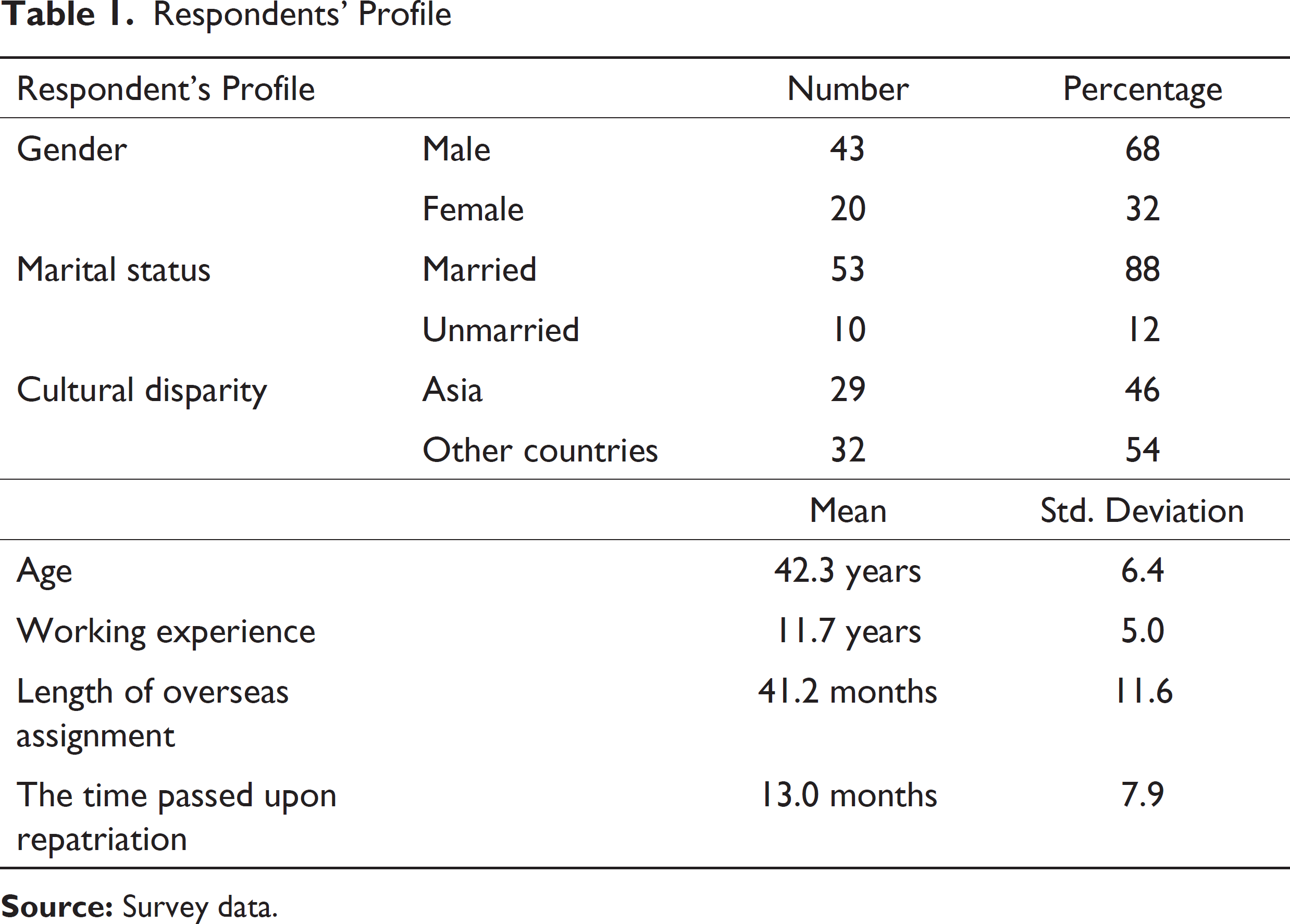
Male participants accounted for 43 (68%) of the respondents and female for 20 (32%). Fifty-three repatriates, accounting for 88 per cent, were married. Regarding cultural disparity, although 29 (46%) respondents had overseas experience in Asian countries, 32 (54%) respondents had such experience in other countries; most of them were in UK, Australia and USA.
Concerning age and working experience of respondents, their average age and working experience were 42.3 years and 11.7 years, respectively, with a standard deviation of 6.4 years and 5.0 years, respectively. Respondents’ expatriation and repatriation experiences were 41.2 months and 13.0 months, respectively, with a standard deviation of 11.6 and 7.9 months, respectively.
Data Analysis Procedures
First, the survey data were entered into a Microsoft Excel sheet and then transferred to SPSS 20 for data cleaning and analysis. Second, the reliability and validity assessment was performed. Then, hypotheses’ testing was done.
Data Analysis and Results
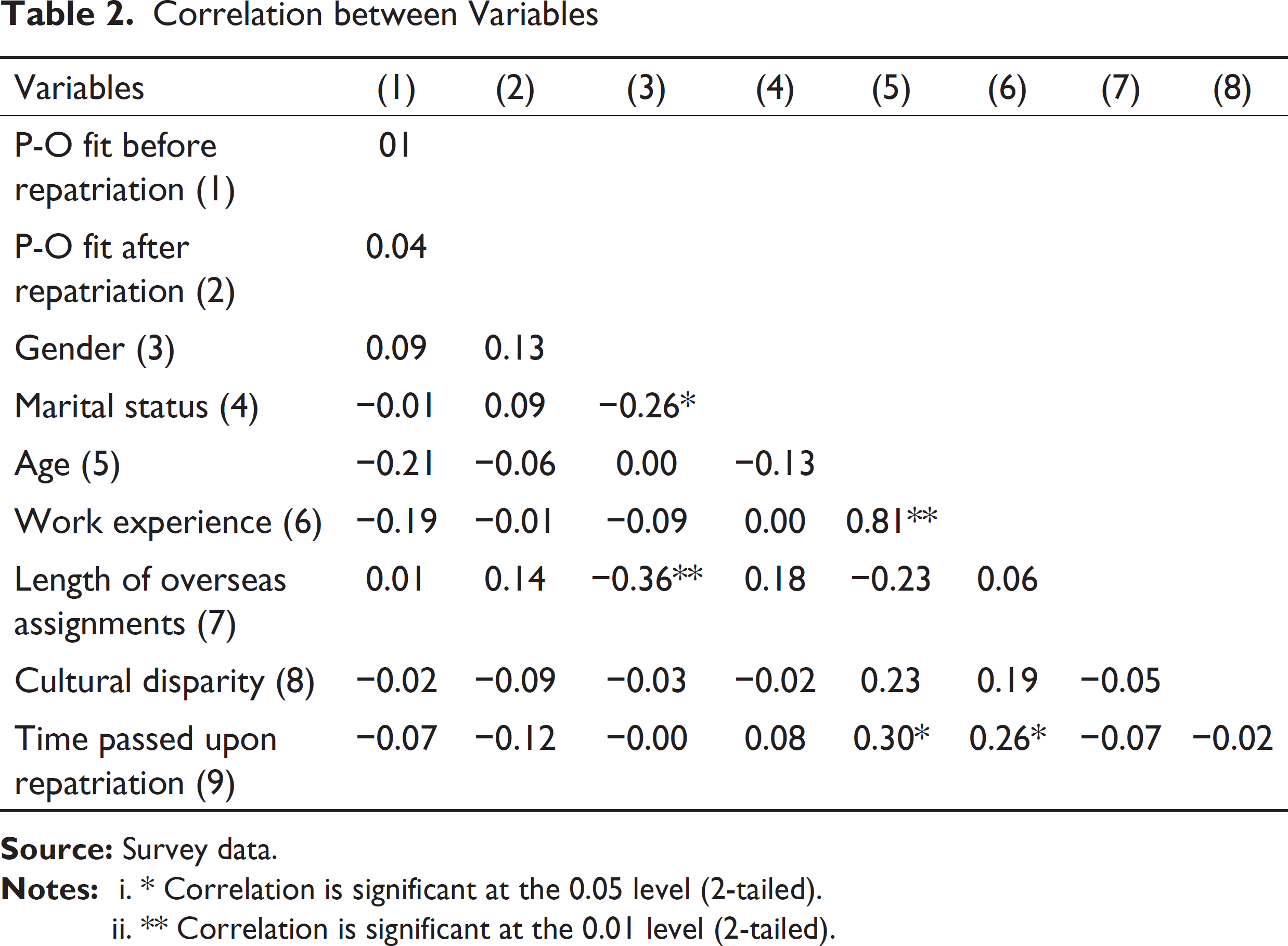
Before conducting the analysis, the accuracy of the data was checked; no values outside the specified range were found, means standard deviations (refer Table 1) and correlations (refer Table 2) appeared to be reasonable. Further, questionnaire non-responsive rate, item non-response rate, distribution of data and outliers were taken into account and treated properly.
Correlation between Variables
Reliability and Validity Assessment
Reliability (indicator reliability and construct reliability) of the two constructs, pre-departure P-O fit and post-return P-O fit of repatriates, has been assessed. The results of reliability and validity assessments of the pre-departure P-O fit and post-return P-O fit are presented in Table 3. Indicator reliability that specifies which part of the variance of an indicator can be described by the underlying latent variables (Götz, Liehr-Gobbers & Krafft, 2010) was satisfactory; a loading of all variables with related factors was greater than 6.5. Cronbach’s alpha and composite reliability (CR) are the two measures of construct reliability. The CR and Cronbach’s alpha for each construct were greater than the threshold value of 0.7, which indicates that the indicators together measure each construct sufficiently (Bagozzi & Baumgarter, 1994; Hair, Ringle & Sarstedt, 2013).
Reliability and Validity Measures

Convergent validity that explains to what extent an indicator of the construct correlates with alternative measures of the same construct (Hair et al., 2013) was assessed through the average variance extracted (AVE). The AVE of pre-departure P-O fit and post-return P-O fit was 0.88 and 0.92, respectively, which was larger than the threshold value of 0.5 (Hair et al., 2013; Rodgers & Pavlou, 2003).
Hypothesis Testing
To test the first hypothesis, I compared the level of P-O fit before their expatriation and after their repatriation. Paired sample t-test was performed to identify whether there are significant differences in respondents’ P-O fit between before their expatriation and after their repatriation and the results were tabulated in Table 4. There was a moderate level of positive correlation (0.612**) of the P-O fit between before expatriation and after repatriation. The mean value of P-O fit indicates that academics’ perceived P-O fit (5.23) was higher before they left the organization than after their returning (3.90) to the home university.
Mean Differences in Adjustment (P-O fit) before Expatriation and after Repatriation

Further, it was found that the difference in P-O fit between before the respondents’ expatriation and after their repatriation is significant at 0.05 levels. Therefore, H1 was supported.
To test the five hypotheses (H2–H6), I employed multiple regressions to identify the single and combined effect of age, length of overseas assignment, time upon repatriation, work experience and cultural disparity on repatriation adjustment. To test the hypothesis related to categorical dependent variables (H7 and H8), independent sample t-test was performed that helps to identify significant differences in dependent variables based on the category specified.
As shown in Table 5, none of the five independent variables has significant influence on repatriation adjustment. Therefore, the hypotheses (H2 to H6) that proposed the positive influence of length of overseas assignment, the time passed upon repatriation, age and work experience on repatriation adjustment and the negative influence of cultural disparity on repatriation adjustment have been rejected.
Path Coefficient between Dependent Variables (Scale) and P-O Fit after Repatriation

As illustrated in Table 6, there is no significant difference in adjustment between male and female or married and single repatriates. Therefore, the two hypotheses (H7 and H8) that proposed a significant difference in repatriation adjustment between male and female repatriates and married and single repatriates have been rejected.
Group Statistics and Independent Sample Test for Independent Variables (Categorical) and P-O Fit after Repatriation

Discussion
This study provides empirical evidence to show that repatriation adjustment is a matter for academic repatriates too. Academics who return to their home university experience less fit to their organization compared to their fit with their home/organization before they had left.
Although people are coming back to their home organization, they see the home organization as unfamiliar, and they need to readjust and settle into that context (Jassawalla & Sashittal, 2011; Tharenou & Seet, 2014). Repatriates found readjustment to their home context is more painful and challenging than they expected and their expatriation adjustment (Vidal et al., 2007).
Adjustment theorists in the area of domestic and international relocation (Ashford & Taylor 1990; Black et al., 1992; Nicholson, 1984) commented that moving to a new place creates uncertainty and loss of control. Thus, repatriation transition creates uncertainty and a sense of loss of control (Suutari & Välimaa, 2002), and thus, repatriates experience psychological discomfort, alienation, uncertainties and loss of control (Kraimer et al., 2012; Sussman, 2002; Vidal et al., 2007). Therefore, consistent with existing literature on employees’ relocation, this study suggests academic repatriates also experience adjustment difficulties when they return to their home university.
Previous studies have found the inconsistent relationship between repatriates’ personal and situational variables and repatriation adjustment. For example, regarding the time spent on an overseas assignment, Black and Gregersen (1991) and Suutari and Välimaa (2002) found its negative influence on adjustment. But, Black (1994) found no significant impact on any facets of adjustment. In the present study, it was found that there is no relationship between times spent overseas and repatriation adjustment. Also, age, gender, marital status, time passed upon repatriation, work experience and the cultural disparity had no significant influence on repatriation adjustment. There are three facets of repatriation adjustment: adjustment to organization, adjustment to interaction and adjustment to the general environment (Black & Gregersen, 1991; Black et al., 1992). But, my study focused on only one facet of adjustment: adjustment to organization. The variables tested in this study may be more relevant to other two facets of adjustment. However, these unexpected findings suggest that further studies need to be carried out to find individual and situation factors that influence adjustment to organization. It was found in the literature that individual’s inner characteristics such as self-efficacy, “Big Five” personality characteristics and attitudes (Black et al., 1992; Jassawalla & Sashittal 2011; O’Sullivan, 2002; Vidal et al., 2007) influence repatriates’ fit to their organization.
Limitations and Implication for Further Study
While my research offers an initial empirical examination about the adjustment of academic repatriates, it is subject to some constraints. The first potential limitation is the way the data were collected. This study relied on cross-sectional and self-reported data. Self-reports might be suitable when the study focus is on perceived experiences, and it can be more appropriate in the process of employee socialization and adjustment. However, cross-sectional and self-reported data are prone to method bias. To minimize method bias, I have taken the necessary steps in the design stage and analysis stage; these steps, however, are not enough to minimize CMV significantly. In addition, as my study measures both pre-departure P-O fit and post-return P-O fit at the same point in time, all kinds of memory and recall biases can scramble into the reporting of pre-departure P-O fit.
Another limitation of my study was using a one-country sample and a small sample. As data were collected from only Sri Lanka, it limits the generalizability of the findings. As I used the one-country sample, the target population of this study is limited. To enhance the quality of the findings by overcoming the limitations of the small sample size, I used appropriate strategies. For example, I used non-parametric test (mean comparison) and a parametric test (regression) with limited variables. Increasing the sample size will increase the reliability of the findings and provide an opportunity to perform more analysis. It should be mentioned that measuring cultural disparity based on repatriates’ perception/experience would be more meaningful than the measure I have employed to measure cultural disparity in this study.
The main purpose of my study is to identify whether academic repatriates experience repatriation issues or not, not analysing in-depth of the repatriation-related issues. Further studies need to be carried out to find the inside of the academic’s repatriation-related issues by adopting a qualitative approach (interviews or participant observation and so on).
This study which provides empirical evidence to confirm that repatriation adjustment is a matter for academic repatriates has put forward new questions in need of further investigation such as: What are the individual-level, group-level and organization-level determinants of successful adjustment of academic repatriates? What are the consequences of unsuccessful adjustment of academic repatriates? How can academic institutions and repatriates effectively manage the repatriation process?
Conclusion
Academics who engage in academic activities’ overseas are expected to return to their previous institution with valuable knowledge and skills developed by engaging in research and teaching during their stay in abroad. Both universities and academics can enjoy the benefits of the international experience of academics (Richardson & McKenna, 2002). For example, universities make use of such experience for institutional development such as course development, international research activities and expansion of institutional networks. Academics also view having such international experience in academic activities as an opportunity for their future career prospects.
Unsuccessful repatriation adjustment (less P-O fit) is a potential hurdle for better use of top talent and hampers the successful process of internationalization of the education and can be costly for both repatriates and the organization. Particularly, in Sri Lanka, government and universities are very keen to upgrade their universities to reach a high international standard and meet national needs. Most importantly, the Sri Lankan government has continued to invest much money in the development of human capital to get Sri Lankan universities to reach international recognition and make the Sri Lanka a global knowledge hub in Asia.
In this context, the issues of repatriation of academics are seriously taken into account for the better uses of academic repatriates to increase the quality of universities and succeed in the process of internationalization of the university/education. Further, since their academic career (with international experience) can be very marketable outside the current employer (Jepsen et al., 2014; Richardson & McKenna, 2002), academic repatriates can be more inclined to leave the organization when they experience unsatisfactory adjustment (less P-O fit). Therefore, universities and government should take necessary actions to manage the repatriates well and make use of their international experience to upgrade their academic institutions.
Universities need to provide appropriate support for repatriates; the support practices should match the individual’s needs at the time (Shinn, Lehmann & Wong, 1984), and organizations need to link their support practices with resources that help to overcome repatriation stress and challenges. Providing support concerning repatriates’ overall well-being might function well in the initial stages of the adjustment process to minimize negative psychological consequences (Caligiuri & Lazarova, 2002). Also, an organization can take the necessary steps to recognize and respect repatriates’ global expertise and to assign them to a job in which they can use their global expertise (Vidal et al., 2007).
Repatriates’ unsatisfactory adjustment to their home/organization can damage their personal and career development expectations, and thus, to better adjust to their repatriation individuals also need to take necessary steps to develop their personal competencies such as self-efficacy (Vidal et al., 2007), emotional stability (O’Sullivan, 2002) and right attitudes (Jassawalla & Sashittal 2011).