




Abstract
Abstract
This study seeks to explore whether the negative mentoring experiences (NMEs) of protégés in Western samples are generalizable, or whether there are possibly NMEs unique to the Indian cultural context. The finding of this exploratory study suggests that the most frequently occurring NME for protégés was mismatch in the membership of social group, as per regional, caste or religious orientation. While Western mentoring models are being practised widely in corporate workplaces in India, the process of enculturation and feeling of belonging to an India-specific social group is strong enough to negatively impact mentoring relationships such that these protégés perceive themselves to be “out-group” members. Managers may consider pairing mentors and protégés taking into consideration demographic profiling.
Introduction
India is a fast-growing region of South Asia which is attracting considerable interest among business leaders as an emerging strategic growth market (Budhwar & Bhatnagar, 2008; Khilji & Rowley, 2013). In this context, it is important for business leaders planning to enter the market and also existing business leaders in India to have an insightful understanding of the workforce. The recent case of the resignation of Uber’s co-founder Travis Kalanick clearly indicates that strategic business growth cannot be effectively implemented if business leaders do not have a pulse on the employee experience. 1
See https://www.theguardian.com/technology/2017/jun/20/uber-ceo-travis-kalanick-resigns
It is particularly important for business leaders to understand what makes development, training and competency initiatives thrive in a particular cultural context (Srikanth & Jomon, 2015), and thus “research should incorporate the influence of larger, historical social structures within which economic action is embedded …” (Barkema, Chen, George, Luo, & Tsui, 2015, p. 470).
India is suitable for understanding the cultural (country) contextualization of the mentoring process, because while Western models of formal mentoring programmes are becoming increasingly replicated as a practice Ramaswami & Dreher, 2010, these are possibly more befitting low power distance, individualistic countries (Kumar, 2018). This juxtaposition makes this topic research-worthy, and it is hoped that studies in this area will contribute to new dimensions and explanatory theoretical development, which continue to evolve in the mentorship literature (Bozeman & Feeney, 2007).
Literature Review
Heeding the call to study mentoring relationships across cultures rather than from solely a Western lens (Chandler, Kram, & Yip, 2011; Clutterbuck, Kochan, Lunsford, Dominguez, & Haddock-Millar, 2017), I have chosen to study the darker side of mentoring, namely the dyadic incongruence between the mentor and protégé in the Indian corporate context, from the protégé perspective. This study draws on the classical definition of mentoring as consisting of developmental assistance provided to a protégé by a more experienced organizational member in the form of career and psycho-social guidance (Kram, 1985); while negative mentoring experiences (NMEs) are defined as specific negative incidents with the mentor which lead to negative outcomes.
Following the foundational studies of Kram (1983, 1985), there has been much research on the antecedents, correlates and outcomes of mentoring (Allen, Eby, Poteet, Lentz, & Lima, 2004; Koberg, Boss, Chappell, & Ringer, 1994; Simon & Eby, 2003; Whitely, Dougherty, & Dreher, 1991). Over three decades of research on the favourable outcomes of mentoring relationships has established mentoring as vital HRM tool in the workplace (Wanberg, Welsh, & Hezlett, 2003).
Amidst the plethora of literature, there is a discernible skew towards positive mentoring outcomes, culminating in two meta-analyses of the literature, namely a multidisciplinary meta-analysis comparing mentored and non-mentored protégés (Eby et al., 2013), and also a study on the benefits of mentoring for mentors (Ghosh & Reio, 2013).
Some early scholars had warned against simplifying mentoring as a positive experience:
[It] is argued that the potential value of a mentor relationship is limited and that, indeed, a relationship of this kind can become destructive. (Kram, 1983, p. 608) Hundreds of books and articles have been written on mentoring, most of them describing the benefits of mentoring to protégés, mentors, and organizations. Yet, mentoring relationships may become dysfunctional, and it is important to recognize the implications of negative aspects of these relationships for the development of human resources in organizations. (Scandura, 1998, p. 449)
One consequence of this positive skew in the literature is that it tends to suggest that negative outcomes are aberrant rather than a normal part of relational experiences as per existing socio-psychological research (Wood & Duck, 1995). NMEs need not be conceptualized as a “deviation from the positive, but (rather) a phenomenon that also composes the totality of relational experiences” (Duck, 1994, p. 5). Much more research is required in this emerging area of scholarship for the advancement of our knowledge about the effective functioning of mentoring, and also about the darker side of management in general (Neider & Schriesheim, 2010).
Furthermore, given that mentoring experiences are essentially the building blocks of a mentoring relationship, more research is desirable not only from the mentor perspective but also from the protégé point of view: “[I] argue that an understanding of problems in mentoring relationships necessitates an in-depth understanding of specific experiences between mentor and protégé that contribute to one’s overall perception of the relationship” (Eby, 2007, p. 324).
This study builds upon Eby, McManus, Simon, and Russells (2000) taxonomy of NMEs. This was developed by asking protégés to describe what it was about the relationship that made it negative. The interviews were content-analysed, leading broadly to 15 types of NMEs, which were further narrowed down to 5 meta-themes (see Table 1).
Five Meta-themes of Protégé Negative Mentoring Experiences

As per Eby et al.’s study, mismatch in the mentoring dyad as per personality, values and workstyle was found to be the most frequently occurring NME for the protégé. In this study, data were obtained by asking protégés details about the nature of their NMEs. 2
Please describe what it was about this mentoring relationship that made it so negative for you. Please provide as many specific examples as possible of things your mentor did, qualities of your mentor, ways you interacted or key situations that made the relationship not work well for you. (Eby et al., 2000, p. 9)
Two research questions addressed in this study are as follows:
Method
The interviews were conducted on two groups of 20 protégés each, one in which the mentor was the direct supervisor and the other in which the mentor was someone other than the direct supervisor. Qualitative research usually works with small groups of people, in which the samples are purposive (Miles & Huberman, 1994).
Since not all units of the sample would have experienced mismatch in the mentoring dyad, a non-probability purposive sample was used, in which respondents were selected as per the objectives of the research (Coyne, 1997). Purposeful selection is said to allow for better representativeness of the respondents, which in turn provides more robustness to the theories associated with the study (Maxwell, 2013).
Those respondents were subsequently interviewed who answer in the affirmative to the three-item instrument used by Burk (2010), as follows:
It is likely that I will actively look for a new mentor soon; I often think about terminating this mentoring relationship; and I intend to exit this mentoring relationship in the near future.
Respondents were assured of both the confidentiality and the non-judgemental nature of the interview. The interviews were recorded and then transcribed. To reduce retrospective bias, or looking back at past events with a preference for a particular perspective or forgetting important details from the more distant past (Pierret, 2001), the very first question asked the respondents to provide details of a recent incident in which they experienced an emotion from an NME.
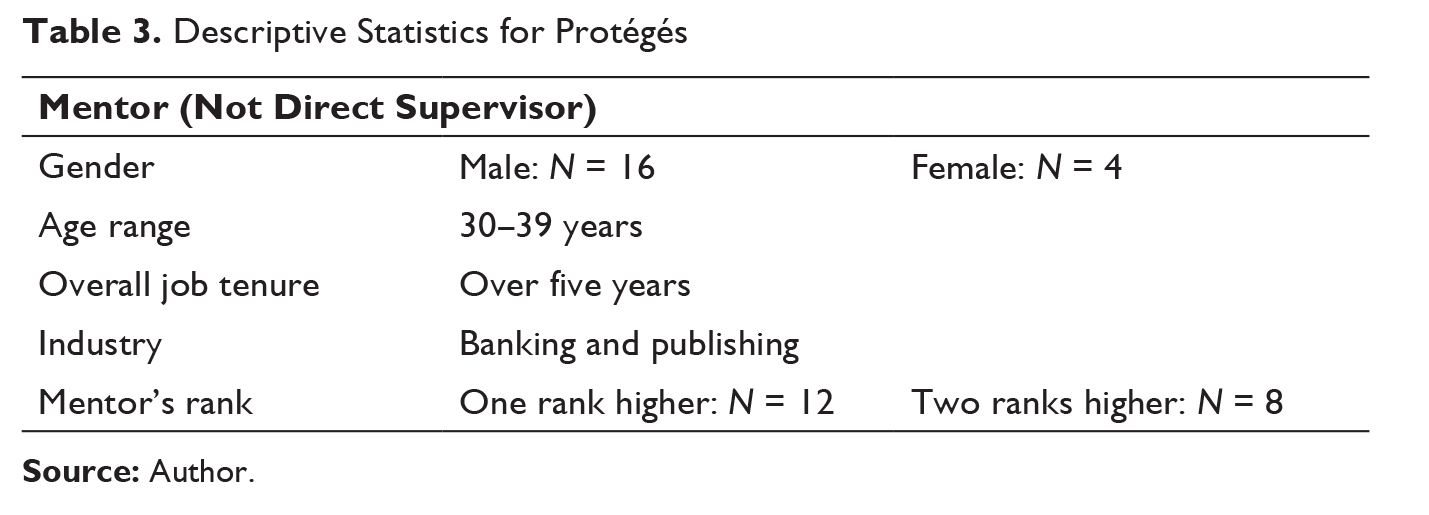
Furthermore, to reduce potential self-presentation bias, the focus of the interview was on reporting actual events and the participant’s attendant behaviour and emotions at the time. The descriptive statistics of the 20 protégés interviewed (with mentor as direct supervisor) and 20 protégés (with mentor who was not a direct supervisor) are presented in Tables 2 and 3, respectively.
Descriptive Statistics for Protégés
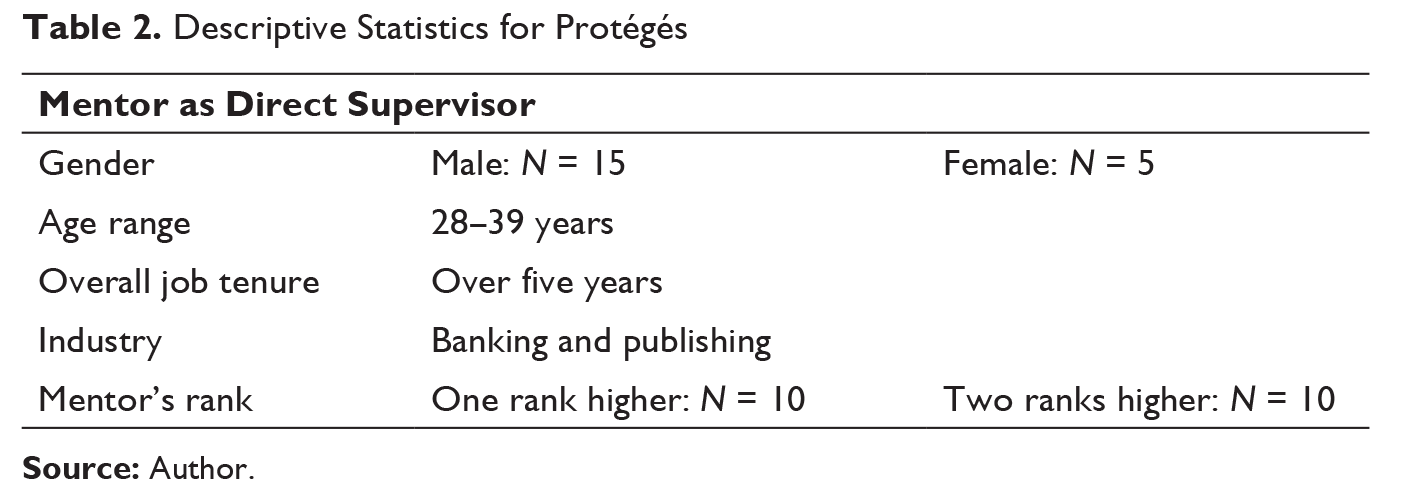
Descriptive Statistics for Protégés
The questions asked of the respondents were as follows 3
Note provided to the respondents to ensure a clear understanding of the questions:Mismatch in the dyad: This includes mismatched values, for example, views on what success is; mismatched personality, bad fit due to personality differences; and mismatched workstyles; for example, one prefers closure and the other does not (Eby et al., 2000).
Tell me about an emotion you felt from a recent NME;
How do you perceive mismatch in the dyad as per values, workstyle and personality ‘or any other mismatch’?
What specific emotions do these mismatches elicit, for example, feeling uneasy, depressed or any other emotion?
What are your coping strategies in the relationship?
What advice would you give to someone in a negative mentoring relationship?
In question 2, a clause was added to ascertain whether the respondents faced any other mismatch in the dyad apart from values, workstyle and personality (“or any other mismatch”).
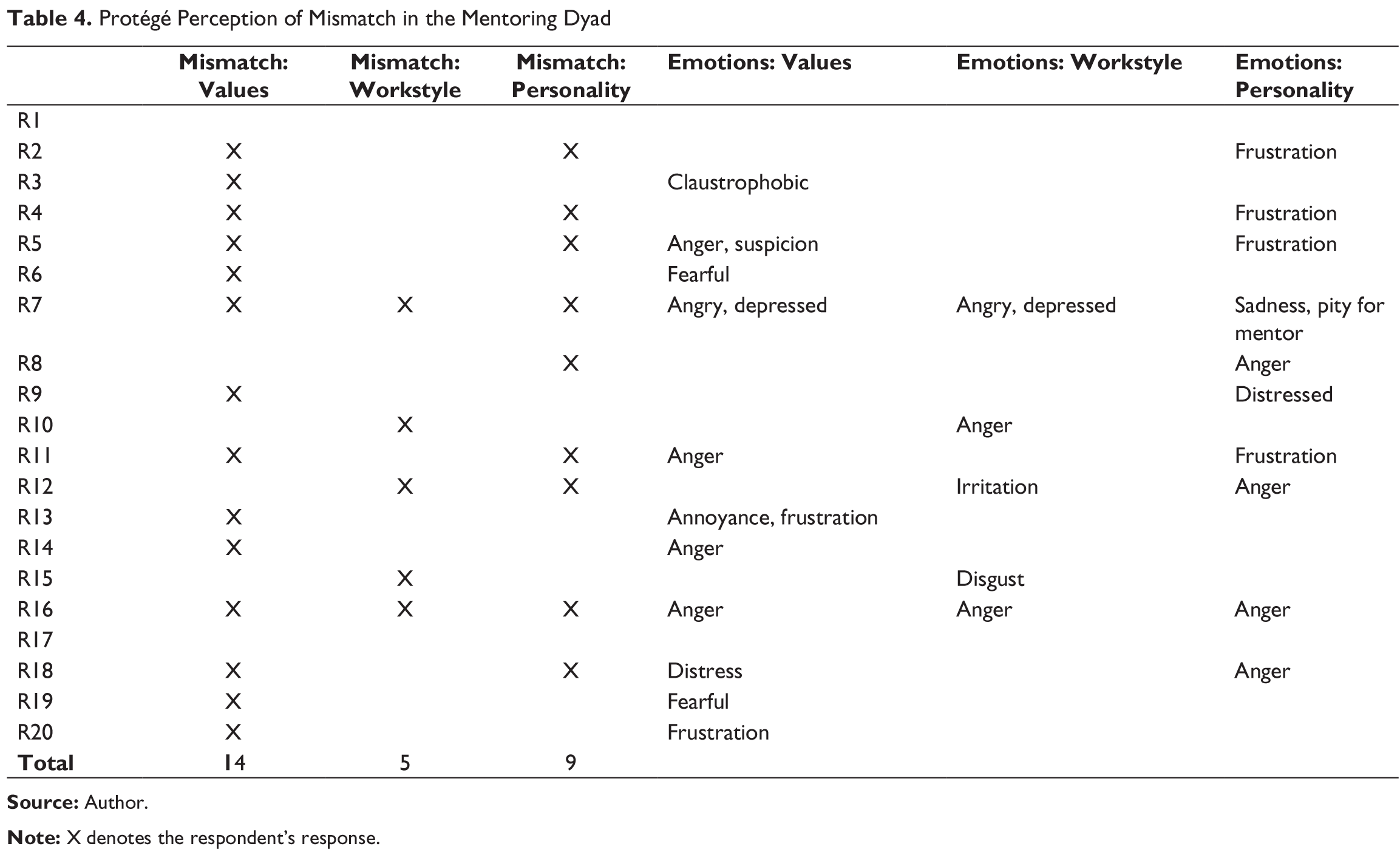
In the interviews, there were a total of 456 statements from 20 respondents who were in a mentoring relationship with their direct supervisor and 555 statements from 20 respondents in a mentoring relationship with a mentor who was not their direct supervisor. These statements were then coded using the descriptive coding technique of a line-by-line analysis, in which meaning is found from the participants’ words (Miles & Huberman, 1994; see Table 4).
In this content analysis, each interview was transcribed and then read in detail to derive meaningful codes, also known as unit labels for the descriptive information. The codes were then further refined as reflective of key categories or meaningful clusters, at first for each interview separately, and then a comparison was made between interviews. In other words, similarly coded data was codified into categories. Finally, common categories were noted in the cross-case analysis and patterns found between them (Miles & Huberman, 1994). Categories enable researchers to reach more abstract constructs, which can lead and facilitate theory development (Corbin & Strauss, 2008).
The author and another researcher in the organizational behaviour area independently coded the interviews. Using the negotiated approach Garrison, Cleveland-Innes, Koole, & Kappelman, 2006), after coding, we discussed the respective codes to see whether we had alignment. This helped in controlling simple errors or misinterpretation. This process was repeated with the other categories too. If there was a disagreement between the two coders, discussions resulted in either one coder changing the code or category to match the others, or alternatively we would agree upon another more suitable alternative. The inter-rater reliability or concurrence of agreement between two coders was 92 per cent (Krippendorff, 2004).
Results and Analysis
Both sample groups reflected the categories of mismatch in the dyad as per Eby et al.’s (2000) study and also the emotions elicited by the protégé from the perception of this mismatch in the mentoring dyad (see Table 4).
Of the 20 respondents with the mentor as the direct supervisor, 5 experienced a mismatch in two dimensions, 9 experienced a mismatch in one dimension and 2 respondents perceived a mismatch in all three dimensions. The most frequently occurring dimension was a mismatch of values (n = 14), followed by mismatch of personality (n = 9) and the mismatch in workstyle (n = 5). These three dimensions were also found in the second sample, with mismatch in values being the most predominant type of mentor–protégé mismatch.
Overall, the most frequently occurring emotions were anger, followed by frustration. Some new emotions (compared to Eby et al.’s (2000) study) were listed by the respondents including claustrophobic (mismatch: values), suspicion of the mentor (mismatch: values) and sadness for the mentor (mismatch: personality).
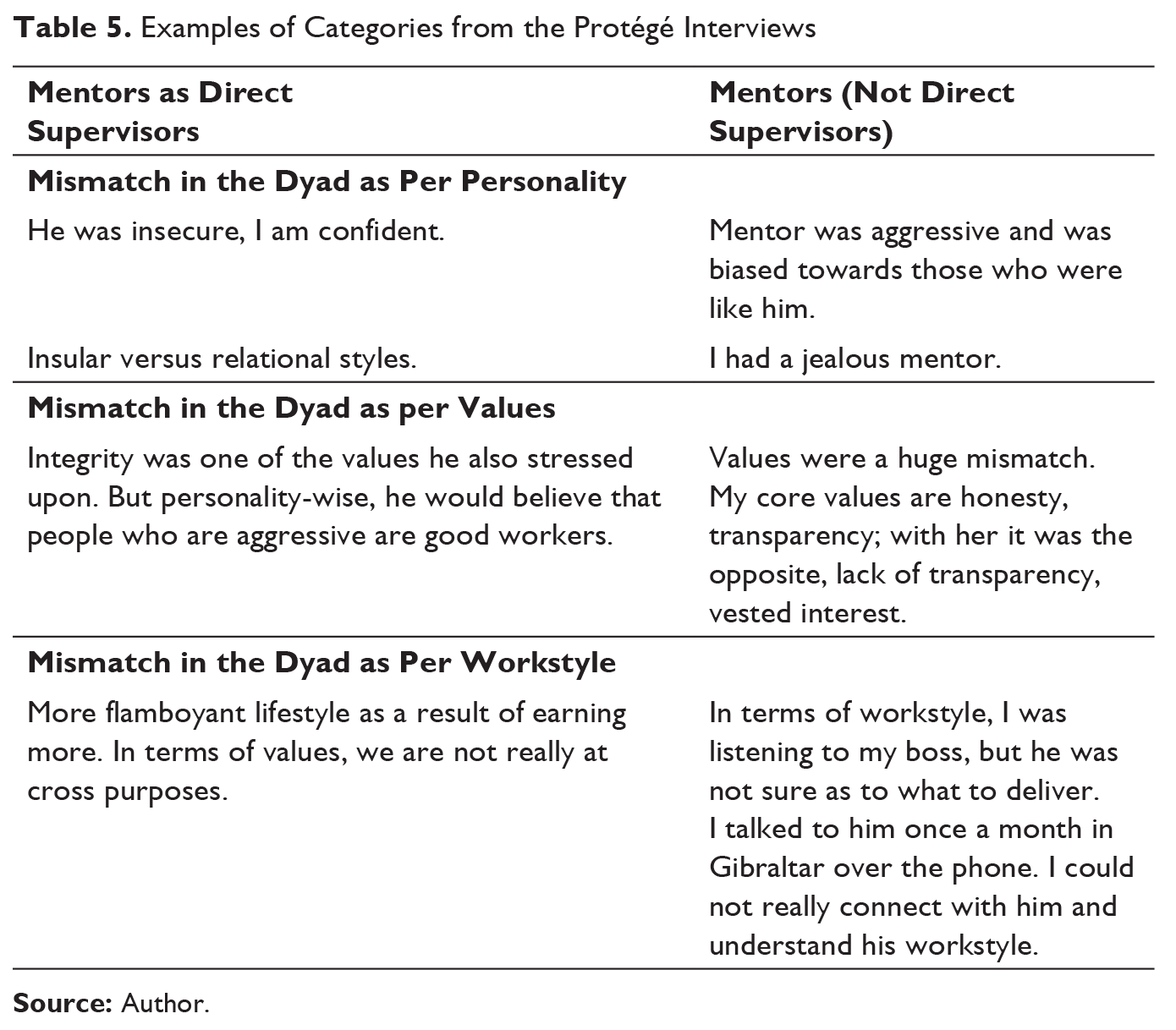
The three mismatches perceived by protégés that were elicited from Eby et al.’s (2000) study were discernible in this study too, namely mismatch in the dyad as per personality, as per values and as per workstyle (see Table 5).
Apart from these mismatches in the dyad validating Eby et al.’s (2000) study, three new mismatches emerged from the 40 respondents.
(1) Mismatch in the membership of social group (regional, caste or religious orientation; n = 16)
Regional
“Once when I talked to my mentor, I inadvertently mentioned that there is a wide North–South Indian divide. While I do not see it as a divide, I realized the boss did actually see the divide. But as a leader and mentor one should arise above all of this. As a leader you have to be objective, and not think that this guy is from my region and so he gets the best of the world. No I do not think that is the right approach.”
Protégé Perception of Mismatch in the Mentoring Dyad
Examples of Categories from the Protégé Interviews
Caste
“If people are doing research, say in caste politics, and you give them a superior who is well read and means well but belongs to an upper caste, the researchers would find that the employees who are from other castes would not identify with that leader or mentor per se.
Religion
“The others my mentor was promoting were of the same religion and also became close to him by going out for booze parties, etc.”
“We have seen followers of same God, for example, Krishnabhakt 4
“Bhakt” means “devotee.”
(2) Mismatch in age (n = 8)
“In my case, my mentor is of 55 years old and I am 25 years old. This huge gap of age difference was making me very nervous in the beginning. And it has been more than six months now and I still cannot open up to my mentor to the extent that I would have opened up to a mentor aged around 35 years.”
“Mentee should feel free to ask any question to the mentor and a very close relationship should be there among them. Mentor and mentee should belong to the same age group for effective mentoring.”
(3) Mismatch in the perceptions about similarity in personality between the mentor and the protégé (n = 3)
“She feels I am very much like her, but I do not think I am anything like her. She is a happy, party kind of a person and quite materialistic, going for a foreign trip every month with her prized Gucci bags. I feel we are completely different persons, although she says we are quite similar.”
Beyond reflecting the categories of mismatch in the mentoring dyad as per Eby et al.’s (2000) study, Table 6 reflects other categories that emerged in this study from the most frequently occurring NME for protégés (mismatch in the membership of social group).
One would intuitively expect that in a country known for its high power distance equation, where leaders tend to be more authoritarian and subordinates more submissive (Pellegrini & Scadura, 2008), predominant dyadic mismatches from the protégé perception would include mismatches between the mentor and protégé in terms of power dynamics, or say in communication styles. Yet this exploratory study strongly suggests that the most frequently occurring NME for the protégés was mismatch in the dyad relating to regional, religious or caste affiliations. In other words, the perceived belonging to a particular Indian social group is strong enough to impact mentoring experiences.
It is likely that this mismatch in the dyad is the biggest pain point for the protégé because in collective societies, where the individual places greater importance on group relations (Hofstede, 1984), there is possibly a sharper distinction between the in-group and the out-group as per leader membership exchange (LMX) theory. This relationship-based theory suggests that leaders develop an exchange with each of their subordinates, the quality of which influences subordinates’ access to resources and performance (Graen & Uhl-Bien, 1995).
Not only is social group identity important in a mentoring context in India but also this study further suggests that protégés perceive membership to such social groups to be the result of one’s upbringing in the form enculturation, a process by which people imbibe culture, values and behaviours thought to be appropriate (Grusec & Hastings, 2014).
“To some extent your upbringing matters. The upbringing shows how open you are to follow someone. For example, if you were brought up in a community where learning is encouraged then mentoring pays, as you have set ethical values and you cannot go down on them” (Respondent 5).
Categories from Mismatch in the Membership of Social Group
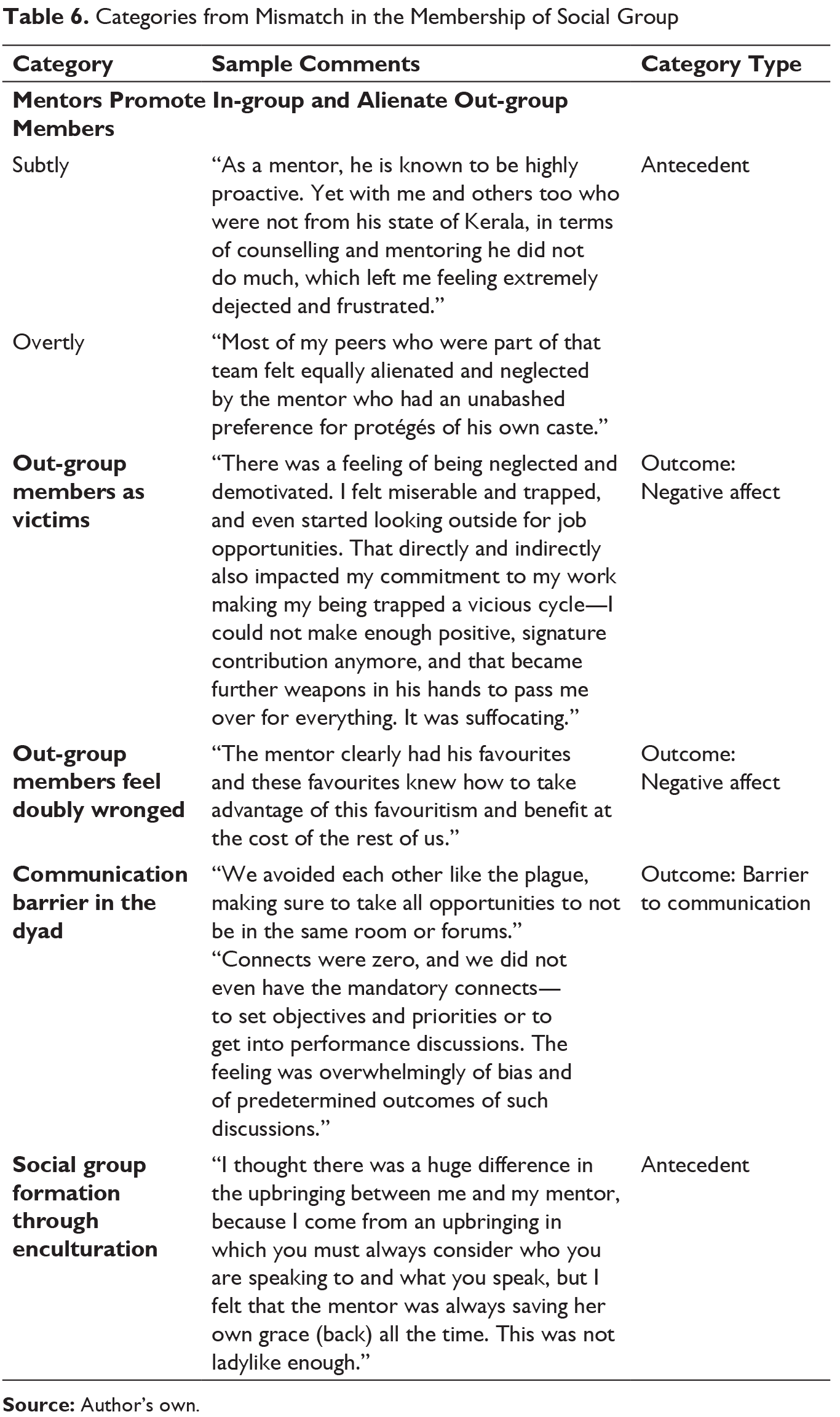
“One’s socialization, gender and demography matters. Due to the varied background and one’s upbringing, the ease of interaction with other employees or senior management will vary” (Respondent 7).
In terms of antecedents to mismatch in the membership of social group, protégés explain that mentors identify with “their own kind” (as per the similarity attraction paradigm of Byrne, Clore, & Smeaton, 1986), in two ways. First, they suggest that grouping with people from the same background is a type of survival mechanism of the minority group in a diverse setting. Said one respondent,
The mentor and protégé belong to the same state and speak the same language. In metropolitan cities and companies which have a diversity of workforce from various regions, this is more likely as only a few of their flock are to be seen. And they must stick together like brothers.
A second explanation put forward was that of the power-seeking mentor who tries to create a coterie of followers (Budhwar & Sparrow, 2002). Said one respondent,
He was a South Indian who created a clan mentality. He would only mentor and provide visibility in the organizations at various meetings and conferences to South Indian protégés, who he believed were intelligent, hardworking and timid—traits that suited him to run his show, without his authority ever being challenged.
In terms of outcomes of NMEs of the protégés who did not belong to the same social group as the mentor, protégés expressed negative affect in the form of distress, alienation, feeling neglected and trapped. This sense of victimization and alienation was doubly felt, not only from the mentor but also from the in-group members. It is likely that such protégés, due to the endorsement of an imbalance of power in a high power distance society, would be less likely to protest or change the status quo (Barkema et al., 2015), but rather would withdraw and communicate less with the mentor. This is a matter for concern given that research posits that robust communication in the mentoring dyad is a predictor for positive mentoring outcomes (Hegstad, 1999), and that communication at frequent intervals helps the protégé benefits more from the relationship in terms of guidance (Ensher & Murphy, 1997; Menges, 2016).
This study and the literature lead to the following two propositions:
These propositions are built upon Hegstad’s study (1999), in which communication was posited as one of three moderators affecting mentoring (the other two being reward systems and selection).
Apart from empirically testing the propositions earlier, given that mismatch in age was another source of discontent for protégés in this study, exploring the intersectionality of social group affiliation and age on mentoring outcomes would merit further study. Researchers may also want to investigate the effects of NMEs on subordinate rating of mentor performance (Varma, Srinivas, & Stroh, 2005). Furthermore, drawing from the theory of the valenced other (Hensley, 1996), future studies can also explore whether role modelling is likely to follow if the protégé does not perceive his idealized self in the mentor. Also, research scholars would do well to test for assumptions of cross-cultural generalizability, especially in the use of instruments commonly used in mentoring research (Mitchell, 2018).
Discussion and Conclusion
This exploratory study on the NMEs of protégés in India adds to the mentoring literature in three ways. First, this study helps confirm that while mentoring is a universal phenomenon, actual protégé mentoring experiences are impacted by demographic variations in social group membership. Gaining a deeper understanding of the contextual interpretation of demographic dynamics specific to a country is important given that “existing theories lack appreciation for the multiple contexts within which mentoring relationships operate” (Humberd & Rouse, 2016; Ramaswami & Dreher, 2010, p. 502).
Thus, despite India’s growth story and apparent Westernization of work practices (Chen, Chittoor, & Vissa, 2015), emerging research suggests that social ties such as caste and religion continue to play an important role in corporate Indian today (Chatterjee, 2007;Sengupta & Sarkar, 2012). For example in study, the formation of social capital for each individual was found to be higher among individuals with the same caste and religious affiliations, while among others there was less trust and more social conflict (Sengupta & Sarkar, 2012). In a more recent study on Gen Y protégés in a start-up firm, incongruence in regional affiliation and caste affiliation was perceived to be a road block to mentoring outcomes, so much so that “a need for a redressal system was expressed in case a mentor delayed or used different mentoring initiatives for a protégé due to certain stereotypes” (P. Kumar & S.Kumar, 2018, p. 62).
Second, unlike Eby et al.’s (2000) study in which deep-level mismatches (personality, values and workstyle) predominated, this study suggests that surface-level variables also have a profound impact on protégé mentoring experiences. As per the mentoring literature, both deep-level similarity (attitudes, values, beliefs or personality) and surface-level congruence (gender, age, class and race) have emerged as predictors to positive mentoring outcomes (Whitely, Dougherty, & Dreher, 1991; Wu, Foo, & Turban, 2008). While homogeneity can lead to high-performing mentoring dyads, this study suggests that the opposite to this may also be true such that heterogeneous variations in a group—such as demographic and regional differences—may have an adverse impact on group dynamics and on mentoring dyads (Williams & O’Reilly, 1998). To sum up, whether deep-level or surface-level mismatches, protégé perception of similarity is an important area of study as this is seen to have a positive relation to protégé commitment to the organization (Humberd & Rouse, 2016).
Third, this study brings to the fore the importance of studying the negative dimensions of mentoring experiences. This study suggests that protégés in the out-group tend to experience accentuated negative affect in the form of alienation, so much so that some protégés referred to themselves as “out-group, alienated” members.
This is possibly because those in collectivist societies tend to emphasize
relational self-concepts, which prioritizes interpersonal relationships (Oyserman, Coon, & Kemmelmeier, 2002; Yuki, 2003). This heightened perception of alienation or marginalization among those in the out-group due to exclusionary strategies of the mentor in a collective society would merit further research in the context of work performance in general, given that in a collectivist society an employee will be more likely to work hard in those contexts in which performance has positive implications for his in-group (Earley, 1993).
Apart from adding to the mentoring literature, this study corroborates LMX theory, as it depicts that in-group members have a high-quality relationship, while out-group members have a lower quality relationship which can lead to reduced employee job satisfaction and well-being (Boies & Howell, 2006). This reduced employee satisfaction is likely to be the result of supervisors allotting membership to the in-group and out-group based on personal characteristics that are often unrelated to performance, which violates the protégé’s sense of justice and equity (Hooper & Martin, 2008).
Furthermore, this study addresses three criticisms of LMX theory. First, much of the research in this area has focused on high-quality relationships and less on low-quality relationships and the impact of the differentiation between the two. Second, the literature so far has tended to lean towards the leader–member dyad in isolation rather than the wider context of the social group at the workplace (Hogg et al., 2005). Third, while scholars have called for more research on the cultural context of LMX relationships given that this theory is descriptive in nature explaining leader–follower relations rather than predictive (Gerstner & Day, 1997), little headway has been made in this area (Schriesheim, Castro, & Cogliser, 1999).
There is a wide-reaching practical implication of this study too. For HRM experts who spearhead workplace mentoring programmes in India, pairing of mentors and protégés needs to take into consideration demographic profiling—especially since in the case of dyadic incongruence, a protégé in a conflict-avoidance country like India may experience negative affect but choose not to voice this. In a study on Korea, another high conflict avoidance country, the relationship between LMX and voice was found to be less positive in employees compared to a sample from the USA (Park & Nawakitphaitoon, 2018).
To sum up, scholars are increasingly questioning the positivist trend of decontextualizing HRM from the social–historical context of the workplace (Cooke, 2018; Knights & Omanović, 2016). This study adds to emerging literature by putting under the scanner mentoring as a one-fits-all-developmental process, by suggesting that while on the face of it Western mentoring models have been imbibed extensively in corporate India, in reality the process of enculturation and perception of belonging to a particular Indian social group is strong enough to impact mentoring experiences and thus cannot be swept under the proverbial carpet.
Declaration of Conflicting Interests
The author declared no potential conflicts of interest with respect to the research, authorship and/or publication of this article.
Funding
The author received no financial support for the research, authorship and/or publication of this article.