



Abstract
Abstract
This article defines a person’s environment as a combination of work and family environments by extending the person–environment fit theory to include the family domain. The study extends the person–environment fit construct by including person–job fit, person–organization fit, person–group fit, person–supervisor fit (all in work environment) and person–family fit (family environment). In the two studies that were carried using operational-level employees from various industries, we empirically develop a scale for the new concept person–family fit, validated person–family fit scale and the person–environment fit construct. This study makes several theoretical contributions including defining person–family fit construct, developing a scale to measure the same and confirming its inclusion into the person–environment fit construct. Managerial implications are provided to ensure person–job fit, person–group fit, person–supervisor fit and person–family fit in the working environment.
Keywords
Introduction
Person–environment fit theory is a prominent concept in well-being studies (Edwards & Rothbard, 1999). The literature discusses person–environment fit factors within the work environment, such as person–job fit, person–vocation fit, person–person fit, person–organization fit, person–group fit, and person–supervisor fit (Chuang, Shen, & Judge, 2016; Edwards & Billsberry, 2010).
At present, there is a considerable amount of studies done in the international arena on person–environment fit (Edwards, 1991; Edwards & Rothbard, 1999; Hassan, 2012; Kristof-Brown, Zimmerman, & Johnson, 2005; Makikangas & Kinnunen, 2003; Verquer, Wagner, & Beehr, 2003). However, this literature defines a person’s environment in a rather narrow sense (Dewe, O’Driscoll, & Cooper, 2012; Edwards, 1992; Edwards & Rothbard, 1999). ‘Person–Environment Fit theory deals with the adjustment of individuals and an organizational/work perspective is recommended’ (Caplan, 1987, p. 264). Drawing from the work/family border theory (Clark, 2000), our study recognizes both work and family environments as comprising a person’s environment.
Person–environment fit theory includes only the work environment as a person’s environment. There is a gap to be addressed in the current literature as it does not include the home environment. The work/family border theory (Clark, 2000) explains that an employee is a border crosser between her/his work and family domains, which indicates that a person’s environment is not limited to her/his work environment only. The theory addresses issues like how domain integration and segmentation, border creation and management, border-crosser participation and relationships between border crossers and others at work and home influence work and family balance. Person–environment fit theory does not specifically mention these two domains that an individual keeps crossing during his/her life. However, we believe that an individual’s environment should consist of both family and work environments. This argument is further supported by Bednar, Marshall, and Bahouth (1995), who state that a person’s environment is a combination of work and non-work environments. Therefore, it is apparent that both work and non-work environments need to be taken into account while defining a person’s environment.
In order to better explain an employee’s environment in the person–environment fit construct, we introduce the concept of person–family fit in the framework by including the family environment. The objectives set to be achieved in this study are: (a) to define person–family fit, (b) to develop a scale to measure person–family fit and (c) to extend the person–environment fit construct.
Significance of the Study
As stated earlier, existing knowledge on person–environment fit is largely focused on environmental factors in the work context (Edwards & Rothbard, 1999). To date, there has been little attempt at exploring non-work-related factors as person–environment fit factors. Thus, we seek to fill a gap in the body of knowledge by defining a person’s environment in a broader way, signifying the family environment by including the concept of person–family fit in the person–environment fit construct. In addition, the introduced construct of person–family fit is more relevant to South Asian context as Hofstede (1989) has specifically indicated that it is difficult to separate the interests of work and family domains when demonstrating cultural dimensions in a collectivist society, and Gupta, Hanges, and Dorfman (2002) have suggested South Asian society as a collective society.
We introduce and define a new construct person–family fit, and develop a new scale to measure it in this study. We conceptualize the person–environment fit construct by including person–family fit, which indicates a person’s interaction with the family environment, while person–job fit, person–organization fit, person–group fit and person–supervisor fit signify her/his interactions with the work environment. The literature illustrates that person–environment fit is a multidimensional construct that includes person–job fit, person–organization fit, person–group fit and person–supervisor fit (Chuang et al., 2016). Our study contributes to the existing knowledge by testing the multidimensionality of person–environment fit in some of the companies in Sri Lanka, which could be relevant to the South Asia.
Findings and recommendations of the study will provide inputs for human resource professionals, practitioners and organizational decision-makers in order to identify a person’s environment in a broader perspective. They then will be able to change/modify the policies and practices designed for employees by including both work and family environments as an employee’s environment.
Literature Review
Theoretical Background of the Study
In the past, person–environment fit discussions were shaped by interactionists who believed that certain attitudes, cognitions and behaviours were the outcomes of the interaction between personal and situational factors (Ostroff & Schulte, 2007). However, this perspective has been criticized due to its lack in adequately explaining how this interaction occurs (Ostroff & Schulte, 2007). To address this lack, French and Kahn (1962) developed the person–environment fit theory that was formulated to develop the construct person–environment fit. Later, Caplan (1983) and Edwards and Harrison (1993) extended the person–environment fit theory.
According to the literature, two basic distinctions stemming from the theory are: (a) objective and subjective persons, with the environments that too are objective and subjective, and (b) the values, goals and abilities of the person with the demands, goals and supplies of the environments (Caplan, 1983; Edwards & Harrison, 1993). According to French, Caplan, and Harrison (1982), the person–environment fit theory involves three different fits: demands–abilities fit (D–A fit), needs–supplies fit (N–S fit) and supplies–values fit (S–V fit). However, initially, person–environment fit was formulated as two different fits: supplementary fit and complementary fit (Edwards, 1996; French et al., 1982; Kristof, 1996), which are similar to D–A fit and S–V fit.
However, over time, researchers have concluded that person–environment fit is a multidimensional construct and have used different dimensions to conceptualize person–environment fit (Chuang et al., 2016; Kristof-Brown et al., 2005). This is quite apparent in the previous studies as is explained next. Kristof-Brown et al.’s (2005) conceptualization of person–environment fit includes person–job fit, person–organization fit, person–group fit and person–supervisor fit. Subsequently, Edwards and Billsberry (2010) categorized person–environment fit into five different dimensions (person–job fit, person–vocation fit, person–person fit, person–group fit and person–organization fit) within the organizational context. Moreover, Chuang et al. (2016) have conceptualized person–environment fit by including person–job fit, person–organization fit, person–group fit and person–supervisor fit.
Critical Review of the Person–Environment Fit Theory
The fundamental notion of the person–environment fit theory is about the fit between individual and her/his organizational environment (Caplan, 1987), and, to date, person–environment fit studies and theory have remained confined to the working environment (Caplan, 1983; Edwards & Rothbard, 1999). Arguing against this quite narrow perspective on ‘environment’ in the person–environment fit theory, in the present study we define a person’s environment as consisting of both work and family environments, as today’s workers’ ‘environments’ go beyond the ‘boundary of the organization’. This is based on the work/family border theory (Clark, 2000).
The work/family border theory (Clark, 2000) shows that there are two domains in a person’s life: the work domain and the family domain, neither of which is identified in the person–environment fit theory. According to work/family border theory, people are border crossers between the work and family domains. The theory addresses issues of domain integration and segmentation, border creation and management, border-crosser participation, and relationships between border-crossers (Clark, 2000). Taken as a whole, it is apparent that a person has two environments, the work and the family environments. Accordingly, to fill the existing knowledge gap in the person–environment fit theory, we define a person’s environment to be a combination of working and family environments. Consequently, a person’s fit with her/his family is identified as person–family fit.
In line with the studies of Kristof-Brown et al. (2005) and Chuang et al. (2016) on the multidimensionality of person–environment fit, we conceptualize the construct person–environment fit as comprising of person–job fit, person–organization fit, person–group fit, and person–supervisor fit. In order to fill the lacuna in the theory, this article later addresses the person–family fit dimension and subsumes it under the person–environment fit.
Person–Job Fit
Specifically, person–job fit is defined as the fit between the demands of a job and the abilities of a person (D–A fit) or the needs of a person and the supplied attributes of a job (N–S fit) (Edwards, 1991). A study by Kulik, Oldham, and Hackman (1987) proposed that person–environment fit creates a good match between certain job characteristics and certain characteristics of individuals.
Person–Organization Fit
Person–organization fit focuses on the fit of the person with the entire organization, rather than merely with the specific job, vocation, group or supervisor (Kristof, 1996; Silverthorne, 2004; Tom, 1971). The current literature defines person–organization fit as a supplementary fit (Cable & DeRue, 2002; Chuang et al., 2016; Kristof, 1996). Muchinsky and Monahan (1987) explained supplementary fit as coming about when a person and the environment possess similar attributes in terms of values or goals of the organization. Consequently, Kristof (1996) defined person–organization fit as the fit/match between an individual and her/his organization in terms of values and goals.
Person–Group Fit
‘Of all types of fit, person–group fit research is the most nascent’ (Kristof-Brown et al., 2005, p. 286). Person–team or person–group fit is defined as the compatibility between individuals and their work group (Edwards & Billsberry, 2010; Kristof, 1996). The similarity attraction paradigm (Byrne, 1971) predicts that, generally, a person is attracted to the other on the basis of the similarities they possess in their social milieu. As the literature shows, a person is attracted to others due to similarities among them, and these similarities could include attitudes, personality, values and goals (Byrne, 1971).
Person–Supervisor Fit
Kristof-Brown et al. (2005) defined ‘person–supervisor fit’ as the match between an individual and her/his supervisor in the working environment. Interpersonal attraction theory explains that an individual is attracted to another individual on the basis of similar characteristics regarding life goals, personality, activity preferences, values and so on (Huston & Levinger, 1978). According to that theory, a subordinate and her/his supervisor could be attracted to one another on the basis of the aforementioned similarities and this attraction is defined as the ‘fit’ between a person and her/his supervisor.
Person–Family Fit
The person–environment fit theory elaborates how individuals adjust in the working environment (Caplan, 1987). Thus, from an organizational perspective, person–environment fit studies defined environmental dimensions by including person–job fit, person–organization fit, person–group fit and person–supervisor fit (Chuang et al., 2016) or person–vocation fit, person–person fit, person–organization fit, person–group fit and person–job fit (Edwards & Billsberry, 2010). It implies that previous studies identified a person’s environment as only the working environment. In the present study we argue that although person–environment fit has witnessed a large number of empirical studies and experiments, researchers have struggled to define the ‘elusive criterion of fit’ (Jansen & Kristof-Brown, 2006, p. 193).
However, the person–environment fit has been considered as the only working environmental fit including person’s fit with job, organization, supervisor, group and so on. Arguing against the existing classifications of a person’s environment in this study, we define that a person’s environment should consist of both work and family environments. Hence, drawing from the work/family border theory, we argue that individuals can bring family to work environment and work to family environment. Further, the theory shows that the two domains that exist in a person’s life as work and family are not identified in the person–environment fit theory. Accordingly, to fill the existing gap, in this study we define that a person’s environment should be broader than the working environment and include both work and family environments. By considering the family environment, a person’s fit with the family can be introduced as the person–family fit. Since they do not include family as an environment, the person–family fit has not been defined by previous scholars. Following the basic premise of the person–environment fit theory, we attempt to fulfil one of the objectives of the study, which is to define the concept the person–family fit.
The forgoing argument is more relevant to Sri Lanka and the South Asian region where the context of the current study exists. Hofstede (1989) states that in the South Asian collectivist societies, it is difficult to separate work and family domains in elaborating cultural dimensions. Meanwhile, Gupta et al. (2002) mention that South Asian societies exhibit collectivist culture. Ballard (1982) posits that South Asian people bond with their families more than other people. His claim is also a supportive evidence to state the fit of this concept to South Asia. The following discussion is about the concept of person–family fit.
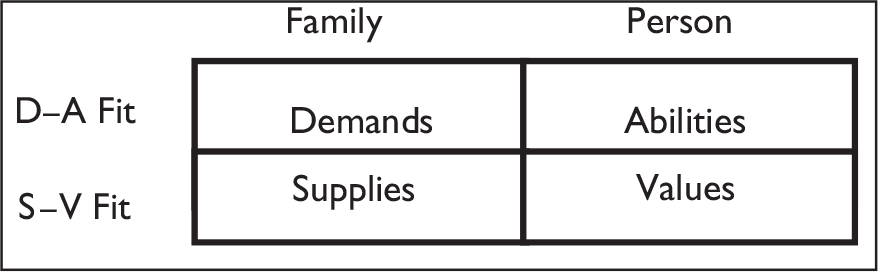
To define the variable person–family fit, we follow the main theoretical premise of person–environment fit theory: D–A fit and S–V fit. Edward (1996) formulated S–V fit as supplementary fit and D–A fit as complementary fit, respectively. Accordingly, we too accept both complementary fit and supplementary fit in defining person–family fit.
D–A fit explains that demands are qualitative and quantitative requirements whereas abilities consist of skills, energy, training, time and resources a person can muster to meet her/his demands (Edwards, Caplan, & Harrison, 1998). In S–V fit, values refer to the desires of a person and subsume her/his interests, preferences and goals (Edwards, 1992). Supplies refer to the environment that fulfils a person’s values (French et al., 1982) and include extrinsic and intrinsic rewards derived from the activities or experiences in the environment. Thus, we use D–A fit and S–V fit from the person–environment fit theory to conceptualize the person–family fit.
On the basis of literature on D–A fit and S–V fit, we define ‘person–family fit’ as the fit between the demands of the person’s family and his/her ability to fulfil those demands (D–A fit) and the supplies available in the family environment to fulfil his/her values (S–V fit; see Figure 1).
Comparison of Person–Family Fit with Work–Life Balance, Work–Life Conflict, Work–Family Fit and Job Embeddedness
In brief, person–family fit describes the fit between a person and her/his family, a construct that explores the family environment of that person. Family environment has been studied in various forms, including work–life balance (Dundas, 2008; Kumarasamy, Pangil, Faizal, & Isa, 2015), work–life conflict (Netemeyer, Boles, & McMurrian, 1996; Thomas & Ganster, 1995) and work–family fit (Major & Burke, 2013; Voydanoff, 2002). In addition, we differentiate construct from job embeddedness (Hom et al., 2009).
Work–life balance is managing and juggling paid work as well as all other activities that are important to a person, including his/her family and the community/society (Dundas, 2008). Most work–life balance studies have explored time balance, involvement balance and satisfaction balance (e.g., Greenhaus & Beutell, 1985; Thomas & Ganster, 1995). However, person–family fit is defined here as a person’s ability to fulfil the different demands created by the family environment (D–A fit) and the supplies available in the family to fulfil her/his values (S–V fit). Hence, we distinguish work–life balance and person–family fit as different concepts, as work–life balance measures only a person’s ability to balance the work and family domains in terms of family demands, while person–family fit is not only about a person’s ability to meet family demands but also about the supplies available in the family environment to meet a person’s values in order to reach S–V fit.
Another family-related construct is the work–life conflict, which is defined as work interfering with the family or a person’s ability to fulfil the demands of family as work interferes with her/his family life (Netemeyer et al., 1996). Accordingly, we posit that a person’s ability to fulfil the demands of the family (D–A fit) appears in both person–family fit and work–family conflict, though, person–family fit is not confined to D–A fit but also includes S–V fit. Therefore, we argue that even though person–family fit and work–family conflict are defined by D–A fit, work–life conflict and person–family fit are different concepts, since person–family fit is broader than work–life conflict.
Even though the concept of work–family fit has been studied, much confusion exists in the literature about the notion of work–family fit (Major & Burke, 2013). Grzywacz and Bass (2003, as cited in Major & Burke, 2013) conceptualized work–family fit as a combination of conflict and enrichment. Voydanof (2002) delineated the work–family concept as work demand–family resources fit and family demand–work resources fit, which implies D–A fit. Edwards et al. (2006, as cited in Major & Burke, 2013) defined work–family fit using N–S fit. It is obvious that work–family fit is still a controversial concept. Thus, Major and Burke (2013) advised researchers to provide a clear definition of the fit that differentiates it from other constructs (work–life balance, work–life conflict, etc.).
Job embeddedness is a collection of forces embedding in on- and off-the-job (Hom et al., 2009). It could be argued that person–environment fit and job embeddedness are not similar concepts. Person–environment fit gives a broad conceptualization including job (D–A fit and N–S fit), organization (values and goals fits), supervisor (attitudes, personality, values and goals fits), group (life goals, personality, activity preferences and values fits) and family (D–A fit and S–V fit). In contrast, Mitchell and Lee (2001) noted three dimensions of job embeddedness: (a) links, (b) sacrifice and (c) fit. Accordingly, it is clear that job embeddedness is yet to be studied in relation to diverse off-the-job factors compared to the person–environment fit, which is recognized as the difference between person–environment fit and job embeddedness as a mistake.
The literature acknowledges that job embeddedness subsumes links, sacrifice and fit aspects. Even though, person–family fit encompasses only a person’s family environment, first dimension of job embeddedness, ‘links’, covers formal and informal connections of an employee in an organization or community (Mitchell, Holtom, Lee, Sablynski, & Erez, 2001). Sacrifice captures the perceived cost of material or psychological benefits that may be sacrificed by leaving a job (Mitchell et al., 2001). This explanation provides a better insight to contrast person–family fit with job embeddedness as person–family fit is not a cost function and it implies positive aspect of a person’s family environment when sacrifice suggests diverse costs associated with a person when he/she leaves a job. Though, job embeddedness and person–family fit concepts discuss the term ‘fit’, fit in job embeddedness covers the fit between an employee’s corporate and external environment/community (Mitchell et al., 2001), which is not limited to family environment as person–family fit. Accordingly, it is apparent that job embeddedness differs from person–family fit.
We have defined the concept of person–family fit in contrast to work–life balance, work–family conflict, work–family fit and job embeddedness.
Methodology
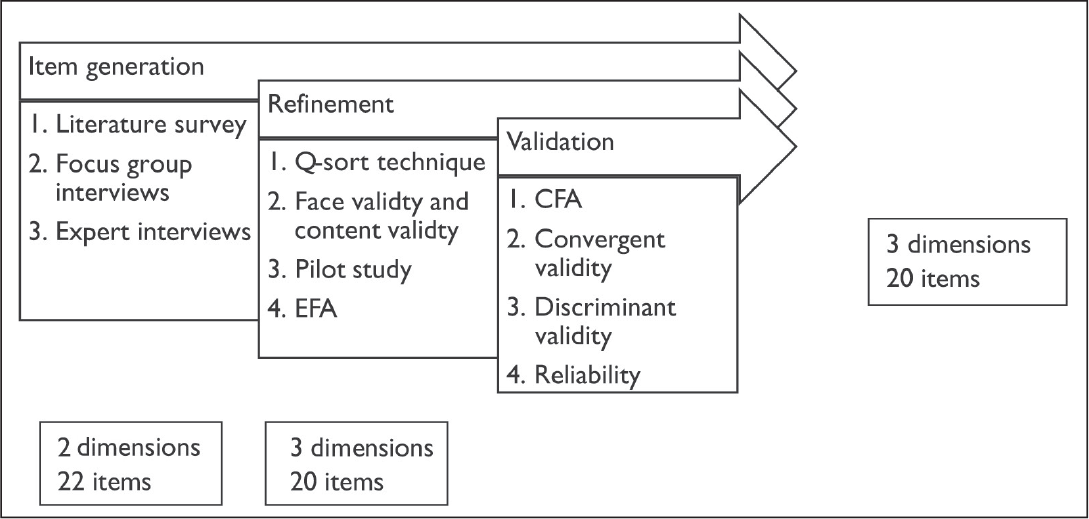
We have followed a mixed method where both qualitative and quantitative approaches are used to achieve the purpose of the study. This study is part of a larger project and this article consists of two studies under that project: Study 1 (item generation and refinement) and Study 2 (validation).
The first author conducted a preliminary investigation in few apparel organizations in the Sri Lankan context and reviewed employee counsellor reports in order to identify why employees opt to get personal counselling. Findings revealed that the majority of cases belong to operational-level employees and those are related to a person’s environmental factors—family/job/supervisor/group/organization, which was the rationale for selecting operational-level employees as the participants in both studies. Thus, the unit of analysis of the present study is the individual and convenience sampling technique is used to collect data.
Initially, we carried out a literature review. In the literature review, we referred to the measurement scales that measured different concepts related to family environment. Accordingly, we referred to the work–life conflicts scales of Netemeyer et al. (1996) and Thomas and Ganster (1995), the work–life balance scales of Hayman (2005), Brough et al. (2014), Valcour (2007) and Edwards and Rothbard (1999) to identify the dimensions for S–V fit. Then, four focus group interviews were conducted by the first author with 20 operational-level employees (five members in each group). As the final step of item generation, the first author had discussions with three experts who were actively involved in human resource management (HRM)-related research and two industrial experts who were in HRM as well. In sum, 22 items were generated after literature review, focus group interviews and discussions with experts.
In the refinement stage, the initial construct validity was examined by using Q-sort technique, which is a widely used validity testing technique in scale development (Boon-itt & Pongpanarat, 2011). Another five members (three experts who were actively involved in HRM-related research and two industrial experts who were also in HRM) were selected to employ the Q-sort technique. Finally, four academic experts who were actively involved in HRM-related research and one industrial expert, who also was in HRM, assessed the face validity and the content validity of the person–family fit scale. Items that were unclear or ambiguous were redefined. After the process, the scale consisted of three dimensions (22 items), that is, D–A fit: involvement, D–A fit: resources and S–V fit.
Face validity, content validity and pilot study were conducted in line with the scale development literature (Chow & Chen, 2012; Furr, 2011; Quazi et al., 2016; Saaksjarvi & Morel, 2010). Face and content validity were assessed by industrial experts and experts who are actively involved in HRM-related research. The pilot study was conducted to ensure the reliability of the new scale. Researchers applied convenience sampling technique to collect data from 60 operational-level employees in two market leading organizations (tires and tubes, and apparel industries). The Cronbach’s alpha value of the person–family fit scale was 0.97, which is above the acceptable value of 0.70 (Nunnally, 1979, as cited in Chow & Chen, 2012).
Thereafter, in order to conduct EFA, a total of 270 respondents were invited to take part in the study out of 1,360 operational-level employees in two market leading organizations (tires and tubes, and apparel industries). A total of 243 questionnaires were returned, yielding a response rate of 90 per cent. Out of the sample, 51 per cent were male. With regard to the respondents’ age, 8.6 per cent were below 20 years, 56.8 per cent were above 20 and less than 30 years, 21 per cent were above 30 and less than 40 years, and 13.6 per cent were 40 years and above.
Prior to conducting EFA, we examined the inter-item correlations among the items, which ensures that all items are drawn from the appropriate domains and the data produces reliable findings (Churchill, 1979). According to Kim and Mueller (1978), any item that correlates at less than 0.4 with all other items should be deleted from the analysis. According to the findings, all items in the person–family fit scale correlated each other between 0.44 and 0.92.
Rotated Factor Loading Matrix for Person–Family Fit.

For Study 2, we sampled operational-level employees in three leading apparel organizations. Out of 2,720 operational-level employees, questionnaires were distributed to 420 employees. The final sample was 393 (94% response rate). We adopted a convenience sampling technique. Initially, we conducted a linguistic equivalence test (Chow & Chen, 2012) for all scales that were used for Studies 1 and 2, because the questionnaire was in English and the respondents’ mother tongue was Sinhala. Accordingly, all measures were professionally translated into Sinhala and back-translated into English to ensure conceptual equivalence. A pilot study was conducted with 100 respondents to ensure the reliability of measurement scales and the results confirmed that Cronbach’s alpha values for all scales were above the acceptable level of 0.7 (Nunnally, 1979, as cited in Chow & Chen, 2012). Figure 2 delineates the process followed in this research in developing the new scale.
Results
In Study 2, the collected data was analysed using SPSS version 20.0 and AMOS version 23.0. Prior to analysis, the data was scanned for accuracy and precision. For missing values, basic checking was conducted and the “subgroup mean substitution” method was applied. Ten outliers in the person–family fit variables were deleted. Accordingly, the sample size (n) of the Study 2 became 393 of operational-level employees in the apparel industry. Of the sample, 49 per cent were female. With regard to age of the respondents, 8.6 per cent were below 20 years; 56.8 per cent were more than 20 but less than 30 years; 21 per cent were 30 or more and less than 40 years; and 13.6 per cent were 40 and above.
Harman’s single-factor analysis was performed to diagnose CMV of the current study (Podsakoff, MacKenzie, Podsakoff, & Lee, 2003) and it proposed 12 factors that was greater than the number of actual factors of the study and the first factor explained only 16 per cent variance, which was below the criterion level of 50 per cent (Mat, 2014). Therefore, it can be concluded that common method bias seems not to be an influence in this study. Tests of normality, distribution of data, linearity and homoscedasticity, and multicollinearity yielded satisfactory results. Thereafter, in Study 2, Phase 1, confirmatory factor analysis (CFA), convergent validity, discriminant validity and reliability (Chiu & Wang, 2008) were checked in order to validate the new person–family fit scale.
Validity and Reliability of the Person–Family Fit Scale

KMO values of the scale exceeded the threshold of 0.5 for each construct (Malhothra & Dash, 2011). Thus, the sample adequately represented the population for all variables (Tabachnick & Fidell, 2001). Further, Bartlett’s test of sphere city was significant for all constructs (p < 0.05; Bartlett, 1954).
Then EFA was performed to determine the factor loading of each of variable in the person–environment fit construct except the variable person–family fit, since this was tested in the Study 2 Phase 1. EFA was performed using principal component analysis and Varimax rotation with Kaiser Normalization (Quazi et al., 2016). Factor loadings of person–job fit, person–organization fit, person–group fit and person–supervisor fit variables reported higher than 0.5 level, except for two items in the person–group fit variable. Hence, two items (person–group fit values: how would you describe the match between your emphasis and your group’s emphasis on the following values? Helping others and person–group fit goals: how would you describe the match between your goals and your group’s goals on the following dimensions? Competition with other groups) were removed in progressive steps. Accordingly, this study we found that the studied operational-level employees did not respond to group values like helping others, and they are not concerned about goals like competition with other groups.
The stepwise method was applied with the aid of AMOS in order to validate the first-order measurement model. Accordingly, in two steps, two items of the latent variable person–group fit: goals (How would you describe the match between your goals and your group’s goals on the following dimensions: (a) rewards and (b) the amount of effort expected?) whose factor values were less than 0.5, were removed. Accordingly, the results confirmed, once more, that this employee category has individualistic goals and not group goals, even when they are working as groups. In addition, there was an item in person–organization fit (how would you describe the match between your emphasis and your organization’s emphasis on the following value: helping others), where the factor value was 0.483 and that item was removed. Finally, the person–group fit variable remained with the dimensions “person–group fit: values” and “person–group fit: attributes” and person–organization fit variable consisting of six items. The refined model, however, consists of 41 items. At this stage, all standard regression weights and correlations were significant at the 95 per cent confidence interval. Thus, CFA confirmed the model fit of the first-order measurement model (χ2/df = 1.99, CFI = 0.95, NFI = 0.90, TLI = 0.94, GFI = 0.85, AGFI = 0.82, RMR = 0.12, RMSEA = 0.05).
Reliability and Validity Testing for Variables

Discriminant Validity

PGFA = person–group fit attributes; PSF = person–supervisor fit.
In the present article, we develop the concept of person–family fit in order to fill an existing gap in the person–environment fit theory. However, a verification of the suitability to include it in the well-established person–environment fit construct is required. Hence, the proposed model: extended person–environment fit construct (person–job fit, person–organization-fit, person–group fit, person–supervisor fit and person–family fit) was tested.
Model Testing of the Person–Environment Fit Construct
Prior to testing the proposed model, verification of the model fit of the second order measurement model was required. The results confirmed the model fit of the second order measurement model (χ2/df = 2.12, CFI = 0.95, NFI = 0.91, TLI = 0.93, GFI = 0.85, AGFI = 0.81, RMR = 0.19, RMSEA = 0.05). The expanded person–environment fit construct was tested and the model fit was assured (χ2/df = 1.96, CFI = 0.95, NFI = 0.91, TLI = 0.95, GFI = 0.86, AGFI = 0.83, RMR = 0.19, RMSEA = 0.05). Fit indices of person–environment fit validated the fit between the observed data and the model.
Discussion of Findings
Study 1 demonstrates that the person–family fit can be used to evaluate the fit between a person and her/his family in terms of D–A fit and S–V fit. The person–family fit scale consists of 20 items of which four items are under D–A fit: involvement, another four items under D–A fit: resources dimension, and 12 items under S–V fit. S–V fit was operationalized as a unidimensional variable as it consists of values autonomy, relationship and life goals.
Study 2 confirmed the suitability of the inclusion of person–family fit into the person–environment fit construct. Thus, the main argument of this study that a person’s environment is much broader than her/his working environment (drawing from the work/family border theory; Clark, 2000) was established. In extending the person–environment fit construct, the proposed model includes person–job fit, person–organization fit, person–group fit, person–supervisor fit and person–family fit. The results of fit indices confirmed the fit between observed data and the model, the suitability of the inclusion of person–family fit into the person–environment construct was also confirmed.
Theoretical Contribution
Existing studies on person–environment fit have largely focused on environmental factors in the work context (Edwards & Rothbard, 1999) such as person–job fit, person–supervisor fit, person–organization fit and person–group fit (Chuang et al., 2016). To date, both debate on the person–environment fit theory and its empirical testing have been minimal and little is known about the work environment fit and family environment fit. Previous studies have identified the potential of person–environment fit theory in the family environment (Edwards & Rothbard, 1999), yet the family environment as a part of a person’s environment studies has not been considered. However, drawing from the work/family border theory (Clark, 2000), the present study we define a person’s environment in a broader sense by including both work and family environments. The new concept person–family fit is in itself a significant theoretical contribution, and is more applicable to the South Asian regions as the people here have a strong bond with their families (Ballard, 1982). Hofstede (1989) also has stated that it is difficult to separate work and family in a South Asian society (Gupta et al., 2002).
In this article, we argue against the narrow perspective taken regarding a person’s environment by the person–environment fit theory. The present study contributes to the theory by extending a person’s environment into the family domain. Accordingly, person–environment fit is defined as a combination of work and family environments, where person–job fit, person–organization fit, person–group fit, person–supervisor fit and person–family fit are co-existent. Statistical verification of a person’s environment comprising of work and family environments would be more applicable to South Asia as the present study was conducted in Sri Lanka, a country in the South Asian region.
Managerial Implications
Apart from the theoretical contribution, this study generates managerial implication as well. Organizations could establish the following practices to ensure person–job fit, person–group fit, person–supervisor fit and person–family fit.
In order to ensure an employee’s fit with her/his job, organizations could implement practices such as provide training in cases where the employee’s knowledge, skills and abilities do not meet the standards and requirements of the job. In addition, to develop a good fit between an employee and her/his group, organizations could implement practices such as group competitions and give award to the best group while promoting common goals. To ensure rapport building between the employee and his/her supervisor, organizations could introduce work practices such as weekly/daily discussions and promote group goals.
Organizations could also implement practices to enhance the employees’ fit with their family environment. For example, organizing outings, celebrating family days, promoting awareness among the employees’ family about their job responsibilities and the contribution they make to the organization, as well as about the benefits provided by the organization for the family such as family insurance, financial aid for children who perform well in examinations, and establishing day-care centres.
Limitations and Future Research
This study has some limitations. First, we have adopted convenience sampling technique due to accessibility issues in data from the operational-level employees who work on a tight schedule. Second, the collected data comes from operational-level employees and excludes other job categories.
Future researchers could test the validity of the postulated person–family fit scale in different contexts, by collecting data from an occupationally diverse sample. It is particularly recommended that future studies test gender differences in person–family fit. In addition, studies could also test the proposed construct of person–environment fit in different contexts to provide detailed insights. Another potential area for future investigation is the investigation of the impact of person–environment fit on different outcomes.
Conclusion
The purpose of the study was to define a person’s environment as a combination of work and family environments. Research findings confirmed the validity of the new scale for person–family fit and of the extended person–environment fit construct, which includes dimensions such as person–job fit, person–organization fit, person–group fit, person–supervisor fit and person–family fit. Consequently, significant theoretical implications such as introduce a new concept of person–family fit in order to redefine the person–environment fit construct and develop a scale to measure person–family fit are demonstrated. For managerial practices, this study recommends various practices to ensure employees’ fit with their work and family environments by ensuring their job fit, group fit, supervisor fit and family fit.
Declaration of Conflicting Interests
The authors declared no potential conflicts of interest with respect to the research, authorship and/or publication of this article.
Funding
The authors received no financial support for the research, authorship and/or publication of this article.
Appendix
Questionnaire: Person–Family Fit
How would you describe the match in each of the following statements in relation to the fit between the demands of the family and your abilities to fulfil those demands?
The time that you can spend with your family members and the time they expect
The time that you can allocate for family activities (e.g., shopping) and the time they expect
Your ability to participate in family activities and the participation they expect
Your ability to involve in family functions and the involvement they expect
The financial support that you can provide for the family members and the financial support they expect
The financial support that you can provide for family activities and the financial support they expect
The physical things (e.g., food, clothes) that you can provide for the family members and the physical things they expect
Long-term assets (e.g., house, vehicle) that you can provide for the family members and the long-term assets they expect
How would you describe the match in each of the following statements in relation to the support given by your family members to achieve your values?
The freedom given by the family members to make your personal decisions yourself and the freedom you expect
The freedom given by the family members to make your job-related decisions (e.g., resign from the job) yourself and the freedom you expect
The freedom given by the family members to handle your job-related activities (e.g., taking leave) yourself and the freedom you expect
The freedom given by the family members to pursue your personal activities (e.g., a day out with friends) yourself and the freedom you expect
The help given by your family members for family activities and the help you expect
The help given by your family members to manage work activities and the help you expect
The affection showed by your family members for you and affection you expect
The love showed by your family members for you and love you expect
The support given by the family members to you in achieving career goals and the support you expect
Understanding of your career goals by family members and the understanding you expect
The support given by the family members to you in achieving family goals (e.g., building a house) and the support you expect
Understanding of your family goals by family members and the understanding you expect