




Abstract
Abstract
The present study investigates the impact of forgiveness at work (self, others and situations) on negative affect (NA) using age as a moderator. Data, collected from 376 employees working in various Indian manufacturing organizations, were analysed with the help of regression analysis. The results show that forgiveness (self, others and situations) is significantly associated with lower NA and age moderates the relationship between forgiveness (self and others) and NA. The study offers a concrete insight into the complicated play of age in linking forgiveness dimensions and NA, an area that has largely been ignored in organizational research. The study shows that forgiveness significantly reduces the NA on employees and hence, organizations should make positive interventions in order to encourage forgiveness at work. Organizational psychologists and HR counsellors can similarly develop psychological tests and use theme-based interventions to foster intrapersonal and interpersonal development of forgiveness at work.
Keywords
Introduction
In order to meet the interests and diverse needs of organizational employees, encountering offences or transgressions have become an inescapable portion of organizational life (Stone, 2002). Transgressions can occur when two co-workers fail to understand things similarly or one of them (or both) commits an offence intentionally. Therefore, job settings can be a reason for transgressions among co-workers. These transgressions can range in severity from an argument to taking personal revenge to severe disputes, which can potentially affect the employees as well as the workplace in general. Hence, researchers and organizational theorists emphasize the importance of forgiveness at work by indicating it as one of the ways to regulate and resolve transgressions and conflicts in organizations (Aquino, Tripp, & Bies, 2006; Ayoko, 2016; Dahiya & Rangnekar, 2018b). Researchers have also suggested that forgiveness at work can also contribute to better physical health, mental well-being and life satisfaction (Costa & Neves, 2017; Dahiya & Rangnekar, 2019a).
For success and survival, organizations have to function effectively while fulfilling the growing demands of workplace behavioural health (Dahiya & Rangnekar, 2018a). Therefore, they have to pay close attention to the negative emotional side of employees. Negative affect (NA) is characterized as distressed and displeasing engagement of employees that involves diverse aversive mood states such as disgust, fear, anger, guilt and contempt (Watson, Clark, & Tellegen, 1988). NA does not only creates obstacles in achieving organizational goals and objectives but also affects the health and performance of employees.
Although previous studies report the relationship between forgiveness and NA among children, students, married couples and elderly people (Akhtar, Dolan, & Barlow, 2017; Allemand, Steiner, & Hill, 2013; Green, DeCourville, & Sadava, 2012; Thompson et al., 2005; Toussaint & Friedman, 2009), little is known regarding the relationship between forgiveness at work and NA in employees. While there is abundance of research on forgiveness, none of the past studies, to the best of our knowledge, has specifically investigated the impact of forgiveness dimensions at work (self, others and situations) on the NA of Indian employees. Moreover, as proposed by Worthington and Scherer (2004), forgiveness is an emotion-focused coping mechanism and, hence, could help in reducing NA in employees. Thus, we expected that forgiveness at work would be related to NA among employees.
Research has indicated forgiveness as a cross-cultural phenomenon (Hook, Worthington, & Utsey, 2009). Although it is unclear what forgiveness may look like across cultures but it is clear that culture plays a large role in an individual’s decision to forgive. While comparing collectivistic culture with individualistic cultures, researchers agree that people from the former are more willing to forgive (Hook et al., 2009; Kadiangandu, Gauché, Vinsonneau, & Mullet, 2007). Possible factors contributing to this include more prevalence of collectivistic values around preserving relationships, producing group harmony, focus on interpersonal processes and an overall holistic outlook (Hook et al., 2009; Kadiangandu et al., 2007).
The South Asians are part of a collectivist culture in which the family or group outweighs an individual. Although South Asian culture differs across regions and religions, values and traditions around family, gender roles, respect to authority and age, tendency to develop harmonious relations, helping attitudes of citizens and high level of tolerance in adversity are some of the common features. The older people in South Asian countries like India are often seen as caring, humble, just, forgiving and ready to make compromises as needed (Chatterji et al., 2008). Moreover, they are primarily seen as the peacemaker and the one who holds families/groups together, doing whatever necessary. Therefore, looking at specific roles among South Asians, the role of elder people is seen primarily in terms of a nurturer. Their strengths are identified as being tolerant, patient, forgiving, modest and humble (Tripathi & Mullet, 2010).
In India, traditionally, forgiveness is known as “Ksama”, denoted as “dharma” (righteousness/duty; Rye et al., 2000). Also, forgiveness is a strong pillar of Indian philosophy (Tripathi & Mullet, 2010). Mahatma Gandhi, Indian political leader, declared forgiveness as a great virtue and stated that the weak can never forgive because forgiveness is the attribute of the strong (Suchday, Friedberg, & Almeida, 2006). Moreover, in South African context, Nelson Mandela’s name is synonymous to forgiveness. He is always remembered worldwide to have lived and died loving and forgiving. Mandela said that “Forgiveness liberates the soul, it removes fear. That’s why it’s such a powerful weapon”. Moreover, the relationship between forgiveness, aging and culture, the researchers have also asserted that collectivistic values are found more among the elder people of South Asia than the young, suggesting greater willingness to forgive (Suchday et al., 2006; Tripathi & Mullet, 2010).
Therefore, the purpose of the present study is to examine the relation between self, others and the situational aspect of forgiveness at work on the NA of employees. Moreover, “age” is one of the significant variables related to differences in forgiveness. Incorporating the influence of age as a moderating variable would be an essential undertaking for a detailed understanding of the relationship between forgiveness at work and NA.
Literature Review and Hypotheses Development
Research on forgiveness has progressed rapidly during the last 25 years. This development, however, has generally centred on interpersonal forgiveness (forgiveness of others [FOO]), and the studies on self-forgiveness have lagged behind to such an extent that Hall and Fincham (2005) alluded to it as the “stepchild” of forgiveness. Typically, forgiveness has been studied in relation to interpersonal transgressions, whereas the object of forgiveness can be one’s own self too. Wohl, DeShea, and Wahkinney (2008) characterized forgiveness of self (FOS) or intrapersonal forgiveness as a constructive attitudinal move in the emotions, beliefs and activities associated with one’s own self.
By forgiving oneself, an individual takes into account the responsibility for overcoming resentments caused by self which further evokes feelings of respect and liking (Strelan, 2007). Moreover, as asserted by the stress-and-coping model of self-forgiveness at work, failures and wrongdoings can have an adverse influence on relational, psychological and organizational well-being (Toussaint, Webb, & Hirsch, 2017). Specifically, while working, mistakes are bound to happen, and employees should forgive oneself and learn from the mistakes. Coping with these experiences ineffectively can result in relational strain, reduced productivity, increased perceptions of stress and, ultimately, burnout (Woodyatt, Cornish, & Cibich, 2017).
Stone (2002) emphasized that the inability of an employee to forgive self and others reduces their ability to appreciate the excellent qualities and characteristics of oneself and others. Thoresen, Harris, & Luskin (2000) proposed that self-forgiveness encourages individuals for spiral thinking, advanced skills and mental clarity. Moreover, it helps employees to work on the current goals, issues and projects instead of being obstinately engaged in past negative episodes. By doing so, employees can channelize their positive energy in the right direction at the workplace, by allowing anger and resentment to dissipate (Baskin & Enright, 2004). Also, with evidence from psychological literature, it is emphasized that self-forgiveness contributes to an individual’s behaviour and in turn affects his/her perception, processes and execution of NA (Fiske & Taylor, 1991). In fact, by forgiving oneself, employees can comfort themselves without holding any grudge against the mistakes and negativities they experience at work. Therefore, because of the role of self-forgiveness at work as a self-help intervention, the present study hypothesizes that self-forgiveness would be related with NA of employees.
H
1
: FOS is negatively associated with NA of employees.
Interpersonal forgiveness or FOO at the workplace has been defined as a process in which an employee considers to denounce the feelings of revenge and blame against the offender, even if he or she feels it is ethically justifiable to do so (Aquino, Grover, Goldman, & Folger, 2003). According to stress and coping theory of forgiveness (Worthington, 2006), offences are stressful events. It is difficult for employees to cope with these negative experiences irrespective of whether they occur accidentally or intentionally. To deal with such offences, an individual formulates several coping strategies, and forgiveness is one of them (Barclay & Saldanha, 2015).
In work relationships, forgiveness is primarily useful because, for effective forgiveness, it is essential that there is a continued contact (as they continue to work together) between the transgressor and the victim (Aquino et al., 2003). As a stress-reducing strategy, forgiveness promotes prosocial exchange among the employees, while other coping strategies, for example, avoidance and revenge, have their adverse outcomes. Researchers have also suggested that forgiveness increases commitment and satisfaction of employees (Aquino et al., 2006). Moreover, forgiveness reassures the transgressed employee in reconciling and overcoming the social estrangement felt towards the offender. Therefore, researchers have considered FOO as a building block of harmonious relationships at work (Aquino et al., 2003; Cox, 2008). Furthermore, Madsen, Gygi, Hammond, and Plowman (2009) suggested that if a transgressed employee does not forgive the offender, it may arouse an aggressive and passive-aggressive behaviour. Thus, we anticipate that FOO is related with NA and formulates the hypothesis as follows:
H
2
: FOO is negatively associated with NA of employees.
The literature is comparatively silent on forgiveness of situations (FOST); only a few studies have focused on this aspect (Kaleta & Mróz, 2018; Strelan, 2007; Thompson et al., 2005). Researchers have asserted that the third dimension of forgiveness i.e. forgiveness of situation (FOST) represents that aspect of forgiveness which is situational (Thompson et al., 2005). In such a case the source of transgression cannot be purely attributed to self or others and refers to the contingent factors that are uncontrollable. For instance, downsizing in an organization due to loss, restructuring/ redesigning work, relocation of employees due to mergers and acquisitions, loss of a job because of poor market conditions or on account of economic recession or natural disasters. In such circumstances, neither oneself nor the other employee is responsible. However, it is source of transgression between employees. For example, transgression happens because of replacement in a job such that “x” is replaced by “y” due to redesigning of work schedules. Undoubtedly, these situations are emotionally taxing for the employees (Clair & Dufresne, 2004) and have a long-lasting impact on their cognitive abilities (Kent, Bradshaw, & Uecker, 2017), health and behaviour (Costa & Neves, 2017). Thus, by forgiving, employees can synthesize their assumptions of perceived transgression and develop an understanding of work situations, which may have NA on them.
Additionally, as per Reinforcement Sensitive Theory (RST; Gray, 1987, 1991), based on a bio-behavioural model inclusive of three interactive system, that is, behavioural inhibition system (BIS), behavioural activation system (BAS) and fight–flight system (FFS), BIS in an individual is activated with the anxiety resulting from conflicting situations that are in response to the aversive or surprising environmental negative cues. Thus, we expect that forgiving these situations may be related with lower NA and formulated the third hypothesis as follows:
H
3
: FOST is negatively associated with NA of employees.
Previous studies have claimed that age is a dominant factor in forgiveness research. More precisely, researchers have argued that the ability to forgive is positively related to age and highlighted that older people are more forgiving than the younger ones (e.g., Allemand, 2008; Subkoviak et al., 1995). Additionally, drawing from the theory of socio-emotional selectivity, effect of age difference in dispositional forgiveness may arise due to different perceptions of an individual about future perspectives, which are based on human motivations and changing preferences for goals across the lifespan (Carstensen, Isaacowitz, & Charles, 1999).
When people perceive their future as limited, they prioritize their emotional experiences and tend to maintain relationships rather than sabotaging them, thereby ensuring their social and emotional well-being at a later stage. Thus, older employees are expected to be more forgiving as their time left in an organization is less. However, younger employees perceive their future in the organization as open-ended. Hence, they prioritize optimization of future goals (e.g., information processing, career promotion, etc.) instead of current goals. As people age, they focus on the regulation of emotions. Moreover, older employees, with life experiences, achieve greater stability in their emotions and are less affected by exposure, frequency and severity of negative events. On the other hand, younger employees are unable to anticipate and avoid interpersonal conflicts and respond aggressively to such negative situations, because they generally emphasize on the mistakes and not the successes and this takes a toll on them. Baumeister, Bratslavsky, Finkenauer, and Vohs (2001) support that, compared to positive information, younger people tend to absorb negative information more than old people.
Therefore, the significant interaction terms of forgiveness (self, others and situations) and age on NA assert that older employees can better anticipate and manage transgressions with their experience of work–life as they develop more efficient emotional regulatory skills leading to less distress, less aggression, less vengeance and more conciliatory behaviour at work than younger employees (Birditt, Fingerman, & Almeida, 2005; Carstensen et al., 1999).
Older employees report less negativity after transgressions and perceive stressors as less severe and threatening (Charles & Almeida, 2006). Moreover, they report less reminiscence of transgressions against them than the younger ones (Allemand, 2008). In South Asian culture, older adults are a symbol of generosity, love, compassion and affection, which makes them more forgiving (Sadiq & Mehnaz, 2017). They do not hold grudges and believe in letting go off bad thoughts. This study assumes that a specific interaction effect between forgiveness (self, others, situations) at work and age play a subtle role in its relationship with employees’ NA. Based on this reasoning, we posit that the relationship between forgiveness and NA would be stronger for older employees than for younger employees. Thus, we propose the following hypothesis:
H
4
: Age moderates the relationship between forgiveness (self, others and situations) and NA in such a way that the relationship will be stronger for older employees than for younger employees.
Methods
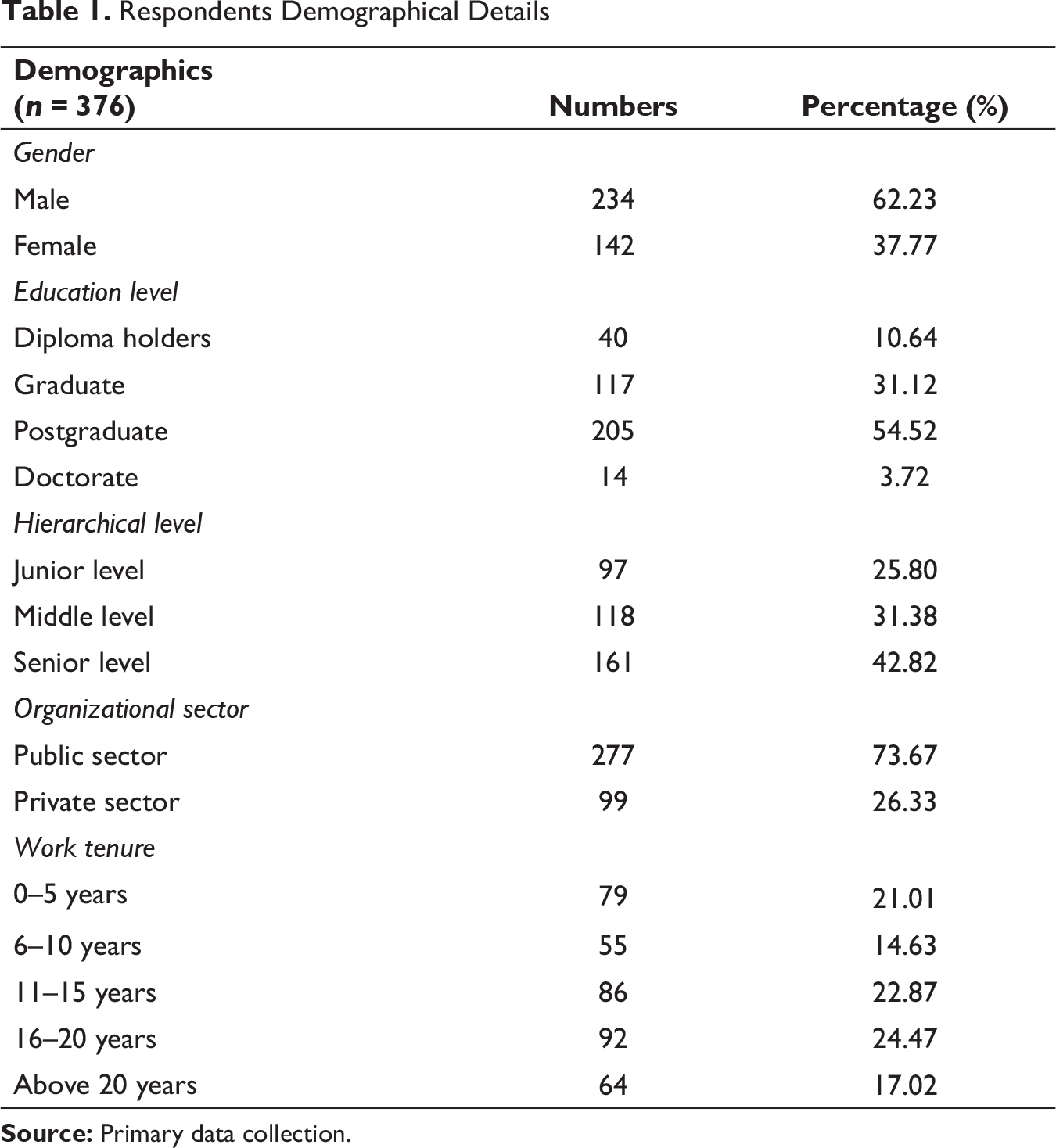
Participants and Procedure
Respondents Demographical Details
Measures
Forgiveness
To measure forgiveness, an adapted version of the Heartland Forgiveness Scale, validated by Dahiya and Rangnekar (2018b) in the context of Indian organizations, was employed, which consisted of 18 items with 3 dimensions, namely FOS, FOO and FOST. Some of the sample items for FOS, FOO and FOST were: “With time, I am developing an understanding of myself for mistakes I have made at work”, “If my colleagues mistreat me, I don’t continue to think badly of them” (reverse worded), “If I am disappointed by uncontrollable circumstances at work, I don’t continue to think negatively about them” (reverse worded), respectively. To maintain the uniformity in scoring and to qualify for higher understanding of items by the respondents, few items of forgiveness were reverse worded, for example, item number 11 and 15 (Dahiya & Rangnekar, 2018b). The responses were taken on a seven-point Likert scale, ranging from one (“almost always false of me”) to seven (“almost always true of me”). The higher the score, the higher the level of forgiveness. Cronbach’s alpha (CA) was 0.889, which indicated internal consistency of the scale.
Negative Affect
In order to measure affect, participants were asked to respond to Positive and Negative Affect Schedule (PANAS) developed by Watson et al. (1988) and validated in Indian manufacturing organizations by Dahiya and Rangnekar (2019b). The measure has two dimensions, namely positive affect and NA. The responses were taken on a seven-point Likert scale, where one indicated “strongly disagree” and seven indicated “strongly agree”. Two of the sample items for NA were: “I feel guilty at work” and “I feel distressed at work”. Similarly, two sample items for positive affect were: “I feel interested at work” and “I feel alert at work”. Researchers have reported that both the dimensions of PANAS are related to each other (Dahiya & Rangnekar, 2019b; Watsson et al., 1988) and positive affect has a high likelihood of affecting this relationship (forgiveness and NA), hence, statistically controlled for analysis. A higher score means a higher level of NA in the respondents. CA in the present study for NA was 0.754, and for positive affect was 0.813.
Age
According to socio-emotional selectivity theory, the subjective importance of well-being increases as a function of reduced future perspective. In the present study, chronological age was used as an age measure for three reasons (Sterns & Doverspike, 1989). First, among the different concepts of age, chronological age is the best indicator of future perspective. Second, it is closely associated with other concepts of age (Kooij, de Lange, Jansen, & Dikkers, 2008). Third, in human resource policies, among the various concepts of age, chronological age is predominantly used. The minimum age of the respondents in the targeted organizations was 21 years and the maximum was 65 years.
Results
Reliability and Validity
Results of Exploratory Factor Analysis, Reliability and Convergent Validity
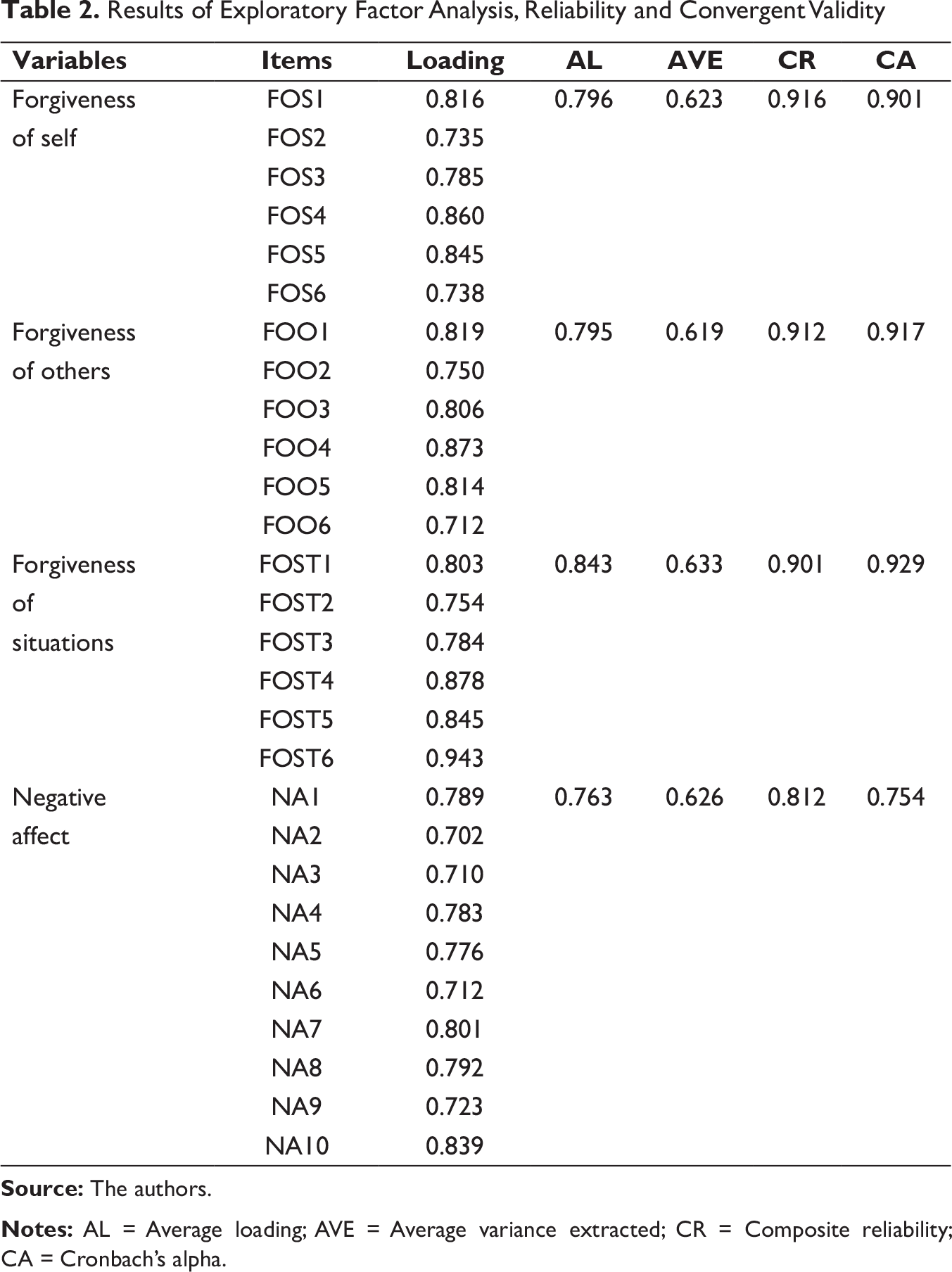
After exploring the factor structure, confirmatory factor analysis (CFA) was performed to evaluate the validity of the factors under study using AMOS (version 24.00) and taking the maximum likelihood approach. The composite reliability (CR) (FOS = 0.916; FOO = 0.912; FOST = 0.901; NA = 0.812) and the average variance extracted (AVE) (FOS = 0.623; FOO = 0.619; FOST = 0.633; NA = 0.626) from the variables under study were greater than the threshold value of 0.70 and 0.50, respectively, indicating good convergent validity (Fornell & Larcker, 1981). The discriminant validity of the scales was examined by comparing MSV and ASV with AVE. The factors under study fulfilled the criteria of discriminant validity recommended by Hair, Black, Babin, and Anderson (2010), as values of MSV and ASV were lower than the values of AVE. Also, the root of AVE was more than the corresponding correlation coefficient, ensuring discriminant validity (Fornell & Larcker, 1981). The results of both the methods were, therefore, satisfactory to ensure the discriminant validity (the values which are in bold and presented diagonally in Table 3) of the factors under study. Thus, validity analysis indicated that, in the Indian context and work settings, the scales were valid and ready for further analysis. Moreover, the values of CA and CR were found to be above 0.70, indicating good reliability of the adapted version of the scales. Also, factors of forgiveness were negatively correlated with NA, providing significant preliminary support for the relationship.
Measurement model fit was evaluated and the results revealed that all fit indices [χ²/degrees of freedom (χ²/df) = 1.89, goodness of fit index (GFI) = 0.89, comparative fit index (CFI) = 0.96, normed fit index (NFI) = 0.92, non-normed fit index (NNFI) = 0.93, root mean square of approximation (RMSEA) = 0.06] were above the minimum recommended values, that is, χ²/df < 3, GFI ≥ 0.80, CFI ≥ 0.90, NFI ≥ 0.90, NNFI ≥ 0.90, RMSEA ≤ 0.08 (Bentler & Bonett, 1980).
Hypotheses Testing
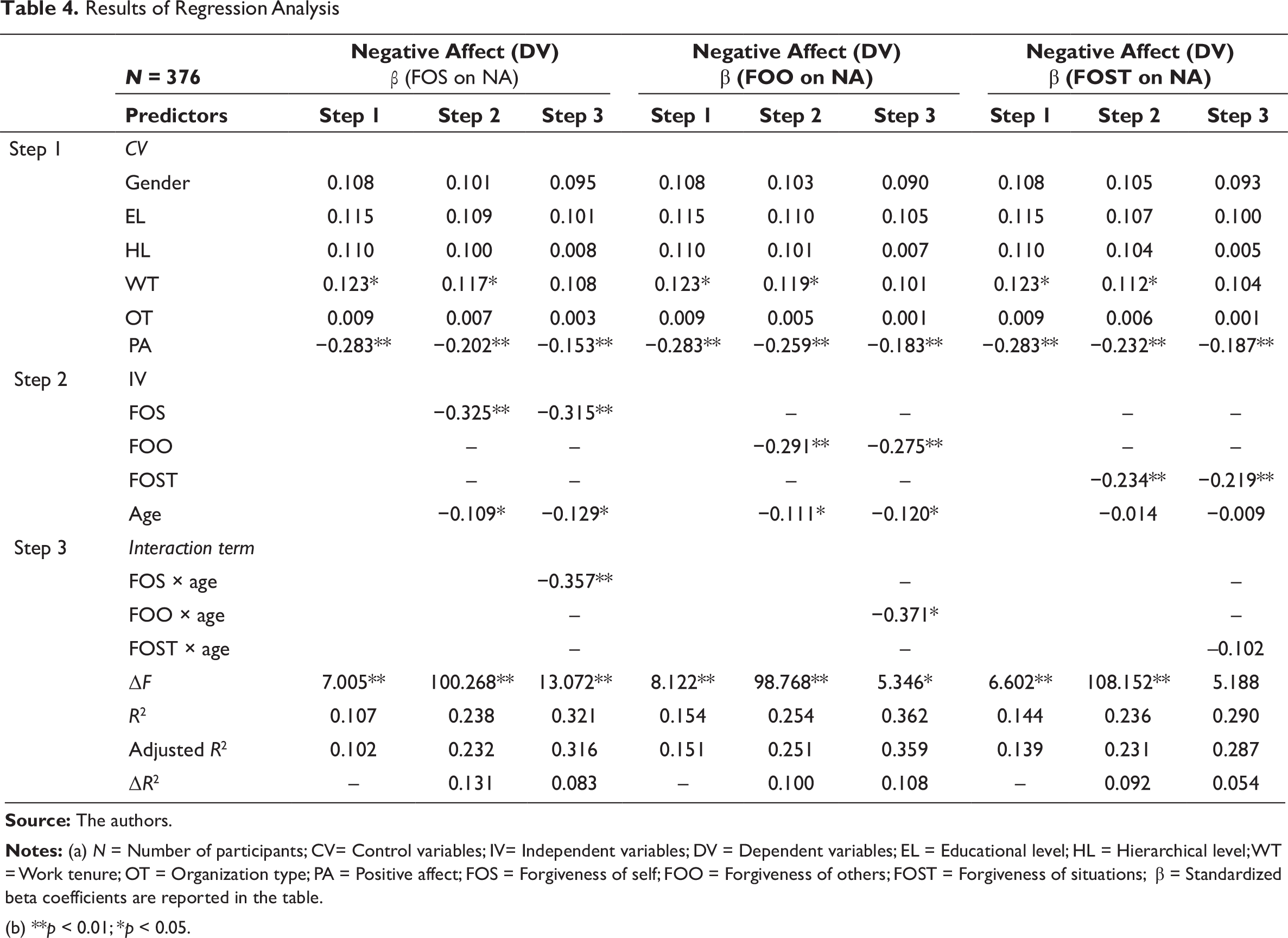
Regression analysis was performed to test the hypotheses and a step-wise procedure was followed, as recommended by Baron and Kenny (1986). In the first step, control variables (gender, educational level, hierarchical level, organizational sector, work tenure and positive affect) were entered. In the second step, predictor variables (FOS, others, situations and age) were entered and it was checked whether they were significant or not for the dependent variable (NA). Before testing the moderating effect of age on the relationship between indicators of forgiveness and NA (for H4), interaction terms were created as suggested by Aiken and West (1991). Therefore, predictor variables (FOS, others and situations) and moderator variable (employee age) were mean centred. Finally, in Step 3, interaction terms were entered, namely FOS × age, FOO × age and FOST × age. Thus, three separate regressions (for each dimension of forgiveness on NA) were conducted.
Results of Discriminant Validity

(b) *Correlation is significant at the 0.05 level.
(c) **Correlation is significant at the 0.01 level.
(d) Discriminant validity of variables are presented in parentheses in bold.
Results of Regression Analysis
(b) **p < 0.01; *p < 0.05.
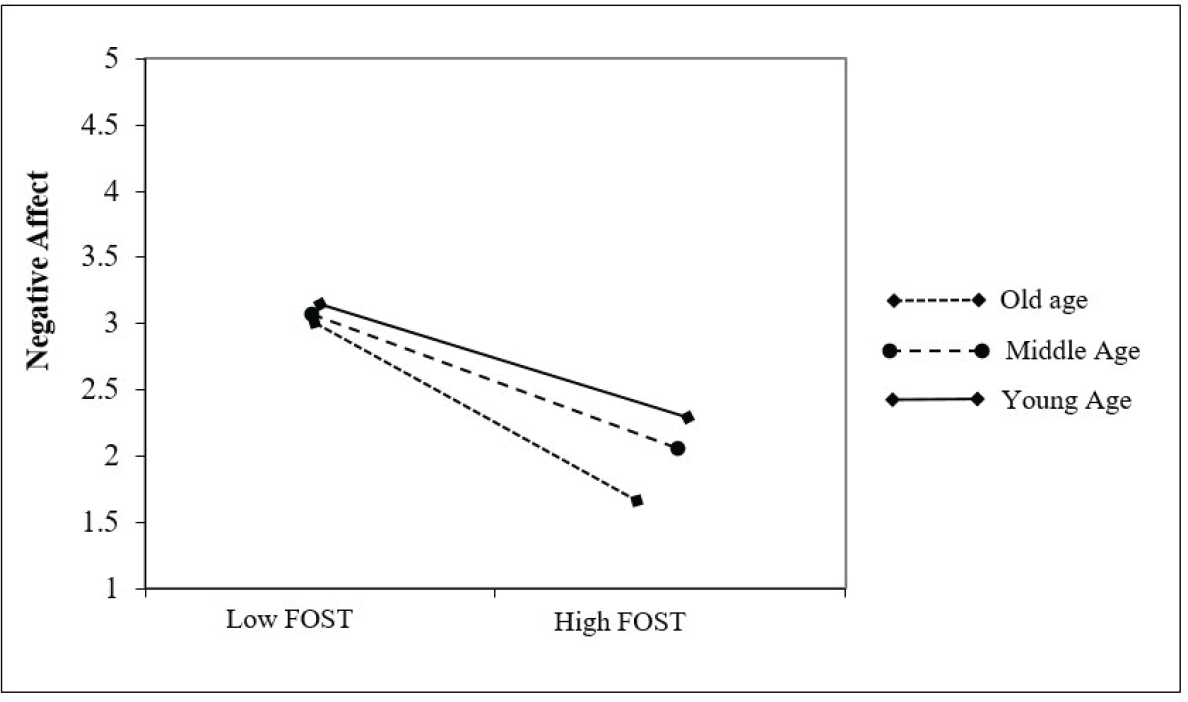
To examine the moderating role of age on the relationship between FOS and NA, the first interaction term (FOS × age) was entered, which was found to be significantly predicting NA in Indian employees (β = −0.357, ΔR2 = 0.083, p < 0.01) with a variance of 32.1 per cent. The second interaction term examining FOO × age was also found to be significantly predicting lower NA of Indian employees (β = −0.371, ΔR2 = 0.108, p < 0.01) with a variance of 36.2 per cent. These results provide empirical evidence that the interaction terms (FOS × age and FOO × age) are significantly related with NA of employees. However, the third interaction term (Figure 3) evaluating FOST × age was found to be non-significant (β = −0.102, ΔR2 = 0.054, p > 0.05). Hence, we partially accepted H4, which concludes that age moderates the relationship between forgiveness (self and others) and NA.
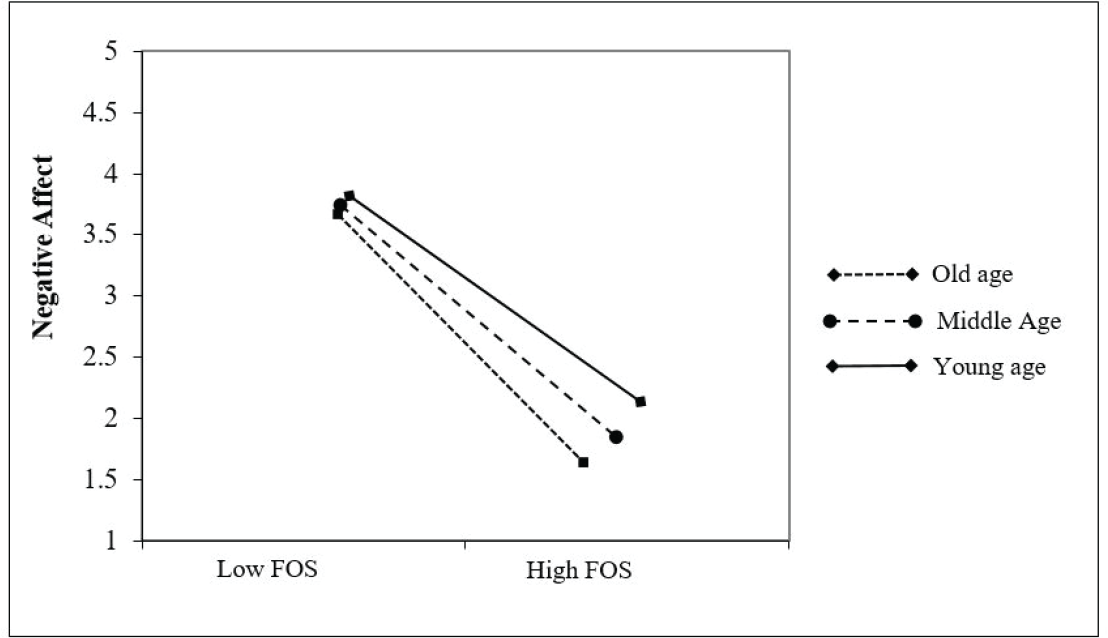
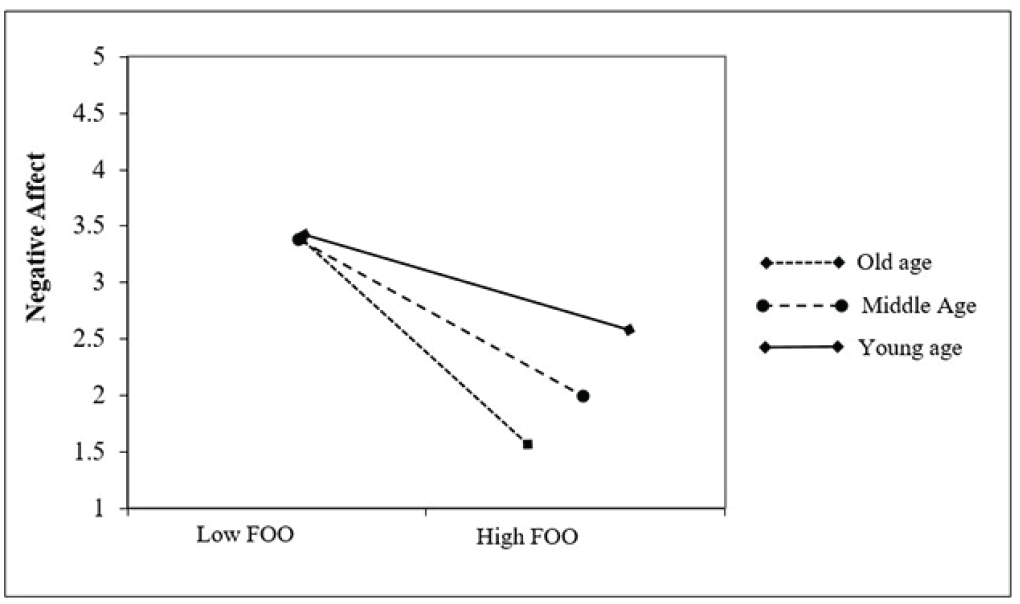
Additionally, following the procedure recommended by Aiken and West (1991) and using unstandardized regression coefficients, three plots were obtained with the help of prediction of criterion variable at low and high levels of forgiveness (self and others; ±1 standard deviation of mean; McClelland & Judd, 1993). From Figure 1, it is clear that relationship between FOS and NA are significant for young and old age employees, although it is stronger for old-aged employees at the high level of forgiveness in comparison to their younger counterparts. Furthermore, pair-wise slope difference test confirmed that the relationship between FOS and NA is significant for the young ones versus the old ones (t value for slope difference = −2.387, p < 0.05).
Figure 2 depicts the relationship between FOO and NA. The pair-wise slope difference test confirmed that the relationship between FOO and NA is significant for the young ones versus the old ones (t value for slope difference = −2.345, p < 0.05). Thus, H4 was corroborated with the empirical evidence that age moderates the relationship between forgiveness (self, others and situations) and NA in such a way that the relationship becomes stronger for older employees than the younger ones.
Discussion, Implications and Conclusions
The present study focuses on examining the relationship between FOS, others, situations and NA along with the moderating effect of age. To the best of our knowledge, this is the first ever study within the organizational psychology literature that has examined the moderating role of age in the relationship between forgiveness and NA. Although FOS has been considered intentional, the results of present study prove that FOS has a significant negative relationship with the NA of employees (e.g., feeling guilty, afraid, hatred, nervousness, sadness, irritability, scared, ashamed, upset and hostile), which is in concordance with previous studies (Chan, 2013; Hall & Fincham, 2005; Thompson et al., 2005). The results also suggest that employees with high level of FOS experience lower NA, as FOS provides them with an internal stability, linear thinking by learning from mistakes and helps them in letting go of resentments, which is also in alignment with the stress and coping model of self-forgiveness, as propounded by Toussaint et al. (2017). Thus, forgiving oneself acts as a guard against NA in employees and predicts lower NA.
Results of H2 indicate that interpersonal forgiveness/FOO significantly predicts lower NA in employees, which is consistent with previous studies (Akhtar et al., 2017; Allemand et al., 2013; Green et al., 2012). McCullough, Bono, and Root (2007) suggest that people who forgive others are less likely to engage in rumination and contributes to mental health and well-being. The present study also suggests that a safe and non-vindictive release of bitterness and annoyance for a colleague heals emotional wounds and supports one to reinstate relationships. Consequently, forgiveness offers a path for employees to manage negative emotions, which are the consequences of transgressions amongst employees, in such a way that it can empower and help them in successful functioning at work.
H3 asserts that FOST significantly predicts lower NA in employees. Drawing upon reinforcement sensitivity theory (Gray, 1987, 1991), and consistent with the findings of a study conducted by Thompson et al. (2005), the results of the present study evince that FOST predicts lower NA. Employees have to face unpleasant and uncontrollable negative situations at work where neither the self nor others are the sources of transgression and by forgiving these situations, they ultimately get away from NA. Although we found little support for the results of this hypothesis, probably because this dimension is relatively new in forgiveness research, they are sizeable enough to warrant attention.
H4 asserts that the relationship between forgiveness (self and others) and NA is moderated by age, whereas it does not in case of FOSTs and NA. As expected, the tendency to forgive increases with aging, and such an increase has been observed in the present study through substantial predictive values. According to Hamachek (1990), if an individual successfully resolves conflicts related to self and others, he/she is able to forgive. The same observation has been made in the present study and it is found that interaction terms (FOS × age and FOO × age) significantly predict lower NA. In order to maintain relationship at work, employees tend to forgive others. Moreover, as they grow old, people show a propensity to become more benign towards offenders and a tendency to forgive, which consequently diminishes their negative emotions, behaviours and thoughts.
The findings also reveal that the interaction term of FOST and age has a non-significant influence on NA. This implies that FOSTs that are uncontrollable at work such as layoffs, downsizing and loss are not under the control of employees. Therefore, age does not influence the FOST–NA relationship. Moreover, it can be seen that experienced employees know better and are less forgiving when it comes to situations, because with time they gain an understanding that situations are aroused by individuals, for instance, problems due to managerial incompetence.
It is emphasized in the present study that organizations should arrange for training sessions to promote workplace forgiveness with particular attention to young employees in order to guide them about the critical strengths of a forgiving culture and unwelcome consequences of NA at work. Moreover, organizational psychologists and HR counsellors may also develop psychological tests and use theme-based interventions to foster intrapersonal and interpersonal development of forgiveness at work. In turn, this could help individuals to utilize the forgiveness process in efforts to improve their overall well-being. In addition, by introducing the study of forgiveness among South Asians, clinicians will be better able to understand and utilize the process of forgiveness when working with them. Forgiveness research has been often focused on Western notions of forgiveness. However, in the last few years, cultural research into forgiveness has increased, but continues to lag at workplace. South Asians, as they prefer keeping private matters private, and due to a lack of culturally trained professionals, are the least likely to seek outside help (e.g., counsellors) for distress. However, by demonstrating competency in understanding forgiveness from a cross-cultural perspectives, clinicians can begin to educate and advocate for forgiveness not only in therapy but also in early intervention programmes.
However, it is emphasized that, although not a noticeable trend yet, fostering forgiveness at work helps in curbing NA in the employees. Therefore, implementing forgiveness dimensions may be a good substitute for stress management at work. Substantial implications are offered in this study to help organizations for building a happy and satisfied workforce. In addition, human resource professionals and organizational development practitioners should bear in mind that an employee’s NA may have adverse outcomes such as absenteeism, increased labour turnover and workplace deviance. It is also advocated that forgiveness (self, others and situations) predicts lower NA and encourages a positive work environment, which may also result in extra-role performance behaviour that ultimately contributes to organizational success.
Limitations and Future Research Directions
The findings of the present study should be considered in light of some limitations. First, our analysis is based on cross-sectional data. Thus, we could not examine the reciprocal effect or directionality (causal inference) of the relationship of variables such as employees having NA are less likely to forgive. In future, longitudinal studies may be carried out so that causal inference can be drawn. Second, the sample of the present study is limited to the manufacturing sector of India, and, in future, other sectors with cross-cultural comparison may be included for the generalizability of the findings of this study. Moreover, future studies can measure forgiveness along with cultural dimensions, which would help in explaining different thresholds within national cultures for tolerating certain types of behaviours (e.g., bullying and sexist behaviours). Third, we have not included intensity and frequency of transgressions at work in our study. Future research may include these variables along with exposure and reaction to transgression, as they relate to forgiveness and would provide a more in-depth understanding of the relationship between forgiveness and NA from the perspective of stress and coping theory of forgiveness (Worthington, 2006). Fourth, we have used self-report measures only. As suggested by Crede and Harms (2019), other data collection methods such as diary data and observer reports can be applied to avoid CMB. Also, future researchers may develop new alternative models of forgiveness based upon future methodological or theoretical insights. Last, more significant the demographic difference between the employees, higher is the impact on an employee’s attitude and behaviour. It is not the direction but the amount of demographic difference that is critical to an organization. Thus, future studies may include other demographic variables (gender, work tenure, status or rank of employees, education, income and so on) to study the relationship between forgiveness at work and NA.
Footnotes
Declaration of Conflicting Interest
The authors declared the following potential conflicts of interest with respect to the research, authorship and/or publication of this article: The authors declare that they have no conflict of interest.
Informed Consent
Informed consent was obtained from all individual participants included in the study.
Funding
The authors disclosed receipt of the following financial support for the research, authorship and/or publication of this article: This research received no grant from any funding agency in the public, commercial, or not-for-profit sectors.