



Abstract
Abstract
This article examines the benefits of applying gamification in the recruitment process. It highlights how it can be effectively leveraged with the right design by involving various stakeholders at varied stages. The Actor Network Theory (ANT) as a theoretical ground has been used as a reference point to take a more detailed look at the ways in which gamification can be effectively deployed for recruitment by organizations. We refer to ANT and the interaction between the human and non-human elements, here, the applicants, the other stakeholders, and the gamification tools, to serve the greater organizational purpose. Questions that interrogate between rules and practices arise, viz. can the game be effectively customized to achieve sophisticated and enhanced selection outcomes. By applying gamification as the reference point within the Actor Network Theory, their associated potential for further research and applications is achieved. A valuable perspective in gaining insights for further understanding of this theory in today’s technologically progressive environment has also been discussed for further reflection.
Introduction and Background
The rapidly transforming workforce dynamics coupled with digitisation and shifting job preferences necessitate continuous evolvement of systems and processes. In an era of fast-changing technology and multi-generational talent pool, it is an intense battle for the best and the brightest. The pressing need for companies to attract talent makes a compelling case to adopt innovative recruitment methods, such as gamification.
Several researchers have highlighted the important facets associated with recruitment. For instance, they have focussed on the process as it begins with an effort towards attracting applicants for the vacant positions (Rynes, 1991), their impression formation about the organisation (Breaugh, 2013), and their attitude towards any organisation being impacted by the way information is disseminated to them (Chow, 2014). The process of identifying the most suitable ones at each stage could be a complex exercise that comes with the need to be creative and inventive along with ensuring that one gets the desired results within the least turnaround time.
Recruitment and Gamification
With the advancements in technology and changing demographics, gamification has presented new possibilities for recruitment in terms of becoming more interactive. Utilising innovative tools like gamification can help competitors to attract candidates in addition to traditional modes of recruitment. Interweaving work and play is expected to yield greater engagement (DeWinter, Kocurek, & Nichols, 2014) and creativity (Kumar & Raghavendran, 2015). Gamification could help in employer branding and increasing prospective applicants’ interest in the job (Woźniak, 2015).
The term gamification was coined in the early twenty-first century (Marczewski, 2013). It is the use of game design techniques, game mechanics and game thinking with the aim of enhancing non-game contexts and is applied to non-game applications and processes to encourage people to adopt them or to influence how they are used (Deterding, Dixon, Khaled, & Nacke, 2011).
In the context of recruiting, gamification can be a persuasion tool too (Chapman & Jones, 2002) to not only attract a pool of potential employees but also influence candidates’ attitudes and perceptions about an organisation. Such design in sync with the recruitment objectives could ensure greater engagement and attention towards desired “organizational information,” thereby “influencing their states of decisive attention” (Chow & Chapman, 2013). The principle of gamification works on one of the most basic psychologies of human mind, that is, it thrives on the spirit of competition that can foster the best out of people. Robson, Plangger, Kietzmann, McCarthy, and Pitt (2015) connected the main drivers of gamification to the factors that propelled motivation in human beings in terms of extrinsic and intrinsic reinforcements and emotions. They also stated that such elements reinforced the desired behaviour amongst the players due to competition involved in reaching the solutions. A gaming environment has the potential to motivate the actions of players or could trigger desirable changes in their behaviour.
Gamification has the potential to convert the entire process or at least a part of it into bite sized manageable steps for engaging the applicants. The latter are expected to cross various stages, as they would in a game scenario, by earning points or rewards at each stage. Another noteworthy focus can be endorsement of equal opportunities during recruitment by keeping the spotlight solely on performance rather than on other factors like “race, experience, or education” (Negrusa et al., 2015). The assumption is that immediate gratification is more than satisfying in such cases for the participants. It is in this background that the article posits that gamification can offer a creative and effective platform not only for the applicants but also for the recruiters and the organisation.
Overview of Gamification
The employment of games in the field of training and development has an established past. Plato recommended that games be used for the education and honing of skills in children of The Republic (as mentioned in Pornel, 2014). In 1955, Huizinga further chronicled the fundamental role of “play” as being highly instrumental in the development of many aspects of culture such as war, literature, philosophy, law and art. He explained how all the seemingly light-hearted games that are taught to, and played by, the children of today have also helped to socialise succeeding generations into the long list of accepted cultural norms like following rules, taking turns, healthy competition, working together in groups and any other constitutive and implicit rules that are deemed valuable by society (Chen & Duh, 2007).
Xu, Weber, and Buhalis (2013) defined gamification thus: it is “not all about giving out badges and points to incentivise behaviour, but needs to apply game thinking to encourage and motivate for further activities” (pp. 534). Gamification is the process of taking already existing resources such as an enterprise application, a site on the internet or an online community and then integrating a few gaming mechanics into it. This is usually done to help increase participation, engagement and loyalty. It adopts the complex data-driven techniques that are used by game designers to engage players, and by applying the same techniques to various non-game situations, it tries to motivate actions and add value to business.
The application of gamification can be seen in various contexts of business and management, such as encouraging customer loyalty, employee engagement, training and development (Negruşa, Toader, Sofică, Tutunea, & Rus, 2015). It benefits not only internal processes and employees but can also be deployed for other functions such as for creating brand awareness or for promoting new technologies, research & innovation, vendor engagement and supply chain solutions (Froehlich, 2015). In the area of human resource (HR) management, some organisations use it for recruitment as well as for training and for modifying the behaviour and practices of employees to achieve organisational goals (DeWinter et al., 2014).
Gamification is not merely playing for fun; it can offer a chance to have serious fun for business if backed by a design in sync with the recruiting objective. The success of gamification is relative to a subjective understanding of the quality of its initiative, which can usually be judged by the user experience and the degree to which the outcomes of the gamified processes match the intended goals.
Talent development, for instance, post recruitment and selection, involves the use of gamification processes. This is illustrated through the nuanced theoretical accounts of how a variety of shifting and competing developmental and learning opportunities are portrayed as a variant of “double-consciousness” by the highly potential organisational talent in order to “win the selection game” (Dery, Tansley, & Hafermalz, 2014a). Gamification has helped to significantly convert the frustrating and mind-numbing task of recruitment into a more fun and evolved element. It has helped employers and recruiters to spark interest in multiple qualified candidates about the job openings available in their companies. The popularity of gamification plays to the highly competitive nature that is always present in most people within or outside an organisation.
Gamification in Recruitment
The fundamental task of any recruiter is attracting a pool of qualified applicants. In most circumstances, when gamification is applied to the recruitment process, it brings forth many benefits. The elimination process of unfit candidates is much faster in the initial stages as companies can test specific skills and aptitudes like time management, creativity and innovative thinking before making a hiring decision. Hence, speeding up the recruitment process along with generation of interest in the process could be considered as the pros associated with gamification.
The game elements often indicate that the players involved in a game could become highly keen and competitive as they would want to achieve maximum rewards and advance fast to the next level. The incorporation of gamification and its principles into a company’s recruitment process could ensure that organisations are able to attract and engage applicants on a wider scale in addition to the other modes of recruitment. The HR department can also use this understanding to evaluate the skills and abilities of the said pool. This enables the company to pick only the best who have already proven their fitness and value within the organisation which inevitably translates into a unified workforce. The entry of Gen Y & Z candidates into the job market, coupled with their increased interest in technology, increases the likelihood of gamification becoming a successful strategy for recruitment (Oprescu, Jones, & Katsikitis, 2014). Their active presence on social media platforms further helps the case.
It is necessary to learn how to identify, hone and engineer the multiplicity of sophisticated recruitment processes through the aid of technology, such as gamification. Many organisations in their bid to stay updated with the latest are increasingly integrating gamification in their recruitment processes. Google, Formapost, Dominos and Umbel are some of the companies using it (White, 2015). The idea is simply to personalise the process and also to make it engaging. It makes measurement and evaluation of prospective hires’ cognitive and analytical capabilities easier in a simulated environment. Virtual games can provide an impetus to the competitive spirit of the prospective candidates which can be used very effectively to attract and assess potential employees, especially those candidates that are products of the new generation (Deterding et al., 2011).
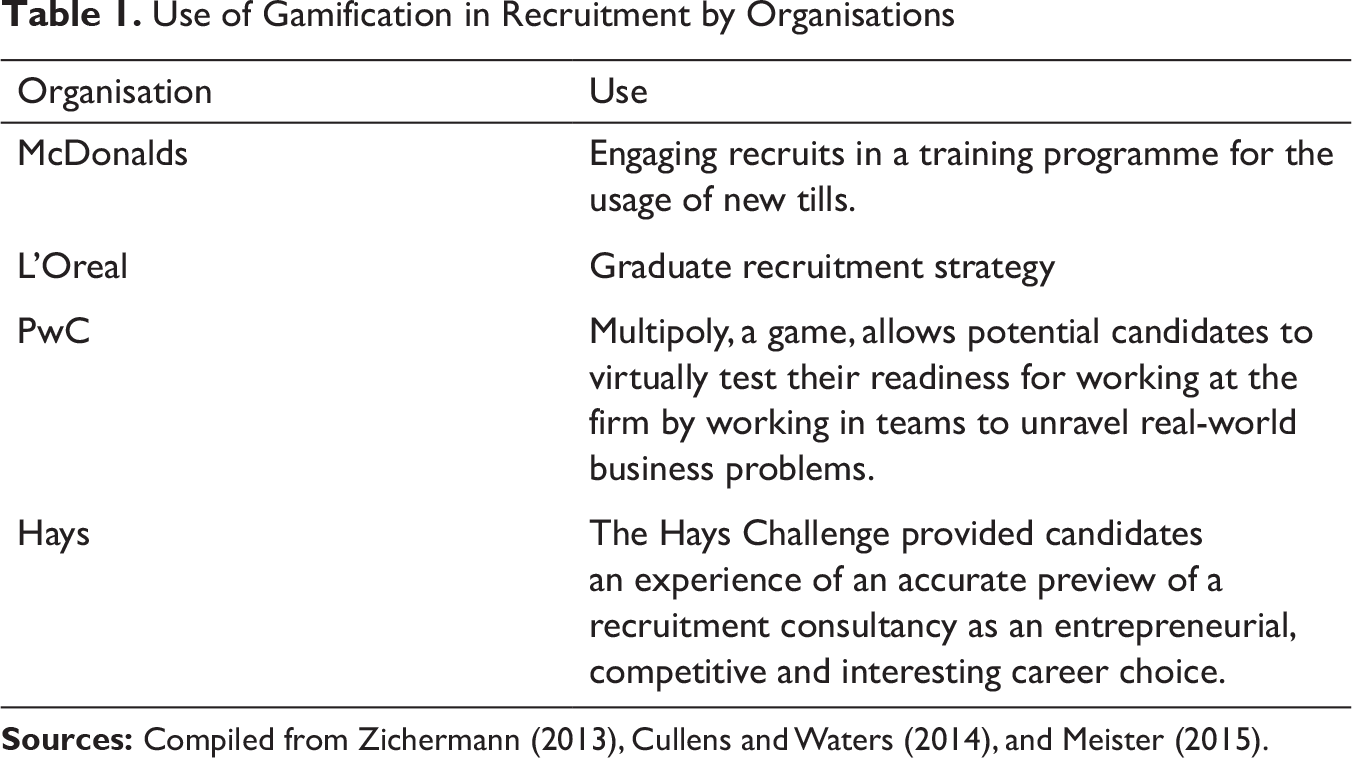
The automated systems can be used to reward candidates or the actors with points and badges at each stage of the process and provide a boost to the participants by pitching them versus the best and outdoing each other. The results are instant in the form of scores or leader boards. Recruiters can filter out the top performers through the multi-stage gaming process which can considerably bring down the time and effort involved in recruitment. There are some other successful examples (Table 1) of use of gamification in the arena of recruitment and training, which have received international attention for their innovation and the potential prospects they provide to recruiters on the lookout for a representative and strategic advantage, particularly in the competitive graduate recruitment market.
Use of Gamification in Recruitment by Organisations
Motivational Affordances, Psychological Outcomes and Behavioral Outcomes in Gamification of Recruitment Process

During this process, organisations may use multiple choice questions and case studies embedded in gamified settings to capture the level of cognitive and affective domains of the users. A case study of the graduate-level recruitment processes followed in a global professional services firm had the various applicants work together in groups and create innovative ways to understand the criteria for getting success in the job. It heavily employed the use of social media for working together (as mentioned in Dery, Tansley, & Hafermalz, 2014b).
Designing Gamification in Recruitment
Recruitainment is a hybrid word that combines recruitment and entertainment. When used with recruitment, Gamification is often termed as recruitainment. (as cited in Korn, Brenner, Börsig, Lalli, Mattmüller, & Müller, 2017). One of the key skills required in a HR manager today is the ability to attract talent in the organisation. High performance organisations have the following characteristics, as supported by numerous studies, like high level of team work, candidness between peers, opportunities for growth and development and proactive HR processes (Hiltrop, 1999) Organisations need a steady pipeline of talent to drive their growth. The task becomes more difficult with the increase in talent mobility. Employees can readily switch organisations for better roles and incentives.
Organisations may benefit by implementing and/or emphasising non-financial rewards as part of a total rewards package when they attempt to attract or recruit potential employees (Schlechter, Thompson, & Bussin, 2015). An attractive policy is key to winning the global talent war and determining the future development path (Harvey, 2014). Recruitment makes the path for a selection process which in turn affects the other processes. A gamified recruitment process has the potential to sift the fun loving, risk taking, tech savvy applicants from the traditional ones. Hence, if there must be gamification of recruitment, the design must be in sync with the overall objective.
There must be several rounds of discussion before finalising and implementing exact gamified settings for the recruitment process. The steps are as follows.
Internal Discussion I
between the line managers, HR professionals and the IT team of the organisation with respect to overall goals and objectives and the associated expectations from gamification; identification of stages of recruitment process for implementation of gamification through research, internal and external benchmarking and by taking into account the types of desired applicants expected to apply. Internal Discussion II
including existing employees’ feedback and/or suggestions finalisation of recruiting elements/activities to be included in gamification External Discussion I
between employer and vendors with respect to clearly laying down the expectations associated with gamification of recruitment. pilot testing the gamified setting on existing employees by keeping in mind the similarity with the prospective applicants in demographics. reworking on the design on the basis of feedback from the existing employees finalising the vendor External Discussion II
Between the employer and the applicants through feedback from the latter Between the employer and the vendor on the basis of the above Between the vendor and the modders for further changes in the elements and/or the design
It is important that there are wide-ranging solutions developed with an understanding of the expectations of young prospective applicants entering the job market. With these considerations, a participatory approach is recommended for designing gamified settings which are engaging and helpful (Nacke & Deterding, 2017). To make it happen, there must be involvement of organisation as well as the vendor and the applicants (through their feedback). Modders can be engaged in developing as well as improving the game intervention. It will help in reducing the cost associated with it and will ensure updated and relevant gamified setting. This cannot happen without inputs from recruiters and game designers (Kücklich, 2005).
Such solutions with their offerings must meet the employers’ expectations as well as the technical necessities of new recruitment and selection methods (Krasulak, 2015). Conway (2014) advocated for a balanced application of gamification by taking into account the organisation-centred design as opposed to only user-centred design. Landers (2019) called the application of game elements like points, badges and leaderboards, without focus on design and development as fake gamification. He distinguished between a fake and real gamification by the element of research that backs any gamified process.
Not all activities associated with recruitment can be gamified, and little is known about the actual effect of types of players and the effectiveness of designing with those types in mind (Nacke & Deterding, 2017). There must be a legitimate reason to include gamification when the game elements are added to the existing systems and processes. The design process must involve developing such game interventions which appeal to recruiters and participant alike. Data acts as proof. A Forbes article (Meister, 2015) reported that when the firm Pricewaterhouse Coopers (Hungary) launched a cloud-based game called Multipoly that was designed to present the users with various activities based on the firm’s competency framework for the current employees, the recruitment manager noticed that the candidates who had engaged with this game were not only “better prepared” for the interviews as they had got some idea about the company, but also found onboarding easier due to some exposure to its culture through the game. There was a 190 per cent growth in applicants as a result of this initiative, out of which 78 per cent expressed keenness “to learn more about working at PwC.”
It is critical to examine the gamification process currently used for recruitment and important aspects for attracting applicants to the organisation before one can arrive at recommendations for customising the gamification process for even more sophisticated and improvised selection of talent. Hence, to understand gamification in the context of recruitment, the Actor Network Theory (ANT) helps explore the effectiveness of applicants engaging both with the game technology and virtually with each other in some cases.
The Actor Network Theory (ANT) and Gamification of Recruitment
The ANT has many interpretations. The following figure summarises its essence based on the work of Tummons, Fournier, Kits, and MacLeod (2018). ANT is about network formation and how projects are achieved and completed within “networks of associations or links.” The focus here is on the linking of people and objects and the subsequent accomplishment of objectives as a result of this. The networks/associations are influencers across time and boundaries and the success or failure of something would depend on both people and objects involved in it. This works on the principle of symmetry which means that both the human and non-human elements are considered equal for performance of a project. There is no question of bifurcating people and objects. The end results are achieved through a successful coordination of the participants and the way each process or participant in the process influences the overall scheme of things—individual or collective.
Gamification involves the marriage of people, ideas and technology which play a crucial role in facilitating this process. The concept of sociomateriality, in this context, is based upon the juncture of work and organisation and technology. It helps to understand the predicament of both the social and the material. Dery, Tansley, and Hafermalz (2014a) considered sociomateriality akin to being actors and the technological artefacts and stated the instrumental role these could play through narratives and other media for gamifying the recruitment process.

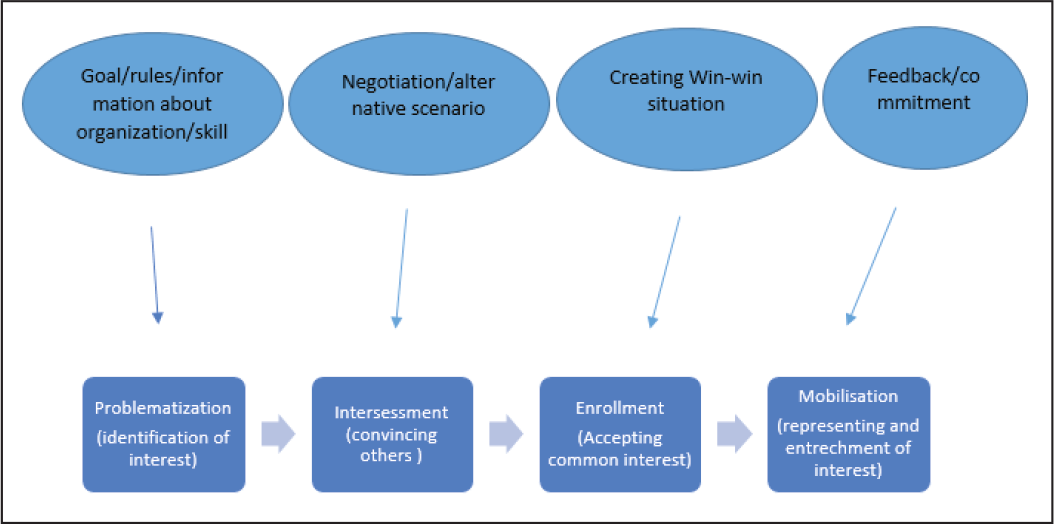
ANT helps in understanding the relationships between non-humans and humans through formation of networks. The theory becomes useful here to understand the process and how networks form and reform as they try to make sense of the gamified process and how to succeed in it. ANT is an approach to social theory and research which treats objects as part of social networks. Actors, both human and non-human, in a network take the shape by virtue of their relations with one another (Dery et al., 2014a). ANT states that the world is full of hybrid or fusion entities (Latour, 1996). Callon (1999) stated that ANT could be helpful in analysing situations involving an interaction of human and non-human elements. In this research, actors are the prospective applicants for recruitment, and non-human actors are the gamification tools used. While the participants/applicants try to decipher the recruitment process through gamified steps, there is also a scope to compete and cooperate at the same time, especially in group exercises. This provides them with a chance to showcase themselves in a more favourable position in the journey towards moving closer to the coveted job. Users get intrinsically motivated by seeing points, badges and leaderboards. It acts as informational feedback mechanism, giving them idea about their progress in the game. The following conceptual framework (Figure 2) depicts the various stages of ANT and the way each relates to a gamified recruitment process/step.
According to Callon (1984), ANT has four stages, sometimes known as Translation, for network formation, that is, problematisation, interessement, enrolment and mobilisation. The initial stage is where the nature of the problem is not clear to the participants and can be defined in a particular state by an actor (a group or an individual). Here, there is an element of dependency that is established because of this. Thereafter, discussions could be centred on process and shared solutions and understandings.
Ezzamel (1994) explained problematisation as the efforts undertaken by actors to convince others to buy in their mode of thinking by showing they have the right solution. In this case, the actors endeavour to impose their version of problems on others (Carrington & Johed, 2007). Post this, discussions could be centred on process and shared solutions and understandings. At the Interessement stage, the lead actors focus on consolidating the strength of link creation between various points and forms of interests (Lowe, 2004). They could be more interested in finding solutions together if the rules of the gamified setting state so. Network formation at Enrolment stage leads to creation of alliances with an effort to build consensus among the various actors regarding their interests and how those interests could be aligned with the primary actor (Alcouffe, Berland, & Levant, 2008). Applicants could form virtual groups, if the task demands it, and assign roles amongst themselves in order to reach at a solution quickly.
As the gamification stages during recruitment processes advance in complexity, there are increased chances of development of networks amongst the candidates. At the stage of mobilisation, the various interests are monitored for ensuring their stability (Mouritsen, Larsen, & Bukh, 2001). In true sense, networks are framed by the initiator of network, that is, organisation conducting selection process by means of gamification to get the applicants together for purpose of engaging with the problem. Its main purpose is to facilitate exchange of knowledge about the recruitment and selection process and organisation on a broader level. However, as the participants progress further, they realise that additional knowledge is critical to succeed. Therefore, they interact with each other in order to decipher their interpretation of the implicit rules of the game. Actors (the applicants) seek clarification and support from each other. In this stage, organiations can share their goals, rules, norms, as well as skills required to perform the job with candidates; similar information should also be shared by the applicants in terms of their individual goals, aspiration and competency.
In the next stage, by using gamification, both the parties can negotiate with each other. Here, alternative scenario also can be provided to see the various outcomes and reaction of each other. The process should enable the organisation to judge the skill set of candidates, their personality and potential of the candidates. The third stage would be arrival at one common point where both the parties see benefits in joining the network. Organisations should see that candidates exhibit the ability to work in group, have detailed information about the organisation and desire to win in any situation. In the last stage, both parties are expected to share their views about the process which will help the organisation in strengthening the process in future. In this stage, commitment to remain in the relationship should be visible. They should be in a position to see the long-term benefits of remaining in the network.
The following table depicts the various “human” and “non-human” actors in the whole process at each stage:
Human and Non-human Actors at Various Stages

The next stage of Interessement would address the question how to move forward through negotiation. It involves convincing others by providing alternative scenario, if required. Here, the human actors would involve vendors and negotiating manager who would utilise the non-human actors like various prototypes and feedback for arriving at a solution. At the users’ end, the applicants would interact with virtual communities and make sense of the rules of the gamified setting; points, badges and leaderboards and technological settings to proceed further.
The third stage of Enrolment is about reaching a common ground that would involve negotiating a manager for shortlisting a vendor and/or game designer after taking into the consideration the various aspect like total cost, services and the gamified settings being offered. The finalisation of the product is done at this stage for the organisation. At the other end, participants inch towards various stages of gamified recruitment setting through cooperation and formation of networks, if required.
The final stage of Mobilisation would involve representing and entrenchment of various interests of the involved stakeholders. Here, the human actors like vendors and modders take over and work on the feedback received from the applicants as well as the recruiters for improvising the gamified settings for future. The role of organisational internal stakeholders is at the periphery, and they are just expected to oversee the final outcome. At the participants’ end, the final performance is taken in the stride in the light of the non-human actors as feedback, technological settings, steps of the game, points, badges and leaderboards.
The interaction of human and non-human actors at the organisational and users’ end provides a broad gamut of scope for feedback and improvisation of the gamified settings. The key is to update the settings at each stage to cater to the organisational requirements. The changes must be made in sync with the greater goals and objectives.
Discussion
This study raises more questions than answers at this stage but also offers some insights for both practitioners and academics. First, it suggested benefits for practitioners to applying gamification in the recruitment process of talent. At the same time, it also highlighted the warnings associated with “fake” gamification clearly. In the race to keep abreast with the rise in popularity of gamification due to changing demographics within the business environment (Hiltbrand & Burke, 2011), organisations must not ignore the design element backed by research. The article also brought out the fact that due to younger, tech-savvy people looking for novelty in everything, entering the workforce, adoption of gamified settings generates interest. Secondly, the importance of serious dialogue between the various stakeholders involved in the process was detailed in the article. The design element cannot be deemed fit till there is inclusion of all the parties who have knowledge about it.
Technology is as important as the ones implementing it and the purpose for which it is being used. Clarity of communication and feedback at various stages were highlighted as indispensable aspects of a successful execution of the process. Next, ANT as a theoretical ground provided a valuable perspective. Along with gamification, it provided insights for further development of this theory to become more valuable in today’s technologically progressive environment. Furthermore, the identification of human and non-human actors was done at each step of a gamified recruitment process from inception till execution, and from the organisation-centric to the user-centric ends. As the central idea of ANT is formation of networks and associations and the role played by human and non-human actors in this journey to accomplish the objective or the end result, this pinpointed effort to highlight them at each step contributed to the literature. Lastly, in this study, ANT has been used to understand how the psychological angles of cooperation and competition could be understood and leveraged for application of gamification to recruitment, which to the best of researchers’ knowledge is a unique contribution.
Limitations
Gamification works, but there are some caveats. It cannot be the ultimate panacea for all recruitment woes. The results of gamification may be for short term only. Once implemented, removal from the system might affect the engaged players especially those who have more points and badges. Success of the gamification process is also dependent on the context and how users perceive it. All users may not have similar attitude towards the game; some of them may be complacent while others hyper-competitive. It may not be applicable at every stage of recruitment and may demand the contextual requirement to utilise it properly.
Conclusion and Future Directions
Gamification has the potential to add fun element to an otherwise monotonous recruitment process. It could be treated as an add-on to the existing processes for attracting and engaging applicants with the process as well as with the company. For instance, a simulated work environment presented through gamification or including quiz around the company or the industry could be effective tools for this. Gamification of recruitment, when designed in sync with the organisational goals and objectives, can offer an attractive proposition to attract diverse set of applicants vis-à-vis traditional recruitment methods. A prospective applicant has the tendency to engage more with the careers page of a firm, for instance, if there is game embedded into it. This might propel him/her to spend more time, perhaps in hours, versus a traditional approach of just scrolling down the page for more information that could get over in minutes.
The view that gamification might only appeal to specific personality types and hence be divisive for the organisation could be true if only the gamified elements are not personalised. However, game concepts can inspire more customised environments. This suggests that the gamification of recruitment could lead to being more inclusive rather than exclusive. Ultimately, all this boils down to one fact that applicants have to be the best whether analytically, creatively or intelligence wise to become aware of skills and competencies required for the position.
Organisations must take into account the increasing interest of younger generation in games and technology and leverage these into their recruitainment. Accompanied by feedback, it could not only act as the guiding north star for future positions for the unsuccessful candidates, but also give the recruiters, game designers and modders to work on improvising the game elements to take into account the requirements of both recruiters and applicants. Users are engaged at multiple levels. Interaction of different levels with the gamification process need to be identified and aligned (Taylor, Bergstrom, Jenson, & de Castell, 2015). The process needs to have the elements of goal of the organisation, rules to be followed, and should provide feedback to the candidate.
As analysed, ANT clearly demonstrates how the critical aspects of a game, like working as a team, yet competing with each other to achieve the goal, are applicable in identifying the individual talent and working in team ability of talent. Future researchers could focus on empirical studies and establishing or exploring causal relations between various constructs. Understanding the psychological angle of gamification within the ANT could be another area of study.
Footnotes
Declaration of Conflicting Interests
The authors declared no potential conflicts of interest with respect to the research, authorship, and/or publication of this article.
Funding
The authors received no financial support for the research, authorship, and/or publication of this article.