




Abstract
This study aims to investigate and compare human resource management (HRM) practices among the foreign manufacturing subsidiaries operating in Bangladesh. We interviewed 36 managerial employees from three types of companies based on their country of origin: two Japanese, two British and two American. The findings reveal that a blend of HRM practices has been adopted by the foreign subsidiaries, executed by imitating home and host country practices. Results found that Japanese subsidiaries are heavily influenced by their parent company, which affects the core HRM practices of their companies in Bangladesh. On the other hand, the subsidiaries of the United Kingdom and the United States in Bangladesh have taken a different route. They have adapted and adjusted the HRM practices from the host country and implemented them with their internationalisation stages. This study further suggests that the home and host country debate through the framework of national culture may need to be re-examined. This research fills the knowledge gap in the literature on cross-cultural HRM practices, convergence–divergence debate among MNC firms’ HRM practices and foreign subsidiaries’ relationships by analysing the socio-cultural and institutional influences of the host countries.
Keywords
Introduction
Several research scholars have devoted considerable research in comparing the human resource management (HRM) practices of subsidiaries of multinational companies (MNCs) in host and home countries (Bücker, & Korzilius, 2015; Farley & Yang, 2004; Koveshnikov et al., 2014). However, the focus of research to date has been limited to Western and Asian MNCs (Almond et al., 2003; Edwards & Ferner, 2004; Farley, 2004; Muller, 1998). In comparison, scholars have paid relatively little attention to this topic in the context of developing countries (Miah & Wali, 2012; Miah & Bird, 2007; Minbaeva, 2016). These investigations are especially applicable to today’s marketplace as foreign MNCs continue to face institutional pressures resulting from immense exposure to foreign company operations. Recently, investigators have frequently drawn on comparative institutionalism theory to identify the dispersion of organisational practices across countries (Ayentimi et al., 2016; Horwitz & Budhwar, 2015; Harzing & Noorderhaven, 2008;). However, it is also essential to state that MNCs must be aware of adapting their operational practices to the host countries’ cultural norms and practices and their legal environments on issues such as labour regulations (Foley et al., 2012; Vo & Rowley, 2010).
The increasing presence of MNC subsidiaries in developing countries leads us to focus on their capability to advance beyond cross-border constraints in implementing home country HRM practices, which is a critical issue. Bangladesh is considered notable among the rapidly developing South Asian countries for its capability to attract foreign investment, and its unique emphasis on competent HRM practices. Besides, many scholars have identified a need for further research on HRM practices in South Asia due to the inadequate number of comparative HRM studies on developing and developed countries (Budhwar & Sparrow, 2001; Miah & Kitamura, 2005; Miah et al., 2003; Mahmood & Absar, 2015). Prior studies have discovered that the ongoing cross-cultural research tends to be written from either an American or European point of view rather than from a global perspective (Brewster & Scullion, 1997; Brown et al., 2011). Moreover, in the past, scholars have recognised that the HRM practices exhibit a substantial drawback when MNCs attempt to execute universal strategies across cultural and institutionally diverse geographic locations of the subsidiaries of the MNCs (Edwards & Ferner, 2004; Ovadje & Ankomah, 2013).
Since foreign subsidiaries can contribute positively to the parent company through the resources and capabilities that are unique to them, MNCs are better off adopting a local strategy than adjusting to the host country’s practices to a global one (Brewster et al., 2015; Kostova & Zaheer, 1999). In contrast, several investigators have argued that the subsidiaries of the MNCs that adopt HRM practices aligned to their operations (rather than tailored to the local practices) are enormously successful (Ayentimi et al., 2016; Brewster et al., 2015; Brown et al., 2011; Nohria & Ghoshal, 1997).
The MNCs operating in Bangladesh are different in their HRM practices. Considering the need for HRM practices to address poor organisational bonds to motivate and retain staff, organisations tend to introduce home country practices to manage and control the local operations efficiently (Liu & Shaffer, 2005; Varma et al., 2016). This study compares how the HRM practices from diverse countries are implemented within the established business environment of Bangladesh to motivate and retain talented employees (Harzing & Noorderhaven, 2008; Kostova, & Roth, 2002; Miah & Kitamura, 2005; Miah & Hossain, 2014).
The increased internationalisation of the businesses, the emerging new markets and economic alliances, and growing competition amongst firms at both local and international levels in Bangladesh necessitate the attempt to conduct comparative or cross-cultural human resource studies (Harzing & Noorderhaven, 2008; Miah & Hossain, 2014). The industrial and economic giants, such as Japan, the United Kingdom, and the United States, have developed unique HRM practices globally. Currently, the manufacturing sector in Bangladesh suffers from several major problems, including low productivity, the imperfect working environment requiring improvement, ineffective top leadership, faulty trade unions disregarding national norms and rules, and cheap human resources lacking skills. All these adversely affect foreign investment and a high-performance work environment. Currently, thousands of small-, medium- and large-sized Japanese, British and American services and manufacturing companies operate in Bangladesh. In addition, as development partners, Japan, the United Kingdom and the United States’ contributions to the Bangladeshi economy are extensive, ranging from the grass-root level activities of NGOs to significant industrial investment and from investing in infrastructural facilities to socio-economic service development.
However, it has been reported that there are fundamental problems concerning definitions and objectives of business conducts among the countries because of cultural differences (Dickmann & Müller-Camen, 2006; Miah & Bird, 2007; Mahmood & Absar, 2015).
The present study explores how we can improve HRM in Bangladesh and how foreign subsidiary companies in Bangladesh can utilise Bangladeshi human resources better despite cultural differences between the three countries. Despite the growing concern over this issue, very few studies investigate how foreign manufacturers manage local human resources.
Home and Host Country-Specific Factors and Transferring HRM Practices
It has been noted that transferring HRM policies to different countries can be challenging (Harzing, 2004; Geppert, 2003; Harzing & Noorderhaven, 2008). Some significant barriers are related to the host country’s cultural and institutional environment. In this study, the cultural and institutional theory becomes essential for transferring HRM practices to the host countries in transitional conditions. The dominance of the USA management theory has led to the belief in universal management practices that can be applied anywhere. However, several types of research have shown that managerial attitudes, values and behaviours differ across national cultures. There is no method that is the only and the best one to manage an organisation since other factors and differences in the national cultural environment sometimes require differences in HRM practices. Over the past two decades, institutional theorists have focused on the impact of social forces on corporate procedures and employee behaviour.
The fundamental logic is that social institutions systematically impact company HRM practices, resulting in configurations and strategies that reflect national conventions (Ferner et al., 2005; Harzing & Sorge, 2003; Whitley, 2000). Several researchers have examined how institutional procedures shape organisations as an operation of their establishment across the domain, size, company position, etc. (Harzing & Noorderhaven, 2008; Harzing, 2004; Hoque et al., 2022). Regarding transferring HRM practices to host countries, the extent to which firms can transfer country of origin practices depends on the host country’s national business systems and institutional policy, enabling or impeding the transfer of HRM policy (Dickmann & Müller-Camen, 2006; Ferner & Quintanilla, 1998). MNCs may adapt to the local practices where organisations are cohesive, integrated, and have developed a unique corporation strategy (Guo, 2015). The host country’s legal rules ascribe an intense environmental pressure on MNC subsidiaries (Sinkovics et al., 2008; Taylor et al., 1996). The legal circumstances in which the MNC subsidiary is embedded can constrain the transfer of HRM practices from its parent institution (Bartlett & Ghoshal, 2000).
However, Japanese MNCs have substantial influence in transferring the parent country’s HRM practices to their local subsidiaries using the expatriates of the parent country as channels compared to MNCs from other countries. Japanese MNCs are predominantly group-oriented and emphasise teamwork and harmonious work relationships (Miah & Bird, 2007; Takeuchi et al., 2003). Japanese MNCs tend to adopt culturally distinctive HRM practices to elicit the employees’ loyalty and commitment to the organisations. For example, the seniority wage and promotion system, lifetime employment, extensive training programs and group orientation are notable features of the Japanese firms. In Japanese HRM practices, the home country determines the systems and rules of multinational operations (Mellahi et al., 2013; Miah & Bird, 2007; Takeuchi et al., 2003).
In contrast, MNCs from the United States and the United Kingdom reward performance rather than seniority (Chew, 2005; Mohamed et al., 2013). The performance–reward relationship is so strong in these organisations that the pay is contingent upon performance evaluation. It also reflects the HRM practices intertwined with individualistic values and superior employee performance. MNCs from the United States and the United Kingdom usually do not hesitate to terminate employees with poor performance regardless of the economic nature of the employment contract. Western firms have recently noticed that this dynamic as the motivation to cut costs has resulted in substantial downsizing. In short, Western management systems are characterised by individualism, impersonal relationships, high payment and high inter-firm mobility.
Western MNC subsidiaries in South Asia often consider it too costly to train employees beyond a basic required skill set (Aycan et al., 2007). These firms also tend to view developmental training as detrimental to employee retention, as it can facilitate job mobility. Edwards et al. (2013) and Khilji (2003) concluded that Western firms, especially the organisations from the United States, are characterised by high individualism, professionalism in relationships and emphasis on pay as a motivational factor. Some progressive US companies have adopted Western HRM practices in their Bangladeshi subsidiaries. These firms recognise the strategic importance of advanced HRM practices, focus on employee welfare and emphasise human development to achieve optimal productivity. Evidence exists to substantiate the claim that the home country plays a significant role in managing labour at MNC subsidiaries. In this regard, Edwards and Ferner (2004), Harzing and Noorderhaven (2008), Harzing (2004) and Ulrich (2013) argue that the parent company is seen as an element implanted in the host country’s institutional environment. The distinctive features of the home country become inevitable in the MNC’s corporate identity at different levels, moulding the approach adopted by the parent company in its formulation of HRM systems to be used in its overseas subsidiaries. Hence, subsidiaries often lack the authority to exert significant influence on formulating specific HRM practices (Ferner et al., 2005; Harry & Nakajima, 2007; Khilji, 2003).
Rationale for the Study
Bangladesh acquired a record amount of $3.61 billion last year as foreign direct investment (FDI), which has gone up by 67.94% more than in 2017, and the government has taken various steps to attract new investments. In general, the United States as the top investor, and the UK as the third has invested the highest amount at $371 million. However, it has been highlighted at a discussion organised by BIDA and Better Bangladesh Foundation (BBF), the top authority of businesses in Bangladesh that many big Japanese companies, including Mitsubishi, will invest more in economic zones in Araihazar, Mirsarai and Matarbari on 24 April 2021. It has also been mentioned that the initiatives to specify 100 special economic zones (SEZs) by 2030 also significantly boosted FDI, with investors already having started production in some of the zones, as the BGMEA president, Faruque Hassan, told Dhaka Tribune in 2021.
FDI in Bangladesh averaged about 1086.83 USD million from 2002 to 2019, reaching an all-time highest amount of 2650 USD million in 2019 and a record lowest of 276 USD Million in 2004. As discussed by Bangladesh Investment Development Authority (2021), Japanese companies are keen to invest more in the special economic zones in Bangladesh. In the seminar, HE Ambassador of Japan Naoki Ito mentioned in his speech that around 300 Japanese companies currently operate in Bangladesh.
According to the latest data from the World Trade Organization (2019), Bangladesh retained its second position in manufacturing export. The Bangladeshi workforce consists of an 80–20 female to male ratio. Consequently, Bangladesh has become the second-largest apparel exporting country globally (Hoque et al., 2022). As a result, effective HRM practices in relation to the industry’s workforce have become a vital concern for MNCs in Bangladesh.
In short, this study seeks to decode foreign manufacturers’ HRM practices and understand how the Japanese, the UK-based, and the US-based subsidiaries are adapting to different HRM practices in the manufacturing industry in Bangladesh. This research is essential for two reasons: first, the number of foreign manufacturers is growing in Bangladesh, wrestling with how and what to transfer through the HRM practices and second, the knowledge regarding the relative level of influence the host and home countries have over HRM practices in MNCs will inform future knowledge transfer efforts.
Research Methodology
Three foreign manufacturer subsidiaries from three different countries were selected for an in-depth study to investigate the HRM practices of these MNCs. All the selected companies have been divided into three categories—category A from Japan, category B from the United Kingdom and category C from the United States, which are currently operating in Dhaka, Bangladesh. A judgment sampling was used to collect in depth information to achieve the objective of this study. While sampling from the companies during the pandemic, the study focused on keeping a blend of three different foreign companies to give a holistic idea about the existing situation and its consciousness and effect on HRM practices.
For this research, the initial plan was to collect data by conducting face-to-face interviews. However, interviews were taken virtually instead of face-to-face interviews using a questionnaire because of the health risks and social distancing protocols resulting from COVID-19 (see Appendix A). Data were collected through a semi-structured questionnaire from several managerial employees drawn from HR managers to HR executives at various departments within each company. To collect accurate information, we interviewed the participants using different telecommunication and social media such as WhatsApp, Messenger, Imo and Telephone. The HRM practices included in the questionnaire are recruitment, training, development, performance appraisal, compensation and fringe benefits. The first part of the questionnaire was used to collect demographic information about the companies, such as the company’s origin, main product and the year of establishment. The latter sections of the questionnaire were designed to measure and identify the different HRM practices adopted by the foreign manufacturers. These questions identified the hiring techniques practised by foreign companies operating in Bangladesh, the resources these companies invest in training and development programs, the performance appraisal techniques they use to motivate their employees and the compensation packages they offer to retain employees.
The interview questionnaire primarily focused on open-ended answers from participants. As no records of similar previous studies were available, understanding the behavioural aspect of the participant companies was critical to this study as quantitative research. The interview questionnaire, consisting of references to different HRM practices, was developed together with relevant data from the selected companies. The questionnaire was handed to the interviewees ahead of time while official appointments were scheduled to call through telephone and virtual meetings with different executives and managers. This study was conducted from March 2021 to October 2021 under the direct supervision of the first author in all sessions. When further input was necessary, follow-up communication with participants occurred via telephone and social media. The interviews were not recorded to avoid inter-firm tensions and the open transfer of information, but notes were taken. At the time of data collection, we measured the regularity of research methods and directions to facilitate a fair comparison of results with other researchers (Sinkovics et al., 2008).
The study was beneficial for the foreign manufacturers from the three regions (Japan, the United Kingdom and the United States) to provide input because these firms have a strong foothold in the worldwide manufacturing industry. For instance, Company A is a Japanese subsidiary that replaced traditional Japanese HRM practices typically based on seniority-based performance by adjusting HR’s priorities and shifting administrative roles to a strategic position, focusing on the Bangladeshi subsidiary and functions of the seniority systems. The UK- and the US-subsidiary manufacturing industries are represented by Companies B and C. The sample represented 36 senior, mid-level and lower-level managers: from the Japanese subsidiaries, 12 managers (N = 12); from the UK subsidiaries, 12 (N = 12); and from the US subsidiaries, the rest of the 12 managers (N = 12) (see Table 1).
Background Information of Foreign Manufacturing Companies in Bangladesh.
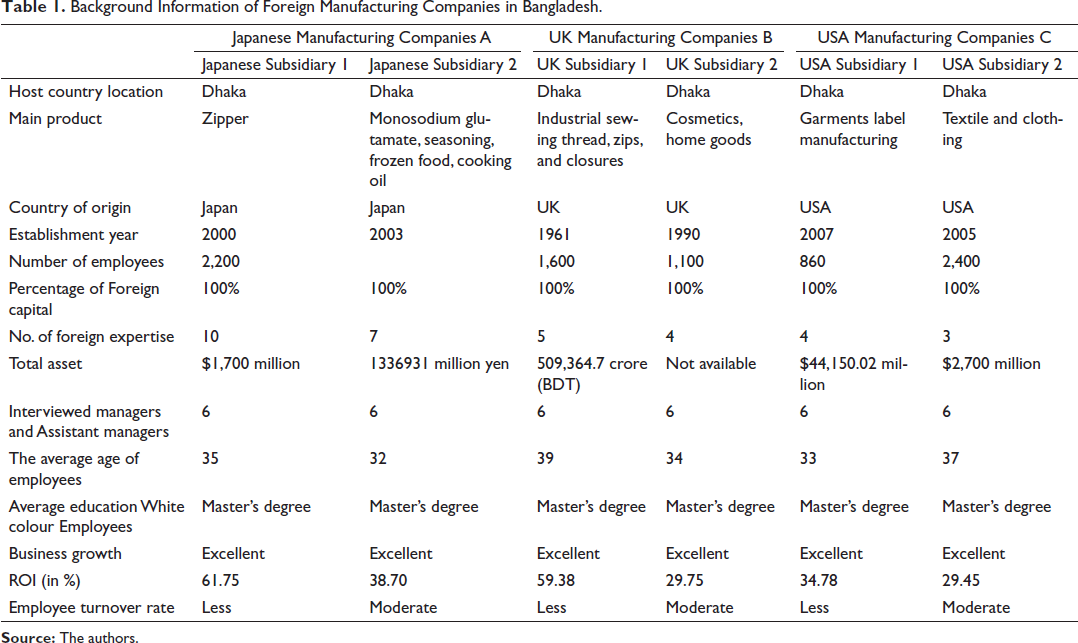
This study is qualitative in nature. For data analysis, an overview of the collected responses is provided descriptively. All field notes were converted into text for analysing the interview responses and reorganised to provide a consistent flow and structure for ease of reference. After collecting information, the narratives were reviewed, compared and contrasted with the emerging patterns of these three cases. Finally, all three HRM practices developed a general conclusion of the cause-and-effect relationship. The data were then used to reorganise the responses into categories among foreign subsidiaries to gain insight into the nature of HRM activities and the transference of HRM practices in Bangladesh (Mahmood & Absar, 2015; Miah & Hossain, 2014; Piekkari et al., 2010). Several review tables revealed similarities and differences in HRM practices among foreign-manufacturing subsidiaries in Bangladesh.
Findings and Discussion
Recruitment and Selection
Table 2 demonstrates the different recruitment methods practised by the selected manufacturing companies. The evidence reveals differences in the employment technique of a hiring exercise among foreign companies. For instance, the United Kingdom and the United States manufacturing companies mostly use newspaper advertisements and university career service departments to recruit experienced and fresh talented employees. These organisations facilitate recruitments by putting employees on the person and job (PJ) fit.
Comparison of Recruitment and Selection Practices Among the Foreign Companies in Bangladesh.
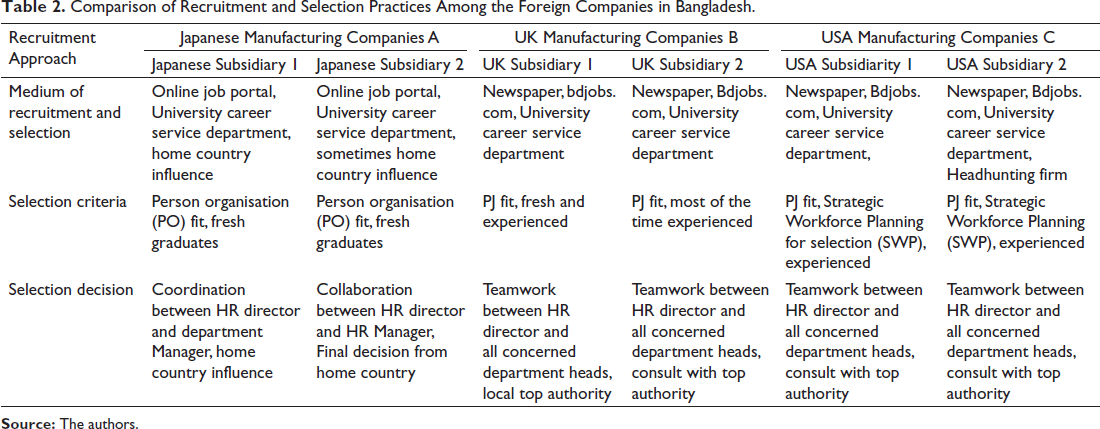
In contrast, Japanese manufacturing companies consider the potential fit between a person’s abilities and skills and the aspects of the job as essential selection criteria. Potential job candidates are expected to fit into the organisational setup and fulfil the firm’s policy and requirements. They screen job candidates by measuring their work enthusiasm, employee attitude and salary expectations. Japanese firms mainly used the university career services centre or a third-party outsourcing firm guided by the parent country as the primary modes of recruitment.
Training and Development
Table 3 reveals the training and development policies of employees at the companies under investigation. Foreign manufacturers invest considerable resources into training and development programs that, in turn, aid future promotions and succession planning.
Comparison of Training and Development Practices Among the Foreign Companies in Bangladesh.
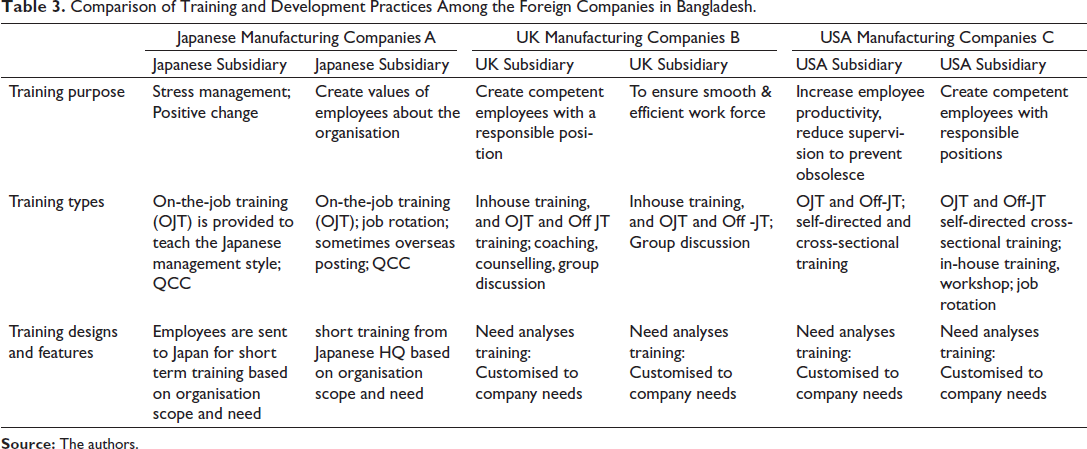
Japanese manufacturers have introduced reduced stress management, reskilling and teaching Japanese style management techniques with quality control circle (QCC) and job rotation training programs to broaden the employees’ exposure to the firm at the Japanese headquarters. In contrast, the training procedures of the manufacturers from the United Kingdom and the United States are more cost-effective comparison. The manufacturers from the United Kingdom and the United States utilise self-directed in-house cross-sectional training with the on-the-job training (OJT) and Off-JT technique.
Performance Appraisal
Table 4 shows that the parent companies from the United Kingdom and the United States integrate and utilise performance appraisal (PA) for respective performance management methods, designing conduct and measurement criteria which are extensively formal, management by objective (MBO) and key performance indicator (KPI). Both types of companies encourage participation in the appraisal process extensively by local top authority monitoring.
Comparison of performance appraisal practices Among the foreign companies in Bangladesh.
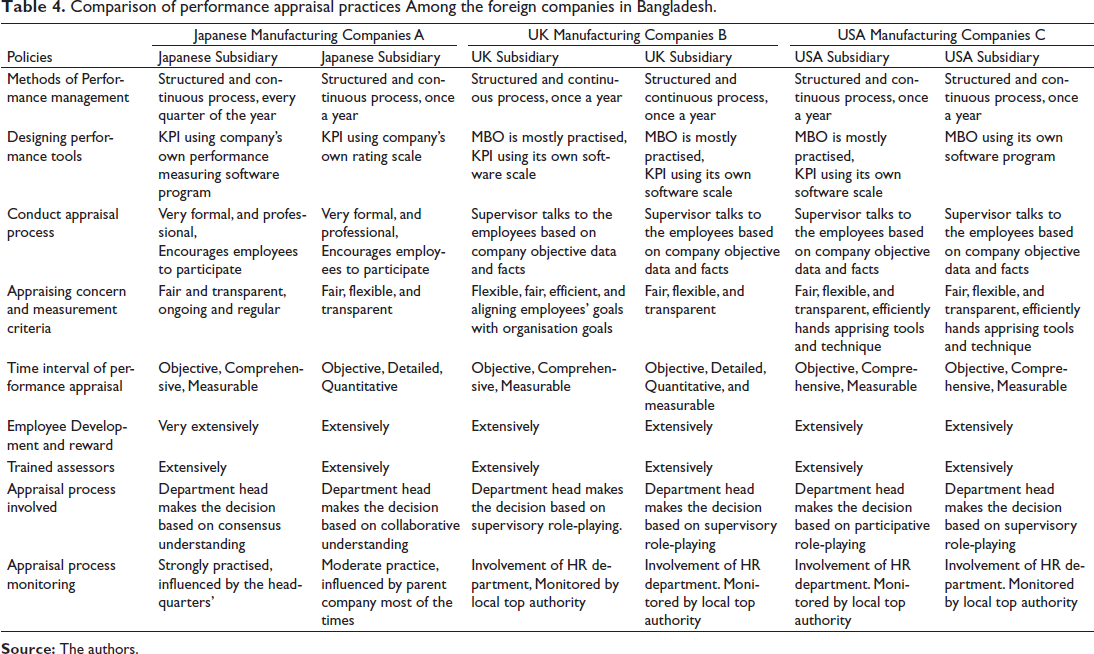
In contrast, Japanese subsidiaries handle their PA systems in a more structured way using MBO and their rating KPI scale to encourage the participation of all employees along with the continuous process of the headquarters’ influence.
Compensation and Fringe Benefits
Table 5 demonstrates that the Japanese subsidiaries offer structured and competency-based compensation packages to retain employees with competitive financial benefits. Individual performance outcome is the dominant measurement of all manufacturing companies’ performance, and all companies follow local market trends in compensation and fringe benefits. For instance, Japanese manufacturing companies offer elderly benefits based on rank including full-time car with driver and fuel cost, and extensive medical and insurance coverage to top and mid-level permanent personnel.
Comparison of Compensation and Fringe Benefits Among the Foreign Companies in Bangladesh.
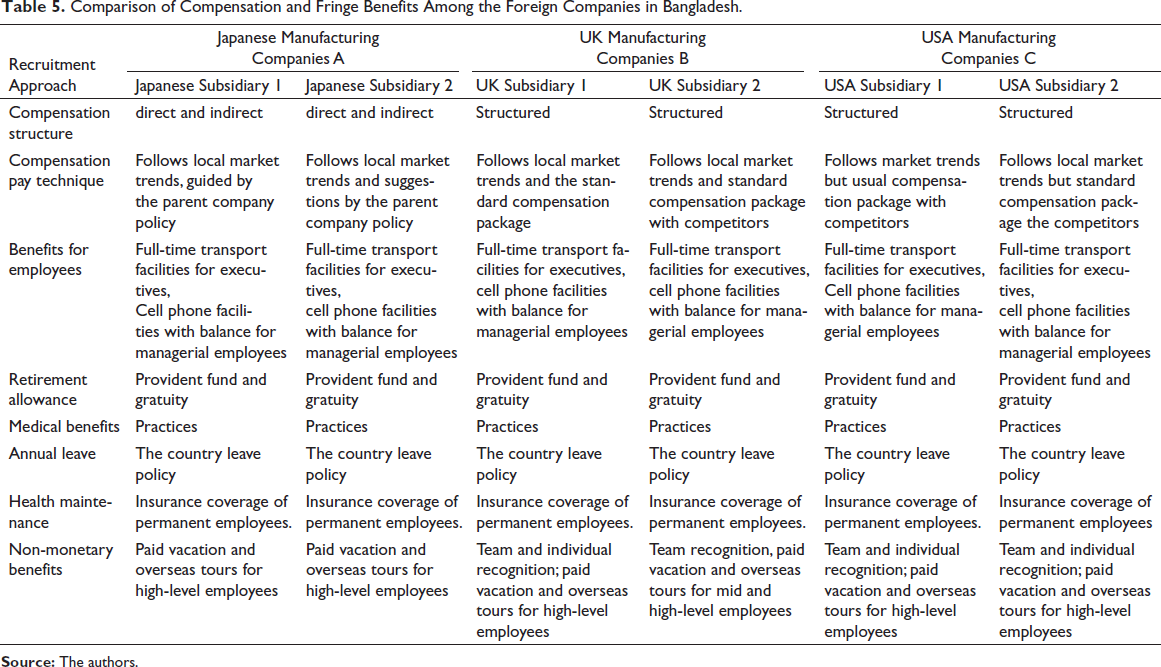
On the other hand, manufacturers from the United Kingdom and the United States provide generous fringe benefits, including better medical coverage, affordable housing, seniority, performance-based combined compensation, leave and health coverage for elderly staff and an attractive retirement package.
The Effect of HRM Transfer and Adaptation Between Home and Host Country Policies in Foreign Companies
Table 6 shows that foreign manufacturers adopt different hybrids of HRM practices in Bangladesh. There is a high level of transfer of HRM practices from parent country to affiliate host country among subsidiaries of Japanese manufacturers. In contrast, the transfer level among the UK and the US-originated manufacturers’ subsidiaries is relatively low. Scholars tend to agree that the transfer of HRM practices abroad is a prime necessity for the successful operation of MNCs (Bartlett & Ghoshal, 2000; Evans et al., 2002; Guo, 2015; Mariappanadar, 2005; Miah & Hossain, 2014; Poedenphant, 2002).
The Effect of HRM Transfer and Adaptation Between Home and Host Country in Foreign Companies.
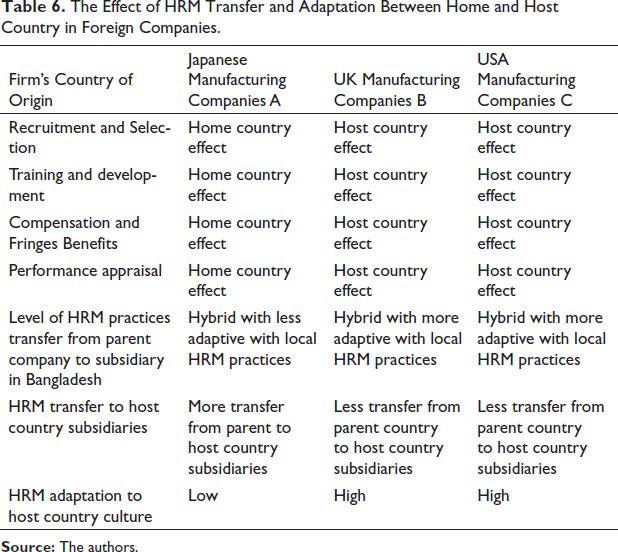
The factors that impact transfer success include how the HRM practices adapt to local social, political, economic, legal and strategic contexts. Today, MNCs are beginning to face pressures for global amalgamation versus local awareness and the budding approach of international HRM practices (Bartlett & Ghoshal, 2000). As MNCs begin to understand the importance of blending global and local HRM practices, the concept of a global mindset in HRM practices is losing its appeal.
The findings demonstrate that the subsidiary manufacturing companies from Japan, United Kingdom, and United States set in Bangladesh have adopted a combination of home and host country HRM practices. All companies’ push and full-facing factors play a significant role in the HRM practices of the subsidiary companies in Bangladesh. One of the significant findings of this research is that the cross-country cultural influences can be enhanced by using selective HRM practices to expand the business needs of the foreign subsidiaries in Bangladesh.
The Japanese manufacturers emphasise compatibility between individual candidates to match the potential roles of the organisation. Given the focus on operating the company, the Japanese subsidiary companies engage the employees most effectively by carefully matching organisational values with individual attitudes and knowledge. Earlier research reveals that establishing a fit between the values of an individual and the organisation may influence the company’s success (Harzing & Noorderhaven, 2008; Morley, 2007; Schneider, 1987; Schuler & Jackson, 1987). Regarding the HRM practices of the Japanese subsidiaries, the central fundamental strategic decision-making depends on the headquarters in Japan, especially on recruitment, selection, training, development, performance appraisal, compensation and fringe benefits.
On the other hand, the subsidiaries in Bangladesh from the United Kingdom and the United States focus more on the person–job fit policy and how well candidates’ attention and abilities align with the responsibilities and values of a particular position. Companies from both origins adopted a polycentric approach to recruiting people in their respective subsidiaries in Bangladesh. The subsidiaries from the United Kingdom and the United States were more influential concerning practices on recruitment, training, performance appraisal and development, compensation and fringe benefits, and managing their practices with the local standard system.
Another significant theme encountered through the case study is how the companies manage organisational fairness through performance appraisal practices. Recent empirical research incorporating Bangladeshi samples shows that employee perceptions of corporate fairness are related to their willingness to engage in organisational modification (Bischoff & Wood, 2012; Mahmood & Absar, 2015; Miah et al., 2003). This research reveals that foreign manufacturers are increasingly concerned about organisational adaptation to the host country’s environment.
Institutional influences from the host country, such as contextual and contingency environment and proper utilisation of local resources, are the priority of the companies in Bangladesh originating in the United Kingdom and the United States. The host country HRM practices such as recruitment, training, compensation and performance appraisal are commonly practised by the subsidiaries in Bangladesh from the United Kingdom and the United States. The results suggest that individual performance is widely practised for rewarding and promoting employees in the subsidiaries from the United Kingdom and the United States. The practices of operation of foreign subsidiaries in host countries may be close and open hybrid in which the host and home country practices and policies reconcile the influence of the foreign subsidiaries. This is consistent with earlier empirical findings (Gerhart et al., 2000; Gupta & Govindarajan, 2000; McDonnell et al., 2015).
All manufacturers have substantially benefited from performance-oriented practices by engaging employees in operational and performance-related decisions to elicit input. All subsidiaries’ firms also redesigned PA to reflect fairness, objectivity and measurability resulting in improved employee morale, dedication to the organisation and a healthier workplace, thereby contributing to a lower staff turnover rate. Performance-based reward and promotion systems among foreign companies support a fairer distribution of compensation and fringe benefits and enhance standard organisational transformation. These findings show that committed employees were less likely to leave an organisation, consistent with the earlier research findings (Chow et al., 2000; Debrah, 2013; Malek & Budhwar2013; Pudelko, 2006b).
The research results suggested that both the host country performance and adaptation of headquarters’ performance measures were commonly adopted in foreign companies. An application of choice of modified HRM practices influences the host country’s national culture. As a result, the foreign subsidiaries have utilised the intermediary practices in Bangladesh. A few vital essential features seem to influence the subsidiaries to develop HRM practices globally and internationally. There is a practice that the international transfer of HRM practices is a fundamental prerequisite for successful MNCs (Bartlett & Ghoshal, 2000; Evans et al., 2002; Mayrhofer et al., 2011). Differences of opinion occur about factors influencing the decision to adopt HRM policies for the MNCs’ foreign subsidiaries. Some factors include the impact of political, legal, social and economic, and local business strategic contexts (Bartlett & Ghoshal, 2000; Cheng et al., 2005).
This study found that both the subsidiary companies from the United Kingdom and the United States adopted local HRM practices, maintained international standards and was less influenced by the headquarters while operating the manufacturing in Bangladesh. On the other hand, the Japanese subsidiary companies in Bangladesh adopted a mix of Japanese HRM practices to create positive outcomes for operating business in Bangladesh. They were assigning specialists in specific HR professionals with global responsibility such as top management appointments with a deep understanding of a country of origin or nationality (Ayentimi et al., 2016). Another key finding is that the managers’ promotions shared by the managers in subsidiaries in Japanese firms affect the parent firms (closed hybrid), whereas that from the United Kingdom and the United States strongly affect the style of HRM in the local setting (open hybrid) (Bjorkman & Lu, 2001; Debrah, 2013; Cheng et al., 2005).
Implication
The results suggest that Japanese subsidiaries follow the parent company’s influence of transferring its core HRM practices to its subsidiary companies in Bangladesh. On the other hand, subsidiaries of the manufacturers in Bangladesh from the United Kingdom and the United States adapted and adjusted the HRM practices from the host country and implemented them with their internationalisation stages.
The findings further indicate that some vital socio-cultural and institutional norms compel the MNCs to adjust some practices conforming to the local model (Bischoff & Wood, 2012; Miah & Wali, 2012; Nolan & Morley, 2014; Tayeb, 1998). The companies undergo a considerable extent of HRM transfer, resulting in mixed HRM practices. The collision occurs while practicing the mixed HRM policies because certain HRM practices are more restricted and affected by the socio-cultural and institutional environment of the host country. On the other hand, other practices are expected to be assimilated throughout the MNCs and display an advanced level of compliance to the practices of the headquarters (Chow et al., 2000; Hasan, 2010; Lee et al., 2018). For example, Monk et al. (2001) found that MNCs developed more formal and proactive HR policies and appointed a higher number of headquarters expatriates in the overseas subsidiaries with their increased global operations.
The findings of this research have several theoretical and managerial implications and contributions to different aspects of IHRM home and host country perspectives. The article can also be utilised to develop future HRM theories in the Bangladeshi context. It has been designed to contribute to the cultural and institutional theory essential for HRM transfer from parent country to host country in a transitional condition: Future theoretical efforts should examine the possibilities and implications of management development, including the cross-cultural HRM systems. This study shows why efforts should be made to explore the significant differences in the structure of HRM systems and practices. Another broad avenue of future research is to examine the various ‘exogenous’ and ‘endogenous’ factors and corporate concerns that can influence HRM practices in an international context.
Despite the above limitations, we expect this study to contribute to the convergence/divergence and standardisation/localisation debate in HRM transfer. This case study finding suggests that the most localised HRM practices could be considered to add to the home and host influences perceived to represent worldwide ‘best practices’ which is present for Japan-, the UK-, and the US-origin subsidiaries in Bangladesh. Several cross-organisational learning activities also recognised the importance of the organisational study of the parent county (Bücker & Korzilius, 2015; Edwards et al., 2013; Katz & Dabishire, 2000).
Conclusion
In conclusion, this case study originates from significant divergence and convergence of HRM approaches in the three foreign subsidiaries studied in this research. Numerous cross-organisational knowledge activities were also recognised as contributing to the accumulation of the small body of investigations that has emphasised the importance of parent-country organisational learning (Budhwar, 2012; Edwards et al., 2013; Pudelko, 2006a). There are several opportunities for further research to know more details and develop better insights, which will eventually open up new avenues for expatriates working for different foreign subsidiaries in the same national environment. Such studies would be more accommodating in implementing the paramount global HRM approach to contribute to the booming foreign MNCs company HRM practices that are mainly suitable for Bangladesh.
However, this study also has some limitations, which need to be addressed in future research for more generalised findings. The study sample of this research was not large in size as we collected information only from subsidiaries from three foreign countries operating in Bangladesh. The sample sizes would be more effective if we could select more home and host country combinations, including diverse information for a cross-cultural issue with factual information. Another limitation worth noting is that we considered only HRM practices and country comparisons in developing countries. Indeed, other relevant variables such as industry characteristics, organisational life cycles, MNCs versus exclusively home country companies, and, for MNCs, factors in their structural, cross-cultural, and national and corporate levels could be included as well. Another limitation of this study is that we collected data from a single informant from subsidiaries only, not from the headquarters, which provided a weak extensive argument. Future research comprising a more significant number of samples from different industries could provide more substantial evidence regarding cross-cultural HRM practices. Therefore, we conclude that there is a need for an in depth study focusing on the relationship between HRM practices and the tie between national culture and manufacturer performance in Bangladesh.
Footnotes
Declaration of Conflicting Interests
The authors declared no potential conflicts of interest with respect to the research, authorship, and/or publication of this article.
Funding
This study was conducted by North South University Annual Research Grants-2020-2021, CTRG -20/SBE/24.
