



Abstract
In this qualitative study spread across three Indian states—Assam, Kerala and Maharashtra, we explore how 13 Indian staff nurses working full time in the first wave of the COVID pandemic cope with the increased job demands and perceived psychological contract breaches (PCB) from a work−home resources (W−HR) perspective. The study utilises the W−HR model as a theoretical lens to analyse the nurses’ lived experiences through a phenomenological approach. We could observe that a significant black swan event such as the pandemic can trigger resource depletion at work and home and materialise in PCB at work for the nurses. Nurses then resort to sensemaking to tide over the pandemic-affected work circumstances by balancing contextual demands and personal resources. By integrating PCB experienced by these nurses via a W−HR model framework, we address calls by researchers to understand how psychological contracts change over time.
Introduction
The pandemic has been a game-changer in our personal and work domains (across occupations). Most employees have been facing disruptions in their work−home interface, amounting to increased burnout and job demands leading to disengagement, exhaustion and altered status quo at their work-family interface front (Rapp et al., 2021). With the increasing job demands and the high-pressure work environments they are situated in, healthcare workers such as nurses are experiencing elevated job demands leading to stress and work fatigue. It has been reported that the increase in work-related exhaustion and its transfer to the home front is prevalent among healthcare workers during pandemic times. This relation is significant when they perceive that management’s support and upkeeping of promises are not up to the mark (Morgantini et al., 2020).
When employees start to feel the increased job demands kicking in with little or inadequate support or resources from their employers, their efficiency levels start to dip, and exhaustion sets in (Bakker et al., 2014). Such job demand–resource mismatches can thus burn employees out and make them feel dismayed. This breach by organisations of their psychological contract (PC), an implicit set of non-formalised contracts which the employee expects the employer to commit and uphold (Rousseau, 1989), can thus lead the employee to be negatively impacted and non-committed to the job. Questions on such demand−resource misbalancing and its effects on the employee’s social exchange relationships with their respective organisations from a South Asian perspective have been raised for further exploration and clarity (Kutaula et al., 2020).
A meaningful and gratifying profession such as nursing could turn strenuous and demanding of resources under the various major work shifts an unprecedented event such as the pandemic brings. The increase in work pressure, stress on limited resources at disposal, and work-related conflicts may cause the work to suffer and affect job performance (Bakker et al., 2019). When in such situations, if the management starts to distance themselves away from some of the work-related agreements perceived as promises by the employee, the latter then starts experiencing a loss of resources at work, leading to mental strain and psychological contract breaches (PCBs). Extant literature (Morrison & Robinson, 1997; Parzefall & Coyle-Shapiro, 2011) have attributed the sensemaking by employees post such breaches as a step-by-step process. By proposing a model to capture this process, Tomprou et al. (2015) identified how employees made sense of their discrepancies and developed a post-contract breach model based on coping and self-regulatory frameworks. Though notably, the model still leaves room for capturing the post-breach PC shifts as a process and potential influencers of such a process.
Past studies (Bakker & Demerouti, 2017; Bakker & de Vries, 2021) have linked burnout and stress to this job demand—resources mismatch, further leading to PCBs. Nevertheless, it would be prudent to explore the various factors aiding or attenuating it from an individual level. This examination could be based on the job demands−resources theory and how breaches or violations resulting from these two aspects being non-synchronised can affect the employee’s day-to-day working.
The role of the family could merit a higher emphasis in influencing the post-breach response by the health workers, especially in a collectivist South Asian society such as India. Family-to-work enrichment (FWE) is a process that happens when the resources in the family domain help to meet the demand in the work domain and ease the demands and strain experienced by the employees at the workplace. How such contextual personal resources boost a health worker’s adaptation to the straining job demands and PCBs is an area meriting a deeper analysis. Our study adds to the literature by considerably enhancing how the transfer of resources from one domain to another is possibly an adaptive process of self-regulation undertaken by employees in the face of job-related adversities such as PCBs.
An imminent and narrow focus on the job as a means to attain financial solace for the family may reduce work as an avenue to exert controlled efforts with less creative risks to be taken, which may interfere with their short-term financial goals (Menges et al., 2017). It may be prudent to examine whether all families exert such motivation towards short-term financial needs or whether they stay true to the meaningful job angle and aim for creative work.
Thus, our study qualitatively examines the post-PC breach phenomena of nurses who went through a life-altering experience while in service during the pandemic. They shared about experiencing drastic changes in work−life, with breaches to their pre-pandemic PCs. As this unprecedented situation warrants changes in the PC makeup of the employees, we endeavour to study these plausible alterations to employee PCs and efforts, if any, to sustain, modify or abandon their pre-pandemic PCs. We seek to understand the role of the family as a personal resource sourcing platform (from a W−HR model [ten Bruhmmelhuis & Bakker, 2012] perspective) and how family-based motivation may influence work positioning in an employee’s life.
Literature Review
Working during the pandemic and the strain it can put a nurse through to cater to the interpersonal demands of the healthcare ecosystem can be demanding. The task becomes daunting when the lack of adequate job resources and organisational support is also put into this equation (Bakker & Demerouti, 2007). This incongruence leads to a plausible scenario when the PCs of these workers are under threat, as the pandemic has put them in a vulnerable stage, with increasingly depleting work and non-work resources being their everyday reality (Rapp et al., 2021). This tug of war between job demands (organisational elements of work demanding an employee’s physical and mental effort) and job resources (elements that help see the work through, such as physical and mental resources and co-worker support) causes much strain on the employees (Bakker et al., 2005).
When the employee perceives that the employer is not honouring their end of the promises, especially during a physically and emotionally demanding pandemic work environment, they may seek to modify their existing PCs or even harbour intentions to leave their organisation (Krause & Moore, 2018; Rai & Agarwal, 2017). Thompson and Bunderson (2003) argued that for the three broad types of PCBs (transactional, relational and ideological), employee responses could vary (from quitting, resorting to downgrade of their contract to transactional levels, and dissent to uphold employee values). Tomprou et al. (2015) developed a model that captured these post-contract breach or violation stages according to the repair grade or newer elements these post-PCB contracts constituted. Tomprou et al. (2015) theoretically defined these stages but called for further empirical studies to assess these at ground levels. Therefore, the current study would want to look at identities, contextual resources and family-based gains as underexplored antecedents (Kutaula et al., 2020) to counter job demand induced psychological breaches of these nurses.
PCB-related burnout of employees could result in the loss of resources, distancing from the organisation and co-workers with a cynical attitude, and reduced self-efficacy and sense of accomplishment at work (Bakker & de Vries, 2021; Sivarajan et al., 2021). When employees sense this loss of resources, lack of control and perceived loss of organisational support and feedback, they could attitudinally turn negative in their intentions towards work. However, increasing work demands supported by resources and perceived autonomy have turned the tables and improved employee relationships (Bakker et al., 2005). Therefore, the current study would want to look at identities, contextual resources and family-based gains as underexplored antecedents in a South Asian context (Kutaula et al., 2020) to counter job demand-induced psychological breaches of these nurses. We study how the family may play a role in the way these nurses cope and make sense of their depleted job resources, thereby attempting to address a significant research gap in South Asian literature on PCs as a process (Kutaula et al., 2020).
Drawing from job and personal resources have been associated with employees’ enhanced coping with increasing job demands (Bakker & de Vries, 2021). Employees’ use of personal resources also helps them boost their gain spirals against increased job demands via optimism and self-efficacy and aids in their recovery and enhanced job resources (Xanthopoulou et al., 2009). Such coping strategies could be termed approach-oriented coping, where the employees are involved consciously to tackle their job demands and associated stress (Tobin et al., 1989). This approach contrasts avoidance coping, where the employee seeks roundabouts to avoid the job strain and ignore the additional job demand. Scholars (Bonanno & Burton, 2013) have pointed out that a flexible approach where both coping-based strategies are in play might be a better approach to tackle employees’ increased job demands. Though from a temporal view, strategies adopted for the short term, such as avoidance coping, may help re-evaluate the stressor and bring in adaptive coping strategies for the long term. Rigidly sticking to one set of coping strategies for a continuous period could be detrimental and have adverse effects in case of uncontrollable stressor events (Cheng et al., 2014). As the job stress goes up, it is more likely that the employee may use coping inflexibility and maladaptive coping strategies.
Employees may try to recover from such job demands by engaging in time off the job with their families (recovery) or by proactively adopting measures at work to balance their demands, resources and relationships (job crafting). This approach helps them combat stress at work and increase the resources at hand to tackle the job strain (Bakker & de Vries, 2021). Nevertheless, this may be easier said than done as replenishing during off-job hours may not be possible for the employees, as most of them may carry work home and ruminate about the work pressure demands (Kinnunen & Feldt, 2013). The role of job crafting thus acquires a more significant part in recovery from job stress, as it adds a means by which personal resources (from the point of view of conservation of resources theory) could be leveraged to meet demands. It has also been observed that proactive employees have a higher chance of job crafting than their peers (Zahoor, 2021).
The self-regulated initiatives employees undertake at work (in terms of task rearrangement, seeking efficient ways of structuring work, and finding meaningful activities) to optimise the job demands and improve their job resources constitute job crafting (Wrzesniewski & Dutton, 2001). However, job crafting may be tough without a facilitating factor. With increasing job stress and burnout, the chances of job crafting take a hit as social support, work-related autonomy and job-related proactivity all nose dives with increasing job demands (Bakker & Demerouti, 2017).
Essential personal resources acquire salience in this context. It may act as a facilitator or a buffer to hold job demands and stress at bay while setting the ground for resource-enhancing activities such as job crafting (Hardré, 2003). With their capacity to enhance, alter or implement other resources, key personal resources, such as proactive career behaviour, proactiveness at work-related activities (Bateman & Crant, 1993), or family-based motivation can activate other resources. As per the work−home resources (W−HR) model these resources help employees meet job demands and cope healthier (ten Brummelhuis & Bakker, 2012). For instance, being sensitive to one’s familial and societal background could make an employee emotionally intelligent and help regulate their job-related demands and tasks from both a problem-focused and emotion-focused coping perspective (Bakker & de Vries, 2021; Grandey & Melloy, 2017). Such emotionally aware and proactive employees may seize opportunities and set goal-based agendas to enable a positive work environment (Bakker & de Vries, 2021; Crant, 1995). They respond actively to job demands, avoid maladaptive strategies such as emotion-focused coping, and separate their identity from work to focus on their goals and reduce job demands and stress (Op den Kamp et al., 2018).
To enable these job crafting measures and proactive workplace behaviours and reduce job demand−resource dissonance, employees can resort to enrichment sourced from home (Du et al., 2020; ten Brummelhuis & Bakker, 2012). Support from home could trigger controlled motivation to materialise performance and productivity from limited access to job resources. Positive and favourable experiences from the home front, from sharing their workplace-related conundrums at home, could generate familial support and positive affect. Employees have adapted in the past to capitalise on positive experiences from home without fear of judgement and transfer that emotional energy back to work to enhance productivity (Du et al., 2020).
As explained by ten Brummelhuis and Bakker (2012), such an enrichment from transferring the contextual positive home experiences and motivation could expand an employee’s key personal resources. These personal resources amounting to enhanced individual energy and self-efficacy could result in the transfer across the home−work domain, enhance workplace productivity, courtesy increased cognition and efficient task performance (Du et al., 2020). Sharing work experiences, leveraging positive interactions with the significant others in one’s family, and obtaining encouragement and self-belief from them to focus on work-based individual goals may spur the employee to higher self-esteem. This motivational boost alters their job demands evaluations, enabling them to look at such conflicts or demands as opportunities for the next steps in their goal-based organisational journey and better performance (Webster et al., 2011). Family-based motivation has been described as the need to bring gains to one’s family by expending the necessary work and thereby accreting value to the family members as the end benefactors (Menges et al., 2017). It may not be strictly confined to one’s parent, but family-based motivation is also sourced from the immediate kin that the individual regards as family. Through their self-determination theory, Deci and Ryan (2010) posit that such motivation could range from a continuum of autonomous to controlled.
Autonomous motivation comes with the discretion to pursue individual goals sustained by the family’s blessings. In contrast, controlled motivation could have specific short-term family-based financial goals in our study’s context. The former is adapted to long-term goals and innovative work behaviour. The latter would contend with short-term productivity and financial viability as the end goal (Deci et al., 2017). In a typical Indian nurse’s case, they may experience financial pressure from the family, which would be a case for controlled motivation. In a family viewing the nursing profession as a considerable boon to society, it will be an autonomous motivation that the nurse will experience. Our study believes that the family-based motivation for nurses working through the arduous pandemic could be controlled as they are responsible for earning and supporting their families (Zhang et al., 2020). The economic benefits from work are too significant for them to avoid at this stage of their career. Their extrinsic motivations would be pivoted around this primary financial need for an average-earning health worker.
Thus, it may be immaterial for the family how the employee feels or goes about his work routine as long as the financial benefits of continuing at work accrue (Menges et al., 2017). Even if family-based motivation may drive employees to perform at work despite a PCB, it is still susceptible to hampering the creative nous (which the employees may otherwise exhibit within a more autonomous form of motivation). Employees with controlled family-based motivation may ascribe work as a positive activity or means to acquire the necessary resources to sustain their family rather than as an end. However, this may not be the case every time as the informational aspect (triggering the individual competencies and self-efficacy) of family motivation may still hold sway over or at par with the controlling effects and enable the employee to pursue creativity at work beyond its instrumental clutches (Zhang et al., 2020). With an uncertain outcome, employees are in a riskier position to undertake creative endeavours and may thus opt for the safe zone of assured economic returns addressing their immediate concerns (Dewett, 2006).
Theoretical Perspectives
PCs are considered a yardstick or a set of standards for an employee in assessing the actions he or she may put forward to benefit the employer in a work environment. This PC is measured against the social exchange with the employer—as a set of needs, support or emoluments. A balance in this arrangement is vital and sought after by both parties to uphold the PC and maintain a smooth exchange at work (Rousseau, 2001). Previous studies (Rousseau, 2011; Thompson & Bunderson, 2003) have identified three types of currencies employees trade for PCs. It constitutes transactional contracts that are short-term and economic, relational contracts that are socio-emotional and long-term in nature, and ideological contracts concerning an employee’s principles and ideals. When an employer upkeeps the PCs and these distinct elements, their employees perceive a valid contract, and when any of these contracts are perceived as not honoured, they feel a breach in their PCs (Tomprou et al., 2015).
Contract breaches are also strongly associated with employee intentions rather than behaviours, with an employee leaving his or her organisation after a breach being a rare event. Under such situations, employees resort to making sense of and coping with their PCBs, further shaping their organisational actions and determining their post-breach PCs and outcomes (Bankins, 2015; Krause & Moore, 2018; Tomprou et al., 2015). These extensive steps by the employees, from a triggering event followed by cognitive dissonance, seeking clarity and forming employee reactions, thus leave an opportunity to probe why PCBs engender such outcomes and what could further impact this relationship between PCBs and employee intentions (Conway & Briner, 2009).
Tomprou et al. (2015) systematically organised employee responses to PC breaches in a theoretical model, using self-regulation theory as a foundation. According to the model, the employees track their performance concerning identified goals and dynamically modify their responses depending on the goal progression. Any mismatch between goals set and efforts not achieving the same leads to employee actions in self-regulation to attenuate the dissonance (Krause & Moore, 2018; Rousseau, 2011). Thus, not every breach leads to a contract violation with retaliatory employee behaviour or display of emotional repercussions. Employees would weigh in and evaluate several factors, such as the adoption of the contract by the employer and the organisation’s current business environment, employee actions as a party to the contract, and the organisational justice procedure followed by the employer (Restubog et al., 2015). However, post-evaluation, if the employee experiences cognitive dissonance and is negatively affected by a sense of violation, he or she would resort to renegotiating the contract violation. As Tomprou et al. (2015) outlined in their theoretical model, this contract restructuring is carried out through a process of coping (emotion or problem-focused) and disengagement (mental or behavioural).
As Tomprou et al.’s model (2015) outlines, PCBs may be coped with at the individual employee level. Bakker and de Vries (2021) found that employees may resort to adaptive and maladaptive coping strategies in working around their job demands and resources and arrive at job crafting solutions as a proactive measure. Such mobilisation and transfer of personal resources would enable favourable individual outcomes as per the W−HR Model (ten Brummelhuis & Bakker, 2012) and the Job Demands−Resources Model (Bakker & Demerouti, 2007). This choice of coping will depend on the personal resources an employee can draw from stably over a while.
In their W−HR model, ten Brummelhuis and Bakker (2012) posit that the work-related functioning of an employee could be enhanced with favourable surge in his or her personal resources driven by the contribution from contextual resources imparted by the employee’s family. Family can ramp up such personal resources (mood, energy and self-efficacy, for instance) even though it may be in the form of controlled motivation amidst domestic demands (Du et al., 2020). In a collectivist Indian society, filial responsibilities are considered paramount (Rajan & Balagopal, 2017), and therefore ensuring that the family is doing well and drawing from the positive reinforcements from one’s kith and kin may increase the employee’s personal resources and thereby lead to better performance at work to meet the job demands. Being enabled with personal resources also help employees to capitalise better at work with stress and job demands, making them seek optimal ways to arrive at an acceptable level of job performance (Bakker & Sanz-Vergel, 2013). As per the W−HR model (ten Brummelhuis & Bakker, 2012), such enrichment from home transfers back to work. This enrichment is possible as employees with boosted self-esteem resources will put more effort into performing and managing their productivity to meet increasing job demands (Du et al., 2020; Webster et al., 2011).
Considering the spike in workplace demands and the increased attention on healthcare workers due to the pandemic, it would be worth probing about the disengagement and burnout these workers might be experiencing at their jobs. These issues can negatively impact job performance, especially if employees perceive PCs as being breached or violated. How they react to these breaches could depend on work factors and non-work resource elements (Rapp et al., 2021). As employees still spend considerable time outside the job environment, influences of such non-work spaces could transfer and impact their job performance. How such work-non-work dynamics affect the PCs of healthcare employees, especially in the context of the pandemic, are worth examining as studies in this regard are sparse. Further, there have been calls (Kutaula et al., 2020) to qualitatively probe the impact of PCB to capture the nuances of the process flow employees go through during a breach or violation by integrating theoretical frameworks focused on the demand−resource allocation.
Method
Our research used an interpretative phenomenological analysis (IPA) to capture the shared lived experiences of Indian staff nurses (Creswell, 2014). For data collection, we used semi-structured interviews to investigate how these nurses fared across the pandemic wave in India. We chose an interpretative approach over the descriptive phenomenology-based one. Such a selection was justified to go beyond merely describing a phenomenon that has been incompletely captured from a prior literature point of view. The priority was to explore and depict the contextual experiences of the research participants in practice. Thus, a hermeneutic effort helped us uncover experiences situated uniquely for each participant in their contexts yet sharing the roots of a common phenomenon (Lopez & Willis, 2004).
Research Participants
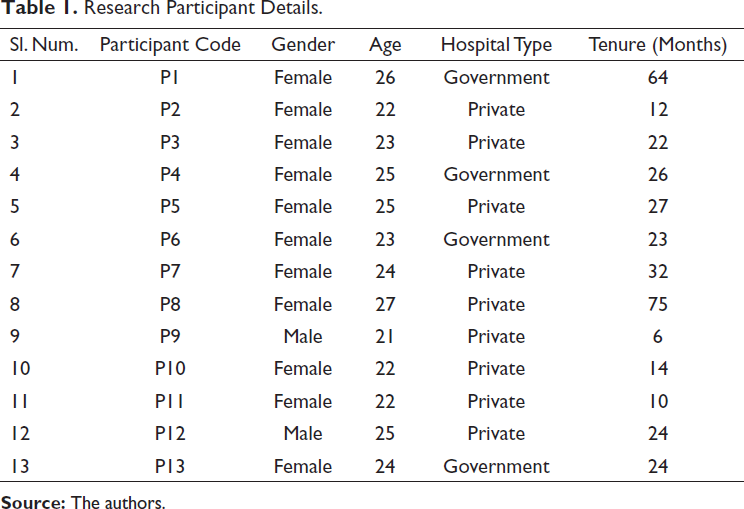
These participants were full-time nurses working across hospitals in Kerala, Maharashtra and Assam, India. The study’s sample of nurses was identified based on snowball and purposeful sampling (Patton, 2002), considering the feasibility and access to the information required. The initial few participants were identified from our networks. We did in-depth interviews with 13 staff nurses for a rich analysis required in phenomenology. These nurses working across government and private hospitals or nursing homes were selected based on their experience (having spent at least 3–6 months) serving COVID-infected patients admitted to hospitals. All the nurses were college graduates, with an average age of 23.75 years, and had their mean work experience at 27.6 months. The participants’ detailed characteristics are listed in Table 1. All the nurses had worked through the first wave of the pandemic in full professional capacities.
Research Participant Details.
Data Collection
All the research participants were aware of the study’s purpose, objective and methodology, and their consent was obtained before going forward with semi-structured interviews. The researchers maintained the confidentiality of the data and anonymity of participation records throughout this process. We had approached 21 nurses initially, and 13 were shortlisted for the final study as they had experienced dissonance in their perceived PCs during their post-pandemic working tenure. Interviews were either telephonic or over zoom as in-person interviews were out of the question considering the access restrictions and schedule of the nurses. The interviews were transcribed verbatim to Malayalam or Hindi and later translated into English by the respective researchers proficient in these native languages and English. It was further cross-checked with experts outside the research team to ensure reliability.
The questions revolved around how it felt to work during the pandemic (the interviews were conducted before the second wave of COVID hit the country) and the promises upheld by their respective hospitals during this period. Work-based relevance and autonomy experienced in the wake of the heroic status ascribed to health workers during the pandemic, how their PCs fared, what coping methods were in use and how the nurses garnered resources to work through this period were also discussed. We requested all the research participants to recall critical incidents in all the facets mentioned above/areas of working through a pandemic with either a negative or positive impact (Critical Incident Technique [Flanagan, 1954]).
Depending on their work schedule or post-work fatigue levels, interviews were often unpredictable in their flow. Interruptions were common if the nurse had to rush back in an emergency or if some personal work came up between the calls. Each interview lasted an average of 55 minutes, with the shortest interview taking 35 minutes and the longest going up to 115 minutes.
Data Analysis
Following Smith et al. (2009), we proceeded with an IPA approach to capture the major themes from the common factors in the lived experiences of our research participants. We resorted to the steps identified by Smith et al. (2009) to glean these themes from the individual quotes in the transcripts. Initially, the data was familiarised thoroughly by reading the individual transcripts repeatedly. We were careful not to let our pre-judgements cloud the analysis of these shared narratives and influence the textual experience of the data. For purposeful bracketing of their perceptions from past experiences and to ensure trustworthiness, the researchers kept a reflexive account (Lincoln & Guba, 1985) of their thoughts after each interview and while reading the transcripts during data analysis. These notes were used alongside the transcripts, as we compiled them in an MS Word file to compare and generate the codes and develop second-order themes.
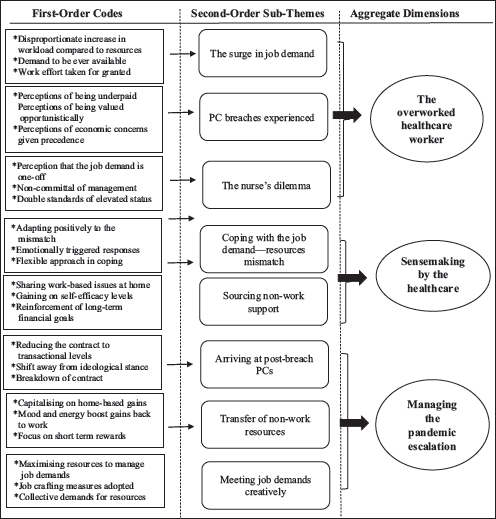
Efforts were taken to ensure the reliability of the analysis. The researchers read the transcripts multiple times, re-analysed the emergent codes and compared their findings as a group. Once an agreement was reached, these themes were then integrated into three aggregate dimensions as an overall structure emerged to make sense of the phenomenon experienced by the staff nurses. This structure is depicted in Figure 1. We also sought the help of a colleague (outside the research team) proficient in the methodology to review our analysis. The emergent themes were discussed with four of our research participants for further feedback and validity before the manuscript compilation.
Findings
In general, we found that the nurses felt the brunt of the pandemic as it was a very raw and one-of-a-kind experience in their professional and personal lives. The demands and their magnitude and how the nurses cognitively and practically managed them within their personal capacities are captured through the following three phases—the overworked healthcare worker, sensemaking by the healthcare worker and managing pandemic escalation, are outlined below. The three aggregate dimensions capture the shared realities in addressing the challenges posed by the pandemic and the contextual, organisational and familial factors which enabled them to work through such an unprecedented situation.
The Overworked Healthcare Worker
The pandemic had impacted the lives of all the healthcare workers we spoke to in a very adverse manner. Seeing the workload go exponentially from an already strained experience level to the most challenging shifts, the nurses had almost reached the end of giving up. The nurses also felt it as a jolt to their routine and saw many work and family-related changes that hit them hard.
The Surge in Job Demands
All the nurses were unanimous in their observation that it was a unique and challenging experience to tend to patients during the pandemic. Most of them were burned out and worried about all of this. Especially since most of the nurses feared affecting their families due to the nature of their work. Participant 1 shared that
It is getting complicated every day. Not just the mental strain of being put up so close with this fatal contagion, but the physical restrictions we have concerning doing all these time-consuming tasks with additional gear (shields and PPE kits). Sometimes we cannot even hear each other out. It takes more time to read a case sheet as with my glasses, I cannot read the letters through the face shield. Let us not even talk about the suffocation of being inside the kit for more than 10 hours.
The nurses also observed that it was mentally very taxing to see what the patients and their families went through. All of them reported a significant increase in the quantum of work, with no visible additional job aids coming their way.
Psychological Contract Breaches Experienced
We saw that the sustained increase in workload and job demands and the associated uncertainty and stress of dealing with the pandemic made the nurses vulnerable and even more perceptive to the job resources that were not provided. Most of them were openly vocal about what the hospitals failed in providing to them to face the load. Some of them pointed out how strained the work-related relationships with the management were turning out to be due to the ignorance of their demands and being money-minded. Participant 2 shared the below excerpt:
It was supposed to be there (the promised raise in allowance for pandemic duty), but then it remained only on the paper. We felt short-changed and taken advantage of as the hospital was profiteering out of its ‘service to the society’. It was impossible to fight for this, too, as the strain with the daily functioning itself was too much. The profession seemed to be not heeding its principles anymore.
When the issues kept going on loops, and when pleas were left unheeded, the nurses reported feelings of emotional outburst, frustration and anger, which resulted in PC violations within a relatively short period considering the unique situation event that the pandemic was, as Participant 6 had noted that
Everything was reduced—the team was disbanded, in terms of breaks between shifts or allowances considering the extraordinary situation we were in, and on top of this ever-increasing demands to be switched on 24 × 7, I had just been frustrated and angry whenever when I went home. It was only because of the support and encouragement at home that I am still here working. We were promised better working conditions, but then it simply is not there. I have never felt so overworked and underpaid for the effort. This is not how it is supposed to be!
We could see that most of the nurses expressed similar frustration and dismay at the process of working through the pandemic with minimal support. Most of them felt the management let them down.
The Nurse’s Dilemma
Nurses felt appreciated when they were hailed for putting in heroic efforts, yet they felt dismayed at the price they had to pay for it and were left wondering if it was all worth it. At first, they felt gratified and acknowledged, but it swiftly turned to dismay and drew further from their coping resources. Participant 8 had the following observation:
Though we were putting our life on the line, it felt good in the beginning to be appreciated. We had a ceremony with the local body felicitating us in a brief ceremony held at the hospital and were praised for our efforts. However, then, as time passed on, our efforts were taken for granted. It all seems like empty rhetoric now. All this will be dusted under the carpet soon.
Most of the nurses had similar experiences. They felt perplexed at the amount of appreciation that came in initially but then it was backed up with little or no reinforcement in terms of physical or mental support on the ground.
Sensemaking by the Healthcare Worker
Here, we tried to understand what the nurses went through after registering the impact of the contextual shock that the pandemic was and seeing their lives get affected. The strain of the increased job demands made them look for available support sources and mould their realities according to individual scenarios and abilities to cope. A few of them found that it increased their job demands beyond what was manageable, only made them cope with it harder, and put them on a negative loop.
Coping with the Job Demand−Resource Mismatch
While a few nurses also underwent self-regulated strategies to reduce the strain and cope with an adaptive mindset, participant 3 noted that the only way was ‘forward’ despite all the negativities around:
I have to take this in my stride and look for what I can salvage. For one, it will be an added advantage to have on my CV. How many will be able to claim such an experience which is probably the most challenging test a nurse can go through. Also, the amount of learning one can get out of this is enormous, yes it does come with a heavy price in terms of stress and workload, but then I believe this is the sacrifice I must make for the sake of my goals.
Though most of these nurses were persistent in adapting to newer ways to work around the challenges posed by the pandemic, some of them were disengaged and displayed job dissatisfaction and a constant sense of being in emotional turmoil and grievance. As we see in Participant 9’s case, he had enough and was on the verge of giving up:
I had put in my papers a week back, the chief did not consider it and asked me to rethink. I have seen a colleague contract the virus, and he cannot even climb up a pair of stairs without being really out of breath. We have to be careful with our PPE kits because it is limited in supply, the dormitory we have had so far is hardly the place to rest after two weeks of duty on the stretch. I used to manage for the last few months, and now it has reached the limits of my frustration.
Sourcing Non-Work Support
Many of the nurses found support from their family members to get through their daily share of job demands−resources mismatch and in the perceived breach of PC by the management. Participant 12 said that he got a lot of support and clarity whenever he talked to his father:
We would have these late-night conversations. Of course, my father was worried. He is a single parent. He always ensured that my comfort food was available whenever I was back from a tiring and exhausting spell of shifts from the hospital. We both would focus on our long-term goal (to migrate to the U.K) and decide to see these struggles of mine off on a day-to-day basis.
In the lack of resources offered at work, we found that for most of these nurses, having the backing of their kith and kin materialised into additional support in terms of increased self-efficacy and better goal setting.
Managing the Pandemic Escalation
From the accounts of nurses, we observed that they found ways to work around the restrictions faced due to the job demand surge. These alternatives included steps taken to restructure their PCs, source more personal resources from individual contexts, and indulge in crafting and modifying their work environments to fit their current situation.
Arriving at Post-Breach PCs
The employees who perceived breaches to their PCs went on to reassess the new equations post-pandemic and reconstructed contracts to the best of their capacities. This remodelling was an effort to reduce their discrepancies and make the day-to-day functioning smoother than hope for any imperative arising from their organisations.
Participant 6 was cognisant of what was not honoured by the management in the agreement she perceived to have, but then rephrased and reduced her PC to the economic (transactional) angle from a relational one:
I started looking more out for my family. Earlier, we felt better as a team, and working as a unit was something I looked forward to. However, the pandemic has crippled our team emotionally and physically. We feel distanced, and there is nothing the management has done to bring back that spirit of camaraderie and team rewards we used to get. So now I try to salvage whatever financial goals I have and not to look too ahead.
A few others changed forms in PCs, but they were still able to retain some of their commitment to the organisation, despite feeling violated by the change in the management’s stance. This switch was the case with Participant 2, who had forsaken her professional identity for a relational one:
I saw the profession and my current job as giving back to society. This is the objective the management had aligned with when I was recruited. But I now feel there is a mad scramble to benefit from this misery. They are not paying us as it should be, which I can understand if we were fully service-oriented, but then they are profiteering out of this. Now I try to be good at my work, but I have no loftier notions of service mentality anymore. I look forward to surviving this period of madness along with my team unit. We share our struggles.
We observed that the rest of the employees refused to adjust to the reduced contracts they perceived. They had strong feelings of violation and could not make peace with the new PC on offer. Participant 13 put it forward so
I feel let down. We deserved so much better. We were pushed and criticised for not being up to the mark. How dare they can do it? After putting our life on the line, with so much less support on offer, this is what we get. I go through the motions now; this is not what was promised when I joined. We stuck it out only to be humiliated further. I am Just biding my days now.
Employees like Participant 13 had found no more meaning attached to their contracts and were hurting severely from the violations they perceived.
Transfer of Non-Work Resources
Some of the nurses we spoke to choose to share their work experiences with their families and reported that it helped them take the cognitive load off to a large extent. This stimulation derived from their families often help them to tackle their job demands more effectively. As Participant 1 observed, it helped her to boost her confidence:
I was able to cope better at work after spending some refreshing time with my family, and there were a lot of positive vibes and reinforcement available. It also solved a big worry by seeing my family relaxed and accommodating of my needs and stress and not pressurising me further. I had much positive energy derived out of the interactions at home, I was told how important a role I am playing as a contributor not just to the family but to my career and also to the society at large. This confidence boost I was able to take across to my work as well.
Nurses felt much safer both physically and emotionally at their homes and thus were able to recharge their resources from a contextual point of view. We found that the nurses fed off the energy they got by sharing important work events with emotionally closer kith and kin and could translate that effect back to work by managing their job demands better.
Meeting Job Demands Creatively
We found that those nurses who adaptively regulated their job demands, drawing from various contextual and personal resources, were able to make changes to their work environments by which the pandemic-induced stress was kept to a manageable limit. Participant 8 learned to keep her boundaries separate as she shared,
I made sure all of us had a plan as a team. We decided pretty early that without much organisational support, this was our only way to thrive. We tweaked the shifts to smaller intervals, which essentially meant that being exhausted from continually running for 8–10 hours were gone. We also pitched in to create a sign language code so that shouting over the PPE kit to be heard and social distancing would be managed.
Thus, by maintaining sufficient recovery periods and building on work resources such as efficient teamwork, some nurses adapted to the changed work conditions and regulated their responses appropriately.
Discussion
Nurses’ narratives showed that the structural imbalance of elevated job demands and tapering access to job resources led to physical and emotional exhaustion. With limited organisational intervention, the situation escalated. The peripheral appreciation as pandemic heroes were not enough for the nurses to thrive in their day-to-day functioning. These healthcare workers were forced to draw from their personal resources or conserve whatever job resources they already had access to, thereby impairing their job performance.
With the organisations reneging away from the promises made on a pre-pandemic basis, the nurses experienced PCBs. Some of them could not make sense of the appreciation showered on one end as their work was appreciated as a worthwhile cause to society. However, their work conditions and compensation took a disproportionate hit, eventually leading to burnout and feelings of PCB.
This exhaustion forced the nurses to cope with the strain, and most of them dipped into personal resources to make good with the loss of job resources, along the lines of the W-HR model where the loss of resources in one domain is compensated by drawing from the other (home or work). We observed that a few nurses switched to adaptive coping by self-regulating their emotions. The rest chose maladaptive measures, resulting in resource loss spirals from feeling PC violations. The former category of nurses drew significantly from their non-work or family circles to sustain this adaptive coping workstyle to plough through their surging job demands.
We could see that the families of these nurses had played a substantial role in ensuring that they had all the support, where it was easier for the former to panic and add additional stress on the latter. By reinforcing career objectives, family needs and constant support by sharing work-related issues and strain, the nurses put their best despite the demanding and uncertain work situations for their families and needs. This effort removed the idea of work as a meaningful activity and replaced it as a tool towards a goal (supporting the family) rather than an end in itself. Such shifts of foci can be attributed to a South Asian cultural paradigm where the salience of family takes precedence.
The nurses were self-driven and forced to make changes to their PCs. We could see that some of them substantially downgraded their PCs to a transactional model and viewed work as a financial means to sustain. This switch came from nurses who felt the demand−resource imbalance was too incongruent with their limits. Also, we saw that nurses moved away from ideological contracts to socio-relational ones as they perceived their organisations to be moving away from the ‘promised cause and goals’ or ideological stances.
However, this distancing did not affect their performance as such. This observation contrasts the findings in Tomprou et al.’s (2015) model, where the disabling of PCs came with a drop in employee performance levels. Nurses here found a balance by drawing out from their non-work resources to help them remain resilient and productive despite non-honoured PCs on the management’s part. We did find that a few of the nurses experienced a total breakdown in their PCs and remained disconnected emotionally from the organisation. This disconnect was similar to what Tomprou et al. (2015) had observed in their contract dissolution model. Most of them also displayed maladaptive coping behaviour, and we believe it had to do more with their personal emotional capacities to sustain relentless job demands than other factors.
The ingenuity of nurses in proactively adapting to new PCs and meeting their job demands with new strategies was mainly possible by the transfer of resources from the non-work family circles. We found that when the nurses could share work-related issues with their families, it transmits the reinforcements to the work domain. The nurses could then capitalise on familial contextual resources to boost personal resources such as self-efficacy and energy to meet job demands. This enrichment across domains parallels the W−HR model by ten Brummelhuis and Bakker (2012), where positive family-related incidents may favourably impact employees’ job productivity and performance. This feat is accomplished by helping them meet job demands as manageable challenges on the back of positive family-based contextual reinforcements. Such positive resource transfers also led to most nurses’ job crafting initiatives, as they went beyond merely reconstructing their PCs. They managed to cater to the surge in job demands by resourcefully designing creative workarounds to meet them.
Theoretical Implications
Through our study, we have integrated the W−HR model and Tomprou’s PC model to address the gap in studying PCB with underexplored theoretical bases by employing a qualitative study (Kutaula et al., 2020). By addressing this lacuna, we have also explored and brought out in detail the role of family-based contextual support in enhancing the personal resources of an employee by a resource transfer phenomenon across family-work domains. Deep dives into exploring the role of family-based motivation and expectations in impacting the PCs of such individuals are next to nil, especially from a South-Asian perspective (Kutaula et al., 2020). Therefore, the study explored the impact of familial motivation as a resource early-career South-Asian nurses rely on from a W−HR perspective. By deciphering the role of this home-to-work enrichment in the post-PCB sensemaking, the study attempts to unravel the complex effects familial affiliations and expectations place on these nurses to navigate their emerging PCs.
The study attempts to merge the differing yet complementary viewpoints they offer by integrating these two theoretical views. This attempt departs from the dominant use of social exchange and equity theory-backed approaches to capture employee PCs. Such amalgamated viewpoints explain how a healthcare professional may override the damaging PC breach due to job demands and lack of perceived organisational support. By incorporating off-the-job resources such as filial support, the study brings forth such underexposed antecedents, especially from a South Asian regional perspective. Moreover, as employees managed to cope in avoidance, approach oriented or flexible manner, the study postulated along the lines of the W−HR model that family-based motivation restored the key and personal resources of the nurses. Such a boost to the nurses’ self and career decision-making-related efficacy, mood and energy levels helped them to positively engage with their job demands. Harvesting such resources to create a balance or surplus in the demand−resource equilibrium in favour of the employee via FWE is aligned with the key resources’ proposition of the W−HR model.
In a collective society like India, where family values are held venerable, our study adds to the literature considerably by studying the effect of this family-based intervention in helping employees cope with pandemic-induced job demand surges. Positive family-based interactions increase the personal resources of the employees, which in turn help them manage job demands better as addressable challenges. Since our semi-structured interviews covered the nurses’ experiences from the first wave of the pandemic in India (March 2020) to the end of the year, we could track this FWE over a period. This approach is consistent with the temporal process advocated by the W−HR model for the enrichment from one domain to the other. Thus, we could show that enrichment from family to work gets sustained over time and helps the contract restructuring of the affected employees. This enrichment could also work in dual directions, as our study observed. Wherever the contracts could sustain, some employees relied on the family−work transfer of resources to remodel their PCs as transactional. At the same time, some employees maintained at least a relational status with their PCs by indulging in job crafting. Future research could explore deeper on this finding and outline factors such as personal dispositions, which may be the enabler of such a contrasting effect.
Practical Implications
Bringing in task redesigning, workload interventions, value-based organisational policymaking and training interventions to sensitise the nursing managers and leaders would be a start. This initiative would help to enable a working environment with adequate job resources, providing nurses with enough support systems and stress reduction initiatives to relax in the face of volatile job demand pressures. Such an effort would strengthen their coping skills via forming support and counselling groups would be a start.
Organisations via HR practices could augment employee resource banks in the face of surging job demands. Regular monitoring of stress levels among employees is possible in a connected ecosystem prevalent today. This assessment could gauge employee mood and energy at a given time. Interventions could thus be made possible to enable the employees to offload the stress. Also, skillsets focused on adaptivity, emotional awareness and proactiveness to manage job demands could be encouraged.
Incentivising job crafting and creativity through suitable rewards and recognition policies is a possible improvement. Immediate managers should also be encouraged to be receptive to effective and creative workarounds suggested by their subordinates and recognise such efforts. Both process-oriented rewards alongside outcome-oriented ones would be an excellent start to sustaining job crafting initiatives.
Leadership initiatives could also encourage creativity at work. The generation of such enabling resources would be possible with leaders and managers recognising the stress formation patterns and intervening at the right time. Empowering employees by giving them autonomy and decision-making powers over optimal day-to-day functioning activities of a work unit may reduce job stress and support job crafting.
Future Research and Limitations
Future studies could compare the impact of family-based reinforcement and motivation on employee PCB management and coping behaviour across periods. Especially since our study’s span did not cover the pandemic’s second wave, it would be interesting to know what worked for those nurses adopting different coping and post-first wave PCs. It would also be worth exploring whether family-based motivation remained effective for them across the impact of the second wave of the pandemic. For non-work resources, we focused mainly on family-based motivation for our study. The role of customers or patients on the post-pandemic PCs of nurses would be worth studying. Their feedback and relationship could also be parallel to the contract a nurse may maintain with their societal ecosystem. The study’s scope could be widened by including diverse categories of essential healthcare workers as research participants.
Conclusion
Our study shows that a significant black swan event such as the pandemic can trigger resource depletion at work and home and materialise in PCB at work for the nurses. We have also observed that sensemaking and adapting proactively to job demands mark their attempt to tide over the pandemic-affected work circumstances by balancing contextual demands and personal resources. By integrating PCB experienced by these nurses via a W−HR model framework, we address calls by researchers to understand how PCs are rebuilt over time.
Supplementary Material
Supplementary files are available online.
Supplemental Material for Leveraging from Home: A Qualitative Study Examining Indian Nurses’ Job Demand Management during the Pandemic by Rahul Sivarajan, Aparna M Varma, Moon Narzary, Cini Siju, in South Asian Journal of Human Resource Management
Footnotes
Declaration of Conflicting Interests
The authors declared no potential conflicts of interest with respect to the research, authorship and/or publication of this article.
Funding
The authors received no financial support for the research, authorship and/or publication of this article.