



Abstract
The Kingdom of Bhutan is an exemplar of ongoing sustainable transformation. From realising over 20% growth in literacy rates in the last 15 years to sustaining an average economic growth of 7.5% per year since 1980 to becoming the world’s first carbon-negative country with forests covering over 70% of the land, Bhutan quietly continues to lead the way with unique foresight and resilience. This tradition of leadership continued in 2020 when His Majesty, the Fifth King of Bhutan’s urgently called upon Bhutanese civil servants to ‘prepare for the future’ as a ‘self-reliant’ nation. In response, the Royal Civil Service Commission of Bhutan launched a development accelerator called the ‘Nurturing Leadership Program’ which leveraged community-based participatory research methodologies to launch 125 innovation projects and build leadership capacity among over 625 civil servants. In total, 98.6% of more than 3,000 stakeholders surveyed at the end of the program agreed that project efforts positively impacted target outcomes, demonstrating that Bhutan can continue its unique role as a human capability incubator by transforming talent, organisation, leadership and HR into a shared and sustained brand of believe.
Keywords
Developing Human Capability to Believe in Bhutan
For hundreds of years, the people of Bhutan have prospered in their high Himalayan valleys and enjoyed a preponderance of peace as a small nation situated between India and Tibet (Phuntsho, 2013). Despite being landlocked and relatively small geographically, the Kingdom of Bhutan has garnered international attention for its distinctive philosophy of Gross National Happiness (GNH) and emphasis on caring for the collective welfare of all living things (Lepeley, 2017; Seligman, 2019). Many nations have since emulated Bhutan’s philosophy of holistic health and well-being, and although still in the process of graduating from ‘less developed nation’ status (Dhume & Kumar, 2020), Bhutan continues to be an exemplar of ongoing sustainable transformation (Sachs, 2012). From realising over 20% growth in literacy rates in the last 15 years (GNHC, 2019) to sustaining an average economic growth of 7.5% per year since 1980 (WB, 2022) and to becoming the world’s first carbon-negative country with forests covering over 70% of the land (Banerjee & Bandopadhyay, 2016), Bhutan quietly continues to lead the way with unique foresight and resilience.
In a world of continuous uncertainty and change, with the COVID pandemic, digital revolution and social trends; people, organisations and countries must continually transform to unlock opportunity and thrive (Ulrich et al., 2015). Transformation requires not only attention to natural resources (mountains, forests, lakes and minerals) in and on the ground but also human resources above the ground (Ulrich & Allen, 2014).
As such, His Majesty, the Fifth King of Bhutan’s urgent call, to ‘prepare for the future’ as a ‘self-reliant’ nation wherein Bhutan’s workforce competes ‘as equals with other nations’ has driven Bhutan to become an innovation incubator in transformation of human development by diagnosing, experimenting and improving human capital investments that will benefit Bhutan’s people and country and be an exemplar to others (Wangchuck, 2020).
To that end, the Nurturing Leadership Program (NLP), sponsored by the Royal Civil Service Commission (RCSC) of Bhutan in October 2021, employed a participatory research-based methodology that catalysed action among Civil Service leaders who actively engaged with stakeholders to design and implement initiatives that are systematically changing the culture of civil service in Bhutan and accelerating execution of His Majesty’s strategy (Israel et al., 1998; Minkler, 2005; Peréa et al., 2019; Rivkin et al., 2010; Wallerstein et al., 2017). The NLP simultaneously addressed both the need to make organisational systemic changes in the Royal Civil Service and the need for Civil Service leaders to continuously develop capacity and improve their leadership skills (Rowley & Ulrich, 2012; Ulrich, 1993; Ulrich & Allen, 2014).
Leadership Laboratories That Drive Real Results
Rather than simply attending a training course, a cohort of 125 senior officials, including ministers and department heads, began the year-long program by actively learning about and focusing on systems thinking and participatory stakeholder engagement. During the first three months, the government leaders trained over 625 of their fellow civil servants to conduct over 6,800 face-to-face interviews and gather survey data from internal and external stakeholders. Executives then conducted 125 ‘North Star’ workshops where they worked with teams to analyse the data and identify stakeholder-priority initiatives.
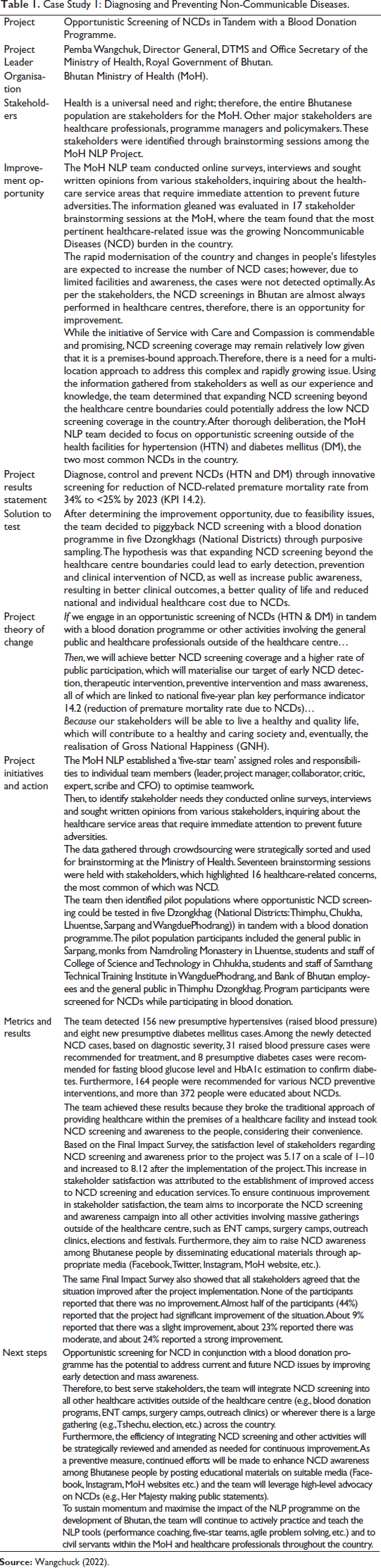
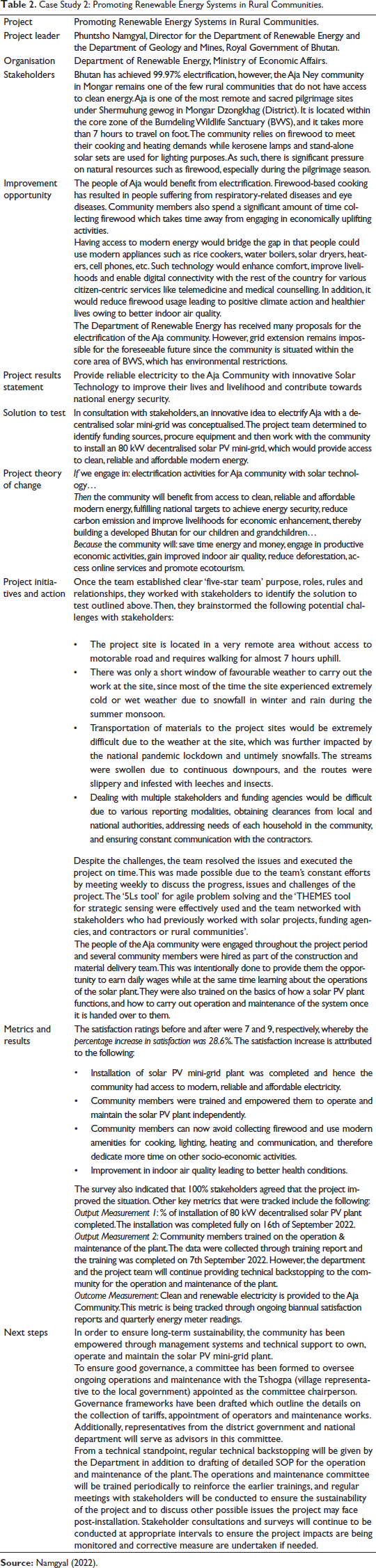
Co-created initiatives were then aligned with national priorities set forth in Bhutan’s twelfth five-year plan (GNHC, 2019), and projects became ‘leadership laboratories’ where executives and their team members learned and leveraged high-impact leadership tools while executing project objectives. As illustrative case studies, Tables 1–3 highlight the focus and outcomes of 3 of the 125 projects.
Case Study 1: Diagnosing and Preventing Non-Communicable Diseases.
Case Study 2: Promoting Renewable Energy Systems in Rural Communities.
Case Study 3: Enhancing Food Sufficiency and Food Security.

Each leader learned performance coaching skills and built high-performing ‘five-star teams’. Leaders were also given a practical leadership toolkit deployed via microlearning e-modules, with tools supporting performance accountability, strategic sensing, decision-making, trust, agile problem-solving, collaboration and change management. Leaders reported a 74% increase in their stakeholder engagement capability, a 90% improvement in their coaching skills and increases of 94% in high-impact team building, 108% in collaboration, 98% in agile problem solving, 85% in performance accountability and a 97% increase in change management capability (RCSC, 2022).
Throughout the program, as leaders learned and practised critical leadership skills, they also collectively completed 125 projects with results ranging from better waste management practices to improved health outcomes to accelerated academic performance for secondary students. 98.6% of 3,000+ stakeholders surveyed at the end of the program agreed that project efforts improved the situation, and stakeholder satisfaction increased by an average of over 28%. Meanwhile, 96% of participants indicated that the program was ‘more effective than other leadership training programs they have attended’, and several leaders expressed gratitude and said, ‘this program changed my life’. Indeed, although the trek towards enlightened human capability development and deployment is long and deliberate, the NLP program provided civil service systems and leaders with a powerful boost. By engaging in this leadership development experience, Bhutan has developed human capability (RCSC, 2022).
Why Human Capital Matters in Today’s World
Each country has multiple resources that create the nation’s future. Natural resources are minerals in the ground, global resources include country location and geographic resources include lakes, rivers and land. These non-renewable resources are often finite and need to be managed carefully to be sustained. Above the ground, a nation also has human resources that include the knowledge, skills and attitudes of its citizens. These resources are renewable in that they can grow through wise investment and transformation. They are characterised by a service and knowledge economy (Ulrich & Allen, 2014; Yeung & Ulrich, 2019).
Any organisation’s success (government agency, education institution, business enterprise) requires strategic clarity (mission, vision, goals) (Parnell, 2010), access to financial resources to invest (Beck & Demirgüç-Kunt, 2008) and operational excellence through technology and systems (Luz Tortorella et al., 2022). Realising strategy, financial and operational success requires people, organisation and leadership (Ulrich et al., 2017). When an organisation faces change, its people need to adapt to be successful (Ulrich & Yeung, 2019). Like a nation’s citizens, an organisation’s people can learn and grow (Bezuijen et al., 2010).
Leaders in government organisations or agencies (ministries, healthcare, education) can model how to care for people in a changing world (Bass et al., 1987). When government organisations model transformation, the government will fulfil its stewardship to its citizens, agencies will better deliver on their goals and firms will become more successful.
What Human Capability Means
As depicted in Figure 1, the management of people and organisations includes a host of initiatives that can be organised into four domains called human capability:
Talent: Talent refers to people, employees, workforce and individual competencies (Ulrich & Smallwood, 2012a). Organisation: Organisation refers to the team, culture, workplace and organisation capabilities (Ulrich et al., 2017; Yeung & Ulrich, 2019). Leadership: Leadership refers to the individual leaders who make set direction and make decisions and to the distribution of leadership throughout an organisation (Ulrich & Smallwood, 2012b). Human resources (HR): Human resources refers to the HR departments, practices (hiring, paying, training, setting policy) and people (Ulrich & Allen, 2014; Ulrich et al., 2009).
Human Capability.
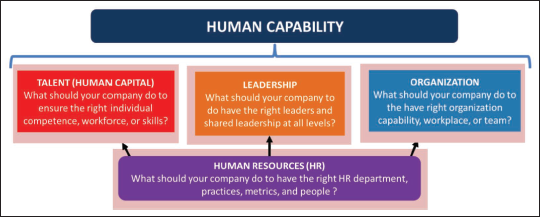
Transformation comes from targeted initiatives such as Bhutan’s NLP that impact each of the four domains (talent + organisation + leadership + HR) and focus on creating value for others (Ulrich, 2020).
Underlying ‘Brand’ or Identity
A nation, organisation or individual has a ‘brand’, or what they are known for that creates value for others who interact with them (Maurya & Mishra, 2012). A nation’s brand defines how citizens and guests think about the nation (e.g., Singapore’s service, Japan’s quality) (Fan, 2006), customers and investors perceive an organisation’s strength (e.g., Apple’s innovation, Huawei’s technological information) (Zhang, 2015), or how an individual is known (learner, caregiver) (Harris & Rae, 2011). Bhutan leaders have captured their emerging national brand as ‘believe’ (UNWTO, 2022).
Believe reflects meaning, purpose and what matters most. Believe captures the aspiration of what can be tomorrow and the actions today to fold the future into the present. Believe is rooted in ideas and images that envision future opportunity. Believe replaces doubt and helplessness with confidence and hopefulness. Believe turns emotional divisiveness into unity and well-being. Believe matters to many stakeholders: Individuals (human capital) who believe include each citizen, employee and visitor to Bhutan. Organisations (human capability) with believe include government ministries, education systems and business enterprises. Leaders (at all levels) who believe become meaning makers who make a difference.
When government transformation embodies the emerging brand of ‘believe’, three outcomes follow:
Efficacy: I (we) can achieve my (our) goals to make a difference in the world. Optimism: I (we) can continue to do so in the future. Imagination: I (we) can interpret the past and imagine and pursue a wide variety of future.
These three outcomes are the sustainable hope that ‘believe’ will create from your Bhutan’s government transformation.
Bhutan’s Transformation to ‘Believe’
In transforming Bhutan’s government service to align with the believe brand, each ministry and department has engaged in transformation projects and leaders of each initiative have learned and leveraged leadership tools that they can now continue to use to sustain the believe brand. By leveraging these tools, civil service systems transformed and leaders gained a common language that aligns with accountability, empowerment and an intense focus on identifying and exceeding stakeholder expectations. To facilitate said transformation, the NLP leadership program included a practical toolkit with the following tools:
Teams (Five-Star Teams): Build and empower high-performing teams with results, roles, rules, relationships and renewal. Performance Accountability (E/F Loops): Establish accountability by aligning expectations through goals, metrics and incentives, then give regular feedback to ensure continuous improvement. Strategic Sensing (THEMES): Constantly evaluate trends, organise information and project the future. Stakeholder Experience (3D-SX): Define stakeholder needs, then delight stakeholders you serve. Build Trust (3 Trust Rs): Be real, reliable, relatable and avoid personal agendas. Decisions (Decision Driver): Select a decision-owner ‘D’ and then surround them with support. Agile Problem-Solving (5 Ls): Solve problems with five skills: love it, look, leverage, leap and link. Performance Collaboration (Maestro Matrix): Identify and best practice ‘maestros’ and invite them to teach everyone else. Monitor Change (Change Dashboard): Manage change with a dashboard and use the tools to stay on track. Sustain Momentum (Spin Sessions): Meet with direct reports in weekly ‘spin session’ to empower and encourage them to develop themselves and delight stakeholders.
By learning these practical management tools and practising them in real project work, Bhutan leaders are now more able to embody the believe national brand by helping individuals realise their potential, organisations achieve their goals and leaders make a difference.
Importance and Challenge of Sustainability
Transformative sustainability is not an isolated event, management practice or program (Kuhlman & Farrington, 2010). Transformation needs to and can be sustained when ideas and practices have a lasting impact. Just like Bhutan’s physical resources can be sustained through thoughtful attention, human capability transformation can be sustained through practising key principles. Throughout the year-long NLP, Bhutanese leaders learned the following principles that embody what leaders can do to sustain transformation (Ulrich & Smallwood, 2013).
Alignment: Ensure that transformation initiatives link to the emerging Bhutan brand of ‘believe’. Simplicity: Keep focused on small and simple successes that can be prioritised, accomplished and have impact. Time: Spend time as the most critical leadership resource to put attention and energy on the transformation. Accountability: Hold self and others accountable to make sure that transformation aspirations happen. Meliorate: Learn from what works and what does not work to progress on transformation. Emotion: Feel the passion and energy of making change happen.
Recommendations
Although Bhutan’s culture, challenges and opportunities are unique, the scalable principles and practices learned and demonstrated in the NLP can be applied in many organisations and spheres. The approach outlined herein accelerates and scales leadership development while simultaneously sustainably exceeding stakeholder expectations. Specifically, organisations can build human capability and a strong organisational brand by leveraging the following elements in their talent development initiatives: constant community engagement, scalable project execution, insights grounded in global research, leader-led train-the-trainer approach, team-based learning, high fidelity customisation, peer performance coaching, practical change tools, microlearning, gamification, virtual synchronous expert-led learning, on-demand learning libraries, linked measurement and evaluation, and incentives that drive real results. We call on executives to set the example as leadership development facilitators and to empower mid-level leaders as facilitators of ongoing development activities. Furthermore, we advocate that human resources, talent and leadership development professionals avoid investing in development programs and training courses that are isolated from the real work and the stakeholders their organisations serve.
Conclusion
Bhutan has been the innovator in focusing nationally on the well-being of all living things within its borders (including human happiness and environmental sustainability) (Banerjee & Bandopadhyay, 2016; Kinga, 2019; Lepeley, 2017; Rose, 2017; Thinley et al., 2017). Now, to respond to external challenges, Bhutan continues to lead as a human capability incubator by transforming talent + organisation + leadership + HR into a shared and sustained brand of believe. Bhutan government leaders can continue to be universally respected for their commitment to creating a better future and have provided a practical pattern for accelerating sustainability in mission-driven organisations around the world.
Footnotes
Declaration of Conflicting Interests
The authors declared no potential conflicts of interest with respect to the research, authorship and/or publication of this article.
Funding
The authors received no financial support for the research, authorship and/or publication of this article.
