




Abstract
The textbook construct of a competitive labour market represents an ideal world in which workers and employers have equal bargaining power. Such a construct yields powerful conclusions: Wages are aligned with productivity; employers earn a normal rate of return; there is no involuntary unemployment and working poverty; regulations—such as minimum wages and the presence of unions—impedes the efficient functioning of the labour market. Yet, these conclusions—which have influenced, academic economists, policymakers and redoubtable international agencies—are impaired in the presence of unequal bargaining power of workers and employers. In such circumstances, unscrupulous employers can exploit the vulnerability of workers leading to such deleterious outcomes as working poverty, unsafe working conditions, use of child labour and so forth. This creates the rationale for appropriately designed regulations that seek to create a level playing field between workers and employers and thus facilitate the transition to an ‘inclusive’ labour market.
Keywords
Introduction
The textbook construct of a competitive labour market represents an ideal world in which workers and employers have equal bargaining power. Such a construct yields powerful conclusions: wages are aligned with productivity; employers earn a normal rate of return; there is no involuntary unemployment and working poverty; regulations—such as minimum wages and the presence of unions—impede the efficient functioning of the labour market. Yet, these conclusions—which have influenced, academic economists, policymakers and redoubtable international agencies—are impaired in the presence of unequal bargaining power of workers and employers. In such circumstances, unscrupulous employers can exploit the vulnerability of workers leading to such deleterious outcomes as working poverty, unsafe working conditions, use of child labour and so forth. This creates the rationale for appropriately designed regulations that seek to create a level playing field between workers and employers and thus facilitate the transition to an ‘inclusive’ labour market.
The normative framework delineated above sets the basis for assessing the nature of the South Asian labour market by highlighting the cases of selected, but regionally representative, countries—Bangladesh, India, Maldives, Nepal, Pakistan and Sri Lanka. Rather than focusing on metrics that seek to evaluate the extent to which the labour market in South Asia is competitive, the paper argues the need to establish the extent to which it is inclusive. This in turn leads one to ascertain the extent to which South Asian countries uphold core international labour standards (CILS) as mandated by member states of the ILO and the extent to which they are aligned with labour market indicators that reflect the ethos and values of the Sustainable Development Goals (SDGs). These labour market indicators (of which the ILO is a custodian agency) cut across working poverty, the unemployment rate, the degree of informality, gender disparities, the share of labour income in GDP, social protection, the status of young men and women in the labour force, the incidence of child labour and occupational health and safety.
An inclusive labour market creates an enabling environment for human resource development because such anomalies as gender discrimination, or indeed any form of discrimination, the use of child labour and the lack of social protection impede the capacity of individuals to reach their full potential. This normative framework also highlights the importance of labour productivity in determining living standards and the welfare of workers. It recognises the need to strike the right balance between the interests of workers and employers and thus avoid the risks associated with excessive regulations of labour markets that can curtail employment opportunities, especially for vulnerable workers.
The paper is structured as follows. As part of setting the analytical framework and empirical context, the first section summarises the view that influential international agencies, such as the OECD and the World Bank, have sought—at least in the past—to highlight the importance of creating a ‘flexible’ labour market within the context of a competitive business environment. The section notes that, in recent years, alternative evidence has emerged in which the exercise of monopsony power in labour markets by firms rather than cumbersome regulations turns out to be primarily responsible for impairing the welfare of workers. Furthermore, the World Bank’s much-cited ease of doing business indicators have now been discontinued in response to persistent concerns about its analytical and methodological soundness and normative foundations.
The second section introduces the reader to the ICLS as mandated by the ILO and highlights its pivotal role in meeting the criteria of inclusive labour markets. This section briefly enumerates SDGs and how selected indicators drawing on this framework can be used to assess the labour market in a global, regional and country-specific context.
The third section applies the ideas discussed in the second section to a sample of regionally representative South Asian countries. This is followed by a concluding section which offers a summary of the key issues and synthesises the key findings.
Assessing the labour market: The discourse on employment protection and the emergence of alternative frameworks.
As noted, elementary models of the labour market as enshrined in textbooks create a world in which utility-maximising workers interact with profit-maximising firms on an equal basis. The result is both an efficient and fair world in which workers are paid in line with productivity and firms earn a normal rate of return. Concerns about unsafe working conditions, the use and abuse of child labour, and various forms of discrimination are notably absent. Indeed, the message is that attempts to provide regulatory protections to workers will paradoxically hurt them by reducing employment opportunities and even economic growth.
One of the most influential documents reflecting this line of thinking was the 1994 OECD Jobs Study (1994). It concluded that the modest labour market performance of Europe relative to the USA in the 1980s and 1990s was that European labour markets were not sufficiently flexible. This led to a Jobs Strategy that highlighted the importance of enhancing labour market flexibility through appropriate reforms along with complementary policies.
The OECD also exerted its intellectual influence on policymakers by introducing measures of ‘employment protection legislation’ or EPL that ranked OECD economies—and selected non-OECD economies—by the strictness of regulatory protections in terms of hiring and firing workers. The EPL index varied from 0 (very few or negligible restrictions) to 6 (extremely high restrictions). The EPL measures were partly responsible for a progressive process of deregulation of labour markets across the OECD.
As noted, the OECD also publishes EPL measures for selected non-OECD countries, one of which is India. The available measures are a bit dated, but they show that between 2008 and 2012 India’s EPL was well in excess of the OECD average (3.19 vs 2.06). This begs the question: Does India’s higher EPL translate into sub-par economic and employment outcomes? In a highly influential paper, Besley and Burgess (2004) offered an affirmative answer. They argued that, based on Indian state-level data, those states that had ‘pro-worker legislation’ had adverse growth, investment, and employment outcomes. In an equally influential paper, Botera et al. (2004), based on 85 countries, arrived at similar conclusions, that is, attempts to provide greater bargaining power to workers are associated with poor employment and economic outcomes.
Critics have dismissed the Besley-Burgess paper as ‘bogus’ and have been equally dismissive of the Botero et al. (2004) paper (Storm, 2019). They highlight multiple analytical and methodological deficiencies of these papers and have decried their undue influence. There is a significant body of literature that concurs with the misgivings of the critics.
Furthermore, it is especially important to note that the OECD itself has moved beyond its 1994 position and has adopted a more nuanced approach to the assessment of labour market performance. Indeed, it emphasises the importance of ‘inclusive labour markets’ (OECD, 2022).
Among other international agencies, the World Bank has offered its contribution to the debate on the pros and cons of employment protection legislation. It went well beyond the OECD and offered a global perspective. In 2002, the World Bank launched an initiative entitled ‘Doing Business’ (henceforth DB) and sought to measure the ‘ease of doing business’ across the world (World Bank, n.d.-a). Countries were ranked on a range of indicators including an ‘Employing Workers’ (henceforth EW) index which conveyed the idea that labour market rigidities were one key factor that constrained the capacity of countries to have a competitive business environment that was deemed critical for driving economic growth (World Bank, n.d.-b).
The World Bank’s DB series become one of the most influential publications in development policy. They even motivated some governments to officially endorse the view that improving their international standing by improving their DB rank ought to be a policy priority, including those in Asia. 1 The EW index courted controversy soon after it was launched as part of the DB project (World Bank, 2018). As a result of relentless criticism from the ILO and others, the index was relegated to an appendix and removed from being counted in inter-country ranking exercises. The DB project itself met sustained opposition from its critics, including a former Chief Economist of the World Bank (Paul Romer) (The Economist, 2018). The DB series was formally withdrawn in September 2021. The World Bank is committed to releasing an updated version in late 2023 based on widespread public consultation (World Bank, n.d.-a).
The discourse on employment protection reflects either the implicit or explicit premise that workers and employers have equal bargaining power. Hence, shifting the balance in favour of workers through so-called pro-worker legislation can be prejudicial to the interests of both workers and employers. Yet, elementary economics is not limited to the discussion of the competitive labour market model. Models of ‘monopsony’ elements in the labour market are also discussed in which employers use their bargaining power over workers leading to a wedge between wages and productivity and sub-optimal employment. 2
For a long time, monopsony models of the labour market never enjoyed the prominence of its competitive counterpart in either academic or policymaking circles perhaps because they were deemed to be empirically insignificant. Yet, a growing literature has now shown that the exercise of labour market power by employers in countries such as the USA and the UK and the OECD in general is pervasive leading to wage suppression (i.e., wages being paid below productivity). 3 They partly explain why minimum wages—provided they are set at reasonable levels—tend to reduce the incidence of low pay without necessarily adversely affecting employment. They also partly explain a decline in the share of labour income in GDP in many countries, discrimination in the labour market along multiple dimensions and why anti-trust legislation or pro-competition policy should pay a lot of attention to the exercise of labour market power by employers. Those who subscribe to the empirical validity of monopsony models of the labour market also argue the case for reinvigorating collective bargaining mechanisms. This is one way of redressing the imbalance in bargaining power between workers and employers.
As noted, empirical work on monopsony models of the labour market appears to be plentiful in the OECD. South Asia, and other developing regions of the world, have not had a similar spate of empirical studies, but there is ‘…growing evidence that the competitive labour markets assumption is not valid for developing countries’ (Kanbur & Soundararajan, 2022).
One could readily argue that negative attributes of the labour market—such as low pay, gender disparities, unsafe working conditions and the incidence of child labour—which should be negligible in the ideal world of competition are instead pervasive. Hence, rather than being fixated on the costs of employment protection, one should focus on documenting the multiple dimensions along which there are labour market deficits (relative to specified benchmarks) in South Asia. This is where international core labour standards (ICLS) endorsed by all member states of the ILO in 1998 and subsequent extensions are so important in creating the normative benchmarks against which the quality of labour market performance can be judged. The approach embodied in the ICLS has now been reinforced by the adoption of the SDGs and the SDG-compliant labour market indicators that fall within the purview of the ILO as a custodian agency. The subsequent section is dedicated to a discussion of these issues.
Assessing the labour market: Insights from ICLS and the SDGs
ICLS have been part of the ILO’s advocacy ever since its inception (1919). In 1998, all member states of the IO—representing government, employers, and workers organisations- decided to embrace the notion of ‘fundamental principles and rights at work’ (henceforth FPRW). A subsequent amendment took place in 2022.
FPRW consists of:
Freedom of association and the effective recognition of the right to collective bargaining. The elimination of all forms of forced or compulsory labour. The effective abolition of child labour. The elimination of discrimination in respect of employment and occupation; and A safe and healthy working environment.
The FPRW are expressed in the form of conventions (C) and protocols (P) which are as shown in Table 1.
Fundamental Principles and Rights at Work.

Hence, one way of assessing the ethical dimension of the labour market in any country is to ascertain the extent to which countries have at least ratified the various ILO conventions. Of course, ratification is different from effective compliance. While the ILO compiles data on ratification on a regular basis, it is more challenging to monitor compliance. Despite this limitation, one measurement approach to compliance, and the evidence based on it, is discussed at a subsequent stage.
The ethos embedded in the ICLS is now part of the labour market indicators that are in turn derived from the principles and values enshrined in the SDGs. As is well known, the SDGs were adopted unanimously by the UN in 2015. The aim is to monitor the socio-economic progress of all countries of the world in terms of the SDGs and assess where they are by 2030. The full list of the seventeen goals is shown in Table 2.
The 17 SDGs.
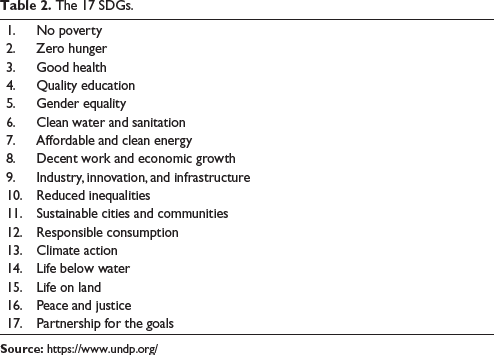
All international agencies within the UN system have been designated as ‘custodian agencies’ with specific responsibilities for monitoring progress in terms of selected SDGs. The ILO, given its mandate, is a custodian agency for SDG-compliant labour market indicators. The full list is shown in Table 3.
List of SDG-compliant Labour Market Indicators as Reported by the ILO.

In sum, there is now an internationally agreed framework that goes well beyond the discussion on the costs and consequences of employment protection as a way of measuring the quality of labour market performance. Except for forced labour, all the elements of ICLS (freedom of association, discrimination, child labour, a healthy and safe working environment) are encapsulated in the SDG-compliant labour market indicators.
The South Asian labour market: insights from ICLS and the SDGs
As a preamble to the discussion of the various indicators pertaining to ICLS and SDGs, it is worth noting that paucity of data is a major concern. In many cases, they are either missing or out of date. In India, for example, the ILO is unable to report earnings data by gender. In Nepal, even a basic indicator like the unemployment rate dates back to 2014. In order to circumvent data constraints, the ILO often resorts to ‘modelled estimates’ which is a euphemism for assigning values to missing observations. This is clearly an unsatisfactory state of affairs, and one hopes that the national authorities in South Asia will play their due role in alleviating data deficiencies.
Ratification of, and Compliance with, ILO-mandated Conventions
The discussion commences in this section with an overview of ratifications of ILO-mandated fundamental conventions in South Asia cutting across freedom of association, forced labour, discrimination, child labour, and health and safety at work. Figure 1 offers an overview. Bangladesh, Pakistan, Maldives, and Sri Lanka have the highest ratifications (eight), while India has the least (six).

Of course, ratification does not reflect the effectiveness of compliance with respect to the fundamental conventions. The ILO has offered, as part of the SDG monitoring system on the labour market, measures based on legal and textual data that assess the extent to which de jure national labour and employment laws are consistent with the fundamental conventions. This is shown in Figure 2.
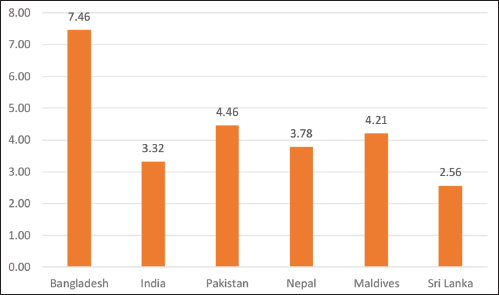
The discrepancy with the pattern revealed in Figure 1 can be readily detected. India, which has the lowest record on ratifications, now has one of the best scores (after Sri Lanka) in terms of the extent to which national labour and employment laws are aligned with the fundamental conventions. Bangladesh, on the other hand, which has the highest number of ratifications, has the worst record—and by a significant margin relative to its South Asian peers—in terms of the degree of compliance of national laws with the core conventions.
One could argue that even the measure of compliance with the core conventions as reflected in Figure 2 does not fully capture the extent to which there is de facto compliance. Here, the picture is quite bleak in South Asia as a whole. The key tripartite social dialogue mechanisms at the national level are passive, there are declining trends in collective bargaining and workplace cooperation, representation of vulnerable workers in the industrial relations system is weak, while there is a growing incidence of labour disputes (ILO, 2020). Hence, South Asia has a long way to go in terms of effective compliance with ICLS.
Working Poverty and the Living Standards of Workers
A measure of the health of the labour market is the extent to which the living standards of workers are adequate. An internationally agreed approach is to assess whether earnings of the average worker are enough to meet the necessities of life. Ideally, this should be based on earnings data derived from regular labour force surveys. Unfortunately, this is difficult to obtain in the case of South Asia (as well as in other developing regions of the world). A proxy that is used by the SDGs monitoring framework is the incidence of the employed population that lies below a global poverty line of USD 1.90 per day (see Figure 3). This yields the notion of ‘working poverty’ which is negligible in Maldives and Sri Lanka and highest in India (5.7%) followed by Nepal (5.1%). Bangladesh and Pakistan low levels of working poverty (<3%). Regardless of the initial level, an encouraging trend is that working poverty has fallen over recent years in all the South Asian countries under review.

Expanding Social Protection
Social protection provided by governments seeks to shield individuals and families and households from various vicissitudes in life—such as spells of involuntary unemployment, income losses due to health breakdowns, old age and so forth. The UN system is committed to a ‘social protection floor’ (SPF)—a goal in which all countries rich and poor, can provide various social benefits to a minimum standard. Currently, at the global level, about four billion people are without any form of social protection. What is the state of play in South Asia?
Figure 4 shows the proportion of the population covered by at least one social benefit. Sri Lanka has the highest coverage, Nepal the lowest. Even then, social protection coverage rates are well below the benchmark of a universal SPF. Attaining the aspirations of SPF is thus a major challenge in South Asia.
Population Covered by at Least one Social Benefit (%).

Women and the World of Work
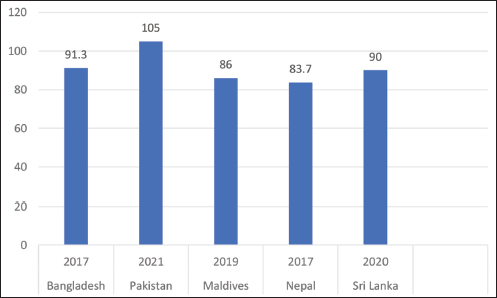
Gender disparities in the work place are significant and persistent around the world. It is widely agreed that a reduction in gender disparities is one of the hallmarks of an inclusive labour market. Two indicators on gender disparities are part of the SDG monitoring framework: (a) share of women in management and (b) the gender pay gap. Figure 4 corresponds to indicator (a) while Figure 5 corresponds to indicator (b).

In all cases, the representation of women in management is low. It is lowest in Pakistan and Bangladesh, followed by Nepal and India. Maldives has a female representation rate in management of >25%.
An unanticipated element of Figure 5 is that female workers earn a little more than men in Pakistan. Elsewhere the status quo prevails, that is, women earn less than men, with the gender pay gap ranging from 83% (Nepal) to 91% (Bangladesh). Unfortunately, there is no pertinent information on India (Figure 6).
Growth, Labour Productivity and Structural Transformation
The SDG-compliant labour market indicators are anchored in the notion of economic growth and decent work (Goal 8). Economic growth is driven by two key sources: (a) factor accumulation and (b) factor productivity. Labour productivity in turn is a key aspect of factor productivity, given the efficiency with which the capital stock is used and the level of technology.
The sources of economic growth can also be analysed from a sectoral perspective. Thus, economic growth is propelled by a process of structural transformation. This means a shift of resources from low productivity to high productivity sectors. In the context of low- and middle-income economies, the informal sector has a preponderance of low productivity activities and high incidence of working poverty, while the formal manufacturing sector exhibits above-average productivity. Hence, a decline in the employment share of the informal sector—and informal employment in general—is a sign of structural transformation as is an increase in the share of employment in manufacturing.
Figure 7 displays trends in labour productivity in real terms (constant US dollars) for the 2011–2022 period. India and Bangladesh have the highest labour productivity growth for the relevant period (>4%) that is consistent with their status as among the most rapidly growing economies in the developing world. The other South Asian economies have moderate labour productivity growth rates, while Maldives has experienced a decline in labour productivity.
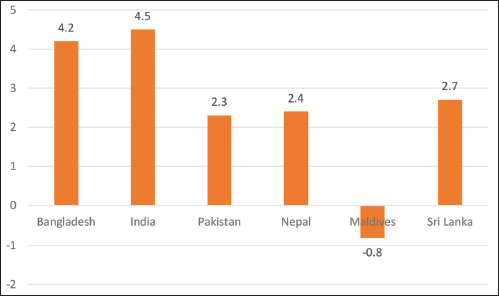
Figure 8 shows that the share of informal employment is strikingly high in Bangladesh (>90%) while it is high in India, Pakistan and Nepal (>80%). Maldives has the lowest incidence of informal employment (<50%) followed by Sri Lanka (<70%). 4
Proportion of Informal Employment in Total Employment (%), Various Years, 2017–2021.
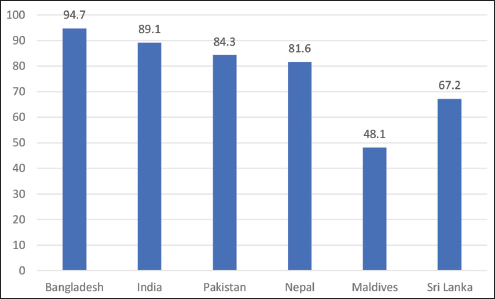
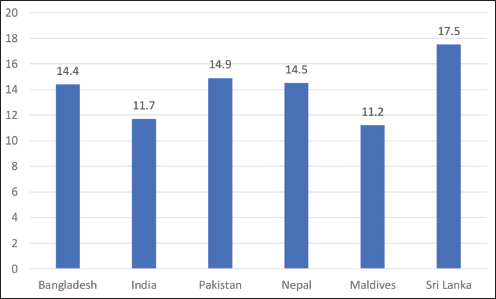
Figure 9 shows the employment share of manufacturing for the selected countries. Maldives has the lowest share of manufacturing employment (around 11%), while Sri Lanka has the highest (>17%). The employment share of manufacturing in India (just over 11%) is well below the regional norm (14%).
Underutilisation of the Workforce and the Status of Young People
The overall ‘open’ unemployment rate is a widely used measure of inadequate utilisation of the skills and talents of the workforce. For young men and women, the SDG monitoring seeks to focus on those who are truly left behind. It is important to record the relative size of young people who are neither in employment nor in education and training (NEET). As the OECD observes:
‘Young people who are neither in employment nor in education or training are at risk of becoming socially excluded – individuals with income below the poverty-line and lacking the skills to improve their economic situation’ (OECD, n.d.).
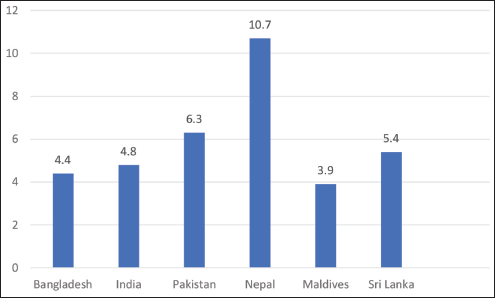
Figure 10 shows the aggregate unemployment rate for the South Asian countries under review. Nepal has the highest unemployment rate (over 10%) followed by Pakistan (just over 6%). For rest, the unemployment rate is in the 4–5% range.
The NEET rate, shown in Figure 11, is high for all the South Asian countries under review and particularly high for Pakistan and Nepal (well over 30%). This represents a major challenge for progress towards an inclusive labour market in the region.

Child Labour and Its Incidence
As the ILO puts it:
The term “child labour” is often defined as work that deprives children of their childhood, their potential and their dignity, and that is harmful to physical and mental development.
This should be read in conjunction with the ILO standard of minimum age set at 18 for hazardous work, thirteen for light work and fifteen for general, non-hazardous employment). The ILO proceeds to offer an important clarification of what should not be considered as ‘child labour’. Thus:
Not all work done by children should be classified as child labour that is to be targeted for elimination. The participation of children or adolescents above the minimum age for admission to employment in work that does not affect their health and personal development or interfere with their schooling, is regarded as being something positive. This includes activities such as assisting in a family business or earning pocket money outside school hours and during school holidays. (International Labour Organization, n.d.)
As the ILO also points out, multiple evaluations have shown that large scale use of child labour depletes the rate of human capital accumulation and hurts growth.
How does the South Asian region fare with respect to the employment of child labour? There is paucity of data with Maldives and Pakistan providing no pertinent information. In some cases, the data reported is dated, as in the case of Nepal. Child labour is significant in Bangladesh, strikingly high in Nepal and negligible in India and Sri Lanka.
Health and Safety at Work
A safe and healthy workplace represents the hallmark of a well-functioning labour market. The pertinent SDG indicators makes a distinction between non-fatal and fatal injuries (both expressed per 100,000 workers).
The issue of health and safety at work is an essential element of the policy agenda in South Asia, especially in light of the Rana Plaza disaster that struck Bangladesh on 24 April 2013. A multi-stories commercial structure, known as Rana Plaza, on the outskirts of the capital city Dhaka, housing garment factories and other establishments collapsed. This led to the death of more than 1,000 workers and incapacitated thousands. The tragedy tarnished the reputation of Bangladesh as one of the world’s leading exporters of garments, garnered a great of global media attention, galvanised policy actions among donors, the ILO, international NGOs, and the national government. Significant progress has been made since then in the sphere of occupational health and safety in the garments industry, but there is still considerable scope for improvement (Rahman & Yadapalli, 2021).
It is disappointing that, despite its critical importance, data on occupational injuries, both fatal and non-fatal, are missing in the case of most South Asian countries. Only Pakistan and Sri Lanka on provide data on non-fatal work-related injuries, while only Sri Lanka maintains administrative records on fatal injuries in the workplace safety. The incidence of non-fatal occupational injuries is shown in Figure 12. They appear high in Pakistan and exceptionally low in Sri Lanka. Fatal work-related injuries are also quite uncommon in Sri Lanka (at least as reported by the ILO).
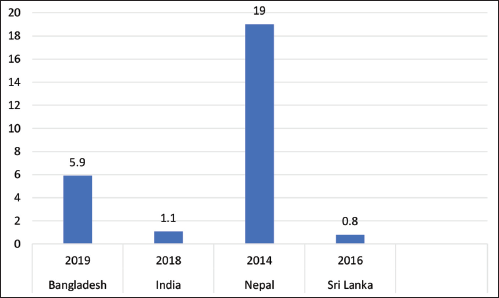
Critical readers might raise concerns about the credibility of the Sri Lankan figures. They are based on administrative records which might be under-reported. The figures for Pakistan, on the other hand, are based on labour force surveys. Hence, direct comparisons between the two cases are problematic.
Labour Income Share and the Issue of Equity
The share of labour in GDP is considered by the SDG monitoring framework as one of measures of equity (Figure 13). Thus, a low and/or declining share of labour income signifies that the fruits of economic growth are being unequally shared. Where do the South Asian countries stand from the perspective of this equity measure? Once again data limitations are immense, with the ILO only offering ‘modelled estimates’.
Labour Share of GDP, Comprising Wages and Social Protection Transfers (%), 2020.

It appears that only India—and Pakistan—have labour income shares that are aligned with global norms. All the countries under review in South Asia have labour income shares that are well below 50%.
Concluding Remarks
An influential strand in the literature on labour markets tends to focus on the adverse effects of ‘pro-worker’ legislation. This entails a presumption that workers and employers have equal bargaining power. Hence, regulatory protections for workers are seen as disrupting the status quo and thus paradoxically hurting rank-and-file workers by constraining employment opportunities. Yet, there is growing empirical evidence that employers can—and do—exercise labour market power to the detriment of workers. Furthermore, multiple labour market maladies that afflict ordinary workers across the world, especially in low- and middle-income countries including those in South Asia, cannot be readily reconciled with the normative framework of a competitive labour market. Ideally, one would like to offer thorough empirical substantiation of the view that labour markets are affected by monopsony elements, but this is limited in the case of South Asia. One way forward is to embrace the notion of inclusion in labour markets. An internationally agreed framework now exists to do so that combines key elements of ILO-mandated ICLS with the ethos and principles of the SDGs.
When applied to selected South Asian countries—Bangladesh, India, Pakistan, Maldives, Nepal and Sri Lanka—the evidence reveals multiple labour market challenges that cannot be reconciled within the narrow confines of a competitive labour market model and its preoccupation with the pros and cons of employment protection. While extreme poverty in the workforce and the unemployment rate appear to be moderate in South Asia, there are many notable deficiencies. These include: the inadequate coverage of social protection, the enormous size of the informal economy and the social exclusion of young men and women. Gender disparities cannot be ignored either, especially in terms of the low representation of women in management positions. The issue of health and safety at work too has emerged as a major area for remedial policy action, especially in light of the Rana Plaza tragedy of 2013. With the exception of India, labour’s share in GDP in the countries under review are strikingly low indicating that the benefits of growth are unequally shared.
The attenuation of labour market deficits along the lines documented here is particularly relevant for broad-based human resource development. The expansion of social protection, facilitating the transition to formality, integrating socially excluded young men and women both in education and training and the workforce, reducing gender disparities, and promoting a healthy and safe workplace empower individuals, families, and households to play a productive role in society by increasing their economic resilience and by creating opportunities for investing in human capital. Sustained improvements in SDG-compliant labour market indicators require policy actions that in turn need to be anchored in regular and reliable data. One hopes that the national authorities in South Asia will invest resources in enhancing a data-driven approach to SDG-oriented labour market assessments.
Footnotes
Declaration of Conflicting Interests
The author declared no potential conflicts of interest with respect to the research, authorship and/or publication of this article.
Funding
The author received no financial support for the research, authorship and/or publication of this article.
