



Abstract
Purpose:
This study aimed to characterize benefits of asynchronous online focus groups (AOFGs) for lesbian, gay, bisexual, transgender, queer, intersex, asexual, and other sexuality- and gender-expansive (LGBTQIA+) young adults with a cervix and to identify strategies for maximizing those benefits and optimizing data collection in order to increase equitable representation of this population in health research.
Methods:
From March to September 2022, we conducted six gender-stratified AOFGs with cisgender women, nonbinary people, and transgender men with a cervix ages 21–29 living in Massachusetts and Rhode Island. Participants completed a questionnaire to evaluate AOFG procedures and experiences. Based on these data and our observations of AOFG engagement, we developed and evaluated strategies to optimize both data collection and participant benefit.
Results:
AOFGs provided participants with informational and instrumental support, connection through shared experiences, and opportunity for introspection. Participants expressed a strong desire for social interaction within AOFG discussions, and we identified several strategies that were effective in promoting engagement and interaction in AOFGs.
Conclusion:
AOFGs can facilitate inclusion in research of LGBTQIA+ individuals for whom other data collection methods are inaccessible, and may offer direct social and emotional benefits to participants. Promoting social interaction among participants is essential for optimizing these benefits. These findings offer important insight for AOFG methodology as a means of increasing equitable representation of LGBTQIA+ people in health research while offering direct and immediate benefits to participants.
Introduction
Following historical erasure, marginalization, and abuse of lesbian, gay, bisexual, transgender, queer, intersex, asexual, and other sexuality- and gender-expansive (LGBTQIA+) people with a cervix in public health and medicine, 1 researchers continue to perpetuate structural violence against these populations by failing to ensure their equitable representation in many areas of health research.2,3 LGBTQIA+ populations are often described as “hard to reach”; however, a more accurate assessment may be that researchers have yet to optimize methods to engage these populations.4–6 Achieving equitable representation of LGBTQIA+ people in health research requires refinement of methodologies that make studies more accessible and acceptable to these populations.
Asynchronous online focus groups (AOFGs), discussions that take place over the course of several days on an online forum, maintain the group interaction through which participants are able to refer to and expand on each other’s responses, a defining feature of focus group methodology as a whole.7,8 Although AOFGs may not capture some of the interpersonal dynamics unique to in-person communication, they can offer unique and important insight into participants’ natural online interactions. 9 Further, AOFGs are not restricted by participants’ geographic location or access to transportation, allowing participants to engage on their own schedules and to take more time to formulate responses, and can be anonymous.10–12
Prior research suggests that AOFGs are particularly well suited for studying structurally minoritized populations and sensitive topics.12,13 AOFGs have been utilized with a number of different LGBTQIA+ populations and health topics,14–22 including sexual health care access among transmasculine adults. 13 These studies show that participants benefited from the opportunity to connect with others with shared gender identities; however, only a small number of prior studies have specifically described participants’ evaluations of AOFG methodology.13,18,23
This analysis was part of a parent study exploring determinants of cervical cancer screening access among LGBTQIA+ young adults with a cervix, who experience numerous inequities in these areas.24–28 In this article, we present participants’ evaluations of AOFG methodology and their perceived benefits of AOFG participation. Using participant data as well as our observations about the nature and extent of participants’ engagement with AOFG discussions, we evaluate different approaches to structuring and moderating AOFGs in order to optimize both data collection and benefits to participants.
Materials and Methods
Recruitment and enrollment
We recruited LGBTQIA+ young adults with a cervix using purposive sampling through online and offline venues. We posted social media-friendly graphics to dating apps and social network channels and posted fliers at coffee shops, medical clinics, and other physical locations in Rhode Island (RI) and Massachusetts (MA). We also invited local LGBTQIA+ organizations, including community advocacy groups, health centers, and support groups, as well as LGBTQIA+ student centers at colleges and universities, to disseminate recruitment materials. Further, we implemented a chain-referral approach by encouraging participants, as well as individuals who expressed interest in the study but were themselves ineligible to participate, to share recruitment materials with their networks.
To be eligible to participate, individuals were required to be LGBTQIA+, have a cervix, live in RI or MA, be able to read and write English, and have access to the internet. In addition, in order to be able to assess routine cervical cancer screening uptake against a uniform standard as part of the parent study, we restricted the age range for eligibility to 21–29 years, because cervical cancer screening guidelines in the United States (US) at the time of data collection recommended Pap testing every three years for individuals in this age range. 29
We utilized non-proportional quota sampling, aiming for 50% of all AOFG participants to be from minoritized racial and ethnic groups. 30 Upon achieving target enrollment numbers of White participants, we added subsequent White prospective participants to a waiting list in a modified phase recruitment approach. 31 Individuals who completed the screening questionnaire and met all eligibility criteria were either deferred to the waiting list or invited to complete informed consent and enroll in the study.
Data collection took place from March to September 2022. The Brown University Institutional Review Board approved all study procedures.
AOFG procedures
Participants created anonymous usernames on the secure online forum platform vBulletin Cloud. 32 The website included a unique forum for each AOFG that was only visible to members of each respective group. Each group’s forum included a separate discussion board that became visible to participants several days prior to the start of their AOFG discussion and provided instructions for using the forum, including: viewing moderator questions and other participants’ responses, making posts and comments, tagging the moderator or other participants, and subscribing to the discussion. This instructional discussion board also delineated the policy prohibiting harassment and hate speech, the expectation of mutual respect and confidentiality, and participants’ right to skip any questions they were uncomfortable answering, information which was reiterated at the start of each AOFG discussion.
All communication between participants took place in writing on the AOFG forum. Each day of the AOFG discussions, we posted brief messages visible at the top of the webpage to welcome participants, direct them to the discussion board, and thank them for participating. We sent participants daily reminder emails, and participants had the option to subscribe to the forum and receive email notifications about new posts. The moderator and participants could make standalone posts to the forum or comment on others’ posts, and had the ability to tag each other (i.e., “@username”), which triggered a notification to be sent to the tagged participant. We utilized a combination of these strategies, testing minor changes in the frequency and type of follow-up questions, tagging, and other approaches to encourage participant engagement over the course of the study based on participants’ post-focus group questionnaire feedback.
Questionnaires
After providing written informed consent and prior to being assigned to an AOFG, participants completed a brief pre-focus group questionnaire to report demographic characteristics.
We assessed participants’ gender using two items: gender identity (“What is your gender identity?”) and transgender identity (“Do you identify as transgender?”). We assessed participants’ sexual identity with the multiple-response question, “What is your sexual identity?” (See complete lists of gender identity, sexual identity, and transgender identity response options provided, as well as “Another gender identity” and “Another sexual identity” write-in responses, in Table 1).
Demographic Characteristics of Lesbian, Gay, Bisexual, Transgender, Queer, Intersex, Asexual, and Other Sexuality- and Gender-Expansive Young Adults with a Cervix in the Asynchronous Online Focus Group Study Sample (n = 50)
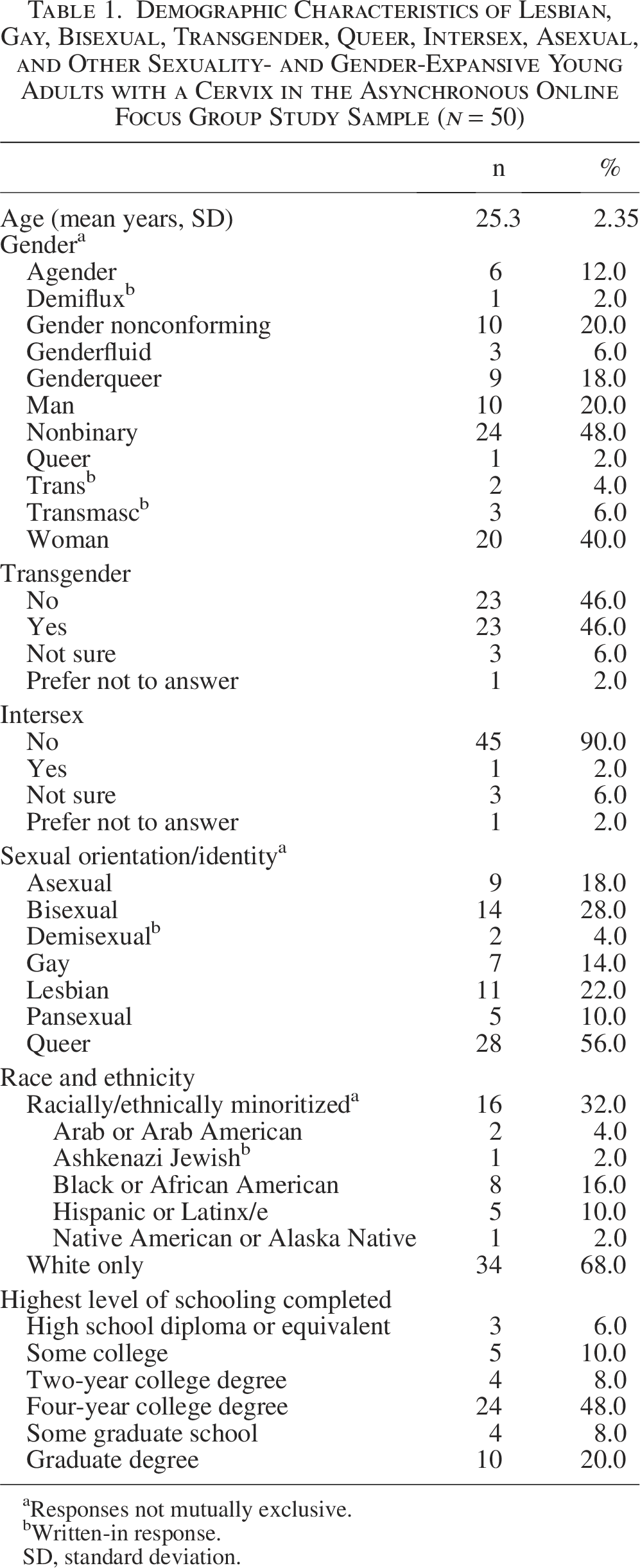
Responses not mutually exclusive.
Written-in response.
SD, standard deviation.
To assess self-identified intersex status, we included the question, “Are you intersex? (By ‘intersex,’ we are referring to the fact that some people are assigned male or female at birth, but are born with sexual anatomy, reproductive organs, or chromosome patterns that do not fit the typical definition of male or female),” offering the response options “yes,” “no,” “not sure,” and “prefer not to answer.”
We collected participants’ racial/ethnic identity using the multiple-response question, “What is your race/ethnicity?” (Response options: “Arab or Arab American,” “Asian American or Pacific Islander,” “Black or African American,” “Hispanic or Latinx/e,” “Native American or Alaska Native,” “White,” “Another race/ethnicity (please specify),” and “Prefer not to answer”).
Upon the completion of each AOFG discussion, we invited participants to complete a post-focus group questionnaire with a combination of multiple-choice and open response items. To evaluate the acceptability of the AOFG platform, we asked participants to rate the difficulty or ease of signing up and logging in, viewing other participants’ posts, and posting their own responses, followed by the open response question, “Please share any other thoughts you have about the difficulty or ease of using the focus group website.” To evaluate perceived confidentiality and security, we asked participants to rate their confidence that their posts were kept secure and confidential by the AOFG website and by the other participants.
We also asked participants to rate their enjoyment of the AOFG study, as well as their likelihood of participating in another similar study and of recommending a similar study to a friend, followed by the open response question, “What did you like or dislike about participating in this focus group?” We asked participants to rate the degree to which they believed that they, their fellow participants, and their communities benefited from the AOFG study, followed by an open response question to explain their rating.
We administered all questionnaires and consent forms using Qualtrics. 33
Participant compensation
Participants received compensation in the form of digital Amazon gift cards in the amount of $10 for each day they made at least one post to the AOFG forum and $5 each for completing the pre- and post-focus group questionnaires, for a possible total of $50.
Data analysis
We generated descriptive statistics of closed-response questionnaire items to summarize demographic characteristics and evaluations of AOFG procedures. To characterize participants’ explanations of their ratings and descriptions of benefits and recommendations, we analyzed responses to the open response questionnaire items using a framework approach.34,35
Reflexivity and positionality
The authors hold diverse identities and backgrounds with respect to sexual orientation, race and ethnicity, academic discipline, and other attributes that shape our individual and collective positionalities and thus our engagement in research. 36 In the present study, our respective positionalities almost certainly informed, to varying degrees, the initial motivation for and conceptualization of the study, as well as the design and execution of the recruitment approach, data collection instruments and methods, and analysis and interpretation of the data.
The first author (M.C.M.), who led recruitment efforts, corresponded with participants, and moderated the AOFG discussions, is a queer, White, cisgender woman, resulting in an insider/outsider dynamic characterized by “insider” status among some participants with shared identities and “outsider” status among others (e.g., those who were transgender or nonbinary, or who held minoritized racial or ethnic identities). 37 Throughout the study process, this “insider” status may have helped to establish trust with LGBTQIA+ community groups and participants, whereas “outsider” status may have negatively affected individuals’ comfort or willingness to participate in the study or to share personal experiences. 38 Authors’ personal identities and experiences also provide a foundation and context for data analysis and interpretation, which can lend both strengths and limitations. 39 In the present study specifically, shared identities between authors and participants may have provided some additional insight that strengthened the analysis,40,41 whereas both similarities and differences may have introduced bias.37,38
In an effort to mitigate possible limitations and biases, we consulted subject matter experts and members of the authors’ personal and professional networks who had relevant academic or lived expertise—including transgender and gender-non-conforming individuals in particular—throughout study design and execution. These individuals reviewed and provided feedback on data collection instruments to identify possible oversights, as well as to ensure sensitivity when asking participants about potentially difficult or traumatic prior health care experiences. We also received feedback from community members and LGBTQIA+ organizations involved in study recruitment, some of which informed revisions to ensure clarity and inclusivity of recruitment materials and methods.
Results
A total of 56 LGBTQIA+ young adults with a cervix participated in one of six AOFG discussions: two groups with only cisgender women (n = 7 and n = 9), two with only nonbinary people (n = 10 and n = 11), one with only transgender men (n = 8), and one with both nonbinary people and transgender men (n = 11). Demographic characteristics are presented in Table 1. Of the 56 total AOFG participants, 50 completed the post-AOFG questionnaire and are included in this analysis. There were no meaningful demographic differences between participants who did and did not complete the questionnaire.
Perspectives on AOFG methodology
The majority of participants were confident that their information was kept secure and confidential by the AOFG forum website (88.0%) and by other participants (70.0%; Table 2). This led participants to feel comfortable discussing topics in the AOFGs that they were less likely to discuss in their day-to-day lives. For example, a participant in a nonbinary group wrote, “I love anonymously talking about taboo/intimate things. less pressure if someone corrects me/needs more info.” Several participants also indicated that the anonymity uniquely led them to feel able to participate. For example, a participant in the transgender men’s group wrote, “I probably would not have felt comfortable signing up or participating in an in-person or live focus group about this subject.”
Evaluation of Asynchronous Online Focus Group Procedures Among Lesbian, Gay, Bisexual, Transgender, Queer, Intersex, Asexual, and Other Sexuality- and Gender-Expansive Young Adults with a Cervix (n = 50)

AOFG, asynchronous online focus group.
The personal benefit most commonly cited in participants’ post-focus group questionnaires was the social interaction with other individuals with shared identities and experiences. Notably, the only negative feedback about social interaction from the questionnaires was a desire for more interaction. A participant in the first group of nonbinary people (the second AOFG discussion conducted) wrote, “It was difficult to interact with others in a meaningful way though, and I feel like there wasn’t much group discussion aside from each sharing our answers.” In the early AOFGs, we released sections of the focus group guide, including some pre-planned follow-up questions two to three times per day, and used additional follow-up questions primarily to ask for clarification or invite participants to expand on their responses with additional detail. With this structure, the discussion progressed in a fairly linear manner, where participants responded to each new set of questions with little other interaction.
To increase interaction in subsequent groups, we tested shorter and more frequent follow-up questions, finding that these were more effective in promoting participant interaction than longer, less frequent questions. Although we continued to refer to the focus group guide, we did so in a more conversational manner: posts introducing new topics were shorter and contained fewer questions at once, and we used probes and follow-up questions based on participants’ responses to advance the discussion. Moderator follow-up questions in the form of comments on participants’ posts instead of standalone posts facilitated more frequent and conversational exchanges. A participant in a nonbinary people’s group reported appreciating “that the forum leader would post follow-ups: this helped keep the conversation going and allowed us to add more details about our experiences or thoughts on pap testing/sexual health.” In addition, tagging participants in follow-up questions and encouraging participants to comment on other posts and tag each other led to a higher number of responses and a greater level of detail in responses.
A participant in a nonbinary people’s group who noted that not all participants in the AOFG contributed equally to the discussion suggested modifying compensation criteria to encourage increased engagement from all participants: “I think in the future it could be good to require a bit more of participants, such as having to post and comment on another post, or having to respond to follow-up questions.” Implementing more stringent criteria for compensation may indeed increase participant engagement and thus interaction among participants; however, we were unable to evaluate this recommendation in the present study. Another potential strategy we were unable to test is enabling participants to “like” or otherwise react to each other’s posts without writing a response, as in most digital communication platforms, which could further increase the sense of interaction among participants.
Enjoyment and benefits of the present AOFG study
Participants’ evaluations of the AOFG study were positive overall. The majority of participants (76.0%) reported that they “Enjoyed” or “Really enjoyed” participating; 22.0% were neutral, and one individual did not enjoy participating (Table 3). A participant in a nonbinary people’s group wrote, “it was a blast. you ask good questions & made me feel heard. good job dudes.” This sentiment of feeling “heard” was common throughout participants’ questionnaire responses; as a participant in a nonbinary people’s group noted, “most studies don’t take into consideration non-cis peoples perspectives and experiences on sexual health topics.” This seemed particularly salient for participants who were nonbinary or transgender in contrast to cisgender women.
Evaluation of Enjoyment and Benefits of Asynchronous Study Among Lesbian, Gay, Bisexual, Transgender, Queer, Intersex, Asexual, and Other Sexuality- and Gender-Expansive Young Adults with a Cervix (n = 50)
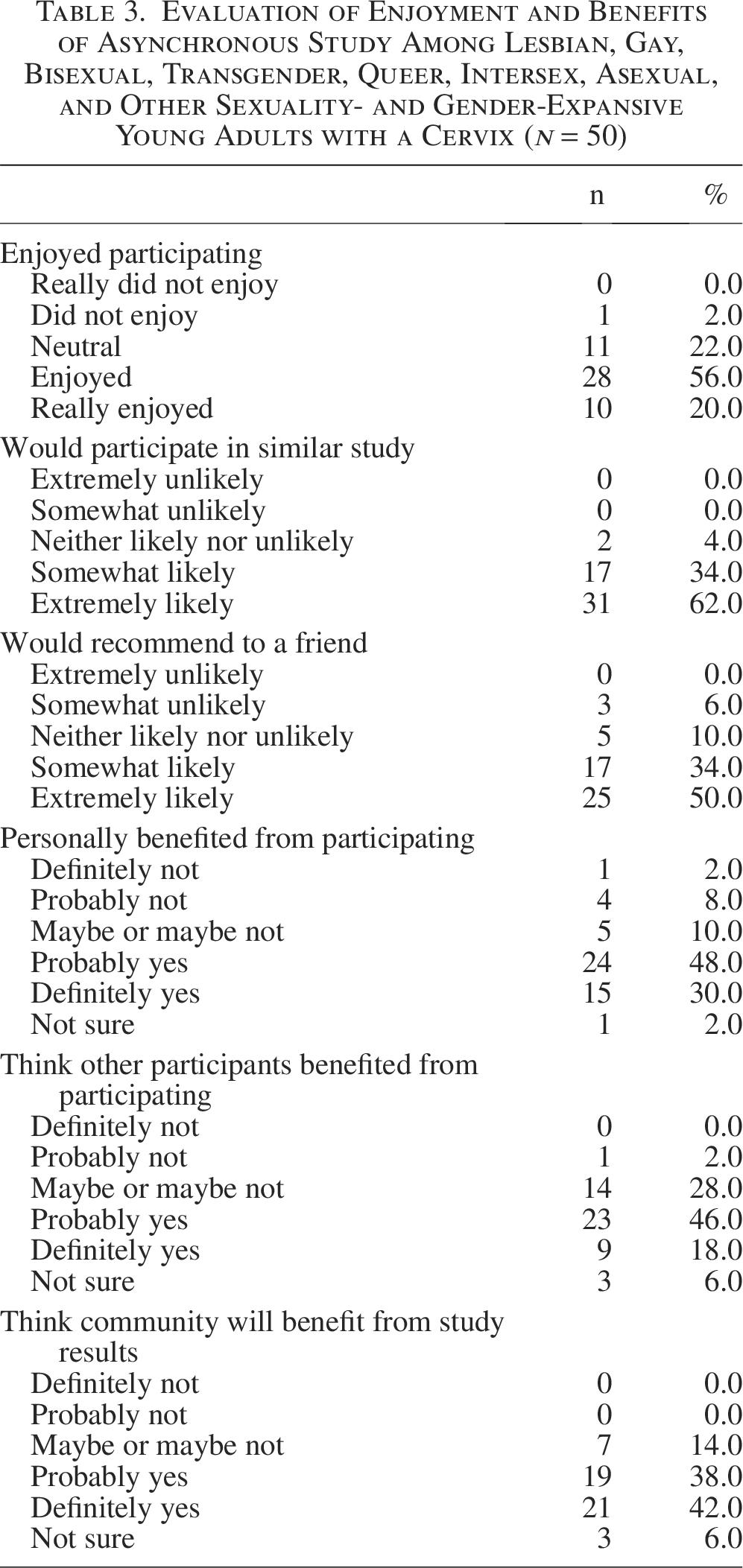
Nearly all participants (96.0%) said that they would be likely to join another similar study, and 84.0% would be likely to recommend a similar study to a friend. Overall, 78.0% of participants said that they personally benefited from participating, and 64.0% said they thought other participants benefited (Table 3). The most commonly cited personal benefits and reasons for enjoyment were exchanging informational and instrumental support, finding connection through shared experiences with fellow participants, and having an opportunity for introspection.
Informational and instrumental support
During AOFG discussions, most participants discussed resources they had personally used to find cervical cancer-related information, such as specific websites and social media pages. A number of participants also specifically requested recommendations from each other, leading to an exchange of local and national LGBTQIA+ community resources for trustworthy information. Reflecting on this on the post-focus group questionnaire, a participant in the transgender men’s group wrote, “Reading other participants’ comments gave me a lot of information and tips on good LGBT groups to look into.”
In addition, several participants mentioned on the post-focus group questionnaire that they appreciated the experiential knowledge shared during discussions. For a participant in a cisgender women’s group, this included learning from others’ approaches to navigating sexual and reproductive health care: “I think they [other participants] benefited similarly to me, they were able to see how other people were received by healthcare professionals and strategies to benefit their sexual health.” A participant in a nonbinary people’s group noted the value of sharing experiences around the subject of sexual and reproductive health in particular, writing, “This was a cool experience to get to share info with others and get other peoples perspectives as well, especially on a topic that some consider sensitive.”
Connection through shared experiences
Interacting with others who shared participants’ identities, experiences, and perspectives was another notable benefit of AOFG participation. Several participants specifically described feeling less alone through the AOFG discussions in their post-focus group questionnaires. A participant in a cisgender women’s group, reflecting on the potential benefit to other AOFG participants, wrote, “I hope that everyone sharing their experiences helps others not feel so alone.” A participant in a nonbinary group took solace in hearing from others, writing, “I found it comforting that some people had the same experience and perspectives as myself.”
Opportunity for introspection
Several participants reported that taking part in the study led them to examine their own prior experiences and perspectives around sexual and reproductive health. A participant in the group of nonbinary people and transgender men wrote, “I also enjoyed how I was able to reflect on my experience in the health care system, something I probably wouldn’t have done otherwise.” AOFG discussions also helped some participants process their experiences in new ways. For example, a participant in the transgender men’s group wrote, “I was able to understand why I felt the way I do about Pap smears.” Similarly, a participant in a nonbinary group wrote, “It was nice to examine my own knowledge about pap smears, and it was interesting to finally put some of my thoughts on the subject into coherent, helpful statements,” later adding, “sometimes sitting down and formulating your thoughts into something tangible can be really therapeutic and helpful.”
Discussion
To our knowledge, this is the most in-depth examination of the social and emotional benefits of AOFG methodology to participants, and the first study with this explicit focus. This study lends support to previously published evidence of the acceptability of AOFGs for research around sensitive topics among LGBTQIA+ adults13,23 and the potential of AOFGs to be a source of informational support around sexual health. 18 As in other AOFG studies among transgender and gender diverse adults,13,23 we found that participants valued the opportunity to connect with others with shared identities and experiences. Our study expands on these prior findings with the inclusion of multiple gender groups and an in-depth characterization of the social and emotional effects of AOFGs on participants.
Discussing with others with shared identities and experiences in a virtual medium led participants to feel connected and validated. AOFGs are uniquely able to facilitate this type of connection because they overcome many of the barriers to in-person social interaction, bring together people with minoritized identities in a way that may be difficult for participants to find on their own, and offer anonymity that led many participants to feel comfortable discussing and receiving support around sensitive topics. Many participants also benefited from the introspection and self-reflection afforded by AOFGs, because the asynchronous nature allowed participants to take more time to reflect when formulating their own responses.
A prior study suggested that AOFGs prevent participants from building rapport. 42 Our findings do not align with this earlier research, as post-focus group questionnaire data clearly show that participants found a meaningful connection with others in their AOFG discussions. Another study suggested that AOFGs limited the breadth or depth of data collected 43 compared to traditional focus groups; we did not find this to be the case. In addition, because the AOFG methodology enabled us to include individuals who would not have felt comfortable participating in a traditional focus group on this topic, these AOFGs produced data that we would have been unable to collect using traditional focus groups.
Limitations
This study is subject to some limitations. First, although the proportion of White participants accurately reflected the state populations of RI and MA,44,45 we did not achieve our goal of 50% representation of Black, Latine, Indigenous, Asian, and other racially and ethnically minoritized people. Sexual and reproductive health inequities rooted in cisgenderism and heterosexism may be further compounded by racism46–48 ; therefore, equitable representation of LGBTQIA+ people with minoritized racial and ethnic identities in health research is critical. 49
Second, because study eligibility was limited to those ages 21–29 living in RI and MA, the findings may not be generalizable to LGBTQIA+ people in other age groups and geographic regions. The study sample was also highly educated, which may further limit generalizability, and we were not able to assess possible differences on the basis of income and other socioeconomic status indicators. Although our study is unique in the AOFG literature due to its inclusion of LGBTQIA+ people with a cervix of all genders, the small sample size limited our ability to meaningfully differentiate between these groups’ experiences.
Conclusion
Our findings show that, in addition to increasing inclusion of an underrepresented population in the literature, AOFG research can confer immediate social and emotional benefits to LGBTQIA+ participants. A core tenet of human subjects research ethics is justice—that those who bear the burden of research also benefit from it. 50 Descriptive research by nature does not immediately improve health outcomes and may therefore have no direct benefit for participants, or even a timely benefit for their communities. 51 This is of particular concern among LGBTQIA+ populations, whom health research has historically marginalized and exploited through burdensome and often invasive studies that do not confer benefit to the individuals and communities who bear those burdens.52–54 It is therefore critical to prioritize the benefits of research to LGBTQIA+ research participants.55,56
Our findings show that, in addition to increasing inclusion of an underrepresented population in health literature, AOFGs can confer direct and immediate social and emotional benefits to LGBTQIA+ participants. Future AOFG studies should take particular care to promote group interaction in order to optimize participant benefits as well as data collection. In addition, centering the strengths and expertise within LGBTQIA+ communities is essential for the further development of ethical research practices and, ultimately, equitable and meaningful inclusion of these communities in health research.
Authors’ Contributions
M.C.M.: Conceptualization, methodology, investigation, data curation, writing—original draft, writing—review and editing, and funding acquisition. M.A.C.: Conceptualization, writing—review and editing, and supervision. D.O.: Conceptualization, writing—review and editing, and supervision. M.A.: Conceptualization, methodology, writing—review and editing, and supervision.
Footnotes
Author Disclosure Statement
The authors declare no competing financial interests.
Funding Information
This study was supported by the Nora Kahn Piore Award through the Brown University School of Public Health.