



Abstract
Purpose:
This systematic review aimed to summarize evidence on continuous testosterone therapy during ovarian stimulation in trans masculine individuals.
Methods:
A search of Medline, EMBASE, Cochrane, PubMed, CINAHL, Web of Science, and ClinicalTrials.gov was conducted through October 2024 in accordance with Preferred Reporting Items for Systematic Reviews and Meta-Analyses guidelines. Studies reporting ovarian stimulation on continuous testosterone therapy were included. The Joanna Briggs Institute Checklist for Case Reports was used to assess risk of bias, and descriptive statistics and qualitative synthesis were conducted.
Results:
The review included six articles involving eight patients. Median age at oocyte cryopreservation was 27 years (range 20–34), and median age at initiation of testosterone was 24 (range 18–27). An antagonist protocol was used for seven patients. Letrozole was given to three patients during their cycle. Oocytes were cryopreserved for four patients, embryos were cryopreserved at the time of stimulation for two patients, and two patients created embryos from cryopreserved oocytes. The median number of oocytes retrieved from seven patients was 20 (range 13–56), and the median number of oocytes cryopreserved from six patients was 22.5 (range 9–30). To date, three embryo transfers (two frozen and one fresh) have been reported, all resulting in live births.
Conclusion:
Live births, oocyte and embryo cryopreservation, are possible across a range of stimulation protocols under testosterone exposure. As trans masculine patients report gender dysphoria with the fertility preservation process, these case reports present an opportunity for reconsideration of current practices and propose a paradigm shift in fertility care for transgender individuals.
Introduction
Oocyte cryopreservation as a means for fertility preservation is increasing in prevalence among transgender and gender-diverse (TGD) individuals who are planning permanent surgical changes or long-term testosterone therapy. Many individuals begin testosterone therapy prior to seeking fertility preservation and will present to care already with the development of sexual characteristics that align with their gender identity, as well as the cessation of certain opposing sexual characteristics.
Testosterone is known to suppress ovulation and alter ovarian histology, 1 and the extent to which it could cause long-term deficits is unclear. 2 Based on this biological rationale, the current best practice includes discontinuation of testosterone prior to ovarian stimulation and resumption following collection of oocytes. 3 However, cessation of testosterone can lead to the return of feminine sexual characteristics that had been previously suppressed, notably the return of menses, which can cause marked psychological distress. 4 In addition, many TGD individuals experience significant delays in accessing gender-affirming therapy, and therefore additional delays in fertility preservation services caused by the testosterone “wash out period” may discourage them from pursuing fertility preservation altogether. 2
To date, multiple case reports and small-scale studies have been published documenting successful oocyte retrieval and cryopreservation among patients with a history of testosterone therapy.5,6 A recent systematic review by Barrero and Mockus summarized oocyte retrieval outcomes following androgen exposure and found that the inhibitory effect of testosterone on ovulation is reversible and allows for successful oocyte retrieval. 7 Despite these encouraging findings, the discontinuation of testosterone is undesirable for many patients, and questions remain regarding the feasibility of continuing testosterone use during ovarian stimulation. This systematic review aimed to evaluate current evidence and cycle outcomes of continuous testosterone therapy during ovarian stimulation in adult TGD individuals.
Methods
Search strategy
The search strategy was designed to address the question: What are the fertility outcomes, including but not limited to oocyte and embryo yield, clinical pregnancies, and live births, for individuals on continuous testosterone therapy throughout ovarian stimulation?
The search strategy was designed together with an information specialist and included the following terms: transgender (trans, transgender, transgender man, trans man, trans masculine, transsexual, people with ovaries, non-binary, female to male transgender, F2M, GTM, assigned female at birth, gender diverse, gender dysphoria, gender identity, gender non-conforming, sexual and gender minorities, health services for transgender persons), fertility outcomes (fertility preservation, ovarian stimulation, ovarian hyperstimulation, ovarian tissue cryopreservation, embryo cryopreservation, oocyte collection, oocyte retrieval, cryopreservation, oocyte harvest, oocyte freezing, oocyte banking, in vitro fertilization, in vitro oocyte maturation techniques, assisted reproductive technology, egg retrieval, egg collection, egg harvest, egg freezing, egg banking, fertility agents, fertility, infertility, and fertility agent), and continuous testosterone (testosterone, testosterone therapy, continuous testosterone, hormone therapy, hormone treatment, hormone substitution, hormone replacement therapy, gender affirming hormone therapy, gender affirming care, androgen therapy, hormone antagonist, GnRH antagonist, and fertility promoting agent), with associated synonyms (see full search strategy, Supplementary Appendix SA1).
The search followed the Preferred Reporting Items for Systematic Reviews and Meta-Analyses guidelines. 8 It was conducted in the following databases: Medline, EMBASE, Cochrane, PubMed, ClinicalTrials.gov, CINAHL, and Web of Science. The search was run in October 2024 and included publications from 1946 to the date of the search. This systematic review was registered in PROSPERO (PROSPERO ID: CRD42024546861). 9 The review did not require institutional review board approval because it used only previously published data and involved no collection of new patient information.
Inclusion criteria
Only studies written in English were included. Systematic reviews, qualitative research, and abstracts without full text were excluded. Only studies in which patients assigned female at birth were undergoing ovarian stimulation with the goal of oocyte, embryo cryopreservation or fresh embryo transfer were included; patients had to be either taking continuous testosterone therapy throughout the entirety of the stimulation process or had stopped testosterone ≤7 days prior to the start of ovarian stimulation.
Studies including patients who had discontinued testosterone therapy >7 days prior to stimulation, who were not on testosterone therapy, or who were on non-testosterone therapy were excluded. In addition, patients who were undergoing ovarian tissue cryopreservation were excluded, as they constitute a distinct group who require separate analysis.
Study selection
After conducting the search, the results were uploaded to and screened on Covidence. Covidence (Veritas Health Innovation, Melbourne, Australia) is a web-based collaboration software platform that streamlines the production of systematic and other literature reviews. Two independent reviewers (G.L. and D.K.) conducted study selection; titles and abstracts were first reviewed, followed by screening of selected full text for eligibility. The two independent reviewers discussed conflicts, and if any disagreements occurred, a third reviewer (J.M.) was available for resolving such conflicts.
Data extraction and analysis
Eligible articles were marked in Covidence and read in-depth to collect the following information: study information, methods, patient and cycle characteristics, testosterone exposure, stimulation cycle outcomes, and transfer cycle outcomes. Individual patient-level data were extracted, and when needed, study authors were contacted for further clarification.
Quality assessment
To mitigate the risk of bias, two reviewers were involved in the quality assessment and independently judged the studies using the Joanna Briggs Institute Checklist for Case Reports. 10 Any discrepancy that existed between reviewers after the quality assessment was first discussed, and any unresolved conflicts were sent to the third reviewer for a final decision.
Data synthesis
Limited by the small number of studies and participants, a meta-analysis was not possible. Descriptive statistics and qualitative synthesis of results with basic effect measures were conducted.
Results
A total of 1676 studies were initially identified by search strategy. After removal of duplicates, 1098 studies were screened, and 47 full-text studies were assessed for eligibility. We identified six studies with eight total patients meeting the inclusion criteria, all case reports (Fig. 1).8,11–16

The Preferred Reporting Items for Systematic Reviews and Meta-Analyses Flow Diagram of Study Selection. 8
Baseline characteristics
The median age at oocyte cryopreservation was 27 years (range 20–34), and the median age at initiation of testosterone was 24 (range 18–27) (Table 1). Nulliparity was noted in four patients11,13,14; gravida and parity were not reported for the remaining four.12,15,16 No previous medical or surgical history was reported for five patients.11–14,16 Baseline anti-mullerian hormone values were reported for six patients,11,12,14,15 with a mean of 8.84 ng/mL (range 1.89–19.6). Baseline testosterone was reported for four patients,11,14,15 with a mean of 780.25 ng/dL (range 410–1273). Only Cho et al. reported on baseline follicle-stimulating hormone for their patient, which was 0.8 IU/L. 11
Study Identification, Study Methods, and Baseline Characteristics
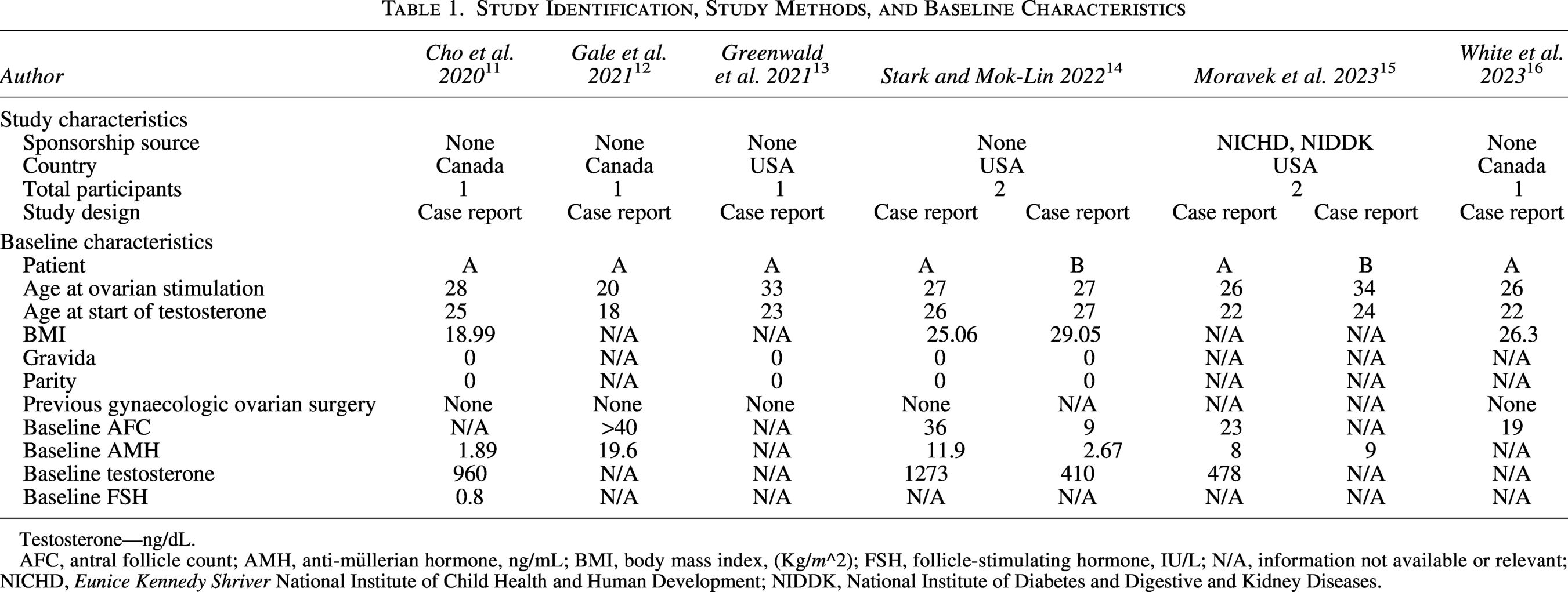
Testosterone—ng/dL.
AFC, antral follicle count; AMH, anti-müllerian hormone, ng/mL; BMI, body mass index, (Kg/m^2); FSH, follicle-stimulating hormone, IU/L; N/A, information not available or relevant; NICHD, Eunice Kennedy Shriver National Institute of Child Health and Human Development; NIDDK, National Institute of Diabetes and Digestive and Kidney Diseases.
Cycle characteristics
Stimulation protocols were reported for seven of the eight patients (Table 2).11–16 Only stimulation and transfer cycle outcomes were described for the remaining patient. 15 All seven patients were stimulated with an antagonist protocol. Fertility preservation with oocyte cryopreservation was performed in four cycles.11,12,14 Of the remaining four patients, two were for the purpose of subsequently conceiving and thus embryos were cryopreserved;13,15 the remaining two patients cryopreserved oocytes but then subsequently returned for the creation and transfer of embryos.15,16 Vitrification for gamete and embryo freezing was reported in seven studies.11,12,14–16 Intracytoplasmic sperm injection was used for fertilization in four patients13,15,16 and two had in-vitro maturation (IVM) performed on their initially collected oocytes, which increased their total number of oocytes. 14
Cycle Characteristics
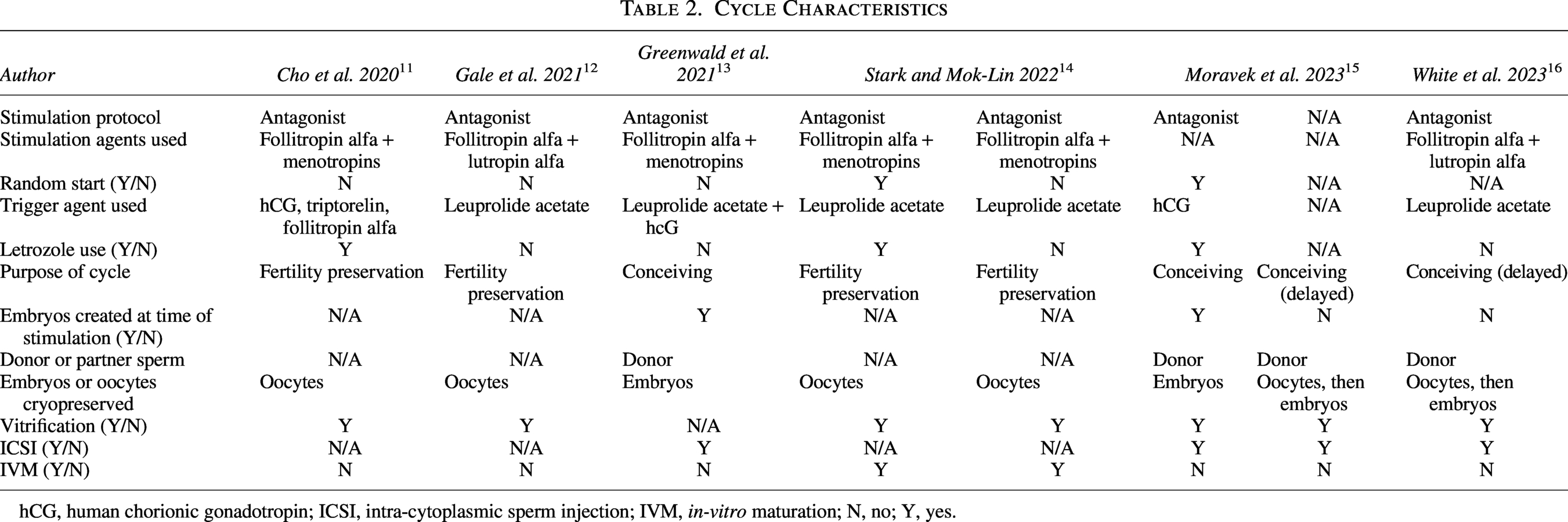
hCG, human chorionic gonadotropin; ICSI, intra-cytoplasmic sperm injection; IVM, in-vitro maturation; N, no; Y, yes.
Testosterone
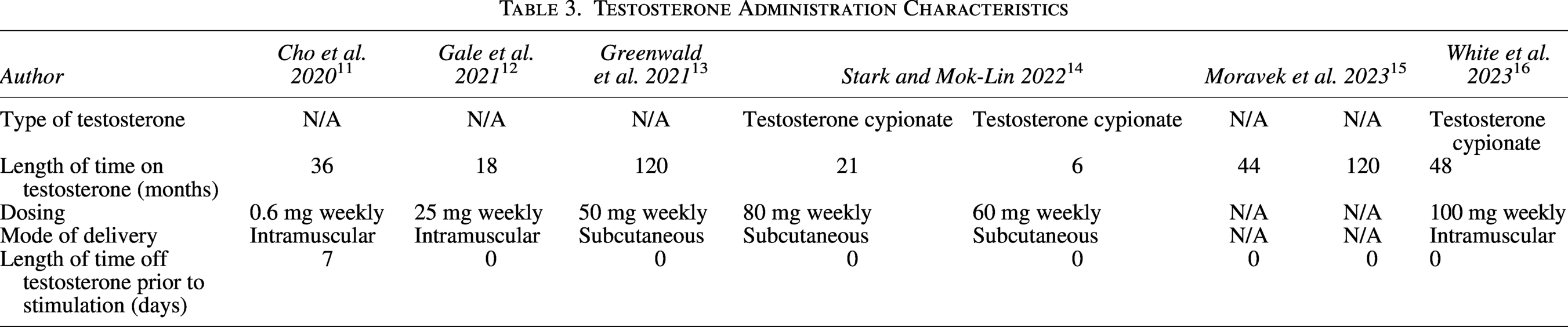
The mean length of exposure to testosterone prior to ovarian stimulation was 52 months (range 6 months–120 months) (Table 3). Testosterone was continued throughout the entire stimulation in seven patients.12–16 Only one patient from Cho et al. reported a brief discontinuation of 7 days prior to stimulation, still meeting our criteria for inclusion in this review. 11 Only Stark and Mok-Lin and White et al. reported the exact formulation of testosterone their patients were exposed to during ovarian stimulation (testosterone cypionate).14,16 Of those who reported dosing and mode of delivery, Cho et al. reported their patient was on 0.6 mg intramuscular weekly; given that this seemed low, the authors were contacted and confirmed from their records that this was correct.
Testosterone Administration Characteristics
Stimulation cycle outcomes
The median number of oocytes retrieved from seven patients was 20 (range 13–56) and the median number of oocytes cryopreserved from six patients was 22.5 (range 9–30) (Table 4). Both patients stimulated by Stark and Mok-Lin reported having IVM. 14 They separated their initial metaphase II oocyte count from additional oocytes that progressed to metaphase II post-retrieval with IVM; these IVM oocytes are included in the total number of oocytes frozen. There were limited data for the patient from Gale et al. 12
Stimulation and Transfer Cycle Outcomes
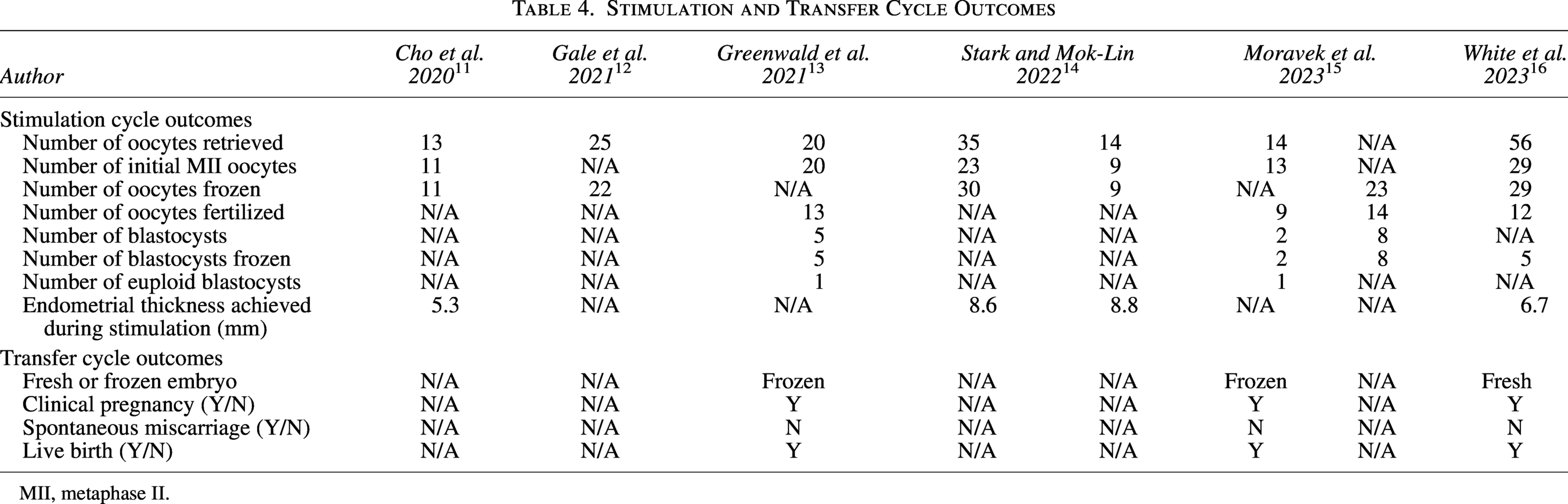
MII, metaphase II.
Transfer cycle outcomes
Transfer cycle outcomes were reported in three articles (Table 4). In all cases, embryos were transferred to the patient’s partner (reciprocal in vitro fertilization). Two patients underwent euploid frozen embryo transfers,13,15 and one patient had a fresh untested embryo transfer created from cryopreserved oocytes. 16 All transfers resulted in clinical pregnancies and live births.
Discussion
Assisted reproduction and fertility preservation allow patients to fulfill their dreams of a biological child at their preferred time in life. Among the many challenges that TGD patients face, the journey for family building often involves medical intervention in the form of fertility treatment. 17 These treatments can cause unfavorable effects in this population. This review summarizes recent evidence and provides important proof of concept regarding the feasibility of ovarian stimulation while continuing testosterone therapy in transgender individuals.
Gender dysphoria and other barriers to fertility preservation in TGD individuals
Gender dysphoria is defined in the Diagnostic and Statistical Manual of Mental Disorders, Fifth Edition, as marked incongruence between experienced or expressed gender and the one assigned at birth. 18 Testosterone in various preparations is the mainstay of gender-affirming hormonal treatment for gender dysphoria. Injectables are the main route of delivery to limit the first-pass effect. Testosterone therapy leads to increased muscle mass and libido, as well as cessation of menses, in the majority of patients within 6 months. 19 With longer therapy, voice deepening and clitoral enlargement can occur. 20
TGD individuals report negative experiences with the health care system, associated with system- and provider-level factors. 21 Lack of access to gender-affirming treatment (GAT) is associated with depression, thoughts of self-harm or suicide, and anxiety. 22 Improved access to GAT has been shown to significantly improve quality of life and reduce morbidity and mortality in this vulnerable population. 23
Limited access to fertility consultation and treatment are well-documented barriers. A recent meta-analysis showed that 49%–67% of transgender adolescents wish to have children in the future. 24 Nadgauda and Butts found that although only 5%–10% of adolescents are pursuing fertility preservation treatments, 37.5% of trans masculine adults would have pursued fertility preservation if they had been counselled appropriately on their options. 25
The risk of GAT delays or disruptions is an additional barrier to accessing fertility preservation care among TGD individuals. It has been well documented that TGD patients experience significant wait times and often see >1 provider prior to receiving the appropriate referral. 26 It is, therefore, not surprising that the idea of discontinuing and delaying hormonal GAT for fertility preservation is off-putting to many TGD individuals. A survey of TGD youth in 2017 found that the majority of individuals were not willing to pause or delay their treatment by up to 3 months to preserve fertility (97%); however, they did find that if allowed to continue hormonal GAT, 34% of individuals would pursue fertility preservation. 27
Effect of testosterone therapy on ovulatory function and ovarian stimulation cycles
The current understanding of testosterone therapy and its relationship to ovulatory function is that it causes dose-dependent suppression of ovulation. This effect is through rapid hypothalamic-pituitary-gonadal suppression, either through testosterone acting directly to downregulate the axis or by testosterone that has been aromatized to estrogen. This results in anovulation in most users. 28 Cessation of testosterone thus will disinhibit this downregulation and should eventually cause resumption of the ovulatory cycle.
A case–control study investigated whether long-term testosterone therapy affects the ability to conceive in the TGD population. It compared TGD patients on extended testosterone treatment undergoing ovarian stimulation with cisgender women who had no history of testosterone exposure, matched for demographic factors. The study found no significant difference in the number of mature oocytes between the two groups. All participants in the study either discontinued testosterone and resumed their menstrual cycles or stopped testosterone and had serum testosterone levels at the upper normal range for females before stimulation. 29 Further small-scale studies have emerged to support favorable stimulation outcomes for patients with a history of long-term testosterone usage.5,30
The threshold testosterone dose that disrupts ovulatory function is unknown and likely multifactorial and patient dependent. There is no homogenous protocol for initiating gender-affirming testosterone therapy in TGD patients, and therefore, different centers start patients on varying doses aiming to achieve the desired masculine effects. We have found that there is not one testosterone dose or administration protocol that is necessary for achieving adequate ovarian stimulation results, and successful oocyte harvest and pregnancy can be achieved with varying continuous testosterone exposure doses.
There are currently no clinical guidelines or practice recommendations related to the discontinuation of testosterone prior to ovarian stimulation. Timing of cessation is dependent on the center, ranging from 4 weeks to 6 months; some suggest a resumption of menses is indicated prior to initiation of ovarian stimulation.3,11 This lack of consensus is largely due to the lack of robust data related to embryology and pregnancy outcomes.
A cohort study by Albar et al. assessed the association between the timing of testosterone discontinuation and stimulation cycle outcomes (N = 18). The mean time on testosterone was 44 months, and the median time off testosterone was 7.7 weeks, with a range of 4.3 weeks to 20.7 weeks. There was no association in outcomes between the timing of testosterone cessation and the number of mature oocytes retrieved. 3
In the current review, we summarized ovarian stimulation protocols in people under continuous testosterone administration; all the reported cycles in our review utilized gonadotropin-releasing hormone (GnRH) antagonist protocols. Various trigger medications were reported, including human chorionic gonadotropin, GnRH agonist, or variations of dual trigger.
Concurrent letrozole use during stimulation was reported for three patients in our review. Reasons for use were not clearly stated, but we can assume that it was used to reduce any distressing feminizing characteristics that TGD patients may experience during the ovarian stimulation process, as letrozole downregulates estrogen levels. We can conclude that concurrent letrozole and testosterone administration during ovarian stimulation can lead to viable oocytes and embryos as well as live births.
Strengths and limitations
The main strength of this review is providing a proof of concept that continuous testosterone therapy during fertility treatment cycles can be allowed to achieve favorable cycle outcomes, including live births. This opens the conversation and calls to reconsider current fertility practice patterns that require testosterone discontinuation with negative implications on patient experience.
This review’s major limitation is the small number of articles and patients eligible for inclusion per study design. Due to this, the results are descriptive in nature, and we were not able to perform complex statistical analysis. Furthermore, some studies partially lack information about stimulation or testosterone treatment protocols. We reached out to the relevant authors and were able to obtain additional information from one of them. This lack of detailed information limits the ability to make robust conclusions and limits the reproducibility of the results.
Significance and future directions
TGD individuals represent a historically marginalized population with a unique fertility preservation challenge. Clinicians should strive to identify the fine balance between optimizing protocols and cycle outcomes while minimizing the distress associated with the ovarian stimulation process. Importantly, distress is not only associated with the physiological aspects of the process but also with health care provider attitudes and bias toward this population. These contribute to negative patient experiences and present an additional barrier to family building in the TGD population.
The novelty of summarized emerging case reports is of great significance as an important step toward mitigating the risk of biases in TGD care. The data presented in the current review suggest a paradigm shift and lay the foundations for the collection of additional high-quality data that will broaden fertility preservation options available for TGD patients. As data continue to emerge, we call for continued analysis and reassessment of outcomes to identify the optimal regimens that allow for maximal patient comfort during fertility treatments.
Although reported findings provide reassurance to both health care providers and patients choosing to continue testosterone throughout stimulation, further research should explore what the optimal GAT protocols are to achieve a proper transitioning process and how these interact with ovarian stimulation. Questions remaining for future research include the effects of length of testosterone exposure prior to stimulation, type of testosterone regimen, choice of downregulation protocol, choice of type of gonadotropins and trigger medications, the role of co-treatment with letrozole, optimization of embryology and pregnancy outcomes, and finally, the long-term neonatal outcomes resulting from these treatment cycles.
Future qualitative studies should investigate how TGD patients view fertility preservation procedures and whether the ability to continue testosterone during ovarian stimulation changes their attitude toward pursuing fertility care. Physician perspective and readiness to adopt new stimulation protocols should also be explored.
Continuously assessing emerging evidence regarding efficacy and outcomes will allow us to provide higher-quality care for the TGD population. Beyond this, we must continue to advocate for this community, particularly for larger-scale and higher-quality studies, so that we can provide evidence-driven, patient-centered, inclusive care for all.
Conclusion
Successful ovarian stimulation, oocyte harvest, embryo development and live birth are possible in TGD patients on continuous testosterone GAT. This is an important paradigm shift in current fertility practice and transgender care, where patient preference and quality of life are at the forefront of clinical decision-making.
Authors’ Contributions
G.L.: Conceptualization, methodology, investigation, writing—original draft and writing—review and editing, visualization. D.K.: Methodology, investigation, supervision, writing—review and editing. B.L.: Methodology, writing—review and editing. J.M.: Conceptualization, methodology, writing—review and editing, supervision.
Footnotes
Author Disclosure Statement
No competing financial interest exist.
Funding Information
This review was not supported by any funding.
Supplemental Material
References
Supplementary Material
Please find the following supplemental material available below.
For Open Access articles published under a Creative Commons License, all supplemental material carries the same license as the article it is associated with.
For non-Open Access articles published, all supplemental material carries a non-exclusive license, and permission requests for re-use of supplemental material or any part of supplemental material shall be sent directly to the copyright owner as specified in the copyright notice associated with the article.
