



Abstract

We were happy to see the new article, “Disparities in Substance Use and Psychological Distress During Pregnancy Among Pregnant Bisexual and Heterosexual Females in the United States” in LGBT Health. 1 Despite emerging research on reproductive outcomes for sexual minority women, perinatal mental health and health behaviors of LGBT people remain understudied; identifying modifiable contributors to reproductive health disparities is critical.
In engaging with this important contribution, we noticed that this article overadjusts for several variables, hampering the interpretability of this study. This practice is common in LGBT health research, and our comments reflect a broader pattern beyond this study. Schuler and Prince frame their article in terms of describing disparities, implying a descriptive (rather than causal or predictive) research question. 2 Nonetheless, Schuler and Prince adjust for several covariates.
Although it is often appropriate to weight the sample to reflect the target population, descriptive analyses should be minimally adjusted.3,4 Covariate adjustment produces estimates in a counter-to-fact world where sexual orientation groups do not differ on the adjusted variables, that is, a world that differs from the world in which these inequities actually arise. Therefore, while the unadjusted results in their Table 2 reveal striking disparities, the adjusted results have key interpretational problems.
Nevertheless, LGBT health researchers are often interested in understanding disparities that operate in the absence of specific pathways. 5 When this is the goal, careful thought must be put into variable inclusion. To demonstrate this, we created a directed acyclic graph for the variables included in Schuler and Prince’s analysis (Fig. 1). The authors’ adjustment for age, race/ethnicity, and year (depicted by L1) leads to the clearest interpretation: these variables may impact an individual’s probability of identifying as bisexual or heterosexual and the outcomes. Adjusting for them brings us closer to estimating the effect of sexual identity.
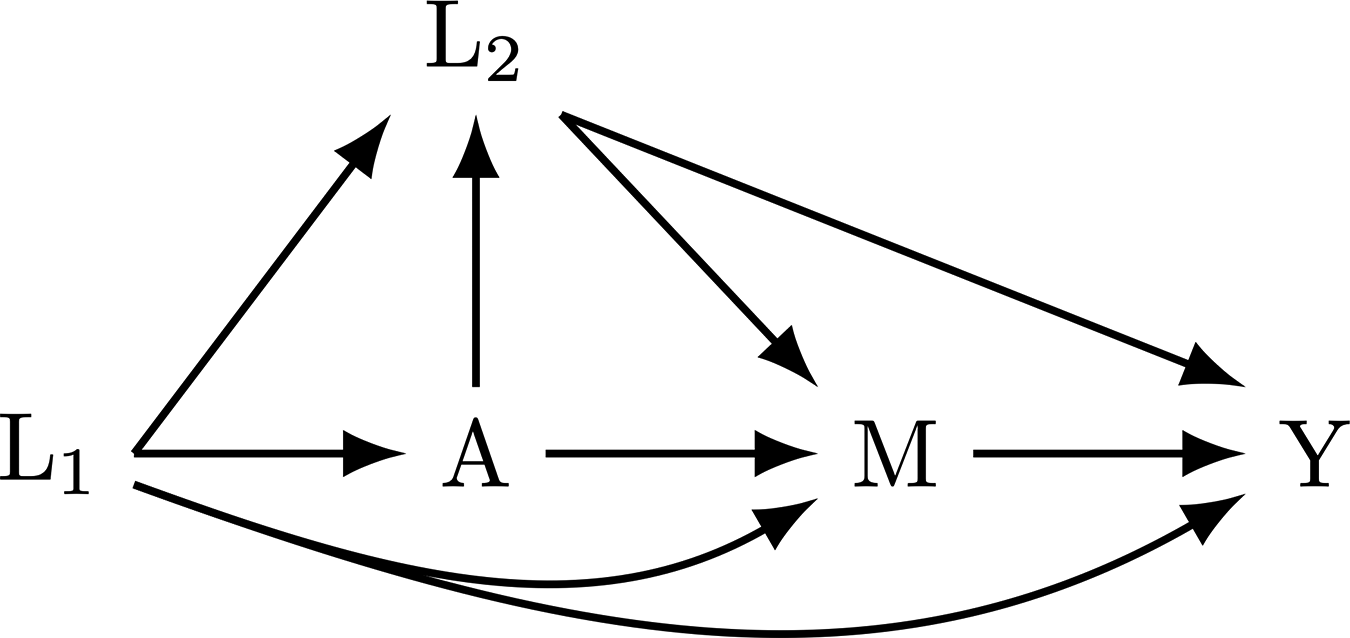
Hypothesized directed acyclic graph for Schuler and Prince. 1 L1: age, race/ethnicity, year. A: sexual identity. L2: mediator–outcome confounders. M: household income, marital status, self-reported health, children in the household, and health insurance status. Y: substance use and psychological well-being.
The remaining covariates, income, marital status, self-reported health, children in the household, and health insurance status (depicted by M), likely mediate the relationship between sexual orientation (A) and the outcomes (Y). Adjusting for these partially blocks the mechanisms through which sexual orientation disparities arise, 3 leading to an underestimation of disparities. Worse yet, adjustment for these variables does not estimate the disparity that would exist if sexual orientation disparities did not operate through these paths (also known as the mediational direct effect). This is because there may be unmeasured mediator–outcome confounders affected by exposure (L2), such as education, employment, or social support, that differ by sexual orientation (A) and affect both the potential mediator (M) and the outcome (Y).
Therefore, adjusting for potential mediating variables (M) introduces collider stratification bias, which creates estimates (like those in their Table 2) that mix the disparity of interest and bias. This practice can lead to uninterpretable and even paradoxical results, yet it is widely done across fields. To estimate the disparities beyond possible mediators, advanced mediation techniques, such as randomized interventional analogues, are needed. 3 In conclusion, we call on LGBT health researchers to more judiciously evaluate the implications and assumptions baked into covariate adjustment.
Authors’ Contributions
C.A.R. conceptualized and drafted the letter. P.C. and C.A.R. revised the letter.
Ethical Considerations
There are no human participants in this article and informed consent is not required.
Consent to Participate
Not applicable.
Consent for Publication
Not applicable.
Footnotes
Declaration of Conflicting Interest
The authors declared no potential conflicts of interest with respect to the research, authorship, and/or publication of this article.
Funding Statement
The authors received no financial support for the research, authorship, and/or publication of this article.