Abstract
Background:
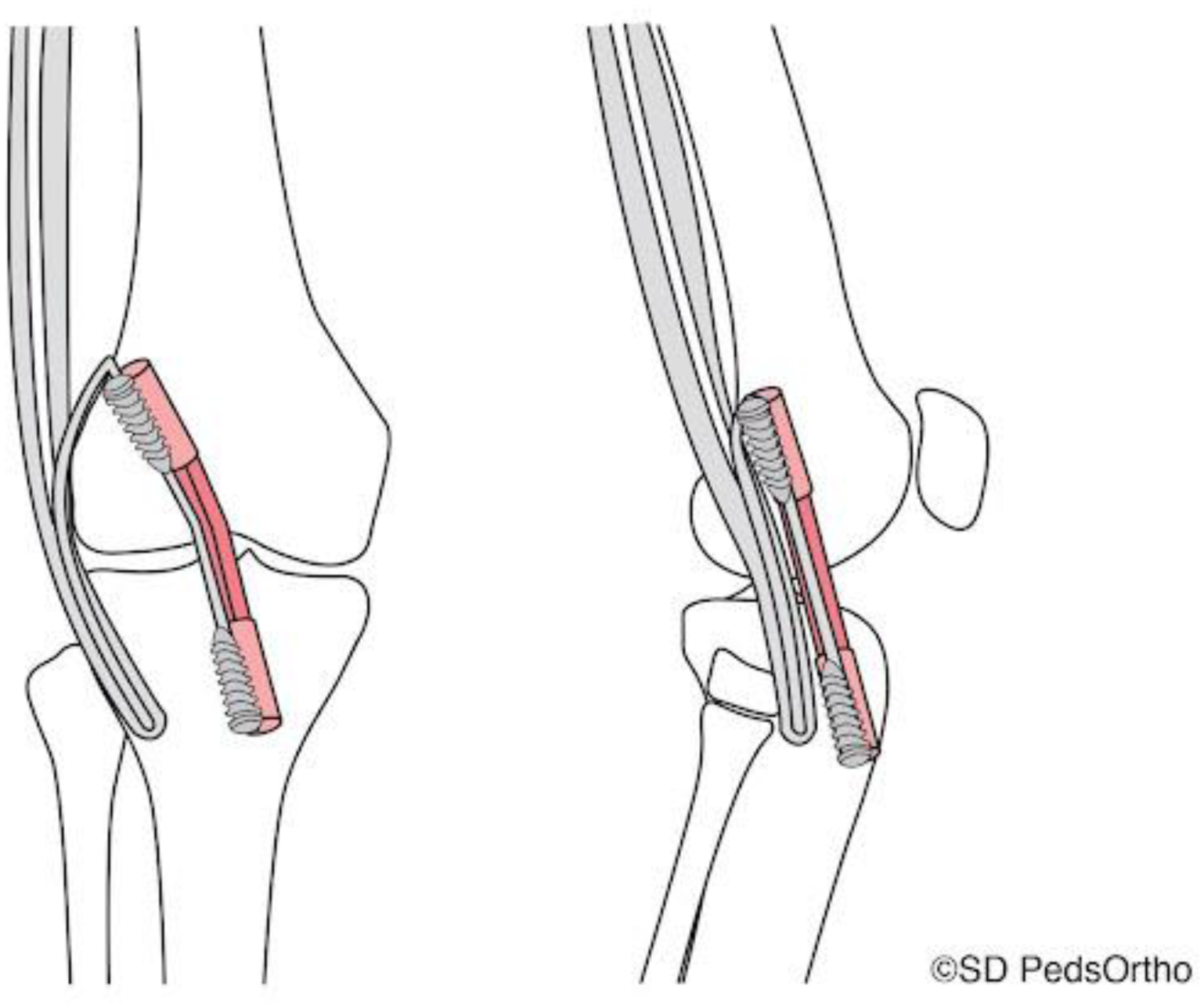
Many pediatric orthopaedic surgeons are comfortable performing a primary extra-articular intra-articular anterior cruciate ligament (ACL) reconstruction with an iliotibial (IT) band autograft. Modifications of this technique can be utilized to augment revision reconstructions. By using a strip of the IT band that is pulled through the femoral tunnel, across the joint, and into the tibial tunnel, three functions are achieved: (1) a lateral extra-articular tenodesis, (2) increased cross-sectional area of the intra-articular graft, and (3) improved graft fill of the tunnels. The purpose of the current study was to examine early outcomes and complications of augmenting ACL revision reconstructions with an extra-articular intra-articular graft using the iliotibial band.
Hypothesis:
Incorporating an IT band augmentation with ACL revision reconstruction provides enhanced anterolateral rotational stability while offering a reproducible and straightforward approach to address recurrent ACL instability in pediatric patients.
Methods:
This retrospective study examined all pediatric patients who underwent a revision ACL reconstruction at one of two institutions between 2018 and 2024 using an iliotibial band intra-articular extra-articular augment. This augment was utilized with a variety of revision grafts (BTB autograft, hamstring autograft, quadriceps autograft, and allograft) and without modification of previous tunnel placement. This technique utilized a 10 mm strip of the IT band left attached distally at Gerdy’s tubercle and released 12cm proximal to the lateral epicondyle. Femoral and tibial fixation was achieved within the ACL tunnels using interference screw fixation. (Image 1) Patients were contacted post-operatively at a minimum of 12 months.
Results:
This study included 9 pediatric patients (6M/3F, mean age 16.1 years). The revision procedures were performed with a variety of grafts based on patient, radiographic, and surgeon variables, which included 4 BTB autografts, 1 BTB allograft, 1 hamstring autograft, and 3 quadriceps autografts. During revision, all nine patients had concomitant meniscal work (6 repairs and 3 meniscectomies). At a mean follow-up of 22 months, the pediatric IKDC averaged 90 with eight having returned to their pre-injury activities and one was no longer interested in sports. One patient required a partial lateral meniscectomy one year post-operatively; otherwise, there were no complications or further revision surgeries amongst the cohort.
Conclusion:
Revision ACL reconstruction augmented with an extra-articular intra-articular IT band graft can yield favorable short term outcomes in a challenging patient population. This relatively simple technique has the benefit of utilizing a variety of revision grafts, requiring no additional bone tunnels or fixation devices, and a low complication profile.