Abstract
Background:
Recovery from anterior cruciate ligament reconstruction (ACLR), common in adolescent athletes, requires restoration of knee strength, stability, and range of motion prior to return-to-sport (RTS) clearance. RTS protocols incorporate strength and functional testing with patient-reported outcome measures (PROMs) to assess readiness. However, females report lower RTS readiness and lower RTS rates (37%) compared to males (52%) (Webster, 2018; Kostyun, 2021). Understanding sex-based differences in RTS testing is essential for optimizing rehabilitation and outcomes.
Hypothesis:
Sex based differences exist in RTS testing metrics following ACLR in adolescent athletes.
Methods:
A retrospective chart review was conducted on 69 (37M, 32F) patients, aged 13-20y, who underwent primary ACL-R and RTS testing. Eighty-eight RTS tests were completed at 6 months (n=44) or 9 months (n=44) post-operatively; 19 patients tested at both time points. Exclusions included multi-ligament injuries, revision ACL, outside surgeries, and extreme outliers (> 3 SD). Patients were grouped by sex and subdivided by RTS testing interval (6- or 9-months post-op) for comparisons. Physical RTS measures included limb symmetry index (LSI) of quadriceps and hamstring strength, Y-balance composite, and single-leg hop scores. PROM consisted of the ACL-Return to Sport after Injury (ACL-RSI) scale. Passing threshold was defined as ≥90% on physical metrics and ≥80% on ACL-RSI. Fisher’s exact test (α = 0.05) was used to compare the proportion of patients meeting RTS passing criteria between sexes and across time points.
Results:
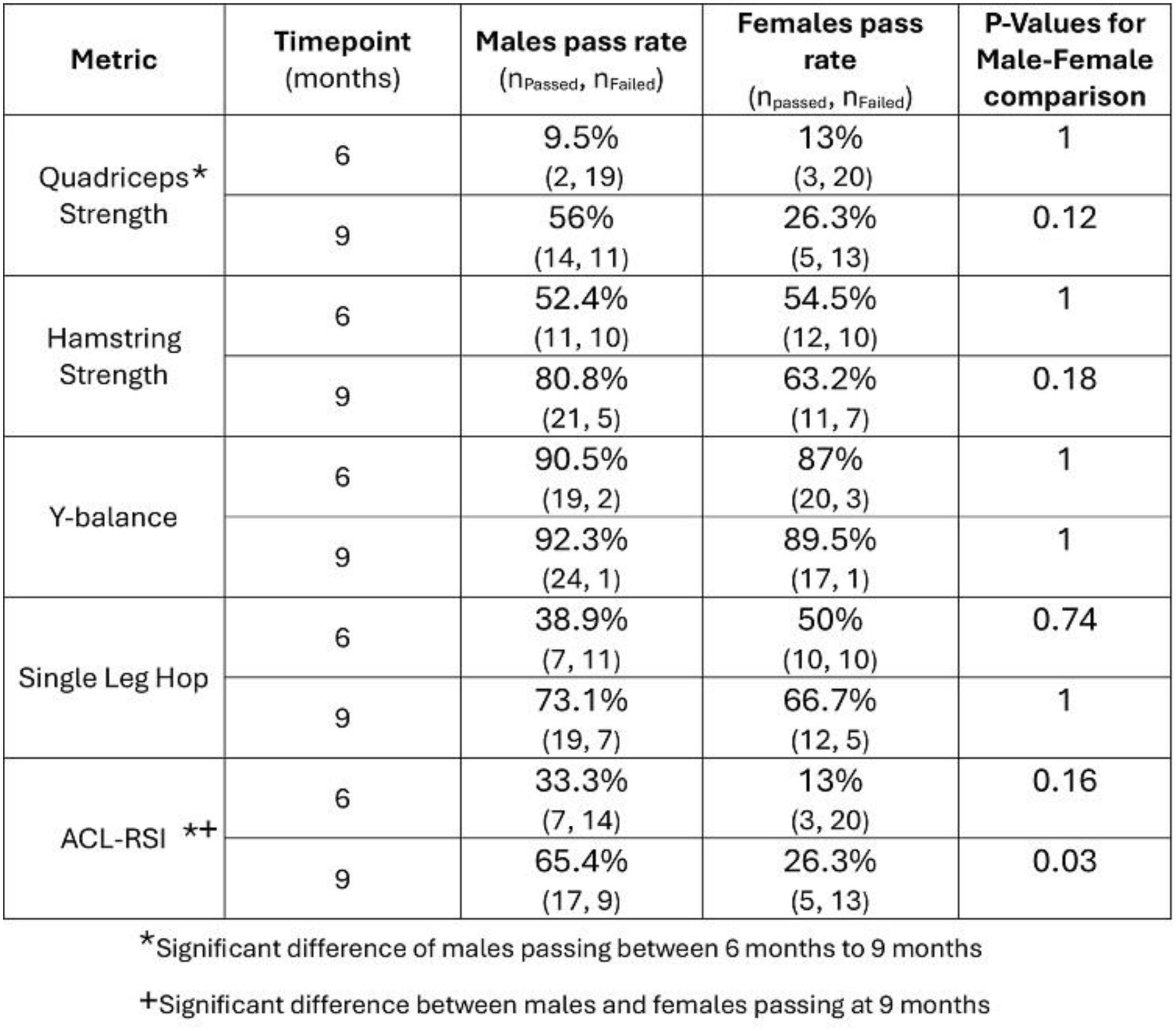
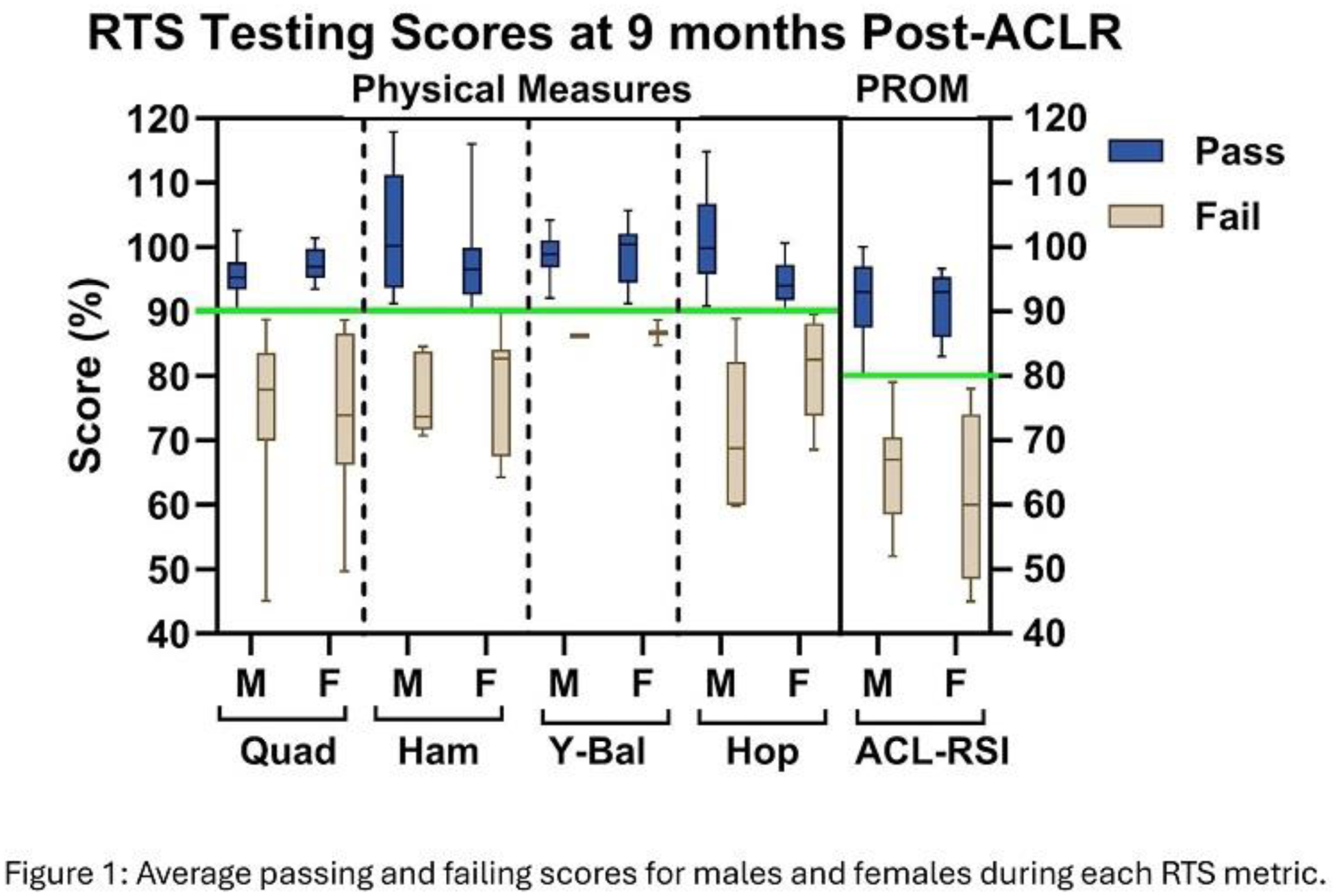
Passing rates for quadriceps and hamstring strength, hop tests, and balance assessments were low at 6 months post-op but improved by 9-months in both sexes (Table 1). Males consistently demonstrated higher passing rates across all RTS metrics and timepoints (Figure 1). Overall, only 44.2% of patients passed quadriceps strength testing and 50% of patients passed the ACL-RSI at 9-month post-op. Males had significant differences passing quadriceps testing (p =.002) and ACL-RSI (p =.041) between 6 and 9-months. The proportion of males passing ACL-RSI was significantly higher (p =.031) than females 9 months post-op.
Conclusion:
Identifying sex-based differences in RTS metrics can help specialize RTS rehabilitation and improve outcomes for adolescent athletes post-ACLR. The quadriceps strength and ACL-RSI passing rate for males is double that of females while reporting similar averages between patients who passed those metrics. Overall, nearly 50% of patients did not meet passing criteria in quadriceps strength and ACL-RSI at 9 months post-op, suggesting that this standard timepoint used for RTS criteria may be too early for many patients.