Abstract
Background:
Achilles tendon ruptures, though uncommon in the pediatric population, present significant clinical challenges due to the unique biomechanical and physiological characteristics of developing tissues. While adult management is well studied, the optimal pediatric approach remains unclear, with limited large-scale studies on this topic. The purpose of this study was to evaluate national trends in the incidence and management of pediatric Achilles tendon ruptures in the United States and compare short-term complication rates and long-term outcomes between operative and nonoperative approaches.
Hypothesis:
Treatment patterns for pediatric Achilles tendon ruptures have shifted over time, with nonoperative management yielding lower complication and failure rates compared to operative approaches.
Methods:
A retrospective cohort study using the PearlDiver database identified pediatric patients (ages 0-18) diagnosed with Achilles tendon ruptures from 2016 to 2022. Patients were stratified by rupture type (open vs. closed) and management (operative vs. nonoperative). Population-normalized incidence rates were assessed by age group. A subset of patients with a minimum of 2 years of follow-up was analyzed for complications, including 90-day infection, nerve injury, and wound complication rates, as well as two-year ankle fracture and failure rates. Statistical analyses included Student’s t-tests, chi-square tests, and linear regression.
Results:
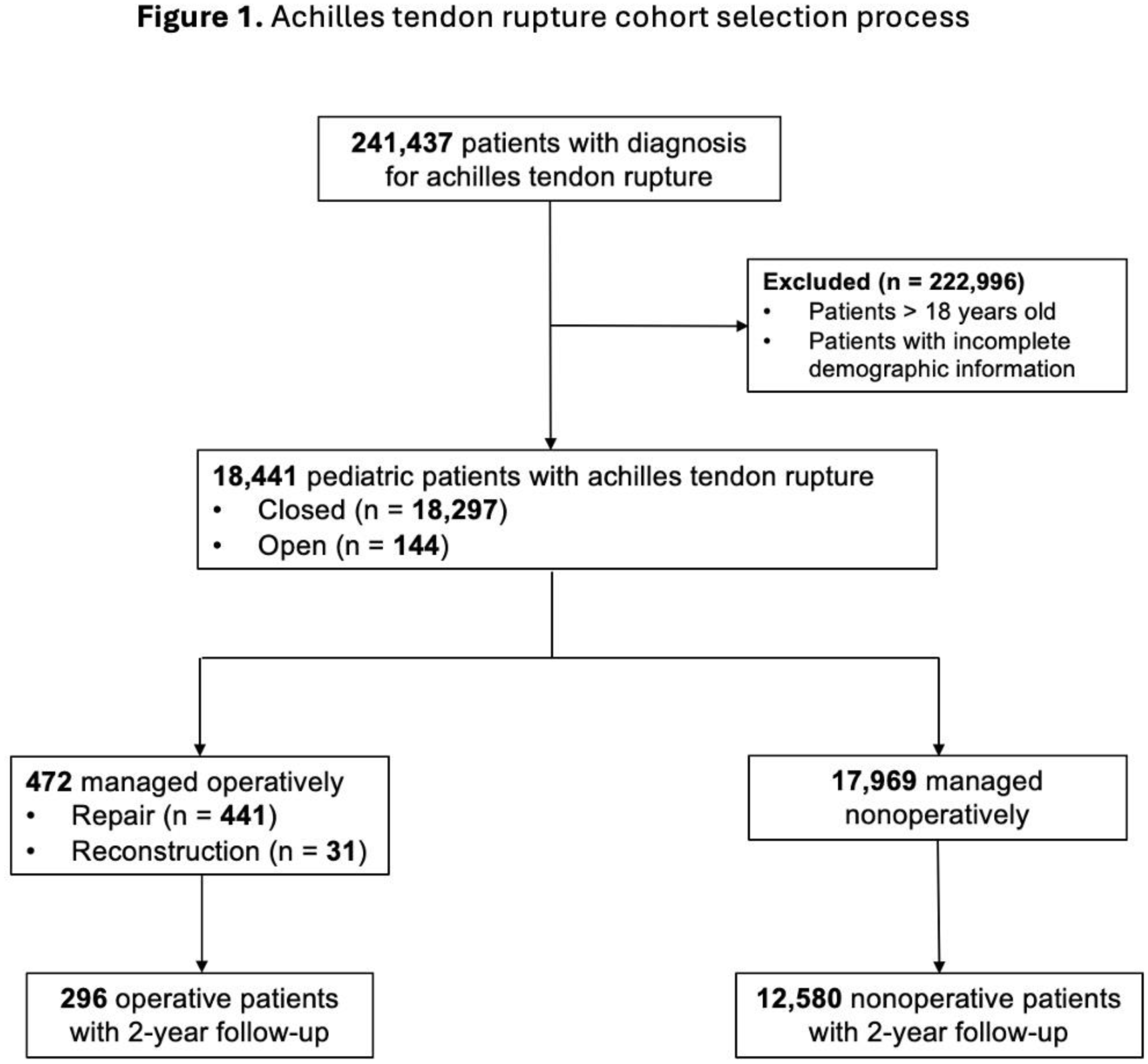
A total of 18,441 pediatric patients with Achilles tendon ruptures were identified. Most injuries (88.0%) were in the 10-18 year age group with an even distribution of males and females (50% each). Most ruptures were closed (99.2%) and managed nonoperatively (97.4%), with nonoperative treatment more common in closed vs. open ruptures (97.6% vs. 71.5%, p<0.001). From 2016 to 2022, rupture incidence declined across all age groups (p<0.05), most notably in ages 10-14 (p=0.004). The distribution of operative vs. nonoperative management remained unchanged. Complication rates were higher in the operative cohort compared to the nonoperative cohort: infections (5.07% vs. 0.32%), nerve injuries (0.68% vs. 0.03%), wound complications (1.01% vs. 0.04%), two-year failure (5.74% vs. 0.10%), and ankle fracture (1.69% vs. 0.75%), though statistical comparison was limited by low event counts.
Conclusion:
The incidence of pediatric Achilles tendon ruptures has declined significantly over the past decade. Nonoperative management remains the dominant treatment approach and is associated with low complication and failure rates. These findings highlight the importance of careful patient selection for operative intervention.