Abstract
Background:
Adolescent female runners have higher rates of running-related injuries compared to male runners.1 Prior studies comparing running mechanics between male and female runners have demonstrated conflicting results,2 with limited data regarding adolescent runners.
Hypothesis:
Females will demonstrate different running biomechanics when compared to males over a 5-mile distance run.
Methods:
High-school cross-country runners were outfitted with motion capture markers and force sensor insoles prior to completing a five-mile indoor-outdoor course run at a self-selected speed on a flat surface. Running mechanics were captured every mile using a motion capture system and used to compute running pace, as well as trunk and pelvis angles, and lower extremity kinematics and kinetics (external). Additionally, insoles in the runners’ shoes measured force and rate of force development (RFD) in the forefoot, midfoot, and hindfoot regions during each stride and were normalized by bodyweight (kg). Peak and range-of-motion (ROM) stance phase joint angles, joint moments, and plantar pressures were extracted and the change in the kinematic and kinetic variables between Mile 1 (M1) and Mile 5 (M5) was calculated. Mann-Whitney U tests were performed to compare differences between males and females at each individual mile, and for the M1 to M5 change.
Results:
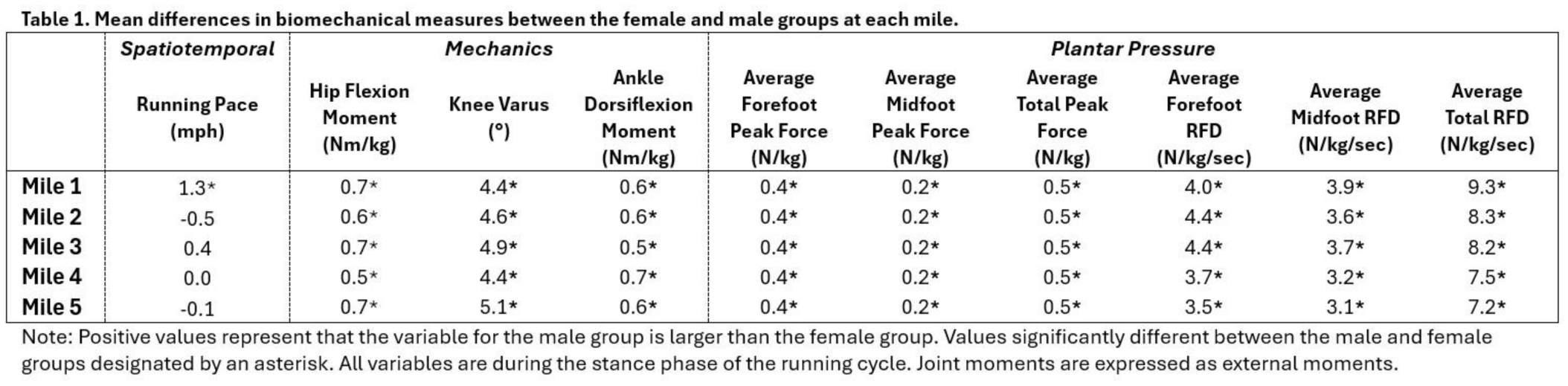
Twenty healthy runners (11 male, 9 female) were included in this analysis (Male: 16.1±1.2 years, 1.8±0.1 m, 59.3±8.0 kg; Female: 16.5±1.2 years, 1.7±0.0 m, 53.5±7.7 kg). Running pace was different between males and females only at M1, where males ran 1.3mph faster than females (p=0.036). Knee varus was increased in males by 4.4° - 5.1° compared to females consistently across all 5 miles (p≤0.030). Hip flexion moment (p≤0.007) and ankle dorsiflexion moment (p≤0.005) were also increased in males compared to females at all miles. The average forefoot, midfoot, and total peak forces were larger for males compared to females (p≤0.037). The RFD (time to peak force) was increased in males compared to females for forefoot, midfoot and total regions of the foot (p≤0.039). From M1 to M5, the change in stance phase trunk flexion ROM was increased in females by 2.5° (p=0.027).
Conclusion:
Kinematic and kinetic differences were observed between male and female high school cross-country runners while running pace was not significantly different. Males consistently had increased knee valgus, hip flexion moment, and ankle dorsiflexion moment at all 5 miles. Biomechanical differences should be further investigated as a potential contributing factor to higher injury rates in adolescent female runners compared to their male counterparts.