Abstract
Background:
Hip translational motion may contribute to complex hip pain and microinstability, particularly in high-demand athletes. Dynamic ultrasound (DUS) offers a real-time, non-invasive method to assess femoroacetabular translation. Sport- and sex-based differences in hip morphology and mobility are well documented but remain poorly characterized dynamically. The purpose of our study was to quantify femoroacetabular translation using DUS in collegiate ice hockey athletes, evaluate differences by sex, and examine clinical factors associated with hip motion.
Hypothesis:
Femoroacetabular translation measured by DUS will vary by sex.
Methods:
A cross-sectional cohort of collegiate ice hockey athletes underwent DUS of the right and left hips in anterior (neutral [N], neutral flexed [NF], extension external rotation [EER]) and posterior (posterior neutral [PN], posterior flexion-adduction-internal rotation [PFADIR], stand-and-load [PStand]) positions. Biometric data included femoral version (TPAT), Thomas test, and Beighton score. Multivariate regression adjusted for age, sex, and BMI identified predictors of translation.
Results:
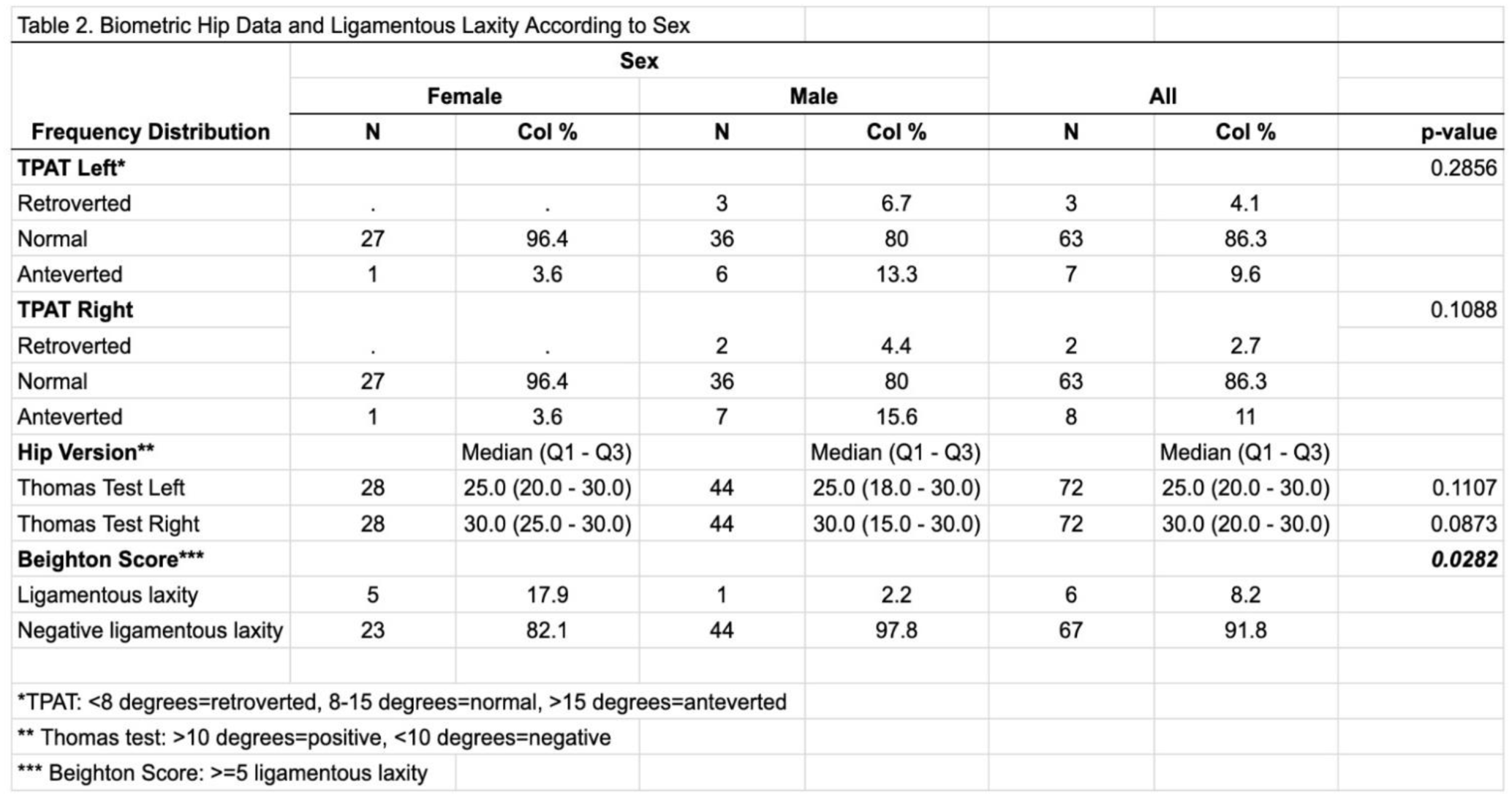
73 athletes (61.6% male; median age 21.0 yrs.; IQR: 20-22) were included (Table 1). Median US measures (mm) by sex are presented in Table 1. Males demonstrated greater median DUS translation across most measures. Significant sex differences (mm) included right anterior N (4.2 vs 3.2; P=.036), left N (6.5 vs 3.9; P=.0019), NF (9.6 vs 7.0; P=.0069), EER (10.1 vs 8.1; P=.0054), right PN (3.4 vs 1.6; P=.0079), left PN (3.8 vs 1.7; P=.0148), and PFADIR (11.6 vs 9.2; P=.0375). Most athletes had normal femoral version and low Beighton scores. Females ice hockey athletes showed more ligamentous laxity (18% vs 2.2%; P=.0282) (Table 2).
Conclusion:
DUS identifies sex-based differences in femoroacetabular translation, with males exhibiting greater motion in both anterior and posterior hip positions. These findings support the use of DUS in assessing hip microinstability and highlight the influence of sex-specific factors beyond morphology and laxity.